SHRI SHANKARACHARYA COLLEGE OF
NURSING,HUDCO BHILAI
PRACTICE TEACHING
ON
SUB- OBSTERICS AND GYNOCOLOGY
TOPIC-PROLONGED LABOR
SUBMITTED TO SUBMITTED BY
MRS.PRITI BHATT MISS MONIKA KOSRE
ASSOCIATE PROFESSOR MSC 2nd YEAR
SSCN SSCN
PROLONED LABOR
INTRODUCTION
Prolonged labor is the inability of a woman to
proceed with child birth upon going into labor.
Prolonged labor typically lasts over 20 hours for
first time mother’s, and over 14 hours for women
that have already had children.
DEFINITION
The labor is said to be prolonged when the combined
duration of the first and second stage is more than the
arbitrary time limit of 18 hours.
“ Acc. To DC DUTTA”
“Labor is considered prolonged when the cervical dilatation is
less than 1cm/h and decent of the presenting part is <1cm/h
for a period of minimum 4 hours observation.
“Acc. To WHO”
Causes of Prolonged labor
Malpresentation
 Cephalopelvic Disproportion
 Problem with uterine contractions
 Use of sedative and anesthesia
 Cervical dystocia and stenosis
Signs and symptoms of prolonged labor
 Labor extended for more than 18 hours .
 Patient looks exhausted and distressed .Dehydration may
be present .Mouth may be dry due to prolonged mouth
breathing .
 Pain may be more than back radiating to the things rather
then inside the abdomen .This is due to pressure over the
muscles become fatigued .
 Pulse rate is often high.
continue……
 The large intestines are dilated and can be palpated along
both sides of the uterus as large, thick structure filled with
air .they give off the hollow sound of drums on tapping.
 Ketosis may develop due to prolonged starvation .
 Fetal distress may develop .
 Membranes may or may not rupture early .In early rupture
,there is a risk of infection of the uterine contents if proper
antibiotics are not prescribed .
Risk factors
 Fetal Risk
1. Fetal Distress
2. Intracranial bleeding
3. Increased chances of operative delivery like cs
4. Cerebral palsy
 Maternal Risk
1. Intrauterine infection
2. Trauma and injury
3. Postpartum hemorrhage
4. Post partum infection
Causes of prolonged labor
CAUSES OF PROLONGED LABOR
Any one or combination of the factors in labor could be
responsible-
FRIST STAGE
Failure to dilate the cervix due to-
Fault in power- Abnormal uterine contraction such as uterine
inertia (common)or incoordinate uterine contraction
Fault in passage- Contraction pelvic ,cervical dystocia pelvic tumor
or even full bladder.
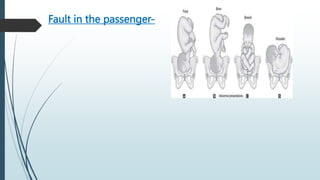
Fault in the passenger –Malposition and malpresentation
,congenital anomalies of the fetus (hydrocephalus).
Others- Injudicious (early ) administration of and
analgesics before the active labor
SECOND STAGE
Sluggish or non –descent of the presenting part
the second stage is due to-
Fault in the power –
. Uterine inertia
.Inability to bear down
.Regional (epidural)analgesia
.contraction ring.
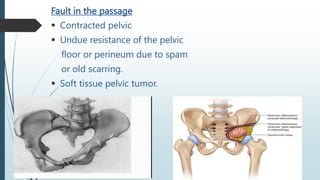
Fault in the passage
 Contracted pelvic
 Undue resistance of the pelvic
floor or perineum due to spam
or old scarring.
 Soft tissue pelvic tumor.
Fault in the passenger-
Diagnosis
Abdominal and vaginal examination
 If one finger accommodated in between the cervix and the
head of the fetus during contraction ,pelvic adequacy can
be reasonably established .
Intranatal imaging (USG,CT ,or MRI)
determine-1)Fetal station and position
2)Pelvic shape and size
FRIST STAGE
 Frist stage of labor is considered prolonged when the
duration is more than 12 hours .
 The rate of cervical dilation is <1cm/h in multi .
 The rate of decent of the presenting part is <1cm/h in primi
and 2cm/h in multi.
 In a partograph (WHO)the labor process is divided into 2
phases-
1)Latent phase
2)Active phase
1)Latent phase – That ends when the cervix is 4 cm dilated
2)Active phase- Starts with cervical dilation of 4cm or more.
Prolonged latent phase
 Latent phase is the preparatory phase of the uterus and the
cervix before active onset of labor.
 Mean duration of latent phase is about 8 hours in a primi
and 4 hours in multi.
continue……..
 A latent phase that exceeds 20 hours in primi gravidae or
14 hours in multipara is abnormal.
The cause include
1)Unripe cervix
2)Malposition and malpresentation
3)Cephalopelvic disproportion
 Management
 Rest and analgesic are usually given.
 When augmentation is decided medical methods (oxytocin or
prostaglandins are preferred . Amniotomy is usually avoided.
 Prolonged latent phase is not an indication for caesarean
delivery.
Active phase
 Active phase starts with cervical dilation of 4 cm or more.
 Cervix should dilate at least 1cm/h in this active phase .
 Cervical dilation rate (cervicograph )is plotted in relation to
alert line and action line.
 Alert line start at the end of latent phase(4cm cervical
dilation)and ends with full dilation of cervix (10cm)in 6
hours (1cm /h dilation rate).
 The action line is draw 4 hours to the right of the alert line.
continue……
 An interval of 4 hours is allowed to diagnose delay in
active phase and then appropriate intervention is done.
 Labor is considered abnormal when cervicograph crosses
the alert line and falls zone 2 and intervention is required
when it crosses the action line and falls on zone 3.
 Partograph can diagnose any dysfunction labor early and
help to initiate correct management.
Disorders of the active phase
Active phase disorders may be divided into-
a)Protraction active phase
b)Arrest disorders
a)Protraction active phase – When the dilation is <1.2cm /h in a
primipara and <1.5cm/h in a multipara .A protracted active
phase may be due to-
1)Inadequate uterine contraction
2)Cephalopelvic disproportion
3)Malposition or malpresentation
b)Arrest disorder-Arrest of dilation is defined when no
cervical dilatation occur after 2 hours in the active phase of
labor .It is commonly due to inefficient uterine contraction .
No decent for a period of more than 2 hours is called arrest
of descent .it commonly due to CPD.
Secondary Arrest- Secondary arrest is defined when active
phase of labor (cervical dilation)Commences normally but
stops or slows significant for 2 hours or more prior to full
dilation of the cervix. It is commonly due to malposition or
CPD.
Second stage
 Prolonged second stage is diagnosed if the duration
exceeds 2 hours in nullipara and one hour in a multipara
when no regional anesthesia is used during labor (ACOG).
Disorders of the Second stage
1)Protraction of Decent
2)Arrest of decent
1)Protraction of Decent-Protraction of descent is defined
when the decent of the presenting part (station) is less
than1cm/h in a nullipara or less than 2cm /h in a multipara .
2)Arrest of decent- Arrest of descent is diagnosed when no
progress in decent (no changes in station)is observed over a
period at least 2 hours. It may be due to one or a combination
of several underlying abnormalities like CPD ,malposition,
malpresentation ,inadequate uterine contraction .
Dangers
Fetal
Maternal
There is increase incidence of
1)Distress
2)Chorioamnionitis
3)Postpartum hemorrhage
4)Trauma to the genital tract.
5)Increased operative delivery (Vaginal instrumental or difficult)
cesarean )
6)Puperial sepsis
7)Subinvolution
Management of prolonged labor
 Prevention
 Actual treatment
 Definitive treatment
Prevention
 Antenatal or early intranatal detection of the factors likely
to produce prolonged labor.(big baby ,small women
,malpresentation or position).
 Use of partograph helps early detection .
 Selective and judicious augmentation of labor by oxytocin
drip.
 Change of posture in labor other than supine to increase
contraction ,emotional support and use of adequate
analgesia for pain relief.
Actual Treatment
Careful evaluation is done to be done to fine out
1)Causes of prolonged labor.
2)Effect on the mother
3)Effect on the fetus
Preliminaries –
.In case of neglected prolonged labor dehydration and
ketoacidosis might occur .
.Rapid iv infusion of ringer’s solution used to correct
ketoacidosis
Definitive treatment
Frist stage delay- Vaginal examination is done to verify the
fetal presentation position and station .
 If only uterine activity is suboptimal
1) Amniotomy and /or oxytocin infusion is adequate
2) Effective pain relief is given by intramuscular pethidine
or by regional analgesia .
3) For the management of secondary arrest ,specially in
multipara one should be very carefully to use oxytocin.
continue…….
 3)Cesarean section is done when vaginal delivery is
unsafe (malposition , malpresentation ,big baby or CPD.
 Second stage delay-
 Short period expectant of management
-FHR is reassuring
-Vaginal delivery is imminent
 Otherwise
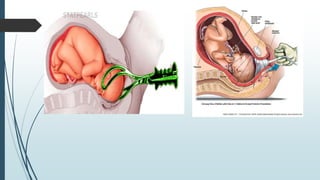
-Assisted vaginal delivery should be done (forceps
,ventose)
-Abdominal (cesarean ).
Management
The management of a mother experiencing a prolonged labor
will the responsibility of the obstetric team .Midwife must seek
medical advice on recognizing any aberration from normal.
1)Determine the cause before deciding management
2)Giving upright position
3)Administration of oxytocin
4)Comfort and analgesia
5)Observation
6)Fluid balance
7)Assessment of progress
8)Fetal well being .
prolonged labor.pptx obg seminar 4th year

prolonged labor.pptx obg seminar 4th year

  • 1.
    SHRI SHANKARACHARYA COLLEGEOF NURSING,HUDCO BHILAI PRACTICE TEACHING ON SUB- OBSTERICS AND GYNOCOLOGY TOPIC-PROLONGED LABOR SUBMITTED TO SUBMITTED BY MRS.PRITI BHATT MISS MONIKA KOSRE ASSOCIATE PROFESSOR MSC 2nd YEAR SSCN SSCN
  • 2.
  • 3.
    INTRODUCTION Prolonged labor isthe inability of a woman to proceed with child birth upon going into labor. Prolonged labor typically lasts over 20 hours for first time mother’s, and over 14 hours for women that have already had children.
  • 4.
    DEFINITION The labor issaid to be prolonged when the combined duration of the first and second stage is more than the arbitrary time limit of 18 hours. “ Acc. To DC DUTTA” “Labor is considered prolonged when the cervical dilatation is less than 1cm/h and decent of the presenting part is <1cm/h for a period of minimum 4 hours observation. “Acc. To WHO”
  • 5.
    Causes of Prolongedlabor Malpresentation  Cephalopelvic Disproportion  Problem with uterine contractions  Use of sedative and anesthesia  Cervical dystocia and stenosis
  • 6.
    Signs and symptomsof prolonged labor  Labor extended for more than 18 hours .  Patient looks exhausted and distressed .Dehydration may be present .Mouth may be dry due to prolonged mouth breathing .  Pain may be more than back radiating to the things rather then inside the abdomen .This is due to pressure over the muscles become fatigued .  Pulse rate is often high. continue……
  • 7.
     The largeintestines are dilated and can be palpated along both sides of the uterus as large, thick structure filled with air .they give off the hollow sound of drums on tapping.  Ketosis may develop due to prolonged starvation .  Fetal distress may develop .  Membranes may or may not rupture early .In early rupture ,there is a risk of infection of the uterine contents if proper antibiotics are not prescribed .
  • 8.
    Risk factors  FetalRisk 1. Fetal Distress 2. Intracranial bleeding 3. Increased chances of operative delivery like cs 4. Cerebral palsy  Maternal Risk 1. Intrauterine infection 2. Trauma and injury 3. Postpartum hemorrhage 4. Post partum infection
  • 9.
  • 10.
    CAUSES OF PROLONGEDLABOR Any one or combination of the factors in labor could be responsible- FRIST STAGE Failure to dilate the cervix due to- Fault in power- Abnormal uterine contraction such as uterine inertia (common)or incoordinate uterine contraction Fault in passage- Contraction pelvic ,cervical dystocia pelvic tumor or even full bladder.
  • 11.
    Fault in thepassenger –Malposition and malpresentation ,congenital anomalies of the fetus (hydrocephalus). Others- Injudicious (early ) administration of and analgesics before the active labor
  • 12.
    SECOND STAGE Sluggish ornon –descent of the presenting part the second stage is due to- Fault in the power – . Uterine inertia .Inability to bear down .Regional (epidural)analgesia .contraction ring.
  • 13.
    Fault in thepassage  Contracted pelvic  Undue resistance of the pelvic floor or perineum due to spam or old scarring.  Soft tissue pelvic tumor.
  • 14.
    Fault in thepassenger-
  • 15.
    Diagnosis Abdominal and vaginalexamination  If one finger accommodated in between the cervix and the head of the fetus during contraction ,pelvic adequacy can be reasonably established . Intranatal imaging (USG,CT ,or MRI) determine-1)Fetal station and position 2)Pelvic shape and size
  • 16.
    FRIST STAGE  Friststage of labor is considered prolonged when the duration is more than 12 hours .  The rate of cervical dilation is <1cm/h in multi .  The rate of decent of the presenting part is <1cm/h in primi and 2cm/h in multi.  In a partograph (WHO)the labor process is divided into 2 phases- 1)Latent phase 2)Active phase
  • 17.
    1)Latent phase –That ends when the cervix is 4 cm dilated 2)Active phase- Starts with cervical dilation of 4cm or more. Prolonged latent phase  Latent phase is the preparatory phase of the uterus and the cervix before active onset of labor.  Mean duration of latent phase is about 8 hours in a primi and 4 hours in multi. continue……..
  • 18.
     A latentphase that exceeds 20 hours in primi gravidae or 14 hours in multipara is abnormal. The cause include 1)Unripe cervix 2)Malposition and malpresentation 3)Cephalopelvic disproportion
  • 19.
     Management  Restand analgesic are usually given.  When augmentation is decided medical methods (oxytocin or prostaglandins are preferred . Amniotomy is usually avoided.  Prolonged latent phase is not an indication for caesarean delivery.
  • 20.
    Active phase  Activephase starts with cervical dilation of 4 cm or more.  Cervix should dilate at least 1cm/h in this active phase .  Cervical dilation rate (cervicograph )is plotted in relation to alert line and action line.  Alert line start at the end of latent phase(4cm cervical dilation)and ends with full dilation of cervix (10cm)in 6 hours (1cm /h dilation rate).  The action line is draw 4 hours to the right of the alert line. continue……
  • 21.
     An intervalof 4 hours is allowed to diagnose delay in active phase and then appropriate intervention is done.  Labor is considered abnormal when cervicograph crosses the alert line and falls zone 2 and intervention is required when it crosses the action line and falls on zone 3.  Partograph can diagnose any dysfunction labor early and help to initiate correct management.
  • 22.
    Disorders of theactive phase Active phase disorders may be divided into- a)Protraction active phase b)Arrest disorders a)Protraction active phase – When the dilation is <1.2cm /h in a primipara and <1.5cm/h in a multipara .A protracted active phase may be due to- 1)Inadequate uterine contraction 2)Cephalopelvic disproportion 3)Malposition or malpresentation
  • 23.
    b)Arrest disorder-Arrest ofdilation is defined when no cervical dilatation occur after 2 hours in the active phase of labor .It is commonly due to inefficient uterine contraction . No decent for a period of more than 2 hours is called arrest of descent .it commonly due to CPD. Secondary Arrest- Secondary arrest is defined when active phase of labor (cervical dilation)Commences normally but stops or slows significant for 2 hours or more prior to full dilation of the cervix. It is commonly due to malposition or CPD.
  • 24.
    Second stage  Prolongedsecond stage is diagnosed if the duration exceeds 2 hours in nullipara and one hour in a multipara when no regional anesthesia is used during labor (ACOG).
  • 25.
    Disorders of theSecond stage 1)Protraction of Decent 2)Arrest of decent 1)Protraction of Decent-Protraction of descent is defined when the decent of the presenting part (station) is less than1cm/h in a nullipara or less than 2cm /h in a multipara . 2)Arrest of decent- Arrest of descent is diagnosed when no progress in decent (no changes in station)is observed over a period at least 2 hours. It may be due to one or a combination of several underlying abnormalities like CPD ,malposition, malpresentation ,inadequate uterine contraction .
  • 26.
  • 27.
    Maternal There is increaseincidence of 1)Distress 2)Chorioamnionitis 3)Postpartum hemorrhage 4)Trauma to the genital tract. 5)Increased operative delivery (Vaginal instrumental or difficult) cesarean ) 6)Puperial sepsis 7)Subinvolution
  • 28.
    Management of prolongedlabor  Prevention  Actual treatment  Definitive treatment
  • 29.
    Prevention  Antenatal orearly intranatal detection of the factors likely to produce prolonged labor.(big baby ,small women ,malpresentation or position).  Use of partograph helps early detection .  Selective and judicious augmentation of labor by oxytocin drip.  Change of posture in labor other than supine to increase contraction ,emotional support and use of adequate analgesia for pain relief.
  • 30.
    Actual Treatment Careful evaluationis done to be done to fine out 1)Causes of prolonged labor. 2)Effect on the mother 3)Effect on the fetus Preliminaries – .In case of neglected prolonged labor dehydration and ketoacidosis might occur . .Rapid iv infusion of ringer’s solution used to correct ketoacidosis
  • 31.
    Definitive treatment Frist stagedelay- Vaginal examination is done to verify the fetal presentation position and station .  If only uterine activity is suboptimal 1) Amniotomy and /or oxytocin infusion is adequate 2) Effective pain relief is given by intramuscular pethidine or by regional analgesia . 3) For the management of secondary arrest ,specially in multipara one should be very carefully to use oxytocin. continue…….
  • 32.
     3)Cesarean sectionis done when vaginal delivery is unsafe (malposition , malpresentation ,big baby or CPD.  Second stage delay-  Short period expectant of management -FHR is reassuring -Vaginal delivery is imminent  Otherwise -Assisted vaginal delivery should be done (forceps ,ventose) -Abdominal (cesarean ).
  • 34.
    Management The management ofa mother experiencing a prolonged labor will the responsibility of the obstetric team .Midwife must seek medical advice on recognizing any aberration from normal. 1)Determine the cause before deciding management 2)Giving upright position 3)Administration of oxytocin 4)Comfort and analgesia 5)Observation 6)Fluid balance 7)Assessment of progress 8)Fetal well being .