PROLONGED
AND
OBSTRUCTED LABOR
Labour
• Series of events that take place in the genital organs in an
effort to expel the viable products of conception out of the
womb through the vagina into the outer world.
 First stage
• start of the true labor pain to full dilatation of
the cervix (10 cm)
• latent phase (primi-8hrs, multi-4hrs) active
phase (primi-4hrs, multi-2hrs)
 Second stage
from full dilatation of the cervix to the
expulsion of the fetus.
Propulsive phase
Expulsive phase
duration-
primi =2 hours
multi = 30 minutes
Third stage
from expulsion of the fetus to the expulsion
of the placenta
Phase of placental separation
Phase of placental descent
Phase of placental expulsion
Duration- 15 minutes (primi and multi)
5 minutes in active management
 Fourth stage
Upto 1 hour of delivery of placenta
NORMAL LABOUR
• Defined as:
Presence of regular painful uterine contractions becoming
progressively stronger and more frequent accompanied by
effacement and progressive dilatation of the cervix and
decent of the presenting part.
• At its onset its usually accompanied by bloody
mucoid vaginal discharge called show.
• The process culminates in expulsion of the baby and
other products of conception.
The course of normal labour
1.The 1st stage of labour
(a)the latent phase
This is the period from 0 – 3 cm
dilatation of the cervix.
Its duration can not be easily
determined but perhaps around 8
hrs.
(b) The active phase
This is the period from 3 – 10 cm (full dilatation)
dilation of the cervix.
In this stage the woman is said to be in established
labour.
The cervix dilates at the rate of about 1 cm/hour
It may be a little faster esp. in multiparous women or
little slower esp. in primigravida, giving an average
duration of labour of about 12 hrs.
2.The 2nd stage of labour
•This is the stage from full dilatation of the
cervix to the delivery of the baby.
•It takes
•2 hours in primigravidas
•30 minutes in multigravidas
The 3rd stage of labour
This is the stage of labour after delivery of
the baby to the delivery of the placentaand
membranes.
•It usually takes 15 minutes
The 4th stage of labour
•This is the stage in the first 24 hours after
delivery
•This is the period where majority of
maternal deaths occurs
•It needs close monitoring of the mother in
the hospital esp. for PPH, Eclampsia etc..
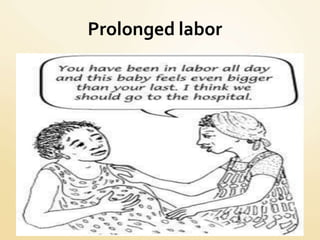
Prolonged labor
DEFINITION:
Labor is said to be prolonged when the
combined duration of the first and second
stage is more than the arbitrary time limit of
18 hours.
According to WHO- labor is considered to be
prolonged when the cervical dilatation rate is
less than 1 cm/hr and descent of the
presenting part is <1 cm/hr for a period of
minimum 4 hours observation.
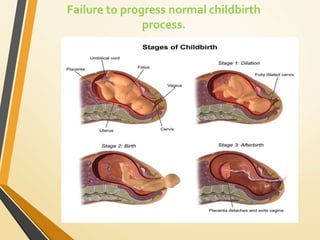
Failure to progress normal childbirth
process.
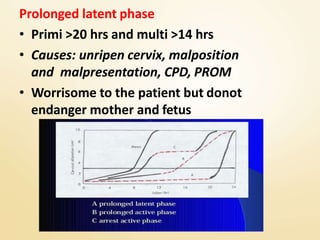
Prolonged latent phase
• Primi >20 hrs and multi >14 hrs
• Causes: unripen cervix, malposition
and malpresentation, CPD, PROM
• Worrisome to the patient but donot
endanger mother and fetus
 Expectant management is usually done unless
there is any indication (for the fetus or mother) for
expediting the delivery.
 Rest and Analgesic are usually given
 When augmentation is decided, medical
methods ( oxytocin or prostaglandin) are
preferred.
 Amniotomy is usually avoided.
 Prolonged latent phase is not an indication for
cesarean section delivery.
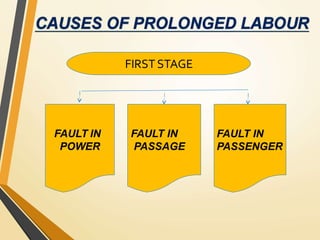
FIRSTSTAGE
FAULT IN
POWER
FAULT IN
PASSAGE
FAULT IN
PASSENGER
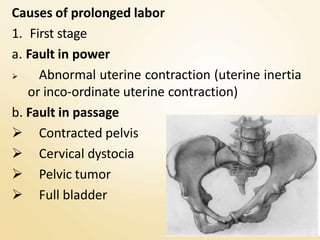
Causes of prolonged labor
1. First stage
a. Fault in power
 Abnormal uterine contraction (uterine inertia
or inco-ordinate uterine contraction)
b. Fault in passage
 Contracted pelvis
 Cervical dystocia
 Pelvic tumor
 Full bladder
c. Fault in the passenger
 Malposition or malpresentation
 Congenital anomalies of the fetus
(hydrocephalus)
d. Others – early administration of sedatives
and analgesics before active labor
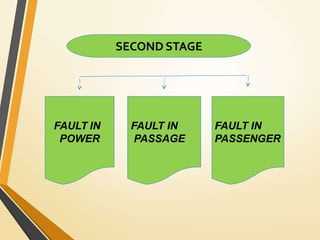
SECOND STAGE
FAULT IN
POWER
FAULT IN
PASSAGE
FAULT IN
PASSENGER
2. Second stage
a. Fault in the power
 Uterine inertia
 Inability to bear down
 Epidural analgesia
 Constriction ring
b. Fault in the passage
 CPD, android pelvis, contracted pelvis
 Undue resistance (spasm or old scarring)
 Soft tissue pelvic tumor
c. Fault in the passenger
 Malposition
 Malpresentation
 Big baby
 Congenital malformation of the baby
Diagnosis
History:-
 Age
 Parity
 Duration of labour
 Duration of membrane rupture
 Whether the patient was handle outside the
hospital
 Whether she was treated with oxytocic drugs
outside the hospital
 Previous history of difficult labour, instrumental
delivery or stillbirth.
General examination :-
• Height of patient
• Dehydration
• Acetone breath
• Pallor
• Raise in temperature
• Tachycardia
• Decrease in BP
Abdominal examination :-
 Contour of the uterus
 Presentation & position
 Tenderness of uterus
 Frequency, intensity &
duration of uterine
contraction.
 Lower segment distended or
not.
 Distension of the bladder.
 Fetal heart sound.
Vaginal examination:-
- The vulva usually swollen and edematous.
- The vagina is dry, hot and occasionally offensive
and purulent discharge.
- The cervix is almost fully dilated or hanging like a
curtain.
- The presenting part is extremely moulded and
jammed in the pelvis.
- There is usually large caput formation.
Diagnosis cont..
Prolonged labor is not a diagnosis but it is the
manifestation of an abnormality.
• The cause of which should be detected by a thorough
abdominal and vaginal examination.
• During vaginal examination if the finger is accomodated in
between the cervix and the head during uterine
contraction pelvic adequecy can be reasonably
established.
• Intranatal imaging ( radiography, CT or MRI) is of help in
determining the fetal station and position as well as pelvic
shape and size.
FIRST STAGE
 Duration is > 12 hours
 Cervical dilatation rate < 1 cm/hr in primi and
< 1.5 cm/hr
 Rate of descent of presenting part is < 1 cm/hr
in primi and < 2 cm/hr in multi
SECOND STAGE
Duration >2 hrs (nullipara), >1 hr (multipara)
[if regional analgesia is given then one hour is
permitted in both groups]
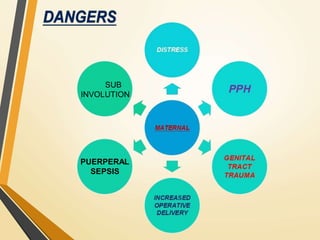
PUERPERAL
SEPSIS
SUB
INVOLUTION
Treatment
Prevention
Antenatal or early intranatal detection
Use of partograph
Selective and judicious augmentation
Change of posture in labor, avoidance of
dehydration in labor and use of adequate
analgesia for pain relief
ActualTreatment
Careful evaluation is to be done
 Evaluate carefully to find out
 Cause of prolonged labor (inadequate uterine
activity in nulliparous, primary dysfunctional labour;
cephalopelvic disproportion in multiparous)
 Effect on the mother
 Effect on the fetus
Preliminaries
Correct fluid and electrolyte imbalance
 Correction of dehydration and ketoacidosis
by IV fluids in case of neglacted prolonged
labour
Control of infections (ampicillin,
metronidazole, ceftriaxone)
Emptying the bladder (catheterization)
Emptying the stomach
Blood cross matching
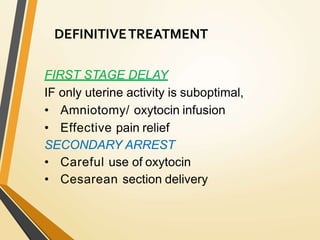
DEFINITIVETREATMENT
FIRST STAGE DELAY
IF only uterine activity is suboptimal,
• Amniotomy/ oxytocin infusion
• Effective pain relief
SECONDARY ARREST
• Careful use of oxytocin
• Cesarean section delivery
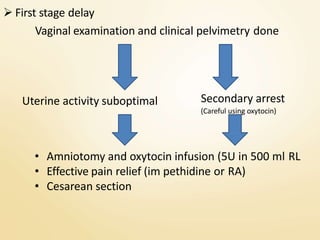
 First stage delay
Vaginal examination and clinical pelvimetry done
Uterine activity suboptimal Secondary arrest
(Careful using oxytocin)
• Amniotomy and oxytocin infusion (5U in 500 ml RL
• Effective pain relief (im pethidine or RA)
• Cesarean section
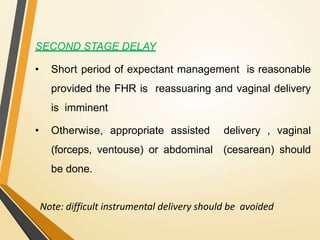
SECOND STAGE DELAY
• Short period of expectant management is reasonable
provided the FHR is reassuaring and vaginal delivery
is imminent
• Otherwise, appropriate assisted delivery , vaginal
(forceps, ventouse) or abdominal (cesarean) should
be done.
Note: difficult instrumental delivery should be avoided
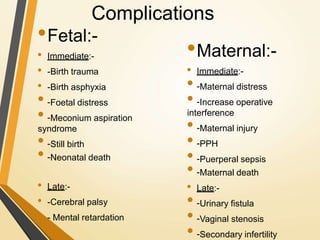
Complications
•Maternal:-
• Immediate:-
• -Maternal distress
• -Increase operative
interference
• -Maternal injury
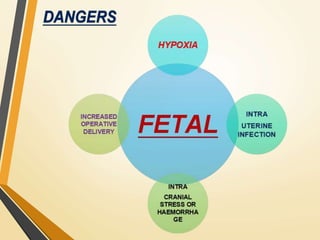
• -PPH
• -Puerperal sepsis
• -Maternal death
• Late:-
• -Urinary fistula
• -Vaginal stenosis
• -Secondary infertility
•Fetal:-
• Immediate:-
• -Birth trauma
• -Birth asphyxia
• -Foetal distress
• -Meconium aspiration
syndrome
• -Still birth
• -Neonatal death
• Late:-
• -Cerebral palsy
• - Mental retardation
Obstructed labor
Obstructed labour
• Definition :- obstructed labour can be
defined as a labour where there is poor
or no progress of labour in spite of good
uterine contraction.
• Incidence :- 1 -2% of referral cases in
developing country.
Obstructed labor is one where in spite of good
uterine contractions, the progressive descent
of the presenting part is arrested due to
mechanical obstruction.
Result due to factors in the fetus or in the
birth canal or both
Causes:
a. Fault in the passage
 Cephalopelvic disproportion
 Contracted pelvis
 Cervical dystocia
 Cervical or broad ligament fibroid
 Impacted ovarian tumor
 Non gravid horn of bicornuate uterus
b. Fault in the passenger
 Transverse lie
 Brow presentation
 Congenital malformations (hydrocephalus,
ascites, double monsters)
 Big baby, occipitofrontal position
 Compound presentation
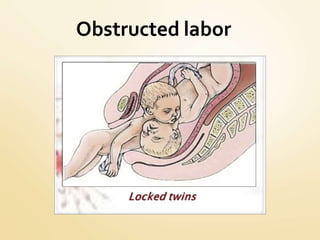
 Locked twins
Morbid anatomical changes
a. Uterus
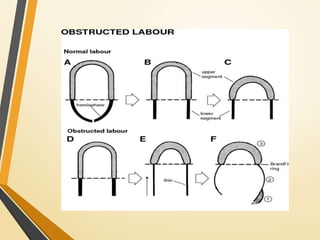
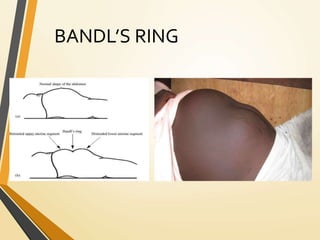
 Formation of bandl’s ring
 Gradual increase in intensity, duration and
frequency of contraction.
 Relaxation becomes less and less
 Ultimately, a state of tonic contraction develops
b. Bladder
Becomes abdominal organ
Compression of urethra b/w presenting part and
symphysis pubis→urinary retention
Trauma→blood stained urine
Pressure necrosis of the bladder and urethra→
genitourinary fistula
Diagnosis
• Partograph will recognize impending
obstruction early. If the labour is slow to
progress, careful general, abdominal and
vaginal examination is necessary.
• Woman gives the history of:-
- prolong labour and
- the labour pain become severe and frequent
Examination
General examination:-
Features of maternal distress i.e.
Exhaustion & keto acidosis
Dehydration
Tachycardia >100/m
Raise temperature
Scanty urine
Clinical features
Maternal condition
Mother is in agony, exhausted, sepsis appear
early
Abdominal examination
• Uterus tense and tender
• Fetal parts easily felt
• Distended bladder due to retention or edema
• Retraction Ring may be felt
• FHS usually absent
• “Three tumor abdomen” evident
BANDL’S RING
Vaginal examination
• Lower segment pressed by forcibly driven
presenting part
• Edematous vulva (cannula sign) and cervix
• Severe caput and moulding
• Ring not felt vaginally
• Descent of presenting part absent
Anticipation of Obs. Labor during
ANC
Short stature particularly in primi <150 cm
Large fetus >4 kg
Obvious pelvis/spinal deformities
Gynetresia (at least one pelvic exam be done
at ANC)
Uterine myomas in lower segment or cervix
Abnormal lie
Severe degree of overlap at pelvic brim
Dangers
1. Mother
a. Immediate
Exhaustion
Dehydration
Metabolic acidiosis
Hypoglycemia
Genital sepsis
Injury to the genital tract includes rupture of the
uterus
Postpartum hemorrhage and shock
b. Remote
 Genitourinary fistula or rectovaginal fistula
 Variable degree of vaginal atresia
 Secondary amenorrhea
2. Fetus
a. Asphyxia
b. Acidosis
c. Intracranial hemorrhage
d. Infection
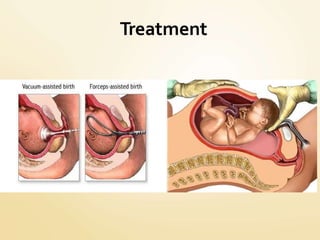
Treatment
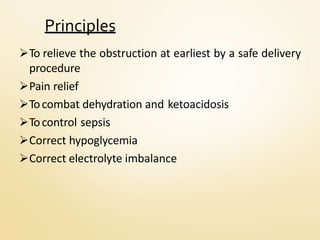
Principles
To relieve the obstruction at earliest by a safe delivery
procedure
Pain relief
Tocombat dehydration and ketoacidosis
Tocontrol sepsis
Correct hypoglycemia
Correct electrolyte imbalance
1. Prevention
Same as prolonged labor
2. Initial assessment of the patient
 Pallor, pulse, blood pressure, dehydration
 Fundal height, fetal lie, presentation and heart
rate, state of the uterus and bladder
 Level of presenting part, cervical dilatation, caput
formation and moulding
 Do pelvic assessment and note the measurement
and the presence of infected liquor
 Access urine
 Blood group and cross matching
3. Resuscitate the patient
IV fluids at least 3 litres
Give dextrose saline for hypoglycemia initially
then ringers lactate
Oxygen if fetal distress or maternal distress
4. Control infection
Give broad spectrum IV antibiotics
Stat dose of Ampicillin 1g and Chloramphenicol
5. Check if the fetus is alive and decide mode of
delivery
6. Empty bladder with self retaining catheter
Obstetric management
No place of “wait and watch”, neither any scope of
using oxytocin to stimulate uterine contraction.
Before proceeding for definitive operative
treatment, rupture of the uterus must be
excluded.
Decide best method to relieve the obstruction with
least hazards to the mother.
Vaginal delivery
If baby dead, destructive operation (craniotomy,
decapitation, evisceration and cleidotomy) is
best choice
If baby living and head is low down and vaginal
delivery not risky→forceps extraction
After delivery, explore uterus and lower genital
tract to exclude uterine rupture or tear
Cesarean delivery
Done if the case is detected early with good fetal
outcome.
In late case, desperate attempt to do a C/S to save
the morbidund baby more often leads to
disastrous consequents.
Symphysiotomy
Alternate to risky cesarean
In case of established obstruction due to outlet
contraction with vertex presentation having good
FHS
Post delivery care
Continue monitoring of temperature, pulse, BP,
urine output and colour
Monitor abdominal distension
Continue antibiotics
Continuous bladder drainage for at least 10
days
Check for perineal nerve damage and
rehabilitate accordingly
Bear in mind, possibility of secondary PPH
Counseling for future pregnancies and deliveries
Thankyou!!!!

Prolonged and obstructed labour

  • 1.
  • 2.
    Labour • Series ofevents that take place in the genital organs in an effort to expel the viable products of conception out of the womb through the vagina into the outer world.  First stage • start of the true labor pain to full dilatation of the cervix (10 cm) • latent phase (primi-8hrs, multi-4hrs) active phase (primi-4hrs, multi-2hrs)
  • 3.
     Second stage fromfull dilatation of the cervix to the expulsion of the fetus. Propulsive phase Expulsive phase duration- primi =2 hours multi = 30 minutes
  • 4.
    Third stage from expulsionof the fetus to the expulsion of the placenta Phase of placental separation Phase of placental descent Phase of placental expulsion Duration- 15 minutes (primi and multi) 5 minutes in active management  Fourth stage Upto 1 hour of delivery of placenta
  • 5.
    NORMAL LABOUR • Definedas: Presence of regular painful uterine contractions becoming progressively stronger and more frequent accompanied by effacement and progressive dilatation of the cervix and decent of the presenting part. • At its onset its usually accompanied by bloody mucoid vaginal discharge called show. • The process culminates in expulsion of the baby and other products of conception.
  • 6.
    The course ofnormal labour
  • 7.
    1.The 1st stageof labour (a)the latent phase This is the period from 0 – 3 cm dilatation of the cervix. Its duration can not be easily determined but perhaps around 8 hrs.
  • 8.
    (b) The activephase This is the period from 3 – 10 cm (full dilatation) dilation of the cervix. In this stage the woman is said to be in established labour. The cervix dilates at the rate of about 1 cm/hour It may be a little faster esp. in multiparous women or little slower esp. in primigravida, giving an average duration of labour of about 12 hrs.
  • 9.
    2.The 2nd stageof labour •This is the stage from full dilatation of the cervix to the delivery of the baby. •It takes •2 hours in primigravidas •30 minutes in multigravidas
  • 10.
    The 3rd stageof labour This is the stage of labour after delivery of the baby to the delivery of the placentaand membranes. •It usually takes 15 minutes
  • 11.
    The 4th stageof labour •This is the stage in the first 24 hours after delivery •This is the period where majority of maternal deaths occurs •It needs close monitoring of the mother in the hospital esp. for PPH, Eclampsia etc..
  • 12.
  • 13.
    DEFINITION: Labor is saidto be prolonged when the combined duration of the first and second stage is more than the arbitrary time limit of 18 hours. According to WHO- labor is considered to be prolonged when the cervical dilatation rate is less than 1 cm/hr and descent of the presenting part is <1 cm/hr for a period of minimum 4 hours observation.
  • 14.
    Failure to progressnormal childbirth process.
  • 15.
    Prolonged latent phase •Primi >20 hrs and multi >14 hrs • Causes: unripen cervix, malposition and malpresentation, CPD, PROM • Worrisome to the patient but donot endanger mother and fetus
  • 16.
     Expectant managementis usually done unless there is any indication (for the fetus or mother) for expediting the delivery.  Rest and Analgesic are usually given  When augmentation is decided, medical methods ( oxytocin or prostaglandin) are preferred.  Amniotomy is usually avoided.  Prolonged latent phase is not an indication for cesarean section delivery.
  • 17.
  • 18.
    Causes of prolongedlabor 1. First stage a. Fault in power  Abnormal uterine contraction (uterine inertia or inco-ordinate uterine contraction) b. Fault in passage  Contracted pelvis  Cervical dystocia  Pelvic tumor  Full bladder
  • 19.
    c. Fault inthe passenger  Malposition or malpresentation  Congenital anomalies of the fetus (hydrocephalus) d. Others – early administration of sedatives and analgesics before active labor
  • 20.
    SECOND STAGE FAULT IN POWER FAULTIN PASSAGE FAULT IN PASSENGER
  • 21.
    2. Second stage a.Fault in the power  Uterine inertia  Inability to bear down  Epidural analgesia  Constriction ring b. Fault in the passage  CPD, android pelvis, contracted pelvis  Undue resistance (spasm or old scarring)  Soft tissue pelvic tumor
  • 22.
    c. Fault inthe passenger  Malposition  Malpresentation  Big baby  Congenital malformation of the baby
  • 23.
    Diagnosis History:-  Age  Parity Duration of labour  Duration of membrane rupture  Whether the patient was handle outside the hospital  Whether she was treated with oxytocic drugs outside the hospital  Previous history of difficult labour, instrumental delivery or stillbirth.
  • 24.
    General examination :- •Height of patient • Dehydration • Acetone breath • Pallor • Raise in temperature • Tachycardia • Decrease in BP
  • 25.
    Abdominal examination :- Contour of the uterus  Presentation & position  Tenderness of uterus  Frequency, intensity & duration of uterine contraction.  Lower segment distended or not.  Distension of the bladder.  Fetal heart sound.
  • 26.
    Vaginal examination:- - Thevulva usually swollen and edematous. - The vagina is dry, hot and occasionally offensive and purulent discharge. - The cervix is almost fully dilated or hanging like a curtain. - The presenting part is extremely moulded and jammed in the pelvis. - There is usually large caput formation.
  • 27.
    Diagnosis cont.. Prolonged laboris not a diagnosis but it is the manifestation of an abnormality. • The cause of which should be detected by a thorough abdominal and vaginal examination. • During vaginal examination if the finger is accomodated in between the cervix and the head during uterine contraction pelvic adequecy can be reasonably established. • Intranatal imaging ( radiography, CT or MRI) is of help in determining the fetal station and position as well as pelvic shape and size.
  • 28.
    FIRST STAGE  Durationis > 12 hours  Cervical dilatation rate < 1 cm/hr in primi and < 1.5 cm/hr  Rate of descent of presenting part is < 1 cm/hr in primi and < 2 cm/hr in multi SECOND STAGE Duration >2 hrs (nullipara), >1 hr (multipara) [if regional analgesia is given then one hour is permitted in both groups]
  • 30.
  • 31.
  • 32.
    Prevention Antenatal or earlyintranatal detection Use of partograph Selective and judicious augmentation Change of posture in labor, avoidance of dehydration in labor and use of adequate analgesia for pain relief
  • 33.
    ActualTreatment Careful evaluation isto be done  Evaluate carefully to find out  Cause of prolonged labor (inadequate uterine activity in nulliparous, primary dysfunctional labour; cephalopelvic disproportion in multiparous)  Effect on the mother  Effect on the fetus
  • 34.
    Preliminaries Correct fluid andelectrolyte imbalance  Correction of dehydration and ketoacidosis by IV fluids in case of neglacted prolonged labour Control of infections (ampicillin, metronidazole, ceftriaxone) Emptying the bladder (catheterization) Emptying the stomach Blood cross matching
  • 35.
    DEFINITIVETREATMENT FIRST STAGE DELAY IFonly uterine activity is suboptimal, • Amniotomy/ oxytocin infusion • Effective pain relief SECONDARY ARREST • Careful use of oxytocin • Cesarean section delivery
  • 36.
     First stagedelay Vaginal examination and clinical pelvimetry done Uterine activity suboptimal Secondary arrest (Careful using oxytocin) • Amniotomy and oxytocin infusion (5U in 500 ml RL • Effective pain relief (im pethidine or RA) • Cesarean section
  • 37.
    SECOND STAGE DELAY •Short period of expectant management is reasonable provided the FHR is reassuaring and vaginal delivery is imminent • Otherwise, appropriate assisted delivery , vaginal (forceps, ventouse) or abdominal (cesarean) should be done. Note: difficult instrumental delivery should be avoided
  • 38.
    Complications •Maternal:- • Immediate:- • -Maternaldistress • -Increase operative interference • -Maternal injury • -PPH • -Puerperal sepsis • -Maternal death • Late:- • -Urinary fistula • -Vaginal stenosis • -Secondary infertility •Fetal:- • Immediate:- • -Birth trauma • -Birth asphyxia • -Foetal distress • -Meconium aspiration syndrome • -Still birth • -Neonatal death • Late:- • -Cerebral palsy • - Mental retardation
  • 39.
  • 40.
    Obstructed labour • Definition:- obstructed labour can be defined as a labour where there is poor or no progress of labour in spite of good uterine contraction. • Incidence :- 1 -2% of referral cases in developing country.
  • 41.
    Obstructed labor isone where in spite of good uterine contractions, the progressive descent of the presenting part is arrested due to mechanical obstruction. Result due to factors in the fetus or in the birth canal or both
  • 42.
    Causes: a. Fault inthe passage  Cephalopelvic disproportion  Contracted pelvis  Cervical dystocia  Cervical or broad ligament fibroid  Impacted ovarian tumor  Non gravid horn of bicornuate uterus
  • 43.
    b. Fault inthe passenger  Transverse lie  Brow presentation  Congenital malformations (hydrocephalus, ascites, double monsters)  Big baby, occipitofrontal position  Compound presentation  Locked twins
  • 44.
    Morbid anatomical changes a.Uterus  Formation of bandl’s ring  Gradual increase in intensity, duration and frequency of contraction.  Relaxation becomes less and less  Ultimately, a state of tonic contraction develops
  • 45.
    b. Bladder Becomes abdominalorgan Compression of urethra b/w presenting part and symphysis pubis→urinary retention Trauma→blood stained urine Pressure necrosis of the bladder and urethra→ genitourinary fistula
  • 46.
    Diagnosis • Partograph willrecognize impending obstruction early. If the labour is slow to progress, careful general, abdominal and vaginal examination is necessary. • Woman gives the history of:- - prolong labour and - the labour pain become severe and frequent
  • 47.
    Examination General examination:- Features ofmaternal distress i.e. Exhaustion & keto acidosis Dehydration Tachycardia >100/m Raise temperature Scanty urine
  • 48.
    Clinical features Maternal condition Motheris in agony, exhausted, sepsis appear early Abdominal examination • Uterus tense and tender • Fetal parts easily felt • Distended bladder due to retention or edema • Retraction Ring may be felt • FHS usually absent • “Three tumor abdomen” evident
  • 50.
  • 51.
    Vaginal examination • Lowersegment pressed by forcibly driven presenting part • Edematous vulva (cannula sign) and cervix • Severe caput and moulding • Ring not felt vaginally • Descent of presenting part absent
  • 52.
    Anticipation of Obs.Labor during ANC Short stature particularly in primi <150 cm Large fetus >4 kg Obvious pelvis/spinal deformities Gynetresia (at least one pelvic exam be done at ANC) Uterine myomas in lower segment or cervix Abnormal lie Severe degree of overlap at pelvic brim
  • 53.
    Dangers 1. Mother a. Immediate Exhaustion Dehydration Metabolicacidiosis Hypoglycemia Genital sepsis Injury to the genital tract includes rupture of the uterus Postpartum hemorrhage and shock
  • 54.
    b. Remote  Genitourinaryfistula or rectovaginal fistula  Variable degree of vaginal atresia  Secondary amenorrhea 2. Fetus a. Asphyxia b. Acidosis c. Intracranial hemorrhage d. Infection
  • 55.
  • 56.
    Principles To relieve theobstruction at earliest by a safe delivery procedure Pain relief Tocombat dehydration and ketoacidosis Tocontrol sepsis Correct hypoglycemia Correct electrolyte imbalance
  • 57.
    1. Prevention Same asprolonged labor 2. Initial assessment of the patient  Pallor, pulse, blood pressure, dehydration  Fundal height, fetal lie, presentation and heart rate, state of the uterus and bladder  Level of presenting part, cervical dilatation, caput formation and moulding  Do pelvic assessment and note the measurement and the presence of infected liquor  Access urine  Blood group and cross matching
  • 58.
    3. Resuscitate thepatient IV fluids at least 3 litres Give dextrose saline for hypoglycemia initially then ringers lactate Oxygen if fetal distress or maternal distress 4. Control infection Give broad spectrum IV antibiotics Stat dose of Ampicillin 1g and Chloramphenicol
  • 59.
    5. Check ifthe fetus is alive and decide mode of delivery 6. Empty bladder with self retaining catheter
  • 60.
    Obstetric management No placeof “wait and watch”, neither any scope of using oxytocin to stimulate uterine contraction. Before proceeding for definitive operative treatment, rupture of the uterus must be excluded. Decide best method to relieve the obstruction with least hazards to the mother.
  • 61.
    Vaginal delivery If babydead, destructive operation (craniotomy, decapitation, evisceration and cleidotomy) is best choice If baby living and head is low down and vaginal delivery not risky→forceps extraction After delivery, explore uterus and lower genital tract to exclude uterine rupture or tear
  • 62.
    Cesarean delivery Done ifthe case is detected early with good fetal outcome. In late case, desperate attempt to do a C/S to save the morbidund baby more often leads to disastrous consequents. Symphysiotomy Alternate to risky cesarean In case of established obstruction due to outlet contraction with vertex presentation having good FHS
  • 63.
    Post delivery care Continuemonitoring of temperature, pulse, BP, urine output and colour Monitor abdominal distension Continue antibiotics Continuous bladder drainage for at least 10 days Check for perineal nerve damage and rehabilitate accordingly Bear in mind, possibility of secondary PPH Counseling for future pregnancies and deliveries
  • 64.