MITTAL COLLEGE OF NURSING
AJMER
PRESENTATION ON :- MULTIPLE PREGNANCY
SUBMITTED TO: SUBMITTED BY :
MRS. SNEHLATA PARASHAR GAVRIKA DADHICH
(NURSING LECTURER) B.SC NURSING 4thyear
Multiple
pregnancy
Multiple pregnancy
Definition-
 'Multiple Pregnancy' is the development of more than one fetus
in the utero at the same time. The simultaneous development
of two fetuses is termed twins, three-triplets, four-
quadruplets, five-quintuplets, six as sextuplets and seven-
septuplets.
Or
 All gestasions where more then one conceptus is formed is
called multiple pregnancy.
 Twin pregnancy is the most commonly seen type of multiple
pregnancy with two fetuses in utero.
Classification of twin pregnancy
..
 1. Dizygotic or biovular twins - develop from
two separate oocytes, fertilized by two sperms
during the same ovarian cycle. They are referred
as "non-identical twins". They may be of same
or of different sex.
 2. Monozygotic or uniovular twins - are known
as "identical twins" They develop from the
fusion of one oocyte and one spermatozoon,
which after fertilization splits into two. These
twins will be of the same sex and have same
genes, blood groups and physical features such
as eyes and hair colour, ear shapes etc.
On extreme rare occasions:-
division occurs after 2 weeks of the development of
embryonic disc resulting in the formation of conjoined
twins called-Siamese twins.
Types:-
 -Thoracopagus (commonest)
 - Pyopagus (Posterior fusion)
 - Craniopagus (cephalic)
 -Ischiopagus (caudal)
-Thoracopagus (commonest)
-pyopagus (posterior fusion)
-craniopagus (cephalic)
-ischiopagus (caudal)
Terms used for twin:-
- Superfecundation
- Superfetation
- Fetus papyraceous or compressus
- Fetus acardius
- Vanishing twin
Superfecundation:
 Fertilization of two different ova released in the
same cycle ,by separate act of coitus with in a
short period of time.
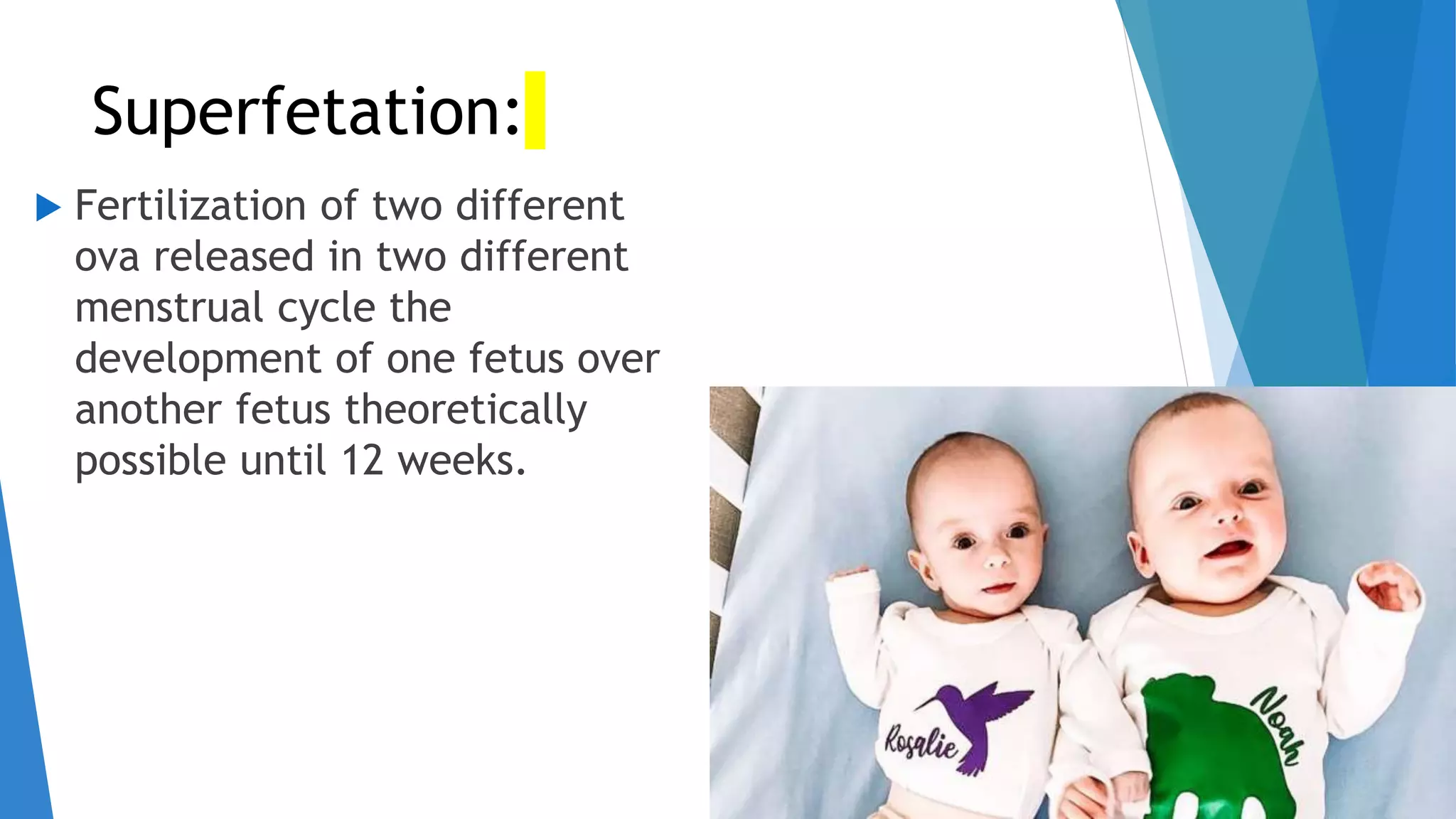
Superfetation:
 Fertilization of two different
ova released in two different
menstrual cycle the
development of one fetus over
another fetus theoretically
possible until 12 weeks.
Fetus compressus:
 It is a state of pregnancy when one
of the fetuses dies early, gets
compressed and flattened in
between the membranes of the
living fetus and the uterine wall.
The condition is common in
uniovular twins and rarely occurring
in biovular twin pregnancy. The
thinned out fetus is easily
detectable on ultrasound
examination conducted during
pregnancy
Fetus acardius :
 Fetus developed
with no heart,
connected as a
parasite to another
fetus.
Vanishing twin syndrome:
Death of one of the twins during second
trimester and becoming fetus
compressus , getting embedded into the
placenta and expelling out during
delivery with the other one may
complete the term in healthy form is
called vanishing twin syndrome.
Diagnosis:-
 History and clinical examination-
- Family history
- drug history
symptoms-
- Increased nausea and vomiting.
- Uterine enlargement.
- Swelling in the legs.
- Excessive fetal movements.
- Cardiorespiratory changes.
Abdominal examination-
 inspection: abdomen is enlarged and barrel shaped.
 Palpation: palpation of too many fetal parts.
 Ascultation: difference in heart rates is atleast 10 beats/min.
Sonography-
-Separater gestational sac identified early.
-amniotic fluid volume.
sonography
Biochemical tests:
 Levels of hCG in plasma and in urine :
higher
 Maternal serum alpha-fetoprotein
level : Elevated
Complication:
Maternal Fetal
-nausea ,vomiting - vanishing twin
-anemia - preterm birth
-pre eclampsia - LBW baby
-preterm labor - cord compression
-prolonged labor - locke twins
locked twin:-
Management:-
antenatal management:
 Early diagnosis of twin pregnancy is
extreamly important in order to prepare
parents ,by giving specialist support and
the advice needed by them. This will help
them to care the fetus properly during
antenatal period as well as prevent
occurance of complication during intranatal
and postnatal period .
Diet :
The diet of a mother with multiple pregnancy should
include extra calories (aprox 300 g/day) in the form
of protein 80gm/day ,fat and protein .
Rest:
Extra bed rest and light work is adviced .a good night
sleep and away from worries is needed during
antenatal period .
.
Fetal growth assessment is
carried out to find the
development of fetus as serial
ultrasound examination.
Supplement therapy includes
iron , folic acid , vitamins , and
calcium
Hospitalization:
If beds are available , the optimum time
when maximum benifits is expected is
hospitalization b/w 30-36 weeks.
On hospitalization the risk of prematurity
is much reduced , timely admission
decrease frequency of preeclampsis and
lower the prenatal mortility .
Management during labour:
 Induction of labour usually done around 37
weeks of gestation because of having risk
of complications like intranatal bleeding ,
intra uterine growth retardation .
 progress of labour is detected by carring ut
vaginal examination.
 Labour room should be prepared before
receive pt.
Cont…….
An obstetrician , pediatritian, and
anesthetist should be present in case
of any complication.
There is possibility of emergency
caesarean section may be carried out,
the midwife should make necessary
arrangement and be prepared to meet
such situations.
Cont………
Explain the relatives the progress of
labour ,obtain written concent.
Make sure availability of one unit of
compatible and cross matched blood .
Careful monitoring .
An intravenous line with RL solution .
Delivery of first baby:
 Same guideline as in normal labour.
 Clamp the cord at two place and cut it b/w.
 The baby should be labled .
 Vaginal examination should be carried out.
 If the uterine contraction is poor ,5 unit of
oxytocin is added.
 Delivery of second baby must be complete within
30-35 mins.
Cont……
 The delivery of second baby carried out in same
manner.
 Oxytocin administration help in easy delivery of the
baby .
Indication of urgent delivery of 2nd baby:
-severe veginal bleeding -cord prolapse
-first delivery under GA -appearance of fetal distress
-Delay in birth of second baby ;
risk of –intrauterine hypoxia and sepsis.
 Methargin 0.2 mg IV is administred with the
delivery of second baby.
 The time ,sex of the baby is noted and
labelled as second twin .
 The risk of asphyxia is greater for second
twin and active resuscitation is required
immidiately after the birth .
Management of the third stage of
labour:
 Deliver the placenta without delay.
 Empty the uterus.
 Oxytocin drip is continued for atleast 45 mins.
Following delivery of second baby
 Vital sign of mother are closely observed for
atleast 2 hr.
 Excessive blood loss is replaced by blood
transfusion.
management of postnatal period:
*care of baby-
 Immidiate care
*maintain airway
*documentation (APGAR)
*care of eye
*care of skin
*vit.k
 Maintenance of body temperature
 Initiation of breast feeding
 Monitor for weight
Care of mother:
 Gradually Pain increase, so analgesics should be
offered.
 High calorie diet.
 Extra support to handle twin baby.
 Reassure that lactation respond to the demand made by
babies sucking.
 At feeding time, mother must provided support and
adviced for positioning.
 Provide knowledge to mother regarding different
positions , along with advantages, attachment, from
positioning.
Bibliography :-
 Dc. Dutta textbook of obstetrics. 6th
edition.
 Gk sandhu textbook of obstetric and
midwifery.
 Reena wani textbook of midwifery for
nurses.
 www.slidshare.net
ok
Thank you

multiple pregnancy ppt..pptx

  • 1.
    MITTAL COLLEGE OFNURSING AJMER PRESENTATION ON :- MULTIPLE PREGNANCY SUBMITTED TO: SUBMITTED BY : MRS. SNEHLATA PARASHAR GAVRIKA DADHICH (NURSING LECTURER) B.SC NURSING 4thyear
  • 2.
  • 3.
    Multiple pregnancy Definition-  'MultiplePregnancy' is the development of more than one fetus in the utero at the same time. The simultaneous development of two fetuses is termed twins, three-triplets, four- quadruplets, five-quintuplets, six as sextuplets and seven- septuplets. Or  All gestasions where more then one conceptus is formed is called multiple pregnancy.  Twin pregnancy is the most commonly seen type of multiple pregnancy with two fetuses in utero.
  • 4.
  • 5.
    ..  1. Dizygoticor biovular twins - develop from two separate oocytes, fertilized by two sperms during the same ovarian cycle. They are referred as "non-identical twins". They may be of same or of different sex.  2. Monozygotic or uniovular twins - are known as "identical twins" They develop from the fusion of one oocyte and one spermatozoon, which after fertilization splits into two. These twins will be of the same sex and have same genes, blood groups and physical features such as eyes and hair colour, ear shapes etc.
  • 8.
    On extreme rareoccasions:- division occurs after 2 weeks of the development of embryonic disc resulting in the formation of conjoined twins called-Siamese twins. Types:-  -Thoracopagus (commonest)  - Pyopagus (Posterior fusion)  - Craniopagus (cephalic)  -Ischiopagus (caudal)
  • 9.
  • 10.
  • 11.
  • 12.
  • 13.
    Terms used fortwin:- - Superfecundation - Superfetation - Fetus papyraceous or compressus - Fetus acardius - Vanishing twin
  • 14.
    Superfecundation:  Fertilization oftwo different ova released in the same cycle ,by separate act of coitus with in a short period of time.
  • 15.
    Superfetation:  Fertilization oftwo different ova released in two different menstrual cycle the development of one fetus over another fetus theoretically possible until 12 weeks.
  • 16.
    Fetus compressus:  Itis a state of pregnancy when one of the fetuses dies early, gets compressed and flattened in between the membranes of the living fetus and the uterine wall. The condition is common in uniovular twins and rarely occurring in biovular twin pregnancy. The thinned out fetus is easily detectable on ultrasound examination conducted during pregnancy
  • 17.
    Fetus acardius : Fetus developed with no heart, connected as a parasite to another fetus.
  • 18.
    Vanishing twin syndrome: Deathof one of the twins during second trimester and becoming fetus compressus , getting embedded into the placenta and expelling out during delivery with the other one may complete the term in healthy form is called vanishing twin syndrome.
  • 19.
    Diagnosis:-  History andclinical examination- - Family history - drug history symptoms- - Increased nausea and vomiting. - Uterine enlargement. - Swelling in the legs. - Excessive fetal movements. - Cardiorespiratory changes.
  • 20.
    Abdominal examination-  inspection:abdomen is enlarged and barrel shaped.  Palpation: palpation of too many fetal parts.  Ascultation: difference in heart rates is atleast 10 beats/min. Sonography- -Separater gestational sac identified early. -amniotic fluid volume.
  • 21.
  • 22.
    Biochemical tests:  Levelsof hCG in plasma and in urine : higher  Maternal serum alpha-fetoprotein level : Elevated
  • 23.
    Complication: Maternal Fetal -nausea ,vomiting- vanishing twin -anemia - preterm birth -pre eclampsia - LBW baby -preterm labor - cord compression -prolonged labor - locke twins
  • 24.
  • 25.
    Management:- antenatal management:  Earlydiagnosis of twin pregnancy is extreamly important in order to prepare parents ,by giving specialist support and the advice needed by them. This will help them to care the fetus properly during antenatal period as well as prevent occurance of complication during intranatal and postnatal period .
  • 26.
    Diet : The dietof a mother with multiple pregnancy should include extra calories (aprox 300 g/day) in the form of protein 80gm/day ,fat and protein . Rest: Extra bed rest and light work is adviced .a good night sleep and away from worries is needed during antenatal period .
  • 27.
    . Fetal growth assessmentis carried out to find the development of fetus as serial ultrasound examination. Supplement therapy includes iron , folic acid , vitamins , and calcium
  • 28.
    Hospitalization: If beds areavailable , the optimum time when maximum benifits is expected is hospitalization b/w 30-36 weeks. On hospitalization the risk of prematurity is much reduced , timely admission decrease frequency of preeclampsis and lower the prenatal mortility .
  • 29.
    Management during labour: Induction of labour usually done around 37 weeks of gestation because of having risk of complications like intranatal bleeding , intra uterine growth retardation .  progress of labour is detected by carring ut vaginal examination.  Labour room should be prepared before receive pt.
  • 30.
    Cont……. An obstetrician ,pediatritian, and anesthetist should be present in case of any complication. There is possibility of emergency caesarean section may be carried out, the midwife should make necessary arrangement and be prepared to meet such situations.
  • 31.
    Cont……… Explain the relativesthe progress of labour ,obtain written concent. Make sure availability of one unit of compatible and cross matched blood . Careful monitoring . An intravenous line with RL solution .
  • 32.
    Delivery of firstbaby:  Same guideline as in normal labour.  Clamp the cord at two place and cut it b/w.  The baby should be labled .  Vaginal examination should be carried out.  If the uterine contraction is poor ,5 unit of oxytocin is added.  Delivery of second baby must be complete within 30-35 mins.
  • 33.
    Cont……  The deliveryof second baby carried out in same manner.  Oxytocin administration help in easy delivery of the baby . Indication of urgent delivery of 2nd baby: -severe veginal bleeding -cord prolapse -first delivery under GA -appearance of fetal distress
  • 34.
    -Delay in birthof second baby ; risk of –intrauterine hypoxia and sepsis.  Methargin 0.2 mg IV is administred with the delivery of second baby.  The time ,sex of the baby is noted and labelled as second twin .  The risk of asphyxia is greater for second twin and active resuscitation is required immidiately after the birth .
  • 35.
    Management of thethird stage of labour:  Deliver the placenta without delay.  Empty the uterus.  Oxytocin drip is continued for atleast 45 mins. Following delivery of second baby  Vital sign of mother are closely observed for atleast 2 hr.  Excessive blood loss is replaced by blood transfusion.
  • 36.
    management of postnatalperiod: *care of baby-  Immidiate care *maintain airway *documentation (APGAR) *care of eye *care of skin *vit.k  Maintenance of body temperature  Initiation of breast feeding  Monitor for weight
  • 37.
    Care of mother: Gradually Pain increase, so analgesics should be offered.  High calorie diet.  Extra support to handle twin baby.  Reassure that lactation respond to the demand made by babies sucking.  At feeding time, mother must provided support and adviced for positioning.  Provide knowledge to mother regarding different positions , along with advantages, attachment, from positioning.
  • 38.
    Bibliography :-  Dc.Dutta textbook of obstetrics. 6th edition.  Gk sandhu textbook of obstetric and midwifery.  Reena wani textbook of midwifery for nurses.  www.slidshare.net
  • 39.

Editor's Notes

  • #17 Fens papyraceous: It is a state of pregnancy when one of the fetuses dies early, gets compressed and flattened in between the membranes of the living fetus and the uterine wall. The condition is com mon in uniovular twins and rarely occurring in biovular twin pregnancy. The thinned out fetus is easily detectable on ultrasound examination con ducted during pregnancy