Presentation on
TOPIC:- POLYCYSTIC OVARIAN SYNDROME
Submitted To :-
Mrs. Snehlata Parashar
(lecturer OBG)
Submitted By :-
Miss Muskan Mathur
B.Sc. nursing 4th yr)
 Introduction
 Definition
 Epidemiology
 Types
 Risk factors and causes
 Pathophysiology
 Clinical features
 Diagnostic evalution
 Management
polycystic ovarian syndrome 2
Polycystic ovarian syndrome { PCOD } is a
complex endocrine disorder associated with
long term anovulation and an excess of
androgen circulation in blood.
In PCOS womenʹs sex hormones are out of
balance which leads to the growth of ovarian
cysts.
First described in 1935 by american
gynaecologist Irving F Stein and Michael L
Leventhal .
polycystic ovarian syndrome 3
 The PCOS is formation of cysts in the ovaries
or dysfunction of ovaries along with cardinal
features of LH hyper-secretion, ovarian
hyper-androgenism, hyper-insulinemia,
reduced fertility.
polycystic ovarian syndrome 4
 In this condition both the ovaries have multiple
small cysts with thickened tunica albuginea and
hyperplasia of the theca cell.
 The cyst is usually 5-10mm and total size of the
ovary may be three times that of normal size.
There is thickening of the ovarian stroma. There
is no dominant follicle.
 The patients usually present when they are young
but disease can be seen at anytime the during
the childbearing age.
polycystic ovarian syndrome 5
polycystic ovarian syndrome 6
 The most common endocrine disorder in
reproductive age 4~20% of women in
worldwide.
 A statistical report by frutterweit 50~70% are
unaware.
 In 2021 today prevalence rate 22.5% or every
one woman in five suffers from PCOS in india
due to obese.
polycystic ovarian syndrome 7
polycystic ovarian syndrome 8
polycystic ovarian syndrome 9
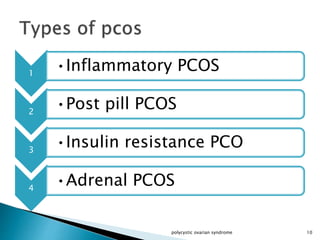
1
•Inflammatory PCOS
2
•Post pill PCOS
3
•Insulin resistance PCO
4
•Adrenal PCOS
polycystic ovarian syndrome 10
it happens when the immune system tries to protect
against foreign body but when it become
overreacted create such condition.
It is due to inflammation,ovulation is prevented,
hormones get imbalanced and androgen produced. It
can caused by stress.
 Long term chronic inflammation
 Irritable bowel syndrome
 Unexplained fatigue
 Headache
 Join pain
 Skin condition
 Food sensitivities
polycystic ovarian syndrome 11
This type is the second most common PCOS. It
gets developed due to the birth control pills
which suppress ovulation.
 Temporary surge of androgens
 Ovulation suppression
 LH incresed
polycystic ovarian syndrome 12
This is most common type of PCOS. It
caused by smoking pollution and trans fat.
It affect up to 70% of all pcos. In this your
cell not recognise that insulin exists in the
body,causing insulin rise over time and
cause the following:
 Irregular periods
 Excess weight
 Hormonal acne
 Hirsutism
polycystic ovarian syndrome 13
This type of PCOS is due to an abnormal
stress response and affects around 10% of
those diagnosed. This caused by excessive
androgen by ovary.
 some symptoms of inflammatory PCOS
 tests will show elevated
dehydroepiandrosterone sulfate(DHEAS)
 normal levels of testosterone.
polycystic ovarian syndrome 14
 - unknown
 - irregular periods
 - low level of progesterone
 - genetic factor
 - increased insulin resistance
 - bad dietary choice
 - liver dysfunction
 - stress & genetic mutation in autosomal chromosomes
 - obesity
 - hypothyroidism
 - excessive androgen
 - imbalance LH & FSH
 - diabetes
 - HTN
polycystic ovarian syndrome 15
polycystic ovarian syndrome 16
polycystic ovarian syndrome 17
 Increasing obesity, especially central obesity.
 Menstrual abnormalities in the form of oligomenorrhea,
amenorrhea, or dysfunctional uterine bleeding.
 Infertility
 Hirsutism (hair growth on womanʹs face)
 Acne
 Weight gain
 Dark patches of skin
 pelvic pain
 fatigue
 depression
 increased Blood Pressure
polycystic ovarian syndrome 18
polycystic ovarian syndrome 19
1. Biochemical tests:
 FSH LH
 Testosterone
 Thyroid function test
 Sugar test
 Lipid profie
 Cortisol
polycystic ovarian syndrome 20
2. Radiological test
 Ultrasound scan
 CT Scan
 MRI Scan
3. Histology
 Endometrial biopsy
polycystic ovarian syndrome 21
polycystic ovarian syndrome 22
 No universal treatment for PCOS is available.
 Conservative treatment ;
 Mild hyperandrogenism
 Encourage weight loss
 Diet modification
 Exercise
 Screening for dyslipidemia and DM
polycystic ovarian syndrome 23
Lower insulin levels
Restore regular menstruation
Restore fertility
Treat hirsutism or acne
Prevent endometrial hyperplasia and
endometrial cancer
polycystic ovarian syndrome 24
 Anti-diabetic medication ; example metformin
500mg twice a day.
 Oral contraceptive ; example cyprotoerone acetate
 Help in ovulate: example clomiphene citrate
 Hormone : example gonadotropins
 Hair growth inhibitor ; Eflornithine
 Fertility treatment ; example LH FSH
polycystic ovarian syndrome 25
 Surgical management :
 Laparoscopic ovarian drilling by laser
 Cyst aspiration
 Oophorectomy
polycystic ovarian syndrome 26
 The possible long term complication of
polycystic ovaries are as follows:
 Insulin resistance leads to impaired glucose
tolerance, diabetes and obesity.
 Dyslipidaemia
 Devlopment of cancer
polycystic ovarian syndrome 27
 Fertility counseling
 Contraception
 Treatment of hyperandrogenic symptoms
 Lifestyle plan and support
 Monitoring and screening
 Nutritional counseling
 Psychological and behavioral support
polycystic ovarian syndrome 28
 Rashid & yousaf latif khan textbook of
gynaecology CBS Publisher tumours of the
ovary 214 215
 Ncbi.nlm.nih.gov/pmc/articles/PMC626641
 Indraivf.com
 www.wikipedia.com
 www.verywellhealth.com
 ReseachGate.net
polycystic ovarian syndrome 29
polycystic ovarian syndrome 30

pCOS.pptx

  • 1.
    Presentation on TOPIC:- POLYCYSTICOVARIAN SYNDROME Submitted To :- Mrs. Snehlata Parashar (lecturer OBG) Submitted By :- Miss Muskan Mathur B.Sc. nursing 4th yr)
  • 2.
     Introduction  Definition Epidemiology  Types  Risk factors and causes  Pathophysiology  Clinical features  Diagnostic evalution  Management polycystic ovarian syndrome 2
  • 3.
    Polycystic ovarian syndrome{ PCOD } is a complex endocrine disorder associated with long term anovulation and an excess of androgen circulation in blood. In PCOS womenʹs sex hormones are out of balance which leads to the growth of ovarian cysts. First described in 1935 by american gynaecologist Irving F Stein and Michael L Leventhal . polycystic ovarian syndrome 3
  • 4.
     The PCOSis formation of cysts in the ovaries or dysfunction of ovaries along with cardinal features of LH hyper-secretion, ovarian hyper-androgenism, hyper-insulinemia, reduced fertility. polycystic ovarian syndrome 4
  • 5.
     In thiscondition both the ovaries have multiple small cysts with thickened tunica albuginea and hyperplasia of the theca cell.  The cyst is usually 5-10mm and total size of the ovary may be three times that of normal size. There is thickening of the ovarian stroma. There is no dominant follicle.  The patients usually present when they are young but disease can be seen at anytime the during the childbearing age. polycystic ovarian syndrome 5
  • 6.
  • 7.
     The mostcommon endocrine disorder in reproductive age 4~20% of women in worldwide.  A statistical report by frutterweit 50~70% are unaware.  In 2021 today prevalence rate 22.5% or every one woman in five suffers from PCOS in india due to obese. polycystic ovarian syndrome 7
  • 8.
  • 9.
  • 10.
    1 •Inflammatory PCOS 2 •Post pillPCOS 3 •Insulin resistance PCO 4 •Adrenal PCOS polycystic ovarian syndrome 10
  • 11.
    it happens whenthe immune system tries to protect against foreign body but when it become overreacted create such condition. It is due to inflammation,ovulation is prevented, hormones get imbalanced and androgen produced. It can caused by stress.  Long term chronic inflammation  Irritable bowel syndrome  Unexplained fatigue  Headache  Join pain  Skin condition  Food sensitivities polycystic ovarian syndrome 11
  • 12.
    This type isthe second most common PCOS. It gets developed due to the birth control pills which suppress ovulation.  Temporary surge of androgens  Ovulation suppression  LH incresed polycystic ovarian syndrome 12
  • 13.
    This is mostcommon type of PCOS. It caused by smoking pollution and trans fat. It affect up to 70% of all pcos. In this your cell not recognise that insulin exists in the body,causing insulin rise over time and cause the following:  Irregular periods  Excess weight  Hormonal acne  Hirsutism polycystic ovarian syndrome 13
  • 14.
    This type ofPCOS is due to an abnormal stress response and affects around 10% of those diagnosed. This caused by excessive androgen by ovary.  some symptoms of inflammatory PCOS  tests will show elevated dehydroepiandrosterone sulfate(DHEAS)  normal levels of testosterone. polycystic ovarian syndrome 14
  • 15.
     - unknown - irregular periods  - low level of progesterone  - genetic factor  - increased insulin resistance  - bad dietary choice  - liver dysfunction  - stress & genetic mutation in autosomal chromosomes  - obesity  - hypothyroidism  - excessive androgen  - imbalance LH & FSH  - diabetes  - HTN polycystic ovarian syndrome 15
  • 16.
  • 17.
  • 18.
     Increasing obesity,especially central obesity.  Menstrual abnormalities in the form of oligomenorrhea, amenorrhea, or dysfunctional uterine bleeding.  Infertility  Hirsutism (hair growth on womanʹs face)  Acne  Weight gain  Dark patches of skin  pelvic pain  fatigue  depression  increased Blood Pressure polycystic ovarian syndrome 18
  • 19.
  • 20.
    1. Biochemical tests: FSH LH  Testosterone  Thyroid function test  Sugar test  Lipid profie  Cortisol polycystic ovarian syndrome 20
  • 21.
    2. Radiological test Ultrasound scan  CT Scan  MRI Scan 3. Histology  Endometrial biopsy polycystic ovarian syndrome 21
  • 22.
  • 23.
     No universaltreatment for PCOS is available.  Conservative treatment ;  Mild hyperandrogenism  Encourage weight loss  Diet modification  Exercise  Screening for dyslipidemia and DM polycystic ovarian syndrome 23
  • 24.
    Lower insulin levels Restoreregular menstruation Restore fertility Treat hirsutism or acne Prevent endometrial hyperplasia and endometrial cancer polycystic ovarian syndrome 24
  • 25.
     Anti-diabetic medication; example metformin 500mg twice a day.  Oral contraceptive ; example cyprotoerone acetate  Help in ovulate: example clomiphene citrate  Hormone : example gonadotropins  Hair growth inhibitor ; Eflornithine  Fertility treatment ; example LH FSH polycystic ovarian syndrome 25
  • 26.
     Surgical management:  Laparoscopic ovarian drilling by laser  Cyst aspiration  Oophorectomy polycystic ovarian syndrome 26
  • 27.
     The possiblelong term complication of polycystic ovaries are as follows:  Insulin resistance leads to impaired glucose tolerance, diabetes and obesity.  Dyslipidaemia  Devlopment of cancer polycystic ovarian syndrome 27
  • 28.
     Fertility counseling Contraception  Treatment of hyperandrogenic symptoms  Lifestyle plan and support  Monitoring and screening  Nutritional counseling  Psychological and behavioral support polycystic ovarian syndrome 28
  • 29.
     Rashid &yousaf latif khan textbook of gynaecology CBS Publisher tumours of the ovary 214 215  Ncbi.nlm.nih.gov/pmc/articles/PMC626641  Indraivf.com  www.wikipedia.com  www.verywellhealth.com  ReseachGate.net polycystic ovarian syndrome 29
  • 30.