INTRODUCTION OF PROJECT
MANAGEMENT
CONTENTS
❑ Introduction to project
❑Classification
❑ Project management
❑ Project life cycle
❑ Project appraisal
❑ Project planning
❑ Project scheduling
❑ Project implementation
WHAT IS A PROJECT?
•“A project is a temporary endeavor undertaken to create a unique product
or service”
•Unique set of inter-related activities
•Common activities
•Consumes resources
•Specified durations
EXAMPLES
▪Construction of a Building /Dam
▪Setting up a factory
▪Conceive a new product
▪Development of a software
▪Erection of a power plant
▪Implementation of SAP
CLASSIFICATION OF PROJECT
•The projects are basically defined in two aspects or categories : one is
defensive project and other is aggressive project.
•Defensive Project: This type of the project initiated to stabilize and sustain
the current business situation.
•Aggressive Project: This type of the project initiated to enter into new
business in a commercial manner and majorly depends upon the future
prospective rather than the current scenario.
•There is other classification of projects as well which is based on the need of
execution and the time, these can be categorized as:
i. Normal Project: Where the time limits are set and adequate.
ii. Brash Project: Where additional cost are involved to gain time.
iii. Disaster Project: Anything is allowed to gain time.
•Projects can be further classified into various other
classifications:-
i. National and International Projects:
ii. Industrial and Non-industrial Projects:
iii. Projects based on its size:
•Project based on ownership: This can be further classified as:-
i. Public Sector Projects
ii. Private Sector Projects
iii. Joint Sector Projects
•Need based projects:
i. Balancing Project
ii. Modernization Project
iii. Expansion Project
iv. Diversification Project:
v. Rehabilitation Project:
vi. Plant Relocation Project
CLASSIFICATION OF PROJECTS BY TYPE AND AREA
8
Mixed
projects
Technical
projects Organizational
projects
Economical
projects
Social
projects
Types of
projects by
area
•Privatization of the
company;
•Introduction of
financial planning
and budgeting;
•Introduction of a
new taxation
system.
•Construction of a
building or
structure;
•Developing of a
new product line;
• Software
development.
• Reorganizing or
creating a new
company;
• Implementation of a
new system of
management;
• Execution of an
international
conference or
exhibition.
•Reform of welfare;
• Social protection of
vulnerable
population;
•Overcoming the
effects of natural
and social
disasters.
Restructuring plan of
the company,
including the
introduction of a
system of financial
planning and
budgeting,
development and
implementation of
special software
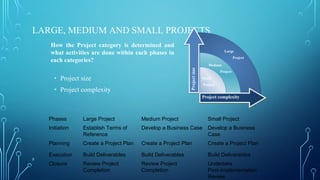
LARGE, MEDIUM AND SMALL PROJECTS
Large
Project
Medium
Project
Small
Project
Project
size
Project complexity
9
Phases Large Project Medium Project Small Project
Initiation Establish Terms of
Reference
Develop a Business Case Develop a Business
Case
Planning Create a Project Plan Create a Project Plan Create a Project Plan
Execution Build Deliverables Build Deliverables Build Deliverables
Closure Review Project
Completion
Review Project
Completion
Undertake
Post-Implementation
Review
How the Project category is determined and
what activities are done within each phases in
each categories?
• Project size
• Project complexity
CHARACTERISTICS OF A PROJECT
❖ Focus
❖ Uniqueness
❖ Common objectives
❖ Optimality
❖ Risk and uncertain
❖ Team work
❖ Life cycle
❖ Customer specific (customization)
❖ Life span
❖ Flexibility
PROJECT VS PRODUCTION
•Project is done only once, whereas production is done repetitively or
continuously.
•Example:-
• Setting up a factory produce component
• Construct a Dam store the water
IMPORTANCE OF PROJECT
•Project contributes and increases the economic growth and development of
the country.
•Project offers jobs, development and generation of income.
•Project design the road map for the future activities of the organization.
•Project builds trends for the future services.
•Project facilitates infrastructure and quality of life and hence increases the
social environment for good and brings out the necessary changes.
PROJECT MANAGEMENT
•Project management is the application of knowledge, skills,
tools and techniques to project activities in order to meet the
objective of the project.
•Main objective:- to minimize project completion time and its
cost.
•Project constraint : - Time, Cost and Quality
WHY PROJECT MANAGEMENT IS IMPORTANT
?
1. Strategic Alignment
Project management is important because it ensures what is
being delivered, is right, and will deliver real value against the
business opportunity.
2. Leadership
it brings leadership and direction to projects.
3. Clear Focus & Objectives
4. Realistic Project Planning
it ensures proper expectations are set around what can be delivered, by when, and for
how much.
5. Quality Control
it ensures the quality of whatever is being delivered, consistently hits the mark.
6. Risk Management
•it ensures risks are properly managed and mitigated against to avoid
becoming issues.
7. Orderly Process
• it ensures the right people do the right things, at the right time – it ensures
proper project process is followed throughout the project lifecycle.
8. Continuous Oversight
•Project management is important because it ensures a project’s progress
is tracked and reported properly.
9. Subject Matter Expertise
•Project management is important because someone needs to be able to
understand if everyone’s doing what they should.
10. Managing and Learning from Success and Failure
•Project management is important because it learns from the successes
and failures of the past.
PROJECT MANAGEMENT PHASES:-
1. Project Initiation
2. Project planning
3. Project Execution
4. Project Monitor and control
5. Project termination
PROJECT SCHEDULING
Scheduling
tools
Charts
1. Horizontal Bar chart
(Gantt Chart)
2. Milestone chart
3. Linked Bar chart
Network Diag.
1. CPM
2. PERT
MILESTONE CHART
LINKED BAR CHART
PROJECT MANAGEMENT BODY OF KNOWLEDGE
(PMBOK)
•Project scope Management
•Project time Management
•Project cost Management
•Project quality Management
•Project Risk Management
•Project procurement Management
PROJECT MANAGEMENT TOOLS
1. Project selection Techniques
a. Cost benefit analysis
b. Risk and Sensitivity Analysis
2. Project planning techniques
a. Work Breakdown Structure (WBS)
b. Project Execution Plan(PEP)
c. Project Responsibility Matrix
d. Project management manual
3. Project scheduling techniques
a. Bar Charts
b. Network Diagram
c. Line Of Balance (LOB)
d. Life Cycle Curves
4. Project monitoring and progress techniques
a. project progress measurement Techniques(PROMPT)
b. Performance monitoring techniques (PERMIT)
C. Updating, Reviewing And Reporting Techniques (URT)
LIFE CYCLE OF PROJECT
PROJECT
CYCLE
CONCEPTIO
N
PROJECT
PLANNING
PROJECT
SCHEDULIN
G
IMPLEMENTATIO
N
PROJECT
TERMINATI
ON
PROJECT LIFE CYCLE
WORK BREAKDOWN STRUCTURE (WBS)
•The WBS is a hierarchial structure which is best presented by a
graphical subdivision of the scope of work in boxes.
WORK BREAKDOWN STRUCTURE (WBS)
PROJECT IMPLIMENTATION
•THE implementation phase involves to putting the project plan into action.
Its here that the project manager will co ordinate and direct project resources
to meet the objectives of the project plan.
•The implementation phase is where project manager and project team
actually do the project work to produce the deliverables.
PROJECT COMPLETION
•Every project needs to end and that’s what project completion is
all about in the last phase of the project life cycle.
•The key activities in project completion is gathering project record
and disseminating information to formalize acceptance of the
product, service or project as well as to perform project closure.
•Contracts come to a close just as projects come to a close.
Contracts closer is concerned with completing and settling the
terms of the contracts.
PROJECT TERMINATION
1. Releasing project team
2. Final payments
3. Post project evaluation
4. Schedule and budget management
5. Procurement contracts
6. Customer satisfaction

project introduction.pdf

  • 1.
  • 2.
    CONTENTS ❑ Introduction toproject ❑Classification ❑ Project management ❑ Project life cycle ❑ Project appraisal ❑ Project planning ❑ Project scheduling ❑ Project implementation
  • 3.
    WHAT IS APROJECT? •“A project is a temporary endeavor undertaken to create a unique product or service” •Unique set of inter-related activities •Common activities •Consumes resources •Specified durations
  • 4.
    EXAMPLES ▪Construction of aBuilding /Dam ▪Setting up a factory ▪Conceive a new product ▪Development of a software ▪Erection of a power plant ▪Implementation of SAP
  • 5.
    CLASSIFICATION OF PROJECT •Theprojects are basically defined in two aspects or categories : one is defensive project and other is aggressive project. •Defensive Project: This type of the project initiated to stabilize and sustain the current business situation. •Aggressive Project: This type of the project initiated to enter into new business in a commercial manner and majorly depends upon the future prospective rather than the current scenario.
  • 6.
    •There is otherclassification of projects as well which is based on the need of execution and the time, these can be categorized as: i. Normal Project: Where the time limits are set and adequate. ii. Brash Project: Where additional cost are involved to gain time. iii. Disaster Project: Anything is allowed to gain time. •Projects can be further classified into various other classifications:- i. National and International Projects: ii. Industrial and Non-industrial Projects: iii. Projects based on its size:
  • 7.
    •Project based onownership: This can be further classified as:- i. Public Sector Projects ii. Private Sector Projects iii. Joint Sector Projects •Need based projects: i. Balancing Project ii. Modernization Project iii. Expansion Project iv. Diversification Project: v. Rehabilitation Project: vi. Plant Relocation Project
  • 8.
    CLASSIFICATION OF PROJECTSBY TYPE AND AREA 8 Mixed projects Technical projects Organizational projects Economical projects Social projects Types of projects by area •Privatization of the company; •Introduction of financial planning and budgeting; •Introduction of a new taxation system. •Construction of a building or structure; •Developing of a new product line; • Software development. • Reorganizing or creating a new company; • Implementation of a new system of management; • Execution of an international conference or exhibition. •Reform of welfare; • Social protection of vulnerable population; •Overcoming the effects of natural and social disasters. Restructuring plan of the company, including the introduction of a system of financial planning and budgeting, development and implementation of special software
  • 9.
    LARGE, MEDIUM ANDSMALL PROJECTS Large Project Medium Project Small Project Project size Project complexity 9 Phases Large Project Medium Project Small Project Initiation Establish Terms of Reference Develop a Business Case Develop a Business Case Planning Create a Project Plan Create a Project Plan Create a Project Plan Execution Build Deliverables Build Deliverables Build Deliverables Closure Review Project Completion Review Project Completion Undertake Post-Implementation Review How the Project category is determined and what activities are done within each phases in each categories? • Project size • Project complexity
  • 10.
    CHARACTERISTICS OF APROJECT ❖ Focus ❖ Uniqueness ❖ Common objectives ❖ Optimality ❖ Risk and uncertain ❖ Team work ❖ Life cycle ❖ Customer specific (customization) ❖ Life span ❖ Flexibility
  • 11.
    PROJECT VS PRODUCTION •Projectis done only once, whereas production is done repetitively or continuously. •Example:- • Setting up a factory produce component • Construct a Dam store the water
  • 12.
    IMPORTANCE OF PROJECT •Projectcontributes and increases the economic growth and development of the country. •Project offers jobs, development and generation of income. •Project design the road map for the future activities of the organization. •Project builds trends for the future services. •Project facilitates infrastructure and quality of life and hence increases the social environment for good and brings out the necessary changes.
  • 13.
    PROJECT MANAGEMENT •Project managementis the application of knowledge, skills, tools and techniques to project activities in order to meet the objective of the project. •Main objective:- to minimize project completion time and its cost. •Project constraint : - Time, Cost and Quality
  • 14.
    WHY PROJECT MANAGEMENTIS IMPORTANT ? 1. Strategic Alignment Project management is important because it ensures what is being delivered, is right, and will deliver real value against the business opportunity. 2. Leadership it brings leadership and direction to projects. 3. Clear Focus & Objectives
  • 15.
    4. Realistic ProjectPlanning it ensures proper expectations are set around what can be delivered, by when, and for how much. 5. Quality Control it ensures the quality of whatever is being delivered, consistently hits the mark. 6. Risk Management •it ensures risks are properly managed and mitigated against to avoid becoming issues. 7. Orderly Process • it ensures the right people do the right things, at the right time – it ensures proper project process is followed throughout the project lifecycle.
  • 16.
    8. Continuous Oversight •Projectmanagement is important because it ensures a project’s progress is tracked and reported properly. 9. Subject Matter Expertise •Project management is important because someone needs to be able to understand if everyone’s doing what they should. 10. Managing and Learning from Success and Failure •Project management is important because it learns from the successes and failures of the past.
  • 17.
    PROJECT MANAGEMENT PHASES:- 1.Project Initiation 2. Project planning 3. Project Execution 4. Project Monitor and control 5. Project termination
  • 18.
    PROJECT SCHEDULING Scheduling tools Charts 1. HorizontalBar chart (Gantt Chart) 2. Milestone chart 3. Linked Bar chart Network Diag. 1. CPM 2. PERT
  • 19.
  • 20.
  • 21.
    PROJECT MANAGEMENT BODYOF KNOWLEDGE (PMBOK) •Project scope Management •Project time Management •Project cost Management •Project quality Management •Project Risk Management •Project procurement Management
  • 22.
    PROJECT MANAGEMENT TOOLS 1.Project selection Techniques a. Cost benefit analysis b. Risk and Sensitivity Analysis 2. Project planning techniques a. Work Breakdown Structure (WBS) b. Project Execution Plan(PEP) c. Project Responsibility Matrix d. Project management manual
  • 23.
    3. Project schedulingtechniques a. Bar Charts b. Network Diagram c. Line Of Balance (LOB) d. Life Cycle Curves 4. Project monitoring and progress techniques a. project progress measurement Techniques(PROMPT) b. Performance monitoring techniques (PERMIT) C. Updating, Reviewing And Reporting Techniques (URT)
  • 24.
    LIFE CYCLE OFPROJECT PROJECT CYCLE CONCEPTIO N PROJECT PLANNING PROJECT SCHEDULIN G IMPLEMENTATIO N PROJECT TERMINATI ON
  • 25.
  • 26.
    WORK BREAKDOWN STRUCTURE(WBS) •The WBS is a hierarchial structure which is best presented by a graphical subdivision of the scope of work in boxes.
  • 27.
  • 28.
    PROJECT IMPLIMENTATION •THE implementationphase involves to putting the project plan into action. Its here that the project manager will co ordinate and direct project resources to meet the objectives of the project plan. •The implementation phase is where project manager and project team actually do the project work to produce the deliverables.
  • 29.
    PROJECT COMPLETION •Every projectneeds to end and that’s what project completion is all about in the last phase of the project life cycle. •The key activities in project completion is gathering project record and disseminating information to formalize acceptance of the product, service or project as well as to perform project closure. •Contracts come to a close just as projects come to a close. Contracts closer is concerned with completing and settling the terms of the contracts.
  • 30.
    PROJECT TERMINATION 1. Releasingproject team 2. Final payments 3. Post project evaluation 4. Schedule and budget management 5. Procurement contracts 6. Customer satisfaction