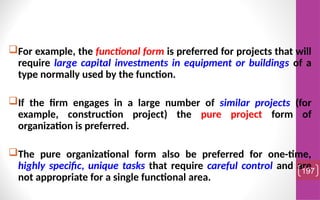
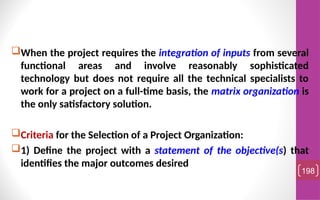
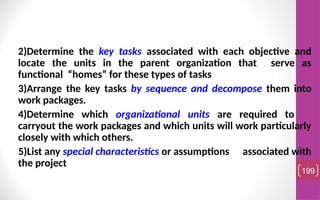
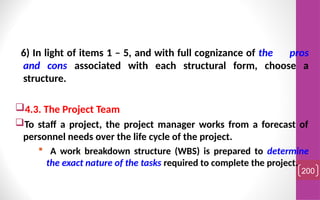
1.1) Concepts andDefinitions
Projects exist as components of broader development and expansion
programs of a firm or a nation.
The promoters of a project may be the government, private sector,
NGOs, development agencies, and partners.
There are many definitions of a project. Consider the following 3
definitions 1
CHAPTER ONE
INTRODUCTION
2.
It is anendeavors (try to achieve A goal ) in which human, (or
machine), material, and financial resources are organized in a
novel way to undertake a unique scope of work, of a given
specification or standard, within constraints of cost and time,
so as to deliver beneficial change defined by quantitative and
qualitative objectives (Turner, 1993)
• It is a temporary endeavor undertaken to create or provide a
unique product or service. Temporary means that every
project has a defined end. Unique implies that the product or
service is different in some distinguishing way from all similar
products or services. (Project Management Institute )
2
3.
• Potts (2002)suggested to define a project by outlining the
common characteristics:
• A project involves the investment of scarce resources (physical,
financial, and human) in the expectation of future benefits.
• A project can be planned, financed, and implemented as a unit
subject to special financial arrangements and have their own
management.
• A project has a specific starting and finishing time in which a
clearly defined set/s of objective(s) is/are expected to be
achieved. 3
4.
• A projecthas a conceptual boundary. It can be geographical or
institutional.
Five key considerations always involved in a project:
(1) How much will it cost?
(2)What time is required to complete the project?
(3)What technical quality/specification will it provide?
(4)How much? This refers to the scope of the project
(5)How will the project results fit into the design and
implementation of organizational strategies?
4
5.
• Projects differin size, scope, cost and time, but all have the
following characteristics:
1) Objectives:
The objectives should be SMART in terms of cost, schedule,
quality, scope, and management.
Discussion Questions
Do all projects have the same objectives?
Does the work of every project have similar features,
pressure, and need similar plan? 5
1.2. Project Characteristics
6.
• The qualityof those plans, projects, and how well resources are
used, are also critical factors for success.
• Well, there are two sayings about planning:
“If you fail to plan, then plan to fail”
and
“We never seem to have time to plan our projects, but we
always have time to do them twice” 6
7.
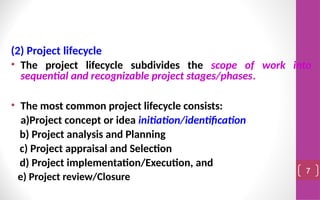
(2) Project lifecycle
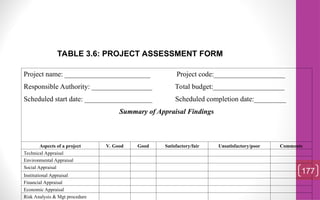
•The project lifecycle subdivides the scope of work into
sequential and recognizable project stages/phases.
• The most common project lifecycle consists:
a)Project concept or idea initiation/identification
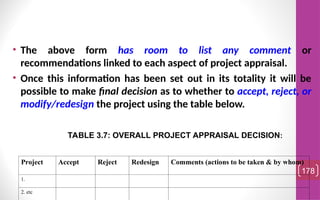
b) Project analysis and Planning
c) Project appraisal and Selection
d) Project implementation/Execution, and
e) Project review/Closure
7
8.
The task, people,organizations, and other resources change as
the project moves from one phase to the next.
(3) Definite Time Limit (Temporary)
•A project has a definite and specific starting and finishing time
frame. It cannot continue forever.
(4) A set of activities, which are sequential, unique and non-
repetitive
•Every project is unique and no two projects are similar.
8
9.
• Constructing ahighway connecting two cities A & B and
constructing another highway between cities C & D are unique
in themselves.
• Differences exist in the organization, infrastructure, location,
technical specifications and the people behind the projects.
• (5) Budget & use of resources, which may require coordinating
9
10.
• (6)Centralized responsibilitiesfor management and
implementation
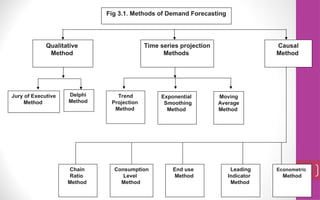
(7) Teamwork
Any project calls for the services of experts from a host of
disciplines.
Coordination among the diverse areas call for teamwork.
Hence, a project can be implemented only with teamwork.
10
11.
(8) Complexity: Aproject is complex set of activities relating to
diverse areas. Examples
Technology survey, choosing the appropriate technology, hiring
the right kind of people, arranging for financial resources,
execution of the project in time by proper scheduling of the
different activities, etc. contribute to the complexity of the
project.
• (9) Risk and Uncertainty- a risk free project cannot be thought
of. 11
12.
• Project managementis the process of scoping, planning, staffing,
organizing, directing, and controlling the development of an
acceptable system at a minimum cost within a specified
timeframe.
Project management comprises:
A set of Skills. Specialist skills and experience are required to
reduce the level of risk within a project and thereby enhance its
likelihood of success.
A Suit of Tools. Various types of tools are used by project
managers to improve their chances of success. Examples include
planning software, modelling software, audit checklist and review
forms. 12
1.3. Project Management (PM)objectives
13.
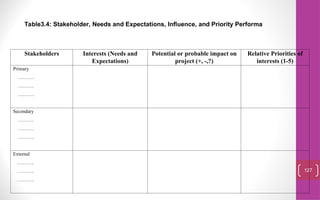
A Series ofProcesses. Various management techniques and
processes are required to monitor and control time, cost,
quality and scope of projects.
Examples include
time management,
quality management,
change management,
risk management, etc.
13
14.
Project management couldenhance the following attributes of
professionals:
• Technical skill,
• Communication skill,
• Decision making skill,
• Problem-solving skill,
• Interpersonal skill,
• Leadership skill,
14
15.
1.3.1) PM Derivers:What Causes PM?
• The expansion of knowledge (knowledge explosion)
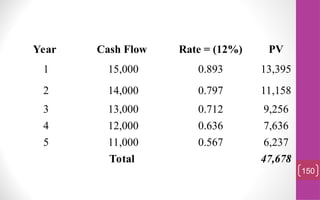
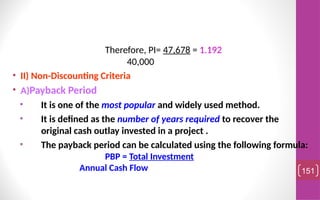
• Scarcity of resources & the increasing DD for new
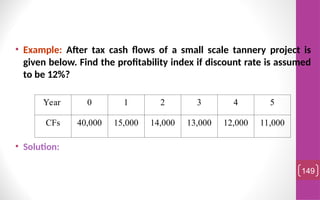
products/services
• The increase in worldwide market
• Increased competition
• The belief that “better living through technology”
• Expanding size of projects – some projects may be expanding
too much thus requiring project management.
15
16.
1.3.2) Typical ProjectProblems/causes
• Scope may not be clearly defined when commitment is made to
a client.
• Premature commitment to a fixed budget and resources. There
may not be enough resources allocated (people, money,
materials, time, space, etc).
• Conflict of interest between or among stakeholders (ops vs.
engineers, sales vs.technical support, line staff).
• Commitment to unrealistic dates/schedule – the PM may be too
optimistic about the completion date of the project. 16
17.
• Failure to“manage to the plan” due to inadequate people
management skills
• There may be unclear roles and responsibilities, among project
teams and members, due to
• Failure to establish upper-management commitment to the
project
• Lack of organization’s commitment to the system development
• Poor estimating techniques
• Things may go wrong for some natural reasons.
• Failure to adapt to business change, etc.
17
18.
1.3.3) Major functionsof Project managers
Plan work (scope, budget, schedule),
Obtain and manage resources,
Resolve conflicts and problems,
Motivate people
Communicate to teams, organization, and the clients,
Set priorities,
Make decisions,
Control technical quality, scope, budget, and schedule
Integrate multiple skills 18
Before any projectis actually realized it goes through various
planning phases.
The different phases through which a project passes constitutes
what is often called “the project cycle”.
The main features of this process are information gathering,
analysis and decision making.
There are various models that deal with the project cycle. The
most important ones are the Baum’s cycle, and UNIDO project
cycle.
20
2.1. Project Lifecycle
21.
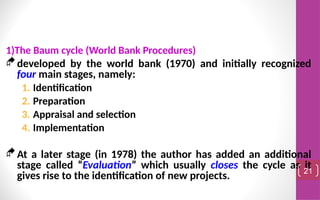
1)The Baum cycle(World Bank Procedures)
developed by the world bank (1970) and initially recognized
four main stages, namely:
1. Identification
2. Preparation
3. Appraisal and selection
4. Implementation
At a later stage (in 1978) the author has added an additional
stage called “Evaluation” which usually closes the cycle as it
gives rise to the identification of new projects. 21
22.
22
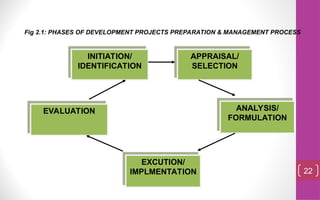
Fig 2.1: PHASESOF DEVELOPMENT PROJECTS PREPARATION & MANAGEMENT PROCESS
EXCUTION/
IMPLMENTATION
ANALYSIS/
FORMULATION
INITIATION/
IDENTIFICATION
APPRAISAL/
SELECTION
EVALUATION
23.
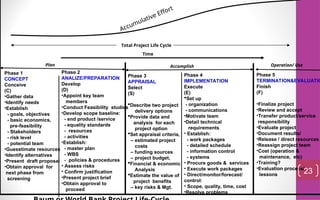
Time
Total Project LifeCycle
Plan Accomplish
Phase 1
CONCEPT
Conceive
(C)
•Gather data
•Identify needs
•Establish
- goals, objectives
- basic economics,
pre-feasibility
- Stakeholders
- risk level
- potential team
•Guesstimate resources
•Identify alternatives
•Present draft proposal
•Obtain approval for
next phase from
screening
Phase 4
IMPLEMENTATION
Execute
(E)
Set up
- organization
- communications
•Motivate team
•Detail technical
requirements
• Establish:
- work packages
- detailed schedule
- information control
- systems
• Procure goods & services
• Execute work packages
• Direct/monitor/forecast/
control:
• Scope, quality, time, cost
•Resolve problems
Phase 5
TERMINATION&EVALUATIO
Finish
(F)
•Finalize project
•Review and accept
•Transfer product/service
responsibility
•Evaluate project
•Document results/
•Release / direct resources
•Reassign project team
•Cost (operation &
maintenance, etc)
•Training?
•Evaluation process/
lessons
Accumulative Effort
Phase 2
ANALIZE/PREPARATION
Develop
(D)
•Appoint key team
members
•Conduct Feasibility studies
•Develop scope baseline:
- end product /service
- equality standards
- resources
- activities
•Establish:
- master plan
- WBS
- policies & procedures
• Assess risks
• Confirm justification
•Present project brief
•Obtain approval to
proceed
Phase 3
APPRAISAL
Select
(S)
Describe two project
delivery options
Provide data and
analysis for each
project option
Set appraisal criteria,
– estimated project
costs
– funding sources
– project budget,
Financial & economic
Analysis
Estimate the value of
project benefits
– key risks & Mgt.
Operation/ Use
23
24.
• A) Howcan promising project ideas be generated?
• The search for promising project idea is the first step towards
establishing a successful project.
• Project ideas evolve usually from the work environment (internal
or external).
• Today, development agencies place much emphasis on project
identification as an important element in the overall success of
the project.
24
Stage 1: Concept Initiation/Identification
25.
• Defined priorityareas within broad development strategies are
used to encourage project idea generation.
• In-depth knowledge and experience of local conditions can be an
important source for project identification & formulation.
• Thus, project ideas arise from identification of a number of
different factors such as:
• Unsatisfied (material or psychological) needs
25
26.
• DD forgoods and services
• Underutilized resources (both human and physical)
• Investment opportunities
• Pursuit of national policy objectives.
• Ideas, needs, problems, and opportunities crystallize into projects
in different ways.
• Sometimes, identification is often the outcome of a triggering
process rather than an analytical exercise.
26
27.
• The intentionof this initial stage should be to generate as wide
as possible range of alternatives project ideas as possible.
• Identification of good project ideas/business opportunities
requires
• realistic assessment of what the organization can do or mandated
to do (SWOT analysis),
• fostering conducive organizational work climate, and
• environment analysis or Sensitivity to environmental changes
include PEST plus competitors and suppliers 27
28.
• SWOT analysisrepresents conscious, deliberate and systematic
effort by an organization to identify opportunities that it can
exploit wisely.
• Periodic SWOT analysis facilitates the generation of project ideas
to address one or more of the following operational objectives of
an organization.
• Cost reduction/minimization =>efficiency,
• Productivity improvement (labour and physical capital),
• Increase in capacity utilization,
28
29.
• Improve socialinclusiveness,
• Ensure customers satisfaction,
• Improve organizational learning and growth, etc.
• Stimulated work force can generate promising project ideas from
one or more of the following variety of internal and external
sources.
• Knowledge of existing market, products, and services.
• Knowledge of potential customer choice
• Emerging trends in demand for particular product.
29
30.
• Well informedtechnical specialists and local leaders are also
common sources of projects.
• Scope for producing substitute product
• Market survey and research
• Analyze economic and social trends,
• Study new technological developments,
• Making visits to national and international trade fairs and
exhibitions.
• Study government guidelines, plans, and policy pertinent to potential
DD for goods or services
• Analyze export and import trends for a period of five to seven years,
30
31.
• Investigate localmaterials and resources. Various ways of
adding value to locally available materials may be examined,
Ideas given by the experienced person.
• Ideas based on own experience.
• Ideas from the suggestions of financial institutions and
development agencies, etc.
• B) Pre-feasibility study
• The tradition adage (proverb) states that “the key to success lies
in getting into the right business at the right time”.
31
32.
• Though thisadvice is simple, its accomplishment is difficult
because good project ideas or business opportunities-the key to
success-tend to be elusive.
• The identification of a number of project ideas by an organization
allows conducting preliminary analysis (or pre-feasibility study)
to ensure the relative worthwhileness of the project ideas,
prioritize them, and develop Preliminary Project profile.
32
33.
• Some ofthe perspectives for pre-feasibility analysis include
scratchy analysis on the following:
• Problem /opportunity analysis (challenges or needs)
• Stakeholder analysis
• Demand and Market analysis
• Technical analysis (size/scope, location and site, availability of
inputs, reasonability of costs, and compatibility with the
national development program)
33
34.
• C) Structureof preliminary project profile
• In the initiation phase, the core team should put together a brief
issues note/profile and draft work plan. This can be refined as the
planning process proceeds.
• The profile/note
• should capture whatever information is available on the critical
challenges or needs to be addressed. This is the first deliverable, and
serves as a basis in the planning process.
• may reflect key priorities in the organizational missions and
documents as well as the findings of various analyses
34
35.
• The profileshould have at least three sections:
• Section 1: Background and purpose of the profile
• In this section, the core team should outline the rationale for the
project. This would generally include:
• Background (why the core team got together to initiate a planning
process)
• The nature of the planning process that is being embarked on
(such as participatory or by core team alone.)
• Which stakeholders will be involved during the detailed feasibility
analysis phase?
35
36.
• The processshould be fluid enough to involve additional
stakeholders during the project planning phase.
• Once, the list of stakeholders are identified exhaustively, it may
be helpful to conduct a second stakeholder analysis to determine
their interest and impact.
• Section 2: Overview of priority issues
• Major needs/opportunities to be addressed identified
• People or areas to be served identified
36
37.
Critical areasof capacity constraints
• Section 3: Work plan for completing the planning exercise
• The core team should prepare a simple outline of the activities,
schedules and resources for the overall planning process at this
stage to ensure that the main issues are considered before
additional stakeholders are engaged.
• The work plan should address a number of issues that the team
should consider before actual commencement of the planning
exercise.
37
38.
• Specifically, theteam should ask itself:
• What is the overall timeframe we have for planning the project?
• What are the key milestones in the process that we must meet to
ensure that we produce the plan within the expected time frame?
• At what stage will we finalize the monitoring and evaluation
plan?
• How participatory should the process be given the context within
which stakeholders are operating?
• General implementation arrangement
38
39.
• Tentative financingarrangement/plan
• What resources will be needed for the planning exercises? (For
example, facilitators, venues, resource persons, important
speakers, etc.)
• Who will be responsible for the different elements of the planning
process? (For example, organizing workshops, inviting
participants, contracting facilitators, etc.)
• How much will it all cost?
• A “ToR” is completed, which outlines the vision, proposed specific
objectives, scope, deliverables and structure of the new project,
and a Project Manager is appointed.
39
40.
• The draftconcept note/project profile will subsequently be
finalized with greater details for specific activities in the
feasibility study.
• Questions
• Is it possible to implement all promising public projects? Why or
why not?
• If it is not possible, outline the criteria for screening potential
projects at the early stage of project development.
40
41.
• D) ProjectScreening & Purposes
• It is not possible to implement all promising projects due to the
general scarcity of resources.
• All projects should undergo at some point feasibility study not
only to ensure the project is feasible but also to ensure the project
would make best use of your company’s resources.
• Since appraisal of a detailed project proposal consumes both time
and money, it is necessary to introduce a screening process
through which all project idea must pass.
41
42.
• Screening meansthat those projects not deemed to be
worthwhile are discarded or amended at an early stage; thus
helping to save time and money.
• Due to the early stage of project development at which
screening occurs the criteria used should be general and wide
ranging. Such criteria could include:
• Wealth generation potential,
• Coherence/consistency with the government priorities,
• Acceptability by local communities/beneficiaries 42
43.
• Potential forinstitutional capacity development,
• Environmental impact,
• Sustainability of the project etc.
• As a result, the following aspects may be looked into:
• Compatibility with the promoter’s objective of wealth generation
potential:
• The project idea must be compatible with the interest, and
resources of the public sector organization initiating the project.
The following issues should be addressed 43
44.
• Does theproject generate additional revenue or profit to the
organization?
• Does the project ensure the prospect of rapid growth and high
return on the invested capital?
• Consistency with government priorities: The project idea must be
feasible given the national development goals and government
regulatory frameworks. Ask
Is the project consistent with national goals and priorities?
Can the foreign exchange requirements of the project be easily accommodated? 44
45.
• Will therebe any difficulty in obtaining license for the project?
• Acceptability to local community: Questions include
• Does the project utilize local labour?
• Does the project utilize local raw materials/resources?
• Does the project benefit local community directly (e.g., get
basic products or services, employment in the project, buys
input etc.) or indirectly (e.g. better infrastructure due to the
project) 45
46.
Institutional capacitydevelopment,
Does the project enhance organizational capabilities, training, proclivities, and
competitiveness to resource constraints?
• Environmental impact of the project: This can be judged using the
four Environmental Impact Assessment (EIA) procedures that have
gained worldwide acceptance including Ethiopia.
• Are there any environmental effects contrary to the government
regulations?
• Is there a plan for internalizing project externalities? 46
47.
• Sustainability: Questionsto be address include during initial
screening
• Does the implementing agency has the follow up capacity?
• Can the benefits produced by the project for the target groups
will continue after the project has ended?
E) Links of the Projects and organizational/ national/ Regional
Policies and Priorities
• The project profile should also make an explicit connection
between specific project objectives and wider organizational/
national and regional priorities.
47
48.
• To ensureprojects selected for implementation will have the
greatest possible organizational development impact, it is
necessary at ask the following questions:
• What is the major objective of the project?
• What is the basis for the DD/need of the good or services to be
produced by the project?
• How does the project contribute to the wider goals of the
organization/ sector/ region?
• What problem or opportunity is the project addressing?
• Why is the proposed project the most appropriate way of
addressing the problem/opportunity?
48
49.
• What alternativeways of addressing the problem/ opportunity
that has been considered?
• What is the appropriate cost and timetable of the project?
• Who are the major stakeholders and beneficiaries of the project?
In what ways are they expected to participate?
• Which institution(s) is/are proposed to be involved in
implementing the project?
• Are there any important additional or special circumstances
relevant to the project? Examples
49
50.
• Adverse effects=> huge foreign currency requirement, tax
holiday/exemption, high dependence on imported inputs and
expertise, protection requirements, etc. or
• Positive impacts => import substitution, enhance competitiveness,
potential for scaling up, economics of scale, etc.
F) Result of Project Screening
• Once the project profile has undergone screening on the basis of the
criteria and questions listed above, there are two possible decision
outcomes. based on the answer for the following question 50
51.
• Is theproject idea still prima facie promising or worthwhile?
• YES
Proceed to further work (detailed project feasibility study &
preparation)
• NO
Reject/ terminate the project
51
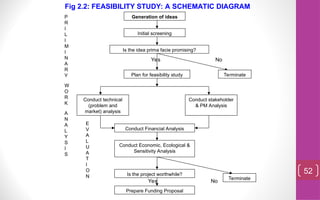
52.
52
Fig 2.2: FEASIBILITYSTUDY: A SCHEMATIC DIAGRAM
Generation of ideas
Initial screening
Is the idea prima facie promising?
Plan for feasibility study Terminate
Conduct technical
(problem and
market) analysis
Prepare Funding Proposal
Conduct Financial Analysis
Conduct Economic, Ecological &
Sensitivity Analysis
Conduct stakeholder
& PM Analysis
Terminate
Is the project worthwhile?
E
V
A
L
U
A
T
I
O
N
P
R
I
L
I
M
I
N
A
R
Y
W
O
R
K
A
N
A
L
Y
S
I
S
Yes No
Yes No
53.
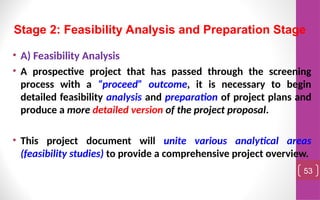
• A) FeasibilityAnalysis
• A prospective project that has passed through the screening
process with a “proceed” outcome, it is necessary to begin
detailed feasibility analysis and preparation of project plans and
produce a more detailed version of the project proposal.
• This project document will unite various analytical areas
(feasibility studies) to provide a comprehensive project overview.
53
Stage 2: Feasibility Analysis and Preparation Stage
54.
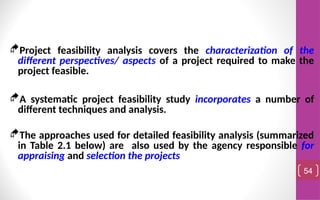
Project feasibility analysiscovers the characterization of the
different perspectives/ aspects of a project required to make the
project feasible.
A systematic project feasibility study incorporates a number of
different techniques and analysis.
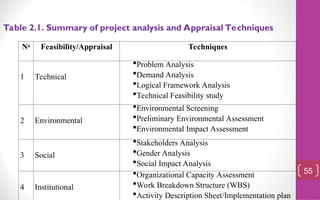
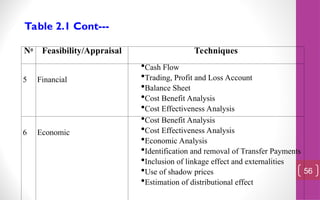
The approaches used for detailed feasibility analysis (summarized
in Table 2.1 below) are also used by the agency responsible for
appraising and selection the projects
54
55.
55
No
Feasibility/Appraisal Techniques
1 Technical
ProblemAnalysis
Demand Analysis
Logical Framework Analysis
Technical Feasibility study
2 Environmental
Environmental Screening
Preliminary Environmental Assessment
Environmental Impact Assessment
3 Social
Stakeholders Analysis
Gender Analysis
Social Impact Analysis
4 Institutional
Organizational Capacity Assessment
Work Breakdown Structure (WBS)
Activity Description Sheet/Implementation plan
Table 2.1. Summary of project analysis and Appraisal Techniques
56.
56
No
Feasibility/Appraisal Techniques
5 Financial
CashFlow
Trading, Profit and Loss Account
Balance Sheet
Cost Benefit Analysis
Cost Effectiveness Analysis
6 Economic
Cost Benefit Analysis
Cost Effectiveness Analysis
Economic Analysis
Identification and removal of Transfer Payments
Inclusion of linkage effect and externalities
Use of shadow prices
Estimation of distributional effect
Table 2.1 Cont---
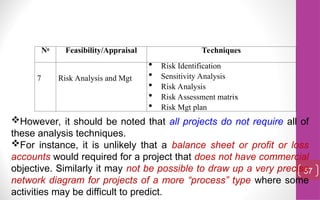
57.
57
No
Feasibility/Appraisal Techniques
7 RiskAnalysis and Mgt
Risk Identification
Sensitivity Analysis
Risk Analysis
Risk Assessment matrix
Risk Mgt plan
However, it should be noted that all projects do not require all of
these analysis techniques.
For instance, it is unlikely that a balance sheet or profit or loss
accounts would required for a project that does not have commercial
objective. Similarly it may not be possible to draw up a very precise
network diagram for projects of a more “process” type where some
activities may be difficult to predict.
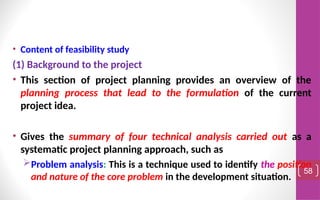
58.
• Content offeasibility study
(1) Background to the project
• This section of project planning provides an overview of the
planning process that lead to the formulation of the current
project idea.
• Gives the summary of four technical analysis carried out as a
systematic project planning approach, such as
Problem analysis: This is a technique used to identify the position
and nature of the core problem in the development situation.
58
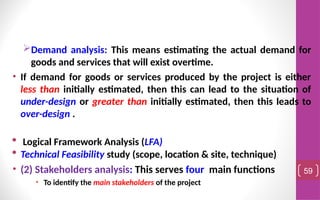
59.
Demand analysis: Thismeans estimating the actual demand for
goods and services that will exist overtime.
• If demand for goods or services produced by the project is either
less than initially estimated, then this can lead to the situation of
under-design or greater than initially estimated, then this leads to
over-design .
Logical Framework Analysis (LFA)
Technical Feasibility study (scope, location & site, technique)
• (2) Stakeholders analysis: This serves four main functions
• To identify the main stakeholders of the project
59
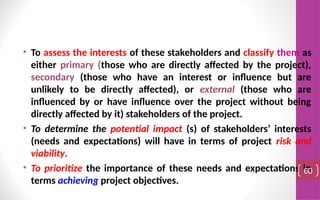
60.
• To assessthe interests of these stakeholders and classify them as
either primary (those who are directly affected by the project),
secondary (those who have an interest or influence but are
unlikely to be directly affected), or external (those who are
influenced by or have influence over the project without being
directly affected by it) stakeholders of the project.
• To determine the potential impact (s) of stakeholders’ interests
(needs and expectations) will have in terms of project risk and
viability.
• To prioritize the importance of these needs and expectations in
terms achieving project objectives.
60
61.
(3)Objectives and Rationale
Thissection should answer the question why the project?
(4)Implementation Plan (including progress monitoring system)
Should indicate both parallel and sequential activities as shown
below
It should also outline when will review take place
(5) Project activities (including work breakdown structure) 61
62.
(6) Project inputsand Costs
(7) Project Management, organization and institutional context
(including capacity building and beneficiary participation where
relevant
(8) Assessment of Environment and Social Impact (where necessary
include mitigation measures and costs)
(10) Financial Plan
(11)Arrangement of Project handover, operation, maintenance and
or termination
(12) Assumptions, Risks, and Risk management strategies
62
63.
B) Planning phase
•Based on the above analyses, the detailed planning phase
involves producing:
Resource Plan (listing the labour, equipment and materials
required)
Financial Plan (estimating the cost labour, equipment, and
materials and costs)
Quality Plan (providing quality targets, assurance and control measures)
Procurement Plan (identifying products to be acquired from external suppliers)
63
64.
Economic plan(estimating the costs and benefits of the project
from the national point of view and is therefore concerned with
the impact of proposed projects on the national economy). No
need for private projects
Risk Plan (highlighting assumptions, potential risks and actions
taken to mitigate them)
Project Implementation Plan (Outlining the activities, tasks,
dependencies, timeframes, and progress monitoring system
Project management Plan (project organization, including
capacity building & beneficiaries' participation)
Communications Plan (listing the information needed to inform
and involve stakeholders) 64
65.
After a projecthas been prepared, it is generally appropriate for
a critical or an independent review to be conducted.
This provides an opportunity to reexamine every aspect of the
project plan to assess whether the proposal is appropriate and
sound before large amount of money is committed.
Appraisal should cover at least seven aspects of a project, each of
which must have been given special consideration during the
project preparation phase.
65
Stage 3: Appraisal
66.
• A)Technical –here the appraisal concentrates in verifying whether
what is proposed will work in the way suggested or not.
• B)Financial– to verify:
• if money needed for the project have been properly calculated.
• their sources are identified, and
• reasonable plans for their repayments are made.
66
67.
• C) Commercial– to examine whether the necessary inputs for the
project are supplied.
to see whether the arrangements for the disposal of the products are
verified.
• D)Incentive - to see whether things are arranged in such a way that
all those whose participation is required will find it in their interest
to take part in the project.
• E)Economic – to see the economic significance of the project
towards the nation’s development.
67
68.
• F)Managerial –this aspect of the appraisal examines:
• to see if the capacity exists for operating the project, and
• to see if the responsible ones are given sufficient power and
scope to do what is required.
• G) Organizational – to see if it is organized internally and
externally into units so as to allow the proposals to be carried-out
properly and to allow for change as the project develops.
68
69.
• On thebasis of this appraisal report financial decisions are made
– whether to go ahead with the project or not.
• NB 1. If the project involves loan finance, the lender will almost
certainly wish to carryout its own appraisal before completing
negotiations with the borrower.
• 2. Comments made at the appraisal stage possibly results in
alterations in the project plan (Project proposal).
69
70.
• The objectiveof any project planning and analysis clearly is to
have a project that can be implemented to the benefit of the
society. Thus, implementation is perhaps the most important part
of the project cycle
• In this stage,
• Funds are actually disbursed to get the projects started and
keep running,
• A major priority during this stage is to ensure that the project is
carried out in the way and within the period that was planned.
70
Stage 4. Implementation
71.
• It isduring implementation that many of the real problems of
projects are first identified.
• Therefore, to allow the management to become aware of the
difficulties that might arise, recording, monitoring and progress
reporting are important activities during the implementation
stage.
• Stage 5: Evaluation
The final phase in the project cycle is evaluation.
Once a project has been implemented, it is often useful, to look
back over what took place, to compare actual progress with the
plans, and to judge whether the decisions and actions taken were
responsible and useful.
71
72.
Evaluation is notlimited only to completed projects. It is
important managerial tool in ongoing projects. And formalized
evaluation may take place at several times in the life of a project.
Evaluation should be undertaken when a project is terminated or
is well into routine operation.
72
73.
2) UNIDO –Project Cycle
UNIDO has established a project cycle comprising three distinct
phases:
I. The pre-investment
II. The investment, and
III.The operational phase
• The pre-investment phase comprises several stages:
• I) Identification of investment opportunities (Opportunity Study
73
74.
• II) Analysisof project alternatives and preliminary project
selection (pre-feasibility and feasibility studies) and
• III) Project appraisal and investment decisions (appraisal report).
• NB. Support or functional studies are also part of the project preparation stage
and are usually conducted separately, for later incorporation in the pre-
feasibility or feasibility study.
74
75.
• A) OpportunityStudies:
• The identification of investment opportunities is the starting point
in a series of investment related activities.
It may also eventually even be the beginning of the
mobilization of investment funds.
The opportunity study would analyses
The general availability of natural resources,
Future demand for consumer goods,
Imports substitution and export possibilities,
Environmental impact,
75
76.
Expansion ofexisting capacity, etc.
• Opportunity studies could be general or specific:
• I)General Opportunity Studies (Sectoral Approach):
It requires an analysis of the overall investment potentials in developing
countries and the general interest of developed countries in investing
abroad.
It could be:-
(a) Area studies - designed to identify opportunities on a given areas (Adm.
Province, emerging regions, etc.),
76
77.
(b) Industry studies– to identify opportunities to delimit industrial branch, and
(c) Resource-based studies – to reveal opportunities based on the utilization of
natural, agricultural or industrial resources.
II) Specific Project Opportunity Study (Enterprise Approach):
Involves the identification of specific investment requirements of individual
project promoters
Are seen in the form of products with potential for domestic manufacture
77
78.
A specificproject opportunity study may be defined as the transformation
of a project idea into a broad investment proposition.
NB. Opportunity studies are rather sketchy in nature and rely more on
aggregate estimates than on detailed analysis. Cost data are
usually taken from comparable existing projects and not from
suppliers
• B) Pre-feasibility Studies:
The project idea must be elaborated in a more detailed study.
78
79.
• Formulation ofa feasibility study that enables a definite decision to
be made on the project is a costly and time-consuming task.
• Therefore, before assigning large funds for such a study, a further
assessment of project idea might be made in a pre-feasibility study.
The objectives of which are to see whether
All possible project alternatives have been examined,
The project concept justifies detailed study,
All aspects are critical and need in-depth investigation through functional
studies
79
80.
The projectidea is viable and attractive for a particular investor
or investor group.
A pre-feasibility study should be viewed as an intermediate stage
between a project opportunity study and a detailed feasibility
study, the difference begin in the degree of detail of the information
obtained and the intensity with which project alternatives are
discussed.
The structure of the pre-feasibility study should be the same as a
detailed feasibility study. 80
81.
• A pre-feasibilitystudy is conducted if the economics of the project
are doubtful.
• Note: A well prepared and comprehensive opportunity study may
justify by passing the pre-feasibility stage
• C) Support or Functional Studies:
• These studies covers aspects of an investment project, and are
required as a pre-requisites for, or in support of, pre-feasibility and
feasibility studies, particularly for large scale investment proposals.81
82.
• This mayinclude:
• Market studies of products to be manufactured
• Raw materials and factory supply studies
• Laboratory and pilot plant tests.
• Location studies
• Environmental impact assessment
• Economies of scale studies, Which are required when large plants with
numerous divisions are involved.
• D) Feasibility Studies:
• A feasibility study should provide all data necessary for an
investment decision.
82
83.
• The commercial,technical, financial, economic, and
environmental prerequisites for an investment project should be
defined and critically examined on the basis of alternative
solutions already reviewed in the pre-feasibility study.
• The financing part of the study covers:-
• The scope of the investment,
• The production and marketing costs,
• The sales (revenue), and
• The return on capital invested (RoE)
83
84.
• Even afeasibility study that does not lead to an investment
recommendation is of great value as it prevents the misallocation
of scarce resources.
• A feasibility study should be carried-out only if the necessary
financing facilities, as determined by the studies, can be
identified with a fair degree of accuracy.
84
85.
• E)Appraisal Report:
•When a feasibility study is completed the various parties involved
in the project will carryout their own appraisal of the investment
project in accordance with their individual objectives and
evaluation of expected risks, costs and gains.
• Large investment and development finance institutions have
formalized project appraisal procedures and usually prepare an
appraisal report.
85
86.
• The betterthe quality of the feasibility study, the easier will be
the appraisal work.
• 2)The investment phase
The investment or implementation phase of a project provides wide
scope for consultancy and engineering work, first and foremost in
the field of project management.
The investment phase can be divided into the following stages:
Establishing the legal, financial, and organizational basis for the implementation
of the project. 86
87.
• Technology acquisitionand transfer, including basic
engineering
• Detail engineering design and contracting, including tendering,
evaluation of bids and negotiations.
• Acquisition of land, construction work and installation
• Recruitment and training of personnel
• Plant commissioning and start-up
87
88.
• 1. ExecutiveSummary
• The executive summary should concentrate on and cover all critical
aspects of the study, such as the following:-
• The degree of reliability of data on the business environment;
• Project input and output,
• The margin of error (uncertainty, risk) in forecasts of market,
supply and technological trends; and
• Project design.
88
CHAPTER THREE
FEASIBILITY STUDY
89.
• The executivesummary should have the same structure as the body
of the feasibility study, and cover-but must not be limited to-the
following areas;
• Summary of the project background and history
• Summary of market analysis and marketing concept
• Raw materials and supply
• Location, site and environment
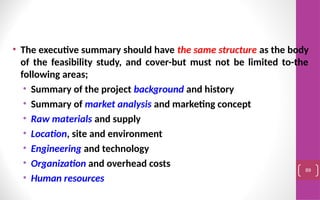
• Engineering and technology
• Organization and overhead costs
• Human resources
89
90.
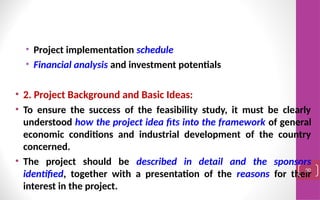
• Project implementationschedule
• Financial analysis and investment potentials
• 2. Project Background and Basic Ideas:
• To ensure the success of the feasibility study, it must be clearly
understood how the project idea fits into the framework of general
economic conditions and industrial development of the country
concerned.
• The project should be described in detail and the sponsors
identified, together with a presentation of the reasons for their
interest in the project.
90
91.
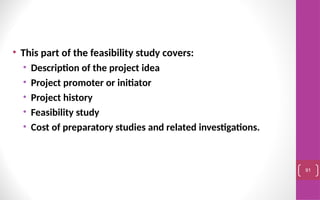
• This partof the feasibility study covers:
• Description of the project idea
• Project promoter or initiator
• Project history
• Feasibility study
• Cost of preparatory studies and related investigations.
91
92.
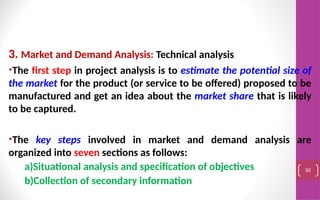
3. Market andDemand Analysis: Technical analysis
•The first step in project analysis is to estimate the potential size of
the market for the product (or service to be offered) proposed to be
manufactured and get an idea about the market share that is likely
to be captured.
•The key steps involved in market and demand analysis are
organized into seven sections as follows:
a)Situational analysis and specification of objectives
b)Collection of secondary information
92
93.
It providesthe base and the starting point for the market and
demand analysis
• c)Conducting market survey
• Secondary information, though useful often, does not provide a
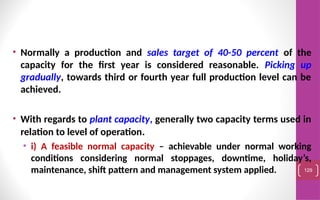
comprehensive basis for market and demand analysis.
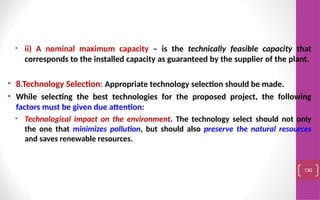
• It needs to be supplemented with a primary information gathered
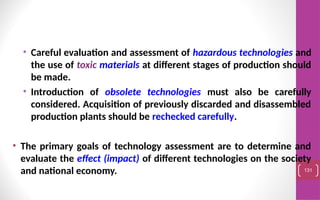
through a market survey, specific to the project being appraised.
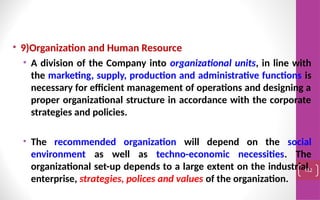
• The market survey may be a census survey or sample survey. 93
94.
• d). Characterizationof the market:
• Based on the information gathered from secondary sources and
through the market survey, the market for the product/service may
be described in terms of the following:-
• Effective demand in the past and present
• Methods of distribution and sales promotion
• Price mechanism
• Potential Consumers (segments also)
• Supply and competition
• Government policy
94
95.
• e)Demand Forecasting
•A wide range of forecasting method is available to the market
analyst.
• (i) Qualitative Methods
• (1) Jury of Executive Method: Involves soliciting the opinions of a
group of managers on expected future sales and combining them
into a sales estimate.
• It permits variety of factors like economic climate, competitive
environment, consumers’ preferences, and technological
development so on to be included in the subjective estimates
provided by experts.
95
96.
96
Qualitative
Method
Time series projection
Methods
Juryof Executive
Method
Delphi
Method
Trend
Projection
Method
Exponential
Smoothing
Method
Moving
Average
Method
Fig 3.1. Methods of Demand Forecasting
Causal
Method
Chain
Ratio
Method
Consumption
Level
Method
End use
Method
Leading
Indicator
Method
Econometric
Method
97.
• It hasimmense appeal to managers who end to prefer their
judgment to mechanistic procedures.
• The disadvantages of this method are:
• The basis underlined subjective estimates cannot be earthed
easily.
• The reliability of this method is questionable due to biased
estimate
97
98.
• (2)Delphi Method:This method is used for eliciting the opinions of a
group of experts with the help of a mail survey.
• The steps involved in this method are:
• A questionnaire is sent to a group of experts by mail and asked
their views.
• The process may be continued for one or more rounds till
reasonable agreements emerge from the views of the experts
98
99.
• (ii) TimeSeries Projection Methods
• (1) Trend Projection Method
• Trend projection method involves the following steps
• Determine the trend of consumption by analyzing past
consumption statistics
• Projecting future consumption by extrapolating the trend.
• NB. When the trend projection method is used the most commonly
employed relationship is the linear relationship.
Y = a + bT
99
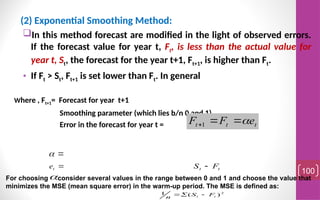
100.
(2) Exponential SmoothingMethod:
In this method forecast are modified in the light of observed errors.
If the forecast value for year t, Ft, is less than the actual value for
year t, St, the forecast for the year t+1, Ft+1, is higher than Ft.
• If Ft > St, Ft+1 is set lower than Ft. In general
Where , Ft+1= Forecast for year t+1
Smoothing parameter (which lies b/n 0 and 1)
Error in the forecast for year t =
100
t
t
t e
F
F
1
t
e t
t F
S
For choosing consider several values in the range between 0 and 1 and choose the value that
minimizes the MSE (mean square error) in the warm-up period. The MSE is defined as:
2
)
(
1
i
i F
S
n
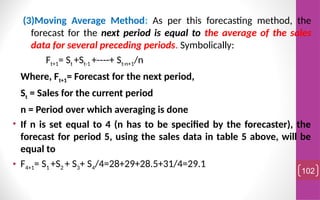
(3)Moving Average Method:As per this forecasting method, the
forecast for the next period is equal to the average of the sales
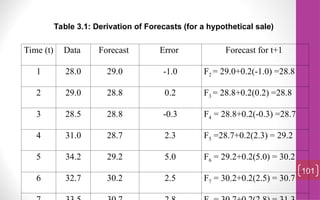
data for several preceding periods. Symbolically:
Ft+1= St +St-1 +----+ St-n+1/n
Where, Ft+1= Forecast for the next period,
St = Sales for the current period
n = Period over which averaging is done
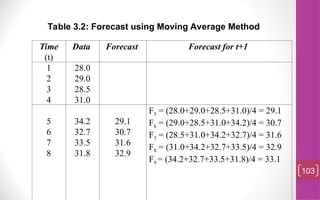
• If n is set equal to 4 (n has to be specified by the forecaster), the
forecast for period 5, using the sales data in table 5 above, will be
equal to
• F4+1= S1 +S2 + S3+ S4/4=28+29+28.5+31/4=29.1
102
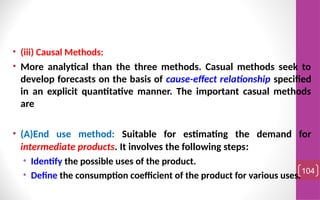
• (iii) CausalMethods:
• More analytical than the three methods. Casual methods seek to
develop forecasts on the basis of cause-effect relationship specified
in an explicit quantitative manner. The important casual methods
are
• (A)End use method: Suitable for estimating the demand for
intermediate products. It involves the following steps:
• Identify the possible uses of the product.
• Define the consumption coefficient of the product for various uses.104
105.
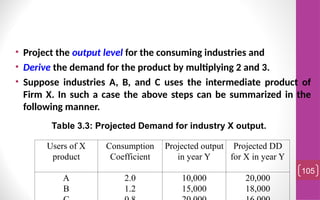
• Project theoutput level for the consuming industries and
• Derive the demand for the product by multiplying 2 and 3.
• Suppose industries A, B, and C uses the intermediate product of
Firm X. In such a case the above steps can be summarized in the
following manner.
105
Users of X
product
Consumption
Coefficient
Projected output
in year Y
Projected DD
for X in year Y
A
B
2.0
1.2
10,000
15,000
20,000
18,000
Table 3.3: Projected Demand for industry X output.
106.
• Nevertheless, itmay be difficult to estimate the projected output
levels of consuming industries (firms).
• More importantly, the consumption coefficient may vary from one
period to another in the wake of technological changes and
improvements in the methods of manufacturing.
• (B)Leading indicator method: They are variables that change ahead
of other variables, the lagging variables.
• Hence, observed changes in the leading indicators may be used to
predict the changes in lagging variables. 106
107.
• For example,the change in the level of urbanization can be used
to predict the changes in the demand for air conditioner.
• Two basic steps are involved in using the leading indicator
method:
• First, identify the appropriate leading indicator(s).
• Second, establish the relationship between the leading
indicator (s) and the variable of forecast.
107
108.
• The principalmerit of this method is that it does not require a
forecast of an explanatory variable.
• Its limitations are that it may be difficult to find an appropriate
leading indicator(s) and the led-lag relationship may not be
earthed/observed easily.
• f)Uncertainties in Demand Forecasting
• The DD forecasting methods are characterized by the inability to
handle unquantifiable factors.
108
109.
• Hence, demandforecasts are subject to error and uncertainty which
arise from the principal sources:
• Data about past and present market
• Methods of forecasting
• Environmental change
• The influence of abnormal factors
• Uncertainty in business environment such as
• Technological changes
• Shift in government policies (e.g. granting licence to foreigners,
relaxation of interest rate, foreign exchange, price, distribution
control etc.
109
110.
Development ofinternational scene (e.g. global recession since
2008)
• g)Market Planning. Prepare a marketing plan for the new
product.
• 4) Raw Materials and Supplies Study
• Different materials and other inputs required for operating the
project should be identified and their availability, supply and
method of estimating operating costs should be analyzed.
110
111.
• In thispart of the feasibility study the following can be include:-
I) Identification of the type of raw materials and supplies to be
used in the project.
II) All requirements of materials and supplies should be
identified and specified in the study considering all socio,
economic, commercial, financial, and technical factors.
III) The source of materials availability, their users and price of
inputs are to be analyzed.
111
112.
The interdependenciesbetween projects, material and input
requirements and supply of these items should be considered.
Location of the available resources, area of supply, access to
transport, transport costs and alternate usage of such materials
need to be collected.
Costs of raw materials and supplies:-
• The costs of materials and other supplies have to be analyzed
in detail to determine project economies. 112
113.
• Estimating annualoperating costs for materials and supplies
are to be made explaining the price mechanisms and key
factors affecting prices.
• Cost estimates may be expressed either as the cost per unit
produced or in terms of a certain production level to conduct
sensitivity analysis.
113
114.
• 5) Location,Site and Environmental Impact Assessment
• 5.1. Location
• Location analysis has to identify locations suitable for the industrial
project under consideration.
• Traditional approach to industrial location focused, on the proximity
of raw materials and market place, mainly with the intention of
minimizing transport costs.
114
115.
• However, themodern view requires consideration of not only
commercial, technical and financial factors, but also of the social
and environmental impact a project might have.
• The strategic orientation of the choice of suitable locations
requires an assessment of inter alias,
• Market and marketing aspects,
• The availability of critical project inputs (raw materials and
factory supplies)
• Technical project requirements.
115
116.
• The typeof industry,
• Technological and process characteristics,
• Products or outputs,
• Size of the plant,
• Organizational requirements and management structures
•The simplest location model is to calculate the transport,
production and distribution costs at alternate locations determined
principally by the availability of raw material and principal markets.
116
117.
• Projects basedlargely on imported material may need to be
located at ports or near terminals.
• Perishable products or agro-processing industries are market
oriented and it is advantageous to locate such production near
the major consumption centers.
• Petroleum products and pharmaceutical can be located at source
or near consumption centers or even at some intermediation
point.
117
118.
• As faras financial feasibility of alternative locations is concerned,
the following data-as well as related financial risks, should be
assessed.
• Production costs (including environmental protection costs)
• Marketing costs
• Investment costs
• Revenues
• Taxes, subsidies, grant and allowance
• Net cash flows 118
119.
5.2 . SiteSelection
Once the location is decided upon, a specific project site
alternative should be defined in the feasibility study. This will
require evaluation of the characteristics of each site.
When selecting sites within the selected location, the following
requirements and conditions are to be assessed:-
• Ecological conditions on site (soil, site hazards, climate etc.)
• Environment impact (restrictions, standards, guidelines)
• Socioeconomic conditions (restrictions, incentives, requirements) 119
120.
• Local infrastructureat site location (existing industrial infrastructure,
economic and social infrastructure, availability of critical project
inputs such as labor and factory supplies)
• Strategic aspects (corporate strategies regarding possible future
extension, supply and marketing polices
• Cost of land
• Site preparation and development requirements and costs.
• Topography, altitude and climate may be important for a project as
well as access to water, electric power, roads and railways transport.
120
121.
• Recruitment ofmanagerial staff and labor may be a critical factor
for the viability of the project. Development of housing, schools,
medical and social center is necessary to attract the required staff
and labor force.
Note: Plant location and site selection can be undertaken simultaneously .
121
122.
5.3 Environmental ImpactAssessment
Designed to develop an understanding of the environmental
consequences of newly planned or existing projects and of any
project related activities.
EIA is part of project planning process. Environmental benefits or
costs are usually externalities or side effects that affect the
society in whole or in part.
122
123.
• 6. Stakeholder/needAnalysis:
• Project stakeholders are organizations or people (both internal and
external) who are either involved actively in the project or whose
interests are affected in some way (positively or negatively) by the
project being implemented.
• Stakeholder analysis enables project planners to
• gain full understanding of the specific social conditions in which the
project will be implemented.
• to judge the social impact of the project and the willingness of the
various stakeholders to participate in project activities.
123
124.
• Project managersshould create an environment where by
stakeholders are encouraged to contribute their skill and knowledge,
which may be useful to the success of the project.
• This is because some stakeholders are interested in the output and
outcome of the project while others may be interested in the project
while being implemented.
• Stakeholders are also classified into those who are either negatively
or positively affected by the project or indifferent when the project
is being implemented.
124
125.
• The purposesof stakeholder analysis are:
• To identify all stakeholders of the project.
• To assess the interests (needs and expectations) of stakeholders
and classify them either as primary (those who are affected
directly by the project); secondary (those engaged as
intermediaries in the delivery of project benefit); and external
(those who are influenced by or have influence over the project
without being directly affected by it).
• Because these needs should be managed, influenced, and balanced
to ensure project success. 125
126.
• To determinethe probable/potential impact(s) of stakeholders’
interests (needs and expectations) in terms of project risk and
viability and displayed as positive (+), negative (-), or uncertain (?)
• To prioritize the importance of these needs and expectations in
terms achieving project objectives. The final column of the table
is concerned with the relative priorities of stakeholders’ interests
and should be categorized on the scale of 1 (high priority) to 5
(low priority).
• The information should be summarized in Table 3.4 below. 126
127.
127
Stakeholders Interests (Needsand
Expectations)
Potential or probable impact on
project (+, -,?)
Relative Priorities of
interests (1-5)
Primary
……….
……….
……….
Secondary
……….
……….
……….
External
………..
………..
………..
Table3.4: Stakeholder, Needs and Expectations, Influence, and Priority Performa
128.
• 7.Production Programand Plant Capacity
• The production program, range and volume of products to be
produced depend on the market requirements, proposed marketing
strategy and the availability of resources.
• A production program should define the levels of output to be
achieved during specified periods related to the sales forecast.
• Full production level may not be possible during initial production
operation due to various technological, production and commercial
difficulties in addition to marketing bottlenecks.
128
129.
• Normally aproduction and sales target of 40-50 percent of the
capacity for the first year is considered reasonable. Picking up
gradually, towards third or fourth year full production level can be
achieved.
• With regards to plant capacity, generally two capacity terms used in
relation to level of operation.
• i) A feasible normal capacity – achievable under normal working
conditions considering normal stoppages, downtime, holiday’s,
maintenance, shift pattern and management system applied. 129
130.
• ii) Anominal maximum capacity – is the technically feasible capacity that
corresponds to the installed capacity as guaranteed by the supplier of the plant.
• 8.Technology Selection: Appropriate technology selection should be made.
• While selecting the best technologies for the proposed project, the following
factors must be given due attention:
• Technological impact on the environment. The technology select should not only
the one that minimizes pollution, but should also preserve the natural resources
and saves renewable resources.
130
131.
• Careful evaluationand assessment of hazardous technologies and
the use of toxic materials at different stages of production should
be made.
• Introduction of obsolete technologies must also be carefully
considered. Acquisition of previously discarded and disassembled
production plants should be rechecked carefully.
• The primary goals of technology assessment are to determine and
evaluate the effect (impact) of different technologies on the society
and national economy. 131
132.
• 9)Organization andHuman Resource
• A division of the Company into organizational units, in line with
the marketing, supply, production and administrative functions is
necessary for efficient management of operations and designing a
proper organizational structure in accordance with the corporate
strategies and policies.
• The recommended organization will depend on the social
environment as well as techno-economic necessities. The
organizational set-up depends to a large extent on the industrial,
enterprise, strategies, polices and values of the organization.
132
133.
• A designof the organization usually includes the following steps:
Goals and objectives of the business are stated
Then functions are identified
Functions are grouped or related
Organizations structure or framework designed
All key jobs are analyzed, designed, and described
A recruitment and training program prepared.
133
134.
• The tworeasons for preparing an organization:-
• To achieve optimal coordination and control on all project inputs.
• To structure the investment and production costs and to
determine the costs linked with corresponding organizational
units.
134
135.
• 9.1 OrganizationalStructure
• Usually the organization structure is designed primarily in line with
the different functions. Such as finance, marketing, production and
purchasing. However, there is no unique organizational pattern.
• 9.2 Human Resource
• The successful implementation and operation of industrial projects
need different categories of human resources.
• Example, management, supervisory staff and workers- with
sufficient skill and experience
135
136.
• The followingfactors should be given due consideration when the
availability and employment of human resources are analyzed:-
• i)The general availability of relevant human resource categories in
the country and the project region.
• ii)The labour supply and demand situation in the project region
• Iii) Recruitment policy and methods
• Iv)Training policy and program
136
137.
• 10) FinancialAnalysis:
• Since reliable cost estimates are fundamental to the appraisal of an
investment project it is necessary to check carefully all cost items
that could have a significant impact on financial feasibility. Cost
estimates cover:-
• Initial investment cost
• Cost of production
• Marketing and distribution costs
• Plant and equipment replacement costs
• Working capital requirements and decommissioning at the end of the
project life.
137
138.
• 10.1) InitialInvestment Cost
Initial investment costs are the total of fixed assets (fixed asset costs
plus pre-production expenditures) and net working capital.
Fixed assets constitute the resources required for constructing and
equipping an investment project, and net working capital
corresponding to the resources needed to operate the project
totally or partially.
10.1.1) Pre-production Expenditures: In every industrial project
certain expenditures are incurred prior to commercial production.
They are:-
138
139.
• 1)Preliminary capital– issue expenditures: include expenditures
incurred during the registration and formation of the company.
E.g. Legal fees, preparation and issue of a prospectus, public
announcement, brokerage commission, etc.
• 2)Expenditures for preparatory studies: include expenditures for
pre-investment studies like opportunity and feasibility and other
expenses for planning the project.
• 3)Other pre-production expenditures: like
• Salaries, fringe benefits and social security contributions of
personnel engaged during the pre-production period.
• Travel expenses
139
140.
Preparatory installations,such as work camps, temporary offices and
stores.
• 4)Cost of trial-runs, start up and commissioning expenditures:
• Fees payable for supervision or start up operations,
• wages, salaries, social security contributions of personnel employed,
• consumption of production materials and supplies, utilities and other
incidental start up costs.
• 10.1.2) Fixed Assets: These should include the following main cost
items: 140
141.
Land purchase,site preparation and improvements,
Building and civil works
Plant machinery and equipment including auxiliary equipment
Other assets like industrial property rights and lump sum
payments for know-how and patents.
10.1.3) Net working capital
This is defined as current assets (the sum of inventories, marketable
securities, prepared items, Accounts Receivable and cash) minus
current liabilities.
141
142.
10.2 ) ProductionCost
It is essential to make realistic forecasts of production and
manufacturing costs for a project proposal in order to determine
the future viability of the project.
Production costs should be determined for the different levels of
capacity utilization. The production costs are classified into four major
categories. They are:
Factory costs
Administrative overhead costs
Depreciation and cost of financing
Operating cost (the sum of factory and administrative overhead costs).
142
143.
10.3) Marketing Costs:
Thiscomprise the costs for all marketing activities and may be
divided into direct marketing costs and indirect marketing costs.
• Direct marketing costs – are costs for packaging and storage, sales,
product advertisement, transport and distribution costs.
• Indirect marketing costs – are costs related to marketing department.
They are salaries for personnel, materials and communication,
market research, public relation and promotional activities.
143
144.
10.4) Cash FlowStatement
The cash flow statement shows the movement of cash into and out of
the firm and its net impact on the cash balance within the firm.
10.5)Financial Evaluation
• Ranking projects and measuring their profitability have replaced
evaluation based on inadequate planning and subjective judgment.
• There are two quantitative investment evaluation methods
(criteria) for commercial projects
144
145.
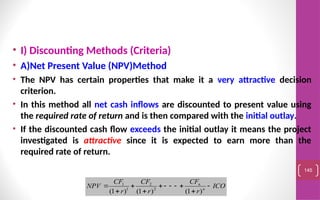
• I) DiscountingMethods (Criteria)
• A)Net Present Value (NPV)Method
• The NPV has certain properties that make it a very attractive decision
criterion.
• In this method all net cash inflows are discounted to present value using
the required rate of return and is then compared with the initial outlay.
• If the discounted cash flow exceeds the initial outlay it means the project
investigated is attractive since it is expected to earn more than the
required rate of return.
145
ICO
r
CF
r
CF
r
CF
NPV n
n
)
1
(
)
1
(
)
1
( 2
2
1
1
146.
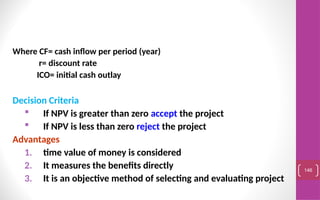
Where CF= cashinflow per period (year)
r= discount rate
ICO= initial cash outlay
Decision Criteria
If NPV is greater than zero accept the project
If NPV is less than zero reject the project
Advantages
1. time value of money is considered
2. It measures the benefits directly
3. It is an objective method of selecting and evaluating project
146
147.
Limitations
• The NPVmethod does not consider the life of the project. Hence,
when mutually exclusive projects with different lives are being
considered, the NPV rule is biased in favor of the longer term
project.
• Example: To illustrate the calculation of the NPV consider a
project which has the following cash flow streams.
147
148.
• C)Benefit-Cost Ratio(Profitability Index)
• The profitability index, also called benefit - cost ratio, is the ratio of
the PV of the future net cash inflows to the initial outlay of the
project.
• It measures the desirability of the project and evaluates the worth of
an investment.
PI= PV (NCF)
PV (IO)
• In the application of PI, a project is accepted if PI > 1, rejected if
PI < 1 and we remain indifferent if PI = 1.
• It should be noted that when PI > 1, NPV is positive; PI < 1, NPV is
negative and PI=1 when NPV is zero.
148
149.
• Example: Aftertax cash flows of a small scale tannery project is
given below. Find the profitability index if discount rate is assumed
to be 12%?
• Solution:
149
Year 0 1 2 3 4 5
CFs 40,000 15,000 14,000 13,000 12,000 11,000
Therefore, PI= 47,678= 1.192
40,000
• II) Non-Discounting Criteria
• A)Payback Period
• It is one of the most popular and widely used method.
• It is defined as the number of years required to recover the
original cash outlay invested in a project .
• The payback period can be calculated using the following formula:
PBP = Total Investment
Annual Cash Flow 151
152.
• Example 1:If a project has an investment of Br. 60,000 and annual
cash inflow is Br. 15,000 per year for 10 years. Compute the PBP?
PBP = 60,000/15000= 4 years
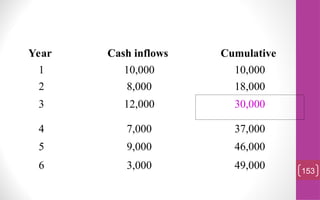
• Example 2:If the project cash inflow is not in “annuity form”,
cumulative cash inflow method may be used to compute that PBP.
Assuming an initial investment of Br. 30,000 for the following stream
of cash flows and compute the PBP.
152
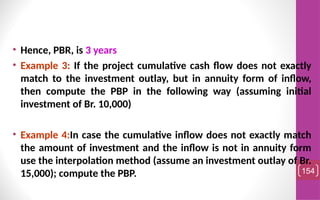
• Hence, PBR,is 3 years
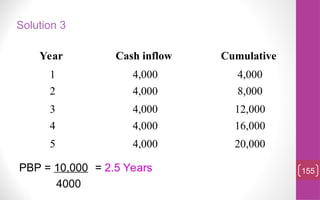
• Example 3: If the project cumulative cash flow does not exactly
match to the investment outlay, but in annuity form of inflow,
then compute the PBP in the following way (assuming initial
investment of Br. 10,000)
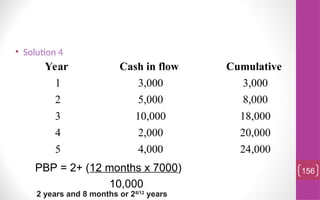
• Example 4:In case the cumulative inflow does not exactly match
the amount of investment and the inflow is not in annuity form
use the interpolation method (assume an investment outlay of Br.
15,000); compute the PBP. 154
• Solution 4
156
YearCash in flow Cumulative
1 3,000 3,000
2 5,000 8,000
3 10,000 18,000
4 2,000 20,000
5 4,000 24,000
PBP = 2+ (12 months x 7000)
10,000
2 years and 8 months or 28/12
years
157.
• B)Accounting Rateof Return (ARR)
• This method uses accounting information, as presented by
financial statements, to measure profitability of investment.
• It is sometimes known as Average Rate of Return and calculated by
dividing the average income after tax by the average investment of
project.
ARR= Average income x 100 or Average Income
Average investment Total Investment 157
158.
• Decision Criteria
•Projects which have an ARR equal to or greater than a pre-specified
cutoff rate of return – which is usually between 15% and 30% - are
accepted otherwise, rejected.
• Advantages
• It simple to calculate
• It is based on accounting information, which is readily available, and familiar
to businessman
• It considers benefits over the entire life of the project.
• Limitations
• It is based upon accounting profit, not cash flow
• It does not take into account the time value of money.
158
159.
• 11)Economic analysis
•Economic analysis, also referred as SCBA, is concerned with the
judging a project from the larger social point of view. I
• n such an evaluation the focus is on the social costs and benefits
of a project, which may be often be different from its monetary
cost and benefits.
• The questions sought to be answered are in SCBA are: 159
160.
• What arethe direct economic benefits and costs of the project
measured in terms of shadow (efficiency) prices and not in terms
of market prices?
• What would be the impact of the project on the distribution of
income, saving, and investment in the society?
• What would be the contribution of the project towards the
fulfillment of certain merit wants like self-sufficiency,
employment, access, and social order?
160
161.
• 12)Identify, Evaluateconstraints (Risk and Sensitivity Analysis) and
develop a strategy to cop with them
• Projects are implemented within a constantly changing and complex
environment.
• All projects are therefore subjected to some varied degree of risk
and uncertainty.
161
162.
• Risk anduncertainty are two related but slightly different concepts.
Risk refers to the probability of an event occurring and can be
quantified.
• Uncertainty on the other hand is inherently unpredictable event/factor
that cannot be quantified, although the effects of a specified uncertain
event can often be quantified, but affects the outcome of a project by
disrupting project implementation and operation.
• The first stage is known as risk identification or project constraints
identification stage.
162
163.
• A)Internal ProjectConstraints (Stand-alone risks):-These include risks
related directly to the scope of a project when viewed in isolation. To
identify stand-alone risks ask the following basic questions about the
product/service of the project.
• Can the product be made realistically as expected? Consider Royal
Crown mineral water, where the company’s liquidation in 2000.
• Does the company have the appropriate technology? If no, can the
technology be acquired through a technology transfer, if so from
where or from whom?
• Should the project start with the present technology or wait until new
and better technology is available?
163
164.
• Are specialmachines and equipment required? If yes, can these be sub-
contracted out or procured?
• Can the project be completed within the budget? Is there a need for
financial collaboration?
• Can the workforce (human resource) be trained up to the required level
of ability or should consultants be employed to meet the forecast skill
requirements?
• Are there special transport requirements? Can the product be
transported to where it is required or does it need to be made piece
small and assembled on site?
• Are there company policy and procedures in place? If no is there time to
develop them?
164
165.
• Is theproject office set up? Has the project manager been appointed, the
project team selected, the office space allocated, and the equipment and
information system available?
• Are the project risks and uncertainty acceptable?
• B)Internal Corporate Constraints (organizational/ institutional risks):
• The Company itself can impose further quasi constraints on the project.
Corporate umbrella policy and strategy usually relates to long-term
issues, which indirectly (and unintentionally) may impose limitation on
the project. Some of the issues include:
165
166.
Marketing: Theproject may be delayed until the company advertises its
product well enough to enter into new market and get foot in the door.
• Training: The project may become the training ground for new recruits, in
which case the learning curve will be an expense to the project.
• Industrial relation: Industrial unrest is often caused by conflicts over pay
and working conditions. The project manager may have little power to
influence thee conditions.
• C)External constraints (systematic or business environment risks)
• External constraints are those imposed by parties outside the company
and the project’s sphere of influence. Any of these constraints may not
be negotiable. Examples include 166
167.
• National andinternational laws and regulations.
• Limited number of sub-contractors who can do the work.
• Availability of transportation.
• Availability of foreign currency and currency fluctuation.
• Market force, supply and demand curve.
• Environmental issues, government legislations, and pressure group.
• Climatic conditions, rain, wind, heat, and humidity
• Political unrest.
• Construction site in a residential area may not be allowed to work a night
shift because of noise.
167
• The secondstage is identification of alternatives/options. This include
• The need for considering alternatives in technical analysis is highly
emphasized. The alternatives may differ in one or more of the following
aspects:
• Nature of project: The project may consist of processing up to the
finished stage or may stop at a semi-finished stage.
• Production process: The availability and characteristics of raw materials,
the cost of production, and the nature of the market served are factors
that have to be born in mind while deciding about the process.
169
170.
• Production quality:Barring a few products such as Computers, clinical
thermometer, lab equipment, and the like where a certain
specification/standards has to be maintained,
• This is also particularly true in the case of products like textile and
footwear and service like education, health, banking, and hotel.
• Scale of operation and time phasing/sequential investment: In many
cases several scales of operation are feasible technically and financially.
The choice of a particular scale of operation would depend on the
financial resource available, the nature of competition, the nature of
DD, and the economics of scale.
170
171.
• Location: Locationand size are closely interrelated. Perhaps the same
DD could be satisfied by: (a) a single plant for the entire market; or (b)
one large plant for the bulk of the market with a few smaller plants for
the remaining market; or (c) several plants of a similar size spread over
the market areas
• The third stage is developing Strategies to cope up risks
• Project managers want to explore ways and means of mitigating
risk. Some of the ways of doing this are:-
Financial leverage: Reducing the proportion of fixed operating cost will
lowers risk. Likewise, reducing the dependence on debt lowers risk.
171
172.
• Pricing strategy:Pricing strategy is used by many firms to manage
risk. A lower price increases potential DD, but also raises the BEP.
• Sequential investment: If you are not sure about the market response
to your product or service, you may start small and later expand as
the market grows.
• Improving information: An African proverb says “ Don’t test the depth
of a river with both feet”. You may like to gather more information
about the market and technology before taking the plunge.
172
173.
Additional studyoften improves the quality of forecasts but involves
direct cost as well as the opportunity cost of delayed action
• Insurance: You can get an insurance cover against a variety of risks like
physical damage, theft, loss of key person, and so on. Insurance is a
pure antidote for such risks.
173
174.
• Long-term arrangement:One way to mitigate risk is to enter into long-
term arrangements with suppliers, employees, lenders, and customers,
which ensures availability of inputs at a predictable price; a long-term
wage contract with employees removes uncertainty about employee
cost; a long-term debt contract reduces risk about interest rate; finally a
long-term sales contract with customers eliminates revenue risk.
• Often long-term contracts are indexed. This means that the prices are
periodically adjusted in line with the movement of some index, which
essentially reflects inflation. Price indexing protects both the buyer and
seller against inflation risk because the indexing ensures that the real
price (price in terms of purchasing power) is constant. 174
175.
• Strategic allianceor joint venture: When the resource required for a
project or the risks inherent in a project are beyond the capacity of a
single company, strategic alliance may be the way out.
• Competitors are beginning to cooperate leading to a phenomenon called
as “co-optition”.
• Cost leadership and/or product differentiation: This refers to becoming
the lowest total delivered cost producer in the industry, while
maintaining an acceptable service/quality combination relative to
competition.
175
176.
• 13) Appraisaland Decision
• Decision/selection criteria (accept, modify/revise, reject)
• Should be conducted by independent team.
• Should be made based on published appraisal and selection
criteria.
• This enables projects to be appraised in a uniform and transparent
manner.
• The appraisal team should study the published appraisal
techniques and selection criteria in advance so that they have a
general comprehension of the standards that should be met.
176
177.
Project name: ________________________Project code:____________________
Responsible Authority: _________________ Total budget:____________________
Scheduled start date: ___________________ Scheduled completion date:_________
Summary of Appraisal Findings
Aspects of a project V. Good Good Satisfactory/fair Unsatisfactory/poor Comments
Technical Appraisal
Environmental Appraisal
Social Appraisal
Institutional Appraisal
Financial Appraisal
Economic Appraisal
Risk Analysis & Mgt procedure
177
TABLE 3.6: PROJECT ASSESSMENT FORM
178.
• The aboveform has room to list any comment or
recommendations linked to each aspect of project appraisal.
• Once this information has been set out in its totality it will be
possible to make final decision as to whether to accept, reject, or
modify/redesign the project using the table below.
178
Project Accept Reject Redesign Comments (actions to be taken & by whom)
1.
2. etc
TABLE 3.7: OVERALL PROJECT APPRAISAL DECISION:
179.
When projects areinitiated, two issues immediately arise:
First, a decision must be made about how to tie the project to the
parent firm.
Second, a decision must be made about how to organize the
project itself.
This chapter focuses on the interface between the project and its
parent organization or how the project is organized as a part of its
host.
4.1. Types of Project Organizations
There are three fundamentally different ways of organizing projects
within the parent organization: These are:
179
CHAPTER FOUR
PROJECT ORGANIZATION
180.
• I)The projectas a free-standing part of the parent organization (Pure
Project Organization), and
• II)The project as part of the functional organization (Functional Project
Organization).
• III)Matrix Organization or a hybrid of the two main types.
Each of these organizational types has advantages and disadvantages.
I. The Project as a Free-Standing Part of the Parent Organization
(Pure Project Organization)
In this arrangement, the project is separated from the rest of the
parent system.
180
181.
It becomesa self-contained unit with its own technical staff, its own
administration, tied to the parent firm by periodic progress reports
and oversight.
Advantages of Pure Project Organization
(a) The project manager has full line authority over the project.
(b) All members of the project workforce are directly responsible to
the PM.
(c) When the project is detached from the functional division, the
lines of communication are shortened. As a result, decisions are made
quickly.
181
182.
(d) Team pride,motivation, and commitment are high.
(e) Unity of command exists. That is subordinate has one, and
only one boss.
(f) They are structurally simple and flexible, which makes them
relatively easy to understand and to implement.
(g) Because authority is centralized, the ability to make swift
decisions is greatly enhanced. The entire project organization can
react more rapidly to the requirements of the client and the needs
of senior management.
(h) The organizational structure tends to support a holistic approach
to the project.
182
183.
Disadvantages of PureProject Organization:
(a) Duplication of resources. Each project tends to be fully
staffed which can lead to a duplication of effort in every area
from clerical staff to technological support. Equipment and people
are not shared across projects.
(b) Organizational policies and goals are ignored because team
members are often both physically and psychologically removed
from headquarters.
(c) Because team members have no functional area home, they
worry about “life-after the project ends”. As a result, project
termination is delayed.
183
Housing the projectwithin the functional division.
185
II. The Project as Part of the Functional Organization
186.
Advantages of functionalproject organization include:
(a) A team member can work in several projects. With the broad
base of technical personnel available in the functional divisions,
people can be switched back and forth between or among the
different projects with relative ease.
(b) The functional area is a home after the project is completed.
Functional specialists can advance vertically.
(c) A critical mass of specialized functional area experts creates
synergistic solutions to a project’s technical problems.
186
187.
(d) There ismaximum flexibility in the use of staff.
(e)Specialists in the division can be grouped to share knowledge and
experience
(f)The functional division also serves as a base of technological
continuity when individuals choose to leave the project.
Disadvantages of housing the project in a functional area:
(a) The client is not the primary focus of activity and concern. The
functional unit has its own work to do, which usually takes precedence
over the work of the project, and hence over the interests of the client.
187
188.
(b)There is atendency to sub-optimize the project. Project issues
that are directly within the interest area of the functional home
may be dealt with carefully, but those outside normal interest areas
may be given short shrift, if not totally ignored.
(c) The motivation of people assigned to the project tends to be
weak. The project is not in the mainstream of activity and interest,
and some project team members may view service on the project
as secondary.
188
189.
(d) The functionalorganizational arrangement does not
facilitate a holistic approach to the project. Cross-divisional
communication and sharing of knowledge is slow and difficult at
best.
(e) Aspects of the project that are not directly related to
the functional area tend to be short-lived.
(f) There are often several layers of management between
the project and the client.
(g) Occasionally, no individual is given full responsibility for the
project.
189
190.
The matrix projectattempts to blend properties of functional and
pure project structures. Each project utilizes people from
different functional areas.
The PM decides what tasks and when they will be performed, but
the functional managers control which people and technologies
are used.
A matrix organization can take one of the following specific forms
(i) “project” or “strong” matrix organization most resembles the pure project
organization. 190
III. The Matrix Project Organization
191.
• team leaderis the principal authority, Control of schedule and budget, Acquire
personnel, Perform reviews
• (ii) The “weak” or “coordination” or “functional” matrix most
resembles the functional form.
• team leader is only a coordinator, Spokesperson to higher management, Steering
committee has ultimate authority
• (iii)The “balanced” matrix lies in between the others
191
192.
Example of MatrixProject Structure. Rather than being a stand
alone organization, like the pure project, the matrix project is not
separated from the parent organization.
192
Dept A Dept B Dept C Dept D
PROJECT
ORGANIZATION
Requirements
Specification
Procurement Finance
Marketing
Project
Manager
193.
Advantages of MatrixProject Organization.
(a) Communications between functional divisions is enhanced
(b) A project manager is held responsible for successful
completion of the project.
(c) Duplication of resources is minimized
(d) Team members have a functional “home” after project
completion, so they are less worried about “life after the project
ends”
(e) Policies of the parent organization are followed- increases
support for the project
193
194.
(f) The projectis the point of emphasis
(g)Response to client’s needs tend to be rapid as in the pure project
organization.
(h) Gives the project access to representatives from the
administrative units of the parent firm.
(i) Allows a better company-wide balance of resources to achieve
goals.
Disadvantages of Matrix Project Organization.
(a) There are two bosses. As a result, the principle of unity of
command is violated. The functional manger will be listened to
before the project manager. 194
195.
(b) It isdoomed to failure unless the PM has strong negotiating skills.
(c) Sub-optimization is a danger, as PMs hoard resources for their
own project, thus harming other projects.
(d)Division of authority and responsibility in a matrix organization is
complex, and uncomfortable for the PM.
(e) Staff attention fractured
(f) Conflicting obligations
(g) Requires large amount of communication
(h) Strong top management involvement;
(i) Reporting to home “base” is difficult
195
196.
• 4.2. Choosingan Organizational Form
Choosing the organizational interface between the project and
the firm is determined by the situation and partly intuitive.
While choosing organizational forms we shall consider such
factors as
The nature of the potential project
The characteristics of the various organizational options,
The advantages and disadvantages of each,
The cultural preferences of the parent organization, and then
make the best compromise that can be made.
196
197.
For example, thefunctional form is preferred for projects that will
require large capital investments in equipment or buildings of a
type normally used by the function.
If the firm engages in a large number of similar projects (for
example, construction project) the pure project form of
organization is preferred.
The pure organizational form also be preferred for one-time,
highly specific, unique tasks that require careful control and are
not appropriate for a single functional area.
197
198.
When the projectrequires the integration of inputs from several
functional areas and involve reasonably sophisticated
technology but does not require all the technical specialists to
work for a project on a full-time basis, the matrix organization is
the only satisfactory solution.
Criteria for the Selection of a Project Organization:
1) Define the project with a statement of the objective(s) that
identifies the major outcomes desired
198
199.
2)Determine the keytasks associated with each objective and
locate the units in the parent organization that serve as
functional “homes” for these types of tasks
3)Arrange the key tasks by sequence and decompose them into
work packages.
4)Determine which organizational units are required to
carryout the work packages and which units will work particularly
closely with which others.
5)List any special characteristics or assumptions associated with
the project
199
200.
6) In lightof items 1 – 5, and with full cognizance of the pros
and cons associated with each structural form, choose a
structure.
4.3. The Project Team
To staff a project, the project manager works from a forecast of
personnel needs over the life cycle of the project.
A work breakdown structure (WBS) is prepared to determine
the exact nature of the tasks required to complete the project.
200
201.
Skills requirementsfor these tasks are assessed and like skills are
aggregated to determine workforce needs
From this base, the functional departments are contacted to
locate individuals who can meet this needs.
Certain tasks may be subcontracted.
• There are some people who are more critical to the project’s
success than others and should report directly to the project
manager or the project manager’s deputy.
Senior project team members who will be having a long-term relationship with
the project.
201
202.
Those withwhom the project manager requires continuous or
close communication.
Those with rare skills necessary to project success.
• 4.3.1.Human Factors and the Project Team
Meeting schedule and cost goals, without compromising
performance is a technical problem, with a human dimension
Project professionals tend to be perfectionists.
Pride in workmanship leads the team member to improve (and thus change) the
product. 202
203.
These changescause delays in the project.
Inspiring Project Team Members: The project manager often has
little control over the economic rewards and promotions of project
team members, but this does not mean s/he cannot facilitate
motivation of team.
How are technical employees motivated?
• Recognition Achievement
• Assigning Responsibility Advancement
• Learning new skills 203
204.
Empowerment of projectteams is also a motivational factor: Advantages
(1) It harnesses the ability of the team members to manipulate tasks so that
project objectives are met. The team is encouraged to find better ways of
doing things.
(2)Professionals do not like being micromanaged. Participative management
does not tell them how to work but given a goal, allows them to design their
own methods.
(3)Team members know they are responsible and accountable for achieving the
project deliverables.
(4)There is a good chance that synergistic solutions will result from team
interaction. 204
205.
• (5)Team membersget timely feedback on their performance.
(6)The project manager is provided a tool for evaluating the
team’s performance.
4.3.2. Interpersonal Conflict
The focus of conflict can often be related to the stage in the
project’s life cycle.
When the project is first organized, priorities, procedures and
schedules all have roughly equal potential to cause conflict 205
206.
During thebuild-up phase, priorities become significantly more
important than any other conflict factor
In the program phase schedules are the most important cause of
conflict followed by technical disagreements
At the project finish, meeting the schedule is the critical issue.
4.3.3.Conflict and the Project Manager:
Most of the conflicts in project teams is the result of individuals
focusing on the project through the eyes of their individual
discipline or department. 206
207.
Conflict avoidersdo not make successful project managers.
Though compromise appears to be helpful, but most often,
gently confronting and resolving the conflict is the method of
choice, for a win-win situation.
207