Construction Law

                                 Elliot Fus
                   Kilpatrick Stockton LLP
Topic Range

   Construction Contracting
   Construction Regulation
   Construction Disputes
Construction Contracting

   AIA Forms commonly used
   Can be used without change,
    except for project specific
    additions, or with selective
    modifications; topics changed
    most frequently are arbitration,
    indemnification, payment, and
    the responsibilities of the
    architect.
   Changes must be done carefully.
     A change in one clause may
    create confusion.
Construction Contracting

   Large-scale industrial construction, such as
    fertilizer plants or nuclear facilities, are not
    likely to use AIA documents.
   The organizational systems used in those
    projects do not fit the fundamental
    assumptions of the AIA system.
   Also, amounts at stake in such projects are
    sufficient to justify a tailor-made contract or
    form created by one of the contracting
    parties.
Construction Contracting

   AIA documents most useful for small and
    middle-priced projects; large-scale
    residential or commercial projects in which
    design and construction are separated, and in
    which the architect plays a central
    administrative role.
   Less likely to be used by public owners who
    face many more legal constraints than private
    owners.
Construction Regulations

               Multiple Levels (State, local,
                etc.)
               Numerous areas of
                government regulation (e.g.,
                from codes providing building
                standards to regulations
                governing the practice of
                contracting)
Construction Disputes

   Cast of characters can vary (contractor v.
    owner; subcontractor v. contractor; claims
    involving architects, suppliers, etc.)
   May involve counterclaims /cross-claims
   Forum may vary (liens, litigation, arbitration,
    mediation)
   Claims typically contractual; sometimes tort
    (e.g., negligence)
   Several typical scenarios; overview, then
    focus on experts
Change Orders/ Extra Work

   Because it is virtually impossible for an
    owner, architect, engineer or contractor to
    foresee every design or construction problem
    that will encountered on a project, most
    construction contracts contain a “changes”
    clause.
   The purpose of the “changes” clause is to
    account for changes in design, to correct
    errors in plans and specifications and to avail
    the parties of flexibility in adapting their
    contract so that it mirrors the conditions of
    the site, the events that transpire and the
    parties’ conduct.
Change Orders/ Extra Work
                 Was the original scope of
                  work changed?
                 Was the person who
                  changed the scope of the
                  work authorized to order
                  changes?
                 Was a written change
                  order required?
                 Was a written notice of a
                  claim for additional
                  compensation required?
Constructive Change

   A “constructive change” occurs when the
    contractor is required to perform work
    different from that prescribed by the original
    contract, which should have been covered by
    a change order.
   A contractor becomes entitled to additional
    compensation for a “constructive change”
    just as if the work had been performed
    pursuant to a formal change order.
Constructive Change

   Site conditions different from what
    reasonably expected
   Owner dictates different method of
    performance
   Impossibility
Warranties

   Warranties are generally defined in the
    construction industry as promises, assurances
    or guarantees of the quality, quantity or
    duration of a product or of certain work
    performed.
   Express warranties
   Implied warranties
    • of plans and specifications
    • of workmanship
    • of livability
PERFORMANCE/ BREACH ISSUES

   2 types of performance: substantial and
    complete
    • The “substantial performance doctrine” entitles a
      contractor who has substantially (but not fully)
      performed the work required under a contract to
      be paid for the work performed, less the cost to
      fully perform.
    • This rule of “substantial compliance” is only
      applied when a builder has undesignedly violated
      the strict terms of this contract, and the owner
      has received and retained the benefit of the
      builder’s labor and material, and the builder is
      ready to remedy. The defects must be trivial and
      slight…
PERFORMANCE/ BREACH ISSUES
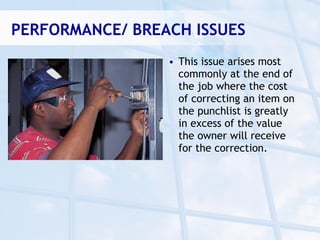
                 • This issue arises most
                   commonly at the end of
                   the job where the cost
                   of correcting an item on
                   the punchlist is greatly
                   in excess of the value
                   the owner will receive
                   for the correction.
PERFORMANCE/ BREACH ISSUES

   2 types of breach: material and immaterial
    • A material breach of a construction contract
      occurs when either the owner or the contractor
      fails to perform (1) a substantial part of the
      contract documents, (2) one or more of the
      essential terms or conditions of such, or (3) the
      breach substantially defeats the purpose of the
      contract. For example, if the owner’s failure to
      pay the contractor on time involves only a
      reasonable delay or involves a disputed amount, it
      will be deemed an immaterial breach.
PERFORMANCE/ BREACH ISSUES

    • In administering a construction contract, the
      distinction between a material and an immaterial
      breach of contract can be quite important. For
      example, courts generally require a material
      breach to justify suspension or termination of the
      contract by the non-breaching party. Not only
      must the party seeking to terminate a construction
      contract show that the other party materially
      breached the contract but also the terminating
      party must not (a) have breached the contract him
      or herself, or (b) waived the other party’s material
      breach.
DELAY/ DISRUPTION/ ACCELERATION

    In general terms, a party to a contract who delays,
     hinders or wrongfully prevents performance by the
     other party is liable to the other party for the costs
     incurred as the result of a delay.
    An excusable delay is a delay for which neither party
     (contractor or owner) is responsible. Excusable
     delays are generally (1) unforeseeable (2) involve
     outside forces over which neither the owner or the
     contractor have any control and (3) not due to the
     contractor’s fault of negligence, e.g. unusually
     severe weather.
DELAY/ DISRUPTION/ ACCELERATION

    “Acceleration” or “escalation” is generally
     the result of a previous delay. Under certain
     circumstances a contractor is entitled to
     recover the additional costs associated with
     acceleration.
ACCEPTANCE

  It is a well-recognized rule of contract law
   that strict performance may be waived by the
   party entitled to performance. In the context
   of construction contracts, this means that the
   owner may acquiesce in the contractor’s
   failure to perform according to the strict
   terms of the agreement if the owner accepts
   the contractor’s work.
CONTRACTS IMPLIED IN LAW

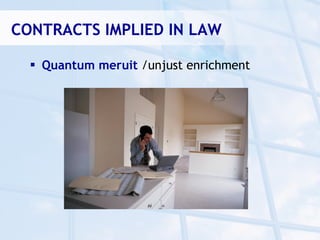
   Quantum meruit /unjust enrichment
DAMAGES
  When a person seeks to recover damages for breach of a
   contract, the applicable rule of law is that the non-
   breaching party should be put in the same position he or
   she would have been had the contract been performed
   according to its terms and conditions. As in non-
   construction cases, a contractor has the burden of proving
   that he or she has been injured and is entitled to damages
   as a result of the breaching party’s actions or inactions in
   violation of the construction contract. If the contractor
   has fully completed his work, he or she is entitled to
   recover the contract price. On the other hand, if the
   contractor has only “substantially completed” the work,
   he or she will be entitled to recover the contract price,
   less the amount of damages sustained by the other
   contracting party as a result of the contractor’s failure to
   fully perform.
DAMAGES

  If the owner’s breach occurred prior to the
   contractor’s completion of the work and prevented
   the contractor from completing the work, the
   contractor will be entitled to recover from the owner
   that portion of the contract balance earned by the
   contractor plus the contractor’s lost or anticipated
   profits. Lost of anticipated profits are calculated by
   subtracting from the contract price the contractor’s
   costs of completion. The contractor must prove the
   lost profits by reasonable, factual evidence showing
   that lost profits were “anticipated” by the contractor
   both at the time of contracting and at the time the
   contractor was prevented from continuing
   performance. Otherwise, lost profits will not be
   recoverable.
DAMAGES

  Where there is an implied rather than an
   express contract, the contractor’s recovery of
   damages against an owner is based on
   quantum meruit, i.e., the reasonable value
   of the services rendered. The measure of
   these damages is usually determined by such
   things as the type of work performed and the
   prevailing rate of pay for such work at the
   time and in the place performed.
  Liquidated damages
  Exemplary damages
EXPERTS IN CONSTRUCTION CASES

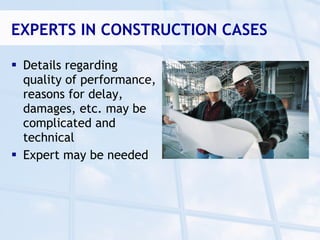
 Details regarding
  quality of performance,
  reasons for delay,
  damages, etc. may be
  complicated and
  technical
 Expert may be needed
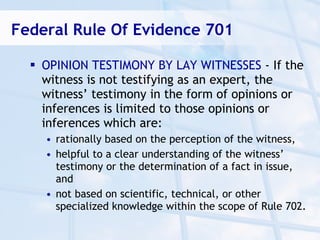
Federal Rule Of Evidence 701

   OPINION TESTIMONY BY LAY WITNESSES - If the
    witness is not testifying as an expert, the
    witness’ testimony in the form of opinions or
    inferences is limited to those opinions or
    inferences which are:
    • rationally based on the perception of the witness,
    • helpful to a clear understanding of the witness’
      testimony or the determination of a fact in issue,
      and
    • not based on scientific, technical, or other
      specialized knowledge within the scope of Rule 702.
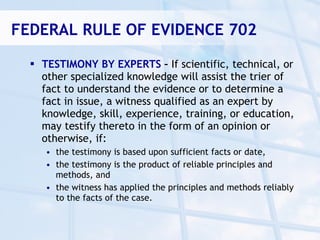
FEDERAL RULE OF EVIDENCE 702

   TESTIMONY BY EXPERTS – If scientific, technical, or
    other specialized knowledge will assist the trier of
    fact to understand the evidence or to determine a
    fact in issue, a witness qualified as an expert by
    knowledge, skill, experience, training, or education,
    may testify thereto in the form of an opinion or
    otherwise, if:
     • the testimony is based upon sufficient facts or date,
     • the testimony is the product of reliable principles and
       methods, and
     • the witness has applied the principles and methods reliably
       to the facts of the case.
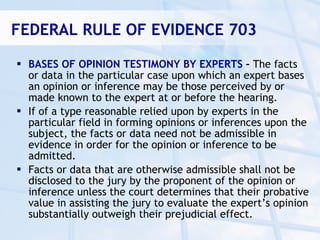
FEDERAL RULE OF EVIDENCE 703

 BASES OF OPINION TESTIMONY BY EXPERTS – The facts
  or data in the particular case upon which an expert bases
  an opinion or inference may be those perceived by or
  made known to the expert at or before the hearing.
 If of a type reasonable relied upon by experts in the
  particular field in forming opinions or inferences upon the
  subject, the facts or data need not be admissible in
  evidence in order for the opinion or inference to be
  admitted.
 Facts or data that are otherwise admissible shall not be
  disclosed to the jury by the proponent of the opinion or
  inference unless the court determines that their probative
  value in assisting the jury to evaluate the expert’s opinion
  substantially outweigh their prejudicial effect.
Stephen J. Peklenk

              Corporate Construction Services
The Effective Use of Experts in
Construction Cases
For More Information…

   NCBA North Carolina Construction
    Law Deskbook
   Justin Sweet, Sweet on Construction
    Law
   Smith, Currie & Hancock’s Common
    Sense Construction Law
Elliot Fus

                  Kilpatrick Stockton LLP
             efus@kilpatrickstockton.com

Construction Law Presentation

  • 1.
    Construction Law Elliot Fus Kilpatrick Stockton LLP
  • 2.
    Topic Range  Construction Contracting  Construction Regulation  Construction Disputes
  • 3.
    Construction Contracting  AIA Forms commonly used  Can be used without change, except for project specific additions, or with selective modifications; topics changed most frequently are arbitration, indemnification, payment, and the responsibilities of the architect.  Changes must be done carefully. A change in one clause may create confusion.
  • 4.
    Construction Contracting  Large-scale industrial construction, such as fertilizer plants or nuclear facilities, are not likely to use AIA documents.  The organizational systems used in those projects do not fit the fundamental assumptions of the AIA system.  Also, amounts at stake in such projects are sufficient to justify a tailor-made contract or form created by one of the contracting parties.
  • 5.
    Construction Contracting  AIA documents most useful for small and middle-priced projects; large-scale residential or commercial projects in which design and construction are separated, and in which the architect plays a central administrative role.  Less likely to be used by public owners who face many more legal constraints than private owners.
  • 6.
    Construction Regulations  Multiple Levels (State, local, etc.)  Numerous areas of government regulation (e.g., from codes providing building standards to regulations governing the practice of contracting)
  • 7.
    Construction Disputes  Cast of characters can vary (contractor v. owner; subcontractor v. contractor; claims involving architects, suppliers, etc.)  May involve counterclaims /cross-claims  Forum may vary (liens, litigation, arbitration, mediation)  Claims typically contractual; sometimes tort (e.g., negligence)  Several typical scenarios; overview, then focus on experts
  • 8.
    Change Orders/ ExtraWork  Because it is virtually impossible for an owner, architect, engineer or contractor to foresee every design or construction problem that will encountered on a project, most construction contracts contain a “changes” clause.  The purpose of the “changes” clause is to account for changes in design, to correct errors in plans and specifications and to avail the parties of flexibility in adapting their contract so that it mirrors the conditions of the site, the events that transpire and the parties’ conduct.
  • 9.
    Change Orders/ ExtraWork  Was the original scope of work changed?  Was the person who changed the scope of the work authorized to order changes?  Was a written change order required?  Was a written notice of a claim for additional compensation required?
  • 10.
    Constructive Change  A “constructive change” occurs when the contractor is required to perform work different from that prescribed by the original contract, which should have been covered by a change order.  A contractor becomes entitled to additional compensation for a “constructive change” just as if the work had been performed pursuant to a formal change order.
  • 11.
    Constructive Change  Site conditions different from what reasonably expected  Owner dictates different method of performance  Impossibility
  • 12.
    Warranties Warranties are generally defined in the construction industry as promises, assurances or guarantees of the quality, quantity or duration of a product or of certain work performed.  Express warranties  Implied warranties • of plans and specifications • of workmanship • of livability
  • 13.
    PERFORMANCE/ BREACH ISSUES  2 types of performance: substantial and complete • The “substantial performance doctrine” entitles a contractor who has substantially (but not fully) performed the work required under a contract to be paid for the work performed, less the cost to fully perform. • This rule of “substantial compliance” is only applied when a builder has undesignedly violated the strict terms of this contract, and the owner has received and retained the benefit of the builder’s labor and material, and the builder is ready to remedy. The defects must be trivial and slight…
  • 14.
    PERFORMANCE/ BREACH ISSUES • This issue arises most commonly at the end of the job where the cost of correcting an item on the punchlist is greatly in excess of the value the owner will receive for the correction.
  • 15.
    PERFORMANCE/ BREACH ISSUES  2 types of breach: material and immaterial • A material breach of a construction contract occurs when either the owner or the contractor fails to perform (1) a substantial part of the contract documents, (2) one or more of the essential terms or conditions of such, or (3) the breach substantially defeats the purpose of the contract. For example, if the owner’s failure to pay the contractor on time involves only a reasonable delay or involves a disputed amount, it will be deemed an immaterial breach.
  • 16.
    PERFORMANCE/ BREACH ISSUES • In administering a construction contract, the distinction between a material and an immaterial breach of contract can be quite important. For example, courts generally require a material breach to justify suspension or termination of the contract by the non-breaching party. Not only must the party seeking to terminate a construction contract show that the other party materially breached the contract but also the terminating party must not (a) have breached the contract him or herself, or (b) waived the other party’s material breach.
  • 17.
    DELAY/ DISRUPTION/ ACCELERATION  In general terms, a party to a contract who delays, hinders or wrongfully prevents performance by the other party is liable to the other party for the costs incurred as the result of a delay.  An excusable delay is a delay for which neither party (contractor or owner) is responsible. Excusable delays are generally (1) unforeseeable (2) involve outside forces over which neither the owner or the contractor have any control and (3) not due to the contractor’s fault of negligence, e.g. unusually severe weather.
  • 18.
    DELAY/ DISRUPTION/ ACCELERATION  “Acceleration” or “escalation” is generally the result of a previous delay. Under certain circumstances a contractor is entitled to recover the additional costs associated with acceleration.
  • 19.
    ACCEPTANCE  Itis a well-recognized rule of contract law that strict performance may be waived by the party entitled to performance. In the context of construction contracts, this means that the owner may acquiesce in the contractor’s failure to perform according to the strict terms of the agreement if the owner accepts the contractor’s work.
  • 20.
    CONTRACTS IMPLIED INLAW  Quantum meruit /unjust enrichment
  • 21.
    DAMAGES  Whena person seeks to recover damages for breach of a contract, the applicable rule of law is that the non- breaching party should be put in the same position he or she would have been had the contract been performed according to its terms and conditions. As in non- construction cases, a contractor has the burden of proving that he or she has been injured and is entitled to damages as a result of the breaching party’s actions or inactions in violation of the construction contract. If the contractor has fully completed his work, he or she is entitled to recover the contract price. On the other hand, if the contractor has only “substantially completed” the work, he or she will be entitled to recover the contract price, less the amount of damages sustained by the other contracting party as a result of the contractor’s failure to fully perform.
  • 22.
    DAMAGES  Ifthe owner’s breach occurred prior to the contractor’s completion of the work and prevented the contractor from completing the work, the contractor will be entitled to recover from the owner that portion of the contract balance earned by the contractor plus the contractor’s lost or anticipated profits. Lost of anticipated profits are calculated by subtracting from the contract price the contractor’s costs of completion. The contractor must prove the lost profits by reasonable, factual evidence showing that lost profits were “anticipated” by the contractor both at the time of contracting and at the time the contractor was prevented from continuing performance. Otherwise, lost profits will not be recoverable.
  • 23.
    DAMAGES  Wherethere is an implied rather than an express contract, the contractor’s recovery of damages against an owner is based on quantum meruit, i.e., the reasonable value of the services rendered. The measure of these damages is usually determined by such things as the type of work performed and the prevailing rate of pay for such work at the time and in the place performed.  Liquidated damages  Exemplary damages
  • 24.
    EXPERTS IN CONSTRUCTIONCASES  Details regarding quality of performance, reasons for delay, damages, etc. may be complicated and technical  Expert may be needed
  • 25.
    Federal Rule OfEvidence 701  OPINION TESTIMONY BY LAY WITNESSES - If the witness is not testifying as an expert, the witness’ testimony in the form of opinions or inferences is limited to those opinions or inferences which are: • rationally based on the perception of the witness, • helpful to a clear understanding of the witness’ testimony or the determination of a fact in issue, and • not based on scientific, technical, or other specialized knowledge within the scope of Rule 702.
  • 26.
    FEDERAL RULE OFEVIDENCE 702  TESTIMONY BY EXPERTS – If scientific, technical, or other specialized knowledge will assist the trier of fact to understand the evidence or to determine a fact in issue, a witness qualified as an expert by knowledge, skill, experience, training, or education, may testify thereto in the form of an opinion or otherwise, if: • the testimony is based upon sufficient facts or date, • the testimony is the product of reliable principles and methods, and • the witness has applied the principles and methods reliably to the facts of the case.
  • 27.
    FEDERAL RULE OFEVIDENCE 703  BASES OF OPINION TESTIMONY BY EXPERTS – The facts or data in the particular case upon which an expert bases an opinion or inference may be those perceived by or made known to the expert at or before the hearing.  If of a type reasonable relied upon by experts in the particular field in forming opinions or inferences upon the subject, the facts or data need not be admissible in evidence in order for the opinion or inference to be admitted.  Facts or data that are otherwise admissible shall not be disclosed to the jury by the proponent of the opinion or inference unless the court determines that their probative value in assisting the jury to evaluate the expert’s opinion substantially outweigh their prejudicial effect.
  • 28.
    Stephen J. Peklenk Corporate Construction Services
  • 29.
    The Effective Useof Experts in Construction Cases
  • 30.
    For More Information…  NCBA North Carolina Construction Law Deskbook  Justin Sweet, Sweet on Construction Law  Smith, Currie & Hancock’s Common Sense Construction Law
  • 31.
    Elliot Fus Kilpatrick Stockton LLP efus@kilpatrickstockton.com