first-1
Chapter 1
Introduction of Project
Management
first-2
Introduction
• Examples of projects
– Split the atom
– Tunnel between England and France
– Introduce Windows 8
– Disneyland's Expedition Everest
“Projects, rather than repetitive tasks, are now the
basis for most value-added in business”
-Tom Peters
first-3
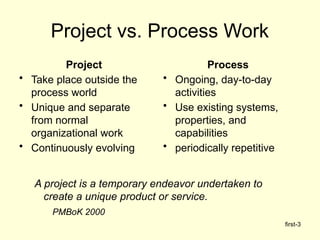
Project vs. Process Work
Project
• Take place outside the
process world
• Unique and separate
from normal
organizational work
• Continuously evolving
Process
• Ongoing, day-to-day
activities
• Use existing systems,
properties, and
capabilities
• periodically repetitive
A project is a temporary endeavor undertaken to
create a unique product or service.
PMBoK 2000
first-4
Additional Definitions
• A project is a unique venture with a beginning
and an end, conducted by people to meet
established goals within parameters of cost,
schedule and quality. Buchanan & Boddy 92
• Projects are goal-oriented, involve the
coordinated undertaking of interrelated activities,
are of finite duration, and are all, to a degree
unique. Frame 95
first-5
Elements of Projects
• Complex , one-time processes
• Limited by budget, schedule, and resources
• Developed to resolve a clear goal or set of
goals
• Customer-focused
first-6
General Project Characteristics (1/2)
• Ad-hoc endeavors with a clear life cycle
• Building blocks in the design and execution of
organizational strategies
• Responsible for the newest and most improved
products , services, and organizational processes
• Provide a philosophy and strategy for the management
of change
first-7
General Project Characteristics (2/2)
• Entail crossing functional and organizational
boundaries
• Traditional management functions of planning,
organizing, motivating, directing, and controlling apply
• Principal outcomes are the satisfaction of customer
requirements within technical , cost , and schedule
constraints. constraints
• Terminated upon successful completion
first-8
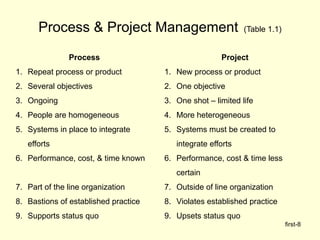
Process & Project Management (Table 1.1)
Process
1. Repeat process or product
2. Several objectives
3. Ongoing
4. People are homogeneous
5. Systems in place to integrate
efforts
6. Performance, cost, & time known
7. Part of the line organization
8. Bastions of established practice
9. Supports status quo
Project
1. New process or product
2. One objective
3. One shot – limited life
4. More heterogeneous
5. Systems must be created to
integrate efforts
6. Performance, cost & time less
certain
7. Outside of line organization
8. Violates established practice
9. Upsets status quo
A Project
first-9
A project can be considered to be any series of activities and tasks that:
- Have a specific objective to be completed
within certain specifications
- Have defined start and end dates
- Have funding limits
- Consume human and nonhuman resources
- Are multifunctional
first-10
Why are Projects Important?
1. Shortened product life cycles
2. Narrow product launch windows
3. Increasingly complex and technical products
4. Emergence of global markets
5. Economic period marked by low inflation
first-11
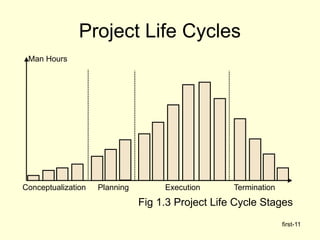
Project Life Cycles
Man Hours
Conceptualization Planning Execution Termination
Fig 1.3 Project Life Cycle Stages
first-12
Project Life Cycles
• Conceptualization - the development of the initial
goal and technical specifications.
• Planning – all detailed specifications, schedules,
schematics, and plans are developed
• Execution – the actual “work” of the project is
performed
• Termination – project is transferred to the
customer, resources reassigned, project is
closed out.
first-13
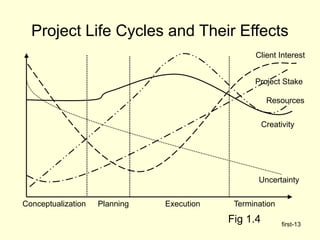
Project Life Cycles and Their Effects
Conceptualization Planning Execution Termination
Uncertainty
Client Interest
Project Stake
Creativity
Resources
Fig 1.4
What is Project Management?
• The art of organizing, leading, reporting and
completing a project through people
12/11/2024
15
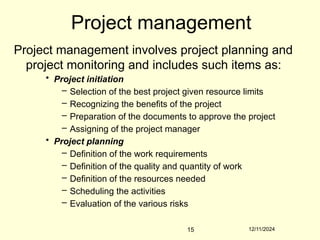
Project management
Project management involves project planning and
project monitoring and includes such items as:
• Project initiation
– Selection of the best project given resource limits
– Recognizing the benefits of the project
– Preparation of the documents to approve the project
– Assigning of the project manager
• Project planning
– Definition of the work requirements
– Definition of the quality and quantity of work
– Definition of the resources needed
– Scheduling the activities
– Evaluation of the various risks
12/11/2024
16
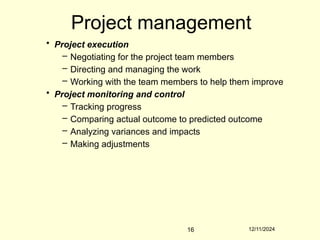
Project management
• Project execution
– Negotiating for the project team members
– Directing and managing the work
– Working with the team members to help them improve
• Project monitoring and control
– Tracking progress
– Comparing actual outcome to predicted outcome
– Analyzing variances and impacts
– Making adjustments
12/11/2024
17
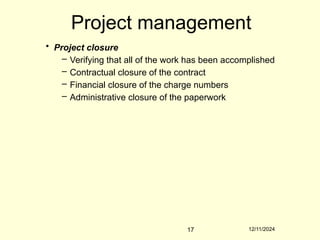
Project management
• Project closure
– Verifying that all of the work has been accomplished
– Contractual closure of the contract
– Financial closure of the charge numbers
– Administrative closure of the paperwork
first-18
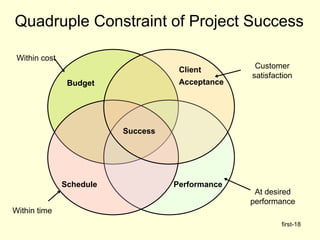
Quadruple Constraint of Project Success
Success
Budget
Client
Acceptance
Schedule Performance
Within time
Within cost
At desired
performance
Customer
satisfaction
What is Project Management?
• A project is a planned undertaking
• A project manager is a person who causes things
to happen
• Therefore, project management is causing a
planned undertaking to happen.
12/11/2024
20
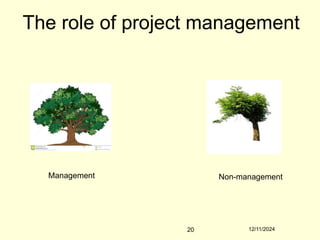
The role of project management
Management Non-management
12/11/2024
21
Benefits from project management
• Identification of functional responsibilities to ensure that
all activities are charged for, regardless of personal
turnover
• Minimizing the need for continuous reporting
• Identification of time limits for scheduling
• Identification of a methodology for trade-off analysis
• Measurement of accomplishment against plans
• Early identification of problems so that corrective action
may follow
• Improved estimated capability for future planning
• Knowing when objectives cannot be met or will be
exceeded
Project Manager Role
• Integrating the activities necessary to
develop a project plan
• Integrating the activities necessary to
execute the plan
• Integrating the activities necessary to
make changes to the plan
12/11/2024
23
Project Manager Role
Managing relationships:
- Within the project team
- Between the project team and the functional organizations
- Between the project team and senior management
- Between the project team and the customer's organization,
whether an internal or external organization
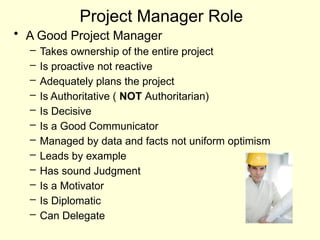
Project Manager Role
• A Good Project Manager
– Takes ownership of the entire project
– Is proactive not reactive
– Adequately plans the project
– Is Authoritative ( NOT Authoritarian)
– Is Decisive
– Is a Good Communicator
– Managed by data and facts not uniform optimism
– Leads by example
– Has sound Judgment
– Is a Motivator
– Is Diplomatic
– Can Delegate
first-25
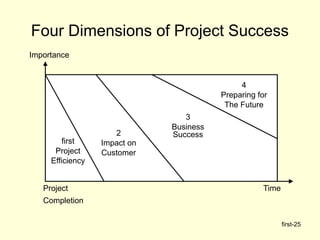
Four Dimensions of Project Success
Project
Completion
Time
Importance
first
Project
Efficiency
4
Preparing for
The Future
2
Impact on
Customer
3
Business
Success
first-26
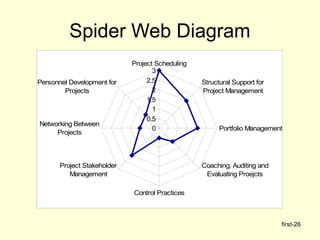
Spider Web Diagram
0
0.5
1
1.5
2
2.5
3
Project Scheduling
Structural Support for
Project Management
Portfolio Management
Coaching, Auditing and
Evaluating Proejcts
Control Practices
Project Stakeholder
Management
Networking Between
Projects
Personnel Development for
Projects
first-27
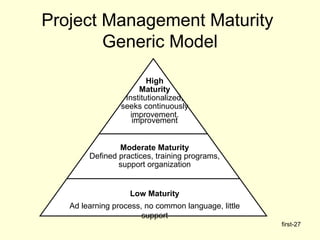
Project Management Maturity
Generic Model
Low Maturity
Ad learning process, no common language, little
support
Moderate Maturity
Defined practices, training programs,
support organization
High
Maturity
Institutionalized,
seeks continuously
improvement.
improvement
first-28
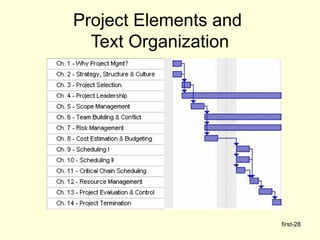
Project Elements and
Text Organization
first-29
Project management Plan - PMP
 Master Document for Project
 Defines the following:-
 Project Objectives, Scope, Deliverables
 Stakeholders (Internal & External)
 Work to be done (WBS)
 Project Organization and Resources (OBS)
 Project Costings (CBS)
 Project Schedule
 Procurement/Contract Strategy
 Risk Management
 Quality management
 Change Management
Project Planning
Project Planning
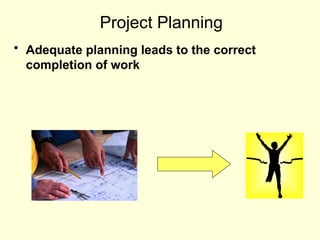
• Adequate planning leads to the correct
completion of work
Planning
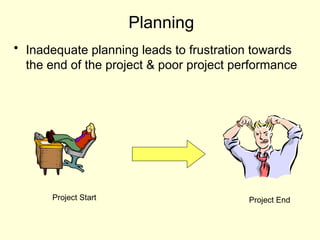
• Inadequate planning leads to frustration towards
the end of the project & poor project performance
Project Start Project End
Work Breakdown Structure (WBS)
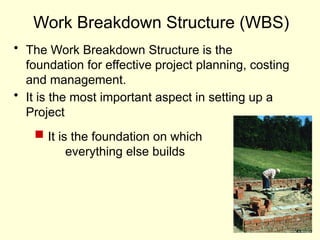
• The Work Breakdown Structure is the
foundation for effective project planning, costing
and management.
• It is the most important aspect in setting up a
Project
 It is the foundation on which
everything else builds
Work Breakdown Structure -
Definition
“A Work Breakdown Structure (WBS) is a
hierarchical (from general to specific) tree
structure of deliverables and tasks that need to
be performed to complete a project.”
Project Planning – WBS (1)
 Lowest Level of WBS is the Work Package
(WP)
 WP can be clearly defined allowing package
to be costed , scheduled and resourced
 WP contains a list of Tasks to be Performed
that form the basis for the Schedule
 WP allows assignment of responsibilities
(Work Package Manger, WPM)
Project Planning – WBS (2)
 WBS allows hierarchical build-up of costs
and schedule
 Cost and Schedule can be reported at any
level of the WBS
 WBS facilitates strong management during
project execution (Cost and Schedule
control)
 WBS can be used for many other things -
Document Management, Risk Management
etc.
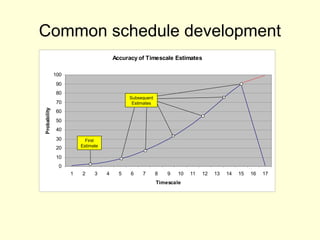
Project Planning
 A word about Scheduling
– Schedules (task durations) can have a wide
variation
– There is no unique answer. Rather, there is a
statistical variation depending on assumptions
– Need to understand the basis of scheduling
(Most challenging; Most likely; Absolute certainty
- bet your life on it!)
– Most people are very/naive optimistic
Common schedule development
Accuracy of Timescale Estimates
0
10
20
30
40
50
60
70
80
90
100
1 2 3 4 5 6 7 8 9 10 11 12 13 14 15 16 17
Timescale
Probability
First
Estimate
Subsequent
Estimates
Project Planning – Key Points
• Recognize that adequate project planning is
essential
• Produce a sound WBS
• Use the framework provided by the Project
Management Plan (PMP) template
• Involve the right people
• Allow enough time
• Be systematic
Project Risk Management
Project Risk – Definition (1)
“Project risk is an uncertain event or condition that,
if it occurs, has a positive or negative effect on a
project objective”
Project Risk – Definition (2)
“A combination of the probability of a defined threat
or opportunity (Likelihood) and the magnitude of
the consequences of the occurrence (Impact)
defines a Risk Index”
Risk Impact
Threat → Scope → Poor Quality Product
Threat → Schedule → Late Delivery
Threat → Cost → Overspend
• In addition there are health, safety and
environmental threats that must be managed
Risk Management Process
• Identify Risks
• Assess likelihood and impact
• Rank risks and priorities
• Define risk management approach & actions
• Implement actions
• Monitor & review
Risk Management – Key Points
• Make the management of risk integral to the way
the project is managed
• Ensure that cost and time contingencies are
consistent with identified risks
• Focus on the “significant few” – don't try to
manage too many risks
• Be vigilant and proactive
Project Monitoring and Control
Project Monitoring
• Typical Monitoring Activities
– regular reviews of progress against schedule using WBS
as basis (Plan against Baseline)
– regular review of actual costs (O/P from SAP) against
budgeted costs and Earned Value at WBS level
– regular review of resource loading
– regular progress meetings with project team
– regular meetings with contractors
– production of progress periodic reports
– risk reviews
– inspections/ audits
Project Control
• Typical Control Activities
– assign responsibilities at Work Package level
– staged authorization of work to be done
– staged release of budgets (staged release of WBS(e)
numbers)
– ensure PM has a 'Management Reserve' under his
control
– seek corrective action reports when work packages go
'off track' (overrunning or overspending)
– release Management Reserve carefully
Project Monitoring and Control
Summary
• Monitor against the plan – status regularly
• Take a factual approach to decisions
• Identify management action early
• Check that defined controls are being applied –
correct if necessary
• Apply change control
Introduction to Design
Management
Design Management
• Design takes place as part of a project
• Design Management is part of Project
Management
• Design Management considerations must be
included in the PMP
Design Stages
• Conceptual Design
• Scheme Design
• Detailed Design
Conceptual Design Phase
• Develop Conceptual Design
• Define Constraints & Interfaces
• Carry out Conceptual Design Review
• Initiate Safety Case Modification if required
• Obtain Approval to Proceed to next stage
Scheme and Detailed Design
• Basic considerations and processes similar to
concept
• Need to ensure that safety & environmental
issues receive proper consideration as design
develops
Safety & Environment
• Need to ensure that safety & environmental issues
receive proper consideration as design develops
– Involve the right people from the start
– Systematically identify issues – Hazards/Risks,
Environmental Aspects & Impacts
– Carry out rigorous reviews at each design stage
– Control Design Changes
• MUST take note of CDM Regulations
CDM Regulations
• CDM - Construction (Design & Management)
• Regulations recently updated
• Now there must be someone in EACH Project
Responsible for CDM
• Currently information is on the Conceptual,
Scheme & Detailed Design steps on the Process
Maps
• More information will be developed over the
coming months
Design Change control
• Needs to be a formal and defined procedure
• New procedure
Confirm Completion
• Ensure design records are complete and
accurate
• Ensure any outstanding actions or issues are
addressed
• Ensure Maintenance Records are produced
• Ensure User Manuals are produced
• Hold a formal Post Project review

Chapter 1 Overview project mângement.ppt

  • 1.
  • 2.
    first-2 Introduction • Examples ofprojects – Split the atom – Tunnel between England and France – Introduce Windows 8 – Disneyland's Expedition Everest “Projects, rather than repetitive tasks, are now the basis for most value-added in business” -Tom Peters
  • 3.
    first-3 Project vs. ProcessWork Project • Take place outside the process world • Unique and separate from normal organizational work • Continuously evolving Process • Ongoing, day-to-day activities • Use existing systems, properties, and capabilities • periodically repetitive A project is a temporary endeavor undertaken to create a unique product or service. PMBoK 2000
  • 4.
    first-4 Additional Definitions • Aproject is a unique venture with a beginning and an end, conducted by people to meet established goals within parameters of cost, schedule and quality. Buchanan & Boddy 92 • Projects are goal-oriented, involve the coordinated undertaking of interrelated activities, are of finite duration, and are all, to a degree unique. Frame 95
  • 5.
    first-5 Elements of Projects •Complex , one-time processes • Limited by budget, schedule, and resources • Developed to resolve a clear goal or set of goals • Customer-focused
  • 6.
    first-6 General Project Characteristics(1/2) • Ad-hoc endeavors with a clear life cycle • Building blocks in the design and execution of organizational strategies • Responsible for the newest and most improved products , services, and organizational processes • Provide a philosophy and strategy for the management of change
  • 7.
    first-7 General Project Characteristics(2/2) • Entail crossing functional and organizational boundaries • Traditional management functions of planning, organizing, motivating, directing, and controlling apply • Principal outcomes are the satisfaction of customer requirements within technical , cost , and schedule constraints. constraints • Terminated upon successful completion
  • 8.
    first-8 Process & ProjectManagement (Table 1.1) Process 1. Repeat process or product 2. Several objectives 3. Ongoing 4. People are homogeneous 5. Systems in place to integrate efforts 6. Performance, cost, & time known 7. Part of the line organization 8. Bastions of established practice 9. Supports status quo Project 1. New process or product 2. One objective 3. One shot – limited life 4. More heterogeneous 5. Systems must be created to integrate efforts 6. Performance, cost & time less certain 7. Outside of line organization 8. Violates established practice 9. Upsets status quo
  • 9.
    A Project first-9 A projectcan be considered to be any series of activities and tasks that: - Have a specific objective to be completed within certain specifications - Have defined start and end dates - Have funding limits - Consume human and nonhuman resources - Are multifunctional
  • 10.
    first-10 Why are ProjectsImportant? 1. Shortened product life cycles 2. Narrow product launch windows 3. Increasingly complex and technical products 4. Emergence of global markets 5. Economic period marked by low inflation
  • 11.
    first-11 Project Life Cycles ManHours Conceptualization Planning Execution Termination Fig 1.3 Project Life Cycle Stages
  • 12.
    first-12 Project Life Cycles •Conceptualization - the development of the initial goal and technical specifications. • Planning – all detailed specifications, schedules, schematics, and plans are developed • Execution – the actual “work” of the project is performed • Termination – project is transferred to the customer, resources reassigned, project is closed out.
  • 13.
    first-13 Project Life Cyclesand Their Effects Conceptualization Planning Execution Termination Uncertainty Client Interest Project Stake Creativity Resources Fig 1.4
  • 14.
    What is ProjectManagement? • The art of organizing, leading, reporting and completing a project through people
  • 15.
    12/11/2024 15 Project management Project managementinvolves project planning and project monitoring and includes such items as: • Project initiation – Selection of the best project given resource limits – Recognizing the benefits of the project – Preparation of the documents to approve the project – Assigning of the project manager • Project planning – Definition of the work requirements – Definition of the quality and quantity of work – Definition of the resources needed – Scheduling the activities – Evaluation of the various risks
  • 16.
    12/11/2024 16 Project management • Projectexecution – Negotiating for the project team members – Directing and managing the work – Working with the team members to help them improve • Project monitoring and control – Tracking progress – Comparing actual outcome to predicted outcome – Analyzing variances and impacts – Making adjustments
  • 17.
    12/11/2024 17 Project management • Projectclosure – Verifying that all of the work has been accomplished – Contractual closure of the contract – Financial closure of the charge numbers – Administrative closure of the paperwork
  • 18.
    first-18 Quadruple Constraint ofProject Success Success Budget Client Acceptance Schedule Performance Within time Within cost At desired performance Customer satisfaction
  • 19.
    What is ProjectManagement? • A project is a planned undertaking • A project manager is a person who causes things to happen • Therefore, project management is causing a planned undertaking to happen.
  • 20.
    12/11/2024 20 The role ofproject management Management Non-management
  • 21.
    12/11/2024 21 Benefits from projectmanagement • Identification of functional responsibilities to ensure that all activities are charged for, regardless of personal turnover • Minimizing the need for continuous reporting • Identification of time limits for scheduling • Identification of a methodology for trade-off analysis • Measurement of accomplishment against plans • Early identification of problems so that corrective action may follow • Improved estimated capability for future planning • Knowing when objectives cannot be met or will be exceeded
  • 22.
    Project Manager Role •Integrating the activities necessary to develop a project plan • Integrating the activities necessary to execute the plan • Integrating the activities necessary to make changes to the plan
  • 23.
    12/11/2024 23 Project Manager Role Managingrelationships: - Within the project team - Between the project team and the functional organizations - Between the project team and senior management - Between the project team and the customer's organization, whether an internal or external organization
  • 24.
    Project Manager Role •A Good Project Manager – Takes ownership of the entire project – Is proactive not reactive – Adequately plans the project – Is Authoritative ( NOT Authoritarian) – Is Decisive – Is a Good Communicator – Managed by data and facts not uniform optimism – Leads by example – Has sound Judgment – Is a Motivator – Is Diplomatic – Can Delegate
  • 25.
    first-25 Four Dimensions ofProject Success Project Completion Time Importance first Project Efficiency 4 Preparing for The Future 2 Impact on Customer 3 Business Success
  • 26.
    first-26 Spider Web Diagram 0 0.5 1 1.5 2 2.5 3 ProjectScheduling Structural Support for Project Management Portfolio Management Coaching, Auditing and Evaluating Proejcts Control Practices Project Stakeholder Management Networking Between Projects Personnel Development for Projects
  • 27.
    first-27 Project Management Maturity GenericModel Low Maturity Ad learning process, no common language, little support Moderate Maturity Defined practices, training programs, support organization High Maturity Institutionalized, seeks continuously improvement. improvement
  • 28.
  • 29.
  • 30.
    Project management Plan- PMP  Master Document for Project  Defines the following:-  Project Objectives, Scope, Deliverables  Stakeholders (Internal & External)  Work to be done (WBS)  Project Organization and Resources (OBS)  Project Costings (CBS)  Project Schedule  Procurement/Contract Strategy  Risk Management  Quality management  Change Management
  • 31.
  • 32.
    Project Planning • Adequateplanning leads to the correct completion of work
  • 33.
    Planning • Inadequate planningleads to frustration towards the end of the project & poor project performance Project Start Project End
  • 34.
    Work Breakdown Structure(WBS) • The Work Breakdown Structure is the foundation for effective project planning, costing and management. • It is the most important aspect in setting up a Project  It is the foundation on which everything else builds
  • 35.
    Work Breakdown Structure- Definition “A Work Breakdown Structure (WBS) is a hierarchical (from general to specific) tree structure of deliverables and tasks that need to be performed to complete a project.”
  • 36.
    Project Planning –WBS (1)  Lowest Level of WBS is the Work Package (WP)  WP can be clearly defined allowing package to be costed , scheduled and resourced  WP contains a list of Tasks to be Performed that form the basis for the Schedule  WP allows assignment of responsibilities (Work Package Manger, WPM)
  • 37.
    Project Planning –WBS (2)  WBS allows hierarchical build-up of costs and schedule  Cost and Schedule can be reported at any level of the WBS  WBS facilitates strong management during project execution (Cost and Schedule control)  WBS can be used for many other things - Document Management, Risk Management etc.
  • 38.
    Project Planning  Aword about Scheduling – Schedules (task durations) can have a wide variation – There is no unique answer. Rather, there is a statistical variation depending on assumptions – Need to understand the basis of scheduling (Most challenging; Most likely; Absolute certainty - bet your life on it!) – Most people are very/naive optimistic
  • 39.
    Common schedule development Accuracyof Timescale Estimates 0 10 20 30 40 50 60 70 80 90 100 1 2 3 4 5 6 7 8 9 10 11 12 13 14 15 16 17 Timescale Probability First Estimate Subsequent Estimates
  • 40.
    Project Planning –Key Points • Recognize that adequate project planning is essential • Produce a sound WBS • Use the framework provided by the Project Management Plan (PMP) template • Involve the right people • Allow enough time • Be systematic
  • 41.
  • 42.
    Project Risk –Definition (1) “Project risk is an uncertain event or condition that, if it occurs, has a positive or negative effect on a project objective”
  • 43.
    Project Risk –Definition (2) “A combination of the probability of a defined threat or opportunity (Likelihood) and the magnitude of the consequences of the occurrence (Impact) defines a Risk Index”
  • 44.
    Risk Impact Threat →Scope → Poor Quality Product Threat → Schedule → Late Delivery Threat → Cost → Overspend • In addition there are health, safety and environmental threats that must be managed
  • 45.
    Risk Management Process •Identify Risks • Assess likelihood and impact • Rank risks and priorities • Define risk management approach & actions • Implement actions • Monitor & review
  • 46.
    Risk Management –Key Points • Make the management of risk integral to the way the project is managed • Ensure that cost and time contingencies are consistent with identified risks • Focus on the “significant few” – don't try to manage too many risks • Be vigilant and proactive
  • 47.
  • 48.
    Project Monitoring • TypicalMonitoring Activities – regular reviews of progress against schedule using WBS as basis (Plan against Baseline) – regular review of actual costs (O/P from SAP) against budgeted costs and Earned Value at WBS level – regular review of resource loading – regular progress meetings with project team – regular meetings with contractors – production of progress periodic reports – risk reviews – inspections/ audits
  • 49.
    Project Control • TypicalControl Activities – assign responsibilities at Work Package level – staged authorization of work to be done – staged release of budgets (staged release of WBS(e) numbers) – ensure PM has a 'Management Reserve' under his control – seek corrective action reports when work packages go 'off track' (overrunning or overspending) – release Management Reserve carefully
  • 50.
    Project Monitoring andControl Summary • Monitor against the plan – status regularly • Take a factual approach to decisions • Identify management action early • Check that defined controls are being applied – correct if necessary • Apply change control
  • 51.
  • 52.
    Design Management • Designtakes place as part of a project • Design Management is part of Project Management • Design Management considerations must be included in the PMP
  • 53.
    Design Stages • ConceptualDesign • Scheme Design • Detailed Design
  • 54.
    Conceptual Design Phase •Develop Conceptual Design • Define Constraints & Interfaces • Carry out Conceptual Design Review • Initiate Safety Case Modification if required • Obtain Approval to Proceed to next stage
  • 55.
    Scheme and DetailedDesign • Basic considerations and processes similar to concept • Need to ensure that safety & environmental issues receive proper consideration as design develops
  • 56.
    Safety & Environment •Need to ensure that safety & environmental issues receive proper consideration as design develops – Involve the right people from the start – Systematically identify issues – Hazards/Risks, Environmental Aspects & Impacts – Carry out rigorous reviews at each design stage – Control Design Changes • MUST take note of CDM Regulations
  • 57.
    CDM Regulations • CDM- Construction (Design & Management) • Regulations recently updated • Now there must be someone in EACH Project Responsible for CDM • Currently information is on the Conceptual, Scheme & Detailed Design steps on the Process Maps • More information will be developed over the coming months
  • 58.
    Design Change control •Needs to be a formal and defined procedure • New procedure
  • 59.
    Confirm Completion • Ensuredesign records are complete and accurate • Ensure any outstanding actions or issues are addressed • Ensure Maintenance Records are produced • Ensure User Manuals are produced • Hold a formal Post Project review