Developing adult social work
effectiveness evaluation
THL, FinSoc-team 2
Goal-oriented adult social work
as a target for evaluation
3THL, FinSoc-team 3
The characteristics of goal-oriented adult social work
• The goal of social work
• The object of social work
• Social work methods
• Contextual and situational factors
• Mechanisms
THL, FinSoc-team 4
Adult social-work effectiveness
evaluation project
THL, FinSoc-team 5
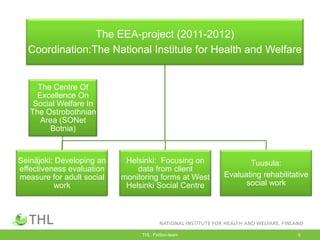
The EEA-project (2011-2012)
Coordination:The National Institute for Health and Welfare
Seinäjoki: Developing an
effectiveness evaluation
measure for adult social
work
The Centre Of
Excellence On
Social Welfare In
The Ostrobothnian
Area (SONet
Botnia)
Helsinki: Focusing on
data from client
monitoring forms at West
Helsinki Social Centre
Tuusula:
Evaluating rehabilitative
social work
THL, FinSoc-team 6
Design: single-case evaluation
THL, FinSoc-team 7
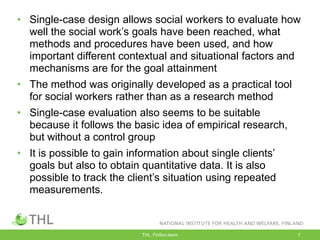
• Single-case design allows social workers to evaluate how
well the social work‟s goals have been reached, what
methods and procedures have been used, and how
important different contextual and situational factors and
mechanisms are for the goal attainment
• The method was originally developed as a practical tool
for social workers rather than as a research method
• Single-case evaluation also seems to be suitable
because it follows the basic idea of empirical research,
but without a control group
• It is possible to gain information about single clients‟
goals but also to obtain quantitative data. It is also
possible to track the client‟s situation using repeated
measurements.
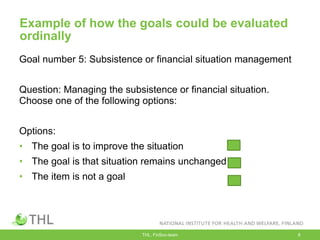
Example of how the goals could be evaluated
ordinally
Goal number 5: Subsistence or financial situation management
Question: Managing the subsistence or financial situation.
Choose one of the following options:
Options:
• The goal is to improve the situation
• The goal is that situation remains unchanged
• The item is not a goal
THL, FinSoc-team 8
THL, FinSoc-team 9
A framework for the measure:
realist evaluation
THL, FinSoc-team 10
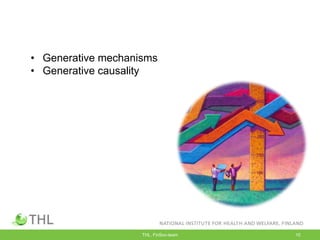
• Generative mechanisms
• Generative causality
THL, FinSoc-team 11
Developing the KEY-measure for
adult social-work effectiveness
evaluation
• Questions about the goals, methods and
procedures of social work and about the
client‟s situation.
• Testing period: November 2011 – August
2012 (10 months)
• Single-case design: Evaluation phase I &
Evaluation phase II
• Evaluation I: 209 client-cases
• Evaluation II: 172 cases
THL, FinSoc-team 12
THL, FinSoc-team 13
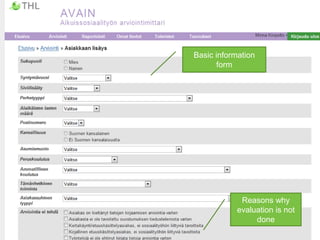
Basic information
form
Reasons why
evaluation is not
done
THL, FinSoc-team 14
Results from adult social-work
effectiveness evaluation
THL, FinSoc-team 15
0 10 20 30 40 50 60 70 80 90
Concern about the close personal relationships
Leisure activities and opportunities for participation
The consequences of anti-social behaviour
Physical problems caused by illness
Child's needs
Substance abuse and consequences
Problems related to mental illnessess
Rental housing situation in the area
Substance use
Social skills
Client's relationships
Mental health
Development of service system
Proceeding with further education
Client's possibility to access housing
Inclusion and participation (eg. hobbies)
Self-esteem
Awareness of the problems due to the society
Getting in to further education
Fluency of everyday life
Life management
Access to housing; keeping it
Clearing up the debt situation
Promoting the employment situation (for long-term…
Supporting client's occupational capabilities
Supporting client's problem-solving capabilities
Service management for a client
Employment, searching for a job
Client's control over his/her economic situation
Women (%)
(N=110)
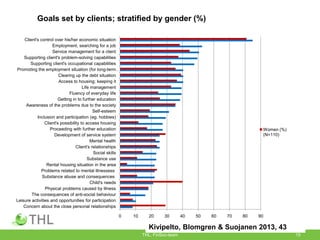
Goals set by clients; stratified by gender (%)
Kivipelto, Blomgren & Suojanen 2013, 43
THL, FinSoc-team 16
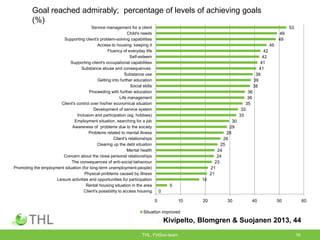
Goal reached admirably; percentage of levels of achieving goals
(%)
Kivipelto, Blomgren & Suojanen 2013, 44
0
5
18
21
21
23
24
24
25
26
28
29
30
33
33
35
36
36
38
39
39
41
41
42
42
45
49
49
53
0 10 20 30 40 50 60
Client's possibility to access housing
Rental housing situation in the area
Leisure activities and opportunities for participation
Physical problems caused by illness
Promoting the employment situation (for long-term unemployment-people)
The consequences of anti-social behaviour
Concern about the close personal relationships
Mental health
Clearing up the debt situation
Client's relationships
Problems related to mental illness
Awareness of problems due to the society
Employment situation, searching for a job
Inclusion and participation (eg. hobbies)
Development of service system
Client's control over his/her economical situation
Life management
Proceeding with further education
Social skills
Getting into further education
Substance use
Substance abuse and consequences
Supporting client's occupational capabilities
Self-esteem
Fluency of everyday life
Access to housing; keeping it
Supporting client's problem-solving capabilities
Child's needs
Service management for a client
Situation improved
THL, FinSoc-team 17
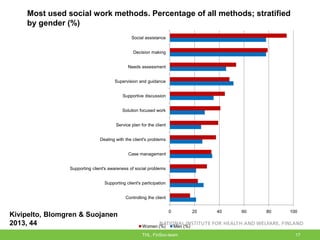
0 20 40 60 80 100
Controlling the client
Supporting client's participation
Supporting client's awareness of social problems
Case management
Dealing with the client's problems
Service plan for the client
Solution focused work
Supportive discussion
Supervision and guidance
Needs assessment
Decision making
Social assistance
Women (%) Men (%)
Most used social work methods. Percentage of all methods; stratified
by gender (%)
Kivipelto, Blomgren & Suojanen
2013, 44
THL, FinSoc-team 18
0 10 20 30 40 50 60 70
Values and attitudes in the living area
Access to the environment
Client's cultural background
The demographic structure of living area
Substance abuse of family members
Concern about the close people
Substance abuse / addictions
Client's mental health
Mental health and well-being
Client's employment situation
Satisfaction of relationships/adequacy
Client's lifestyle
Client's economic situation
Client's physical health
Possibility to access health related technology
Awareness of the bacground determinants behind…
Possibility to influence
Leisure activities and opportunities for participation
Client's ability/motive to plan his/her economic situation
Client's occupation
Seeing solutions and alternatives
Employment and occupational situations
Internet connectivity
Client's self-esteem
Living conditions
Client's motivation
Possibilities to be heard
Service provision / availability of services
Client's attitudes towards the services
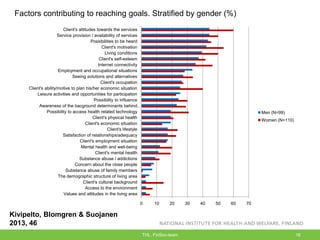
Men (N=99)
Women (N=110)
Kivipelto, Blomgren & Suojanen
2013, 46
Factors contributing to reaching goals. Stratified by gender (%)
THL, FinSoc-team 19
26
10
48
14
27
44
Supportive methods were not used * Used 1-2 supportive methods)* Used 3-4 supportive methods*
Men (%) Women (%)
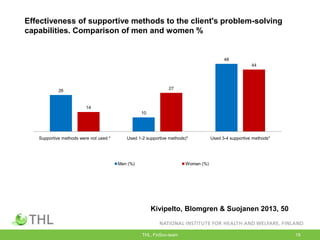
Effectiveness of supportive methods to the client's problem-solving
capabilities. Comparison of men and women %
Kivipelto, Blomgren & Suojanen 2013, 50
THL, FinSoc-team 20
Single-case evaluation fits well
for evaluating social-work with
adults
Advantages
• It was seen as important to integrate
systematic inquiry within adult social
work
• The evaluation measure development
was also an attempt to make the data
collection easier and more systematic
THL, FinSoc-team 21
Difficulties
• Social workers found it difficult to incorporate the use of the
measure into practical social work, even though the
information required for the measure was largely the same
information they needed in client work
• Single-case evaluation is best suited for those situations that
require long-term social work
• Many clients just “disappeared” and the second phase of
evaluation could not be undertaken
• More work is still needed to develop a programme theory that
works well
THL, FinSoc-team 22
THL, FinSoc-team 23
Towards evidence-based
social work
THL, FinSoc-team 24
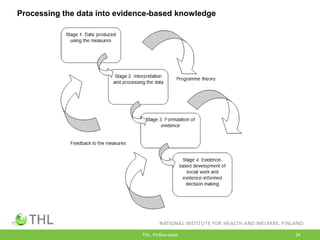
Processing the data into evidence-based knowledge
References
• Blomgren S, Kivipelto M (2012) Valtaistus. Aikuissosiaalityön valtakunnallinen
kartoitus [National Survey of Adult Social Work], Report 27, Helsinki: National
Institute for Health and Welfare (THL).
• Bloom M, Fischer J, Orme J G (2009) Evaluating practice: Guidelines for the
accountable professional, 6th edition, Boston: Allyn & Bacon.
• Cohen B J (2011) Design-based practice: A new perspective for social work, Social
Work, 56(4): 337–346.
• Fischer J, Corcoran K (2007) Measures for Clinical Practice and Research. A
sourcebook. Volume 1. Couples, Families and Children, Fourth Edition, New York:
Oxford University Press.
• Gray M, Plath D, Webb S (2009) Evidence-based social work. A critical
stance, London: Routledge.
• Howe D (2009) A brief introduction to social work theory, Basingstoke: Palgrave
Macmillan.
• Juhila K (2008) ‟Aikuisten parissa tehtävän sosiaalityön yhteiskunnallinen paikka‟
[Social Locus of Social Work With Adults], in A Jokinen and K Juhila
(eds), Sosiaalityö aikuisten parissa [Social Work With Adults], Tampere: Vastapaino:
48–81.
THL, FinSoc-team 25
• Julnes G, Mark M M (1998) „Evaluation as sensemaking: Knowledge construction in
a realist world‟, in G T Henry, G Julnes and M M Mark (eds) Realist Evaluation: An
Emerging Theory In Support Of Practice: New Directions For Evaluation 1998(78):
33–52.
• Kazi M, Wilson J (1996) „Applying single-case evaluation in social work‟, British
Journal of Social Work 26(5): 699–717.
• Kivipelto M, Blomgren S, Suojanen R (2013)‟ AVAIN-mittarin kehittäminen Seinäjoen
sosiaalivirastossa‟ [Developing the KEY-measure in Seinäjoki social security office].
In M Kivipelto, S Blomgren, P Karjalainen and P Saikkonen. Vaikuttavaa
aikuissosiaalityötä – arviointimalleista mittareihin. [Effective adult social work – from
evaluation models to evaluation measures] Research and development project; final
report. Report 8, Helsinki: National Institute for Health and Welfare (THL).
• Kivipelto M, Blomgren S (2012) „Social work with adults as a tool for tackling
exclusion‟, in S Karvonen, I Keskimäki, M Kuronen and K Wilskman (eds) Annual
review, Helsinki: National Institute for Health and Welfare (THL), 21–23.
• Pawson R, Manzano-Santaella A (2012) „A realist diagnostic workshop‟. Evaluation
8(2), 176–191.
• Pawson R, Tilley N (1997) Realistic Evaluation, London: Sage.
• Payne M (2005) Modern Social Work Theory, 3rd edition, Basingstoke: Palgrave
Macmillan.
• Pedersen L, Rieper O (2008) „Is realist evaluation a realistic approach for complex
reforms?‟ Evaluation 14(3), 271–293.
• Wong S E (2010) ‟Single-case evaluation designs for practitioners‟, Journal of Social
Service Research, 36(3): 248–259.
• THL, FinSoc-team 26

Project presentation 2013

  • 1.
    Developing adult socialwork effectiveness evaluation
  • 2.
    THL, FinSoc-team 2 Goal-orientedadult social work as a target for evaluation
  • 3.
    3THL, FinSoc-team 3 Thecharacteristics of goal-oriented adult social work • The goal of social work • The object of social work • Social work methods • Contextual and situational factors • Mechanisms
  • 4.
    THL, FinSoc-team 4 Adultsocial-work effectiveness evaluation project
  • 5.
    THL, FinSoc-team 5 TheEEA-project (2011-2012) Coordination:The National Institute for Health and Welfare Seinäjoki: Developing an effectiveness evaluation measure for adult social work The Centre Of Excellence On Social Welfare In The Ostrobothnian Area (SONet Botnia) Helsinki: Focusing on data from client monitoring forms at West Helsinki Social Centre Tuusula: Evaluating rehabilitative social work
  • 6.
    THL, FinSoc-team 6 Design:single-case evaluation
  • 7.
    THL, FinSoc-team 7 •Single-case design allows social workers to evaluate how well the social work‟s goals have been reached, what methods and procedures have been used, and how important different contextual and situational factors and mechanisms are for the goal attainment • The method was originally developed as a practical tool for social workers rather than as a research method • Single-case evaluation also seems to be suitable because it follows the basic idea of empirical research, but without a control group • It is possible to gain information about single clients‟ goals but also to obtain quantitative data. It is also possible to track the client‟s situation using repeated measurements.
  • 8.
    Example of howthe goals could be evaluated ordinally Goal number 5: Subsistence or financial situation management Question: Managing the subsistence or financial situation. Choose one of the following options: Options: • The goal is to improve the situation • The goal is that situation remains unchanged • The item is not a goal THL, FinSoc-team 8
  • 9.
    THL, FinSoc-team 9 Aframework for the measure: realist evaluation
  • 10.
    THL, FinSoc-team 10 •Generative mechanisms • Generative causality
  • 11.
    THL, FinSoc-team 11 Developingthe KEY-measure for adult social-work effectiveness evaluation
  • 12.
    • Questions aboutthe goals, methods and procedures of social work and about the client‟s situation. • Testing period: November 2011 – August 2012 (10 months) • Single-case design: Evaluation phase I & Evaluation phase II • Evaluation I: 209 client-cases • Evaluation II: 172 cases THL, FinSoc-team 12
  • 13.
    THL, FinSoc-team 13 Basicinformation form Reasons why evaluation is not done
  • 14.
    THL, FinSoc-team 14 Resultsfrom adult social-work effectiveness evaluation
  • 15.
    THL, FinSoc-team 15 010 20 30 40 50 60 70 80 90 Concern about the close personal relationships Leisure activities and opportunities for participation The consequences of anti-social behaviour Physical problems caused by illness Child's needs Substance abuse and consequences Problems related to mental illnessess Rental housing situation in the area Substance use Social skills Client's relationships Mental health Development of service system Proceeding with further education Client's possibility to access housing Inclusion and participation (eg. hobbies) Self-esteem Awareness of the problems due to the society Getting in to further education Fluency of everyday life Life management Access to housing; keeping it Clearing up the debt situation Promoting the employment situation (for long-term… Supporting client's occupational capabilities Supporting client's problem-solving capabilities Service management for a client Employment, searching for a job Client's control over his/her economic situation Women (%) (N=110) Goals set by clients; stratified by gender (%) Kivipelto, Blomgren & Suojanen 2013, 43
  • 16.
    THL, FinSoc-team 16 Goalreached admirably; percentage of levels of achieving goals (%) Kivipelto, Blomgren & Suojanen 2013, 44 0 5 18 21 21 23 24 24 25 26 28 29 30 33 33 35 36 36 38 39 39 41 41 42 42 45 49 49 53 0 10 20 30 40 50 60 Client's possibility to access housing Rental housing situation in the area Leisure activities and opportunities for participation Physical problems caused by illness Promoting the employment situation (for long-term unemployment-people) The consequences of anti-social behaviour Concern about the close personal relationships Mental health Clearing up the debt situation Client's relationships Problems related to mental illness Awareness of problems due to the society Employment situation, searching for a job Inclusion and participation (eg. hobbies) Development of service system Client's control over his/her economical situation Life management Proceeding with further education Social skills Getting into further education Substance use Substance abuse and consequences Supporting client's occupational capabilities Self-esteem Fluency of everyday life Access to housing; keeping it Supporting client's problem-solving capabilities Child's needs Service management for a client Situation improved
  • 17.
    THL, FinSoc-team 17 020 40 60 80 100 Controlling the client Supporting client's participation Supporting client's awareness of social problems Case management Dealing with the client's problems Service plan for the client Solution focused work Supportive discussion Supervision and guidance Needs assessment Decision making Social assistance Women (%) Men (%) Most used social work methods. Percentage of all methods; stratified by gender (%) Kivipelto, Blomgren & Suojanen 2013, 44
  • 18.
    THL, FinSoc-team 18 010 20 30 40 50 60 70 Values and attitudes in the living area Access to the environment Client's cultural background The demographic structure of living area Substance abuse of family members Concern about the close people Substance abuse / addictions Client's mental health Mental health and well-being Client's employment situation Satisfaction of relationships/adequacy Client's lifestyle Client's economic situation Client's physical health Possibility to access health related technology Awareness of the bacground determinants behind… Possibility to influence Leisure activities and opportunities for participation Client's ability/motive to plan his/her economic situation Client's occupation Seeing solutions and alternatives Employment and occupational situations Internet connectivity Client's self-esteem Living conditions Client's motivation Possibilities to be heard Service provision / availability of services Client's attitudes towards the services Men (N=99) Women (N=110) Kivipelto, Blomgren & Suojanen 2013, 46 Factors contributing to reaching goals. Stratified by gender (%)
  • 19.
    THL, FinSoc-team 19 26 10 48 14 27 44 Supportivemethods were not used * Used 1-2 supportive methods)* Used 3-4 supportive methods* Men (%) Women (%) Effectiveness of supportive methods to the client's problem-solving capabilities. Comparison of men and women % Kivipelto, Blomgren & Suojanen 2013, 50
  • 20.
    THL, FinSoc-team 20 Single-caseevaluation fits well for evaluating social-work with adults
  • 21.
    Advantages • It wasseen as important to integrate systematic inquiry within adult social work • The evaluation measure development was also an attempt to make the data collection easier and more systematic THL, FinSoc-team 21
  • 22.
    Difficulties • Social workersfound it difficult to incorporate the use of the measure into practical social work, even though the information required for the measure was largely the same information they needed in client work • Single-case evaluation is best suited for those situations that require long-term social work • Many clients just “disappeared” and the second phase of evaluation could not be undertaken • More work is still needed to develop a programme theory that works well THL, FinSoc-team 22
  • 23.
    THL, FinSoc-team 23 Towardsevidence-based social work
  • 24.
    THL, FinSoc-team 24 Processingthe data into evidence-based knowledge
  • 25.
    References • Blomgren S,Kivipelto M (2012) Valtaistus. Aikuissosiaalityön valtakunnallinen kartoitus [National Survey of Adult Social Work], Report 27, Helsinki: National Institute for Health and Welfare (THL). • Bloom M, Fischer J, Orme J G (2009) Evaluating practice: Guidelines for the accountable professional, 6th edition, Boston: Allyn & Bacon. • Cohen B J (2011) Design-based practice: A new perspective for social work, Social Work, 56(4): 337–346. • Fischer J, Corcoran K (2007) Measures for Clinical Practice and Research. A sourcebook. Volume 1. Couples, Families and Children, Fourth Edition, New York: Oxford University Press. • Gray M, Plath D, Webb S (2009) Evidence-based social work. A critical stance, London: Routledge. • Howe D (2009) A brief introduction to social work theory, Basingstoke: Palgrave Macmillan. • Juhila K (2008) ‟Aikuisten parissa tehtävän sosiaalityön yhteiskunnallinen paikka‟ [Social Locus of Social Work With Adults], in A Jokinen and K Juhila (eds), Sosiaalityö aikuisten parissa [Social Work With Adults], Tampere: Vastapaino: 48–81. THL, FinSoc-team 25
  • 26.
    • Julnes G,Mark M M (1998) „Evaluation as sensemaking: Knowledge construction in a realist world‟, in G T Henry, G Julnes and M M Mark (eds) Realist Evaluation: An Emerging Theory In Support Of Practice: New Directions For Evaluation 1998(78): 33–52. • Kazi M, Wilson J (1996) „Applying single-case evaluation in social work‟, British Journal of Social Work 26(5): 699–717. • Kivipelto M, Blomgren S, Suojanen R (2013)‟ AVAIN-mittarin kehittäminen Seinäjoen sosiaalivirastossa‟ [Developing the KEY-measure in Seinäjoki social security office]. In M Kivipelto, S Blomgren, P Karjalainen and P Saikkonen. Vaikuttavaa aikuissosiaalityötä – arviointimalleista mittareihin. [Effective adult social work – from evaluation models to evaluation measures] Research and development project; final report. Report 8, Helsinki: National Institute for Health and Welfare (THL). • Kivipelto M, Blomgren S (2012) „Social work with adults as a tool for tackling exclusion‟, in S Karvonen, I Keskimäki, M Kuronen and K Wilskman (eds) Annual review, Helsinki: National Institute for Health and Welfare (THL), 21–23. • Pawson R, Manzano-Santaella A (2012) „A realist diagnostic workshop‟. Evaluation 8(2), 176–191. • Pawson R, Tilley N (1997) Realistic Evaluation, London: Sage. • Payne M (2005) Modern Social Work Theory, 3rd edition, Basingstoke: Palgrave Macmillan. • Pedersen L, Rieper O (2008) „Is realist evaluation a realistic approach for complex reforms?‟ Evaluation 14(3), 271–293. • Wong S E (2010) ‟Single-case evaluation designs for practitioners‟, Journal of Social Service Research, 36(3): 248–259. • THL, FinSoc-team 26