21 December 2009


                   MS Project Seminar

                          Eder J Alves, PMP
                           Program Manager
Agenda

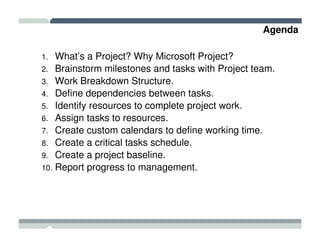
1.  What’s a Project? Why Microsoft Project?
2. Brainstorm milestones and tasks with Project team.
3. Work Breakdown Structure.
4. Define dependencies between tasks.
5. Identify resources to complete project work.
6. Assign tasks to resources.
7. Create custom calendars to define working time.
8. Create a critical tasks schedule.
9. Create a project baseline.
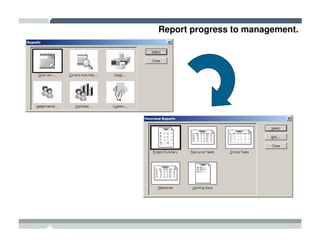
10. Report progress to management.
What’s a Project? Why Microsoft Project?

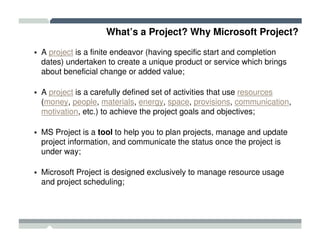
A project is a finite endeavor (having specific start and completion
dates) undertaken to create a unique product or service which brings
about beneficial change or added value;

A project is a carefully defined set of activities that use resources
(money, people, materials, energy, space, provisions, communication,
motivation, etc.) to achieve the project goals and objectives;

MS Project is a tool to help you to plan projects, manage and update
project information, and communicate the status once the project is
under way;

Microsoft Project is designed exclusively to manage resource usage
and project scheduling;
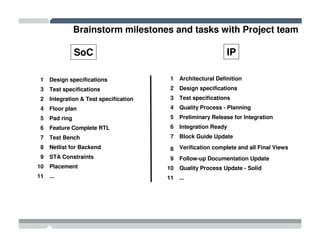
Brainstorm milestones and tasks with Project team

                SoC                                            IP

1    Design specifications              1    Architectural Definition
3    Test specifications                2    Design specifications
2    Integration & Test specification   3    Test specifications
4    Floor plan                         4    Quality Process - Planning
5    Pad ring                           5    Preliminary Release for Integration
6    Feature Complete RTL               6    Integration Ready
7    Test Bench                         7    Block Guide Update
8    Netlist for Backend                8    Verification complete and all Final Views
9    STA Constraints                    9    Follow-up Documentation Update
10   Placement                          10   Quality Process Update - Solid
11   ...                                11   ...
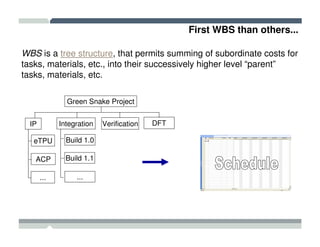
First WBS than others...

WBS is a tree structure, that permits summing of subordinate costs for
tasks, materials, etc., into their successively higher level “parent”
tasks, materials, etc.

               Green Snake Project


  IP         Integration   Verification   DFT

   eTPU        Build 1.0

   ACP         Build 1.1

       ...        ...
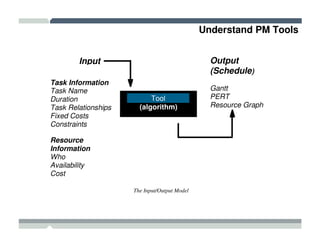
Understand PM Tools


        Input                                   Output
                                                (Schedule)
Task Information
Task Name                                       Gantt
Duration                   Tool
                     The “Black Box”            PERT
Task Relationships     (algorithm)              Resource Graph
Fixed Costs
Constraints

Resource
Information
Who
Availability
Cost

                     The Input/Output Model
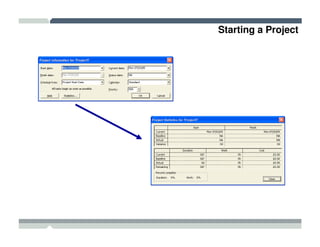
Starting a Project
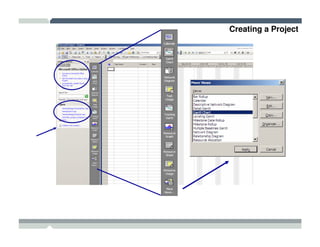
Creating a Project
Ways to view Project Data


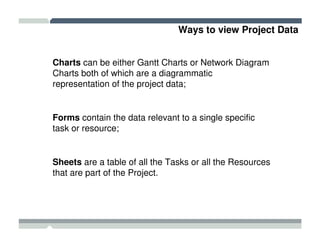
Charts can be either Gantt Charts or Network Diagram
Charts both of which are a diagrammatic
representation of the project data;


Forms contain the data relevant to a single specific
task or resource;


Sheets are a table of all the Tasks or all the Resources
that are part of the Project.
MS Project Menus – The Tool Bars


                                 Back

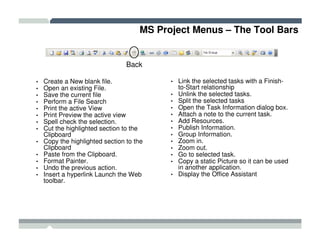
•   Create a New blank file.               •   Link the selected tasks with a Finish-
•   Open an existing File.                     to-Start relationship
•   Save the current file                  •   Unlink the selected tasks.
•   Perform a File Search                  •   Split the selected tasks
•   Print the active View                  •   Open the Task Information dialog box.
•   Print Preview the active view          •   Attach a note to the current task.
•   Spell check the selection.             •   Add Resources.
•   Cut the highlighted section to the     •   Publish Information.
    Clipboard                              •   Group Information.
•   Copy the highlighted section to the    •   Zoom in.
    Clipboard                              •   Zoom out.
•   Paste from the Clipboard.              •   Go to selected task.
•   Format Painter.                        •   Copy a static Picture so it can be used
•   Undo the previous action.                  in another application.
•   Insert a hyperlink Launch the Web      •   Display the Office Assistant
    toolbar.
Duration and Task Types

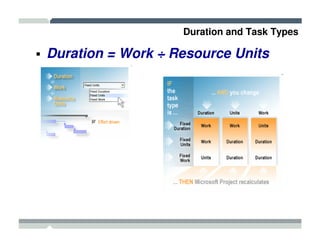
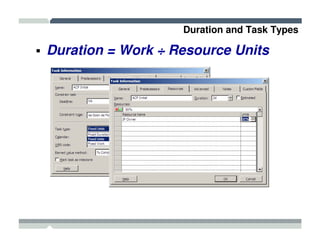
Duration = Work ÷ Resource Units
Duration and Task Types

Duration = Work ÷ Resource Units
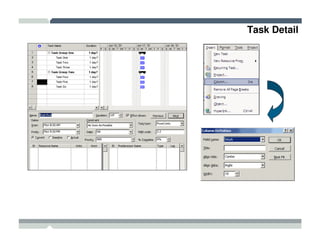
Task Detail
Dependency Links


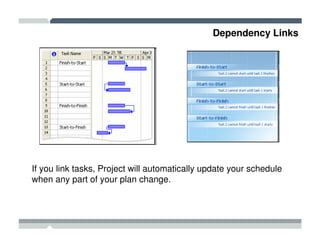
If you link tasks, Project will automatically update your schedule
when any part of your plan change.
Dependency Links


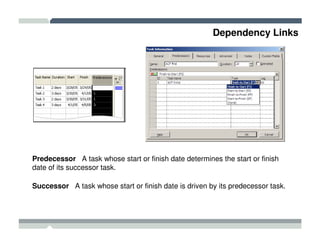
Predecessor A task whose start or finish date determines the start or finish
date of its successor task.

Successor A task whose start or finish date is driven by its predecessor task.
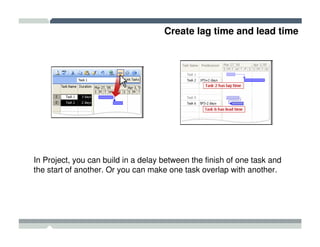
Create lag time and lead time


In Project, you can build in a delay between the finish of one task and
the start of another. Or you can make one task overlap with another.
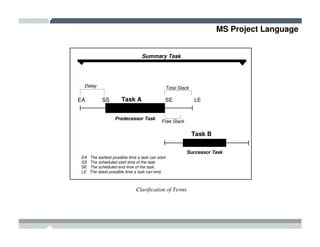
MS Project Language


                                  Summary Task


 Delay                                          Total Slack

EA          SS         Task A                   SE            LE


                   Predecessor Task
                                              Free Slack

                                                              Task B

                                                           Successor Task
EA   The earliest possible time a task can start.
SS   The scheduled start time of the task.
SE   The scheduled end time of the task.
LE   The latest possible time a task can end.


                               Clarification of Terms
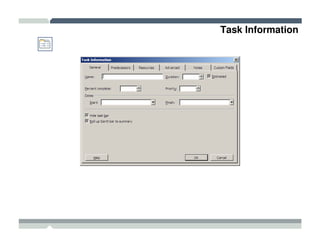
Task Information
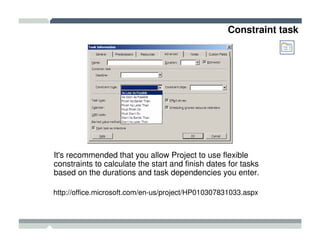
Constraint task


It's recommended that you allow Project to use flexible
constraints to calculate the start and finish dates for tasks
based on the durations and task dependencies you enter.

http://office.microsoft.com/en-us/project/HP010307831033.aspx
Constraint task


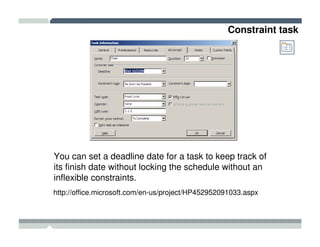
You can set a deadline date for a task to keep track of
its finish date without locking the schedule without an
inflexible constraints.
http://office.microsoft.com/en-us/project/HP452952091033.aspx
Assigning Resources


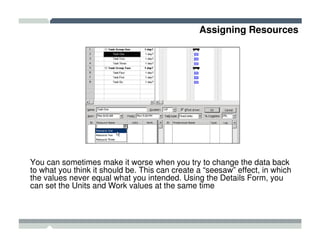
You can sometimes make it worse when you try to change the data back
to what you think it should be. This can create a “seesaw” effect, in which
the values never equal what you intended. Using the Details Form, you
can set the Units and Work values at the same time
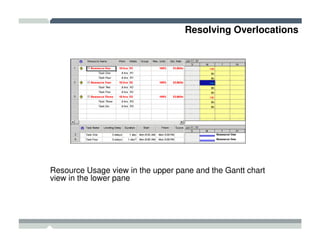
Resolving Overlocations


Resource Usage view in the upper pane and the Gantt chart
view in the lower pane
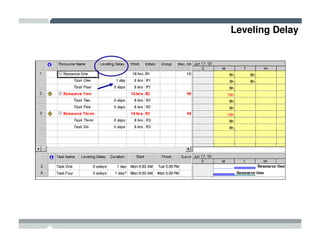
Leveling Delay
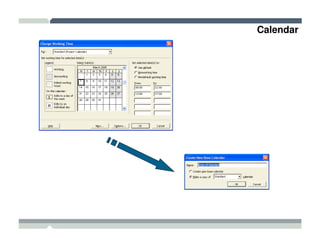
Calendar
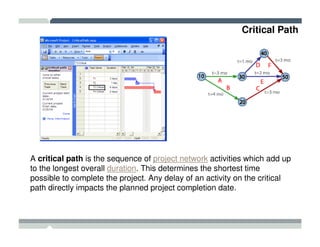
Critical Path


A critical path is the sequence of project network activities which add up
to the longest overall duration. This determines the shortest time
possible to complete the project. Any delay of an activity on the critical
path directly impacts the planned project completion date.
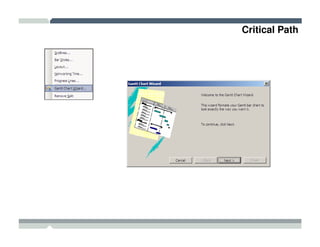
Critical Path
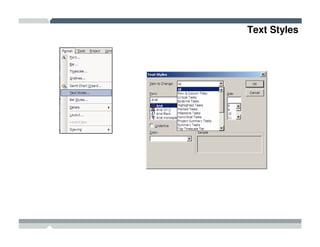
Text Styles
Baseline your project


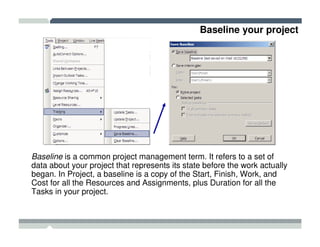
Baseline is a common project management term. It refers to a set of
data about your project that represents its state before the work actually
began. In Project, a baseline is a copy of the Start, Finish, Work, and
Cost for all the Resources and Assignments, plus Duration for all the
Tasks in your project.
Percentage complete


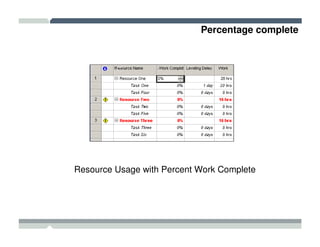
Resource Usage with Percent Work Complete
Actual Work


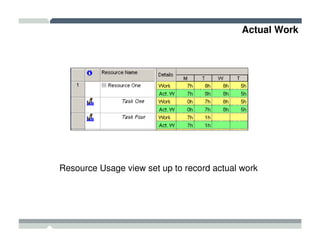
Resource Usage view set up to record actual work
Tracking Gantt view


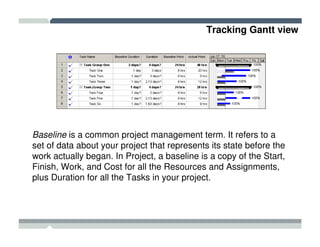
Baseline is a common project management term. It refers to a
set of data about your project that represents its state before the
work actually began. In Project, a baseline is a copy of the Start,
Finish, Work, and Cost for all the Resources and Assignments,
plus Duration for all the Tasks in your project.
Report progress to management.
21 December 2009


                   MS Project Seminar

                          Eder J Alves, PMP
                           Program Manager

Ms Project Workshop

  • 1.
    21 December 2009 MS Project Seminar Eder J Alves, PMP Program Manager
  • 2.
    Agenda 1. What’sa Project? Why Microsoft Project? 2. Brainstorm milestones and tasks with Project team. 3. Work Breakdown Structure. 4. Define dependencies between tasks. 5. Identify resources to complete project work. 6. Assign tasks to resources. 7. Create custom calendars to define working time. 8. Create a critical tasks schedule. 9. Create a project baseline. 10. Report progress to management.
  • 3.
    What’s a Project?Why Microsoft Project? A project is a finite endeavor (having specific start and completion dates) undertaken to create a unique product or service which brings about beneficial change or added value; A project is a carefully defined set of activities that use resources (money, people, materials, energy, space, provisions, communication, motivation, etc.) to achieve the project goals and objectives; MS Project is a tool to help you to plan projects, manage and update project information, and communicate the status once the project is under way; Microsoft Project is designed exclusively to manage resource usage and project scheduling;
  • 4.
    Brainstorm milestones andtasks with Project team SoC IP 1 Design specifications 1 Architectural Definition 3 Test specifications 2 Design specifications 2 Integration & Test specification 3 Test specifications 4 Floor plan 4 Quality Process - Planning 5 Pad ring 5 Preliminary Release for Integration 6 Feature Complete RTL 6 Integration Ready 7 Test Bench 7 Block Guide Update 8 Netlist for Backend 8 Verification complete and all Final Views 9 STA Constraints 9 Follow-up Documentation Update 10 Placement 10 Quality Process Update - Solid 11 ... 11 ...
  • 5.
    First WBS thanothers... WBS is a tree structure, that permits summing of subordinate costs for tasks, materials, etc., into their successively higher level “parent” tasks, materials, etc. Green Snake Project IP Integration Verification DFT eTPU Build 1.0 ACP Build 1.1 ... ...
  • 6.
    Understand PM Tools Input Output (Schedule) Task Information Task Name Gantt Duration Tool The “Black Box” PERT Task Relationships (algorithm) Resource Graph Fixed Costs Constraints Resource Information Who Availability Cost The Input/Output Model
  • 7.
  • 8.
  • 9.
    Ways to viewProject Data Charts can be either Gantt Charts or Network Diagram Charts both of which are a diagrammatic representation of the project data; Forms contain the data relevant to a single specific task or resource; Sheets are a table of all the Tasks or all the Resources that are part of the Project.
  • 10.
    MS Project Menus– The Tool Bars Back • Create a New blank file. • Link the selected tasks with a Finish- • Open an existing File. to-Start relationship • Save the current file • Unlink the selected tasks. • Perform a File Search • Split the selected tasks • Print the active View • Open the Task Information dialog box. • Print Preview the active view • Attach a note to the current task. • Spell check the selection. • Add Resources. • Cut the highlighted section to the • Publish Information. Clipboard • Group Information. • Copy the highlighted section to the • Zoom in. Clipboard • Zoom out. • Paste from the Clipboard. • Go to selected task. • Format Painter. • Copy a static Picture so it can be used • Undo the previous action. in another application. • Insert a hyperlink Launch the Web • Display the Office Assistant toolbar.
  • 11.
    Duration and TaskTypes Duration = Work ÷ Resource Units
  • 12.
    Duration and TaskTypes Duration = Work ÷ Resource Units
  • 13.
  • 14.
    Dependency Links If youlink tasks, Project will automatically update your schedule when any part of your plan change.
  • 15.
    Dependency Links Predecessor Atask whose start or finish date determines the start or finish date of its successor task. Successor A task whose start or finish date is driven by its predecessor task.
  • 16.
    Create lag timeand lead time In Project, you can build in a delay between the finish of one task and the start of another. Or you can make one task overlap with another.
  • 17.
    MS Project Language Summary Task Delay Total Slack EA SS Task A SE LE Predecessor Task Free Slack Task B Successor Task EA The earliest possible time a task can start. SS The scheduled start time of the task. SE The scheduled end time of the task. LE The latest possible time a task can end. Clarification of Terms
  • 18.
  • 19.
    Constraint task It's recommendedthat you allow Project to use flexible constraints to calculate the start and finish dates for tasks based on the durations and task dependencies you enter. http://office.microsoft.com/en-us/project/HP010307831033.aspx
  • 20.
    Constraint task You canset a deadline date for a task to keep track of its finish date without locking the schedule without an inflexible constraints. http://office.microsoft.com/en-us/project/HP452952091033.aspx
  • 21.
    Assigning Resources You cansometimes make it worse when you try to change the data back to what you think it should be. This can create a “seesaw” effect, in which the values never equal what you intended. Using the Details Form, you can set the Units and Work values at the same time
  • 22.
    Resolving Overlocations Resource Usageview in the upper pane and the Gantt chart view in the lower pane
  • 23.
  • 24.
  • 25.
    Critical Path A criticalpath is the sequence of project network activities which add up to the longest overall duration. This determines the shortest time possible to complete the project. Any delay of an activity on the critical path directly impacts the planned project completion date.
  • 26.
  • 27.
  • 28.
    Baseline your project Baselineis a common project management term. It refers to a set of data about your project that represents its state before the work actually began. In Project, a baseline is a copy of the Start, Finish, Work, and Cost for all the Resources and Assignments, plus Duration for all the Tasks in your project.
  • 29.
    Percentage complete Resource Usagewith Percent Work Complete
  • 30.
    Actual Work Resource Usageview set up to record actual work
  • 31.
    Tracking Gantt view Baselineis a common project management term. It refers to a set of data about your project that represents its state before the work actually began. In Project, a baseline is a copy of the Start, Finish, Work, and Cost for all the Resources and Assignments, plus Duration for all the Tasks in your project.
  • 32.
    Report progress tomanagement.
  • 33.
    21 December 2009 MS Project Seminar Eder J Alves, PMP Program Manager