What Is Social Work?
Chapter 1
Introduction to Social Work
Introduction
• Social work and social welfare are based on three
premises:
– That the person is important
– That he or she has personal, family, and community
problems resulting from interaction with others
– That something can be done to alleviate these
problems and enrich the individual’s life
Social Welfare
• The terms social work and social welfare are often
confused and sometimes used synonymously.
• Social welfare has a broader meaning and encompasses
social work, public welfare, and other related programs
and activities.
• Social welfare is described as “the organized system of
social services and institutions, designed to aid
individuals and groups to attain satisfying standards of
life and health”, (Friedlander, 1980).
Social Welfare
• Social welfare encompasses the well-being and
interests of large number of people, including
their physical, educational, mental, emotional,
spiritual, and economic needs.
• As reported in the Social Security Bulletin,
expenditures for social welfare under public law
amounted to $1,434.6 billion in fiscal year 1994.
Social Welfare
• Many professionals deliver social welfare
services, but social workers have always been
prominent welfare service providers.
• The U.S. Labor Department projects there will
be more than 650,000 social workers by the year
2005.
• Minimum traditional standards required a Master
of Social Work degree for the professional social
worker.
Social Work
• Social work seeks to enhance the social
functioning of individuals, singly and in groups,
by activities focused upon their social
relationships which constitute the interaction
between man and his environment. (CSWE,
1959)
Social Work
• These activities can be grouped into three
functions:
– Restoration of impaired capacity.
– Provision of individual and social resources.
– Prevention of social dysfunction.
The basic functions of social work are intertwined and
interdependent.
Social Work
• Restoration of impaired social functioning may be
subdivided into curative and rehabilitative aspects. Its
curative aspects are to eliminate factors that have
caused breakdown of functioning, and its rehabilitative
aspects, to reorganize and rebuild interaction patterns.
• Illustrations of restoration would include assistance in
obtaining a hearing aid for a partially deaf child or
helping a rejected lonely child to be placed in a foster
home.
Social Work
• The rehabilitative aspect might be helping the
one child to psychologically accept and live with
the hearing aid and supporting the other child as
he or she adjusts to the new foster home.
• Provision of resources, social and individual, for
more effective social functioning may be
subdivided into developmental and educational.
Social Work
• The developmental aspects are designed to further the
effectiveness of existing social resources or to bring to
full flower personal capacity for more effective social
interaction.
• An example would be the services of a Family Service
Society that help Mr. and Mrs. X, through individual
and conjoint interviews, to understand each other
better and to open the channels of meaningful
communication between them.
Social Work
• The educational spectrum is designed to
acquaint the public with specific conditions and
needs for new or changing social resources.
• Again, this could be illustrated by public talks
given by staff members of a Family Service
Society, in which counseling services are
described as a resource in alleviating marriage
and family problems.
Social Work
• The third function, prevention of social
dysfunction, involves early discovery, control,
and elimination of conditions and situations that
potentially could hamper effective social
functioning.
• Two main divisions: prevention of problems in
the area of interaction between individuals and
groups; the prevention of social ills.
Social Work
• Premarital counseling is an example of
prevention. That through this process couples
will be able to anticipate possible difficulties in
marital interaction.
• Prevention of social ills ordinarily falls within
the area of community organization.
• An example would be a community developing a
youth center for at risk youths for the
prevention of gang violence.
Social Work
• Social work may be defined as an art, a science, a
profession that helps people to solve personal,
group (especially family), and community
problems and to attain satisfying personal, group
and community relationships through social
work practice
• The major focus is on reducing problems in
human relationships and on enriching living
through improved human interaction.
Social Work
• Social work is an art; it requires great skills to
understand people and to help them to help themselves.
• It is a beginning science because of its problem solving
method and its attempt to be objective in ascertaining
facts and in developing principles and operational
concepts.
• It is a profession because it encompasses the attributes
of a profession.
Distinguishing Characteristics of
Social Work
• Focus is on the wholeness
and totality of the person.
• Emphasis is on the
importance of the family in
molding and influencing
behavior.
• Utilization of community
resources in helping people
to solve problems is very
important.
• Use of the supervisory
process provides for
guidance and direction of
inexperienced workers and
for continuing growth of the
experienced.
• Social work has a unique
educational program
involving class work and
practical field work
experience.
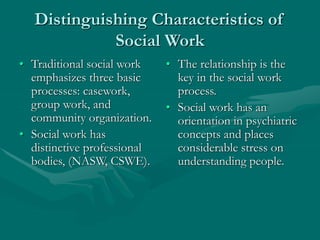
Distinguishing Characteristics of
Social Work
• Traditional social work
emphasizes three basic
processes: casework,
group work, and
community organization.
• Social work has
distinctive professional
bodies, (NASW, CSWE).
• The relationship is the
key in the social work
process.
• Social work has an
orientation in psychiatric
concepts and places
considerable stress on
understanding people.
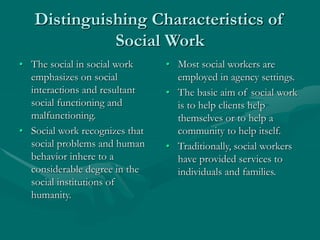
Distinguishing Characteristics of
Social Work
• The social in social work
emphasizes on social
interactions and resultant
social functioning and
malfunctioning.
• Social work recognizes that
social problems and human
behavior inhere to a
considerable degree in the
social institutions of
humanity.
• Most social workers are
employed in agency settings.
• The basic aim of social work
is to help clients help
themselves or to help a
community to help itself.
• Traditionally, social workers
have provided services to
individuals and families.
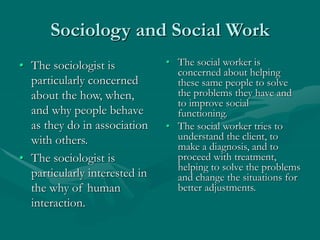
Sociology and Social Work
• The sociologist is
particularly concerned
about the how, when,
and why people behave
as they do in association
with others.
• The sociologist is
particularly interested in
the why of human
interaction.
• The social worker is
concerned about helping
these same people to solve
the problems they have and
to improve social
functioning.
• The social worker tries to
understand the client, to
make a diagnosis, and to
proceed with treatment,
helping to solve the problems
and change the situations for
better adjustments.
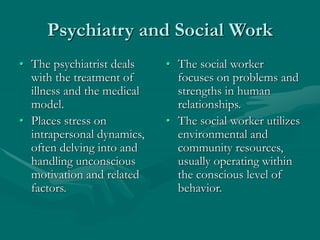
Psychiatry and Social Work
• The psychiatrist deals
with the treatment of
illness and the medical
model.
• Places stress on
intrapersonal dynamics,
often delving into and
handling unconscious
motivation and related
factors.
• The social worker
focuses on problems and
strengths in human
relationships.
• The social worker utilizes
environmental and
community resources,
usually operating within
the conscious level of
behavior.
Psychiatry and Social Work
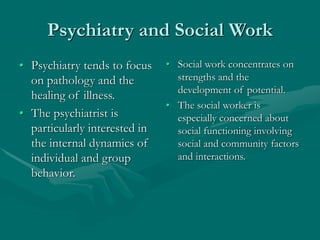
• Psychiatry tends to focus
on pathology and the
healing of illness.
• The psychiatrist is
particularly interested in
the internal dynamics of
individual and group
behavior.
• Social work concentrates on
strengths and the
development of potential.
• The social worker is
especially concerned about
social functioning involving
social and community factors
and interactions.
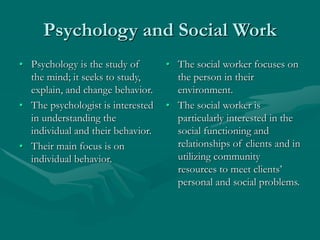
Psychology and Social Work
• Psychology is the study of
the mind; it seeks to study,
explain, and change behavior.
• The psychologist is interested
in understanding the
individual and their behavior.
• Their main focus is on
individual behavior.
• The social worker focuses on
the person in their
environment.
• The social worker is
particularly interested in the
social functioning and
relationships of clients and in
utilizing community
resources to meet clients’
personal and social problems.
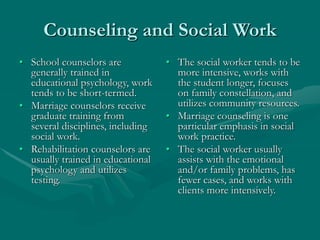
Counseling and Social Work
• School counselors are
generally trained in
educational psychology, work
tends to be short-termed.
• Marriage counselors receive
graduate training from
several disciplines, including
social work.
• Rehabilitation counselors are
usually trained in educational
psychology and utilizes
testing.
• The social worker tends to be
more intensive, works with
the student longer, focuses
on family constellation, and
utilizes community resources.
• Marriage counseling is one
particular emphasis in social
work practice.
• The social worker usually
assists with the emotional
and/or family problems, has
fewer cases, and works with
clients more intensively.
Social Work in the World Today
• Social work is becoming more important because
thousands of persons are benefiting from its services
and are telling their friends and associates who have
problems of its many values and services.
• A prominent American made a statement that what the
United States needs most of all to improve its foreign
policy and relations is to have trained social workers as
State Department attaches where each of the official
government representative works and lives.
Social Work in the World Today
• Trained social workers in foreign countries would
understand the people and work with them where they
are, helping them to help themselves and interpreting
the United States in a much more favorable light than
in the past.
• Social work is here to stay and that in decades ahead it
will likely grow and expand its services, helping more
people with personal, family, and community problems,
especially related to adequate social functioning.

Sw200 whatissocialwork

  • 1.
    What Is SocialWork? Chapter 1 Introduction to Social Work
  • 2.
    Introduction • Social workand social welfare are based on three premises: – That the person is important – That he or she has personal, family, and community problems resulting from interaction with others – That something can be done to alleviate these problems and enrich the individual’s life
  • 3.
    Social Welfare • Theterms social work and social welfare are often confused and sometimes used synonymously. • Social welfare has a broader meaning and encompasses social work, public welfare, and other related programs and activities. • Social welfare is described as “the organized system of social services and institutions, designed to aid individuals and groups to attain satisfying standards of life and health”, (Friedlander, 1980).
  • 4.
    Social Welfare • Socialwelfare encompasses the well-being and interests of large number of people, including their physical, educational, mental, emotional, spiritual, and economic needs. • As reported in the Social Security Bulletin, expenditures for social welfare under public law amounted to $1,434.6 billion in fiscal year 1994.
  • 5.
    Social Welfare • Manyprofessionals deliver social welfare services, but social workers have always been prominent welfare service providers. • The U.S. Labor Department projects there will be more than 650,000 social workers by the year 2005. • Minimum traditional standards required a Master of Social Work degree for the professional social worker.
  • 6.
    Social Work • Socialwork seeks to enhance the social functioning of individuals, singly and in groups, by activities focused upon their social relationships which constitute the interaction between man and his environment. (CSWE, 1959)
  • 7.
    Social Work • Theseactivities can be grouped into three functions: – Restoration of impaired capacity. – Provision of individual and social resources. – Prevention of social dysfunction. The basic functions of social work are intertwined and interdependent.
  • 8.
    Social Work • Restorationof impaired social functioning may be subdivided into curative and rehabilitative aspects. Its curative aspects are to eliminate factors that have caused breakdown of functioning, and its rehabilitative aspects, to reorganize and rebuild interaction patterns. • Illustrations of restoration would include assistance in obtaining a hearing aid for a partially deaf child or helping a rejected lonely child to be placed in a foster home.
  • 9.
    Social Work • Therehabilitative aspect might be helping the one child to psychologically accept and live with the hearing aid and supporting the other child as he or she adjusts to the new foster home. • Provision of resources, social and individual, for more effective social functioning may be subdivided into developmental and educational.
  • 10.
    Social Work • Thedevelopmental aspects are designed to further the effectiveness of existing social resources or to bring to full flower personal capacity for more effective social interaction. • An example would be the services of a Family Service Society that help Mr. and Mrs. X, through individual and conjoint interviews, to understand each other better and to open the channels of meaningful communication between them.
  • 11.
    Social Work • Theeducational spectrum is designed to acquaint the public with specific conditions and needs for new or changing social resources. • Again, this could be illustrated by public talks given by staff members of a Family Service Society, in which counseling services are described as a resource in alleviating marriage and family problems.
  • 12.
    Social Work • Thethird function, prevention of social dysfunction, involves early discovery, control, and elimination of conditions and situations that potentially could hamper effective social functioning. • Two main divisions: prevention of problems in the area of interaction between individuals and groups; the prevention of social ills.
  • 13.
    Social Work • Premaritalcounseling is an example of prevention. That through this process couples will be able to anticipate possible difficulties in marital interaction. • Prevention of social ills ordinarily falls within the area of community organization. • An example would be a community developing a youth center for at risk youths for the prevention of gang violence.
  • 14.
    Social Work • Socialwork may be defined as an art, a science, a profession that helps people to solve personal, group (especially family), and community problems and to attain satisfying personal, group and community relationships through social work practice • The major focus is on reducing problems in human relationships and on enriching living through improved human interaction.
  • 15.
    Social Work • Socialwork is an art; it requires great skills to understand people and to help them to help themselves. • It is a beginning science because of its problem solving method and its attempt to be objective in ascertaining facts and in developing principles and operational concepts. • It is a profession because it encompasses the attributes of a profession.
  • 16.
    Distinguishing Characteristics of SocialWork • Focus is on the wholeness and totality of the person. • Emphasis is on the importance of the family in molding and influencing behavior. • Utilization of community resources in helping people to solve problems is very important. • Use of the supervisory process provides for guidance and direction of inexperienced workers and for continuing growth of the experienced. • Social work has a unique educational program involving class work and practical field work experience.
  • 17.
    Distinguishing Characteristics of SocialWork • Traditional social work emphasizes three basic processes: casework, group work, and community organization. • Social work has distinctive professional bodies, (NASW, CSWE). • The relationship is the key in the social work process. • Social work has an orientation in psychiatric concepts and places considerable stress on understanding people.
  • 18.
    Distinguishing Characteristics of SocialWork • The social in social work emphasizes on social interactions and resultant social functioning and malfunctioning. • Social work recognizes that social problems and human behavior inhere to a considerable degree in the social institutions of humanity. • Most social workers are employed in agency settings. • The basic aim of social work is to help clients help themselves or to help a community to help itself. • Traditionally, social workers have provided services to individuals and families.
  • 19.
    Sociology and SocialWork • The sociologist is particularly concerned about the how, when, and why people behave as they do in association with others. • The sociologist is particularly interested in the why of human interaction. • The social worker is concerned about helping these same people to solve the problems they have and to improve social functioning. • The social worker tries to understand the client, to make a diagnosis, and to proceed with treatment, helping to solve the problems and change the situations for better adjustments.
  • 20.
    Psychiatry and SocialWork • The psychiatrist deals with the treatment of illness and the medical model. • Places stress on intrapersonal dynamics, often delving into and handling unconscious motivation and related factors. • The social worker focuses on problems and strengths in human relationships. • The social worker utilizes environmental and community resources, usually operating within the conscious level of behavior.
  • 21.
    Psychiatry and SocialWork • Psychiatry tends to focus on pathology and the healing of illness. • The psychiatrist is particularly interested in the internal dynamics of individual and group behavior. • Social work concentrates on strengths and the development of potential. • The social worker is especially concerned about social functioning involving social and community factors and interactions.
  • 22.
    Psychology and SocialWork • Psychology is the study of the mind; it seeks to study, explain, and change behavior. • The psychologist is interested in understanding the individual and their behavior. • Their main focus is on individual behavior. • The social worker focuses on the person in their environment. • The social worker is particularly interested in the social functioning and relationships of clients and in utilizing community resources to meet clients’ personal and social problems.
  • 23.
    Counseling and SocialWork • School counselors are generally trained in educational psychology, work tends to be short-termed. • Marriage counselors receive graduate training from several disciplines, including social work. • Rehabilitation counselors are usually trained in educational psychology and utilizes testing. • The social worker tends to be more intensive, works with the student longer, focuses on family constellation, and utilizes community resources. • Marriage counseling is one particular emphasis in social work practice. • The social worker usually assists with the emotional and/or family problems, has fewer cases, and works with clients more intensively.
  • 24.
    Social Work inthe World Today • Social work is becoming more important because thousands of persons are benefiting from its services and are telling their friends and associates who have problems of its many values and services. • A prominent American made a statement that what the United States needs most of all to improve its foreign policy and relations is to have trained social workers as State Department attaches where each of the official government representative works and lives.
  • 25.
    Social Work inthe World Today • Trained social workers in foreign countries would understand the people and work with them where they are, helping them to help themselves and interpreting the United States in a much more favorable light than in the past. • Social work is here to stay and that in decades ahead it will likely grow and expand its services, helping more people with personal, family, and community problems, especially related to adequate social functioning.