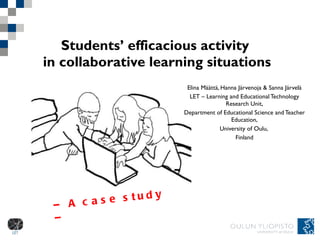
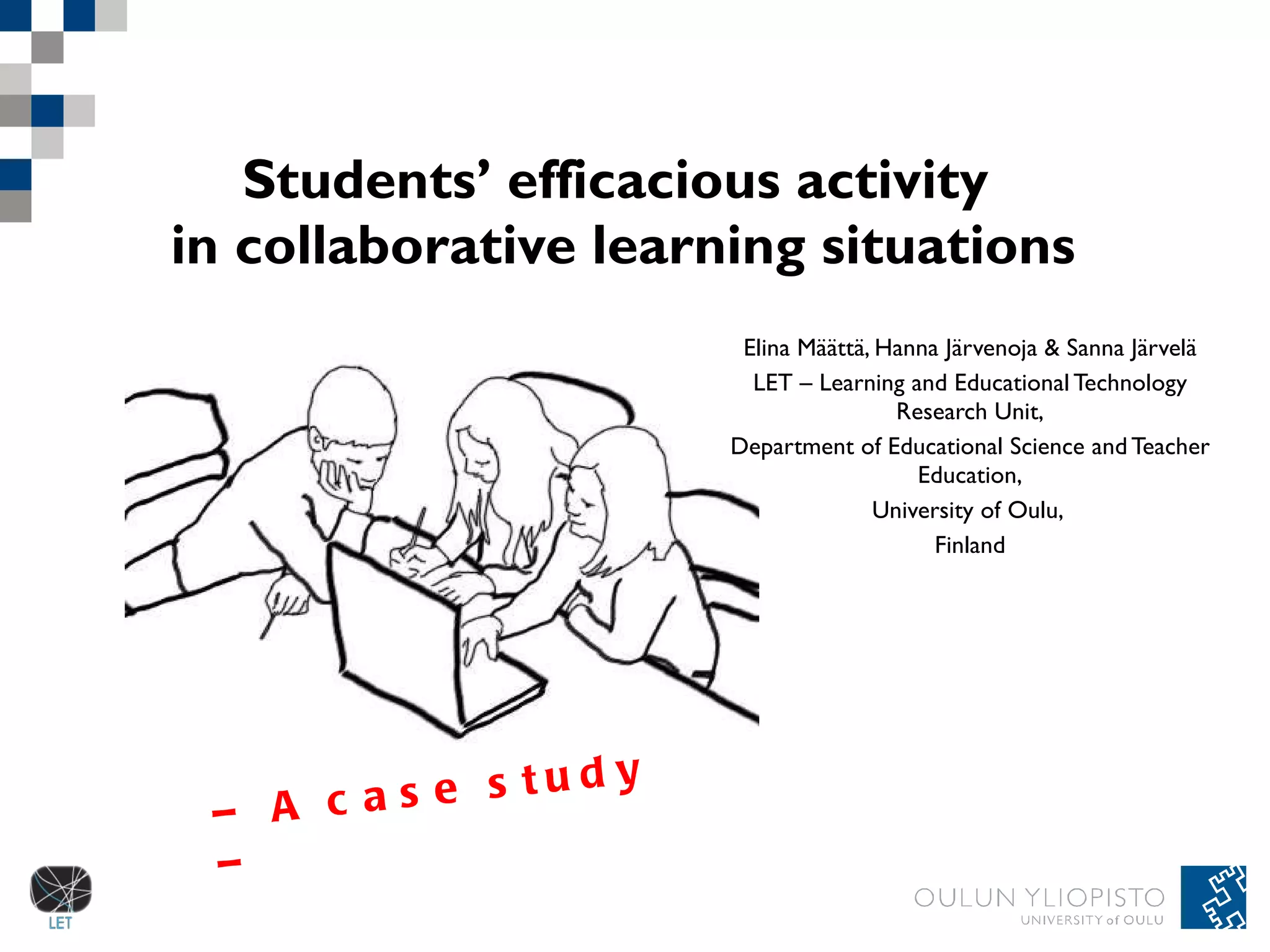
Students’ efficacious activity  in collaborative learning situations Elina Määttä, Hanna Järvenoja & Sanna Järvelä LET – Learning and Educational Technology Research Unit, Department of Educational Science and Teacher Education, University of Oulu,  Finland –  A case study –
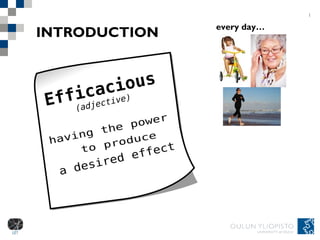
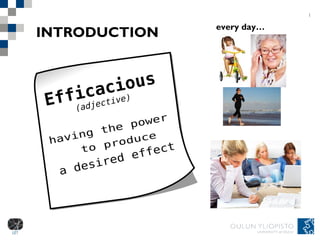
INTRODUCTION 1
INTRODUCTION 1 every day…
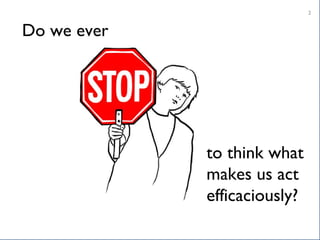
Do we ever to think what makes us act efficaciously? 2
THEORETICAL BACKGROUND 3 Efficacious activity in collaborative learning context = All group members contribute to solving the task and spent minimal time in off-task activities.
THEORETICAL BACKGROUND Research of learning and self-regulation  (e.g. Boekaerts, Pitrich & Zeidner, 2000; Zimmerman & Cleary, 2006; Bandura, 1997).  Research of small group interaction and collaborative learning  (e.g. Webb, 1992;  Järvelä, Volet & Järvenoja, 2010 ).  3 Efficacious activity in collaborative learning context = All group members contribute to solving the problem and spent minimal time in off-task activities.
AIMS OF THE STUDY 4 to define efficacious activity  to explore whether EA can be found from video observation data
AIMS OF THE STUDY 1.  WHAT KIND OF INTERACTIONS OCCUR DURING COLLABORATIVE LEARNING IN TERMS OF TASK INVOLVEMENT?  2.  WHAT TRIGGERS STUDENTS TO ENGAGE IN ON-TASK ACTIVITY? 4 to define efficacious activity  to explore whether EA can be found from video observation data
DATA   AND ANALYSIS Video observation data on children’s interaction collaborative learning situations (SCAMO project 2007). Sample consists of two groups of three students (N=6, 9-10 years).  20 videotaped lessons, resulting in over 10 hours of video observation data.  5
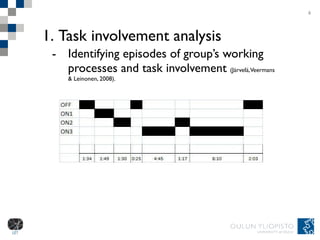
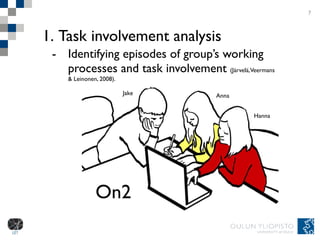
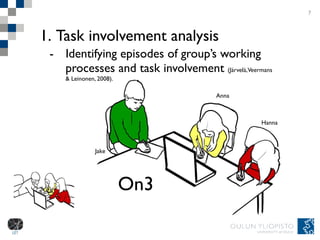
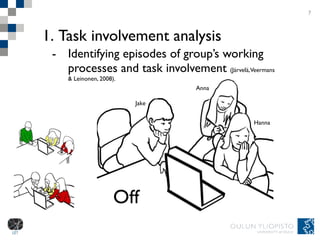
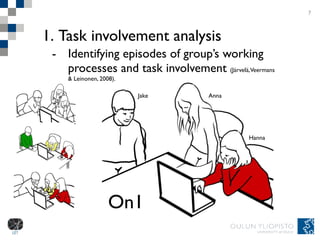
Task involvement analysis Identifying episodes of group’s working processes and task involvement  (Järvelä, Veermans & Leinonen, 2008).  6
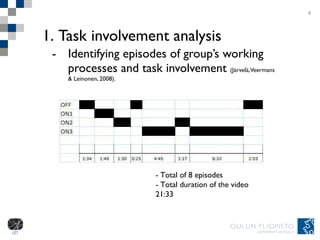
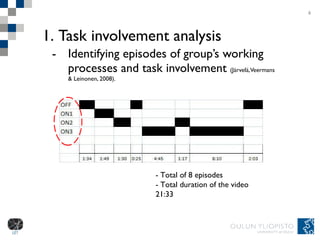
Task involvement analysis Identifying episodes of group’s working processes and task involvement  (Järvelä, Veermans & Leinonen, 2008).  6 - Total of 8 episodes  - Total duration of the video 21:33
Task involvement analysis Identifying episodes of group’s working processes and task involvement  (Järvelä, Veermans & Leinonen, 2008).  7 On2 Jake Anna Hanna
Task involvement analysis Identifying episodes of group’s working processes and task involvement  (Järvelä, Veermans & Leinonen, 2008).  7 On3 Jake Anna Hanna
Task involvement analysis Identifying episodes of group’s working processes and task involvement  (Järvelä, Veermans & Leinonen, 2008).  7 Off Anna Jake Hanna
Task involvement analysis Identifying episodes of group’s working processes and task involvement  (Järvelä, Veermans & Leinonen, 2008).  7 On1 Anna Jake Hanna
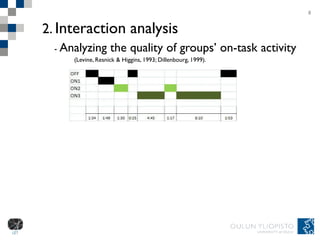
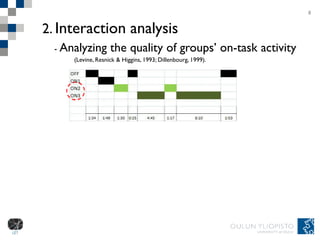
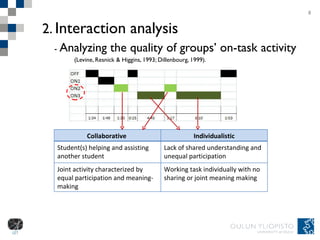
2.  Interaction analysis -  Analyzing the quality of groups’ on-task activity  (Levine, Resnick & Higgins, 1993; Dillenbourg, 1999).  8
2.  Interaction analysis -  Analyzing the quality of groups’ on-task activity  (Levine, Resnick & Higgins, 1993; Dillenbourg, 1999).  8 Collaborative  Individualistic Student(s) helping and assisting another student Lack of shared understanding and unequal participation Joint activity characterized by equal participation and meaning-making Working task individually with no sharing or joint meaning making
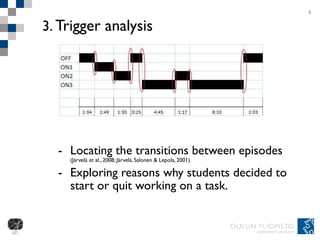
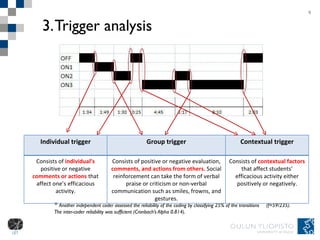
3.  Trigger analysis Locating the transitions between episodes  (Järvelä et al., 2008; Järvelä, Salonen & Lepola, 2001).  Exploring reasons why students decided to start or quit working on a task. 9
3. Trigger analysis *  Another independent coder assessed the reliability of the coding by classifying 25% of the transitions  (f=59/235). The inter-coder reliability was sufficient (Cronbach’s Alpha 0.814).  9 Individual trigger Group trigger Contextual trigger Consists of  individual’s  positive or negative  comments or actions  that affect one’s efficacious activity. Consists of positive or negative evaluation,  comments, and actions from others.  Social reinforcement can take the form of verbal praise or criticism or non-verbal communication such as smiles, frowns, and gestures. Consists of  contextual factors  that affect students’ efficacious activity either positively or negatively.
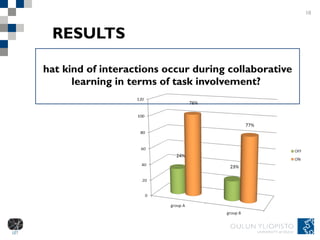
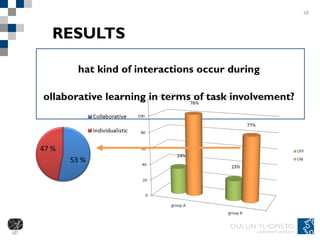
RESULTS What kind of interactions occur during collaborative learning in terms of task involvement?  10
RESULTS What kind of interactions occur during  collaborative learning in terms of task involvement?  10
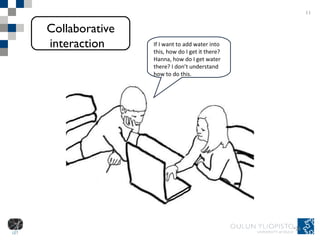
If I want to add water into this, how do I get it there? Hanna, how do I get water there? I don’t understand how to do this. Collaborative interaction  11
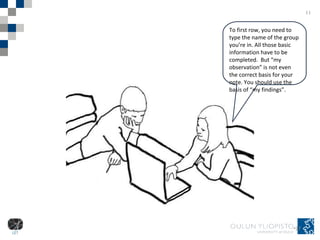
To first row, you need to type the name of the group you’re in. All those basic information have to be completed.  But “my observation” is not even the correct basis for your note. You should use the basis of “my findings”.  11
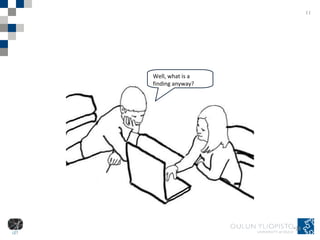
Well, what is a finding anyway? 11
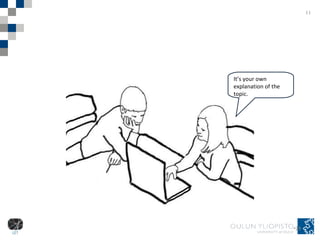
It’s your own explanation of the topic. 11
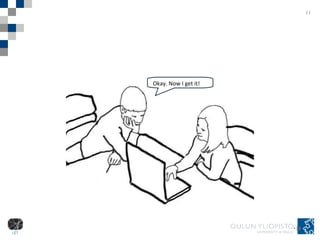
Okay. Now I get it! 11
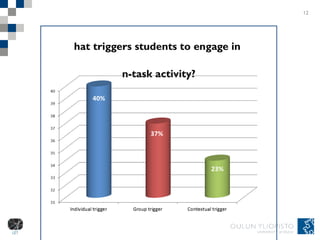
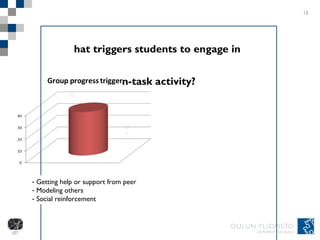
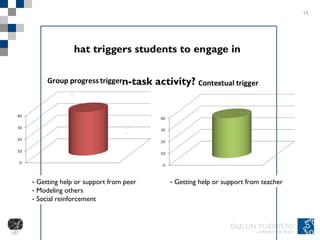
What triggers students to engage in  on-task activity? 12
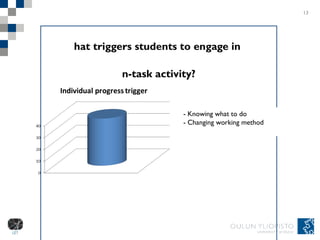
What triggers students to engage in  on-task activity? 13 - Knowing what to do - Changing working method
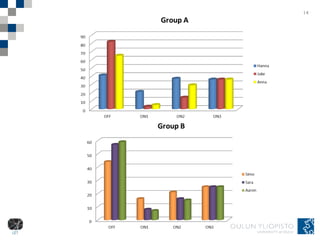
14
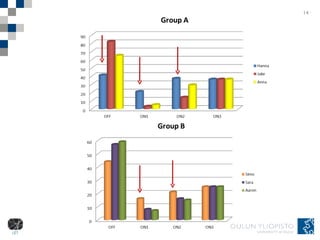
14
What triggers students to engage in  on-task activity? 15 Getting help or support from peer Modeling others Social reinforcement
What triggers students to engage in  on-task activity? 15 Getting help or support from peer Modeling others Social reinforcement Getting help or support from teacher
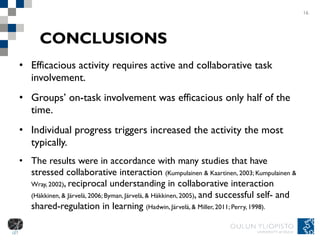
CONCLUSIONS  Efficacious activity requires active and collaborative task involvement. Groups’ on-task involvement was efficacious only half of the time. Individual progress triggers increased the activity the most typically. The results were in accordance with many studies that have stressed collaborative interaction  (Kumpulainen & Kaartinen, 2003; Kumpulainen & Wray, 2002) , reciprocal understanding in collaborative interaction  (Häkkinen, & Järvelä, 2006; Byman, Järvelä, & Häkkinen, 2005) , and successful self- and shared-regulation in learning  (Hadwin, Järvelä, & Miller, 2011; Perry, 1998). 16
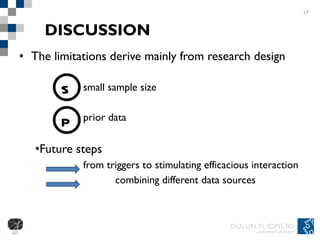
DISCUSSION The limitations derive mainly from research design small sample size  prior data Future steps from triggers to stimulating efficacious interaction combining different data sources  17 S P
SELECTED REFERENCES Bandura, A. (1997).  Self-efficacy: The exercise of control . New York:  Freeman. Boekaerts, M., Pintrich, P. R. & Zeidner, M. (2000). (Eds.).  Handbook of self-regulation . San Diego: Academic Press. Dillenbourg, P. (1999). (Ed.).  Collaborative learning: Cognitive and computational approaches.  Amsterdam, NL: Pergamon, Elsevier Science.  Järvelä, S., Salonen, P. & Lepola, J. (2001).  Dynamic assessment as a key to understanding student motivation in a classroom context. In P. Pintrich & M. Maehr (Eds .), Advances in research on motivation: New directions in measures and methods  (pp. 217-240). Greenwich, CT: JAI Press.  Järvelä, S., Veermans, M. & Leinonen, P. (2008).  Investigating students’ engagement in a computer-supported inquiry - a process-oriented analysis.  Social Psychology in Education,  3, 299–322. Järvelä, S., Volet, S. & Järvenoja, H.  (2010). Research on Motivation in Collaborative Learning: Moving beyond the cognitive-situative divide and combining individual and social processes.  Educational Psychologist, 45  (1), 15-27. Levine, J. M., Resnick, L. B. & Higgins, E. T. (1993). Social foundations of cognition.  Annual Review of Psychology, 44,  585-612.  Zimmerman, B. J., & Cleary, T. J. (2006). Adolescents’ development of personal agency: The role of self-efficacy beliefs and self-regulatory skill. In F. Pajares & T. Urdan (Eds.),  Self-efficacy beliefs of adolescents  (pp. 45–69). Greenwich, CT: Information Age. Webb, N. M., Troper, J. D., & Fall, R. (1995). Constructive activity and learning in collaborative small groups.  Journal of Educational Psychology, 87 , 406–423. 18
CREDITS Images Cover slide: Data snapshot, edited Mikko Määttä 1. www.clker.com, [note], edited Elina Määttä 2. Microsoft Clipart, [stop], edited Mikko Määttä 7. Data snapshot, edited Mikko Määttä 11. Data snapshot, edited Elina Määttä Photos 1. www.dreamstime.com, [kids playing],[woman running], [elderly] Last slide: www.kelloggforum.org, [thank you]
More information: Elina Määttä (elina.maatta@oulu.fi)

JURE 2011 presentation

  • 1.
    Students’ efficacious activity in collaborative learning situations Elina Määttä, Hanna Järvenoja & Sanna Järvelä LET – Learning and Educational Technology Research Unit, Department of Educational Science and Teacher Education, University of Oulu, Finland – A case study –
  • 2.
  • 3.
  • 4.
  • 5.
    Do we everto think what makes us act efficaciously? 2
  • 6.
    THEORETICAL BACKGROUND 3Efficacious activity in collaborative learning context = All group members contribute to solving the task and spent minimal time in off-task activities.
  • 7.
    THEORETICAL BACKGROUND Researchof learning and self-regulation (e.g. Boekaerts, Pitrich & Zeidner, 2000; Zimmerman & Cleary, 2006; Bandura, 1997). Research of small group interaction and collaborative learning (e.g. Webb, 1992; Järvelä, Volet & Järvenoja, 2010 ). 3 Efficacious activity in collaborative learning context = All group members contribute to solving the problem and spent minimal time in off-task activities.
  • 8.
    AIMS OF THESTUDY 4 to define efficacious activity to explore whether EA can be found from video observation data
  • 9.
    AIMS OF THESTUDY 1. WHAT KIND OF INTERACTIONS OCCUR DURING COLLABORATIVE LEARNING IN TERMS OF TASK INVOLVEMENT? 2. WHAT TRIGGERS STUDENTS TO ENGAGE IN ON-TASK ACTIVITY? 4 to define efficacious activity to explore whether EA can be found from video observation data
  • 10.
    DATA AND ANALYSIS Video observation data on children’s interaction collaborative learning situations (SCAMO project 2007). Sample consists of two groups of three students (N=6, 9-10 years). 20 videotaped lessons, resulting in over 10 hours of video observation data. 5
  • 11.
    Task involvement analysisIdentifying episodes of group’s working processes and task involvement (Järvelä, Veermans & Leinonen, 2008). 6
  • 12.
    Task involvement analysisIdentifying episodes of group’s working processes and task involvement (Järvelä, Veermans & Leinonen, 2008). 6
  • 13.
    Task involvement analysisIdentifying episodes of group’s working processes and task involvement (Järvelä, Veermans & Leinonen, 2008). 6 - Total of 8 episodes - Total duration of the video 21:33
  • 14.
    Task involvement analysisIdentifying episodes of group’s working processes and task involvement (Järvelä, Veermans & Leinonen, 2008). 6 - Total of 8 episodes - Total duration of the video 21:33
  • 15.
    Task involvement analysisIdentifying episodes of group’s working processes and task involvement (Järvelä, Veermans & Leinonen, 2008). 7 On2 Jake Anna Hanna
  • 16.
    Task involvement analysisIdentifying episodes of group’s working processes and task involvement (Järvelä, Veermans & Leinonen, 2008). 7 On3 Jake Anna Hanna
  • 17.
    Task involvement analysisIdentifying episodes of group’s working processes and task involvement (Järvelä, Veermans & Leinonen, 2008). 7 Off Anna Jake Hanna
  • 18.
    Task involvement analysisIdentifying episodes of group’s working processes and task involvement (Järvelä, Veermans & Leinonen, 2008). 7 On1 Anna Jake Hanna
  • 19.
    2. Interactionanalysis - Analyzing the quality of groups’ on-task activity (Levine, Resnick & Higgins, 1993; Dillenbourg, 1999). 8
  • 20.
    2. Interactionanalysis - Analyzing the quality of groups’ on-task activity (Levine, Resnick & Higgins, 1993; Dillenbourg, 1999). 8
  • 21.
    2. Interactionanalysis - Analyzing the quality of groups’ on-task activity (Levine, Resnick & Higgins, 1993; Dillenbourg, 1999). 8 Collaborative Individualistic Student(s) helping and assisting another student Lack of shared understanding and unequal participation Joint activity characterized by equal participation and meaning-making Working task individually with no sharing or joint meaning making
  • 22.
    3. Triggeranalysis Locating the transitions between episodes (Järvelä et al., 2008; Järvelä, Salonen & Lepola, 2001). Exploring reasons why students decided to start or quit working on a task. 9
  • 23.
    3. Trigger analysis* Another independent coder assessed the reliability of the coding by classifying 25% of the transitions (f=59/235). The inter-coder reliability was sufficient (Cronbach’s Alpha 0.814). 9 Individual trigger Group trigger Contextual trigger Consists of individual’s positive or negative comments or actions that affect one’s efficacious activity. Consists of positive or negative evaluation, comments, and actions from others. Social reinforcement can take the form of verbal praise or criticism or non-verbal communication such as smiles, frowns, and gestures. Consists of contextual factors that affect students’ efficacious activity either positively or negatively.
  • 24.
    RESULTS What kindof interactions occur during collaborative learning in terms of task involvement? 10
  • 25.
    RESULTS What kindof interactions occur during collaborative learning in terms of task involvement? 10
  • 26.
    If I wantto add water into this, how do I get it there? Hanna, how do I get water there? I don’t understand how to do this. Collaborative interaction 11
  • 27.
    To first row,you need to type the name of the group you’re in. All those basic information have to be completed. But “my observation” is not even the correct basis for your note. You should use the basis of “my findings”. 11
  • 28.
    Well, what isa finding anyway? 11
  • 29.
    It’s your ownexplanation of the topic. 11
  • 30.
    Okay. Now Iget it! 11
  • 31.
    What triggers studentsto engage in on-task activity? 12
  • 32.
    What triggers studentsto engage in on-task activity? 13 - Knowing what to do - Changing working method
  • 33.
  • 34.
  • 35.
    What triggers studentsto engage in on-task activity? 15 Getting help or support from peer Modeling others Social reinforcement
  • 36.
    What triggers studentsto engage in on-task activity? 15 Getting help or support from peer Modeling others Social reinforcement Getting help or support from teacher
  • 37.
    CONCLUSIONS Efficaciousactivity requires active and collaborative task involvement. Groups’ on-task involvement was efficacious only half of the time. Individual progress triggers increased the activity the most typically. The results were in accordance with many studies that have stressed collaborative interaction (Kumpulainen & Kaartinen, 2003; Kumpulainen & Wray, 2002) , reciprocal understanding in collaborative interaction (Häkkinen, & Järvelä, 2006; Byman, Järvelä, & Häkkinen, 2005) , and successful self- and shared-regulation in learning (Hadwin, Järvelä, & Miller, 2011; Perry, 1998). 16
  • 38.
    DISCUSSION The limitationsderive mainly from research design small sample size prior data Future steps from triggers to stimulating efficacious interaction combining different data sources 17 S P
  • 39.
    SELECTED REFERENCES Bandura,A. (1997). Self-efficacy: The exercise of control . New York: Freeman. Boekaerts, M., Pintrich, P. R. & Zeidner, M. (2000). (Eds.). Handbook of self-regulation . San Diego: Academic Press. Dillenbourg, P. (1999). (Ed.). Collaborative learning: Cognitive and computational approaches. Amsterdam, NL: Pergamon, Elsevier Science. Järvelä, S., Salonen, P. & Lepola, J. (2001). Dynamic assessment as a key to understanding student motivation in a classroom context. In P. Pintrich & M. Maehr (Eds .), Advances in research on motivation: New directions in measures and methods (pp. 217-240). Greenwich, CT: JAI Press. Järvelä, S., Veermans, M. & Leinonen, P. (2008). Investigating students’ engagement in a computer-supported inquiry - a process-oriented analysis. Social Psychology in Education, 3, 299–322. Järvelä, S., Volet, S. & Järvenoja, H.  (2010). Research on Motivation in Collaborative Learning: Moving beyond the cognitive-situative divide and combining individual and social processes. Educational Psychologist, 45 (1), 15-27. Levine, J. M., Resnick, L. B. & Higgins, E. T. (1993). Social foundations of cognition. Annual Review of Psychology, 44, 585-612. Zimmerman, B. J., & Cleary, T. J. (2006). Adolescents’ development of personal agency: The role of self-efficacy beliefs and self-regulatory skill. In F. Pajares & T. Urdan (Eds.), Self-efficacy beliefs of adolescents (pp. 45–69). Greenwich, CT: Information Age. Webb, N. M., Troper, J. D., & Fall, R. (1995). Constructive activity and learning in collaborative small groups. Journal of Educational Psychology, 87 , 406–423. 18
  • 40.
    CREDITS Images Coverslide: Data snapshot, edited Mikko Määttä 1. www.clker.com, [note], edited Elina Määttä 2. Microsoft Clipart, [stop], edited Mikko Määttä 7. Data snapshot, edited Mikko Määttä 11. Data snapshot, edited Elina Määttä Photos 1. www.dreamstime.com, [kids playing],[woman running], [elderly] Last slide: www.kelloggforum.org, [thank you]
  • 41.
    More information: ElinaMäättä (elina.maatta@oulu.fi)