PROJECT
MANAGEMENT:
THE INTEGRATION
MANAGEMENT
KNOWLEDGE AREA
Overview of Integration Management
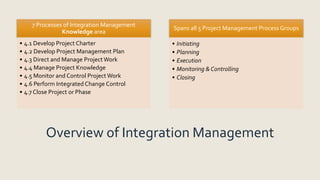
7 Processes of Integration Management
Knowledge area
• 4.1 Develop Project Charter
• 4.2 Develop Project Management Plan
• 4.3 Direct and Manage Project Work
• 4.4 Manage Project Knowledge
• 4.5 Monitor and Control Project Work
• 4.6 Perform Integrated Change Control
• 4.7 Close Project or Phase
Spans all 5 Project Management Process Groups
• Initiating
• Planning
• Execution
• Monitoring & Controlling
• Closing
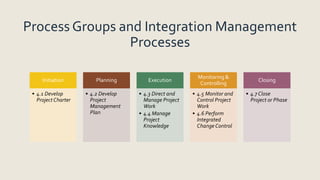
Process Groups and Integration Management
Processes
Initiation
• 4.1 Develop
ProjectCharter
Planning
• 4.2 Develop
Project
Management
Plan
Execution
• 4.3 Direct and
Manage Project
Work
• 4.4 Manage
Project
Knowledge
Monitoring &
Controlling
• 4.5 Monitor and
Control Project
Work
• 4.6 Perform
Integrated
Change Control
Closing
• 4.7 Close
Project or Phase
Overview of the
Integration
Management
Knowledge Area
■ Integration Management aids in creating
and coordinating a cohesive project
■ Justifies the existence of the Project
Manager
– Project Manager is responsible for
integrating the parts of the project
– Works with the least amount of
resources possible
– Works to complete things faster and
more efficient
■ Sponsor works to limit external risks to the
project
4.1 DEVELOP
PROJECT
CHARTER
Belongs to the
Initiating Project
Process Group
4.1 DEVELOP PROJECT CHARTER
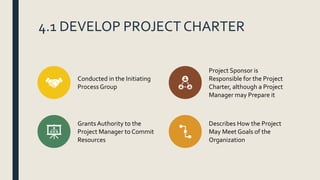
Conducted in the Initiating
Process Group
Project Sponsor is
Responsible for the Project
Charter, although a Project
Manager may Prepare it
GrantsAuthority to the
Project Manager to Commit
Resources
Describes How the Project
May Meet Goals of the
Organization
4.1 DEVELOP PROJECT CHARTER
Goals
• Provides authority to the project manager and the
existence of the project
• Create the Project Charter
Project Charter May Include
• A ProjectTitle and Description
• Project Sponsor(s), Project Manager, and High-
Level Project Manager Authority over the Project
• The Business Case isWritten to describe Why the
Project is Being Done
• Resource Estimates
• High-LevelThreats and Opportunities (Risks)
• Project Stakeholders andTheir Requirements
• High-Level Description of Deliverables and
Measurable Objectives to Reach Goals
• Project Acceptance Criteria
4.2 DEVELOP
PROJECT
MANAGEMENT
PLAN
Belongs to the
Planning Process
Group
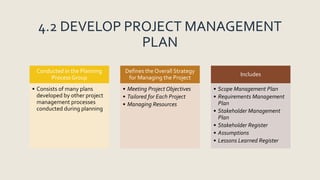
4.2 DEVELOP PROJECT MANAGEMENT
PLAN
Conducted in the Planning
Process Group
• Consists of many plans
developed by other project
management processes
conducted during planning
Defines the Overall Strategy
for Managing the Project
• Meeting Project Objectives
• Tailored for Each Project
• Managing Resources
Includes
• Scope Management Plan
• Requirements Management
Plan
• Stakeholder Management
Plan
• Stakeholder Register
• Assumptions
• Lessons Learned Register
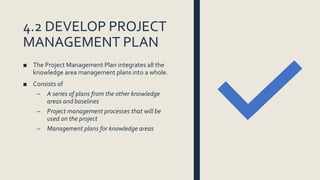
4.2 DEVELOP PROJECT
MANAGEMENT PLAN
■ The Project Management Plan integrates all the
knowledge area management plans into a whole.
■ Consists of
– A series of plans from the other knowledge
areas and baselines
– Project management processes that will be
used on the project
– Management plans for knowledge areas
COMPONENTS OF A
PROJECT
MANAGEMENT
PLAN
4.2 DEVELOP PROJECT MANAGEMENT PLAN
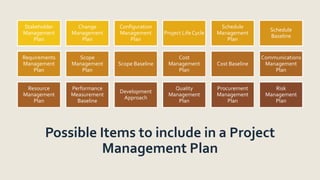
Possible Items to include in a Project
Management Plan
Stakeholder
Management
Plan
Change
Management
Plan
Configuration
Management
Plan
Project Life Cycle
Schedule
Management
Plan
Schedule
Baseline
Requirements
Management
Plan
Scope
Management
Plan
Scope Baseline
Cost
Management
Plan
Cost Baseline
Communications
Management
Plan
Resource
Management
Plan
Performance
Measurement
Baseline
Development
Approach
Quality
Management
Plan
Procurement
Management
Plan
Risk
Management
Plan
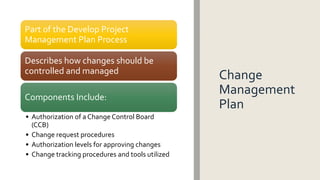
Change
Management
Plan
Part of the Develop Project
Management Plan Process
Describes how changes should be
controlled and managed
Components Include:
• Authorization of a Change Control Board
(CCB)
• Change request procedures
• Authorization levels for approving changes
• Change tracking procedures and tools utilized
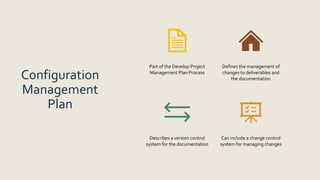
Configuration
Management
Plan
Part of the Develop Project
Management Plan Process
Defines the management of
changes to deliverables and
the documentation
Describes a version control
system for the documentation
Can include a change control
system for managing changes
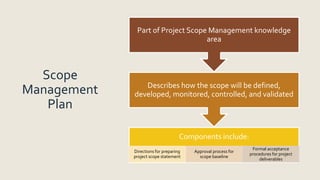
Scope
Management
Plan
Components include:
Directions for preparing
project scope statement
Approval process for
scope baseline
Formal acceptance
procedures for project
deliverables
Describes how the scope will be defined,
developed, monitored, controlled, and validated
Part of Project Scope Management knowledge
area
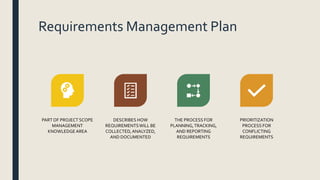
Requirements Management Plan
PART OF PROJECT SCOPE
MANAGEMENT
KNOWLEDGEAREA
DESCRIBES HOW
REQUIREMENTSWILL BE
COLLECTED,ANALYZED,
AND DOCUMENTED
THE PROCESS FOR
PLANNING,TRACKING,
AND REPORTING
REQUIREMENTS
PRIORITIZATION
PROCESS FOR
CONFLICTING
REQUIREMENTS
4.3 DIRECT
AND MANAGE
PROJECT
WORK
Belongs to the
Executing Process
Group
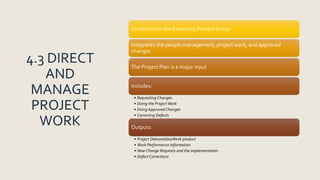
4.3 DIRECT
AND
MANAGE
PROJECT
WORK
Conducted in the Executing Process Group
Integrates the people management, project work, and approved
changes
The Project Plan is a major input
Includes:
• Requesting Changes
• Doing the Project Work
• Doing Approved Changes
• Correcting Defects
Outputs:
• Project Deliverables/Work product
• Work Performance Information
• New Change Requests and the implementation
• Defect Corrections
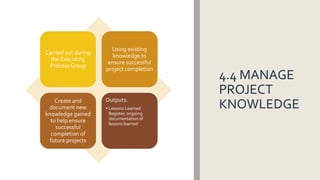
4.4 MANAGE
PROJECT
KNOWLEDGE
Belongs to the
Executing Process
Group
4.4 MANAGE
PROJECT
KNOWLEDGE
Carried out during
the Executing
Process Group
Using existing
knowledge to
ensure successful
project completion
Create and
document new
knowledge gained
to help ensure
successful
completion of
future projects
Outputs:
• Lessons Learned
Register, ongoing
documentation of
lessons learned
4.5 MONITOR
AND CONTROL
PROJECT
WORK
Belongs to the
Monitoring &
Controlling Process
Group
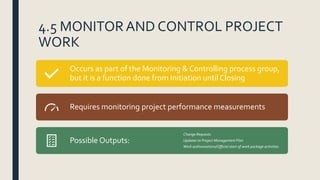
4.5 MONITORAND CONTROL PROJECT
WORK
Occurs as part of the Monitoring & Controlling process group,
but it is a function done from Initiation until Closing
Requires monitoring project performance measurements
Possible Outputs:
Change Requests
Updates to Project Management Plan
Work authorizations/Official start of work package activities
4.6 PERFORM
INTEGRATED
CHANGE
CONTROL
Belongs to the
Monitoring &
Controlling Process
Group
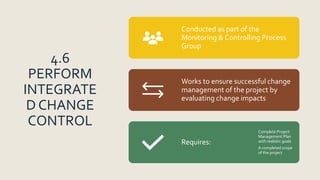
4.6
PERFORM
INTEGRATE
D CHANGE
CONTROL
Conducted as part of the
Monitoring & Controlling Process
Group
Works to ensure successful change
management of the project by
evaluating change impacts
Requires:
Complete Project
Management Plan
with realistic goals
A completed scope
of the project
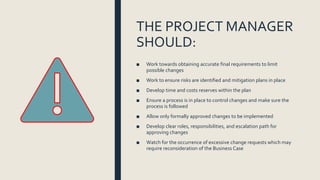
THE PROJECT MANAGER
SHOULD:
■ Work towards obtaining accurate final requirements to limit
possible changes
■ Work to ensure risks are identified and mitigation plans in place
■ Develop time and costs reserves within the plan
■ Ensure a process is in place to control changes and make sure the
process is followed
■ Allow only formally approved changes to be implemented
■ Develop clear roles, responsibilities, and escalation path for
approving changes
■ Watch for the occurrence of excessive change requests which may
require reconsideration of the Business Case
4.7 CLOSE
PROJECT OR
PHASE
Belongs to the
Closing Process
Group
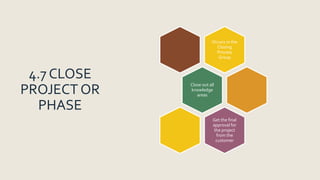
4.7 CLOSE
PROJECT OR
PHASE
Occurs in the
Closing
Process
Group
Close out all
knowledge
areas
Get the final
approval for
the project
from the
customer
Sources
■ A Guide to the Project Management Body of Knowledge – 6th Edition
■ https://www.pmi.org/
Joshua Render
https://agile-mercurial.com

Project Management: Integration Management Knowledge Area

  • 1.
  • 2.
    Overview of IntegrationManagement 7 Processes of Integration Management Knowledge area • 4.1 Develop Project Charter • 4.2 Develop Project Management Plan • 4.3 Direct and Manage Project Work • 4.4 Manage Project Knowledge • 4.5 Monitor and Control Project Work • 4.6 Perform Integrated Change Control • 4.7 Close Project or Phase Spans all 5 Project Management Process Groups • Initiating • Planning • Execution • Monitoring & Controlling • Closing
  • 3.
    Process Groups andIntegration Management Processes Initiation • 4.1 Develop ProjectCharter Planning • 4.2 Develop Project Management Plan Execution • 4.3 Direct and Manage Project Work • 4.4 Manage Project Knowledge Monitoring & Controlling • 4.5 Monitor and Control Project Work • 4.6 Perform Integrated Change Control Closing • 4.7 Close Project or Phase
  • 4.
    Overview of the Integration Management KnowledgeArea ■ Integration Management aids in creating and coordinating a cohesive project ■ Justifies the existence of the Project Manager – Project Manager is responsible for integrating the parts of the project – Works with the least amount of resources possible – Works to complete things faster and more efficient ■ Sponsor works to limit external risks to the project
  • 5.
    4.1 DEVELOP PROJECT CHARTER Belongs tothe Initiating Project Process Group
  • 6.
    4.1 DEVELOP PROJECTCHARTER Conducted in the Initiating Process Group Project Sponsor is Responsible for the Project Charter, although a Project Manager may Prepare it GrantsAuthority to the Project Manager to Commit Resources Describes How the Project May Meet Goals of the Organization
  • 7.
    4.1 DEVELOP PROJECTCHARTER Goals • Provides authority to the project manager and the existence of the project • Create the Project Charter Project Charter May Include • A ProjectTitle and Description • Project Sponsor(s), Project Manager, and High- Level Project Manager Authority over the Project • The Business Case isWritten to describe Why the Project is Being Done • Resource Estimates • High-LevelThreats and Opportunities (Risks) • Project Stakeholders andTheir Requirements • High-Level Description of Deliverables and Measurable Objectives to Reach Goals • Project Acceptance Criteria
  • 8.
  • 9.
    4.2 DEVELOP PROJECTMANAGEMENT PLAN Conducted in the Planning Process Group • Consists of many plans developed by other project management processes conducted during planning Defines the Overall Strategy for Managing the Project • Meeting Project Objectives • Tailored for Each Project • Managing Resources Includes • Scope Management Plan • Requirements Management Plan • Stakeholder Management Plan • Stakeholder Register • Assumptions • Lessons Learned Register
  • 10.
    4.2 DEVELOP PROJECT MANAGEMENTPLAN ■ The Project Management Plan integrates all the knowledge area management plans into a whole. ■ Consists of – A series of plans from the other knowledge areas and baselines – Project management processes that will be used on the project – Management plans for knowledge areas
  • 11.
    COMPONENTS OF A PROJECT MANAGEMENT PLAN 4.2DEVELOP PROJECT MANAGEMENT PLAN
  • 12.
    Possible Items toinclude in a Project Management Plan Stakeholder Management Plan Change Management Plan Configuration Management Plan Project Life Cycle Schedule Management Plan Schedule Baseline Requirements Management Plan Scope Management Plan Scope Baseline Cost Management Plan Cost Baseline Communications Management Plan Resource Management Plan Performance Measurement Baseline Development Approach Quality Management Plan Procurement Management Plan Risk Management Plan
  • 13.
    Change Management Plan Part of theDevelop Project Management Plan Process Describes how changes should be controlled and managed Components Include: • Authorization of a Change Control Board (CCB) • Change request procedures • Authorization levels for approving changes • Change tracking procedures and tools utilized
  • 14.
    Configuration Management Plan Part of theDevelop Project Management Plan Process Defines the management of changes to deliverables and the documentation Describes a version control system for the documentation Can include a change control system for managing changes
  • 15.
    Scope Management Plan Components include: Directions forpreparing project scope statement Approval process for scope baseline Formal acceptance procedures for project deliverables Describes how the scope will be defined, developed, monitored, controlled, and validated Part of Project Scope Management knowledge area
  • 16.
    Requirements Management Plan PARTOF PROJECT SCOPE MANAGEMENT KNOWLEDGEAREA DESCRIBES HOW REQUIREMENTSWILL BE COLLECTED,ANALYZED, AND DOCUMENTED THE PROCESS FOR PLANNING,TRACKING, AND REPORTING REQUIREMENTS PRIORITIZATION PROCESS FOR CONFLICTING REQUIREMENTS
  • 17.
    4.3 DIRECT AND MANAGE PROJECT WORK Belongsto the Executing Process Group
  • 18.
    4.3 DIRECT AND MANAGE PROJECT WORK Conducted inthe Executing Process Group Integrates the people management, project work, and approved changes The Project Plan is a major input Includes: • Requesting Changes • Doing the Project Work • Doing Approved Changes • Correcting Defects Outputs: • Project Deliverables/Work product • Work Performance Information • New Change Requests and the implementation • Defect Corrections
  • 19.
    4.4 MANAGE PROJECT KNOWLEDGE Belongs tothe Executing Process Group
  • 20.
    4.4 MANAGE PROJECT KNOWLEDGE Carried outduring the Executing Process Group Using existing knowledge to ensure successful project completion Create and document new knowledge gained to help ensure successful completion of future projects Outputs: • Lessons Learned Register, ongoing documentation of lessons learned
  • 21.
    4.5 MONITOR AND CONTROL PROJECT WORK Belongsto the Monitoring & Controlling Process Group
  • 22.
    4.5 MONITORAND CONTROLPROJECT WORK Occurs as part of the Monitoring & Controlling process group, but it is a function done from Initiation until Closing Requires monitoring project performance measurements Possible Outputs: Change Requests Updates to Project Management Plan Work authorizations/Official start of work package activities
  • 23.
    4.6 PERFORM INTEGRATED CHANGE CONTROL Belongs tothe Monitoring & Controlling Process Group
  • 24.
    4.6 PERFORM INTEGRATE D CHANGE CONTROL Conducted aspart of the Monitoring & Controlling Process Group Works to ensure successful change management of the project by evaluating change impacts Requires: Complete Project Management Plan with realistic goals A completed scope of the project
  • 25.
    THE PROJECT MANAGER SHOULD: ■Work towards obtaining accurate final requirements to limit possible changes ■ Work to ensure risks are identified and mitigation plans in place ■ Develop time and costs reserves within the plan ■ Ensure a process is in place to control changes and make sure the process is followed ■ Allow only formally approved changes to be implemented ■ Develop clear roles, responsibilities, and escalation path for approving changes ■ Watch for the occurrence of excessive change requests which may require reconsideration of the Business Case
  • 26.
    4.7 CLOSE PROJECT OR PHASE Belongsto the Closing Process Group
  • 27.
    4.7 CLOSE PROJECT OR PHASE Occursin the Closing Process Group Close out all knowledge areas Get the final approval for the project from the customer
  • 28.
    Sources ■ A Guideto the Project Management Body of Knowledge – 6th Edition ■ https://www.pmi.org/ Joshua Render https://agile-mercurial.com