Maksym Vyshnivetskyi: Управління вартістю (Cost) (UA)
2.
Favorite pet
Ozzy Osbourne.Not that one, but this one
with big ears
The quote I like
«A journey of a thousand miles begins with a single step»
Master degree in economical geography
• Delivery Quality Monitoring and Support
dept. (it’s not about testing ), Director
• PM Chapter co-lead
Endless talks about
• Why Agile will not help us to survive
• And a bit about project
management, quality assurance and
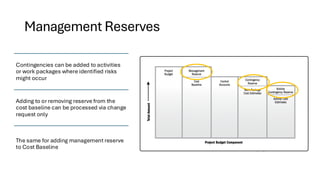
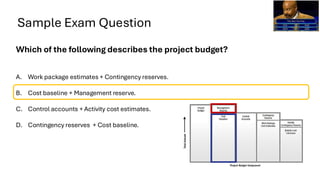
Kanban Method
Experience
• 10 year of project management in public sector
and outsourcing
• 10 year in process management and quality
assurance
Hello, world ☺
3.
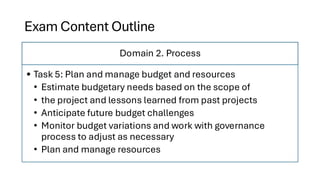
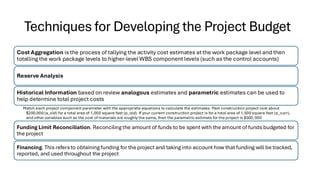
Exam Content Outline
Domain2. Process
• Task 5: Plan and manage budget and resources
• Estimate budgetary needs based on the scope of
• the project and lessons learned from past projects
• Anticipate future budget challenges
• Monitor budget variations and work with governance
process to adjust as necessary
• Plan and manage resources
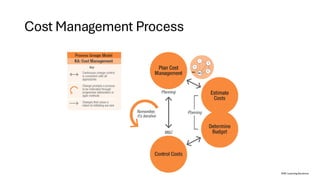
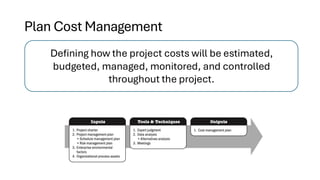
Plan Cost Management
Defininghow the project costs will be estimated,
budgeted, managed, monitored, and controlled
throughout the project.
6.
Cost Management Plan
Answersthe following:
• "How will I go about planning cost for the project?"
• "How will I effectively manage the project to the cost baseline
and manage cost variances?“
• You need to consider the project scope, schedule, project
resources, and the approved project charter when
developing the cost management plan.
• You will use estimating techniques to determine costs and
use the estimates to help control project costs.
7.
Plan Cost Managementmajor inputs
The Project Charter provides high-level budget information and pre-approved financial
resources from which detailed project costs can be developed.
The Project Management Plan contributes essential components including the Schedule
Management Plan and Risk Management Plan, which directly influence cost planning
decisions.
Enterprise Environmental factors such as organizational culture, market conditions, and
commercial databases provide contextual information for cost management planning.
Organizational process assets give us financial controls procedures, historical information,
formal and informal cost estimating and budgeting-related policies, procedures, and
guidelines
8.
Cost Management Planmajor focus
specify the currency and measurement units for different types of costs, ensuring
consistency across all project activities.
Units of measure
establish variance limits that trigger management attention, typically expressed as
percentages of the baseline budget.
Control thresholds
rules define how Earned Value Management will be implemented, including which
techniques will be used and how progress will be measured.
Performance
measurement
specify how cost information will be presented to stakeholders, including frequency, detail
level, and distribution methods.
Reporting formats
This is the degree to which cost estimates will be rounded up or down (US$995.59 to
US$1,000), based on the scope of the activities and magnitude of the project.
Level of precision
The acceptable range (±10%) used in determining realistic cost estimates is specified, and
may include an amount for contingencies.
Level of accuracy
9.
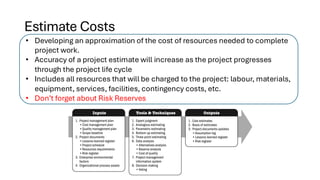
Estimate Costs
• Developingan approximation of the cost of resources needed to complete
project work.
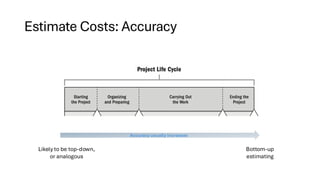
• Accuracy of a project estimate will increase as the project progresses
through the project life cycle
• Includes all resources that will be charged to the project: labour, materials,
equipment, services, facilities, contingency costs, etc.
• Don’t forget about Risk Reserves
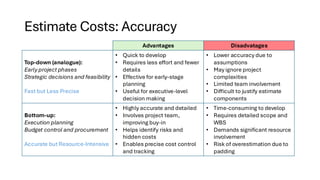
Estimate Costs: Accuracy
AdvantagesDisadvatages
Top-down (analogue):
Early project phases
Strategic decisions and feasibility
Fast but Less Precise
• Quick to develop
• Requires less effort and fewer
details
• Effective for early-stage
planning
• Useful for executive-level
decision making
• Lower accuracy due to
assumptions
• May ignore project
complexities
• Limited team involvement
• Difficult to justify estimate
components
Bottom-up:
Execution planning
Budget control and procurement
Accurate but Resource-Intensive
• Highly accurate and detailed
• Involves project team,
improving buy-in
• Helps identify risks and
hidden costs
• Enables precise cost control
and tracking
• Time-consuming to develop
• Requires detailed scope and
WBS
• Demands significant resource
involvement
• Risk of overestimation due to
padding
12.
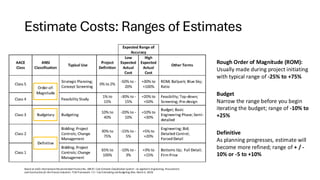
Estimate Costs: Rangesof Estimates
Rough Order of Magnitude (ROM):
Usually made during project initiating
with typical range of -25% to +75%
Budget
Narrow the range before you begin
iterating the budget; range of -10% to
+25%
Definitive
As planning progresses, estimate will
become more refined; range of + / -
10% or -5 to +10%
Based on AACE International Recommended PracticeNo. 18R-97: Cost Estimate Classification System – As Applied in Engineering, Procurement,
and Construction for the Process Industries. TCMFramework: 7.3 – CostEstimating and Budgeting (Rev. March 6, 2019)
13.
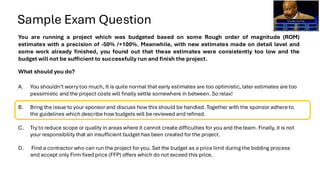
Sample Exam Question
Youare running a project which was budgeted based on some Rough order of magnitude (ROM)
estimates with a precision of -50% /+100%. Meanwhile, with new estimates made on detail level and
some work already finished, you found out that these estimates were consistently too low and the
budget will not be sufficient to successfully run and finish the project.
What should you do?
A. You shouldn’t worry too much, It is quite normal that early estimates are too optimistic, later estimates are too
pessimistic and the project costs will finally settle somewhere in between. So relax!
B. Bring the issue to your sponsor and discuss how this should be handled. Together with the sponsor adhere to
the guidelines which describe how budgets will be reviewed and refined.
C. Try to reduce scope or quality in areas where it cannot create difficulties for you and the team. Finally, it is not
your responsibility that an insufficient budget has been created for the project.
D. Find a contractor who can run the project for you. Set the budget as a price limit during the bidding process
and accept only Firm fixed price (FFP) offers which do not exceed this price.
14.
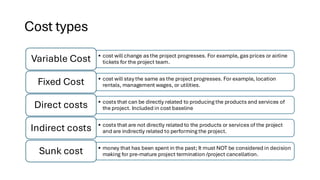
Cost types
• costwill change as the project progresses. For example, gas prices or airline
tickets for the project team.
Variable Cost
• cost will stay the same as the project progresses. For example, location
rentals, management wages, or utilities.
Fixed Cost
• costs that can be directly related to producing the products and services of
the project. Included in cost baseline
Direct costs
• costs that are not directly related to the products or services of the project
and are indirectly related to performing the project.
Indirect costs
• money that has been spent in the past; It must NOT be considered in decision
making for pre-mature project termination /project cancellation.
Sunk cost
15.
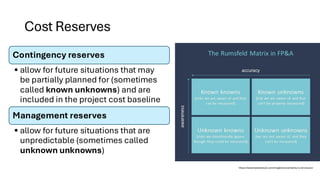
Cost Reserves
Contingency reserves
•allow for future situations that may
be partially planned for (sometimes
called known unknowns) and are
included in the project cost baseline
Management reserves
• allow for future situations that are
unpredictable (sometimes called
unknown unknowns)
https://www.fpandaclub.com/insights/uncertainty-is-all-around
16.
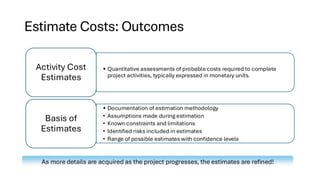
Estimate Costs: Outcomes
•Quantitative assessments of probable costs required to complete
project activities, typically expressed in monetary units.
Activity Cost
Estimates
• Documentation of estimation methodology
• Assumptions made during estimation
• Known constraints and limitations
• Identified risks included in estimates
• Range of possible estimates with confidence levels
Basis of
Estimates
As more details are acquired as the project progresses, the estimates are refined!
17.
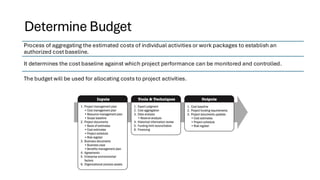
Determine Budget
Process ofaggregating the estimated costs of individual activities or work packages to establish an
authorized cost baseline.
It determines the cost baseline against which project performance can be monitored and controlled.
The budget will be used for allocating costs to project activities.
18.
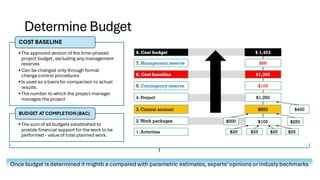
Determine Budget
•The approvedversion of the time-phased
project budget, excluding any management
reserves
•Can be changed only through formal
change control procedures
•Is used as a basis for comparison to actual
results.
•The number to which the project manager
manages the project
COST BASELINE
•The sum of all budgets established to
provide financial support for the work to be
performed - value of total planned work.
BUDGET AT COMPLETION (BAC)
Once budget is determined it mightb e compared with parametric estimates, experts’opinions or industy bechmarks
19.
Budget at Completion(BAC)
Determined at project start based on work planned
Used with Planned Value (PV) to determine budget’s status against
planned
Compared to Estimate at Completion (EAC) at point of analysis
based on expected future work
Expressed in cost units (any currency)
20.
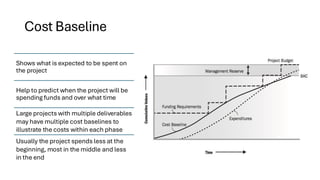
Cost Baseline
Shows whatis expected to be spent on
the project
Help to predict when the project will be
spending funds and over what time
Large projects with multiple deliverables
may have multiple cost baselines to
illustrate the costs within each phase
Usually the project spends less at the
beginning, most in the middle and less
in the end
21.
Management Reserves
Contingencies canbe added to activities
or work packages where identified risks
might occur
Adding to or removing reserve from the
cost baseline can be processed via change
request only
The same for adding management reserve
to Cost Baseline
22.
Sample Exam Question
Aproject underwent an approved major Scope Change, which increased cost
and work levels.
What does this mean for Earned Value Data?
A. The cost baseline will be updated and the new baseline will be the basis for future earned
value analysis.
B. As baselines should generally not be adjusted, the project is due to exceed its budget from
now on.
C. There are several reasons to change a baseline but not scope changes. The project will exceed
its budget.
D. Earned value analysis becomes useless after a scope change, the technique should not be
used any more.
23.
Techniques for Developingthe Project Budget
Cost Aggregation is the process of tallying the activity cost estimates at the work package level and then
totalling the work package levels to higher-level WBS component levels (such as the control accounts)
Reserve Analysis
Historical Information based on review analogous estimates and parametric estimates can be used to
help determine total project costs
Match each project component parameter with the appropriate equations to calculate the estimates. Past construction project cost about
$200,000 (a_old) for a total area of 1,000 square feet (p_old). If your current construction project is for a total area of 1,500 square feet (p_curr),
and other variables such as the cost of materials are roughly the same, then the parametric estimate for the project is $300,000
Funding Limit Reconciliation. Reconciling the amount of funds to be spent with the amount of funds budgeted for
the project
Financing. This refers to obtaining funding for the project and taking into account how that funding will be tracked,
reported, and used throughout the project
24.
Sample Exam Question
Whichof the following describes the project budget?
A. Work package estimates + Contingency reserves.
B. Cost baseline + Management reserve.
C. Control accounts + Activity cost estimates.
D. Contingency reserves + Cost baseline.
25.
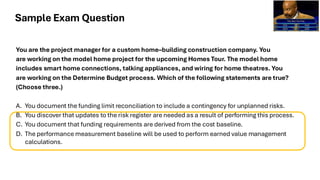
You are theproject manager for a custom home–building construction company. You
are working on the model home project for the upcoming Homes Tour. The model home
includes smart home connections, talking appliances, and wiring for home theatres. You
are working on the Determine Budget process. Which of the following statements are true?
(Choose three.)
A. You document the funding limit reconciliation to include a contingency for unplanned risks.
B. You discover that updates to the risk register are needed as a result of performing this process.
C. You document that funding requirements are derived from the cost baseline.
D. The performance measurement baseline will be used to perform earned value management
calculations.
Sample Exam Question
26.
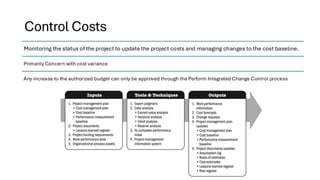
Control Costs
Monitoring thestatus of the project to update the project costs and managing changes to the cost baseline.
Primarily Concern with cost variance
Any increase to the authorized budget can only be approved through the Perform Integrated Change Control process
27.
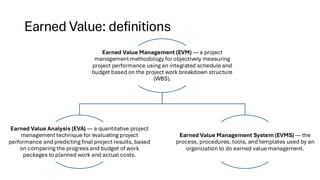
Earned Value: definitions
EarnedValue Management (EVM) — a project
management methodology for objectively measuring
project performance using an integrated schedule and
budget based on the project work breakdown structure
(WBS).
Earned Value Analysis (EVA) — a quantitative project
management technique for evaluating project
performance and predicting final project results, based
on comparing the progress and budget of work
packages to planned work and actual costs.
Earned Value Management System (EVMS) — the
process, procedures, tools, and templates used by an
organization to do earned value management.
28.
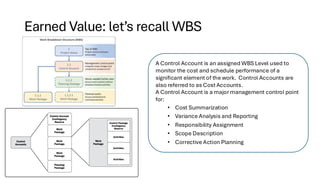
Earned Value: let’srecall WBS
A Control Account is an assigned WBS Level used to
monitor the cost and schedule performance of a
significant element of the work. Control Accounts are
also referred to as Cost Accounts.
A Control Account is a major management control point
for:
• Cost Summarization
• Variance Analysis and Reporting
• Responsibility Assignment
• Scope Description
• Corrective Action Planning
29.
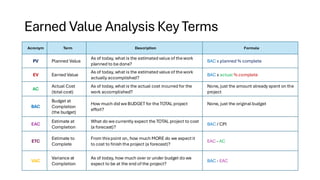
Earned Value AnalysisKey Terms
Acronym Term Description Formula
PV Planned Value
As of today, whatis the estimated value of the work
planned to be done?
BAC x planned % complete
EV Earned Value
As of today, whatis the estimated value of the work
actually accomplished?
BAC x actual % complete
AC
Actual Cost
(total cost)
As of today, whatis the actual cost incurred for the
work accomplished?
None, just the amount already spent on the
project
BAC
Budget at
Completion
(the budget)
How much did we BUDGET for the TOTAL project
effort?
None, just the original budget
EAC
Estimate at
Completion
What do we currently expect the TOTAL project to cost
(a forecast)?
BAC / CPI
ETC
Estimate to
Complete
From thispoint on, how much MORE do we expectit
to cost to finish the project (a forecast)?
EAC - AC
VAC
Variance at
Completion
As of today, how much over or under budget do we
expect to be at the end of the project?
BAC - EAC
30.
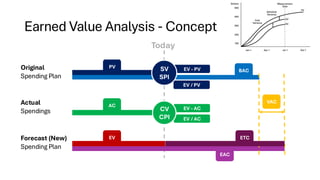
Earned Value Analysis- Concept
Original
Spending Plan
Actual
Spendings
Forecast (New)
Spending Plan
Today
PV
AC
BAC
ETC
EV
EAC
VAC
EV - PV
EV / PV
EV - AC
EV / AC
CV
CPI
SV
SPI
31.
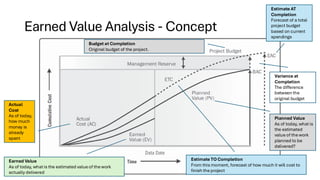
Earned Value Analysis- Concept
Earned Value
As of today, whatis the estimated value of the work
actually delivered
Estimate TO Completion
From thismoment, forecast of how much it will cost to
finish the project
Estimate AT
Completion
Forecast of a total
project budget
based on current
spendings
Variance at
Completion
The difference
between the
original budget
Budget at Completion
Original budget of the project.
Planned Value
As of today, whatis
the estimated
value of the work
planned to be
delivered?
Actual
Cost
As of today,
how much
money is
already
spent
32.
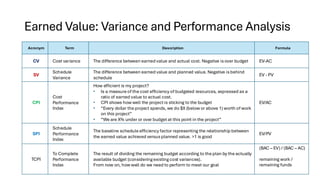
Earned Value: Varianceand Performance Analysis
Acronym Term Description Formula
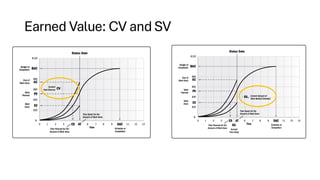
CV Cost variance The difference between earned value and actual cost. Negative isover budget EV-AC
SV
Schedule
Variance
The difference between earned value and planned value. Negative isbehind
schedule
EV - PV
CPI
Cost
Performance
Index
How efficient is my project?
• Is a measure of the cost efficiency of budgeted resources, expressed as a
ratio of earned value to actual cost.
• CPI shows how well the project is sticking to the budget
• “Every dollar the project spends, we do $X (below or above 1) worth of work
on this project”
• “We are X% under or over budgetat this point in the project”
EV/AC
SPI
Schedule
Performance
Index
The baseline schedule efficiency factor representing the relationship between
the earned value achieved versusplanned value. >1 is good
EV/PV
TCPI
To Complete
Performance
Index
The result of dividing the remaining budget according to the plan by the actually
available budget (consideringexistingcost variances).
From now on, how well do we need to perform to meet our goal
(BAC – EV) / (BAC – AC)
remaining work /
remaining funds
33.
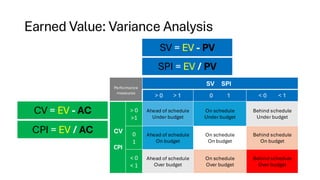
CPI = EV/ AC
SPI = EV / PV
CV = EV - AC
SV = EV - PV
Performance
measures
SV SPI
> 0 > 1 0 1 < 0 < 1
CV
CPI
> 0
>1
Ahead of schedule
Under budget
On schedule
Under budget
Behind schedule
Under budget
0
1
Ahead of schedule
On budget
On schedule
On budget
Behind schedule
On budget
< 0
< 1
Ahead of schedule
Over budget
On schedule
Over budget
Behind schedule
Over budget
Earned Value: Variance Analysis
Forecasting: EAC
EAC isa way to project/estimate the planned cost at project finish based on the currently available data
EAC = BAC/CPI
If we believe the project will continue to spend at the same rate up to now => Normal variant to use
•The delay is caused byreasons which is likelyto continue (e.g. labour with less skilled than expected)
•example: theEAC for the housing project = US$10000 / 0.75= US$13333
EAC = AC + (BAC-EV)
If we believe that future expenditures will occur at the original forecasted amount (no more delays ofthe same kind in future) =>
Ignores a 1-off cost hit, so uses the actuals plus remaining work
•The delay might be caused bysome unforeseen reasons (e.g. typhoon) which is not likely to happen again
•example: theEAC for the housing project = US$4000 + (US$10000 – $3000) = US$11000
EAC = AC + [(BAC-EV)/(SPI*CPI)]
If we believe that both current cost and current schedule performance will impact future cost performance => Project end date must be met
•The performance of the project willcontinue with sub-prime standards (overbudget and behind schedule)
•example: theEAC for the housing project = US$4000 + [(US$10000 – $3000)/(0.75*0.75)] = US$16444
EAC = AC + New Estimate
If we believe the original conditions and assumptions are wrong => When the project is“broken” the baseline is untenable
36.
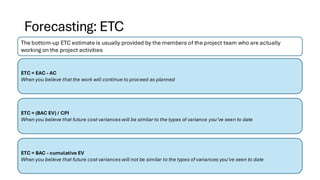
Forecasting: ETC
The bottom-upETC estimate is usually provided by the members of the project team who are actually
working on the project activities
ETC = EAC - AC
When you believe that the work will continue to proceed as planned
ETC = (BAC EV) / CPI
When you believe that future cost variances will be similar to the types of variance you’ve seen to date
ETC = BAC - cumulative EV
When you believe that future cost variances will not be similar to the types of variances you’ve seen to date
37.
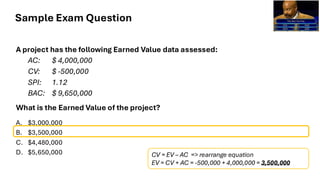
Sample Exam Question
Aproject has the following Earned Value data assessed:
AC: $ 4,000,000
CV: $ -500,000
SPI: 1.12
BAC: $ 9,650,000
What is the Earned Value of the project?
A. $3,000,000
B. $3,500,000
C. $4,480,000
D. $5,650,000 CV = EV – AC => rearrange equation
EV = CV + AC = -500,000 + 4,000,000 = 3,500,000
38.
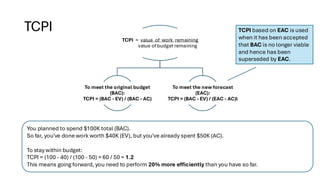
TCPI
TCPI = valueof work remaining
value of budget remaining
To meet the original budget
(BAC):
TCPI = (BAC - EV) / (BAC - AC)
To meet the new forecast
(EAC):
TCPI = (BAC - EV) / (EAC - AC)l
You planned to spend $100K total (BAC).
So far, you've done work worth $40K (EV), but you've already spent $50K (AC).
To stay within budget:
TCPI = (100 - 40) / (100 - 50) = 60 / 50 = 1.2
This means going forward, you need to perform 20% more efficiently than you have so far.
TCPI based on EAC is used
when it has been accepted
that BAC is no longer viable
and hence has been
superseded by EAC.
Sample Exam Question
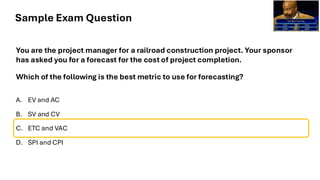
Youare the project manager for a railroad construction project. Your sponsor
has asked you for a forecast for the cost of project completion.
Which of the following is the best metric to use for forecasting?
A. EV and AC
B. SV and CV
C. ETC and VAC
D. SPI and CPI
41.
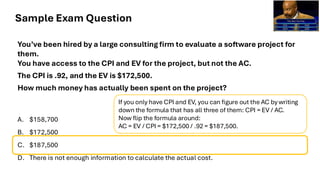
Sample Exam Question
You’vebeen hired by a large consulting firm to evaluate a software project for
them.
You have access to the CPI and EV for the project, but not the AC.
The CPI is .92, and the EV is $172,500.
How much money has actually been spent on the project?
A. $158,700
B. $172,500
C. $187,500
D. There is not enough information to calculate the actual cost.
If you only have CPI and EV, you can figure out the AC by writing
down the formula that has all three of them: CPI = EV / AC.
Now flip the formula around:
AC = EV / CPI = $172,500 / .92 = $187,500.
42.
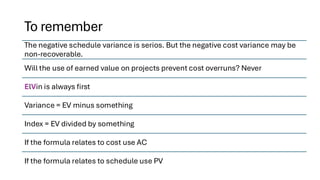
To remember
The negativeschedule variance is serios. But the negative cost variance may be
non-recoverable.
Will the use of earned value on projects prevent cost overruns? Never
ElVin is always first
Variance = EV minus something
Index = EV divided by something
If the formula relates to cost use AC
If the formula relates to schedule use PV
43.
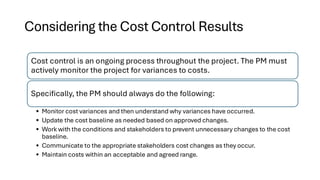
Considering the CostControl Results
Cost control is an ongoing process throughout the project. The PM must
actively monitor the project for variances to costs.
Specifically, the PM should always do the following:
• Monitor cost variances and then understand why variances have occurred.
• Update the cost baseline as needed based on approved changes.
• Work with the conditions and stakeholders to prevent unnecessary changes to the cost
baseline.
• Communicate to the appropriate stakeholders cost changes as they occur.
• Maintain costs within an acceptable and agreed range.
44.
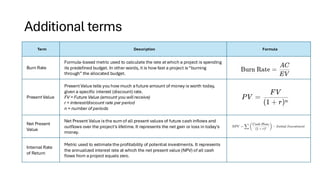
Additional terms
Term DescriptionFormula
Burn Rate
Formula-based metric used to calculate the rate atwhich a project is spending
its predefined budget. In other words, it is how fast a project is“burning
through” the allocated budget.
PresentValue
PresentValue tells you how much a future amount of money is worth today,
given a specific interest (discount) rate.
FV = Future Value (amount you will receive)
r = interest/discount rate per period
n = number of periods
Net Present
Value
Net Present Value isthe sumof all present values of future cash inflows and
outflows over the project’s lifetime. It represents the net gain or loss in today's
money.
Internal Rate
of Return
Metric used to estimate the profitability of potential investments. It represents
the annualized interest rate at which the net present value (NPV) of all cash
flows from a project equals zero.

![Forecasting: EAC
EAC is a way to project/estimate the planned cost at project finish based on the currently available data
EAC = BAC/CPI
If we believe the project will continue to spend at the same rate up to now => Normal variant to use
•The delay is caused byreasons which is likelyto continue (e.g. labour with less skilled than expected)
•example: theEAC for the housing project = US$10000 / 0.75= US$13333
EAC = AC + (BAC-EV)
If we believe that future expenditures will occur at the original forecasted amount (no more delays ofthe same kind in future) =>
Ignores a 1-off cost hit, so uses the actuals plus remaining work
•The delay might be caused bysome unforeseen reasons (e.g. typhoon) which is not likely to happen again
•example: theEAC for the housing project = US$4000 + (US$10000 – $3000) = US$11000
EAC = AC + [(BAC-EV)/(SPI*CPI)]
If we believe that both current cost and current schedule performance will impact future cost performance => Project end date must be met
•The performance of the project willcontinue with sub-prime standards (overbudget and behind schedule)
•example: theEAC for the housing project = US$4000 + [(US$10000 – $3000)/(0.75*0.75)] = US$16444
EAC = AC + New Estimate
If we believe the original conditions and assumptions are wrong => When the project is“broken” the baseline is untenable](https://image.slidesharecdn.com/lempmpcost-251007182834-04159d01/85/Maksym-Vyshnivetskyi-Cost-UA-35-320.jpg)