
Drexler-Sibbet
Team Performance
Model
Drexler-Sibbet Groups
Creating Stages
Encompasses the initial stages of
group development as the group
forms and works to become a single
cohesive unit. The first four stages
are contained within the "Creating
Stages" group.
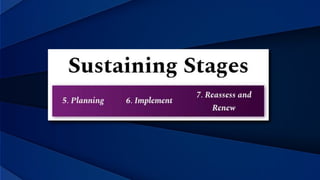
Sustaining Stages
After the group adjusts and becomes
established the Sustaining Stages
begin. The final three stages are
contained within this group.
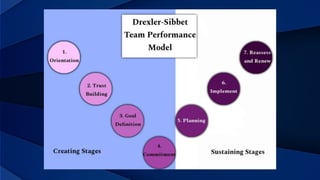
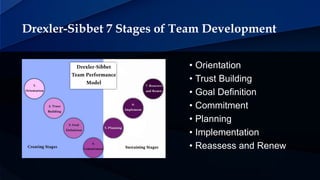
Drexler-Sibbet 7 Stages of Team Development
• Orientation
• Trust Building
• Goal Definition
• Commitment
• Planning
• Implementation
• Reassess and Renew
1. Orientation
Why am I here?
The team may wonder why they
are there and that question is
one that should be answered
early in the group's formation.
2. Trust Building
Who are you?
The team must get to know each
other and learn who they will be
working with and build trust
among the members of the group.
3. Goal Definition
What are we doing?
Informal roles develop and the team should
fall into a pattern of where their skills lie and
only be guided by external leadership
towards that pattern. Conflict naturally arises
as the team figures out their place in the
group.
4. Commitment
How will we do it?
This defines how the team will work
together as a group and how they
proceed to where they can begin to
be their most productive. Conflict
among the team should be reduced.
5. Planning
Who is going to do what?
The team plans the activities
and tasks are assigned or
volunteered for. Planning begins
the transition to completing the
required work.
6. Implementation
Is the team performing?
This is where the work gets
done and ideally, the team is
functioning as a cohesive unit.
7. Reassess and Renew
Do we continue?
Has the group completed objectives
or are the objectives still relevant?
The group identifies what it has
done and if the team's purpose is
completed.
Sources
Kumar, S., Deshmukh, V., & Adhish, V. S. (2014). Building and leading teams. Indian journal of community
medicine : official publication of Indian Association of Preventive & Social Medicine, 39(4), 208–213.
doi:10.4103/0970-0218.143020. Retrieved From https://www.ncbi.nlm.nih.gov/pmc/articles/PMC4215500/
Sibbet, D. (1980). Allan Drexler: In Appreciation. Retrieved From https://davidsibbet.com/2017/11/alan-drexler-in-
appreciation/
Joshua Render
https://agile-mercurial.com/
https://twentyfirstcenturyworkforce.com/
https://agile-mercurial.com/2019/06/13/drexler-and-sibbets-team-performance-model/

Drexler-Sibbet Team Performance Model

  • 1.
  • 3.
    Drexler-Sibbet Groups Creating Stages Encompassesthe initial stages of group development as the group forms and works to become a single cohesive unit. The first four stages are contained within the "Creating Stages" group. Sustaining Stages After the group adjusts and becomes established the Sustaining Stages begin. The final three stages are contained within this group.
  • 4.
    Drexler-Sibbet 7 Stagesof Team Development • Orientation • Trust Building • Goal Definition • Commitment • Planning • Implementation • Reassess and Renew
  • 6.
    1. Orientation Why amI here? The team may wonder why they are there and that question is one that should be answered early in the group's formation.
  • 7.
    2. Trust Building Whoare you? The team must get to know each other and learn who they will be working with and build trust among the members of the group.
  • 8.
    3. Goal Definition Whatare we doing? Informal roles develop and the team should fall into a pattern of where their skills lie and only be guided by external leadership towards that pattern. Conflict naturally arises as the team figures out their place in the group.
  • 9.
    4. Commitment How willwe do it? This defines how the team will work together as a group and how they proceed to where they can begin to be their most productive. Conflict among the team should be reduced.
  • 11.
    5. Planning Who isgoing to do what? The team plans the activities and tasks are assigned or volunteered for. Planning begins the transition to completing the required work.
  • 12.
    6. Implementation Is theteam performing? This is where the work gets done and ideally, the team is functioning as a cohesive unit.
  • 13.
    7. Reassess andRenew Do we continue? Has the group completed objectives or are the objectives still relevant? The group identifies what it has done and if the team's purpose is completed.
  • 14.
    Sources Kumar, S., Deshmukh,V., & Adhish, V. S. (2014). Building and leading teams. Indian journal of community medicine : official publication of Indian Association of Preventive & Social Medicine, 39(4), 208–213. doi:10.4103/0970-0218.143020. Retrieved From https://www.ncbi.nlm.nih.gov/pmc/articles/PMC4215500/ Sibbet, D. (1980). Allan Drexler: In Appreciation. Retrieved From https://davidsibbet.com/2017/11/alan-drexler-in- appreciation/ Joshua Render https://agile-mercurial.com/ https://twentyfirstcenturyworkforce.com/ https://agile-mercurial.com/2019/06/13/drexler-and-sibbets-team-performance-model/