Project Finance Modeling
An Introduction
2
What is a “project”?
 A project is a temporary, one-time activity
undertaken to create a unique product or
service, which is intended to bring about
beneficial change or added value.
3
What is a “project”?
 A project’s characteristic of being a temporary,
one-time event contrasts with processes or
operations, which are ongoing activities
intended to create the same product or service
over and over again.
4
What is “project finance”?
 Project finance is the financing of long-term
infrastructure and industrial projects based
upon a complex financial structure.
 Both project debt and equity are used to finance
the project.
 Debt is repaid using the cash flow generated by
operation of the project, rather than other
resources of the project owners.
5
What is “project finance”?
 Financing is typically secured by all project
assets, including any revenue-producing
contracts intended to be fulfilled by future
activities of the completed project.
 Lenders are also given the right to assume
control of a project if the project company has
difficulties complying with loan terms.
6
What is “project finance”?
 Generally, a special purpose entity is created
for each project.
 This shields other assets owned by a project
sponsor from failure of the project.
 As a special purpose entity, the project
company has no assets other than the project
7
What is “project finance
modeling”?
 Project modeling is the development of
analytical models to assess the risk-reward,
cost-benefit or feasibility of a project.
 Project finance modeling is the development of
analytical models to assess the risk-reward of
lending to or investing in a project.
8
What is “project finance
modeling”?
 All financial evaluations of a project depend
upon projections of expected future cash flows
generated by activities of the completed project.
 Forecasting project cash flows requires a
thorough understanding of the methods,
techniques and computer software commonly
used in such projections.
9
What is “project finance
modeling”?
 The analytical challenge is to design financial
projection models that are:
– Thorough in scope
– Accurate and reliable
– Flexible in accommodating revisions
– Quick to develop and maintain
10
Course Outline
 Project lending: Credit considerations
 Project investing: Measures of return
 Lending or investing: Free cash flow
 Modeling issues
 Dealing with data
11
Project Lending
 Expected from owner before approval:
– Economic justification for project
 Feasibility study
 Cost – benefit analysis
– Demographics
– Assumptions
– Projections
– IRR, NPV, etc.
– Identified risks
12
Project Lending
 Expected from owner before approval:
– Detailed cash flows
– Detailed project time schedule
 Together, cash flows and time schedule dictate
borrowing and repayment schedule
13
Project Lending
 Expected from bank before approval:
– Evaluation of project benefits and risks
 Is economic justification believable?
– Are assumptions logical and believable?
– Are financial projections, especially cash flow, realistic?
– Have all risks been adequately identified?
 Does company management have sufficient expertise?
 Can any risks be mitigated by insurance or “bonding”?
 If recourse, can owner survive failed project and repay
bank?
14
Project Lending
 Expected from bank before approval:
– Is project time schedule realistic?
– Is cost overrun contingency adequate?
– Proposal for loan structure
 Collateral
 Covenants
 Recourse
– Preparation of borrowing schedule
– Can bank manage failed project to recover loan?
15
Project Lending
 Expected from owner after approval:
– Project status reports
 Percentage completion
 Actual expenditures versus budgeted expenditures
 Cash flow re-forecasts
 Changes to project
 Increases or decreases in risk
– Borrowing requests … based on scheduled
expenditures
16
Project Lending
 Expected from bank after approval:
– Ongoing review of status reports provided by owner
– Regular on-site inspections of project progress by
experts
– Careful “yes or no” decision to fund each borrowing
request based on project progress and known risks
– If recourse, ongoing review of owner’s other “normal”
business operations through ordinary credit analysis
17
Project Lending
 Loan structure
– Recourse (guarantees, etc.)
 Bank wants recourse to owner and owner’s assets
– Moral value even if limited economic value
[partner/ sophisticated investor theory]
– Exercising rights of recourse expensive, time consuming
 Owner wants “non-recourse” financing
18
Project Lending
 Loan structure
– To completion versus through completion:
 To completion
– Acquisition/ development/ construction only
– Completion guarantee
 From owner to bank
 From general contractor to owner, assigned to bank
 Liquidated damages
– Standby or “take out” financing
19
Project Lending
 Loan structure
– To completion versus through completion:
 Through completion
– Financing ongoing operations
– Clear conditions for if/ when working capital line/ loan begins
– Clear conditions for if/ when acquisition/ construction loan
converts into permanent term loan for property/ equipment
– Revised set of operating covenants
20
Project Lending
 Loan structure
– Covenants
 Acquisition/ construction
– Restrictive covenants to prevent loss of collateral value
– Prescriptive covenants to promote successful completion
– Tangible Net Worth
– Net Working Capital
 Permanent/ operational financing
– Debt/ Worth
– Current Ratio
– EBITDA
21
Credit Analysis
 What factors influence the ability of a borrower
to repay a loan?
– External factors
– Internal factors
22
Credit Analysis
 External versus internal factors:
– Good external factors can not offset poor internal
factors.
– Good internal factors can often mitigate weak
external factors.
23
Credit Analysis
 External factor analysis — a caution:
– There are vast amounts of macro economic data
available. The amount of industry-specific data is
overwhelming. Analyzing these external factors is
time consuming and often expensive. Decisions
about how much analysis of external factors to
include in a credit report should be based on the
degree to which the analyst thinks these factors will
affect a borrower’s ability to repay its loans.
24
PEST Analysis
 Political Factors
– Political factors include governmental laws and
regulations which define the rules of commerce.
 Political stability
 Labor laws
 Tax laws
 Trade restrictions
 Environmental regulations
25
PEST Analysis
 Economic Factors
– Economic factors include basic characteristics that
affect consumer purchasing power and corporate
capital costs.
 Economic growth
 Wage rates
 Inflation rate
 Interest rates
 Exchange rates
 Energy costs
26
PEST Analysis
 Social Factors
– Social factors include demographic and cultural
attitudes of a population that can influence issues as
diverse as work force flexibility and market potential.
 Population demographics
 Educational quality
 Labor unions
 Healthcare
 Work attitudes
27
PEST Analysis
 Technological Factors
– Technological factors include research and
development activities that can lower barriers to
entry, reduce minimum efficient production levels,
and influence outsourcing decisions.
 Basic academic research
 Applied research and development
 Automation potential
 Information systems
 Technology incentives
28
Sector Analysis
 Industry sector analysis:
– If a borrower has a significant share of industry
sales, say 10% or more, it is then very important to
fully review available information regarding the
outlook for the industry. (Many government agencies and
investment banks publish a variety of sector reviews.)
29
SWOT Analysis
 Strengths
– A company’s strengths are its resources and
capabilities that can be used as a basis for
developing a competitive advantage.
 Good reputation
 Strong brand names
 Patents
 Proprietary cost advantages
 Access to high-grade natural resources
 Favorable access to distribution networks
30
SWOT Analysis
 Weaknesses
– The absence of certain strengths usually results in
weaknesses.
 Poor reputation
 Weak brand names
 Lack of patent protection
 High cost structure
 Lack of access to natural resources
 Lack of access to key distribution channels
31
SWOT Analysis
 Opportunities
– The external environment may offer certain new
opportunities for profit and growth.
 Unfulfilled customer need
 Development of new technologies
 Loosening of regulations
 Removal of trade barriers
32
SWOT Analysis
 Threats
– Changes in the external environment may also
present threats to a company.
 Shifts in consumer tastes away from company’s products
 Emergence of substitute products
 New regulations
 Increased trade barriers
33
Strengths and Weaknesses
S – W > U
34
Strengths and Weaknesses
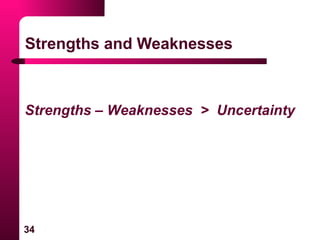
Strengths – Weaknesses > Uncertainty
35
Credit Analysis
 Internal factor analysis:
– Financial information
 Ratios
 Trends
 Cash flow
– Management information
 Background and experience
 Behavior as reflected in financial performance
36
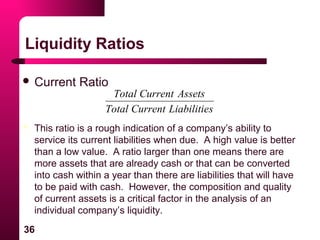
Liquidity Ratios
 Current Ratio
sLiabilitieCurrentTotal
AssetsCurrentTotal
 This ratio is a rough indication of a company’s ability to
service its current liabilities when due. A high value is better
than a low value. A ratio larger than one means there are
more assets that are already cash or that can be converted
into cash within a year than there are liabilities that will have
to be paid with cash. However, the composition and quality
of current assets is a critical factor in the analysis of an
individual company’s liquidity.
37
Leverage Ratios
 Debt/ Worth
 This ratio measures the relationship between capital
contributed by creditors and that contributed by owners
(minus any intangibles). It expresses the degree to which
owners’ equity provides protection for creditors. A value that
is lower than the industry norm is better than a value that is
higher than the industry norm. A lower ratio generally
indicates greater long-term financial safety and greater
flexibility to borrow in the future.
WorthNetTangible
sLiabilitieTotal
38
Project Investing
 Common measures of return
– Cost-benefit analysis (CBA)
– Payback period
– Net present value (NPV)
– Internal rate of return (IRR)
39
Project Investing
 Cost-benefit analysis
– Compare total costs to total benefits
– If competing projects, choose:
 Most profitable
 “Best”
– Not always financial
40
Project Investing
 Payback period
– Period of time it takes to recover the initial
investment
– Does not properly account for:
 Time value of money
 Inflation
 Risk
 Financing costs
– Managers like it because it is easy
41
Project Investing
 Internal Rate of Return
– Potential problems:
 Understates reinvestment value of future positive cash flows
 Cannot deal with negative cash flows near end of a project
(e.g., environmental cleanup costs)
 Cannot deal with changing degrees of risk over life of a
project
– Managers like it because it can be used to compare
projects of different size
42
Project Investing
 Mutual exclusivity
– Assume a limit on availability of capital at
an acceptable cost
– Corresponding limit on the number of investments
that can be made
 If projects are mutually exclusive, academics argue that
NPV is a better analytical measure than IRR
 Ex: High initial cost versus high future cash flows
43
Project Investing
 Complex measures of return
– Modified internal rate of return (MIRR)
 Positive cash flows discounted at weighted average cost of
capital (WACC) instead of discount rate making positive
cash flows more valuable
 Future negative cash flows discounted separately and
added to initial cost of project
44
Project Investing
 Complex measures of return
– Real options analysis
 Each separate cash flow assumed to have unique
uncertainty or risk
 Uncertainty of each separate cash flow accounted for using
“risk-adjusting probabilities”
 Risk-adjusted cash flows then discounted at risk-free rate

Project Finance Modeling

  • 1.
  • 2.
    2 What is a“project”?  A project is a temporary, one-time activity undertaken to create a unique product or service, which is intended to bring about beneficial change or added value.
  • 3.
    3 What is a“project”?  A project’s characteristic of being a temporary, one-time event contrasts with processes or operations, which are ongoing activities intended to create the same product or service over and over again.
  • 4.
    4 What is “projectfinance”?  Project finance is the financing of long-term infrastructure and industrial projects based upon a complex financial structure.  Both project debt and equity are used to finance the project.  Debt is repaid using the cash flow generated by operation of the project, rather than other resources of the project owners.
  • 5.
    5 What is “projectfinance”?  Financing is typically secured by all project assets, including any revenue-producing contracts intended to be fulfilled by future activities of the completed project.  Lenders are also given the right to assume control of a project if the project company has difficulties complying with loan terms.
  • 6.
    6 What is “projectfinance”?  Generally, a special purpose entity is created for each project.  This shields other assets owned by a project sponsor from failure of the project.  As a special purpose entity, the project company has no assets other than the project
  • 7.
    7 What is “projectfinance modeling”?  Project modeling is the development of analytical models to assess the risk-reward, cost-benefit or feasibility of a project.  Project finance modeling is the development of analytical models to assess the risk-reward of lending to or investing in a project.
  • 8.
    8 What is “projectfinance modeling”?  All financial evaluations of a project depend upon projections of expected future cash flows generated by activities of the completed project.  Forecasting project cash flows requires a thorough understanding of the methods, techniques and computer software commonly used in such projections.
  • 9.
    9 What is “projectfinance modeling”?  The analytical challenge is to design financial projection models that are: – Thorough in scope – Accurate and reliable – Flexible in accommodating revisions – Quick to develop and maintain
  • 10.
    10 Course Outline  Projectlending: Credit considerations  Project investing: Measures of return  Lending or investing: Free cash flow  Modeling issues  Dealing with data
  • 11.
    11 Project Lending  Expectedfrom owner before approval: – Economic justification for project  Feasibility study  Cost – benefit analysis – Demographics – Assumptions – Projections – IRR, NPV, etc. – Identified risks
  • 12.
    12 Project Lending  Expectedfrom owner before approval: – Detailed cash flows – Detailed project time schedule  Together, cash flows and time schedule dictate borrowing and repayment schedule
  • 13.
    13 Project Lending  Expectedfrom bank before approval: – Evaluation of project benefits and risks  Is economic justification believable? – Are assumptions logical and believable? – Are financial projections, especially cash flow, realistic? – Have all risks been adequately identified?  Does company management have sufficient expertise?  Can any risks be mitigated by insurance or “bonding”?  If recourse, can owner survive failed project and repay bank?
  • 14.
    14 Project Lending  Expectedfrom bank before approval: – Is project time schedule realistic? – Is cost overrun contingency adequate? – Proposal for loan structure  Collateral  Covenants  Recourse – Preparation of borrowing schedule – Can bank manage failed project to recover loan?
  • 15.
    15 Project Lending  Expectedfrom owner after approval: – Project status reports  Percentage completion  Actual expenditures versus budgeted expenditures  Cash flow re-forecasts  Changes to project  Increases or decreases in risk – Borrowing requests … based on scheduled expenditures
  • 16.
    16 Project Lending  Expectedfrom bank after approval: – Ongoing review of status reports provided by owner – Regular on-site inspections of project progress by experts – Careful “yes or no” decision to fund each borrowing request based on project progress and known risks – If recourse, ongoing review of owner’s other “normal” business operations through ordinary credit analysis
  • 17.
    17 Project Lending  Loanstructure – Recourse (guarantees, etc.)  Bank wants recourse to owner and owner’s assets – Moral value even if limited economic value [partner/ sophisticated investor theory] – Exercising rights of recourse expensive, time consuming  Owner wants “non-recourse” financing
  • 18.
    18 Project Lending  Loanstructure – To completion versus through completion:  To completion – Acquisition/ development/ construction only – Completion guarantee  From owner to bank  From general contractor to owner, assigned to bank  Liquidated damages – Standby or “take out” financing
  • 19.
    19 Project Lending  Loanstructure – To completion versus through completion:  Through completion – Financing ongoing operations – Clear conditions for if/ when working capital line/ loan begins – Clear conditions for if/ when acquisition/ construction loan converts into permanent term loan for property/ equipment – Revised set of operating covenants
  • 20.
    20 Project Lending  Loanstructure – Covenants  Acquisition/ construction – Restrictive covenants to prevent loss of collateral value – Prescriptive covenants to promote successful completion – Tangible Net Worth – Net Working Capital  Permanent/ operational financing – Debt/ Worth – Current Ratio – EBITDA
  • 21.
    21 Credit Analysis  Whatfactors influence the ability of a borrower to repay a loan? – External factors – Internal factors
  • 22.
    22 Credit Analysis  Externalversus internal factors: – Good external factors can not offset poor internal factors. – Good internal factors can often mitigate weak external factors.
  • 23.
    23 Credit Analysis  Externalfactor analysis — a caution: – There are vast amounts of macro economic data available. The amount of industry-specific data is overwhelming. Analyzing these external factors is time consuming and often expensive. Decisions about how much analysis of external factors to include in a credit report should be based on the degree to which the analyst thinks these factors will affect a borrower’s ability to repay its loans.
  • 24.
    24 PEST Analysis  PoliticalFactors – Political factors include governmental laws and regulations which define the rules of commerce.  Political stability  Labor laws  Tax laws  Trade restrictions  Environmental regulations
  • 25.
    25 PEST Analysis  EconomicFactors – Economic factors include basic characteristics that affect consumer purchasing power and corporate capital costs.  Economic growth  Wage rates  Inflation rate  Interest rates  Exchange rates  Energy costs
  • 26.
    26 PEST Analysis  SocialFactors – Social factors include demographic and cultural attitudes of a population that can influence issues as diverse as work force flexibility and market potential.  Population demographics  Educational quality  Labor unions  Healthcare  Work attitudes
  • 27.
    27 PEST Analysis  TechnologicalFactors – Technological factors include research and development activities that can lower barriers to entry, reduce minimum efficient production levels, and influence outsourcing decisions.  Basic academic research  Applied research and development  Automation potential  Information systems  Technology incentives
  • 28.
    28 Sector Analysis  Industrysector analysis: – If a borrower has a significant share of industry sales, say 10% or more, it is then very important to fully review available information regarding the outlook for the industry. (Many government agencies and investment banks publish a variety of sector reviews.)
  • 29.
    29 SWOT Analysis  Strengths –A company’s strengths are its resources and capabilities that can be used as a basis for developing a competitive advantage.  Good reputation  Strong brand names  Patents  Proprietary cost advantages  Access to high-grade natural resources  Favorable access to distribution networks
  • 30.
    30 SWOT Analysis  Weaknesses –The absence of certain strengths usually results in weaknesses.  Poor reputation  Weak brand names  Lack of patent protection  High cost structure  Lack of access to natural resources  Lack of access to key distribution channels
  • 31.
    31 SWOT Analysis  Opportunities –The external environment may offer certain new opportunities for profit and growth.  Unfulfilled customer need  Development of new technologies  Loosening of regulations  Removal of trade barriers
  • 32.
    32 SWOT Analysis  Threats –Changes in the external environment may also present threats to a company.  Shifts in consumer tastes away from company’s products  Emergence of substitute products  New regulations  Increased trade barriers
  • 33.
  • 34.
    34 Strengths and Weaknesses Strengths– Weaknesses > Uncertainty
  • 35.
    35 Credit Analysis  Internalfactor analysis: – Financial information  Ratios  Trends  Cash flow – Management information  Background and experience  Behavior as reflected in financial performance
  • 36.
    36 Liquidity Ratios  CurrentRatio sLiabilitieCurrentTotal AssetsCurrentTotal  This ratio is a rough indication of a company’s ability to service its current liabilities when due. A high value is better than a low value. A ratio larger than one means there are more assets that are already cash or that can be converted into cash within a year than there are liabilities that will have to be paid with cash. However, the composition and quality of current assets is a critical factor in the analysis of an individual company’s liquidity.
  • 37.
    37 Leverage Ratios  Debt/Worth  This ratio measures the relationship between capital contributed by creditors and that contributed by owners (minus any intangibles). It expresses the degree to which owners’ equity provides protection for creditors. A value that is lower than the industry norm is better than a value that is higher than the industry norm. A lower ratio generally indicates greater long-term financial safety and greater flexibility to borrow in the future. WorthNetTangible sLiabilitieTotal
  • 38.
    38 Project Investing  Commonmeasures of return – Cost-benefit analysis (CBA) – Payback period – Net present value (NPV) – Internal rate of return (IRR)
  • 39.
    39 Project Investing  Cost-benefitanalysis – Compare total costs to total benefits – If competing projects, choose:  Most profitable  “Best” – Not always financial
  • 40.
    40 Project Investing  Paybackperiod – Period of time it takes to recover the initial investment – Does not properly account for:  Time value of money  Inflation  Risk  Financing costs – Managers like it because it is easy
  • 41.
    41 Project Investing  InternalRate of Return – Potential problems:  Understates reinvestment value of future positive cash flows  Cannot deal with negative cash flows near end of a project (e.g., environmental cleanup costs)  Cannot deal with changing degrees of risk over life of a project – Managers like it because it can be used to compare projects of different size
  • 42.
    42 Project Investing  Mutualexclusivity – Assume a limit on availability of capital at an acceptable cost – Corresponding limit on the number of investments that can be made  If projects are mutually exclusive, academics argue that NPV is a better analytical measure than IRR  Ex: High initial cost versus high future cash flows
  • 43.
    43 Project Investing  Complexmeasures of return – Modified internal rate of return (MIRR)  Positive cash flows discounted at weighted average cost of capital (WACC) instead of discount rate making positive cash flows more valuable  Future negative cash flows discounted separately and added to initial cost of project
  • 44.
    44 Project Investing  Complexmeasures of return – Real options analysis  Each separate cash flow assumed to have unique uncertainty or risk  Uncertainty of each separate cash flow accounted for using “risk-adjusting probabilities”  Risk-adjusted cash flows then discounted at risk-free rate