SOLAR FINANCING BASICS
An overview of the key points to keep in mind when
evaluating a potential solar installation
About the Presenter
• Aurelien Windenberger, MBA
• Financial and online-marketing consultant
• Frequent writer focused on energy stocks for popular investing
website SeekingAlpha.com
• Have spent past year + analyzing renewable energy trends
• Educator at heart - passionate about helping others make good
financial decisions
Why Buy a Solar System
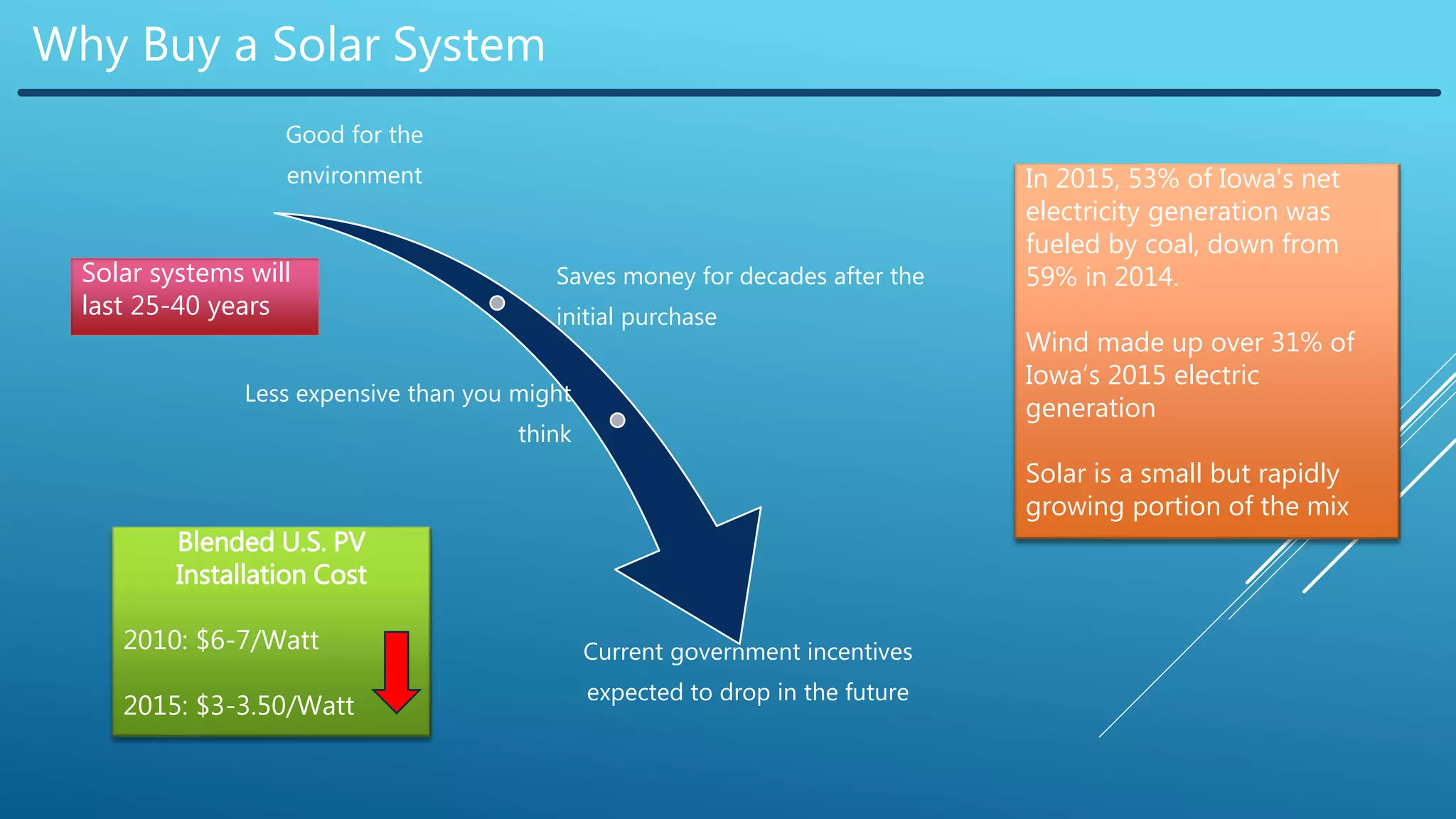
Good for the
environment
Saves money for decades after the
initial purchase
Less expensive than you might
think
Current government incentives
expected to drop in the future
Blended U.S. PV
Installation Cost
2010: $6-7/Watt
2015: $3-3.50/Watt
In 2015, 53% of Iowa's net
electricity generation was
fueled by coal, down from
59% in 2014.
Wind made up over 31% of
Iowa’s 2015 electric
generation
Solar is a small but rapidly
growing portion of the mix
Solar systems will
last 25-40 years
Solar System Basics
•How much will it cost
•How much will it save you
Net Metering
•What is Net Metering
•Who is eligible for Net Metering
Tax Credits
•What incentives are available
•Who qualifies for credits
Tips + Q&A
Table of Contents
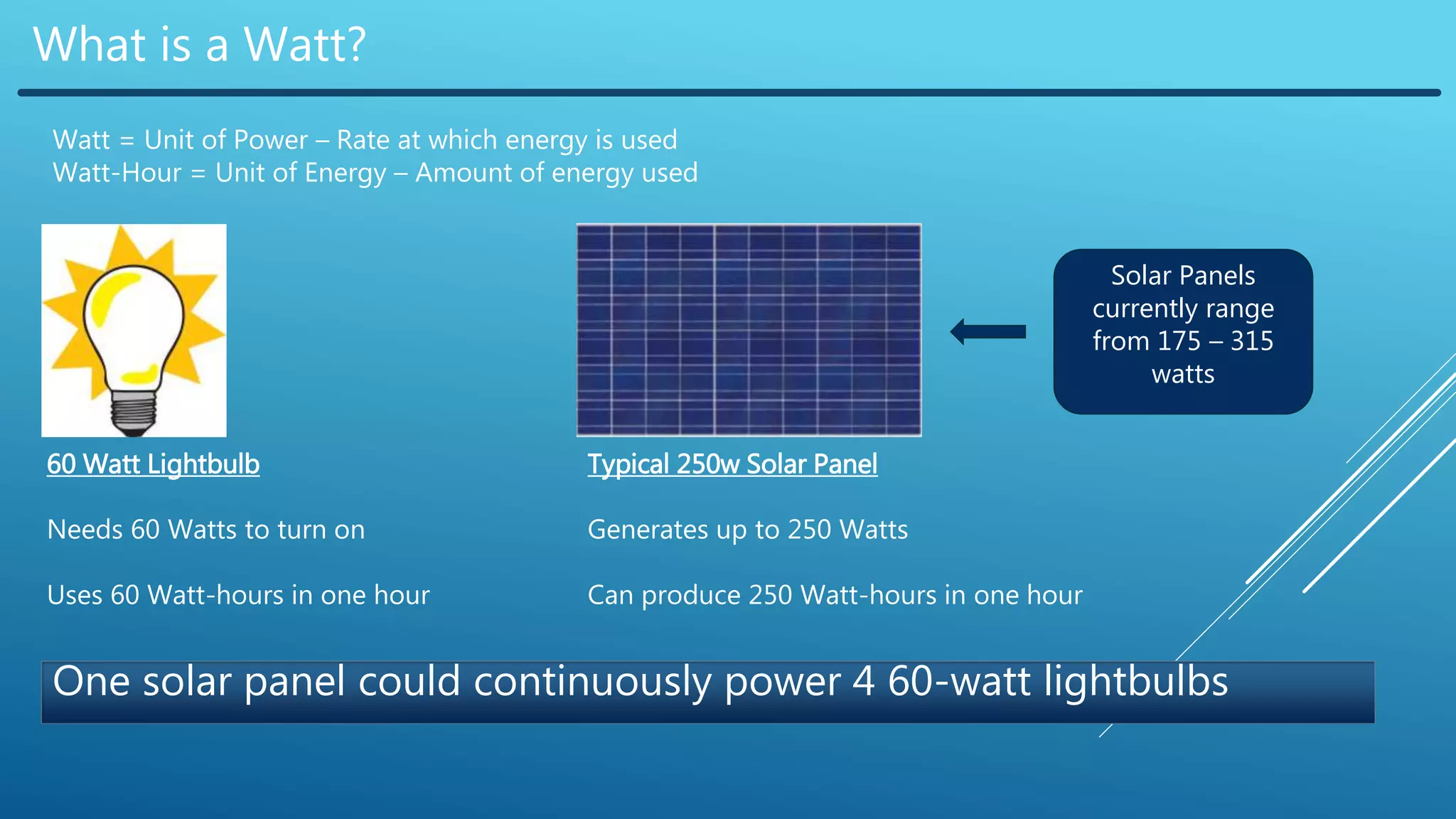
What is a Watt?
Watt = Unit of Power – Rate at which energy is used
Watt-Hour = Unit of Energy – Amount of energy used
60 Watt Lightbulb
Needs 60 Watts to turn on
Uses 60 Watt-hours in one hour
Typical 250w Solar Panel
Generates up to 250 Watts
Can produce 250 Watt-hours in one hour
One solar panel could continuously power 4 60-watt lightbulbs
Solar Panels
currently range
from 175 – 315
watts
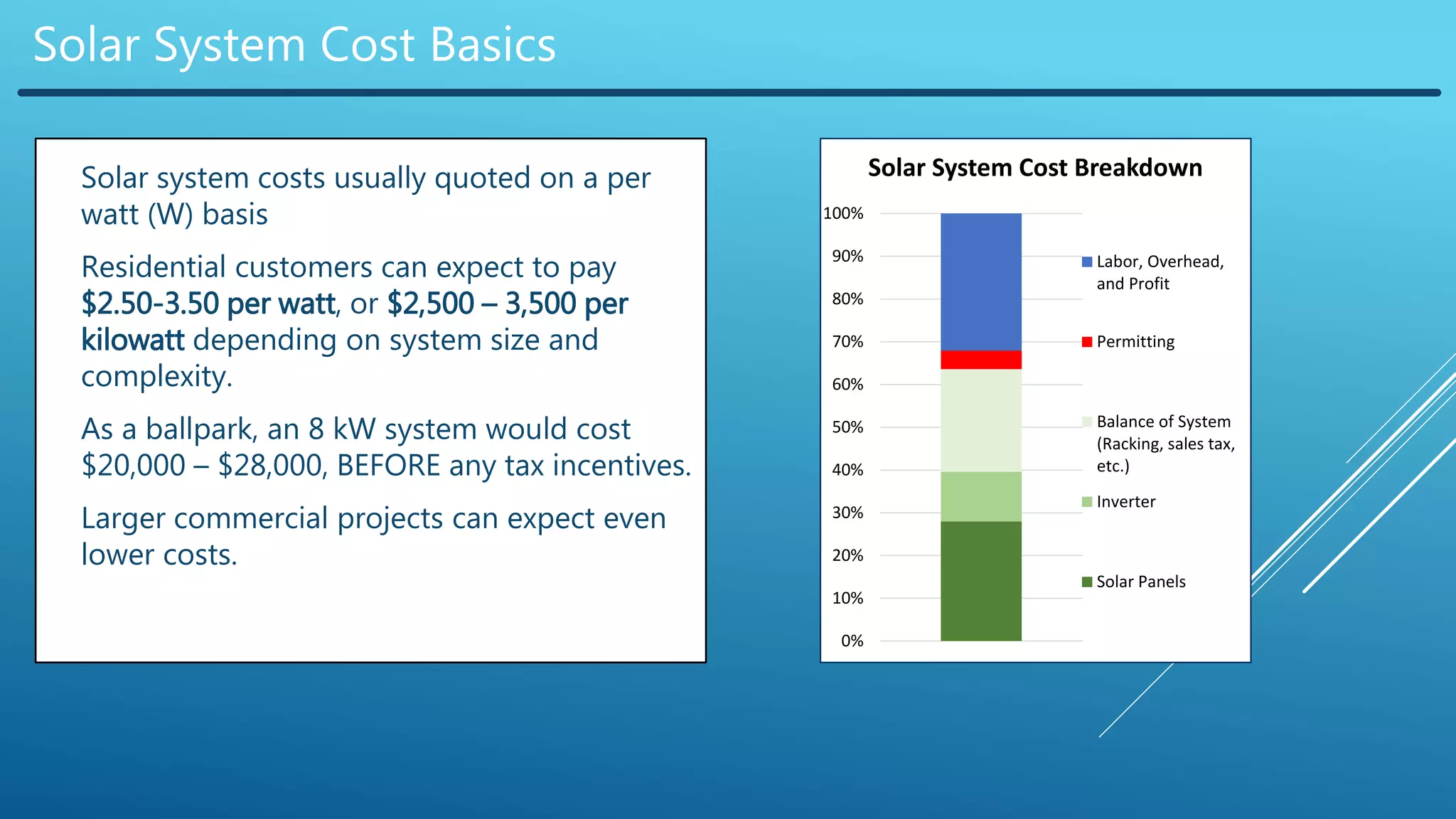
Solar System Cost Basics
 Solar system costs usually quoted on a per
watt (W) basis
 Residential customers can expect to pay
$2.50-3.50 per watt, or $2,500 – 3,500 per
kilowatt depending on system size and
complexity.
 As a ballpark, an 8 kW system would cost
$20,000 – $28,000, BEFORE any tax incentives.
 Larger commercial projects can expect even
lower costs.
0%
10%
20%
30%
40%
50%
60%
70%
80%
90%
100%
Solar System Cost Breakdown
Labor, Overhead,
and Profit
Permitting
Balance of System
(Racking, sales tax,
etc.)
Inverter
Solar Panels
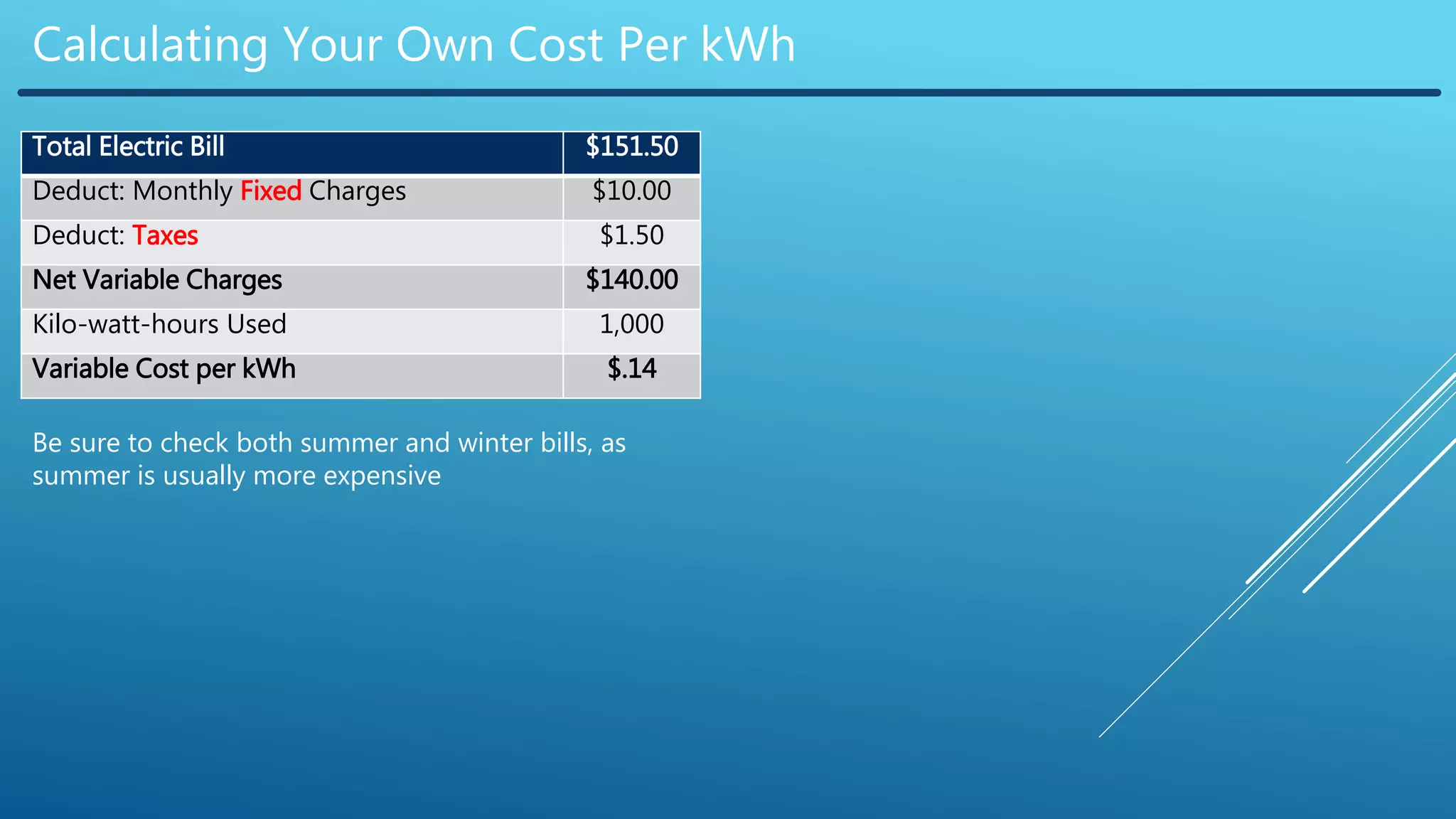
Calculating Your Own Cost Per kWh
Total Electric Bill $151.50
Deduct: Monthly Fixed Charges $10.00
Deduct: Taxes $1.50
Net Variable Charges $140.00
Kilo-watt-hours Used 1,000
Variable Cost per kWh $.14
Be sure to check both summer and winter bills, as
summer is usually more expensive
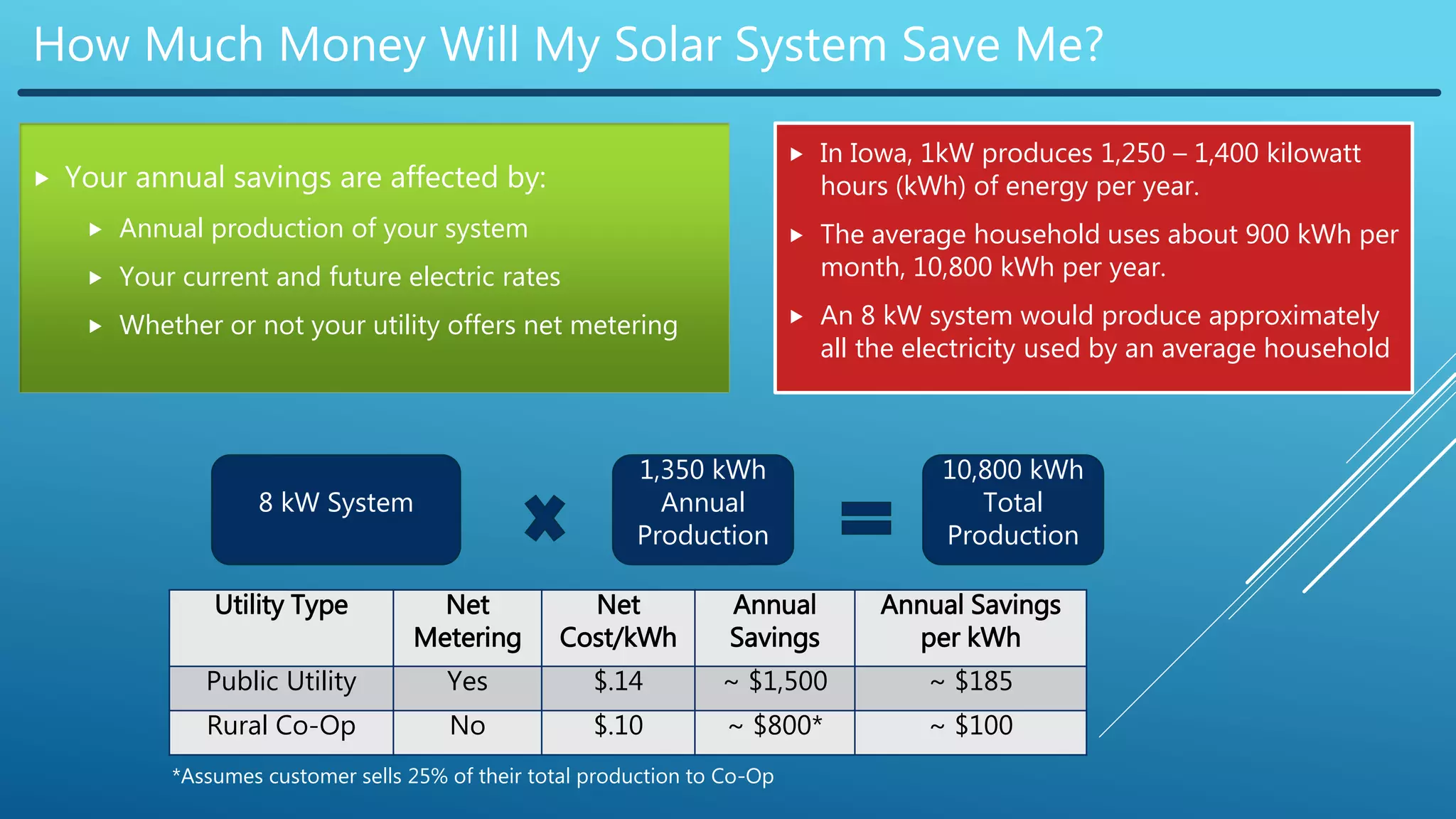
How Much Money Will My Solar System Save Me?
 Your annual savings are affected by:
 Annual production of your system
 Your current and future electric rates
 Whether or not your utility offers net metering
8 kW System
 In Iowa, 1kW produces 1,250 – 1,400 kilowatt
hours (kWh) of energy per year.
 The average household uses about 900 kWh per
month, 10,800 kWh per year.
 An 8 kW system would produce approximately
all the electricity used by an average household
Utility Type Net
Metering
Net
Cost/kWh
Annual
Savings
Annual Savings
per kWh
Public Utility Yes $.14 ~ $1,500 ~ $185
Rural Co-Op No $.10 ~ $800* ~ $100
1,350 kWh
Annual
Production
10,800 kWh
Total
Production
*Assumes customer sells 25% of their total production to Co-Op
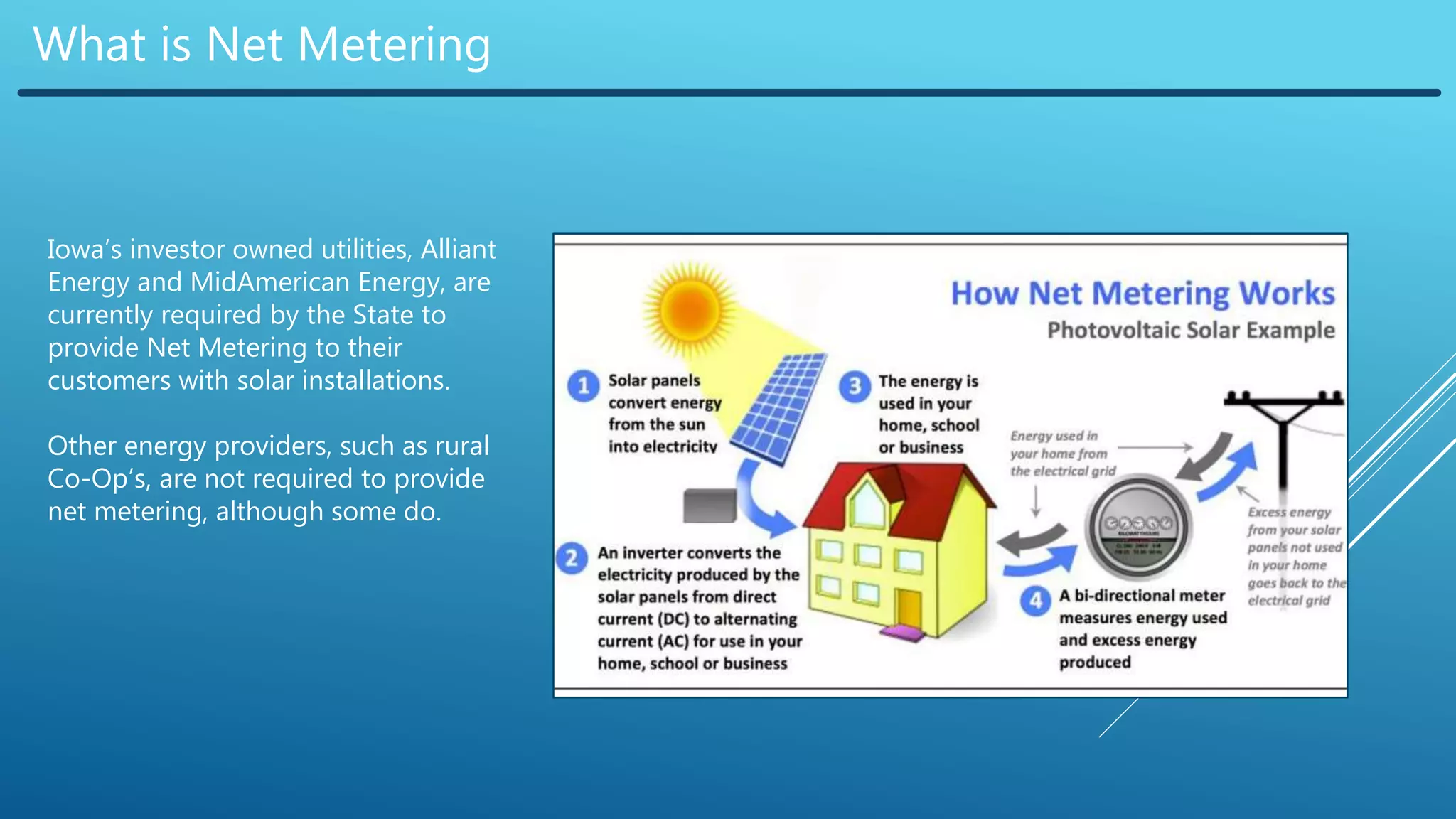
What is Net Metering
Iowa’s investor owned utilities, Alliant
Energy and MidAmerican Energy, are
currently required by the State to
provide Net Metering to their
customers with solar installations.
Other energy providers, such as rural
Co-Op’s, are not required to provide
net metering, although some do.
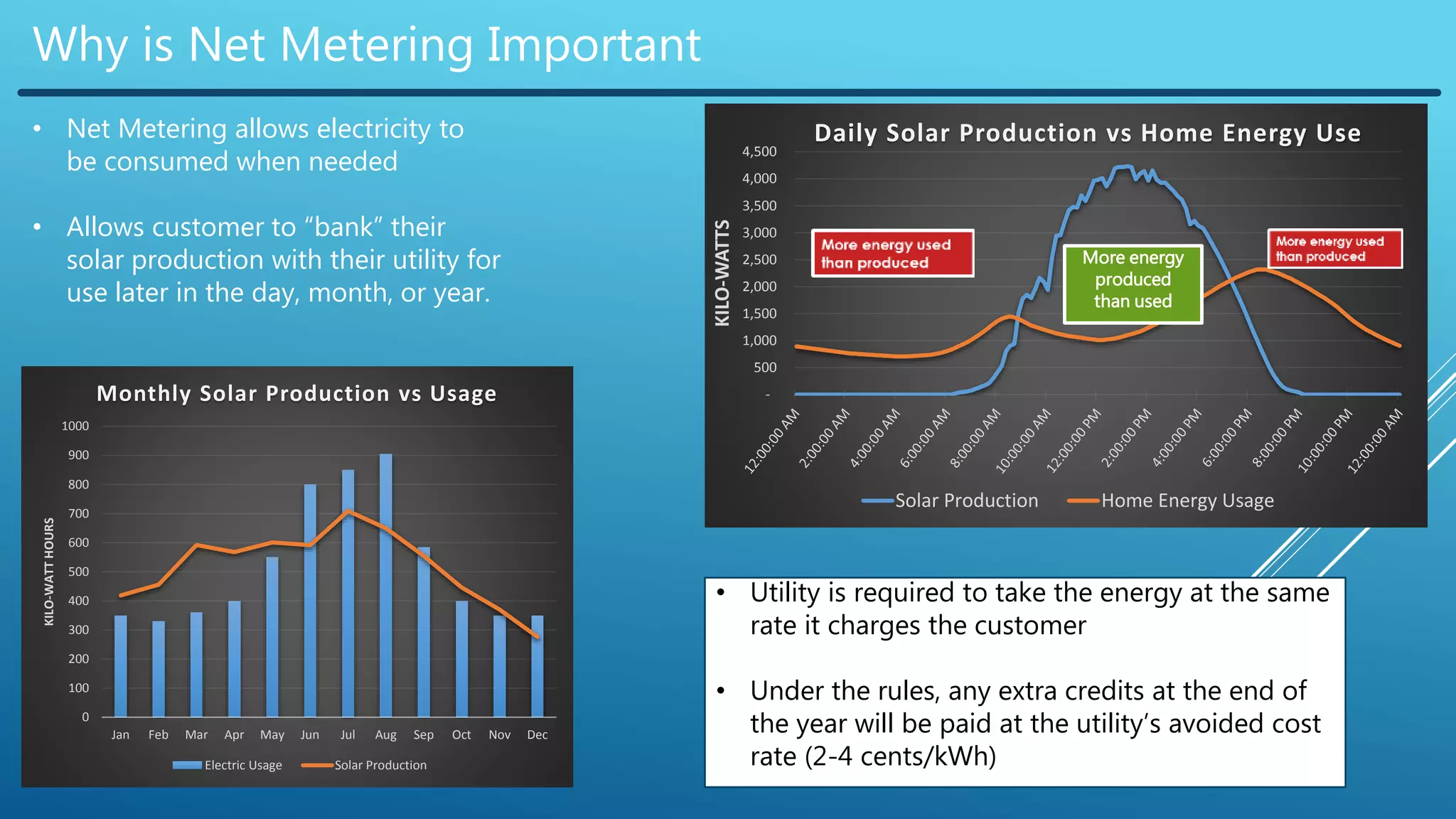
Why is Net Metering Important
-
500
1,000
1,500
2,000
2,500
3,000
3,500
4,000
4,500
KILO-WATTS
Daily Solar Production vs Home Energy Use
Solar Production Home Energy Usage
More energy
produced
than used
• Net Metering allows electricity to
be consumed when needed
• Allows customer to “bank” their
solar production with their utility for
use later in the day, month, or year.
• Utility is required to take the energy at the same
rate it charges the customer
• Under the rules, any extra credits at the end of
the year will be paid at the utility’s avoided cost
rate (2-4 cents/kWh)
0
100
200
300
400
500
600
700
800
900
1000
Jan Feb Mar Apr May Jun Jul Aug Sep Oct Nov Dec
KILO-WATTHOURS
Monthly Solar Production vs Usage
Electric Usage Solar Production
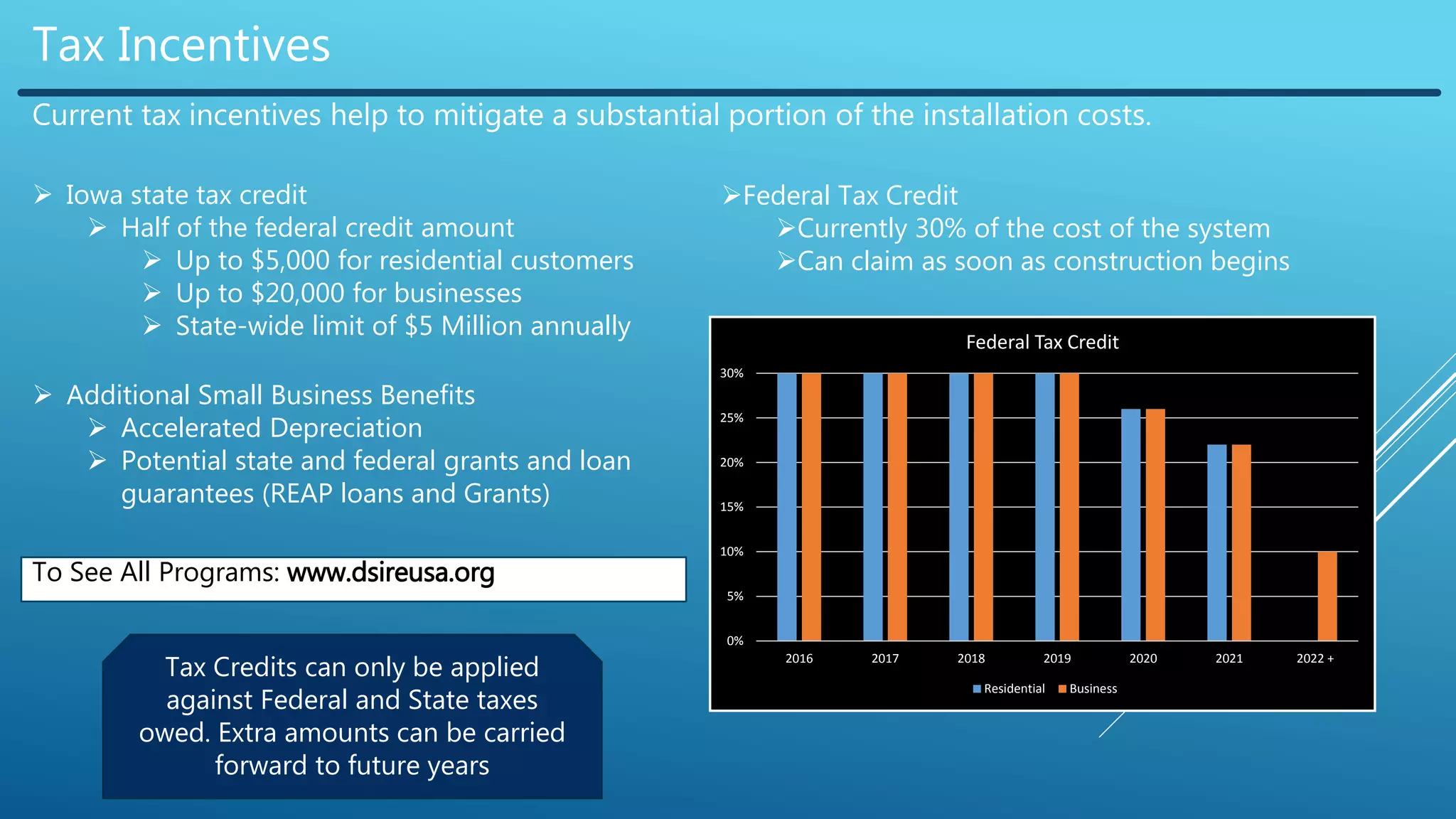
Tax Incentives
Current tax incentives help to mitigate a substantial portion of the installation costs.
 Additional Small Business Benefits
 Accelerated Depreciation
 Potential state and federal grants and loan
guarantees (REAP loans and Grants)
 Iowa state tax credit
 Half of the federal credit amount
 Up to $5,000 for residential customers
 Up to $20,000 for businesses
 State-wide limit of $5 Million annually
Federal Tax Credit
Currently 30% of the cost of the system
Can claim as soon as construction begins
0%
5%
10%
15%
20%
25%
30%
2016 2017 2018 2019 2020 2021 2022 +
Federal Tax Credit
Residential Business
Tax Credits can only be applied
against Federal and State taxes
owed. Extra amounts can be carried
forward to future years
To See All Programs: www.dsireusa.org
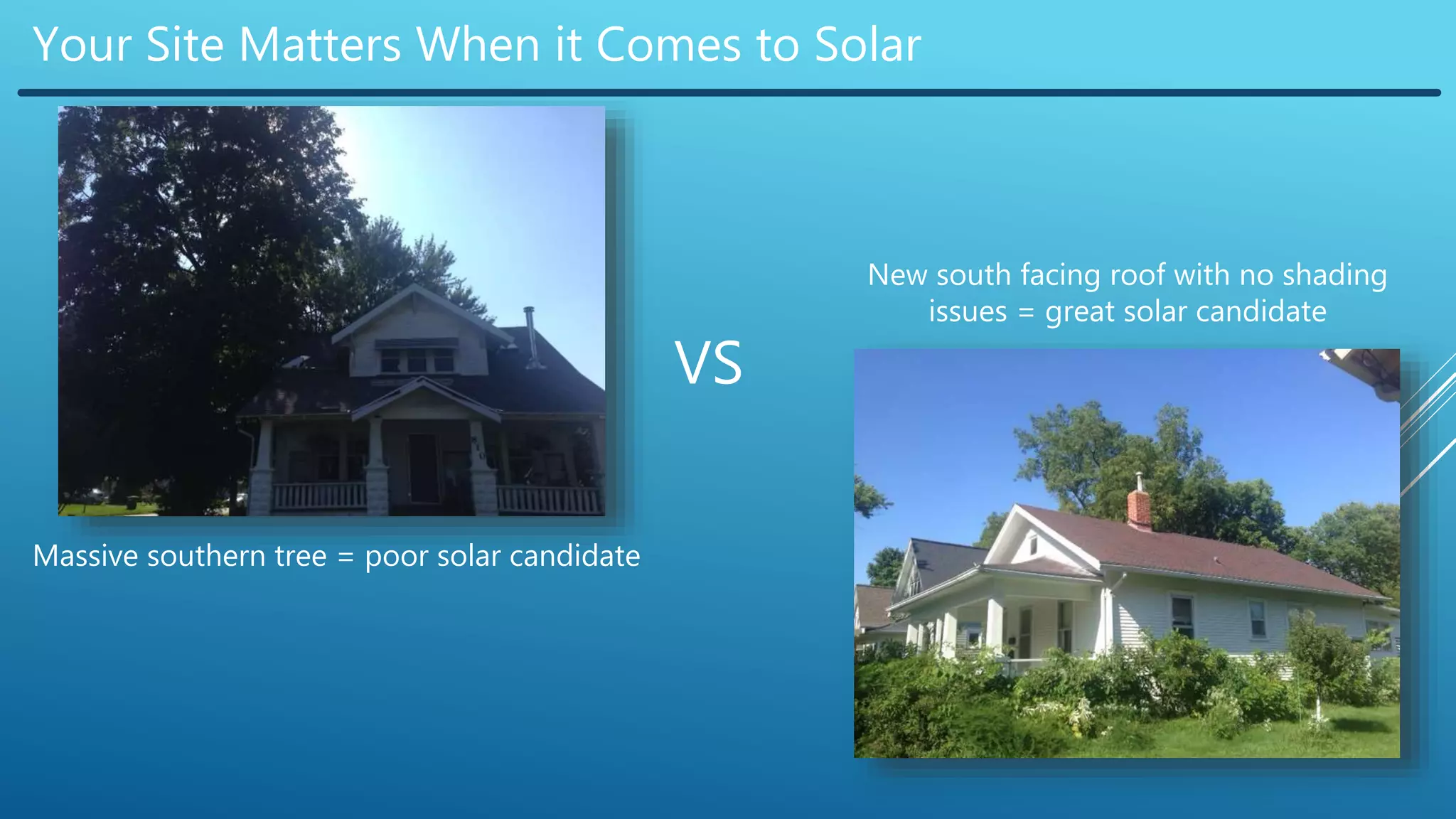
Your Site Matters When it Comes to Solar
VS
Massive southern tree = poor solar candidate
New south facing roof with no shading
issues = great solar candidate
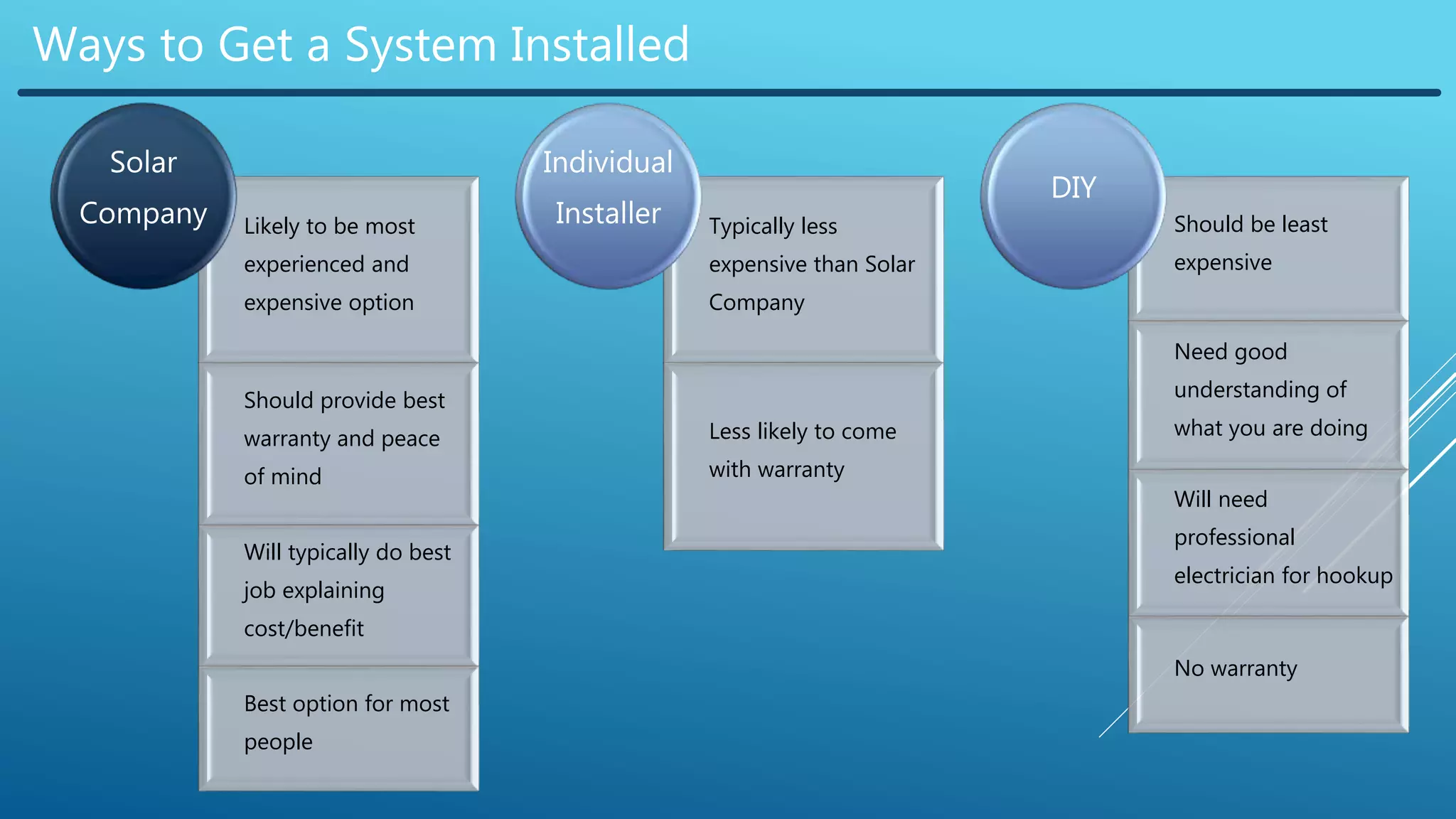
Ways to Get a System Installed
Likely to be most
experienced and
expensive option
Should provide best
warranty and peace
of mind
Will typically do best
job explaining
cost/benefit
Best option for most
people
Solar
Company Typically less
expensive than Solar
Company
Less likely to come
with warranty
Individual
Installer Should be least
expensive
Need good
understanding of
what you are doing
Will need
professional
electrician for hookup
No warranty
DIY
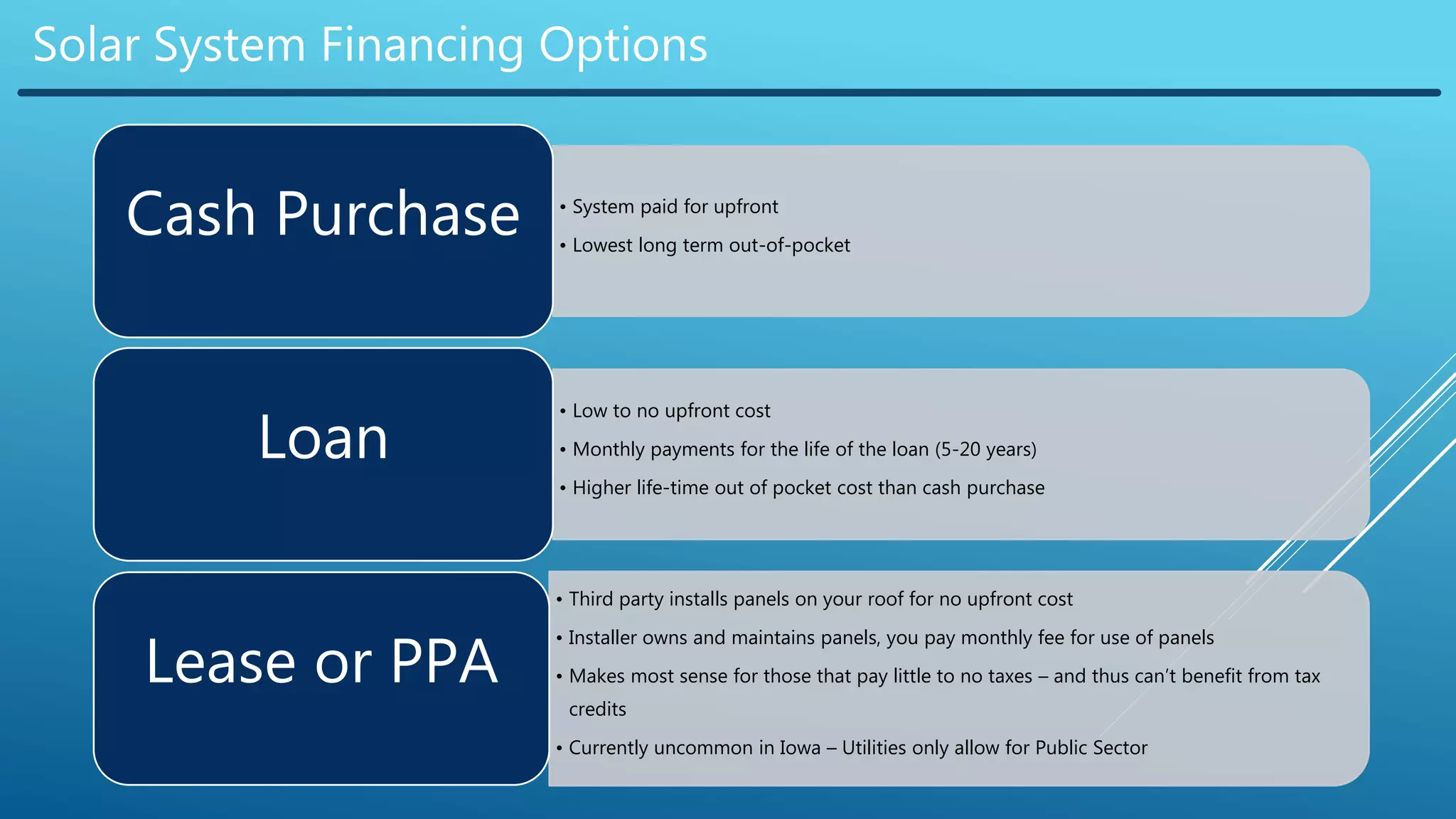
Solar System Financing Options
• System paid for upfront
• Lowest long term out-of-pocket
Cash Purchase
• Low to no upfront cost
• Monthly payments for the life of the loan (5-20 years)
• Higher life-time out of pocket cost than cash purchase
Loan
• Third party installs panels on your roof for no upfront cost
• Installer owns and maintains panels, you pay monthly fee for use of panels
• Makes most sense for those that pay little to no taxes – and thus can’t benefit from tax
credits
• Currently uncommon in Iowa – Utilities only allow for Public Sector
Lease or PPA
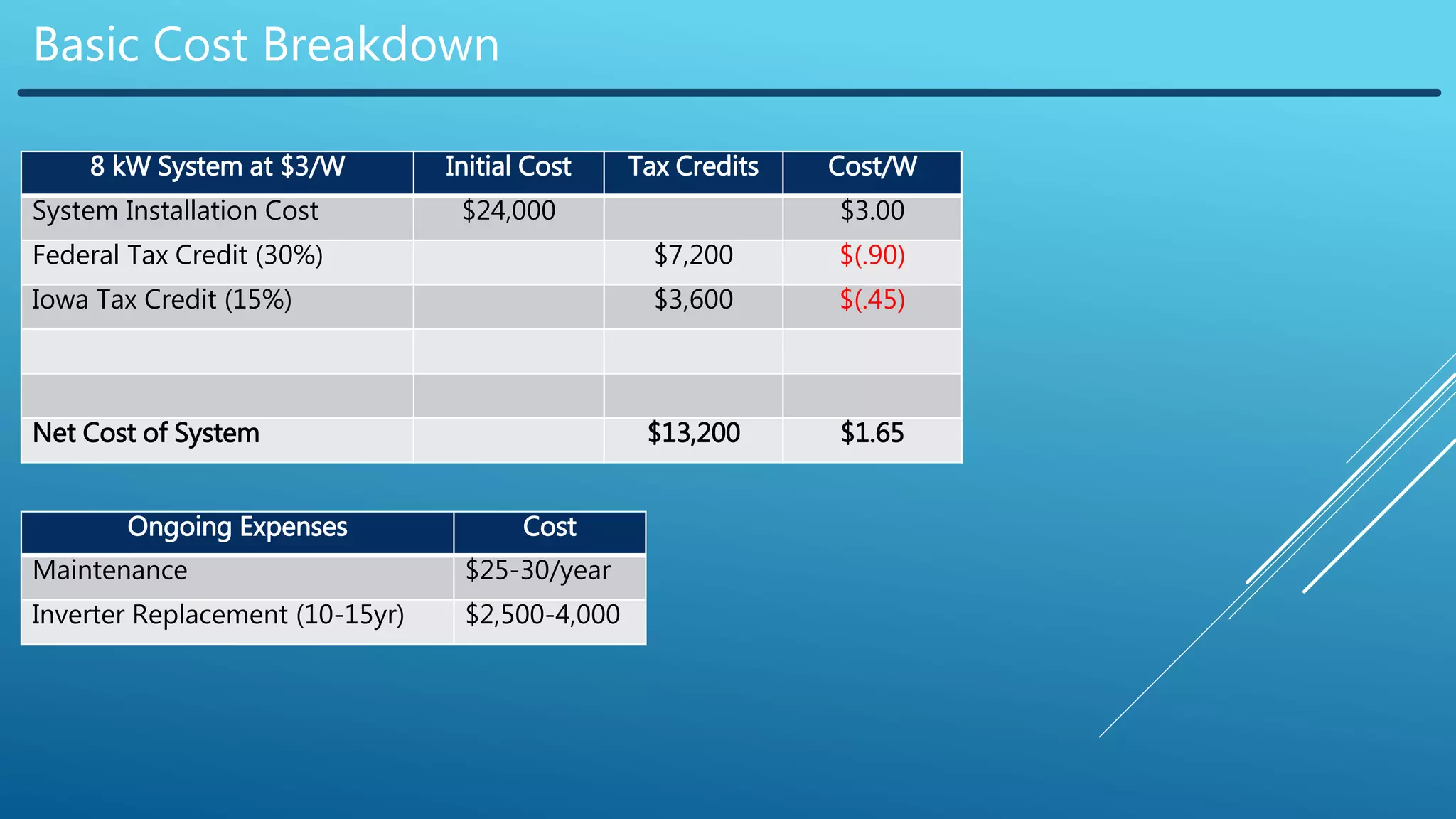
Basic Cost Breakdown
8 kW System at $3/W Initial Cost Tax Credits Cost/W
System Installation Cost $24,000 $3.00
Federal Tax Credit (30%) $7,200 $(.90)
Iowa Tax Credit (15%) $3,600 $(.45)
Net Cost of System $13,200 $1.65
Ongoing Expenses Cost
Maintenance $25-30/year
Inverter Replacement (10-15yr) $2,500-4,000
Buy vs Loan Example
($25,000)
($20,000)
($15,000)
($10,000)
($5,000)
$0
$5,000
$10,000
$15,000
$20,000
0 1 2 3 4 5 6 7 8 9 10 11 12 13 14 15 16 17 18 19 20 21 22 23 24 25
Solar System Financial Analysis - Cash Purchase
Inverter Replacement
Maintanance Expense
Production Savings
Tax Credits
System Cost
Net Cost
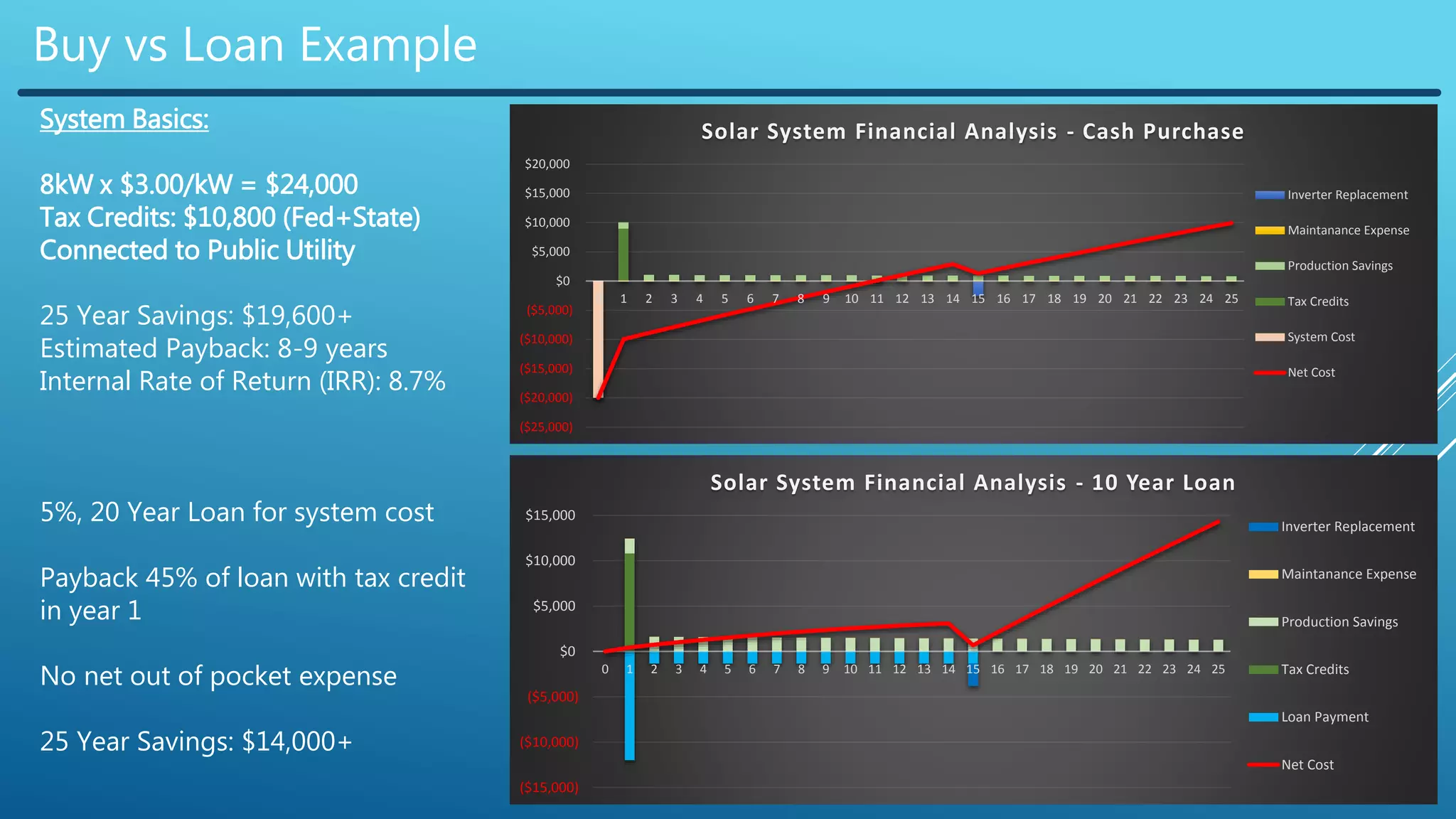
System Basics:
8kW x $3.00/kW = $24,000
Tax Credits: $10,800 (Fed+State)
Connected to Public Utility
25 Year Savings: $19,600+
Estimated Payback: 8-9 years
Internal Rate of Return (IRR): 8.7%
5%, 20 Year Loan for system cost
Payback 45% of loan with tax credit
in year 1
No net out of pocket expense
25 Year Savings: $14,000+
($15,000)
($10,000)
($5,000)
$0
$5,000
$10,000
$15,000
0 1 2 3 4 5 6 7 8 9 10 11 12 13 14 15 16 17 18 19 20 21 22 23 24 25
Solar System Financial Analysis - 10 Year Loan
Inverter Replacement
Maintanance Expense
Production Savings
Tax Credits
Loan Payment
Net Cost
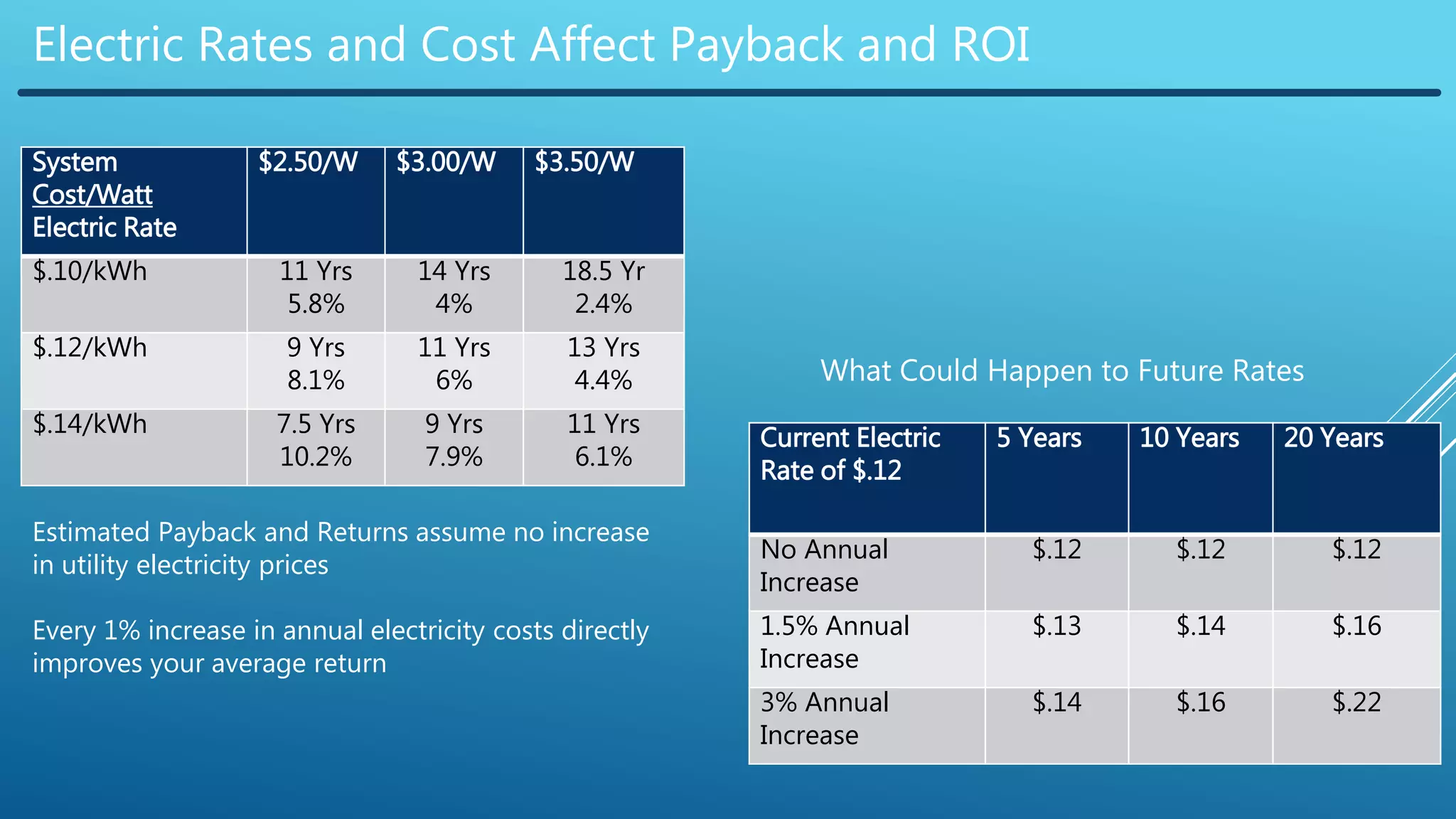
Electric Rates and Cost Affect Payback and ROI
System
Cost/Watt
Electric Rate
$2.50/W $3.00/W $3.50/W
$.10/kWh 11 Yrs
5.8%
14 Yrs
4%
18.5 Yr
2.4%
$.12/kWh 9 Yrs
8.1%
11 Yrs
6%
13 Yrs
4.4%
$.14/kWh 7.5 Yrs
10.2%
9 Yrs
7.9%
11 Yrs
6.1%
Estimated Payback and Returns assume no increase
in utility electricity prices
Every 1% increase in annual electricity costs directly
improves your average return
Current Electric
Rate of $.12
5 Years 10 Years 20 Years
No Annual
Increase
$.12 $.12 $.12
1.5% Annual
Increase
$.13 $.14 $.16
3% Annual
Increase
$.14 $.16 $.22
What Could Happen to Future Rates
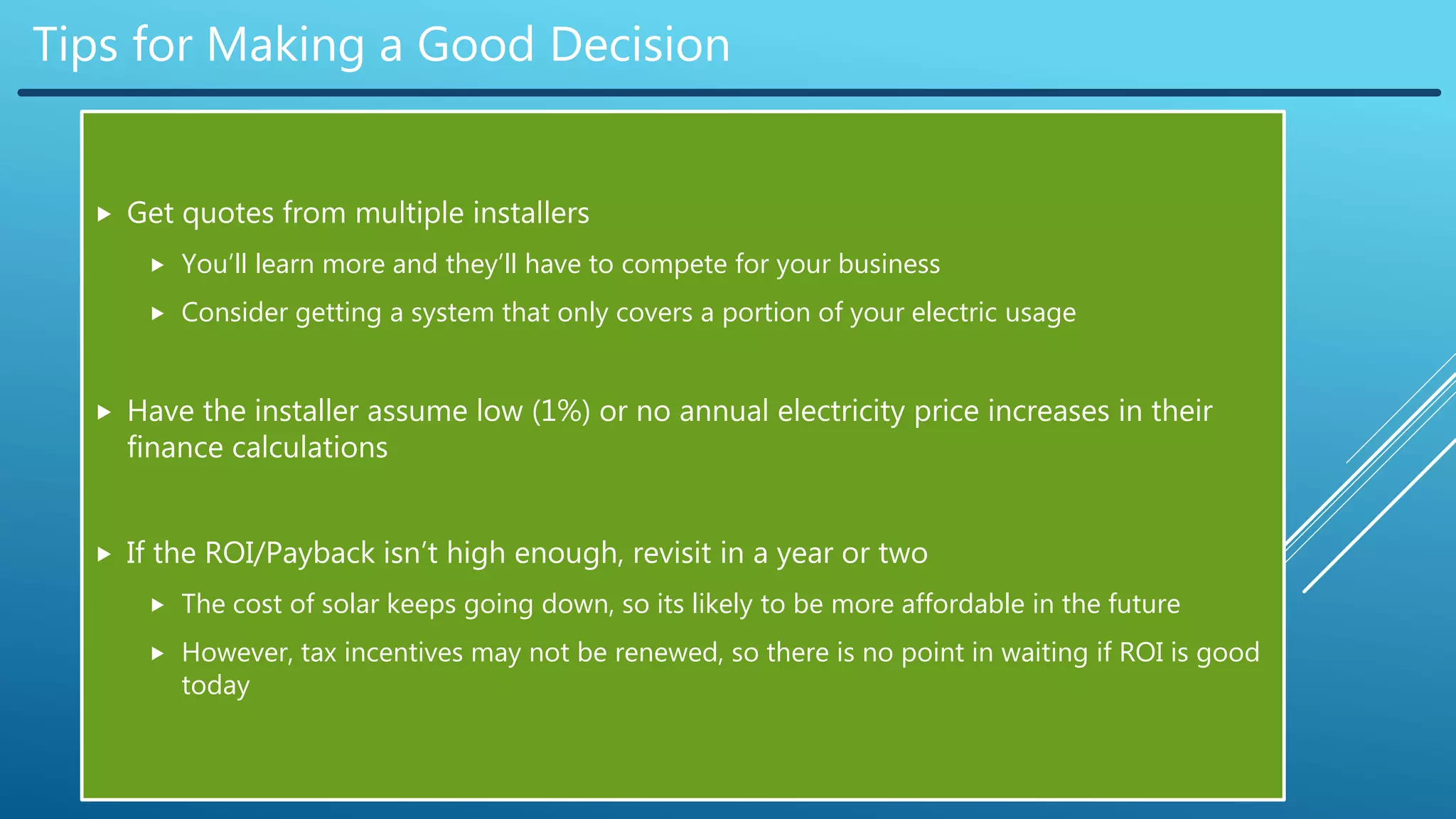
Tips for Making a Good Decision
 Get quotes from multiple installers
 You’ll learn more and they’ll have to compete for your business
 Consider getting a system that only covers a portion of your electric usage
 Have the installer assume low (1%) or no annual electricity price increases in their
finance calculations
 If the ROI/Payback isn’t high enough, revisit in a year or two
 The cost of solar keeps going down, so its likely to be more affordable in the future
 However, tax incentives may not be renewed, so there is no point in waiting if ROI is good
today
Resources
Estimating your solar resource: www.iowaenergycenter.org/solar-calculator-tool/
Database of all state incentives: www.dsireusa.org/
Info on REAP Loans/Grants: www.iowadnr.gov/Conservation/REAP
Alliant Energy Info on Customer Owned Generation:
www.alliantenergy.com/AboutAlliantEnergy/EnvironmentalCommitment/CustomerOwnedGeneration/
IOWA Tax Credit Info: tax.iowa.gov/sites/files/idr/documents/Solarenergytaxcredit.pdf

Solar Financing Basics

  • 1.
    SOLAR FINANCING BASICS Anoverview of the key points to keep in mind when evaluating a potential solar installation
  • 2.
    About the Presenter •Aurelien Windenberger, MBA • Financial and online-marketing consultant • Frequent writer focused on energy stocks for popular investing website SeekingAlpha.com • Have spent past year + analyzing renewable energy trends • Educator at heart - passionate about helping others make good financial decisions
  • 3.
    Why Buy aSolar System Good for the environment Saves money for decades after the initial purchase Less expensive than you might think Current government incentives expected to drop in the future Blended U.S. PV Installation Cost 2010: $6-7/Watt 2015: $3-3.50/Watt In 2015, 53% of Iowa's net electricity generation was fueled by coal, down from 59% in 2014. Wind made up over 31% of Iowa’s 2015 electric generation Solar is a small but rapidly growing portion of the mix Solar systems will last 25-40 years
  • 4.
    Solar System Basics •Howmuch will it cost •How much will it save you Net Metering •What is Net Metering •Who is eligible for Net Metering Tax Credits •What incentives are available •Who qualifies for credits Tips + Q&A Table of Contents
  • 5.
    What is aWatt? Watt = Unit of Power – Rate at which energy is used Watt-Hour = Unit of Energy – Amount of energy used 60 Watt Lightbulb Needs 60 Watts to turn on Uses 60 Watt-hours in one hour Typical 250w Solar Panel Generates up to 250 Watts Can produce 250 Watt-hours in one hour One solar panel could continuously power 4 60-watt lightbulbs Solar Panels currently range from 175 – 315 watts
  • 6.
    Solar System CostBasics  Solar system costs usually quoted on a per watt (W) basis  Residential customers can expect to pay $2.50-3.50 per watt, or $2,500 – 3,500 per kilowatt depending on system size and complexity.  As a ballpark, an 8 kW system would cost $20,000 – $28,000, BEFORE any tax incentives.  Larger commercial projects can expect even lower costs. 0% 10% 20% 30% 40% 50% 60% 70% 80% 90% 100% Solar System Cost Breakdown Labor, Overhead, and Profit Permitting Balance of System (Racking, sales tax, etc.) Inverter Solar Panels
  • 7.
    Calculating Your OwnCost Per kWh Total Electric Bill $151.50 Deduct: Monthly Fixed Charges $10.00 Deduct: Taxes $1.50 Net Variable Charges $140.00 Kilo-watt-hours Used 1,000 Variable Cost per kWh $.14 Be sure to check both summer and winter bills, as summer is usually more expensive
  • 8.
    How Much MoneyWill My Solar System Save Me?  Your annual savings are affected by:  Annual production of your system  Your current and future electric rates  Whether or not your utility offers net metering 8 kW System  In Iowa, 1kW produces 1,250 – 1,400 kilowatt hours (kWh) of energy per year.  The average household uses about 900 kWh per month, 10,800 kWh per year.  An 8 kW system would produce approximately all the electricity used by an average household Utility Type Net Metering Net Cost/kWh Annual Savings Annual Savings per kWh Public Utility Yes $.14 ~ $1,500 ~ $185 Rural Co-Op No $.10 ~ $800* ~ $100 1,350 kWh Annual Production 10,800 kWh Total Production *Assumes customer sells 25% of their total production to Co-Op
  • 9.
    What is NetMetering Iowa’s investor owned utilities, Alliant Energy and MidAmerican Energy, are currently required by the State to provide Net Metering to their customers with solar installations. Other energy providers, such as rural Co-Op’s, are not required to provide net metering, although some do.
  • 10.
    Why is NetMetering Important - 500 1,000 1,500 2,000 2,500 3,000 3,500 4,000 4,500 KILO-WATTS Daily Solar Production vs Home Energy Use Solar Production Home Energy Usage More energy produced than used • Net Metering allows electricity to be consumed when needed • Allows customer to “bank” their solar production with their utility for use later in the day, month, or year. • Utility is required to take the energy at the same rate it charges the customer • Under the rules, any extra credits at the end of the year will be paid at the utility’s avoided cost rate (2-4 cents/kWh) 0 100 200 300 400 500 600 700 800 900 1000 Jan Feb Mar Apr May Jun Jul Aug Sep Oct Nov Dec KILO-WATTHOURS Monthly Solar Production vs Usage Electric Usage Solar Production
  • 11.
    Tax Incentives Current taxincentives help to mitigate a substantial portion of the installation costs.  Additional Small Business Benefits  Accelerated Depreciation  Potential state and federal grants and loan guarantees (REAP loans and Grants)  Iowa state tax credit  Half of the federal credit amount  Up to $5,000 for residential customers  Up to $20,000 for businesses  State-wide limit of $5 Million annually Federal Tax Credit Currently 30% of the cost of the system Can claim as soon as construction begins 0% 5% 10% 15% 20% 25% 30% 2016 2017 2018 2019 2020 2021 2022 + Federal Tax Credit Residential Business Tax Credits can only be applied against Federal and State taxes owed. Extra amounts can be carried forward to future years To See All Programs: www.dsireusa.org
  • 12.
    Your Site MattersWhen it Comes to Solar VS Massive southern tree = poor solar candidate New south facing roof with no shading issues = great solar candidate
  • 13.
    Ways to Geta System Installed Likely to be most experienced and expensive option Should provide best warranty and peace of mind Will typically do best job explaining cost/benefit Best option for most people Solar Company Typically less expensive than Solar Company Less likely to come with warranty Individual Installer Should be least expensive Need good understanding of what you are doing Will need professional electrician for hookup No warranty DIY
  • 14.
    Solar System FinancingOptions • System paid for upfront • Lowest long term out-of-pocket Cash Purchase • Low to no upfront cost • Monthly payments for the life of the loan (5-20 years) • Higher life-time out of pocket cost than cash purchase Loan • Third party installs panels on your roof for no upfront cost • Installer owns and maintains panels, you pay monthly fee for use of panels • Makes most sense for those that pay little to no taxes – and thus can’t benefit from tax credits • Currently uncommon in Iowa – Utilities only allow for Public Sector Lease or PPA
  • 15.
    Basic Cost Breakdown 8kW System at $3/W Initial Cost Tax Credits Cost/W System Installation Cost $24,000 $3.00 Federal Tax Credit (30%) $7,200 $(.90) Iowa Tax Credit (15%) $3,600 $(.45) Net Cost of System $13,200 $1.65 Ongoing Expenses Cost Maintenance $25-30/year Inverter Replacement (10-15yr) $2,500-4,000
  • 16.
    Buy vs LoanExample ($25,000) ($20,000) ($15,000) ($10,000) ($5,000) $0 $5,000 $10,000 $15,000 $20,000 0 1 2 3 4 5 6 7 8 9 10 11 12 13 14 15 16 17 18 19 20 21 22 23 24 25 Solar System Financial Analysis - Cash Purchase Inverter Replacement Maintanance Expense Production Savings Tax Credits System Cost Net Cost System Basics: 8kW x $3.00/kW = $24,000 Tax Credits: $10,800 (Fed+State) Connected to Public Utility 25 Year Savings: $19,600+ Estimated Payback: 8-9 years Internal Rate of Return (IRR): 8.7% 5%, 20 Year Loan for system cost Payback 45% of loan with tax credit in year 1 No net out of pocket expense 25 Year Savings: $14,000+ ($15,000) ($10,000) ($5,000) $0 $5,000 $10,000 $15,000 0 1 2 3 4 5 6 7 8 9 10 11 12 13 14 15 16 17 18 19 20 21 22 23 24 25 Solar System Financial Analysis - 10 Year Loan Inverter Replacement Maintanance Expense Production Savings Tax Credits Loan Payment Net Cost
  • 17.
    Electric Rates andCost Affect Payback and ROI System Cost/Watt Electric Rate $2.50/W $3.00/W $3.50/W $.10/kWh 11 Yrs 5.8% 14 Yrs 4% 18.5 Yr 2.4% $.12/kWh 9 Yrs 8.1% 11 Yrs 6% 13 Yrs 4.4% $.14/kWh 7.5 Yrs 10.2% 9 Yrs 7.9% 11 Yrs 6.1% Estimated Payback and Returns assume no increase in utility electricity prices Every 1% increase in annual electricity costs directly improves your average return Current Electric Rate of $.12 5 Years 10 Years 20 Years No Annual Increase $.12 $.12 $.12 1.5% Annual Increase $.13 $.14 $.16 3% Annual Increase $.14 $.16 $.22 What Could Happen to Future Rates
  • 18.
    Tips for Makinga Good Decision  Get quotes from multiple installers  You’ll learn more and they’ll have to compete for your business  Consider getting a system that only covers a portion of your electric usage  Have the installer assume low (1%) or no annual electricity price increases in their finance calculations  If the ROI/Payback isn’t high enough, revisit in a year or two  The cost of solar keeps going down, so its likely to be more affordable in the future  However, tax incentives may not be renewed, so there is no point in waiting if ROI is good today
  • 19.
    Resources Estimating your solarresource: www.iowaenergycenter.org/solar-calculator-tool/ Database of all state incentives: www.dsireusa.org/ Info on REAP Loans/Grants: www.iowadnr.gov/Conservation/REAP Alliant Energy Info on Customer Owned Generation: www.alliantenergy.com/AboutAlliantEnergy/EnvironmentalCommitment/CustomerOwnedGeneration/ IOWA Tax Credit Info: tax.iowa.gov/sites/files/idr/documents/Solarenergytaxcredit.pdf

Editor's Notes

  • #11 Monthly Totals assume 4.5kW system
  • #12 http://news.energysage.com/congress-extends-the-solar-tax-credit/ REAP Grants can be competitive, Using Grant Writer such as Pathfinders can help. Loan guarantee for up to 75% of total cost, Grants up to 25% of total cost.
  • #14 Websites to check out for DIY Sunelec.com Wholesalesolar.com
  • #17 Assume no increase in utility prices Loan payment is $1,092/year after 1st year