Project FinanceSession 5 – Financing the Deal (Part 1)
AgendaProject Finance ModelFinancing the Deal (Part I)Advising & Arranging ActivitiesFee StructureInternational Financial Institutions & Multilateral BanksBilateral Agencies (ECA's)Case: Dahbol Power Project
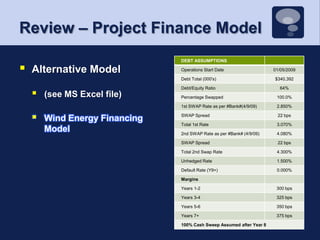
Review – Project Finance ModelAlternative Model (see MS Excel file)Wind Energy Financing Model
Financing the DealAdvising, Arranging & Lending  Services& Fee Structures
Advising & Arranging ActivitiesAdvisory ServicesModelling & Structuring the DealPrimarily the domain of … Investment Banks, Consulting Firms & Engineering FirmsArranging & LendingCommercial BanksMultilateral Institutions Bilateral InstitutionsExport Credit Agencies
Advisory ServicesThe Advisors tasks include:Identify Alternative Solutions Evaluate Risks – Mitigate, Manage & AllocatePrepare & Negotiate ContractsProcess Permits & LicensesAssist / Prepare the Business Plan
Advisory ServicesInformation Memorandum The document with which the advisor contracts potential lenders and begins to negotiate the credit agreement and loan documentation.
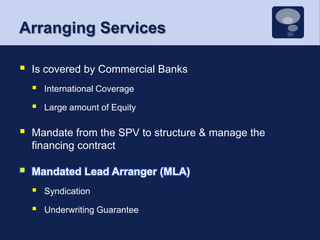
Arranging ServicesIs covered by Commercial BanksInternational CoverageLarge amount of EquityMandate from the SPV to structure & manage the financing contractMandated Lead Arranger (MLA)Syndication Underwriting Guarantee
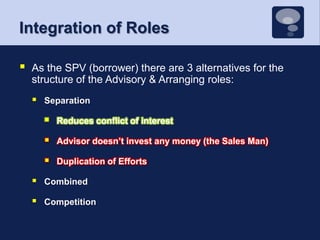
Integration of RolesAs the SPV (borrower) there are 3 alternatives for the structure of the Advisory & Arranging roles:SeparationReduces conflict of interestAdvisor doesn’t invest any money (the Sales Man)Duplication of EffortsCombined Competition
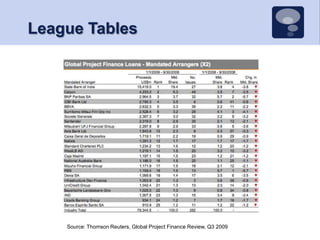
League TablesSource: Thomson Reuters, Global Project Finance Review, Q3 2009
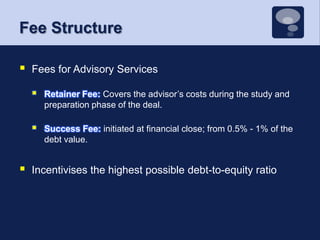
Fee StructureFees for Advisory ServicesRetainer Fee: Covers the advisor’s costs during the study and preparation phase of the deal. Success Fee: initiated at financial close; from 0.5% - 1% of the debt value. Incentivises the highest possible debt-to-equity ratio
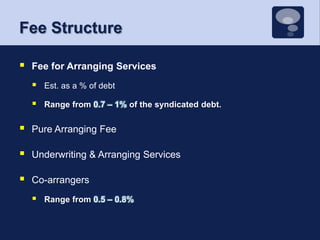
Fee StructureFee for Arranging ServicesEst. as a % of debtRange from 0.7 – 1% of the syndicated debt. Pure Arranging FeeUnderwriting & Arranging ServicesCo-arrangers Range from 0.5 – 0.8%
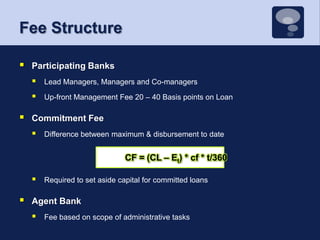
Fee StructureParticipating BanksLead Managers, Managers and Co-managersUp-front Management Fee 20 – 40 Basis points on LoanCommitment FeeDifference between maximum & disbursement to dateRequired to set aside capital for committed loansAgent BankFee based on scope of administrative tasksCF = (CL – Et) * cf * t/360
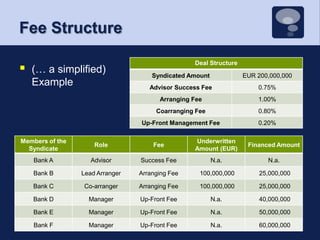
Fee Structure(… a simplified) Example
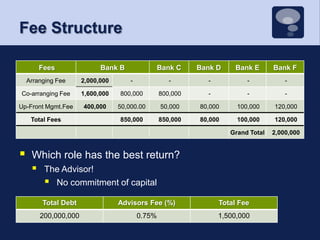
Fee StructureWhich role has the best return? The Advisor!No commitment of capital
Financing the DealMultilateral Organisations & the World Bank
Multilateral OrganisationsLeading role in project finance deals in developing countriesTrends Less Government / More Private Projects Tendency not to lend directlySupport Private Sector through GuaranteesWorld Bank Group Five Institutional AgenciesIBRD, IDA, IFC, MIGA & ICSID
World Bank (Group)Formed at Bretton Wood Conference, 1944Headquartered in Washington D.C.Owned by 186 Member CountriesMillennium Development GoalsGoal 7. Ensure environmental sustainabilityGoal 8. Develop a Global Partnership for DevelopmentLast year, the World Bank provided $46.9 billion for 303 projects in developing countries worldwide
World Bank - IBRDAims to reduce poverty in middle-income and creditworthy poorer countriesInvolvement in Project FinanceDirect LoansPartial Risk GuaranteesPartial Credit GuaranteesEnclave GuaranteesMostly Government Related ProjectsNo private financing available* Enclave = Revenues flow between entities outside the host country
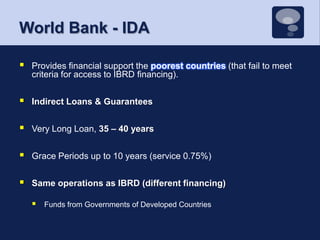
World Bank - IDAProvides financial support the poorest countries (that fail to meet criteria for access to IBRD financing).Indirect Loans & GuaranteesVery Long Loan, 35 – 40 yearsGrace Periods up to 10 years (service 0.75%)Same operations as IBRD (different financing)Funds from Governments of Developed Countries
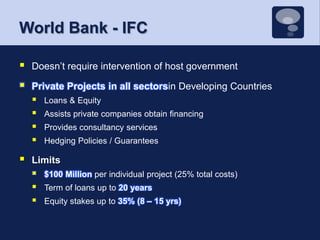
World Bank - IFCDoesn’t require intervention of host governmentPrivate Projects in all sectorsin Developing CountriesLoans & EquityAssists private companies obtain financingProvides consultancy servicesHedging Policies / Guarantees	Limits$100 Million per individual project (25% total costs)Term of loans up to 20 yearsEquity stakes up to 35% (8 – 15 yrs)
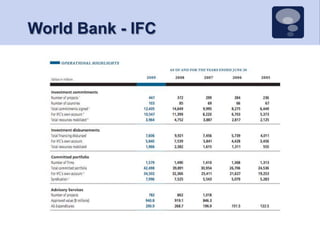
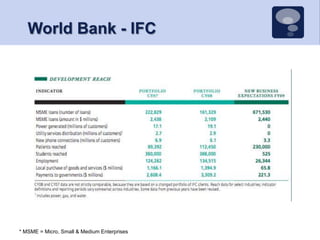
World Bank - IFC
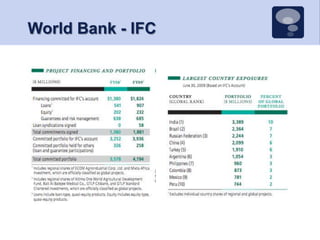
World Bank - IFC
World Bank - IFC* MSME = Micro, Small & Medium Enterprises
World Bank - MIGAProvides Political Risk Coverage to lenders & InvestorsAll 163 World Bank MembersOnly WB agency that offers Political Risk CoverageUp to 95% of debt serviceMax. $200 MillionPremiums range from 0.5 – 1.75%15 years duration
World Bank – ICSIDEstablished in 1966 under the Convention on the Settlement of Investment Disputes.Arbitration on international investment disputes between foreign investors and host states143 Member CountriesTotal Cases Registered 292Cases Registered in (fiscal) 2009, 24E.g. Cambodia Power Company vs. Kingdom of Cambodia and Electricité du Cambodge
Financing the DealOther Development Banks,Bilateral Agencies & ECA’s
EIB – European Investment BankOwned by EU member countriesEIB loans funded from capital markets (AAA)Within EUUp to 50% of project costs12 -  20 yearsNo arranging feesOutside EUEIB takes on political risk (restricted)
AfDB – African Development Bank53 African nations, 24 non-AfricanPromotes infrastructure projects, particularly PPPAssistanceLoans, Guarantees < 1/3 Total Project CostEquity < 25% of the SPV’s capital stockTotal Project Costs < $9 Million
IDB – Islamic Development BankAdheres to Islamic LawProhibits the charging of interest on loansAssistanceLoans < 7 Million Islamic DinarsMaturity ranging 15 – 25 years (grace 3 – 7 yrs)Leasing (ijara)Instalment Sales (murabaha)Equity, max 1/3 capital
Development BanksHandout Examples …EIB – (Poland) A1 Debt Structure EmergingIDB – (Brazil) IDB Approves Rodoanel LoanSource: Project Finance Magazine, Oct 2009 (ProQuest LLC)
Development AgenciesBilateral … pursue aims lined toforeign economic policy or commercial promotion of home countryExamplesCommonwealth Development Corp. (CDC), UKinvests in private equity funds focused on the emerging markets of Asia, Africa and Latin AmericaE.g. US$35 Million, to Private Equity for Microfinance ProjectsDeutsche EntwicklungsGesellschaft (DEG), GermanyE.g. financing of Olkaria III, a geothermal power station in Kenya
ECA’s – Export Credit AgenciesPolitical Risk Coverage, total coverage & direct loans to exporting companies operating in their home countryEnable exporters to be competitive, in otherwise high-risk endeavours. Funding Direct Lending, for purchase from country of originIndirect Lending, financial intermediary (commercial)Interest Rate Equalization, lower than market ratesActivities of ECA’s is regulated by OECD Consensus85% of contract value Duration 8.5 – 10yrs (max.)Constant Repayments, 6 months (max.)
ECA’s – Export Credit AgenciesExamplesExport-Import Bank, United StatesExport Credits Guarantee Department (ECGD), UKAuslandsGeschäftsAbsicherung (AGA), GermanyCompañíaEspañola de Seguros de Crédito a la Exportación (CESCE), Spain Export Finance &Insurance Corporation (EFIC), Australia
ECA Activities MTS secures USD1 billion Credit LineEx-Im Bank Increases Export Credit Support for RenewablesMTS secures USD1 billion credit line according to Russian news agency Prime-Tass, the country’s largest cellco by subscribers, Mobile Tele Systems (MTS), has secured a credit line of USD1.07 billion to finance the purchase of network infrastructure equipment from Ericsson.The facility, backed by Sweden’s Export Credit Agency, has two tranches: the first, valued at USD429 million, has a maturity of June 2019, while the second tranche, worth USD646 million, is due to be repaid in October 2020. Mikhail Shamolin, President and CEO of MTS, said, ‘The terms and size of the loan that we were able to secure provide us with the necessary flexibility in our CAPEX plans going forward as we build out our networks to provide quality services to our subscribers.’… The Export-Import Bank of the United States has established a $250 million credit facility aimed at helping to promote and finance renewable energy exports, including solar, wind and geothermal energy products and projects.The move this week makes Ex-Im the world’s first Export Credit Agency to fashion that kind of credit assistance and also the first to adopt an actual “carbon policy” to guide the financial support of U.S. exports “in light of climate change concerns,” the agency says.In fiscal year 2009, which ended September 30, the Bank authorized more than $21 billion in support of U.S. exports and associated jobs, the highest financing level since it was established in 1934. The Bank, which is the official, independent export credit agency of the U.S., also set a record for financing of U.S. small business exports at $4.36 billion.
Case Review:Dahbol Power Project (India)
Case: Dahbol Power ProjectProject DescriptionDescribe the structure of the Project Company (SPV)What were the key external relationships related to the deal? What we the main risks (problems) of the project? How was the project financed? Describe the main contracts that were associated with the project?How did these contracts impact the viability of the project? Conclusions?

Project Finance - Session 05

  • 1.
    Project FinanceSession 5– Financing the Deal (Part 1)
  • 2.
    AgendaProject Finance ModelFinancingthe Deal (Part I)Advising & Arranging ActivitiesFee StructureInternational Financial Institutions & Multilateral BanksBilateral Agencies (ECA's)Case: Dahbol Power Project
  • 3.
    Review – ProjectFinance ModelAlternative Model (see MS Excel file)Wind Energy Financing Model
  • 4.
    Financing the DealAdvising,Arranging & Lending Services& Fee Structures
  • 5.
    Advising & ArrangingActivitiesAdvisory ServicesModelling & Structuring the DealPrimarily the domain of … Investment Banks, Consulting Firms & Engineering FirmsArranging & LendingCommercial BanksMultilateral Institutions Bilateral InstitutionsExport Credit Agencies
  • 6.
    Advisory ServicesThe Advisorstasks include:Identify Alternative Solutions Evaluate Risks – Mitigate, Manage & AllocatePrepare & Negotiate ContractsProcess Permits & LicensesAssist / Prepare the Business Plan
  • 7.
    Advisory ServicesInformation MemorandumThe document with which the advisor contracts potential lenders and begins to negotiate the credit agreement and loan documentation.
  • 8.
    Arranging ServicesIs coveredby Commercial BanksInternational CoverageLarge amount of EquityMandate from the SPV to structure & manage the financing contractMandated Lead Arranger (MLA)Syndication Underwriting Guarantee
  • 9.
    Integration of RolesAsthe SPV (borrower) there are 3 alternatives for the structure of the Advisory & Arranging roles:SeparationReduces conflict of interestAdvisor doesn’t invest any money (the Sales Man)Duplication of EffortsCombined Competition
  • 10.
    League TablesSource: ThomsonReuters, Global Project Finance Review, Q3 2009
  • 11.
    Fee StructureFees forAdvisory ServicesRetainer Fee: Covers the advisor’s costs during the study and preparation phase of the deal. Success Fee: initiated at financial close; from 0.5% - 1% of the debt value. Incentivises the highest possible debt-to-equity ratio
  • 12.
    Fee StructureFee forArranging ServicesEst. as a % of debtRange from 0.7 – 1% of the syndicated debt. Pure Arranging FeeUnderwriting & Arranging ServicesCo-arrangers Range from 0.5 – 0.8%
  • 13.
    Fee StructureParticipating BanksLeadManagers, Managers and Co-managersUp-front Management Fee 20 – 40 Basis points on LoanCommitment FeeDifference between maximum & disbursement to dateRequired to set aside capital for committed loansAgent BankFee based on scope of administrative tasksCF = (CL – Et) * cf * t/360
  • 14.
    Fee Structure(… asimplified) Example
  • 15.
    Fee StructureWhich rolehas the best return? The Advisor!No commitment of capital
  • 16.
    Financing the DealMultilateralOrganisations & the World Bank
  • 17.
    Multilateral OrganisationsLeading rolein project finance deals in developing countriesTrends Less Government / More Private Projects Tendency not to lend directlySupport Private Sector through GuaranteesWorld Bank Group Five Institutional AgenciesIBRD, IDA, IFC, MIGA & ICSID
  • 18.
    World Bank (Group)Formedat Bretton Wood Conference, 1944Headquartered in Washington D.C.Owned by 186 Member CountriesMillennium Development GoalsGoal 7. Ensure environmental sustainabilityGoal 8. Develop a Global Partnership for DevelopmentLast year, the World Bank provided $46.9 billion for 303 projects in developing countries worldwide
  • 19.
    World Bank -IBRDAims to reduce poverty in middle-income and creditworthy poorer countriesInvolvement in Project FinanceDirect LoansPartial Risk GuaranteesPartial Credit GuaranteesEnclave GuaranteesMostly Government Related ProjectsNo private financing available* Enclave = Revenues flow between entities outside the host country
  • 20.
    World Bank -IDAProvides financial support the poorest countries (that fail to meet criteria for access to IBRD financing).Indirect Loans & GuaranteesVery Long Loan, 35 – 40 yearsGrace Periods up to 10 years (service 0.75%)Same operations as IBRD (different financing)Funds from Governments of Developed Countries
  • 21.
    World Bank -IFCDoesn’t require intervention of host governmentPrivate Projects in all sectorsin Developing CountriesLoans & EquityAssists private companies obtain financingProvides consultancy servicesHedging Policies / Guarantees Limits$100 Million per individual project (25% total costs)Term of loans up to 20 yearsEquity stakes up to 35% (8 – 15 yrs)
  • 22.
  • 23.
  • 24.
    World Bank -IFC* MSME = Micro, Small & Medium Enterprises
  • 25.
    World Bank -MIGAProvides Political Risk Coverage to lenders & InvestorsAll 163 World Bank MembersOnly WB agency that offers Political Risk CoverageUp to 95% of debt serviceMax. $200 MillionPremiums range from 0.5 – 1.75%15 years duration
  • 26.
    World Bank –ICSIDEstablished in 1966 under the Convention on the Settlement of Investment Disputes.Arbitration on international investment disputes between foreign investors and host states143 Member CountriesTotal Cases Registered 292Cases Registered in (fiscal) 2009, 24E.g. Cambodia Power Company vs. Kingdom of Cambodia and Electricité du Cambodge
  • 27.
    Financing the DealOtherDevelopment Banks,Bilateral Agencies & ECA’s
  • 28.
    EIB – EuropeanInvestment BankOwned by EU member countriesEIB loans funded from capital markets (AAA)Within EUUp to 50% of project costs12 - 20 yearsNo arranging feesOutside EUEIB takes on political risk (restricted)
  • 29.
    AfDB – AfricanDevelopment Bank53 African nations, 24 non-AfricanPromotes infrastructure projects, particularly PPPAssistanceLoans, Guarantees < 1/3 Total Project CostEquity < 25% of the SPV’s capital stockTotal Project Costs < $9 Million
  • 30.
    IDB – IslamicDevelopment BankAdheres to Islamic LawProhibits the charging of interest on loansAssistanceLoans < 7 Million Islamic DinarsMaturity ranging 15 – 25 years (grace 3 – 7 yrs)Leasing (ijara)Instalment Sales (murabaha)Equity, max 1/3 capital
  • 31.
    Development BanksHandout Examples…EIB – (Poland) A1 Debt Structure EmergingIDB – (Brazil) IDB Approves Rodoanel LoanSource: Project Finance Magazine, Oct 2009 (ProQuest LLC)
  • 32.
    Development AgenciesBilateral …pursue aims lined toforeign economic policy or commercial promotion of home countryExamplesCommonwealth Development Corp. (CDC), UKinvests in private equity funds focused on the emerging markets of Asia, Africa and Latin AmericaE.g. US$35 Million, to Private Equity for Microfinance ProjectsDeutsche EntwicklungsGesellschaft (DEG), GermanyE.g. financing of Olkaria III, a geothermal power station in Kenya
  • 33.
    ECA’s – ExportCredit AgenciesPolitical Risk Coverage, total coverage & direct loans to exporting companies operating in their home countryEnable exporters to be competitive, in otherwise high-risk endeavours. Funding Direct Lending, for purchase from country of originIndirect Lending, financial intermediary (commercial)Interest Rate Equalization, lower than market ratesActivities of ECA’s is regulated by OECD Consensus85% of contract value Duration 8.5 – 10yrs (max.)Constant Repayments, 6 months (max.)
  • 34.
    ECA’s – ExportCredit AgenciesExamplesExport-Import Bank, United StatesExport Credits Guarantee Department (ECGD), UKAuslandsGeschäftsAbsicherung (AGA), GermanyCompañíaEspañola de Seguros de Crédito a la Exportación (CESCE), Spain Export Finance &Insurance Corporation (EFIC), Australia
  • 35.
    ECA Activities MTSsecures USD1 billion Credit LineEx-Im Bank Increases Export Credit Support for RenewablesMTS secures USD1 billion credit line according to Russian news agency Prime-Tass, the country’s largest cellco by subscribers, Mobile Tele Systems (MTS), has secured a credit line of USD1.07 billion to finance the purchase of network infrastructure equipment from Ericsson.The facility, backed by Sweden’s Export Credit Agency, has two tranches: the first, valued at USD429 million, has a maturity of June 2019, while the second tranche, worth USD646 million, is due to be repaid in October 2020. Mikhail Shamolin, President and CEO of MTS, said, ‘The terms and size of the loan that we were able to secure provide us with the necessary flexibility in our CAPEX plans going forward as we build out our networks to provide quality services to our subscribers.’… The Export-Import Bank of the United States has established a $250 million credit facility aimed at helping to promote and finance renewable energy exports, including solar, wind and geothermal energy products and projects.The move this week makes Ex-Im the world’s first Export Credit Agency to fashion that kind of credit assistance and also the first to adopt an actual “carbon policy” to guide the financial support of U.S. exports “in light of climate change concerns,” the agency says.In fiscal year 2009, which ended September 30, the Bank authorized more than $21 billion in support of U.S. exports and associated jobs, the highest financing level since it was established in 1934. The Bank, which is the official, independent export credit agency of the U.S., also set a record for financing of U.S. small business exports at $4.36 billion.
  • 36.
  • 37.
    Case: Dahbol PowerProjectProject DescriptionDescribe the structure of the Project Company (SPV)What were the key external relationships related to the deal? What we the main risks (problems) of the project? How was the project financed? Describe the main contracts that were associated with the project?How did these contracts impact the viability of the project? Conclusions?

Editor's Notes

  • #18 International Bank for Reconstruction & DevelopmentInternational Development AssociationInternational Finance Corporation Multilateral Investment Guarantee AgencyInternational Centre for Settlement of Investment Disputes