0
BANK MANAGEMENT
SUBMITTED TO: SUBMITTED BY:
RAMNEEK MAM SAKSHA SHARMA
5810, M.COM (II)
PROJECT APPRAISAL
Meaning of Project
Appraisal
1
Project Appraisal:
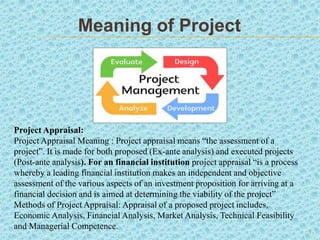
Project Appraisal Meaning : Project appraisal means “the assessment of a
project”. It is made for both proposed (Ex-ante analysis) and executed projects
(Post-ante analysis). For an financial institution project appraisal “is a process
whereby a leading financial institution makes an independent and objective
assessment of the various aspects of an investment proposition for arriving at a
financial decision and is aimed at determining the viability of the project”
Methods of Project Appraisal: Appraisal of a proposed project includes,
Economic Analysis, Financial Analysis, Market Analysis, Technical Feasibility
and Managerial Competence.
THE ROLE AND COMPONENTS OF PROJECT APPRAISAL
l. The Role of Project Appraisal
 To stop bad projects
 To prevent good projects from being destroyed
 To determine if components of projects are
consistent
 To assess the sources and magnitudes of risks
 To determine how to reduce risk and efficiently
share risk
2
IMPACT OF ANALYSIS
 Quality of analysis has been shown by the World
Bank to be a key determinant of the success of a
project’s performance.
 A proper analysis will cause the project to be
redesigned so that it is less likely to fail
 World Bank experience shows that the probability of
failure for poorly prepared projects within 3 years of
a project’s life is 7 times that of well-prepared
projects
 Poorly prepared projects have 16 times as high a
probability of failure within 5 years as compared to
well-prepared projects
3
ROLE AND COMPONENTS OF INVESTMENT
EVALUATION
II. Stages in Project Appraisal and Approval
Why should a project evaluation be done in stages?
A. Idea and Project Definition
B. Pre-Feasibility Study
C. Feasibility and Financing
D. Detailed Design
E. Project Implementation
F. Ex-Post Evaluation
4
A. IDEA AND PROJECT DEFINITION
 Sources of Ideas for
Investments:
 Key questions
a. Where is the demand?
b. Is this project
consistent with the
organization’s
expertise, current plans
and strategy for the
future?
5
PROJECT DEFINITION
 Project definition is defined broadly to include the
scope and specification of the objectives of the project,
its output, its different stakeholders, its economic and
social benefits, and the data requirements.
 Most of the project’s data requirements are identified in
the pre-feasibility and feasibility stages of the project
where the project’s variables and parameters are
analyzed in detail.
 The data are generally arranged in what we refer to as
“building blocks” because they constitute the
foundation for the different types of analyses.
6
B. Pre-Feasibility Study
• Examines overall potential
of project
• Should maintain same
quality of information
across all variables
• Wherever possible should
use secondary information
• Biased information better
than mean values
• Mainly done by the
promoter of the project, also
called as the first look at the
project.
Key questions:
a. Is this project financially and
economically feasible
throughout the project’s
life?
b. What are the key variables?
c. What are the sources of risk?
d. How can the risk be reduced
7
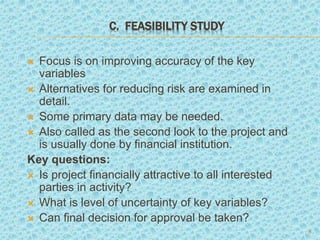
C. FEASIBILITY STUDY
 Focus is on improving accuracy of the key
variables
 Alternatives for reducing risk are examined in
detail.
 Some primary data may be needed.
 Also called as the second look to the project and
is usually done by financial institution.
Key questions:
 Is project financially attractive to all interested
parties in activity?
 What is level of uncertainty of key variables?
 Can final decision for approval be taken?
8
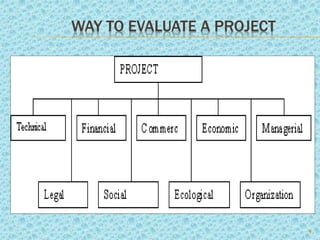
WAY TO EVALUATE A PROJECT
9
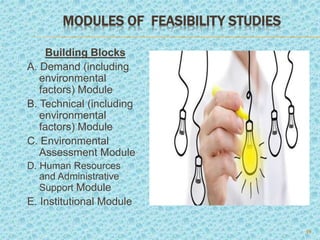
MODULES OF FEASIBILITY STUDIES
Building Blocks
A. Demand (including
environmental
factors) Module
B. Technical (including
environmental
factors) Module
C. Environmental
Assessment Module
D. Human Resources
and Administrative
Support Module
E. Institutional Module
10
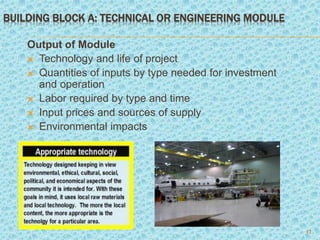
BUILDING BLOCK A: TECHNICAL MODULE
11
 Description of different processes available and Selection of the process for the project
and the reason for the same. Selection of suitable know-how for the said project based
on technical and economic evaluation from available data. Prospective collaborator and
terms of collaborations.
 Plant and Machinery
 List of imported/indigenous machinery Broad specifications of the machinery List of
manufacturers of machinery Critical items of the machinery.
 Location
 Actual site selection survey. Availability of raw material, electricity, water and other
infrastructural facilities.
 Plot plan and building
 Overall plot plan along with building plan.
 Raw materials
 Raw material requirements and their specifications.
 Utilities:
 Requirements of power, water and others including fuel, steam, inert gas etc., and their
specifications.
 Effluents
 Nature and type of effluent/specifications and quality of effluent. Effect of effluent if
discharged as such, Effluent treatment suggested
BUILDING BLOCK A: TECHNICAL OR ENGINEERING MODULE
Output of Module
 Technology and life of project
 Quantities of inputs by type needed for investment
and operation
 Labor required by type and time
 Input prices and sources of supply
 Environmental impacts
12
MODULE B: FINANCIAL APPRAISAL
Cost of the project and means of financing
Profitability statement
Break even analysis
Fund flow statement
Balance sheet projections
Financial ratios
Sensitivity analysis
13
A) COST OF PROJECT
 The major components of cost of project involve land and
building, plant and machinery, equipment for auxiliary services
like transportation, insurance, duty, clearing, loading and
unloading charges etc. It includes consultancy and know how
charges , recurring royalty payment, preliminary expenses
such as cost of incorporation, preparation of feasibility
reports, market surveys, pre operative expenses like-
salary, travelling, start up expenses, mortgage expense incurred
before commencement of commercial production. Provision for
contingencies to meet the unforeseen expenses, price escalation
or other expenses which have been inadvertently omitted like
margin for working capital requirements required to complete
the production cycle, interest during construction period etc.
also a part of capital cost of the project.
14
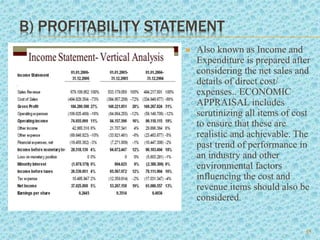
B) PROFITABILITY STATEMENT
 Also known as Income and
Expenditure is prepared after
considering the net sales and
details of direct cost/
expenses.. ECONOMIC
APPRAISAL includes
scrutinizing all items of cost
to ensure that these are
realistic and achievable. The
past trend of performance in
an industry and other
environmental factors
influencing the cost and
revenue items should also be
considered.
15
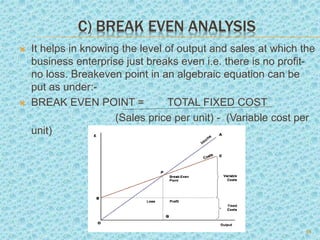
C) BREAK EVEN ANALYSIS
 It helps in knowing the level of output and sales at which the
business enterprise just breaks even i.e. there is no profit-
no loss. Breakeven point in an algebraic equation can be
put as under:-
 BREAK EVEN POINT = TOTAL FIXED COST
(Sales price per unit) - (Variable cost per
unit)
16
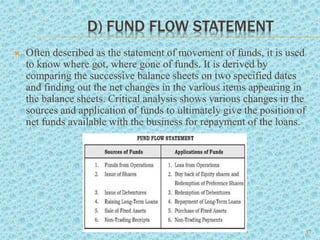
D) FUND FLOW STATEMENT
 Often described as the statement of movement of funds, it is used
to know where got, where gone of funds. It is derived by
comparing the successive balance sheets on two specified dates
and finding out the net changes in the various items appearing in
the balance sheets. Critical analysis shows various changes in the
sources and application of funds to ultimately give the position of
net funds available with the business for repayment of the loans.
17
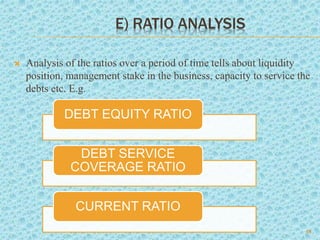
E) RATIO ANALYSIS
 Analysis of the ratios over a period of time tells about liquidity
position, management stake in the business, capacity to service the
debts etc. E.g.
18
DEBT EQUITY RATIO
DEBT SERVICE
COVERAGE RATIO
CURRENT RATIO
19
Analysis Module C: Environmental Assessment Module
• Environmental Assessment augments information for the
Economic Analysis
• Identification of Environmental Impacts and Risks
• Where possible, Quantify the Environmental Impacts
• Key questions:
a. What are the likely environmental impacts from undertaking
project ?
b. What is the cost of reducing the negative impact?
c. Evaluation of the environmental impacts and risks with and
without technical measures are taken to reduce these impacts?
d. Are there alternative ways of supplying the good or service of
project without incurring these environmental costs? What are
the costs of these alternatives?
BUILDING BLOCK D: HUMAN RESOURCES AND
ADMINISTRATIVE SUPPORT MODULE
 What are managerial and labour needs of the
project?
 Does organization have the ability to get the
managerial skills needed?
 Is timing of project consistent with quantity
and quality of management?
 What are wage rates for labor skills required?
 Manpower requirements by category are
reconciled with availabilities and project
timing
20
BUILDING BLOCK E: INSTITUTIONAL MODULE
 This module deals with the adequacy of the institution responsible
for managing the different stages or phases of the project.
 Insufficient attention to the institutional aspects creates serious
problems during the implementation and operations phases of the
project.
 Key questions:
a. Is the entity that is supposed to manage the project properly
organized and its management adequately equipped to handle
the project?
b. Are the capabilities and facilities being properly utilized?
c. Is there a need for changes in the policy and institutional set up
outside this entity? What changes may be needed in policies of
the local, regional and central governments?
21
ANALYSIS MODULE G: ECONOMIC
MODULE
What is done:
 Examines the project using the whole country as the accounting
entity
 Evaluation of externalities including environmental
Key questions:
a. What are differences between financial and economic values for a
variable?
b. What causes these differences?
c. With what degrees of certainty do we know values of these
differences?
d. What is the expected value of economic net benefits?
e. What is the probability of positive economic feasibility?
22
ANALYSIS MODULE H: STAKEHOLDERS AND BASIC NEEDS
ANALYSIS
What is done:
 Identification and quantification of extra-economic impacts of project
 Distributive Appraisal
 Income, Cost, and Fiscal Impacts on various stakeholders
 Poverty Alleviation and Political Necessities
 Basic Needs: Evaluate the impact of project on achieving basic needs
objectives
 Basic needs will vary from country to country
Key Questions:
a. In what ways does project generate beneficial and cost impacts on stakeholders?
b. What stakeholders could the project impact?
c. Who benefits and who pay the costs?
d. What are the basic needs of the society that are relevant in the country?
e. What impact will the project have on basic needs?
f. What alternative ways are there to generate desirable social impacts?
g. Is project relatively cost effective in generation of desirable social impacts?
23
24
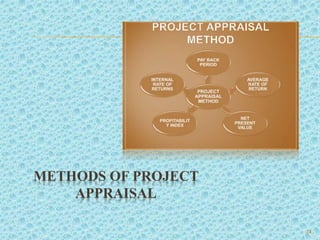
METHODS OF PROJECT
APPRAISAL
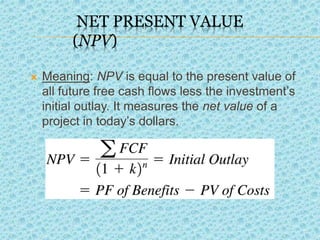
NET PRESENT VALUE
(NPV)
 Meaning: NPV is equal to the present value of
all future free cash flows less the investment’s
initial outlay. It measures the net value of a
project in today’s dollars.
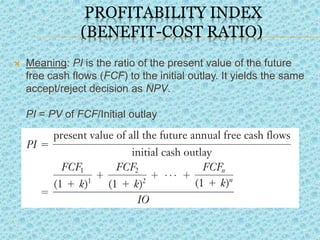
PROFITABILITY INDEX
(BENEFIT-COST RATIO)
 Meaning: PI is the ratio of the present value of the future
free cash flows (FCF) to the initial outlay. It yields the same
accept/reject decision as NPV.
PI = PV of FCF/Initial outlay
.
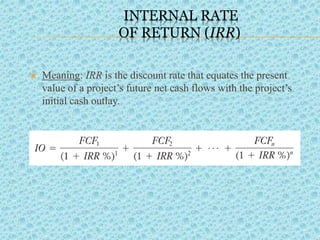
INTERNAL RATE
OF RETURN (IRR)
 Meaning: IRR is the discount rate that equates the present
value of a project’s future net cash flows with the project’s
initial cash outlay.
.
THE PAYBACK PERIOD
 Meaning: Number of years needed to recover the
initial cash outlay of a capital budgeting project.
 Decision Rule: Project feasible or desirable if the
payback period is less than or equal to the firm’s
maximum desired payback period. In general,
shorter payback period is preferred while
comparing two projects.
.
DISCOUNTED PAYBACK
PERIOD
 The discounted payback period is similar to the traditional
payback period except that it uses discounted free cash flows
rather than actual undiscounted cash flows.
 The discounted payback period is defined as the number of years
needed to recover the initial cash outlay from the discounted free
cash flows.
30
THANKYOU

Bank project appraisal,

  • 1.
    0 BANK MANAGEMENT SUBMITTED TO:SUBMITTED BY: RAMNEEK MAM SAKSHA SHARMA 5810, M.COM (II) PROJECT APPRAISAL
  • 2.
    Meaning of Project Appraisal 1 ProjectAppraisal: Project Appraisal Meaning : Project appraisal means “the assessment of a project”. It is made for both proposed (Ex-ante analysis) and executed projects (Post-ante analysis). For an financial institution project appraisal “is a process whereby a leading financial institution makes an independent and objective assessment of the various aspects of an investment proposition for arriving at a financial decision and is aimed at determining the viability of the project” Methods of Project Appraisal: Appraisal of a proposed project includes, Economic Analysis, Financial Analysis, Market Analysis, Technical Feasibility and Managerial Competence.
  • 3.
    THE ROLE ANDCOMPONENTS OF PROJECT APPRAISAL l. The Role of Project Appraisal  To stop bad projects  To prevent good projects from being destroyed  To determine if components of projects are consistent  To assess the sources and magnitudes of risks  To determine how to reduce risk and efficiently share risk 2
  • 4.
    IMPACT OF ANALYSIS Quality of analysis has been shown by the World Bank to be a key determinant of the success of a project’s performance.  A proper analysis will cause the project to be redesigned so that it is less likely to fail  World Bank experience shows that the probability of failure for poorly prepared projects within 3 years of a project’s life is 7 times that of well-prepared projects  Poorly prepared projects have 16 times as high a probability of failure within 5 years as compared to well-prepared projects 3
  • 5.
    ROLE AND COMPONENTSOF INVESTMENT EVALUATION II. Stages in Project Appraisal and Approval Why should a project evaluation be done in stages? A. Idea and Project Definition B. Pre-Feasibility Study C. Feasibility and Financing D. Detailed Design E. Project Implementation F. Ex-Post Evaluation 4
  • 6.
    A. IDEA ANDPROJECT DEFINITION  Sources of Ideas for Investments:  Key questions a. Where is the demand? b. Is this project consistent with the organization’s expertise, current plans and strategy for the future? 5
  • 7.
    PROJECT DEFINITION  Projectdefinition is defined broadly to include the scope and specification of the objectives of the project, its output, its different stakeholders, its economic and social benefits, and the data requirements.  Most of the project’s data requirements are identified in the pre-feasibility and feasibility stages of the project where the project’s variables and parameters are analyzed in detail.  The data are generally arranged in what we refer to as “building blocks” because they constitute the foundation for the different types of analyses. 6
  • 8.
    B. Pre-Feasibility Study •Examines overall potential of project • Should maintain same quality of information across all variables • Wherever possible should use secondary information • Biased information better than mean values • Mainly done by the promoter of the project, also called as the first look at the project. Key questions: a. Is this project financially and economically feasible throughout the project’s life? b. What are the key variables? c. What are the sources of risk? d. How can the risk be reduced 7
  • 9.
    C. FEASIBILITY STUDY Focus is on improving accuracy of the key variables  Alternatives for reducing risk are examined in detail.  Some primary data may be needed.  Also called as the second look to the project and is usually done by financial institution. Key questions:  Is project financially attractive to all interested parties in activity?  What is level of uncertainty of key variables?  Can final decision for approval be taken? 8
  • 10.
    WAY TO EVALUATEA PROJECT 9
  • 11.
    MODULES OF FEASIBILITYSTUDIES Building Blocks A. Demand (including environmental factors) Module B. Technical (including environmental factors) Module C. Environmental Assessment Module D. Human Resources and Administrative Support Module E. Institutional Module 10
  • 12.
    BUILDING BLOCK A:TECHNICAL MODULE 11  Description of different processes available and Selection of the process for the project and the reason for the same. Selection of suitable know-how for the said project based on technical and economic evaluation from available data. Prospective collaborator and terms of collaborations.  Plant and Machinery  List of imported/indigenous machinery Broad specifications of the machinery List of manufacturers of machinery Critical items of the machinery.  Location  Actual site selection survey. Availability of raw material, electricity, water and other infrastructural facilities.  Plot plan and building  Overall plot plan along with building plan.  Raw materials  Raw material requirements and their specifications.  Utilities:  Requirements of power, water and others including fuel, steam, inert gas etc., and their specifications.  Effluents  Nature and type of effluent/specifications and quality of effluent. Effect of effluent if discharged as such, Effluent treatment suggested
  • 13.
    BUILDING BLOCK A:TECHNICAL OR ENGINEERING MODULE Output of Module  Technology and life of project  Quantities of inputs by type needed for investment and operation  Labor required by type and time  Input prices and sources of supply  Environmental impacts 12
  • 14.
    MODULE B: FINANCIALAPPRAISAL Cost of the project and means of financing Profitability statement Break even analysis Fund flow statement Balance sheet projections Financial ratios Sensitivity analysis 13
  • 15.
    A) COST OFPROJECT  The major components of cost of project involve land and building, plant and machinery, equipment for auxiliary services like transportation, insurance, duty, clearing, loading and unloading charges etc. It includes consultancy and know how charges , recurring royalty payment, preliminary expenses such as cost of incorporation, preparation of feasibility reports, market surveys, pre operative expenses like- salary, travelling, start up expenses, mortgage expense incurred before commencement of commercial production. Provision for contingencies to meet the unforeseen expenses, price escalation or other expenses which have been inadvertently omitted like margin for working capital requirements required to complete the production cycle, interest during construction period etc. also a part of capital cost of the project. 14
  • 16.
    B) PROFITABILITY STATEMENT Also known as Income and Expenditure is prepared after considering the net sales and details of direct cost/ expenses.. ECONOMIC APPRAISAL includes scrutinizing all items of cost to ensure that these are realistic and achievable. The past trend of performance in an industry and other environmental factors influencing the cost and revenue items should also be considered. 15
  • 17.
    C) BREAK EVENANALYSIS  It helps in knowing the level of output and sales at which the business enterprise just breaks even i.e. there is no profit- no loss. Breakeven point in an algebraic equation can be put as under:-  BREAK EVEN POINT = TOTAL FIXED COST (Sales price per unit) - (Variable cost per unit) 16
  • 18.
    D) FUND FLOWSTATEMENT  Often described as the statement of movement of funds, it is used to know where got, where gone of funds. It is derived by comparing the successive balance sheets on two specified dates and finding out the net changes in the various items appearing in the balance sheets. Critical analysis shows various changes in the sources and application of funds to ultimately give the position of net funds available with the business for repayment of the loans. 17
  • 19.
    E) RATIO ANALYSIS Analysis of the ratios over a period of time tells about liquidity position, management stake in the business, capacity to service the debts etc. E.g. 18 DEBT EQUITY RATIO DEBT SERVICE COVERAGE RATIO CURRENT RATIO
  • 20.
    19 Analysis Module C:Environmental Assessment Module • Environmental Assessment augments information for the Economic Analysis • Identification of Environmental Impacts and Risks • Where possible, Quantify the Environmental Impacts • Key questions: a. What are the likely environmental impacts from undertaking project ? b. What is the cost of reducing the negative impact? c. Evaluation of the environmental impacts and risks with and without technical measures are taken to reduce these impacts? d. Are there alternative ways of supplying the good or service of project without incurring these environmental costs? What are the costs of these alternatives?
  • 21.
    BUILDING BLOCK D:HUMAN RESOURCES AND ADMINISTRATIVE SUPPORT MODULE  What are managerial and labour needs of the project?  Does organization have the ability to get the managerial skills needed?  Is timing of project consistent with quantity and quality of management?  What are wage rates for labor skills required?  Manpower requirements by category are reconciled with availabilities and project timing 20
  • 22.
    BUILDING BLOCK E:INSTITUTIONAL MODULE  This module deals with the adequacy of the institution responsible for managing the different stages or phases of the project.  Insufficient attention to the institutional aspects creates serious problems during the implementation and operations phases of the project.  Key questions: a. Is the entity that is supposed to manage the project properly organized and its management adequately equipped to handle the project? b. Are the capabilities and facilities being properly utilized? c. Is there a need for changes in the policy and institutional set up outside this entity? What changes may be needed in policies of the local, regional and central governments? 21
  • 23.
    ANALYSIS MODULE G:ECONOMIC MODULE What is done:  Examines the project using the whole country as the accounting entity  Evaluation of externalities including environmental Key questions: a. What are differences between financial and economic values for a variable? b. What causes these differences? c. With what degrees of certainty do we know values of these differences? d. What is the expected value of economic net benefits? e. What is the probability of positive economic feasibility? 22
  • 24.
    ANALYSIS MODULE H:STAKEHOLDERS AND BASIC NEEDS ANALYSIS What is done:  Identification and quantification of extra-economic impacts of project  Distributive Appraisal  Income, Cost, and Fiscal Impacts on various stakeholders  Poverty Alleviation and Political Necessities  Basic Needs: Evaluate the impact of project on achieving basic needs objectives  Basic needs will vary from country to country Key Questions: a. In what ways does project generate beneficial and cost impacts on stakeholders? b. What stakeholders could the project impact? c. Who benefits and who pay the costs? d. What are the basic needs of the society that are relevant in the country? e. What impact will the project have on basic needs? f. What alternative ways are there to generate desirable social impacts? g. Is project relatively cost effective in generation of desirable social impacts? 23
  • 25.
  • 26.
    NET PRESENT VALUE (NPV) Meaning: NPV is equal to the present value of all future free cash flows less the investment’s initial outlay. It measures the net value of a project in today’s dollars.
  • 27.
    PROFITABILITY INDEX (BENEFIT-COST RATIO) Meaning: PI is the ratio of the present value of the future free cash flows (FCF) to the initial outlay. It yields the same accept/reject decision as NPV. PI = PV of FCF/Initial outlay .
  • 28.
    INTERNAL RATE OF RETURN(IRR)  Meaning: IRR is the discount rate that equates the present value of a project’s future net cash flows with the project’s initial cash outlay. .
  • 29.
    THE PAYBACK PERIOD Meaning: Number of years needed to recover the initial cash outlay of a capital budgeting project.  Decision Rule: Project feasible or desirable if the payback period is less than or equal to the firm’s maximum desired payback period. In general, shorter payback period is preferred while comparing two projects. .
  • 30.
    DISCOUNTED PAYBACK PERIOD  Thediscounted payback period is similar to the traditional payback period except that it uses discounted free cash flows rather than actual undiscounted cash flows.  The discounted payback period is defined as the number of years needed to recover the initial cash outlay from the discounted free cash flows.
  • 31.