Project FinanceSession 2 – Project Risk Management
AgendaRevision – Session 1Project Risk ManagementRisk Management ProcessesIdentifying Project RisksRisk Allocation with ContractsRole of AdvisorsLegalIndependent EngineerInsurance2009Project Finance - Session 22
Revision – Session 1Characteristics of Project FinanceDebtor is a Project Company (SPV)Legally Independent from SponsorsInvesting in a Capital AssetLenders have limited recourse to Sponsors AssetsRisk (more) Equitably Allocated Finance Granted on the basis of future cash flows2009Project Finance - Session 23
Revision – Session 1Current Trends in Project FinanceOverall Project Finance market down 61% (3rd Qtr)Shift in Market DynamicsDeveloping CountriesBanks Types of ProjectsThe Future of Global Infrastructure$ Billions to Maintain current living standardsPower, Roads2009Project Finance - Session 24
Session 2 – Risk Management
Project Risk ManagementFrom a Project Finance perspective … Proper Risk Management helps to ensure consistent cash flows throughout the life of the Project, thereby reducing likelihood of default on debt servicing requirements. From a Project Management perspective … Risk Management helps to ensure that the probability & impact of Positive events are increased (negative events are decreased), thereby optimizing profitability of the venture.2009Project Finance - Session 26
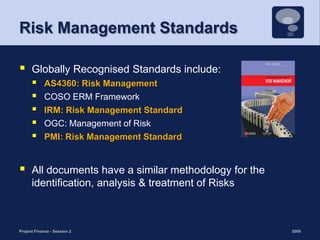
Risk Management StandardsGlobally Recognised Standards include:AS4360: Risk ManagementCOSO ERM Framework IRM: Risk Management StandardOGC: Management of Risk PMI: Risk Management StandardAll documents have a similar methodology for the identification, analysis & treatment of Risks2009Project Finance - Session 27
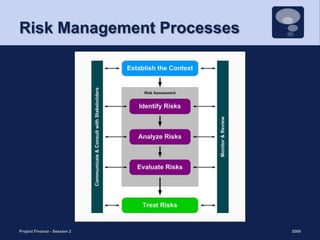
Risk Management Processes2009Project Finance - Session 28
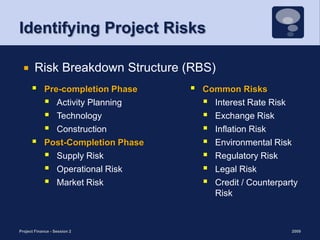
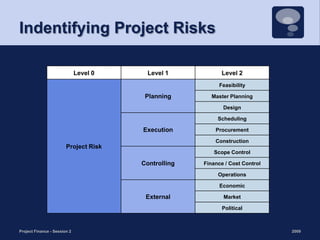
Identifying Project RisksPre-completion PhaseActivity PlanningTechnology ConstructionPost-Completion PhaseSupply RiskOperational Risk Market Risk 2009Project Finance - Session 29Risk Breakdown Structure (RBS)Common RisksInterest Rate Risk Exchange Risk Inflation RiskEnvironmental RiskRegulatory Risk Legal RiskCredit / Counterparty Risk
Indentifying Project Risks2009Project Finance - Session 210
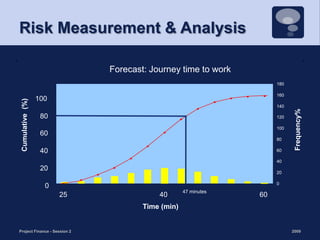
Risk Measurement & Analysis2009Project Finance - Session 211Forecast: Journey time to work18016010014080120Cumulative  (%)100Frequency%608040604020200047 minutes254060Time (min)
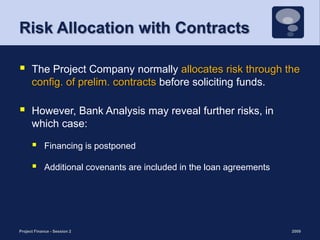
Risk Allocation with ContractsThe Project Company normally allocates risk through the config. of prelim. contracts before soliciting funds. However, Bank Analysis may reveal further risks, in which case:Financing is postponedAdditional covenants are included in the loan agreements2009Project Finance - Session 212
Construction Risk The price paid to the contractor is usually the largest capital expenditure incurred by the project company. The contract is also the most likely source of significant cost overruns. Turnkey / EPC ContractIs usually fixed price, the contractor taking the risk of any fluctuations in the cost of labour or materialsFIDIC / NEC / Bespoke 2009Project Finance - Session 213
Turnkey / EPC ContractFeatures:(Fixed) PriceCompletion Date Handover, Testing & Commissioning (FAC) Plant Performance (Minimum Standards)Liquidate / Make Good Guarantees & WarrantiesDamages (Liquidated) Force Majeure 2009Project Finance - Session 214
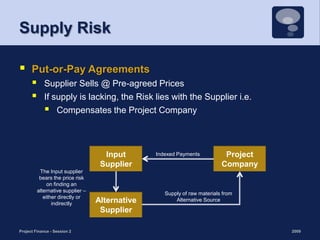
Supply RiskPut-or-Pay AgreementsSupplier Sells @ Pre-agreed Prices If supply is lacking, the Risk lies with the Supplier i.e.Compensates the Project Company 2009Project Finance - Session 215Input SupplierProject CompanyIndexed PaymentsThe Input supplier bears the price risk on finding an alternative supplier – either directly or indirectlySupply of raw materials from Alternative SourceAlternative Supplier
Operational RisksO&M AgreementsFixed Price Contract: The Operator assumes risks relating to the fluctuations in operating costsPass-Through Contract: The Operator receives a fixed payment and performance bonuses*Step-In Right: Lenders may request the right to remove the original operator and substitute with another. 2009Project Finance - Session 216
Market RiskOfftake Agreements: Long-term contracts where the Offtaker agrees to purchase nominated volumes/quantities of a good or services from the Project CompanyTake-or-Pay: the offtaker is obligated to pay even if it does not actually take the good or service i.e. PPAShadow Toll System: payment is made by the Public Admin. on the basis of the volume of traffic & service level. Shadow refers to the fact that the end user does not actually pay the toll. 2009Project Finance - Session 217
The Role of Advisors2009Project Finance - Session 218
The Role of Advisors“Each project finance deal has a critical minimum-size threshold below which structuring costs become excessive in relation to its forecasted income and cash flows.”Although efficiency is questionable, the role of advisors is essential to the closure of Project Finance DealsLegal AdvisorsIndependent Engineers Insurance Advisors2009Project Finance - Session 219
Legal AdvisorsUsually the first “Advisors” to be appointed by both Sponsors & LendersAddress specifics of International Legal Systems i.e. Civil Vs CommonActivities involved in, include:Incorporation of the Project Company (SL)Due Diligence (AL)Legal Opinions (AL)Project Contracts (SL)2009Project Finance - Session 220
Independent EngineerOversees & monitors the Project on behalf of the lending banksThere may be a number of “Independent Engineers” dependent upon the technical nature of the project. Activities involved in, include:Due Diligence ReportingCertification / Issuing of Progress Reports Oversight of Testing & CommissioningMonitoring of Operations2009Project Finance - Session 221
Insurance (General)Insurance is an important risk mitigation tool that must be properly coordinated and linked to the project’s contractual structure. Insurance should be used when the Project Company’s cost of risk mitigation using insurance policies is less than the premium for risk expressed in the interbank interest rates requested by banks if no coverage exists. 2009Project Finance - Session 222
Insurance AdvisorsThe scope of work for an insurance advisor includes:Preliminary Insurance Report Identifying analysis of contractual documentation & recommendations for risk coverageFinal Insurance Report (Construction)Issued at the time of Financial Close – typically constitutes a condition precedent for disbursement (drawdown). Conformity of Insurance Program Finance Insurance Report (Operations) Issued before start-up of Operations 2009Project Finance - Session 223
Typical PF Insurance ProductsThe most common forms of coverage used are: Construction / Contractors – All-Risks Transport PolicyMaterial & Damage – All RisksForce Majeure Key Man Insurance 2009Project Finance - Session 224
SummaryProject Risk Management is an extremely important tool in the identification, analysis and mitigation of Project Risks. Advisors (Legal, Engineering & Insurance) play a crucial role in the mitigation of risks through: Specialized Expertise Due DiligenceStructure / Viability of the Project Monitoring 2009Project Finance - Session 225

Project Finance Session 02

  • 1.
    Project FinanceSession 2– Project Risk Management
  • 2.
    AgendaRevision – Session1Project Risk ManagementRisk Management ProcessesIdentifying Project RisksRisk Allocation with ContractsRole of AdvisorsLegalIndependent EngineerInsurance2009Project Finance - Session 22
  • 3.
    Revision – Session1Characteristics of Project FinanceDebtor is a Project Company (SPV)Legally Independent from SponsorsInvesting in a Capital AssetLenders have limited recourse to Sponsors AssetsRisk (more) Equitably Allocated Finance Granted on the basis of future cash flows2009Project Finance - Session 23
  • 4.
    Revision – Session1Current Trends in Project FinanceOverall Project Finance market down 61% (3rd Qtr)Shift in Market DynamicsDeveloping CountriesBanks Types of ProjectsThe Future of Global Infrastructure$ Billions to Maintain current living standardsPower, Roads2009Project Finance - Session 24
  • 5.
    Session 2 –Risk Management
  • 6.
    Project Risk ManagementFroma Project Finance perspective … Proper Risk Management helps to ensure consistent cash flows throughout the life of the Project, thereby reducing likelihood of default on debt servicing requirements. From a Project Management perspective … Risk Management helps to ensure that the probability & impact of Positive events are increased (negative events are decreased), thereby optimizing profitability of the venture.2009Project Finance - Session 26
  • 7.
    Risk Management StandardsGloballyRecognised Standards include:AS4360: Risk ManagementCOSO ERM Framework IRM: Risk Management StandardOGC: Management of Risk PMI: Risk Management StandardAll documents have a similar methodology for the identification, analysis & treatment of Risks2009Project Finance - Session 27
  • 8.
  • 9.
    Identifying Project RisksPre-completionPhaseActivity PlanningTechnology ConstructionPost-Completion PhaseSupply RiskOperational Risk Market Risk 2009Project Finance - Session 29Risk Breakdown Structure (RBS)Common RisksInterest Rate Risk Exchange Risk Inflation RiskEnvironmental RiskRegulatory Risk Legal RiskCredit / Counterparty Risk
  • 10.
  • 11.
    Risk Measurement &Analysis2009Project Finance - Session 211Forecast: Journey time to work18016010014080120Cumulative (%)100Frequency%608040604020200047 minutes254060Time (min)
  • 12.
    Risk Allocation withContractsThe Project Company normally allocates risk through the config. of prelim. contracts before soliciting funds. However, Bank Analysis may reveal further risks, in which case:Financing is postponedAdditional covenants are included in the loan agreements2009Project Finance - Session 212
  • 13.
    Construction Risk Theprice paid to the contractor is usually the largest capital expenditure incurred by the project company. The contract is also the most likely source of significant cost overruns. Turnkey / EPC ContractIs usually fixed price, the contractor taking the risk of any fluctuations in the cost of labour or materialsFIDIC / NEC / Bespoke 2009Project Finance - Session 213
  • 14.
    Turnkey / EPCContractFeatures:(Fixed) PriceCompletion Date Handover, Testing & Commissioning (FAC) Plant Performance (Minimum Standards)Liquidate / Make Good Guarantees & WarrantiesDamages (Liquidated) Force Majeure 2009Project Finance - Session 214
  • 15.
    Supply RiskPut-or-Pay AgreementsSupplierSells @ Pre-agreed Prices If supply is lacking, the Risk lies with the Supplier i.e.Compensates the Project Company 2009Project Finance - Session 215Input SupplierProject CompanyIndexed PaymentsThe Input supplier bears the price risk on finding an alternative supplier – either directly or indirectlySupply of raw materials from Alternative SourceAlternative Supplier
  • 16.
    Operational RisksO&M AgreementsFixedPrice Contract: The Operator assumes risks relating to the fluctuations in operating costsPass-Through Contract: The Operator receives a fixed payment and performance bonuses*Step-In Right: Lenders may request the right to remove the original operator and substitute with another. 2009Project Finance - Session 216
  • 17.
    Market RiskOfftake Agreements:Long-term contracts where the Offtaker agrees to purchase nominated volumes/quantities of a good or services from the Project CompanyTake-or-Pay: the offtaker is obligated to pay even if it does not actually take the good or service i.e. PPAShadow Toll System: payment is made by the Public Admin. on the basis of the volume of traffic & service level. Shadow refers to the fact that the end user does not actually pay the toll. 2009Project Finance - Session 217
  • 18.
    The Role ofAdvisors2009Project Finance - Session 218
  • 19.
    The Role ofAdvisors“Each project finance deal has a critical minimum-size threshold below which structuring costs become excessive in relation to its forecasted income and cash flows.”Although efficiency is questionable, the role of advisors is essential to the closure of Project Finance DealsLegal AdvisorsIndependent Engineers Insurance Advisors2009Project Finance - Session 219
  • 20.
    Legal AdvisorsUsually thefirst “Advisors” to be appointed by both Sponsors & LendersAddress specifics of International Legal Systems i.e. Civil Vs CommonActivities involved in, include:Incorporation of the Project Company (SL)Due Diligence (AL)Legal Opinions (AL)Project Contracts (SL)2009Project Finance - Session 220
  • 21.
    Independent EngineerOversees &monitors the Project on behalf of the lending banksThere may be a number of “Independent Engineers” dependent upon the technical nature of the project. Activities involved in, include:Due Diligence ReportingCertification / Issuing of Progress Reports Oversight of Testing & CommissioningMonitoring of Operations2009Project Finance - Session 221
  • 22.
    Insurance (General)Insurance isan important risk mitigation tool that must be properly coordinated and linked to the project’s contractual structure. Insurance should be used when the Project Company’s cost of risk mitigation using insurance policies is less than the premium for risk expressed in the interbank interest rates requested by banks if no coverage exists. 2009Project Finance - Session 222
  • 23.
    Insurance AdvisorsThe scopeof work for an insurance advisor includes:Preliminary Insurance Report Identifying analysis of contractual documentation & recommendations for risk coverageFinal Insurance Report (Construction)Issued at the time of Financial Close – typically constitutes a condition precedent for disbursement (drawdown). Conformity of Insurance Program Finance Insurance Report (Operations) Issued before start-up of Operations 2009Project Finance - Session 223
  • 24.
    Typical PF InsuranceProductsThe most common forms of coverage used are: Construction / Contractors – All-Risks Transport PolicyMaterial & Damage – All RisksForce Majeure Key Man Insurance 2009Project Finance - Session 224
  • 25.
    SummaryProject Risk Managementis an extremely important tool in the identification, analysis and mitigation of Project Risks. Advisors (Legal, Engineering & Insurance) play a crucial role in the mitigation of risks through: Specialized Expertise Due DiligenceStructure / Viability of the Project Monitoring 2009Project Finance - Session 225