Page 1 of 12
CHAPTER-4 : SHORT TERM FINANCING
Topics to be Covered:
1. Meaning and nature of short-term financing.
2. Characteristics of short-term financing
3. Sources of Short Term Financing.
4. Advantages of Short-Term Financing.
5. Disadvantages of Short Term financing.
6. Purpose of Short-Term Financing.
7. “Ideal Concept” of Short-Term Financing.
8. What is Trade Credit?
9. Reasons for the use of Trade Credit.
10. Factors determining the amount of Trade Credit used
11. Cost of Trade Credit
12. Who bears the cost of Trade Credit?
13. What is Bank Credit?
14. Distinction between Bank Credit and Short Term credit.
Page 2 of 12
Meaning and Nature of Short-Term Financing:
Short Term financing is that from of financing which embraces borrowing or lending of funds
for a short period of time. It refers to the finance obtained on short term basis, usually one year or less
in duration. Short term finance is secured for financing the current assets, for example, inventories. Short
term finance is also known as working capital which is the excess of current assets over current liabilities.
Current liabilities become due within one year and indicate the amount of short-term credit being utilized
by the business.
Practically all enterprises use the short-term credit as sources of finance. We find in the balance
sheets of almost all the companies some kinds of current liabilities which are the indicator of the uses
of short term finance in business. It has been found in the developed countries especially in USA that
even the largest business establishment makes use of short term finance.
The size of business has an important bearing on the use of short term finance. There is variation
in the use of short term finance between the large and small sized business establishments. In practically
all types of business, there is lesser use of short term credit among larger concerns. The small concerns
make more use of short term financing on account of lower average credit standing and impermanent
nature of business.
Short Term Financing | Characteristics
Funds available for a period of one year or less is called short
term finance. In the conduct of its business a firm obtains its
fund from a variety of sources. While the funds may also arise
from earnings retained in the business. There are some
characteristics of short term financing. The characteristics of
short term financing are given below:
 Duration: Short term financing embraces the borrowing or lending funds for short period of time
say one year or less.
 Cost of funds: Short term financing can provide both the highest and lowest cost of funds in the
firm’s capital structure. Some firms of short terms financing are more costly than intermediate or
long term funds. On the other hand some short term sources provide funds at no cost at all to the
firm payable and accruals fall into this category.
 Use of short term financing: there is a common tendency for greater use short term financing
among small and lesser use among large concerns. It is prevalent in practice that all types of business
funds it quite difficult to raise long term funds resulting on account credit standing and relative
importance of many small units.
 Sources of short term financing: short term finance deals with the commercial bank, trade credit
and other sources of funds that have to be repaid within a year or less. Trade credit is the privilege
extended by suppliers to their customers of delaying payment of goods purchased, sometimes for a
period of a month or more.
 Renewal or recycling: this occurs when short term liabilities are continually refinanced from
financing must by definition be repaid in less that one year, some sources provide funds that are
continuously rolled over. The funds provided by payable. For example, may remain relatively
constant because as some account ate created.
 Sources of short term financing: trade credit advance from customers, outstanding expenses,
commercial bank, friends and relatives etc. are the sources of short term financing.
 Clean up: this occurs when commercial banks or other lenders require the firm to pay off its short
term obligation. Just as some sources are rolled over, some must be reduced to O, or cleaned up, at
Page 3 of 12
one point in the year. This is requirement of a bank credit where the cleanup offers proof that the
short term financing is being used to meet short term or cyclical needs only.
 Speed: a short term loan can be obtained much faster than long term credit. Lenders will insists on
a more through financial examination before extending long term credit and the loan agreement will
have to be spelled out in considerable detail because a lot can happen during the long life the firm
should look to short term markers.
 Less restrictive: short term loan agreement ate generally less restrictive. Long term loan agreements
always contain previsions or covenants, which constrain firm’s future action these ate almost absent
in short term loan.
 Easy collection and control: it is easy to collect and control short term loan. No formalities are
needed to raise funds from short term source.
 Security: short term financing does not require any security to raise the funds.
 No prepayment penalty: there is no prepayment penalty provision in case of short term credit,
which is expensive. Accordingly if a firm thinks its need for fund will diminish in the near future it
should choose short term debt.
Sources of Short Term Financing:
1. Trade Creditors
2. Customers Advances
3. Commercial Banks
4. Finance Companies
5. Commercial Paper House
6. Personal Loan Companies
7. Governmental Institutions
8. Factors or Brokers
9. Co-operative credit society
10. Loan Mortgage Banks
11. Money Lender
12. Accruals
13. Miscellaneous Sources
1. Trade Creditors: Trade creditors are probably the most important single source of short term
credit. Trade creditors are those business establishments which sell good to others on credit. That
is, they do not require payment on the spot; rather they are to be paid after some days from the
date of sale.
2. Customers Advances: Customers often finance the seller through advance payment for the
goods. The prices of the goods to be purchased are paid in advance, i.e. before the receipt of the
goods. This practice is prevalent where the seller does not wish to sell goods without prepayment
and the buyer also can not purchase goods form other sources. The seller might require advance
it the quantity of goods ordered is so large that he cannot afford to tie up more fund in raw
materials or in good-in-process. Special type machine manufactures often demand advance
payment in order to protect them from the loss caused by cancellation of contract at a time when
the machine has been built up or is in work in process.
Page 4 of 12
3. Commercial Banks: The commercial banks of a country generally supply funds to the business
concerns on a short-term basis, either with security or without security if the customer is
financially established. The banks, collecting scattered savings of the people, invest a portion of
the deposits in the business for a short period of time.
4. Finance Companies: Finance companies usually lend money to business. They are specialized
financial institutions and their primary function is to advance funds to the business
5. Commercial Paper House: They are specialized financial agencies and they are created to
purchase promissory notes and to sell them, in turn, to other investors who desire to have some
shot of short-term liquid assets. The firm having high credit standing can use this source for
obtaining short-term funds.
6. Personal Loan Companies: These companies make small loans to individual generally for
consumption purposes. The small business undertakings can procure fund form such companies
7. Governmental Institutions: There are some governmental and semi-governmental corporations
which are authorized to advance short term funds to business concerns. Their importance is of
course not so much less than other sources.
8. Factors or Brokers: In one basic respect, factoring is different from other forms of financing.
In other forms funds are granted to one individual largely on the basis of his property. Factoring
is based on a different philosophy. In considering a company’s request for funds we are more
interested in the men behind the company their ability, their hopes and aspirations for the future.
9. Miscellaneous Sources: There are many more sources from which can secure funds for short
period. They are—friend and relatives, public deposits, loan from officer and the company
directors and foreign exchange banks
Advantages of Short-Term Financing:
1. Easier to Obtain
2. Lower cost
3. Flexibility
4. No Sharing of control
5. Availability
6. Tax Savings
7. Convenience
8. Extension of credit
1. Easier to Obtain: Short –term credit can be more easily obtained than long term credit. A firm
which poor credit standing may be unable to obtain long term funds but it can procure, at least
some trade credit from sellers who are anxious to increase their sales. The short-term creditors,
by granting loans, assume less risk than long term creditors because there is less chance of
substantial change in the financial soundness of the creditor within a few week’s or month’s time.
2. Lower cost: Short term credit may be obtained with lower cost than the long term finance
because of priority of creditors in general. Because of the prior position given creditors in the
matter of claim to income and to assets in dissolution they generally will accept a relatively low
interest.
3. Flexibility: Due to seasonal nature of business many firms have a temporary demand for short-
term funds to carry heavier inventories. Most enterprises are in constant need of short term funds.
Short-term financing is flexible in the sense that the firm is able to secure funds as they are
Page 5 of 12
needed and repay then as soon as the need vanishes. Funds may be needed to meet the daily,
weekly or monthly requirements. Such funds can be advantageously supplied by short term
credit. It long term credit is secured to finance the daily or weekly or seasonal variations, it would
become inflexible because long term funds cannot be repaid as soon as the need for funds
vanishes.
4. No Sharing of control: Obtaining funds form short term creditors prevents the inclusion of more
owners through the procurement of owner’s funds. This results in maintaining the position of
control by the existing owners. Because the creditors have no voice in the operations of the
business.
5. Availability: In many cases, particularly for small enterprises short term credit is the only source
available. It may not be possible for a small firm to obtain long term funds because of poor credit
standing. Long-term credit is not generally granted without adequate margin of protection which
the small firms may not be able to provide with. The small business has then recourse to short
term funds.
6. Tax Savings: The cost of short term funds are deductible for income tax purposes while the
dividend paid to the owners is not deductible. Thus a substantial tax-savings may result form the
use of short-term funds.
7. Convenience: Short Term credit can be more conveniently secured than the other types of funds.
It is more convenient to pay labour weekly or employees monthly than every day
8. Extension of credit: Many enterprises purchase equipments, supplies and good by ordering
from a supplier with the intent of paying after delivery has been made. If subsequently the bills
are met promptly, the firm acquires a good credit standing. Then , if any emergency arises for
the purchase of any goods the firm
DisadvantagesofShort-Term Financing:
1. Frequent Maturity
2. High Cost
1. Frequent Maturity: Short-Term credit is disadvantageous in the sense that it matures frequently.
The principal must be repaid when due, otherwise the creditors may close the business. The use
of such credit is also a risk to the owners’ investment from the inability to meet the creditor’s
claims when due. There may be danger of either meeting the principal payment at maturity of
the loan or meeting the principal payment at maturity of the loan or meeting any periodic interest
payment or both. The sorter the credits the greater the potential risk to the owners because of the
problem of prompter repayment.
2. High Cost: The rate of interest paid on sort-term is usually higher than that on long-term credit
is usually higher than that on long-term credit. The rate of interest usually depends on the risk
involved, size of loan, collateral protection, etc. The lenders may demand a high interest if the
credit involves large amount and the potential credit risk is also high or the debtor may not give
suitable security. A high interest may also be demanded when the firm cannot procure funds
from other sources on suitable terms and conditions.
Purpose/Goalsof Short-Term Financing:
1. Lowering of cost (Low cost financing)
2. Raising Funds according to necessity.
3. Facilitating prosecution of business with other’s money
4. Secure additional fund
Types of Short-term Financing:
Page 6 of 12
There are two broad classes of short-term financing:
1. Spontaneous Financing: It refers to sources of funds that arise almost automatically and do not
require much formal arrangement by the firm such as
i) Trade Credit (Account Payable):
ii) Accruals: Accrued Wages and Accrued Taxes
2. Negotiated Financing: When a firm requires (more or less) intensive effort that must negotiate
for them; the firm must seek out the funds.
i) Secured Financing:
a) Bank Loan
b) Lending Agent
c) Factoring Receivable
d) Accounts Receivable
e) Pledging Receivable
f) Inventory
ii) Unsecured Financing:
a) Commercial Paper
b) International Loan
c) Line of Credit
d) Revolving Credit Agreement
iii) Money Market Credit:
a) Commercial Paper
b) Bankers’ Acceptance
1. Spontaneous Financing:
i) Trade-credit:
Trade Credit refers to the credit that a customer gets from supplier of goods in the
normal course of business. In practice, the buying firms have not to pay cash immediately for
the purchase made. This deferral of payment is a short term financing called trade credit.
Trade-credit: In one word, trade credit is a credit which is provided by sellers or suppliers in
the normal course of business. That means, credit given by all company to another is known
as trade credit.
Trade credit is a kind of business credit which is extended by the seller of goods to the buyer of
the same at all levels of production and distribution process down to the retailer. Before the goods and
services have reached the ultimate users or consumers, they pass through many hands starting from the
producers down to the retailer. Trade credit is used by various agencies operating in the trade channel
between the producer and the retailer. For example, the producer may extend credit to the wholesaler,
who may also facilitate the retailer’s trade by extending credit to him. Such credits extended by the
wholesaler to the retailer or producer to the wholesaler are known as trade credit.
Trade credit has been defined as the short-term credit by a supplier to a buyer in connection with
purchase of goods for ultimate resale. This definition makes it clear that trade credit is a different type
of credit than the consumer credit and installment sale credit. Trade credit is a credit extended for the
purchase of goods with the ultimate purpose of resale. The credit accepted for the purchase of goods
which are consumed by the purchaser is not trade credit—it becomes consumer credit. So a credit, in
Page 7 of 12
order to be designated as trade credit, must be extended in connection with the purchase of goods which
must be resold.
Components of Trade- Credit:
Open account:
For purchasing goods no contract is sign by the purchasers. The seller confidence is
entering this kind of arrangement usually comes from checking the credit worthiness of the
buyers and the history of previous business transactions with the buyer (No contract will be
there).
Note payable/ Promissory note:
When the buyersign’s promissorynote to obtain trade credit it shows upon the buyer’s
balance sheet as a trade note payable. The note will have a specified future payment date. It is
typically used when the sellers has less confidence upon the buyer.
Trade Acceptance:
In this case, buyer’s must acknowledge the debt written against purchasing goods in
credit formally. In this system seller makes a draft before sending goods to buyer which has
been singed by buyer. It is a trade acceptance.
Credit –Term:
The repayment provisions that are part of a credit arrangement. The expression “credit
term” refers to the conditions under which credit is granted.
The three major items of credit -due date, cash discount and discount date are usually
stated as follows
y
x
, net z.
Where,
x is the cash discount
y is the cash discount Period.
z is the Credit period.
For example:
Credit term
10
2
, net 30.
Interpretation:
2% cash discount is allowed if the bills are paid by the 10th day.
If the discount is not taken, the full amount of bill is paid by the 30th day.
Free trade credit: Free trade credit is a credit which involves credit received during the
discount period.
Costly trade credit: Costly trade credit is a credit which involves credit in excess of the free
trade credit whose cost is equal to the discount cost.
Page 8 of 12
Firms always use costly trade credit after analyzing the cost of the capital.
Advantagesof Trade Credit:
1. Easy Availability: Unlike other sources of finance, trade credit is relatively easy to
obtain. Except in the case of financially vary unsound firm, it is almost automatic and
does not require any negotiations. The easy availability is particularly important to
small firms which generally face difficulty in raising funds from the capital markets.
2. Informality: Trade credit is an informal, spontaneous source of finance. It does not
require any negotiations and formal agreement. It does not have the restrictions which
are usually parts of negotiated sources of finance.
3. no need for collateral securities
4. Financing Volume: It depends on the quantity of purchase and period of payment.
5. Flexibility: Here debtor and creditor can easily increase or decrease their amount of
debt.
6. possibility of more profit by increasing sales
7. Less risk of bad debt.
Disadvantages:
1. Shorter repayment period
2. High cost of foregoing cash discount benefit.
3. No exemption of tax.
Cost of Trade Credit (Is trade credit a cost free source of Finance?)
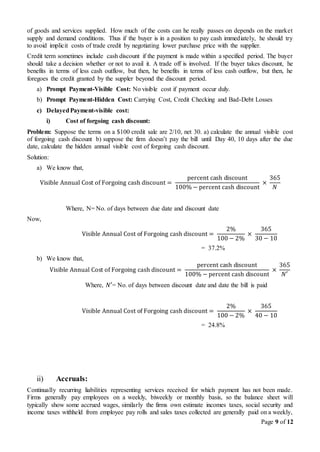
Trade Credit appears to be cost free since it does not involve explicit interest charges. But in practice,
it involves implicit costs. The cost of credit may be transferred to the buyer via the increased price of
goods supplied to him. The user of Trade Credit, therefore, should be aware of the costs of trade credit
to make its intelligent use. The reasoning that it is cost free can lead to incorrect financing decisions.
Prompt
Payment
Delayed
Payment
Visible
cost
None
1.Cost of Forgoing Cash Discount
2.Penalty Charges for Late Payment
Hidden
cost
Costs Passed on to Buyer by Seller for
1. Carrying Cost
2. Credit Checking
3. Bad-Debt Losses
Cost of Paying Late
The supplier extending incurs costs in the forms of the opportunity cost of funds invested in accounts
receivables and cost of any cash discounts taken by the buyer. Does the supplier bear this cost? Most of
the time, he passes on all or part of these costs to the buyer implicitly in form of higher purchase price
Page 9 of 12
of goods and services supplied. How much of the costs can he really passes on depends on the market
supply and demand conditions. Thus if the buyer is in a position to pay cash immediately, he should try
to avoid implicit costs of trade credit by negotiating lower purchase price with the supplier.
Credit term sometimes include cash discount if the payment is made within a specified period. The buyer
should take a decision whether or not to avail it. A trade off is involved. If the buyer takes discount, he
benefits in terms of less cash outflow, but then, he benefits in terms of less cash outflow, but then, he
foregoes the credit granted by the suppler beyond the discount period.
a) Prompt Payment-Visible Cost: No visible cost if payment occur duly.
b) Prompt Payment-Hidden Cost: Carrying Cost, Credit Checking and Bad-Debt Losses
c) DelayedPayment-visible cost:
i) Cost of forgoing cash discount:
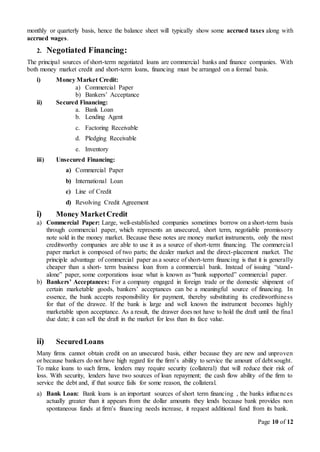
Problem: Suppose the terms on a $100 credit sale are 2/10, net 30. a) calculate the annual visible cost
of forgoing cash discount b) suppose the firm doesn’t pay the bill until Day 40, 10 days after the due
date, calculate the hidden annual visible cost of forgoing cash discount.
Solution:
a) We know that,
Visible Annual Cost of Forgoing cash discount =
percent cash discount
100% − percent cash discount
×
365
𝑁
Where, N= No. of days between due date and discount date
Now,
Visible Annual Cost of Forgoing cash discount =
2%
100 − 2%
×
365
30 − 10
= 37.2%
b) We know that,
Visible Annual Cost of Forgoing cash discount =
percent cash discount
100% − percent cash discount
×
365
𝑁′
Where, 𝑁′= No. of days between discount date and date the bill is paid
Visible Annual Cost of Forgoing cash discount =
2%
100 − 2%
×
365
40 − 10
= 24.8%
ii) Accruals:
Continually recurring liabilities representing services received for which payment has not been made.
Firms generally pay employees on a weekly, biweekly or monthly basis, so the balance sheet will
typically show some accrued wages, similarly the firms own estimate incomes taxes, social security and
income taxes withheld from employee pay rolls and sales taxes collected are generally paid on a weekly,
Page 10 of 12
monthly or quarterly basis, hence the balance sheet will typically show some accrued taxes along with
accrued wages.
2. Negotiated Financing:
The principal sources of short-term negotiated loans are commercial banks and finance companies. With
both money market credit and short-term loans, financing must be arranged on a formal basis.
i) Money Market Credit:
a) Commercial Paper
b) Bankers’ Acceptance
ii) Secured Financing:
a. Bank Loan
b. Lending Agent
c. Factoring Receivable
d. Pledging Receivable
e. Inventory
iii) Unsecured Financing:
a) Commercial Paper
b) International Loan
c) Line of Credit
d) Revolving Credit Agreement
i) Money MarketCredit
a) Commercial Paper: Large, well-established companies sometimes borrow on a short-term basis
through commercial paper, which represents an unsecured, short term, negotiable promissory
note sold in the money market. Because these notes are money market instruments, only the most
creditworthy companies are able to use it as a source of short-term financing. The commercial
paper market is composed of two parts; the dealer market and the direct-placement market. The
principle advantage of commercial paper as a source of short-term financing is that it is generally
cheaper than a short- term business loan from a commercial bank. Instead of issuing “stand-
alone” paper, some corporations issue what is known as “bank supported” commercial paper.
b) Bankers’ Acceptances: For a company engaged in foreign trade or the domestic shipment of
certain marketable goods, bankers’ acceptances can be a meaningful source of financing. In
essence, the bank accepts responsibility for payment, thereby substituting its creditworthiness
for that of the drawee. If the bank is large and well known the instrument becomes highly
marketable upon acceptance. As a result, the drawer does not have to hold the draft until the final
due date; it can sell the draft in the market for less than its face value.
ii) SecuredLoans
Many firms cannot obtain credit on an unsecured basis, either because they are new and unproven
or because bankers do not have high regard for the firm’s ability to service the amount of debt sought.
To make loans to such firms, lenders may require security (collateral) that will reduce their risk of
loss. With security, lenders have two sources of loan repayment; the cash flow ability of the firm to
service the debt and, if that source fails for some reason, the collateral.
a) Bank Loan: Bank loans is an important sources of short term financing , the banks influences
actually greater than it appears from the dollar amounts they lends because bank provides non
spontaneous funds at firm’s financing needs increase, it request additional fund from its bank.
Page 11 of 12
b) Lending Agent: Lending Agent means any person or entity, other than a regulated lending
institution, that finds, administers, facilitates, or services loans for a licensee.
c) Factoring Receivable: Factoring is the sale of accounts receivable of a company to a financing
company at discount. The financing company which buys the receivables is called a factor.
Factoring helps a business convert its receivables immediately into cash instead of waiting for
due dates of payment by customers.
The parties to the factoring agreement assess the recoverability of the accounts receivable, decide
whether or not the factoring agreement will be with recourse and then they agree on a suitable
discount factor to calculate the amount of fee to be charged by the factor. After deducting such
fee from the value of accounts receivable, the factor pays in cash to originating company. The
factor may also withheld an additional amount as a refundable security against bad debts which
may arise.
As a result of the above transaction, the factor gains ownership of the accounts receivable and
has access to the detailed records of those receivables. The factor collects cash from the debtors
as the due dates approach. The procedure to be followed in a situation where a debt becomes
irrecoverable depends on whether or not the factoring agreement is with recourse.
d) Accounts Receivable Baked Loan/ Pledging Receivable/ Line of Credit: Accounts
receivables are one of the most liquid assets of the firm. Consequently, they make desirable
security for a short-term loan. The higher the quality of the accounts the firm maintains, the
higher the percentage the lender is willing to advance against the face value of the receivables
pledged. The lender is concerned not only with the quality of receivable but also with the size.
The smaller the average sizes of the accounts, the more it costs per dollar of loan to process them.
A receivable loan can be either a non-notification or a notification basis. Under the formal
arrangement, customers of the firm are not notified that their accounts have been pledged to the
lender. When the firm receives payment on an account, it forwards this payment, together with
other payments, to the lender. With a notification arrangement, the account is notified of the
assignment and remittances are made directly to the lender.
e) Inventory Baked Loan: Basic raw materials and finished-goods inventories represent
reasonably liquid assets and are therefore suitable as security for short-term loans. As with a
receivable loan, the lender determines a percentage advance against the market value of the
collateral. The percentage varies according to the quality and type of inventory. Lenders
determine the percentage that they are willing to advance by considering marketabilit y,
perishability, market price stability and the difficulty and expense of selling the inventory to
satisfy the loan.
iii) Unsecured Loans:
Finance companies do not offer unsecured loans; simply because a borrower who deserves unsecured
credit can borrow at a lower cost from a commercial bank. Short-term, unsecured bank loans are
typically regarded as “self-liquidating” in that the assets purchased with the proceeds generate sufficient
cash flow to pay off the loan. Unsecured short-term loans may be extended under a line of credit, under
a revolving credit agreement, or on a transaction basis.
a) Line of Credit: A line of credit is an arrangement between a bank and its customer specifying the
maximum amount of unsecured credit the bank will permit the firm to owe at any one time. Usually,
credit lines are established for a one-year period and are set for renewal after the bank receives the latest
annual report and has had a chance to review the progress of the borrower. The amount of the line is
based on the bank’s assessment of the creditworthiness and the credit needs of the borrower. Because
certain banks regard borrowing under lines of credit as seasonal or temporary financing, they may
impose “cleanup” provision. Under a cleanup provision, the borrower would be required to clean up
Page 12 of 12
bank debt-for some specified period of time during the year. The clean up period is usually one to two
months. The clean up itself is evidence to the bank that the loan is truly seasonal in nature and not part
of the permanent financing of the firm. Despite its many advantages to the borrower, it is important to
note that a line of credit does not constitute a legal commitment on the part of the bank. The borrower
is usually informed of the loan by means of a letter indicating that the bank is willing to extend credit
up to a certain amount.
b) Revolving Credit Agreement: A revolving credit agreement is a formal legal commitment by a bank
to extend credit up to a maximum amount. While the commitment is in force, the bank must extend
credit whenever the borrower wishes to borrow, provided that total borrowings do not exceed the
maximum amount specified. For the privilege of having this formal commitment, the borrower is usually
required to pay a commitment fee on the unused portion of the revolving credit in addition to interest
payment.
c) Transaction Loan: Borrowing under a line of credit or under a revolving credit agreement is not
appropriate when the firm needs short-term funds for only one specific purpose. For this type of loan, a
bank evaluates each request by the borrower as a separate transaction. In these evaluations, the cash
flow ability of the borrower to pay the loan is usually of paramount importance.
Problem-1
Find the visible cost of forgoing the cash discount for term of 3/30, net 90, assumeing the firm stretches payables
30 days.
Problem-2:
Suppose the BEXIMCO Limited has negotiated a 180-day, Tk.5,00,000 loan with the IFIC Bank Limited. The
nominal interest rate is 8% .Calculate the cost of bank loans for the following conditions:
i) When the interest and principal are due on the maturity date.
ii) If the commercial bank use discount loan
iii) When the commercial bank use 10% compensating balance on the discount loan.
iv) When the commercial bank use the banker’s year on the commercial loan.
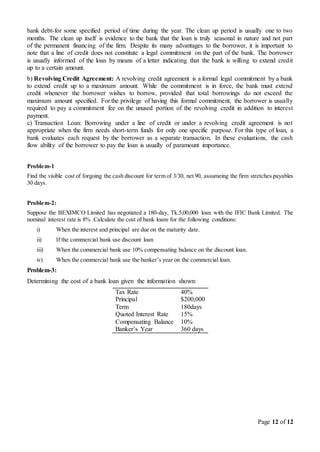
Problem-3:
Determining the cost of a bank loan given the information shown:
Tax Rate 40%
Principal $200,000
Term 180days
Quoted Interest Rate 15%
Compensating Balance 10%
Banker’s Year 360 days

Short term financing

  • 1.
    Page 1 of12 CHAPTER-4 : SHORT TERM FINANCING Topics to be Covered: 1. Meaning and nature of short-term financing. 2. Characteristics of short-term financing 3. Sources of Short Term Financing. 4. Advantages of Short-Term Financing. 5. Disadvantages of Short Term financing. 6. Purpose of Short-Term Financing. 7. “Ideal Concept” of Short-Term Financing. 8. What is Trade Credit? 9. Reasons for the use of Trade Credit. 10. Factors determining the amount of Trade Credit used 11. Cost of Trade Credit 12. Who bears the cost of Trade Credit? 13. What is Bank Credit? 14. Distinction between Bank Credit and Short Term credit.
  • 2.
    Page 2 of12 Meaning and Nature of Short-Term Financing: Short Term financing is that from of financing which embraces borrowing or lending of funds for a short period of time. It refers to the finance obtained on short term basis, usually one year or less in duration. Short term finance is secured for financing the current assets, for example, inventories. Short term finance is also known as working capital which is the excess of current assets over current liabilities. Current liabilities become due within one year and indicate the amount of short-term credit being utilized by the business. Practically all enterprises use the short-term credit as sources of finance. We find in the balance sheets of almost all the companies some kinds of current liabilities which are the indicator of the uses of short term finance in business. It has been found in the developed countries especially in USA that even the largest business establishment makes use of short term finance. The size of business has an important bearing on the use of short term finance. There is variation in the use of short term finance between the large and small sized business establishments. In practically all types of business, there is lesser use of short term credit among larger concerns. The small concerns make more use of short term financing on account of lower average credit standing and impermanent nature of business. Short Term Financing | Characteristics Funds available for a period of one year or less is called short term finance. In the conduct of its business a firm obtains its fund from a variety of sources. While the funds may also arise from earnings retained in the business. There are some characteristics of short term financing. The characteristics of short term financing are given below:  Duration: Short term financing embraces the borrowing or lending funds for short period of time say one year or less.  Cost of funds: Short term financing can provide both the highest and lowest cost of funds in the firm’s capital structure. Some firms of short terms financing are more costly than intermediate or long term funds. On the other hand some short term sources provide funds at no cost at all to the firm payable and accruals fall into this category.  Use of short term financing: there is a common tendency for greater use short term financing among small and lesser use among large concerns. It is prevalent in practice that all types of business funds it quite difficult to raise long term funds resulting on account credit standing and relative importance of many small units.  Sources of short term financing: short term finance deals with the commercial bank, trade credit and other sources of funds that have to be repaid within a year or less. Trade credit is the privilege extended by suppliers to their customers of delaying payment of goods purchased, sometimes for a period of a month or more.  Renewal or recycling: this occurs when short term liabilities are continually refinanced from financing must by definition be repaid in less that one year, some sources provide funds that are continuously rolled over. The funds provided by payable. For example, may remain relatively constant because as some account ate created.  Sources of short term financing: trade credit advance from customers, outstanding expenses, commercial bank, friends and relatives etc. are the sources of short term financing.  Clean up: this occurs when commercial banks or other lenders require the firm to pay off its short term obligation. Just as some sources are rolled over, some must be reduced to O, or cleaned up, at
  • 3.
    Page 3 of12 one point in the year. This is requirement of a bank credit where the cleanup offers proof that the short term financing is being used to meet short term or cyclical needs only.  Speed: a short term loan can be obtained much faster than long term credit. Lenders will insists on a more through financial examination before extending long term credit and the loan agreement will have to be spelled out in considerable detail because a lot can happen during the long life the firm should look to short term markers.  Less restrictive: short term loan agreement ate generally less restrictive. Long term loan agreements always contain previsions or covenants, which constrain firm’s future action these ate almost absent in short term loan.  Easy collection and control: it is easy to collect and control short term loan. No formalities are needed to raise funds from short term source.  Security: short term financing does not require any security to raise the funds.  No prepayment penalty: there is no prepayment penalty provision in case of short term credit, which is expensive. Accordingly if a firm thinks its need for fund will diminish in the near future it should choose short term debt. Sources of Short Term Financing: 1. Trade Creditors 2. Customers Advances 3. Commercial Banks 4. Finance Companies 5. Commercial Paper House 6. Personal Loan Companies 7. Governmental Institutions 8. Factors or Brokers 9. Co-operative credit society 10. Loan Mortgage Banks 11. Money Lender 12. Accruals 13. Miscellaneous Sources 1. Trade Creditors: Trade creditors are probably the most important single source of short term credit. Trade creditors are those business establishments which sell good to others on credit. That is, they do not require payment on the spot; rather they are to be paid after some days from the date of sale. 2. Customers Advances: Customers often finance the seller through advance payment for the goods. The prices of the goods to be purchased are paid in advance, i.e. before the receipt of the goods. This practice is prevalent where the seller does not wish to sell goods without prepayment and the buyer also can not purchase goods form other sources. The seller might require advance it the quantity of goods ordered is so large that he cannot afford to tie up more fund in raw materials or in good-in-process. Special type machine manufactures often demand advance payment in order to protect them from the loss caused by cancellation of contract at a time when the machine has been built up or is in work in process.
  • 4.
    Page 4 of12 3. Commercial Banks: The commercial banks of a country generally supply funds to the business concerns on a short-term basis, either with security or without security if the customer is financially established. The banks, collecting scattered savings of the people, invest a portion of the deposits in the business for a short period of time. 4. Finance Companies: Finance companies usually lend money to business. They are specialized financial institutions and their primary function is to advance funds to the business 5. Commercial Paper House: They are specialized financial agencies and they are created to purchase promissory notes and to sell them, in turn, to other investors who desire to have some shot of short-term liquid assets. The firm having high credit standing can use this source for obtaining short-term funds. 6. Personal Loan Companies: These companies make small loans to individual generally for consumption purposes. The small business undertakings can procure fund form such companies 7. Governmental Institutions: There are some governmental and semi-governmental corporations which are authorized to advance short term funds to business concerns. Their importance is of course not so much less than other sources. 8. Factors or Brokers: In one basic respect, factoring is different from other forms of financing. In other forms funds are granted to one individual largely on the basis of his property. Factoring is based on a different philosophy. In considering a company’s request for funds we are more interested in the men behind the company their ability, their hopes and aspirations for the future. 9. Miscellaneous Sources: There are many more sources from which can secure funds for short period. They are—friend and relatives, public deposits, loan from officer and the company directors and foreign exchange banks Advantages of Short-Term Financing: 1. Easier to Obtain 2. Lower cost 3. Flexibility 4. No Sharing of control 5. Availability 6. Tax Savings 7. Convenience 8. Extension of credit 1. Easier to Obtain: Short –term credit can be more easily obtained than long term credit. A firm which poor credit standing may be unable to obtain long term funds but it can procure, at least some trade credit from sellers who are anxious to increase their sales. The short-term creditors, by granting loans, assume less risk than long term creditors because there is less chance of substantial change in the financial soundness of the creditor within a few week’s or month’s time. 2. Lower cost: Short term credit may be obtained with lower cost than the long term finance because of priority of creditors in general. Because of the prior position given creditors in the matter of claim to income and to assets in dissolution they generally will accept a relatively low interest. 3. Flexibility: Due to seasonal nature of business many firms have a temporary demand for short- term funds to carry heavier inventories. Most enterprises are in constant need of short term funds. Short-term financing is flexible in the sense that the firm is able to secure funds as they are
  • 5.
    Page 5 of12 needed and repay then as soon as the need vanishes. Funds may be needed to meet the daily, weekly or monthly requirements. Such funds can be advantageously supplied by short term credit. It long term credit is secured to finance the daily or weekly or seasonal variations, it would become inflexible because long term funds cannot be repaid as soon as the need for funds vanishes. 4. No Sharing of control: Obtaining funds form short term creditors prevents the inclusion of more owners through the procurement of owner’s funds. This results in maintaining the position of control by the existing owners. Because the creditors have no voice in the operations of the business. 5. Availability: In many cases, particularly for small enterprises short term credit is the only source available. It may not be possible for a small firm to obtain long term funds because of poor credit standing. Long-term credit is not generally granted without adequate margin of protection which the small firms may not be able to provide with. The small business has then recourse to short term funds. 6. Tax Savings: The cost of short term funds are deductible for income tax purposes while the dividend paid to the owners is not deductible. Thus a substantial tax-savings may result form the use of short-term funds. 7. Convenience: Short Term credit can be more conveniently secured than the other types of funds. It is more convenient to pay labour weekly or employees monthly than every day 8. Extension of credit: Many enterprises purchase equipments, supplies and good by ordering from a supplier with the intent of paying after delivery has been made. If subsequently the bills are met promptly, the firm acquires a good credit standing. Then , if any emergency arises for the purchase of any goods the firm DisadvantagesofShort-Term Financing: 1. Frequent Maturity 2. High Cost 1. Frequent Maturity: Short-Term credit is disadvantageous in the sense that it matures frequently. The principal must be repaid when due, otherwise the creditors may close the business. The use of such credit is also a risk to the owners’ investment from the inability to meet the creditor’s claims when due. There may be danger of either meeting the principal payment at maturity of the loan or meeting the principal payment at maturity of the loan or meeting any periodic interest payment or both. The sorter the credits the greater the potential risk to the owners because of the problem of prompter repayment. 2. High Cost: The rate of interest paid on sort-term is usually higher than that on long-term credit is usually higher than that on long-term credit. The rate of interest usually depends on the risk involved, size of loan, collateral protection, etc. The lenders may demand a high interest if the credit involves large amount and the potential credit risk is also high or the debtor may not give suitable security. A high interest may also be demanded when the firm cannot procure funds from other sources on suitable terms and conditions. Purpose/Goalsof Short-Term Financing: 1. Lowering of cost (Low cost financing) 2. Raising Funds according to necessity. 3. Facilitating prosecution of business with other’s money 4. Secure additional fund Types of Short-term Financing:
  • 6.
    Page 6 of12 There are two broad classes of short-term financing: 1. Spontaneous Financing: It refers to sources of funds that arise almost automatically and do not require much formal arrangement by the firm such as i) Trade Credit (Account Payable): ii) Accruals: Accrued Wages and Accrued Taxes 2. Negotiated Financing: When a firm requires (more or less) intensive effort that must negotiate for them; the firm must seek out the funds. i) Secured Financing: a) Bank Loan b) Lending Agent c) Factoring Receivable d) Accounts Receivable e) Pledging Receivable f) Inventory ii) Unsecured Financing: a) Commercial Paper b) International Loan c) Line of Credit d) Revolving Credit Agreement iii) Money Market Credit: a) Commercial Paper b) Bankers’ Acceptance 1. Spontaneous Financing: i) Trade-credit: Trade Credit refers to the credit that a customer gets from supplier of goods in the normal course of business. In practice, the buying firms have not to pay cash immediately for the purchase made. This deferral of payment is a short term financing called trade credit. Trade-credit: In one word, trade credit is a credit which is provided by sellers or suppliers in the normal course of business. That means, credit given by all company to another is known as trade credit. Trade credit is a kind of business credit which is extended by the seller of goods to the buyer of the same at all levels of production and distribution process down to the retailer. Before the goods and services have reached the ultimate users or consumers, they pass through many hands starting from the producers down to the retailer. Trade credit is used by various agencies operating in the trade channel between the producer and the retailer. For example, the producer may extend credit to the wholesaler, who may also facilitate the retailer’s trade by extending credit to him. Such credits extended by the wholesaler to the retailer or producer to the wholesaler are known as trade credit. Trade credit has been defined as the short-term credit by a supplier to a buyer in connection with purchase of goods for ultimate resale. This definition makes it clear that trade credit is a different type of credit than the consumer credit and installment sale credit. Trade credit is a credit extended for the purchase of goods with the ultimate purpose of resale. The credit accepted for the purchase of goods which are consumed by the purchaser is not trade credit—it becomes consumer credit. So a credit, in
  • 7.
    Page 7 of12 order to be designated as trade credit, must be extended in connection with the purchase of goods which must be resold. Components of Trade- Credit: Open account: For purchasing goods no contract is sign by the purchasers. The seller confidence is entering this kind of arrangement usually comes from checking the credit worthiness of the buyers and the history of previous business transactions with the buyer (No contract will be there). Note payable/ Promissory note: When the buyersign’s promissorynote to obtain trade credit it shows upon the buyer’s balance sheet as a trade note payable. The note will have a specified future payment date. It is typically used when the sellers has less confidence upon the buyer. Trade Acceptance: In this case, buyer’s must acknowledge the debt written against purchasing goods in credit formally. In this system seller makes a draft before sending goods to buyer which has been singed by buyer. It is a trade acceptance. Credit –Term: The repayment provisions that are part of a credit arrangement. The expression “credit term” refers to the conditions under which credit is granted. The three major items of credit -due date, cash discount and discount date are usually stated as follows y x , net z. Where, x is the cash discount y is the cash discount Period. z is the Credit period. For example: Credit term 10 2 , net 30. Interpretation: 2% cash discount is allowed if the bills are paid by the 10th day. If the discount is not taken, the full amount of bill is paid by the 30th day. Free trade credit: Free trade credit is a credit which involves credit received during the discount period. Costly trade credit: Costly trade credit is a credit which involves credit in excess of the free trade credit whose cost is equal to the discount cost.
  • 8.
    Page 8 of12 Firms always use costly trade credit after analyzing the cost of the capital. Advantagesof Trade Credit: 1. Easy Availability: Unlike other sources of finance, trade credit is relatively easy to obtain. Except in the case of financially vary unsound firm, it is almost automatic and does not require any negotiations. The easy availability is particularly important to small firms which generally face difficulty in raising funds from the capital markets. 2. Informality: Trade credit is an informal, spontaneous source of finance. It does not require any negotiations and formal agreement. It does not have the restrictions which are usually parts of negotiated sources of finance. 3. no need for collateral securities 4. Financing Volume: It depends on the quantity of purchase and period of payment. 5. Flexibility: Here debtor and creditor can easily increase or decrease their amount of debt. 6. possibility of more profit by increasing sales 7. Less risk of bad debt. Disadvantages: 1. Shorter repayment period 2. High cost of foregoing cash discount benefit. 3. No exemption of tax. Cost of Trade Credit (Is trade credit a cost free source of Finance?) Trade Credit appears to be cost free since it does not involve explicit interest charges. But in practice, it involves implicit costs. The cost of credit may be transferred to the buyer via the increased price of goods supplied to him. The user of Trade Credit, therefore, should be aware of the costs of trade credit to make its intelligent use. The reasoning that it is cost free can lead to incorrect financing decisions. Prompt Payment Delayed Payment Visible cost None 1.Cost of Forgoing Cash Discount 2.Penalty Charges for Late Payment Hidden cost Costs Passed on to Buyer by Seller for 1. Carrying Cost 2. Credit Checking 3. Bad-Debt Losses Cost of Paying Late The supplier extending incurs costs in the forms of the opportunity cost of funds invested in accounts receivables and cost of any cash discounts taken by the buyer. Does the supplier bear this cost? Most of the time, he passes on all or part of these costs to the buyer implicitly in form of higher purchase price
  • 9.
    Page 9 of12 of goods and services supplied. How much of the costs can he really passes on depends on the market supply and demand conditions. Thus if the buyer is in a position to pay cash immediately, he should try to avoid implicit costs of trade credit by negotiating lower purchase price with the supplier. Credit term sometimes include cash discount if the payment is made within a specified period. The buyer should take a decision whether or not to avail it. A trade off is involved. If the buyer takes discount, he benefits in terms of less cash outflow, but then, he benefits in terms of less cash outflow, but then, he foregoes the credit granted by the suppler beyond the discount period. a) Prompt Payment-Visible Cost: No visible cost if payment occur duly. b) Prompt Payment-Hidden Cost: Carrying Cost, Credit Checking and Bad-Debt Losses c) DelayedPayment-visible cost: i) Cost of forgoing cash discount: Problem: Suppose the terms on a $100 credit sale are 2/10, net 30. a) calculate the annual visible cost of forgoing cash discount b) suppose the firm doesn’t pay the bill until Day 40, 10 days after the due date, calculate the hidden annual visible cost of forgoing cash discount. Solution: a) We know that, Visible Annual Cost of Forgoing cash discount = percent cash discount 100% − percent cash discount × 365 𝑁 Where, N= No. of days between due date and discount date Now, Visible Annual Cost of Forgoing cash discount = 2% 100 − 2% × 365 30 − 10 = 37.2% b) We know that, Visible Annual Cost of Forgoing cash discount = percent cash discount 100% − percent cash discount × 365 𝑁′ Where, 𝑁′= No. of days between discount date and date the bill is paid Visible Annual Cost of Forgoing cash discount = 2% 100 − 2% × 365 40 − 10 = 24.8% ii) Accruals: Continually recurring liabilities representing services received for which payment has not been made. Firms generally pay employees on a weekly, biweekly or monthly basis, so the balance sheet will typically show some accrued wages, similarly the firms own estimate incomes taxes, social security and income taxes withheld from employee pay rolls and sales taxes collected are generally paid on a weekly,
  • 10.
    Page 10 of12 monthly or quarterly basis, hence the balance sheet will typically show some accrued taxes along with accrued wages. 2. Negotiated Financing: The principal sources of short-term negotiated loans are commercial banks and finance companies. With both money market credit and short-term loans, financing must be arranged on a formal basis. i) Money Market Credit: a) Commercial Paper b) Bankers’ Acceptance ii) Secured Financing: a. Bank Loan b. Lending Agent c. Factoring Receivable d. Pledging Receivable e. Inventory iii) Unsecured Financing: a) Commercial Paper b) International Loan c) Line of Credit d) Revolving Credit Agreement i) Money MarketCredit a) Commercial Paper: Large, well-established companies sometimes borrow on a short-term basis through commercial paper, which represents an unsecured, short term, negotiable promissory note sold in the money market. Because these notes are money market instruments, only the most creditworthy companies are able to use it as a source of short-term financing. The commercial paper market is composed of two parts; the dealer market and the direct-placement market. The principle advantage of commercial paper as a source of short-term financing is that it is generally cheaper than a short- term business loan from a commercial bank. Instead of issuing “stand- alone” paper, some corporations issue what is known as “bank supported” commercial paper. b) Bankers’ Acceptances: For a company engaged in foreign trade or the domestic shipment of certain marketable goods, bankers’ acceptances can be a meaningful source of financing. In essence, the bank accepts responsibility for payment, thereby substituting its creditworthiness for that of the drawee. If the bank is large and well known the instrument becomes highly marketable upon acceptance. As a result, the drawer does not have to hold the draft until the final due date; it can sell the draft in the market for less than its face value. ii) SecuredLoans Many firms cannot obtain credit on an unsecured basis, either because they are new and unproven or because bankers do not have high regard for the firm’s ability to service the amount of debt sought. To make loans to such firms, lenders may require security (collateral) that will reduce their risk of loss. With security, lenders have two sources of loan repayment; the cash flow ability of the firm to service the debt and, if that source fails for some reason, the collateral. a) Bank Loan: Bank loans is an important sources of short term financing , the banks influences actually greater than it appears from the dollar amounts they lends because bank provides non spontaneous funds at firm’s financing needs increase, it request additional fund from its bank.
  • 11.
    Page 11 of12 b) Lending Agent: Lending Agent means any person or entity, other than a regulated lending institution, that finds, administers, facilitates, or services loans for a licensee. c) Factoring Receivable: Factoring is the sale of accounts receivable of a company to a financing company at discount. The financing company which buys the receivables is called a factor. Factoring helps a business convert its receivables immediately into cash instead of waiting for due dates of payment by customers. The parties to the factoring agreement assess the recoverability of the accounts receivable, decide whether or not the factoring agreement will be with recourse and then they agree on a suitable discount factor to calculate the amount of fee to be charged by the factor. After deducting such fee from the value of accounts receivable, the factor pays in cash to originating company. The factor may also withheld an additional amount as a refundable security against bad debts which may arise. As a result of the above transaction, the factor gains ownership of the accounts receivable and has access to the detailed records of those receivables. The factor collects cash from the debtors as the due dates approach. The procedure to be followed in a situation where a debt becomes irrecoverable depends on whether or not the factoring agreement is with recourse. d) Accounts Receivable Baked Loan/ Pledging Receivable/ Line of Credit: Accounts receivables are one of the most liquid assets of the firm. Consequently, they make desirable security for a short-term loan. The higher the quality of the accounts the firm maintains, the higher the percentage the lender is willing to advance against the face value of the receivables pledged. The lender is concerned not only with the quality of receivable but also with the size. The smaller the average sizes of the accounts, the more it costs per dollar of loan to process them. A receivable loan can be either a non-notification or a notification basis. Under the formal arrangement, customers of the firm are not notified that their accounts have been pledged to the lender. When the firm receives payment on an account, it forwards this payment, together with other payments, to the lender. With a notification arrangement, the account is notified of the assignment and remittances are made directly to the lender. e) Inventory Baked Loan: Basic raw materials and finished-goods inventories represent reasonably liquid assets and are therefore suitable as security for short-term loans. As with a receivable loan, the lender determines a percentage advance against the market value of the collateral. The percentage varies according to the quality and type of inventory. Lenders determine the percentage that they are willing to advance by considering marketabilit y, perishability, market price stability and the difficulty and expense of selling the inventory to satisfy the loan. iii) Unsecured Loans: Finance companies do not offer unsecured loans; simply because a borrower who deserves unsecured credit can borrow at a lower cost from a commercial bank. Short-term, unsecured bank loans are typically regarded as “self-liquidating” in that the assets purchased with the proceeds generate sufficient cash flow to pay off the loan. Unsecured short-term loans may be extended under a line of credit, under a revolving credit agreement, or on a transaction basis. a) Line of Credit: A line of credit is an arrangement between a bank and its customer specifying the maximum amount of unsecured credit the bank will permit the firm to owe at any one time. Usually, credit lines are established for a one-year period and are set for renewal after the bank receives the latest annual report and has had a chance to review the progress of the borrower. The amount of the line is based on the bank’s assessment of the creditworthiness and the credit needs of the borrower. Because certain banks regard borrowing under lines of credit as seasonal or temporary financing, they may impose “cleanup” provision. Under a cleanup provision, the borrower would be required to clean up
  • 12.
    Page 12 of12 bank debt-for some specified period of time during the year. The clean up period is usually one to two months. The clean up itself is evidence to the bank that the loan is truly seasonal in nature and not part of the permanent financing of the firm. Despite its many advantages to the borrower, it is important to note that a line of credit does not constitute a legal commitment on the part of the bank. The borrower is usually informed of the loan by means of a letter indicating that the bank is willing to extend credit up to a certain amount. b) Revolving Credit Agreement: A revolving credit agreement is a formal legal commitment by a bank to extend credit up to a maximum amount. While the commitment is in force, the bank must extend credit whenever the borrower wishes to borrow, provided that total borrowings do not exceed the maximum amount specified. For the privilege of having this formal commitment, the borrower is usually required to pay a commitment fee on the unused portion of the revolving credit in addition to interest payment. c) Transaction Loan: Borrowing under a line of credit or under a revolving credit agreement is not appropriate when the firm needs short-term funds for only one specific purpose. For this type of loan, a bank evaluates each request by the borrower as a separate transaction. In these evaluations, the cash flow ability of the borrower to pay the loan is usually of paramount importance. Problem-1 Find the visible cost of forgoing the cash discount for term of 3/30, net 90, assumeing the firm stretches payables 30 days. Problem-2: Suppose the BEXIMCO Limited has negotiated a 180-day, Tk.5,00,000 loan with the IFIC Bank Limited. The nominal interest rate is 8% .Calculate the cost of bank loans for the following conditions: i) When the interest and principal are due on the maturity date. ii) If the commercial bank use discount loan iii) When the commercial bank use 10% compensating balance on the discount loan. iv) When the commercial bank use the banker’s year on the commercial loan. Problem-3: Determining the cost of a bank loan given the information shown: Tax Rate 40% Principal $200,000 Term 180days Quoted Interest Rate 15% Compensating Balance 10% Banker’s Year 360 days