Managing Resources Net Working Capital  Working Capital Cycle Maroof Hussain Sabri
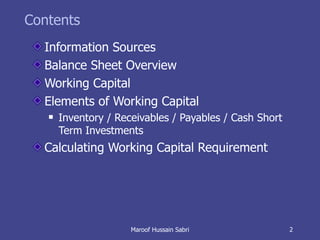
Contents Information Sources Balance Sheet Overview Working Capital Elements of Working Capital Inventory / Receivables / Payables / Cash Short Term Investments Calculating Working Capital Requirement Maroof Hussain Sabri
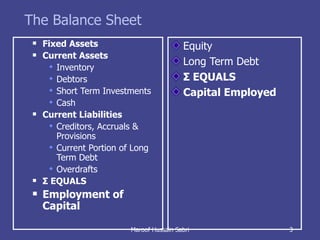
The Balance Sheet Fixed Assets Current Assets Inventory Debtors Short Term Investments Cash Current Liabilities Creditors, Accruals & Provisions  Current Portion of Long Term Debt Overdrafts ÎŁ  EQUALS Employment of Capital Equity Long Term Debt ÎŁ  EQUALS Capital Employed Maroof Hussain Sabri
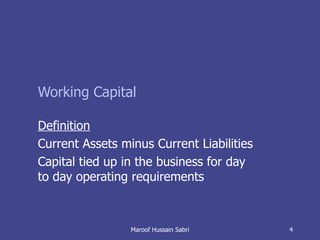
Working Capital Definition Current Assets minus Current Liabilities Capital tied up in the business for day to day operating requirements Maroof Hussain Sabri
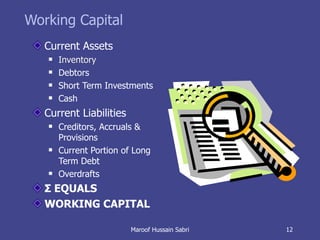
Working Capital Current Assets Inventory Debtors Short Term Investments Cash Current Liabilities Creditors, Accruals & Provisions  Current Portion of Long Term Debt Overdrafts ÎŁ  EQUALS WORKING CAPITAL Maroof Hussain Sabri
Current Assets Inventory Debtors Short Term Investments Cash Current Liabilities Creditors, Accruals & Provisions  Current Portion of Long Term Debt Overdrafts ÎŁ  EQUALS WORKING CAPITAL Maroof Hussain Sabri
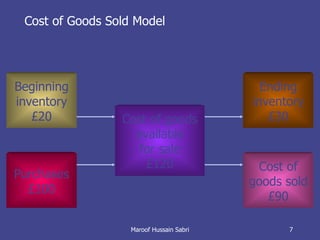
Cost of Goods Sold Model Beginning inventory ÂŁ20 Purchases ÂŁ100 Maroof Hussain Sabri Cost of goods available for sale ÂŁ120 Ending inventory ÂŁ30 Cost of goods sold ÂŁ90
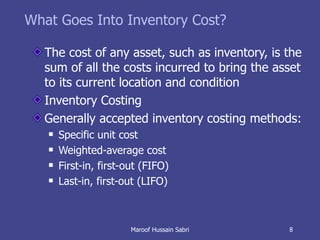
What Goes Into Inventory Cost? The cost of any asset, such as inventory, is the sum of all the costs incurred to bring the asset to its current location and condition Inventory Costing Generally accepted inventory costing methods: Specific unit cost Weighted-average cost First-in, first-out (FIFO) Last-in, first-out (LIFO) Maroof Hussain Sabri
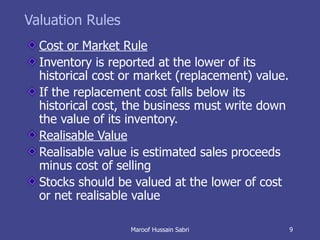
Valuation Rules Cost or Market Rule Inventory is reported at the lower of its historical cost or market (replacement) value. If the replacement cost falls below its historical cost, the business must write down the value of its inventory. Realisable Value Realisable value is estimated sales proceeds minus cost of selling Stocks should be valued at the lower of cost or net realisable value Maroof Hussain Sabri
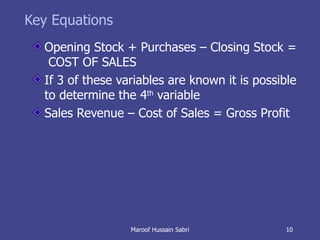
Key Equations Opening Stock + Purchases – Closing Stock =  COST OF SALES If 3 of these variables are known it is possible to determine the 4 th  variable Sales Revenue – Cost of Sales = Gross Profit Maroof Hussain Sabri
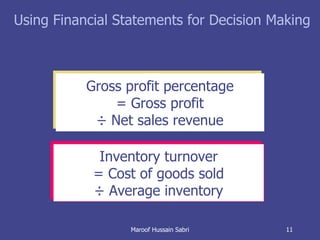
Using Financial Statements for Decision Making Inventory turnover = Cost of goods sold Ă· Average inventory Gross profit percentage = Gross profit Ă· Net sales revenue Maroof Hussain Sabri
Working Capital Current Assets Inventory Debtors Short Term Investments Cash Current Liabilities Creditors, Accruals & Provisions  Current Portion of Long Term Debt Overdrafts ÎŁ  EQUALS WORKING CAPITAL Maroof Hussain Sabri
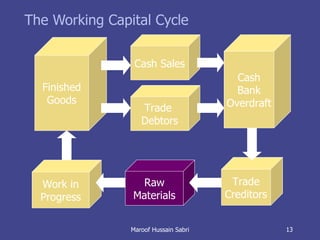
The Working Capital Cycle Finished Goods Work in Progress Cash Sales Trade  Debtors Cash Bank Overdraft Raw Materials Trade Creditors Maroof Hussain Sabri
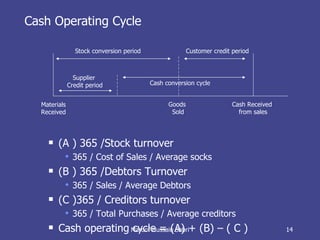
Cash Operating Cycle (A ) 365 /Stock turnover 365 / Cost of Sales / Average socks  (B ) 365 /Debtors Turnover 365 / Sales / Average Debtors (C )365 / Creditors turnover 365 / Total Purchases / Average creditors Cash operating cycle = (A) + (B) – ( C ) Materials Received Supplier  Credit period Goods  Sold Stock conversion period Cash Received  from sales Customer credit period Cash conversion cycle Maroof Hussain Sabri
Short Term Investments Maroof Hussain Sabri
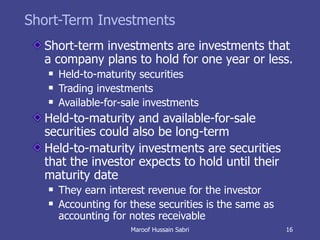
Short-Term Investments Short-term investments are investments that a company plans to hold for one year or less. Held-to-maturity securities Trading investments Available-for-sale investments Held-to-maturity and available-for-sale securities could also be long-term Held-to-maturity investments are securities that the investor expects to hold until their maturity date They earn interest revenue for the investor Accounting for these securities is the same as accounting for notes receivable Maroof Hussain Sabri
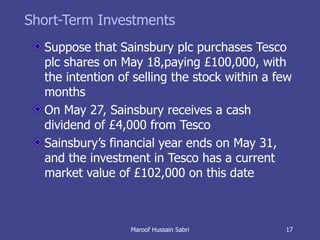
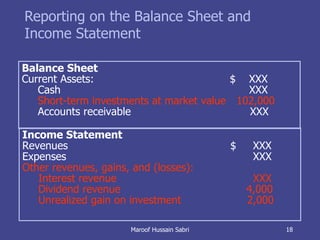
Short-Term Investments Suppose that Sainsbury plc purchases Tesco plc shares on May 18,paying £100,000, with the intention of selling the stock within a few months On May 27, Sainsbury receives a cash dividend of £4,000 from Tesco Sainsbury’s financial year ends on May 31, and the investment in Tesco has a current market value of £102,000 on this date Maroof Hussain Sabri
Reporting on the Balance Sheet and Income Statement Balance Sheet Current Assets: $  XXX Cash  XXX Short-term investments at market value   102,000 Accounts receivable   XXX Income Statement Revenues $  XXX Expenses   XXX Other revenues, gains, and (losses): Interest revenue   XXX Dividend revenue 4,000 Unrealized gain on investment   2,000 Maroof Hussain Sabri
Accounts Receivable Maroof Hussain Sabri
Accounts Receivable Debtors (Receivables) are the third most liquid asset – after cash and short-term investments Debtors (Receivables) are monetary claims against others. Arise principally because Trade Credit is offered by seller Types Sales Debtors (Accounts Receivable) Notes Receivable Other Debtors and Prepayments Maroof Hussain Sabri
Why Offer Trade Credit Marketing decision – price Trade off between credit risk and profit margin Industry Practice Access to Finance is a Competitive advantage – can offer generous credit  Information asymmetry between buyer & seller about condition of Goods – gives inspection period Maroof Hussain Sabri
Valuation of Accounts Receivable Short term receivables are reported at their  net realizable value  (NRV) The NRV is the net amount expected to be collected The NRV is gross accounts receivable less estimated non-collectible accounts Estimating bad debt can be on a balance sheet basis or % of sales revenue basis Maroof Hussain Sabri
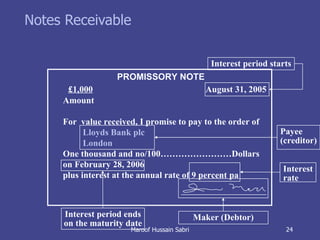
Notes Receivable Notes receivable are more formal than accounts receivable. The creditor has a note receivable. The debtor has a note payable. The principal amount of the note is the amount borrowed by the debtor The maker pays the payee the maturity value The maturity value includes principal plus interest. Maroof Hussain Sabri
Notes Receivable   PROMISSORY NOTE   £1,000     August 31, 2005 Amount For  value received, I promise to pay to the order of Lloyds Bank plc London One thousand and no/100………… …………D ollars on February 28, 2006 plus interest at the annual rate of 9 percent pa Interest period starts Payee (creditor) Interest rate Interest period ends on the maturity date Maker (Debtor) Maroof Hussain Sabri
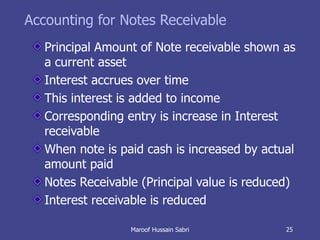
Accounting for Notes Receivable Principal Amount of Note receivable shown as a current asset Interest accrues over time This interest is added to income Corresponding entry is increase in Interest receivable When note is paid cash is increased by actual amount paid Notes Receivable (Principal value is reduced) Interest receivable is reduced Maroof Hussain Sabri
Other Debtors Prepayments Returnable deposits paid Maroof Hussain Sabri
Current Liabilities Maroof Hussain Sabri
Current Liabilities Current liabilities are obligations due within one year or within the company’s normal operating cycle if it is longer than one year Either Known amount Or Amount must be estimated Maroof Hussain Sabri
Current Liabilities Accounts Payable Short-term notes payable Interest to balance sheet date must be accrued Sales tax / VAT payable Current portion of long-term debt Accrued expenses Returnable Deposits Payroll liabilities Unearned revenues Dividend Payable Maroof Hussain Sabri
Creditors, Accruals and Provisions Creditors –  Amounts owing which are Known Goods received on credit & Invoice received Accruals Not known with certainty – Invoice not received Provisions General / specific Bad Debts, IBNR, Maroof Hussain Sabri
Accounts Payable Accounts payable, are: Balances owed for goods, supplies, or services purchased on open account. Valuation is based on invoice amount. Maroof Hussain Sabri
Trade Credit Obtained for period between delivery & Payment Part of Normal trading relationship Early payment discount Terminology 2/10 net 30 Affected by  Industry custom & Practice Relative Bargaining power Type of product small margin less credit Taking excessive credit harms supplier relationship Late Payment & Commercial debts (interest) act 1998 Maroof Hussain Sabri
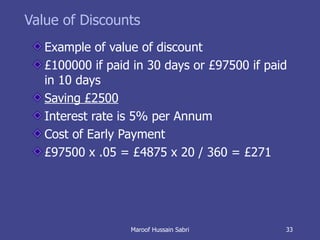
Value of Discounts Example of value of discount  ÂŁ100000 if paid in 30 days or ÂŁ97500 if paid in 10 days  Saving ÂŁ2500   Interest rate is 5% per Annum Cost of Early Payment ÂŁ97500 x .05 = ÂŁ4875 x 20 / 360 = ÂŁ271 Maroof Hussain Sabri
Unearned revenues Unearned revenues represent receipts of cash for sales before goods or services are delivered Magazine Subscription Licences Air Tickets Maroof Hussain Sabri
Current Installment of Long-Term Debt It is the amount of the principal that is payable within one year. At the end of the year, a company reclassifies the amount of its long-term debt that must be paid during the upcoming year Maroof Hussain Sabri
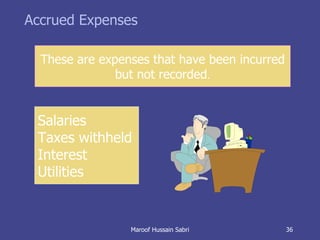
Accrued Expenses These are expenses that have been incurred but not recorded . Salaries Taxes withheld Interest Utilities Maroof Hussain Sabri
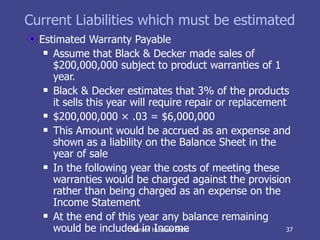
Current Liabilities which must be estimated Estimated Warranty Payable Assume that Black & Decker made sales of $200,000,000 subject to product warranties of 1 year. Black & Decker estimates that 3% of the products it sells this year will require repair or replacement $200,000,000 Ă— .03 = $6,000,000 This Amount would be accrued as an expense and shown as a liability on the Balance Sheet in the year of sale In the following year the costs of meeting these warranties would be charged against the provision rather than being charged as an expense on the Income Statement At the end of this year any balance remaining would be included in Income Maroof Hussain Sabri
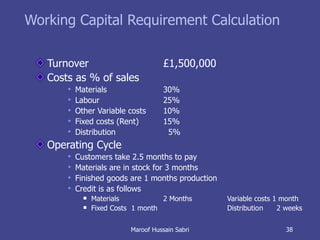
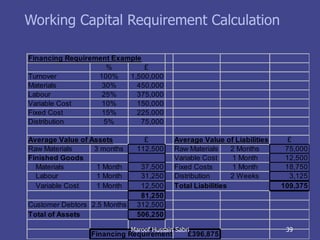
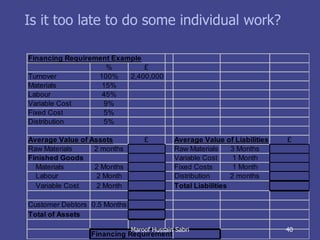
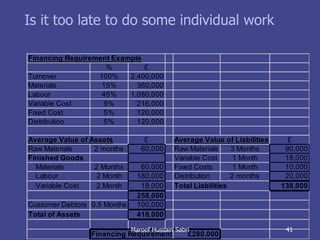
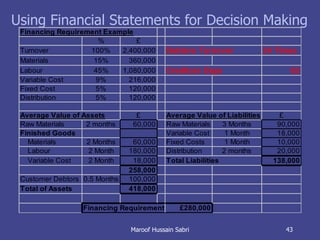
Working Capital Requirement Calculation Turnover ÂŁ1,500,000 Costs as % of sales Materials 30% Labour  25% Other Variable costs 10% Fixed costs (Rent) 15% Distribution   5% Operating Cycle Customers take 2.5 months to pay Materials are in stock for 3 months Finished goods are 1 months production Credit is as follows Materials  2 Months Variable costs 1 month Fixed Costs  1 month  Distributio n  2 weeks Maroof Hussain Sabri
Working Capital Requirement Calculation Maroof Hussain Sabri
Is it too late to do some individual work? Maroof Hussain Sabri
Is it too late to do some individual work Maroof Hussain Sabri
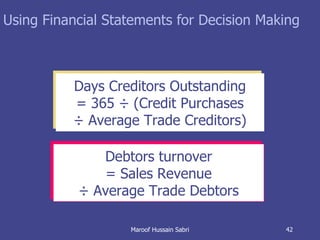
Using Financial Statements for Decision Making Debtors turnover = Sales Revenue Ă· Average Trade Debtors Days Creditors Outstanding = 365 Ă· (Credit Purchases Ă· Average Trade Creditors) Maroof Hussain Sabri
Using Financial Statements for Decision Making Maroof Hussain Sabri
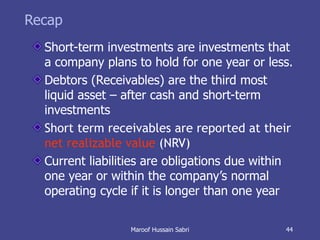
Recap Short-term investments are investments that a company plans to hold for one year or less. Debtors (Receivables) are the third most liquid asset – after cash and short-term investments Short term receivables are reported at their  net realizable value  (NRV) Current liabilities are obligations due within one year or within the company’s normal operating cycle if it is longer than one year Maroof Hussain Sabri
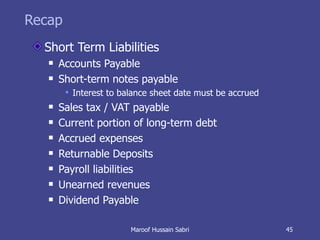
Recap Short Term Liabilities Accounts Payable Short-term notes payable Interest to balance sheet date must be accrued Sales tax / VAT payable Current portion of long-term debt Accrued expenses Returnable Deposits Payroll liabilities Unearned revenues Dividend Payable Maroof Hussain Sabri
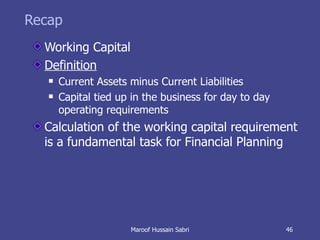
Recap Working Capital Definition Current Assets minus Current Liabilities Capital tied up in the business for day to day operating requirements Calculation of the working capital requirement is a fundamental task for Financial Planning Maroof Hussain Sabri

Working Capital & WOrking Capital Cycle

  • 1.
    Managing Resources NetWorking Capital Working Capital Cycle Maroof Hussain Sabri
  • 2.
    Contents Information SourcesBalance Sheet Overview Working Capital Elements of Working Capital Inventory / Receivables / Payables / Cash Short Term Investments Calculating Working Capital Requirement Maroof Hussain Sabri
  • 3.
    The Balance SheetFixed Assets Current Assets Inventory Debtors Short Term Investments Cash Current Liabilities Creditors, Accruals & Provisions Current Portion of Long Term Debt Overdrafts ÎŁ EQUALS Employment of Capital Equity Long Term Debt ÎŁ EQUALS Capital Employed Maroof Hussain Sabri
  • 4.
    Working Capital DefinitionCurrent Assets minus Current Liabilities Capital tied up in the business for day to day operating requirements Maroof Hussain Sabri
  • 5.
    Working Capital CurrentAssets Inventory Debtors Short Term Investments Cash Current Liabilities Creditors, Accruals & Provisions Current Portion of Long Term Debt Overdrafts ÎŁ EQUALS WORKING CAPITAL Maroof Hussain Sabri
  • 6.
    Current Assets InventoryDebtors Short Term Investments Cash Current Liabilities Creditors, Accruals & Provisions Current Portion of Long Term Debt Overdrafts ÎŁ EQUALS WORKING CAPITAL Maroof Hussain Sabri
  • 7.
    Cost of GoodsSold Model Beginning inventory ÂŁ20 Purchases ÂŁ100 Maroof Hussain Sabri Cost of goods available for sale ÂŁ120 Ending inventory ÂŁ30 Cost of goods sold ÂŁ90
  • 8.
    What Goes IntoInventory Cost? The cost of any asset, such as inventory, is the sum of all the costs incurred to bring the asset to its current location and condition Inventory Costing Generally accepted inventory costing methods: Specific unit cost Weighted-average cost First-in, first-out (FIFO) Last-in, first-out (LIFO) Maroof Hussain Sabri
  • 9.
    Valuation Rules Costor Market Rule Inventory is reported at the lower of its historical cost or market (replacement) value. If the replacement cost falls below its historical cost, the business must write down the value of its inventory. Realisable Value Realisable value is estimated sales proceeds minus cost of selling Stocks should be valued at the lower of cost or net realisable value Maroof Hussain Sabri
  • 10.
    Key Equations OpeningStock + Purchases – Closing Stock = COST OF SALES If 3 of these variables are known it is possible to determine the 4 th variable Sales Revenue – Cost of Sales = Gross Profit Maroof Hussain Sabri
  • 11.
    Using Financial Statementsfor Decision Making Inventory turnover = Cost of goods sold Ă· Average inventory Gross profit percentage = Gross profit Ă· Net sales revenue Maroof Hussain Sabri
  • 12.
    Working Capital CurrentAssets Inventory Debtors Short Term Investments Cash Current Liabilities Creditors, Accruals & Provisions Current Portion of Long Term Debt Overdrafts ÎŁ EQUALS WORKING CAPITAL Maroof Hussain Sabri
  • 13.
    The Working CapitalCycle Finished Goods Work in Progress Cash Sales Trade Debtors Cash Bank Overdraft Raw Materials Trade Creditors Maroof Hussain Sabri
  • 14.
    Cash Operating Cycle(A ) 365 /Stock turnover 365 / Cost of Sales / Average socks (B ) 365 /Debtors Turnover 365 / Sales / Average Debtors (C )365 / Creditors turnover 365 / Total Purchases / Average creditors Cash operating cycle = (A) + (B) – ( C ) Materials Received Supplier Credit period Goods Sold Stock conversion period Cash Received from sales Customer credit period Cash conversion cycle Maroof Hussain Sabri
  • 15.
    Short Term InvestmentsMaroof Hussain Sabri
  • 16.
    Short-Term Investments Short-terminvestments are investments that a company plans to hold for one year or less. Held-to-maturity securities Trading investments Available-for-sale investments Held-to-maturity and available-for-sale securities could also be long-term Held-to-maturity investments are securities that the investor expects to hold until their maturity date They earn interest revenue for the investor Accounting for these securities is the same as accounting for notes receivable Maroof Hussain Sabri
  • 17.
    Short-Term Investments Supposethat Sainsbury plc purchases Tesco plc shares on May 18,paying £100,000, with the intention of selling the stock within a few months On May 27, Sainsbury receives a cash dividend of £4,000 from Tesco Sainsbury’s financial year ends on May 31, and the investment in Tesco has a current market value of £102,000 on this date Maroof Hussain Sabri
  • 18.
    Reporting on theBalance Sheet and Income Statement Balance Sheet Current Assets: $ XXX Cash XXX Short-term investments at market value 102,000 Accounts receivable XXX Income Statement Revenues $ XXX Expenses XXX Other revenues, gains, and (losses): Interest revenue XXX Dividend revenue 4,000 Unrealized gain on investment 2,000 Maroof Hussain Sabri
  • 19.
  • 20.
    Accounts Receivable Debtors(Receivables) are the third most liquid asset – after cash and short-term investments Debtors (Receivables) are monetary claims against others. Arise principally because Trade Credit is offered by seller Types Sales Debtors (Accounts Receivable) Notes Receivable Other Debtors and Prepayments Maroof Hussain Sabri
  • 21.
    Why Offer TradeCredit Marketing decision – price Trade off between credit risk and profit margin Industry Practice Access to Finance is a Competitive advantage – can offer generous credit Information asymmetry between buyer & seller about condition of Goods – gives inspection period Maroof Hussain Sabri
  • 22.
    Valuation of AccountsReceivable Short term receivables are reported at their net realizable value (NRV) The NRV is the net amount expected to be collected The NRV is gross accounts receivable less estimated non-collectible accounts Estimating bad debt can be on a balance sheet basis or % of sales revenue basis Maroof Hussain Sabri
  • 23.
    Notes Receivable Notesreceivable are more formal than accounts receivable. The creditor has a note receivable. The debtor has a note payable. The principal amount of the note is the amount borrowed by the debtor The maker pays the payee the maturity value The maturity value includes principal plus interest. Maroof Hussain Sabri
  • 24.
    Notes Receivable PROMISSORY NOTE £1,000 August 31, 2005 Amount For value received, I promise to pay to the order of Lloyds Bank plc London One thousand and no/100………… …………D ollars on February 28, 2006 plus interest at the annual rate of 9 percent pa Interest period starts Payee (creditor) Interest rate Interest period ends on the maturity date Maker (Debtor) Maroof Hussain Sabri
  • 25.
    Accounting for NotesReceivable Principal Amount of Note receivable shown as a current asset Interest accrues over time This interest is added to income Corresponding entry is increase in Interest receivable When note is paid cash is increased by actual amount paid Notes Receivable (Principal value is reduced) Interest receivable is reduced Maroof Hussain Sabri
  • 26.
    Other Debtors PrepaymentsReturnable deposits paid Maroof Hussain Sabri
  • 27.
  • 28.
    Current Liabilities Currentliabilities are obligations due within one year or within the company’s normal operating cycle if it is longer than one year Either Known amount Or Amount must be estimated Maroof Hussain Sabri
  • 29.
    Current Liabilities AccountsPayable Short-term notes payable Interest to balance sheet date must be accrued Sales tax / VAT payable Current portion of long-term debt Accrued expenses Returnable Deposits Payroll liabilities Unearned revenues Dividend Payable Maroof Hussain Sabri
  • 30.
    Creditors, Accruals andProvisions Creditors – Amounts owing which are Known Goods received on credit & Invoice received Accruals Not known with certainty – Invoice not received Provisions General / specific Bad Debts, IBNR, Maroof Hussain Sabri
  • 31.
    Accounts Payable Accountspayable, are: Balances owed for goods, supplies, or services purchased on open account. Valuation is based on invoice amount. Maroof Hussain Sabri
  • 32.
    Trade Credit Obtainedfor period between delivery & Payment Part of Normal trading relationship Early payment discount Terminology 2/10 net 30 Affected by Industry custom & Practice Relative Bargaining power Type of product small margin less credit Taking excessive credit harms supplier relationship Late Payment & Commercial debts (interest) act 1998 Maroof Hussain Sabri
  • 33.
    Value of DiscountsExample of value of discount ÂŁ100000 if paid in 30 days or ÂŁ97500 if paid in 10 days Saving ÂŁ2500 Interest rate is 5% per Annum Cost of Early Payment ÂŁ97500 x .05 = ÂŁ4875 x 20 / 360 = ÂŁ271 Maroof Hussain Sabri
  • 34.
    Unearned revenues Unearnedrevenues represent receipts of cash for sales before goods or services are delivered Magazine Subscription Licences Air Tickets Maroof Hussain Sabri
  • 35.
    Current Installment ofLong-Term Debt It is the amount of the principal that is payable within one year. At the end of the year, a company reclassifies the amount of its long-term debt that must be paid during the upcoming year Maroof Hussain Sabri
  • 36.
    Accrued Expenses Theseare expenses that have been incurred but not recorded . Salaries Taxes withheld Interest Utilities Maroof Hussain Sabri
  • 37.
    Current Liabilities whichmust be estimated Estimated Warranty Payable Assume that Black & Decker made sales of $200,000,000 subject to product warranties of 1 year. Black & Decker estimates that 3% of the products it sells this year will require repair or replacement $200,000,000 Ă— .03 = $6,000,000 This Amount would be accrued as an expense and shown as a liability on the Balance Sheet in the year of sale In the following year the costs of meeting these warranties would be charged against the provision rather than being charged as an expense on the Income Statement At the end of this year any balance remaining would be included in Income Maroof Hussain Sabri
  • 38.
    Working Capital RequirementCalculation Turnover ÂŁ1,500,000 Costs as % of sales Materials 30% Labour 25% Other Variable costs 10% Fixed costs (Rent) 15% Distribution 5% Operating Cycle Customers take 2.5 months to pay Materials are in stock for 3 months Finished goods are 1 months production Credit is as follows Materials 2 Months Variable costs 1 month Fixed Costs 1 month Distributio n 2 weeks Maroof Hussain Sabri
  • 39.
    Working Capital RequirementCalculation Maroof Hussain Sabri
  • 40.
    Is it toolate to do some individual work? Maroof Hussain Sabri
  • 41.
    Is it toolate to do some individual work Maroof Hussain Sabri
  • 42.
    Using Financial Statementsfor Decision Making Debtors turnover = Sales Revenue Ă· Average Trade Debtors Days Creditors Outstanding = 365 Ă· (Credit Purchases Ă· Average Trade Creditors) Maroof Hussain Sabri
  • 43.
    Using Financial Statementsfor Decision Making Maroof Hussain Sabri
  • 44.
    Recap Short-term investmentsare investments that a company plans to hold for one year or less. Debtors (Receivables) are the third most liquid asset – after cash and short-term investments Short term receivables are reported at their net realizable value (NRV) Current liabilities are obligations due within one year or within the company’s normal operating cycle if it is longer than one year Maroof Hussain Sabri
  • 45.
    Recap Short TermLiabilities Accounts Payable Short-term notes payable Interest to balance sheet date must be accrued Sales tax / VAT payable Current portion of long-term debt Accrued expenses Returnable Deposits Payroll liabilities Unearned revenues Dividend Payable Maroof Hussain Sabri
  • 46.
    Recap Working CapitalDefinition Current Assets minus Current Liabilities Capital tied up in the business for day to day operating requirements Calculation of the working capital requirement is a fundamental task for Financial Planning Maroof Hussain Sabri