IMPLEMENTING PROJECT BASED
         LEARNING

  RACHEL COOK AND STEPHANIE DULMAGE
SESSION AGENDA
The Why and What of PBL

     7 Whys of PBL
     PBL Video
The How of PBL

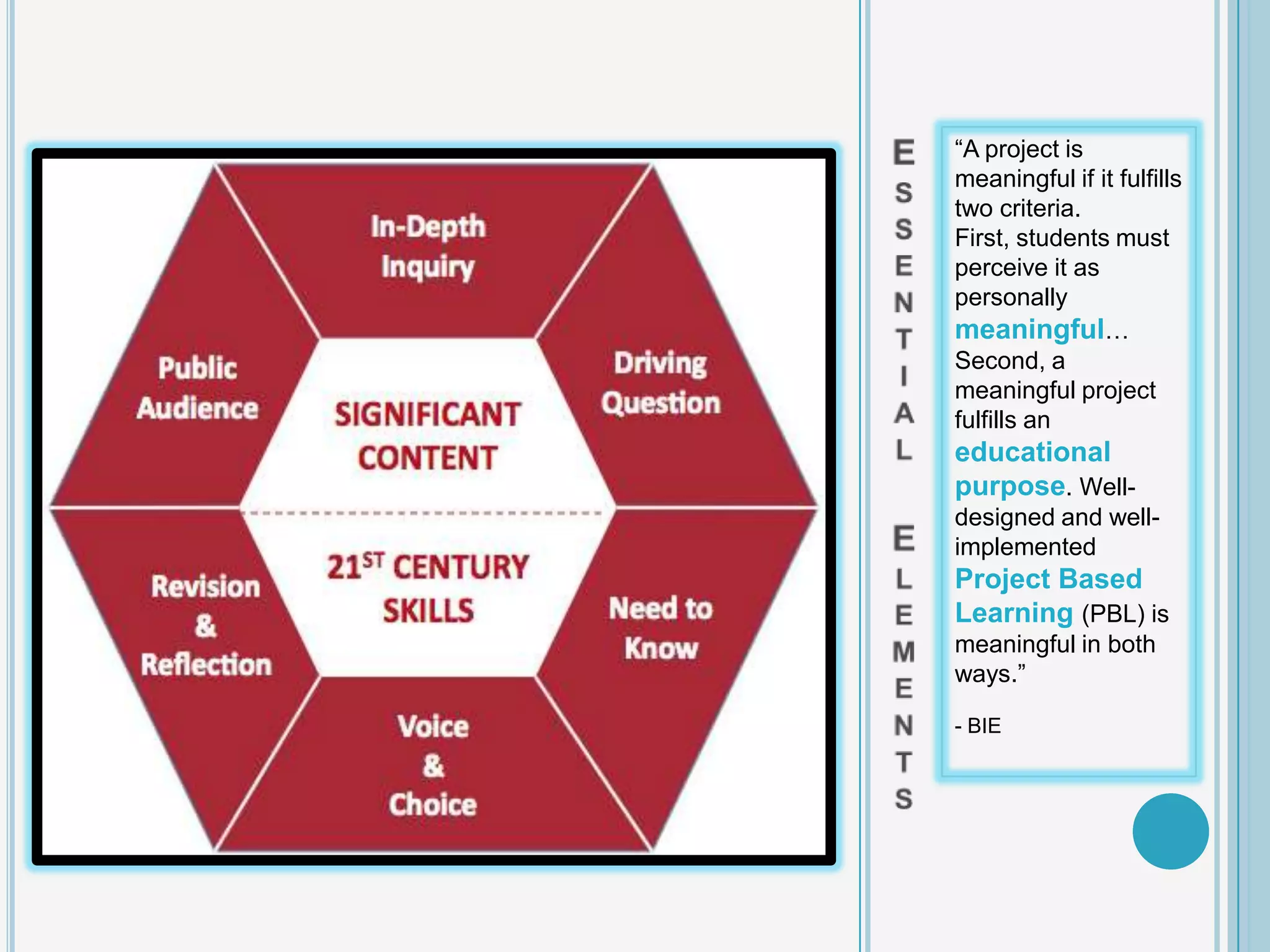
     Essential Elements of PBL
     Project Vs. Project Based Learning
     Project Planning
     PBL in Action
      You Are What You Eat
      Energy Makes The World Go Round - 1st grade PBL
      Un Restaurante Nuevo - MS Spanish PBL
Getting Started
     Resources and Tools
Q and A
WHY PBL?

PBL Helps Students Develop Skills for Living in a
 Knowledge-Based, Highly Technological Society

  Solving highly complex problems requires that students
    have both fundamental skills and 21st century skills:

       personal and social responsibility
       planning, critical thinking, reasoning, and creativity
       strong communication skills, both for interpersonal and presentation
        needs
       cross-cultural understanding
       visualizing and decision making
       knowing how and when to use technology and choosing the most
        appropriate tool for the task


http://www.edutopia.org/project-based-learning-guide-importance
THE WHY CONT’D
   PBL and Technology Use Bring a New Relevance to
    the Learning at Hand

   PBL Lends Itself to Authentic Assessment

   PBL Promotes Lifelong Learning

   PBL Accommodates Students with Varying Learning
    Styles and Differences

   PBL Increases Opportunities For Relationship
    Building and Personalized Learning

   Research Supports PBL
WHAT IS PROJECT BASED LEARNING
 (PBL)? HTTP://WWW.YOUTUBE.COM/WATCH?V=LMCZVGESRZ8

What is Project Based Learning?
“A project is
meaningful if it fulfills
two criteria.
First, students must
perceive it as
personally
meaningful…
Second, a
meaningful project
fulfills an
educational
purpose. Well-
designed and well-
implemented
Project Based
Learning (PBL) is
meaningful in both
ways.”

- BIE
PROJECT ORIENTED LEARNING VS.
       PROJECT-BASED LEARNING

Remember… this is not simply doing a project or
culminating activity that demonstrates what
students learned from teacher-directed lessons or
lectures.

              Watch and reflect…

http://howtovideos.hightechhigh.org/video/265/W
         hat+Project+Based+Learning+Isn
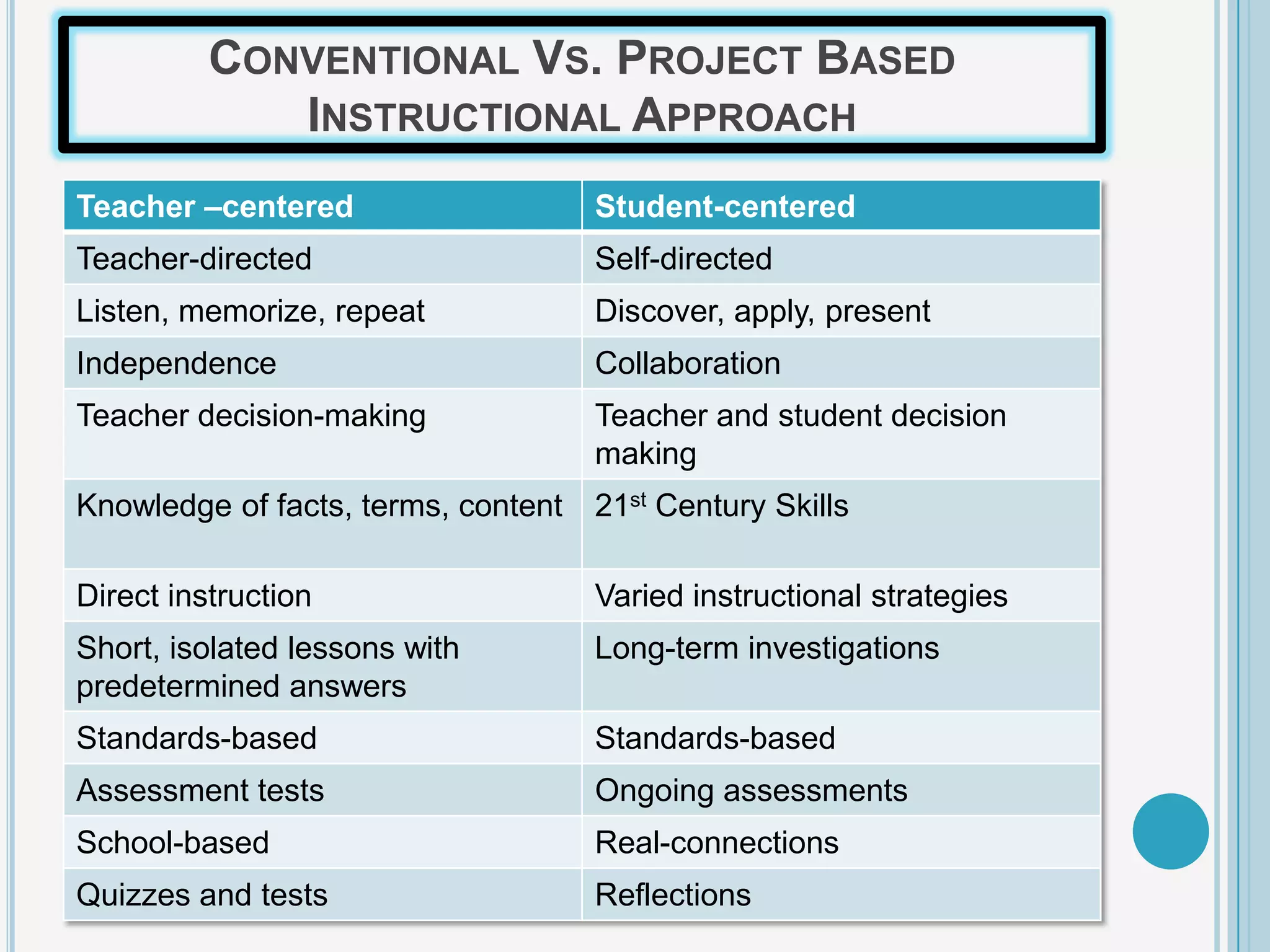
CONVENTIONAL VS. PROJECT BASED
             INSTRUCTIONAL APPROACH
Teacher –centered                    Student-centered
Teacher-directed                     Self-directed
Listen, memorize, repeat             Discover, apply, present
Independence                         Collaboration
Teacher decision-making              Teacher and student decision
                                     making
Knowledge of facts, terms, content   21st Century Skills

Direct instruction                   Varied instructional strategies
Short, isolated lessons with         Long-term investigations
predetermined answers
Standards-based                      Standards-based
Assessment tests                     Ongoing assessments
School-based                         Real-connections
Quizzes and tests                    Reflections
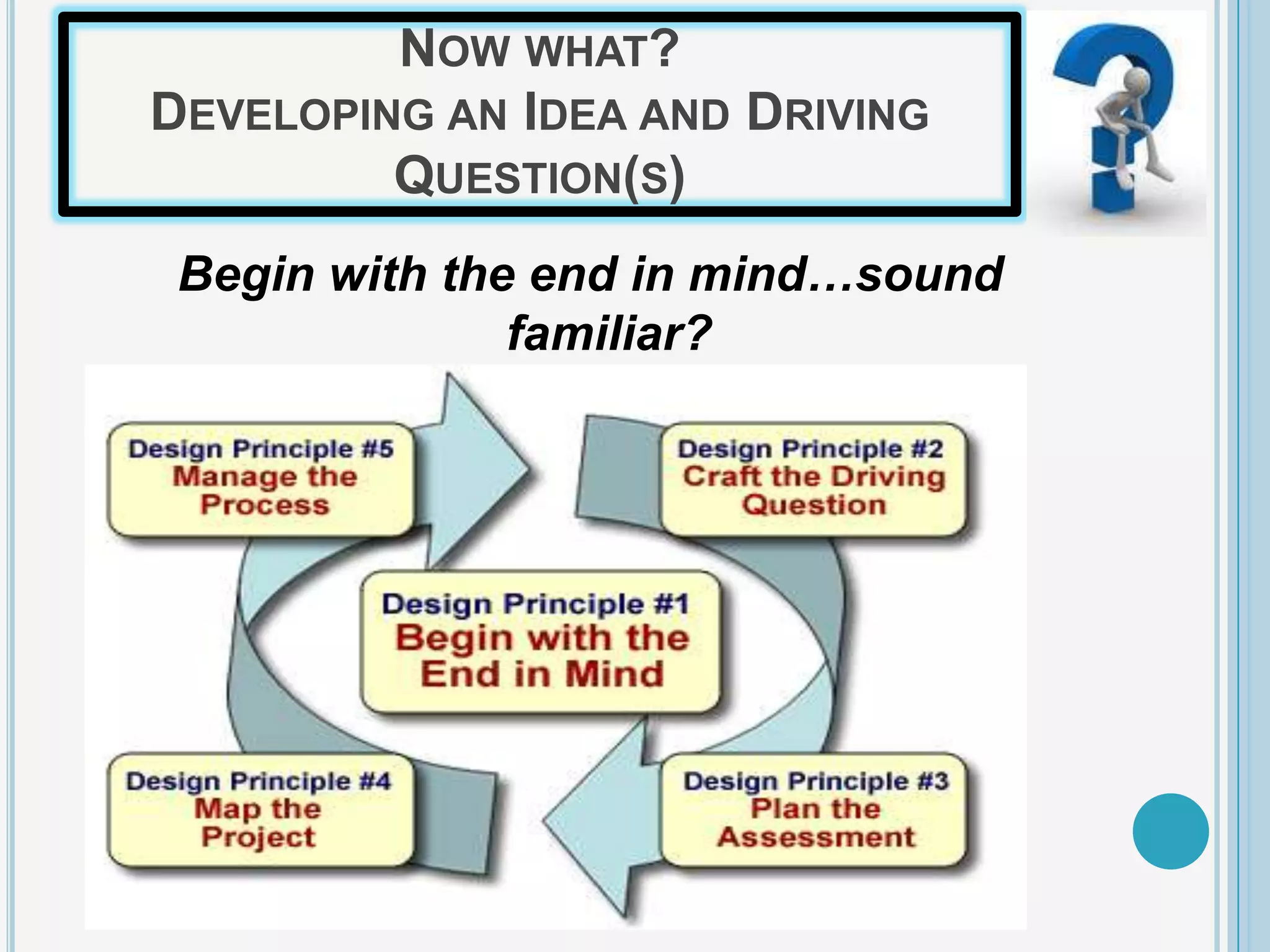
NOW WHAT?
DEVELOPING AN IDEA AND DRIVING
         QUESTION(S)
 Begin with the end in mind…sound
               familiar?
DEVELOPING A PROJECT IDEA:

Developing a Project Idea
   Summary of the issue, challenge, investigation,
    scenario, or problem
   Student-driven
   Project resources
   Planning Forms
   Entry Event
Generate Driving Question (s)              “A project
                                               without a
                                               Driving
Characteristics of a Driving Question
                                               Question is like
   Provocative or challenging to students,    an essay
    because it is relevant, important,         without a thesis.
    urgent or otherwise interesting.           Without one, a
                                               reader might be
   Open-ended and/or complex; there is        able to pick out
    no single “right answer,” or at least no   the main point a
    simple “yes” or “no” answer. It            writer is trying
    requires in-depth inquiry and higher-      to make, but
                                               with a thesis the
    level thinking. Requires action!           main point is
   Linked to the core of what you want        unmistakable.”
    students to learn; to answer it well,      BIE
    students would need to gain the
    knowledge and skills you have
    targeted as goals for the project.
EXAMPLES OF DQS

 Why do people revolt?
 How do humans compete in an ecosystem?
 Will global warming affect our community?
 What does an in-depth study of a pond tell us about
  an ocean?
 How can we educate students so that the amount
  of trash decreases and recycling is increased at our
  school?
 How can individuals make a difference in the
  world?
 Is conquering the impossible possible?
 How are people and plants connected?
 Just because we can, should we?
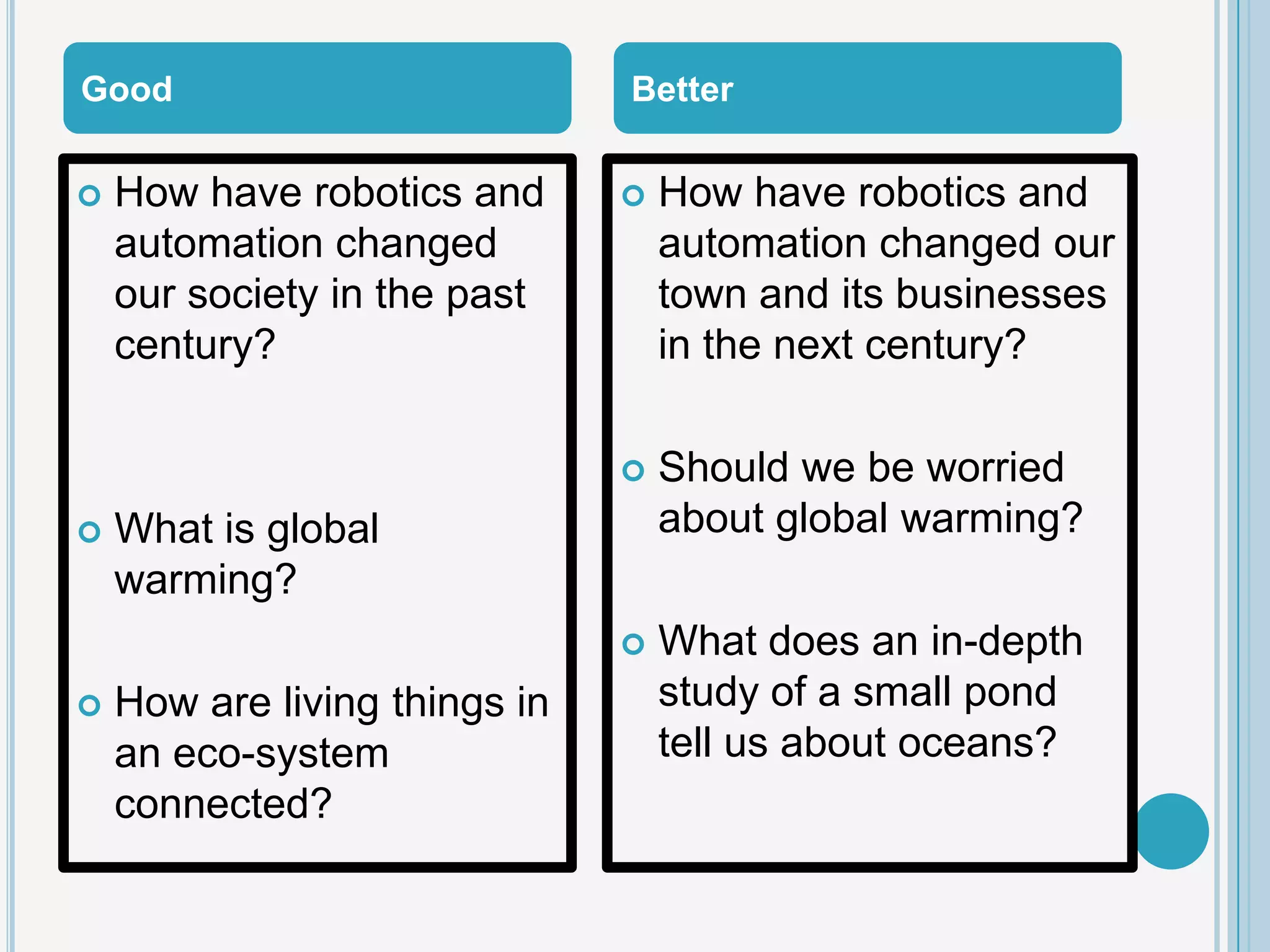
Good                           Better

   How have robotics and         How have robotics and
    automation changed             automation changed our
    our society in the past        town and its businesses
    century?                       in the next century?

                                  Should we be worried
   What is global                 about global warming?
    warming?
                                  What does an in-depth
   How are living things in       study of a small pond
    an eco-system                  tell us about oceans?
    connected?
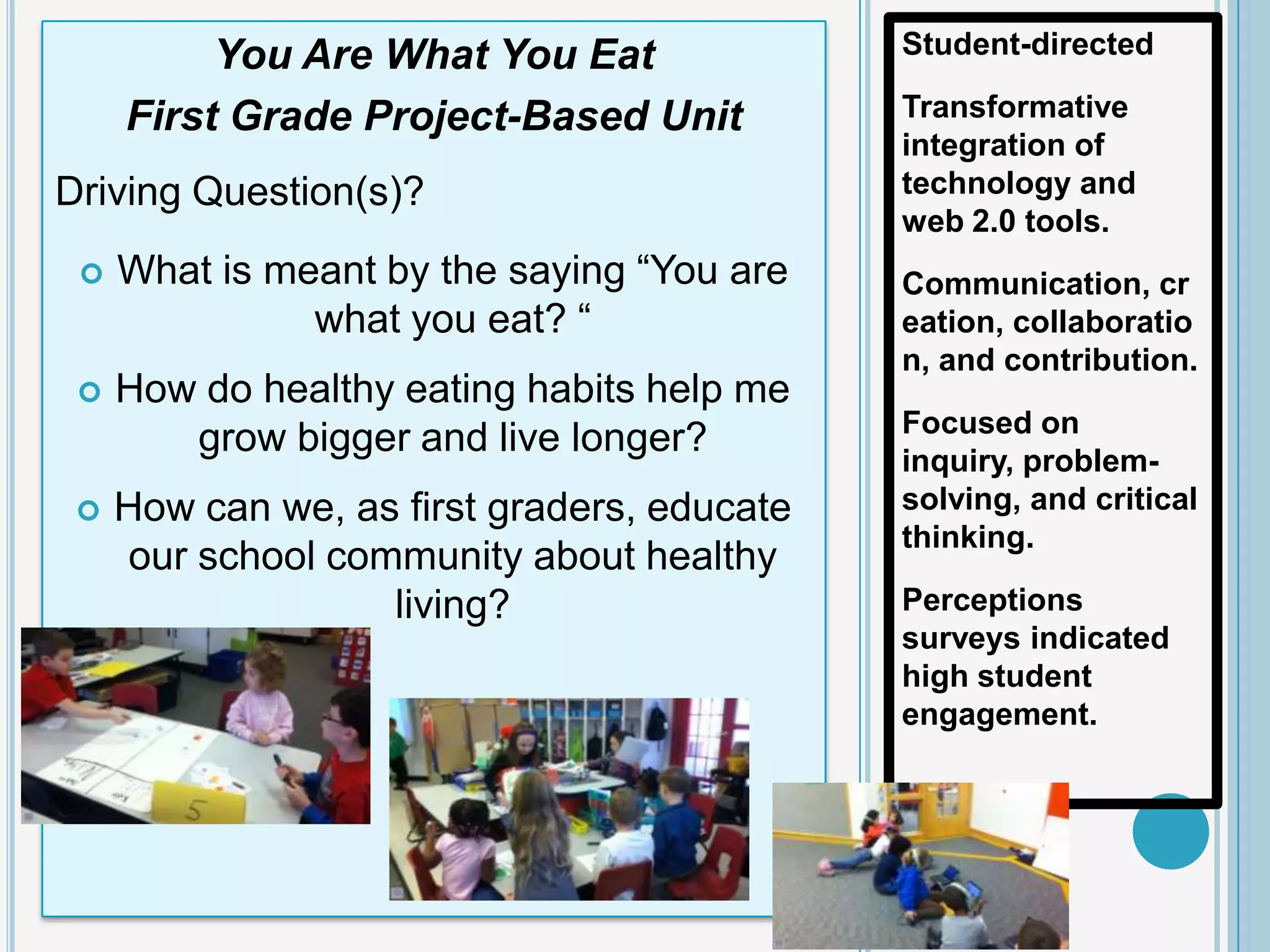
You Are What You Eat               Student-directed

     First Grade Project-Based Unit          Transformative
                                             integration of
Driving Question(s)?                         technology and
                                             web 2.0 tools.
    What is meant by the saying “You are    Communication, cr
               what you eat? “               eation, collaboratio
                                             n, and contribution.
    How do healthy eating habits help me
                                             Focused on
        grow bigger and live longer?
                                             inquiry, problem-
    How can we, as first graders, educate   solving, and critical
                                             thinking.
     our school community about healthy
                   living?                   Perceptions
                                             surveys indicated
                                             high student
                                             engagement.
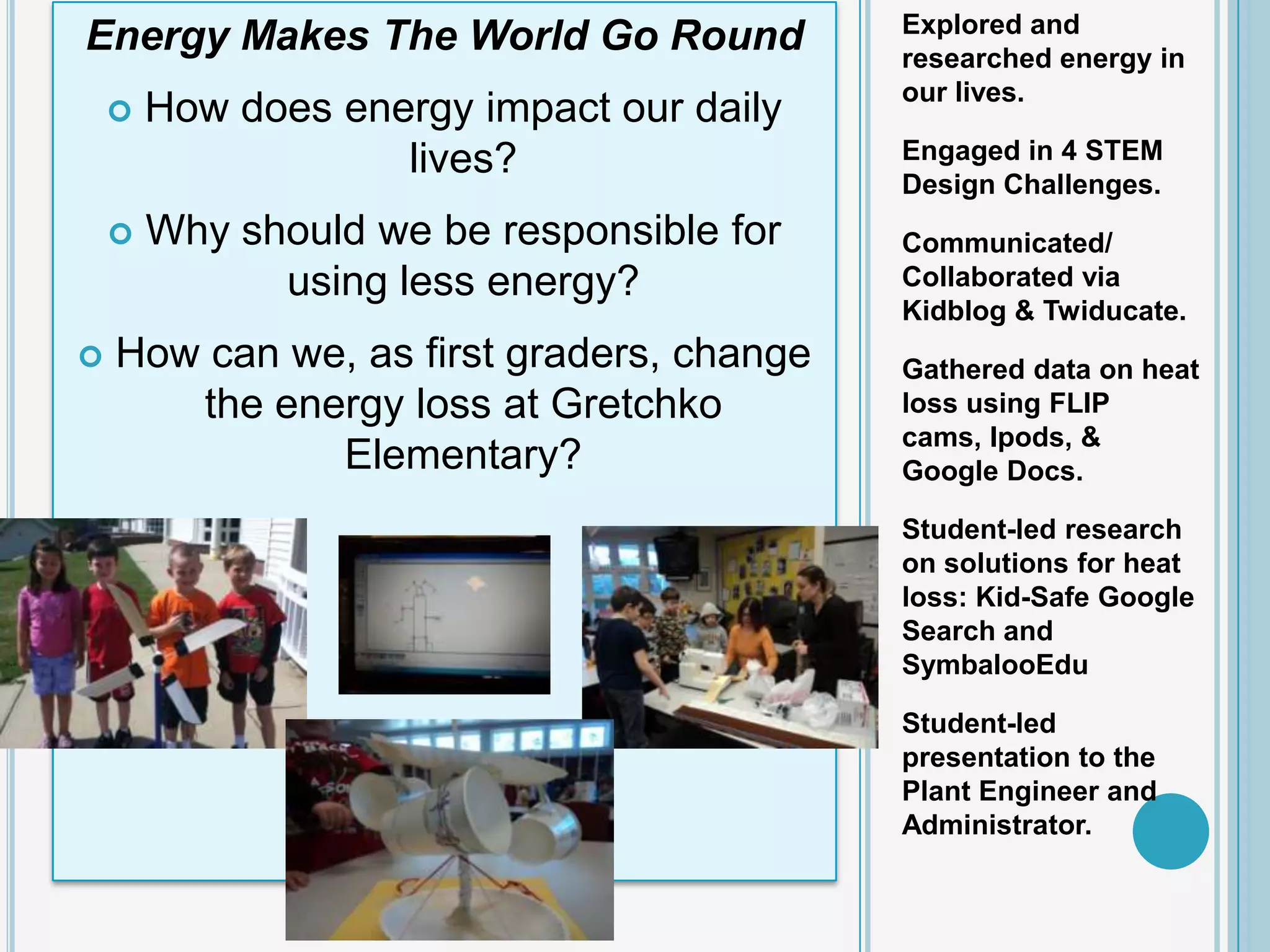
Explored and
Energy Makes The World Go Round            researched energy in
                                           our lives.
       How does energy impact our daily
                    lives?                 Engaged in 4 STEM
                                           Design Challenges.
       Why should we be responsible for   Communicated/
              using less energy?           Collaborated via
                                           Kidblog & Twiducate.
   How can we, as first graders, change   Gathered data on heat
       the energy loss at Gretchko         loss using FLIP
                                           cams, Ipods, &
              Elementary?                  Google Docs.

                                           Student-led research
                                           on solutions for heat
                                           loss: Kid-Safe Google
                                           Search and
                                           SymbalooEdu

                                           Student-led
                                           presentation to the
                                           Plant Engineer and
                                           Administrator.
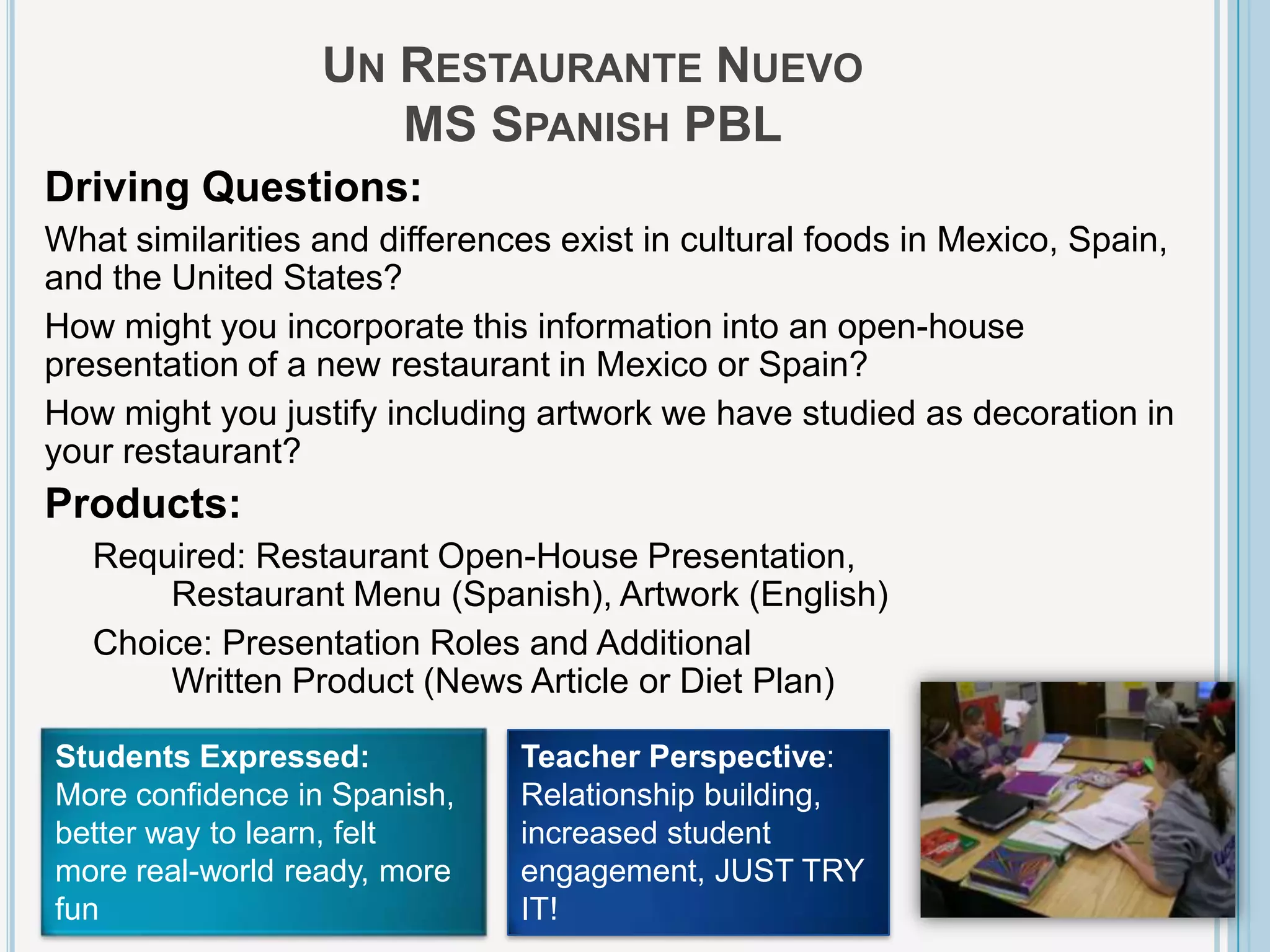
UN RESTAURANTE NUEVO
                     MS SPANISH PBL
Driving Questions:
What similarities and differences exist in cultural foods in Mexico, Spain,
and the United States?
How might you incorporate this information into an open-house
presentation of a new restaurant in Mexico or Spain?
How might you justify including artwork we have studied as decoration in
your restaurant?
Products:
   Required: Restaurant Open-House Presentation,
       Restaurant Menu (Spanish), Artwork (English)
   Choice: Presentation Roles and Additional
       Written Product (News Article or Diet Plan)

Students Expressed:            Teacher Perspective:
More confidence in Spanish,    Relationship building,
better way to learn, felt      increased student
more real-world ready, more    engagement, JUST TRY
fun                            IT!
RESOURCES AND TOOLS
Web Resources
Buck Institute for Education - http://www.bie.org/tools/freebies
Scoop-It - http://www.scoop.it/t/project-based-learning-2
Live Binders - http://www.livebinders.com/edit/index/448454

Suggested Books
Project-Based Learning for Gifted Students : A Handbook for
the 21st-Century Classroom, by Todd Stanley

Bringing Innovation to School and Reinventing Project-Based
Learning– Suzie Boss

Creating Innovators - Tony Wagner

World Class Learners Educating Creative and Entrepreneurial
Students – Yong Zhao
CONTACT INFORMATION
Stephanie Dulmage
Gretchko Elementary
West Bloomfield School District
dulmage@wbsd.org or dulmage@westbloomfield.k12.mi.us
Twitter: stephe1234
http://educationvisionleadership.edublogs.org


Rachel Cook
Brownstown Middle School
Woodhaven-Brownstown School District
cookr@wbsdweb.com

Project Based Learning Presentation

  • 1.
    IMPLEMENTING PROJECT BASED LEARNING RACHEL COOK AND STEPHANIE DULMAGE
  • 2.
    SESSION AGENDA The Whyand What of PBL  7 Whys of PBL  PBL Video The How of PBL  Essential Elements of PBL  Project Vs. Project Based Learning  Project Planning  PBL in Action You Are What You Eat Energy Makes The World Go Round - 1st grade PBL Un Restaurante Nuevo - MS Spanish PBL Getting Started  Resources and Tools Q and A
  • 5.
    WHY PBL? PBL HelpsStudents Develop Skills for Living in a Knowledge-Based, Highly Technological Society Solving highly complex problems requires that students have both fundamental skills and 21st century skills:  personal and social responsibility  planning, critical thinking, reasoning, and creativity  strong communication skills, both for interpersonal and presentation needs  cross-cultural understanding  visualizing and decision making  knowing how and when to use technology and choosing the most appropriate tool for the task http://www.edutopia.org/project-based-learning-guide-importance
  • 6.
    THE WHY CONT’D  PBL and Technology Use Bring a New Relevance to the Learning at Hand  PBL Lends Itself to Authentic Assessment  PBL Promotes Lifelong Learning  PBL Accommodates Students with Varying Learning Styles and Differences  PBL Increases Opportunities For Relationship Building and Personalized Learning  Research Supports PBL
  • 7.
    WHAT IS PROJECTBASED LEARNING (PBL)? HTTP://WWW.YOUTUBE.COM/WATCH?V=LMCZVGESRZ8 What is Project Based Learning?
  • 8.
    “A project is meaningfulif it fulfills two criteria. First, students must perceive it as personally meaningful… Second, a meaningful project fulfills an educational purpose. Well- designed and well- implemented Project Based Learning (PBL) is meaningful in both ways.” - BIE
  • 9.
    PROJECT ORIENTED LEARNINGVS. PROJECT-BASED LEARNING Remember… this is not simply doing a project or culminating activity that demonstrates what students learned from teacher-directed lessons or lectures. Watch and reflect… http://howtovideos.hightechhigh.org/video/265/W hat+Project+Based+Learning+Isn
  • 10.
    CONVENTIONAL VS. PROJECTBASED INSTRUCTIONAL APPROACH Teacher –centered Student-centered Teacher-directed Self-directed Listen, memorize, repeat Discover, apply, present Independence Collaboration Teacher decision-making Teacher and student decision making Knowledge of facts, terms, content 21st Century Skills Direct instruction Varied instructional strategies Short, isolated lessons with Long-term investigations predetermined answers Standards-based Standards-based Assessment tests Ongoing assessments School-based Real-connections Quizzes and tests Reflections
  • 11.
    NOW WHAT? DEVELOPING ANIDEA AND DRIVING QUESTION(S) Begin with the end in mind…sound familiar?
  • 12.
    DEVELOPING A PROJECTIDEA: Developing a Project Idea  Summary of the issue, challenge, investigation, scenario, or problem  Student-driven  Project resources  Planning Forms  Entry Event
  • 13.
    Generate Driving Question(s) “A project without a Driving Characteristics of a Driving Question Question is like  Provocative or challenging to students, an essay because it is relevant, important, without a thesis. urgent or otherwise interesting. Without one, a reader might be  Open-ended and/or complex; there is able to pick out no single “right answer,” or at least no the main point a simple “yes” or “no” answer. It writer is trying requires in-depth inquiry and higher- to make, but with a thesis the level thinking. Requires action! main point is  Linked to the core of what you want unmistakable.” students to learn; to answer it well, BIE students would need to gain the knowledge and skills you have targeted as goals for the project.
  • 14.
    EXAMPLES OF DQS Why do people revolt?  How do humans compete in an ecosystem?  Will global warming affect our community?  What does an in-depth study of a pond tell us about an ocean?  How can we educate students so that the amount of trash decreases and recycling is increased at our school?  How can individuals make a difference in the world?  Is conquering the impossible possible?  How are people and plants connected?  Just because we can, should we?
  • 15.
    Good Better  How have robotics and  How have robotics and automation changed automation changed our our society in the past town and its businesses century? in the next century?  Should we be worried  What is global about global warming? warming?  What does an in-depth  How are living things in study of a small pond an eco-system tell us about oceans? connected?
  • 16.
    You Are WhatYou Eat Student-directed First Grade Project-Based Unit Transformative integration of Driving Question(s)? technology and web 2.0 tools.  What is meant by the saying “You are Communication, cr what you eat? “ eation, collaboratio n, and contribution.  How do healthy eating habits help me Focused on grow bigger and live longer? inquiry, problem-  How can we, as first graders, educate solving, and critical thinking. our school community about healthy living? Perceptions surveys indicated high student engagement.
  • 17.
    Explored and Energy MakesThe World Go Round researched energy in our lives.  How does energy impact our daily lives? Engaged in 4 STEM Design Challenges.  Why should we be responsible for Communicated/ using less energy? Collaborated via Kidblog & Twiducate.  How can we, as first graders, change Gathered data on heat the energy loss at Gretchko loss using FLIP cams, Ipods, & Elementary? Google Docs. Student-led research on solutions for heat loss: Kid-Safe Google Search and SymbalooEdu Student-led presentation to the Plant Engineer and Administrator.
  • 18.
    UN RESTAURANTE NUEVO MS SPANISH PBL Driving Questions: What similarities and differences exist in cultural foods in Mexico, Spain, and the United States? How might you incorporate this information into an open-house presentation of a new restaurant in Mexico or Spain? How might you justify including artwork we have studied as decoration in your restaurant? Products: Required: Restaurant Open-House Presentation, Restaurant Menu (Spanish), Artwork (English) Choice: Presentation Roles and Additional Written Product (News Article or Diet Plan) Students Expressed: Teacher Perspective: More confidence in Spanish, Relationship building, better way to learn, felt increased student more real-world ready, more engagement, JUST TRY fun IT!
  • 19.
    RESOURCES AND TOOLS WebResources Buck Institute for Education - http://www.bie.org/tools/freebies Scoop-It - http://www.scoop.it/t/project-based-learning-2 Live Binders - http://www.livebinders.com/edit/index/448454 Suggested Books Project-Based Learning for Gifted Students : A Handbook for the 21st-Century Classroom, by Todd Stanley Bringing Innovation to School and Reinventing Project-Based Learning– Suzie Boss Creating Innovators - Tony Wagner World Class Learners Educating Creative and Entrepreneurial Students – Yong Zhao
  • 20.
    CONTACT INFORMATION Stephanie Dulmage GretchkoElementary West Bloomfield School District dulmage@wbsd.org or dulmage@westbloomfield.k12.mi.us Twitter: stephe1234 http://educationvisionleadership.edublogs.org Rachel Cook Brownstown Middle School Woodhaven-Brownstown School District cookr@wbsdweb.com

Editor's Notes

  • #4 Press F5 or enter presentation mode to view the poll\r\nIn an emergency during your presentation, if the poll isn't showing, navigate to this link in your web browser:\r\nhttp://www.polleverywhere.com/multiple_choice_polls/MTI1NDc4NjMzOAIf you like, you can use this slide as a template for your own voting slides. You might use a slide like this if you feel your audience would benefit from the picture showing a text message on a phone.
  • #5 Press F5 or enter presentation mode to view the poll\r\nIn an emergency during your presentation, if the poll isn't showing, navigate to this link in your web browser:\r\nhttp://www.polleverywhere.com/multiple_choice_polls/NTE0MTkzMTc5If you like, you can use this slide as a template for your own voting slides. You might use a slide like this if you feel your audience would benefit from the picture showing a text message on a phone.