Project-Based Learning in the Digital Age Jane Krauss and Suzie Boss June 1-3, 2011   Gwinnett County Public Schools
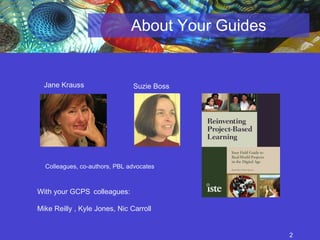
About Your Guides Colleagues, co-authors, PBL advocates Jane Krauss Suzie Boss With your GCPS   colleagues:  Mike Reilly , Kyle Jones, Nic Carroll
Where We’re Going Wednesday  Getting Acquainted Intro to PBL PBL in Practice From Ideas to Design Draft a Project Sketch  Thursday Peer Feedback Entry Event/Driving Question Evidence of Learning/Assessment Implementation Strategies Tools to Support Projects Tuning Protocol Demo
Day 3 and Beyond Friday Morning: Work time to complete your  project plan Afternoon Project Plan Showcase Beyond these days: Seek partnerships, plan to involve experts Conference calls for ongoing support PBL Showcase, Spring 2012
Tools in Context Google Sites (wiki)  blogs Google apps Skype  Wordle Wallwisher Embeddable media Flickr  Delicious, Diigo social bookmarking Ning Network Classroom 2.0 PollEverywhere
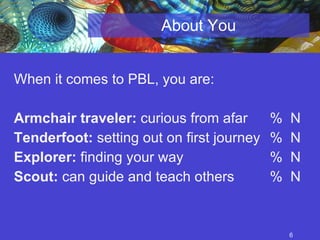
About You When it comes to PBL, you are: Armchair traveler:  curious from afar %  N Tenderfoot:  setting out on first journey %  N Explorer:  finding your way  %  N Scout:  can guide and teach others %  N
About You Don’t forget: You can copy-paste this slide into other presentations, and move or resize the poll.
About You (3 x 5) Side 1:   Picture yourself as the high school student you once were. How would your teachers have described you back then?  (a phrase or two) Side 2: What is your “super power”? (What are you really, really good at?) Please give cards to us—no need for names .
About You Projects are life.  Life is a series of projects.
About You Think:  Project Capabilities you drew on, developed along the way
discussion
Let’s Hear from Kids “ It Really, Actually Changed My Life”
PBL: In Your Words Finish this sentence: In my classroom, PBL means… Think, write notes to yourself for 2 min. (you will be sharing soon)
Let’s Define PBL… In project-based learning,  students learn important subject matter  by investigating open-ended questions  and “making meaning”  that they transmit in purposeful ways.  Projects allow students a degree of choice, setting  the stage for active engagement and teamwork. Technology helps it happen
PBL: In GCPS Classrooms Let’s hear from Kyle, Nic, and Mike … Each will share a project brief … and describe his PBL journey
Conditions that Support PBL What supports do you have in place? What barriers do you want to remove?
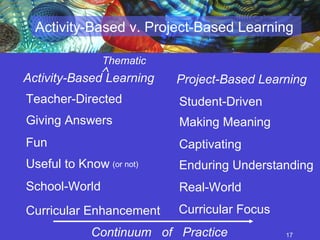
Activity-Based Learning Project-Based Learning Teacher-Directed Student-Driven Giving Answers Making Meaning Useful to Know Enduring Understanding School-World Real-World Curricular Enhancement Curricular Focus Activity-Based v. Project-Based Learning Continuum  of  Practice Fun Captivating (or not) Thematic 
Effective Projects Probe matters of importance Mirror authentic work Are designed for “optimal ambiguity” allowing students multiple points of entry and directions for learning, creativity and outcomes Develop knowledge, skills and dispositions Go beyond understanding and studying to some kind of action or resolve  Are right-sized Cause kids to teach and learn from one another
What Research Tells Us PBL offers benefits for: Student engagement Academic achievement 21 st -century skills Equity Find research summary on our Google site.
Where Projects Lead Science Leadership Academy core values of  Inquiry ,  Research ,  Collaboration ,  Presentation , and  Reflection  are embedded in PBL + outside school experiences to gradually build student competencies. Grade 9: mentoring @ Franklin Museum Grade 10: Individualized Learning Grade 11: Individualized Learning Grade 12:  Senior Capstone
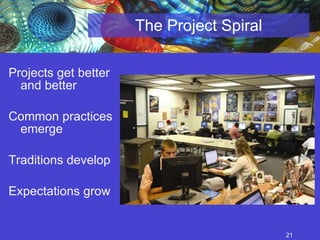
The Project Spiral Projects get better and better  Common practices emerge Traditions develop Expectations grow
Why do we study the Renaissance?  Reinventing a Research Project:  Key Figures of the  Renaissance
Discussion
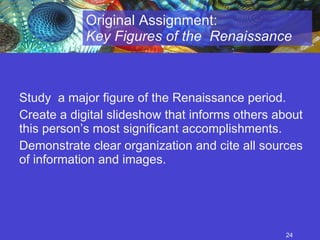
Study  a major figure of the Renaissance period.  Create a digital slideshow that informs others about this person’s most significant accomplishments.  Demonstrate clear organization and cite all sources of information and images. Original Assignment:  Key Figures of the  Renaissance
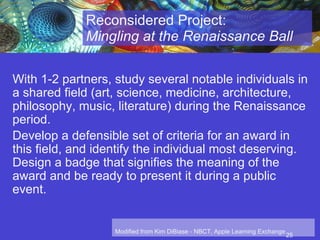
Reconsidered Project:  Mingling at the Renaissance Ball With 1-2 partners, study several notable individuals in a shared field (art, science, medicine, architecture, philosophy, music, literature) during the Renaissance period. Develop a defensible set of criteria for an award in this field, and identify the individual most deserving. Design a badge that signifies the meaning of the award and be ready to present it during a public event.   Modified from Kim DiBiase - NBCT, Apple Learning Exchange
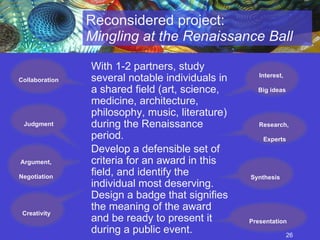
Reconsidered project:  Mingling at the Renaissance Ball With 1-2 partners, study several notable individuals in a shared field (art, science, medicine, architecture, philosophy, music, literature) during the Renaissance period.  Develop a defensible set of criteria for an award in this field, and identify the individual most deserving. Design a badge that signifies the meaning of the award and be ready to present it during a public event.   Collaboration Interest,  Big ideas Research,  Experts Creativity  Argument, Negotiation Synthesis Presentation Judgment
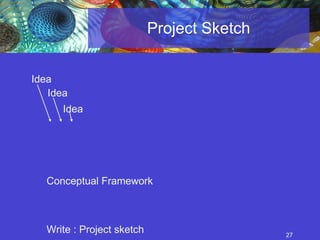
Project Sketch Conceptual Framework Write : Project sketch Include elements that help reader understand subject matter, student interaction, learning outcomes Idea Idea Idea
Project Sketches Pick 2-3 to analyze, improve  --adjust for grade level, rigor, content, scale (too broad/too narrow?) --ensure student voice and choice --expand real-world connections, authenticity, interdisciplinary features
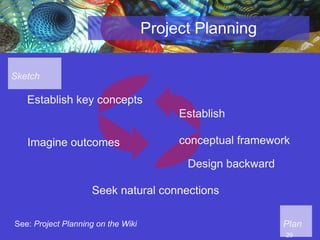
Project Planning Establish key concepts Establish  conceptual framework  Seek natural connections Design backward Imagine outcomes   See:  Project Planning on the Wiki Sketch Plan
Project Planning Today Establish a conceptual framework. Test several project ideas against it before selecting. (attachment) Write  a project sketch on which you will seek input. Include elements that help reader  understand subject matter  student interaction  learning outcomes. Complete in your personal wiki page. Tomorrow 3.  Get input from others early.  4.  Complete a project plan using the Project Plan Form Refer to 5 A’s rubric for project design as you go.
Need Ideas? Scan Projects Buck Institute—Project Libraries http://www.bie.org/tools/links/pbl_in_practice Individual projects: “ Give Me Shelter” project www.edutopia.org/maine-project-	learning-expedition-homeless-video “ D-1” project http://plpnetwork.com/pbl.html
For Tomorrow Have sketch ready to share
Thinking Routines “ Thinking routines are short, easy-to-learn mini-strategies that extend and deepen students’ thinking and become part of the fabric of everyday classroom life.” -- Artful Classroom  website http://pzweb.harvard.edu/tc/overview.cfm
Turn to a Partner Talk briefly about thinking routines.  List any that come to mind.
What just happened? Anyone mention… Think – Pair – Share? Brainstorming?
Routines for Power Teams Stock your PBL toolkit with:  Think-Pair-Share Two Questions The Perfect Brainstorm Know-Wonder-Learn Focus Group Headline (+ What else?)
Two Questions Ask:  What’s going on here? Ask:  What do you see that makes you say so? When to use: during investigations Benefit: better reasoning skills Credit: David Perkins and  Artful Learning
The Perfect Brainstorm Defer judgment  Encourage wild ideas (more=better) Stay focused on the topic  Build on the ideas of others When to use: throughout project cycle Benefit: more innovative thinking Credit: Tim Brown,  Change by Design
Know-Wonder-Learn What do we  K now? What do we  W ant to know? What did we  L earn? When to use: refining driving question, developing need-to-know list to guide research Benefit: activate and build on prior knowledge
Focus  Group Each person represents a particular perspective  (assign each one a “character”). Everyone weighs in on a specific question. There are no right answers. Everyone’s opinions and ideas matter equally. When to use: when identifying problems, during research, for soliciting feedback Benefits: build empathy for other points of view, collaborate for more innovative solutions
Headline This just in… Soggy Oregon Visitors Discover Sun in Georgia
Why Use Headlines? Captures the essence of your thinking, suggests future implications When to use: at project launch, when preparing for presentations, as reflection Benefits: summarize key ideas, create talking points, solicit feedback
Your Turn Write a headline to… … sum up Day 1  OR … capture your reflections about PBL as of right now [END OF DAY 1]
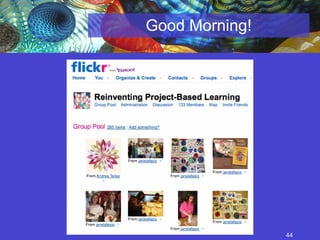
Good Morning!
Good Morning! Thursday Peer Feedback Entry Event/Driving Question Evidence of Learning, Assessment Implementation Strategies Team Strategies Facilitate, Guide, Coach Tools to Support Projects Tuning Protocol Demonstration
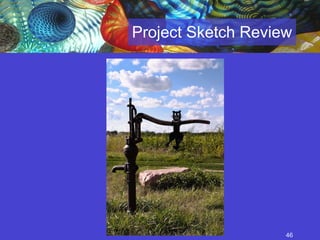
Project Sketch Review
From  Sketch  to  Plan Essential, driving question Entry event Kids craft subordinate questions they can investigate (anticipate)
Entry Events: Making it GO How have you launched projects?  What happened? Results?
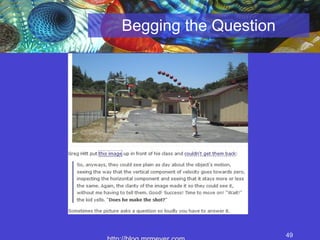
Begging the Question http://blog.mrmeyer.com
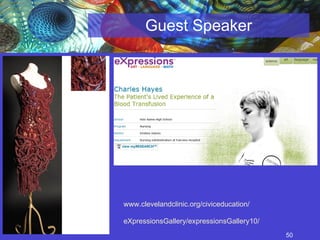
Guest Speaker www.clevelandclinic.org/civiceducation/ eXpressionsGallery/expressionsGallery10/
Another Day@Manor NT http://www.youtube.com/user/ManorNewTechHigh
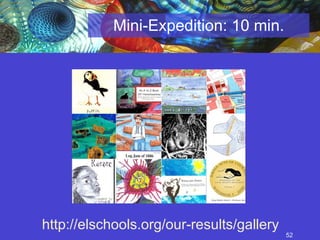
Mini-Expedition: 10 min. http://elschools.org/our-results/gallery
Assessment How do you assess learning?
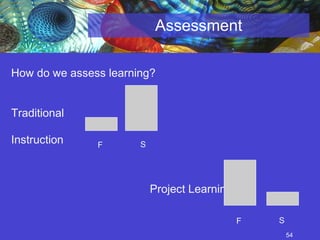
Assessment How do we assess learning?  Traditional Instruction F S Project Learning F S
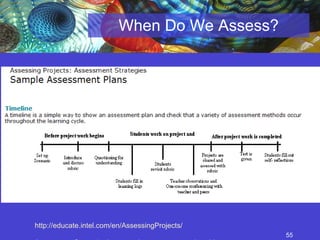
When Do We Assess? http://educate.intel.com/en/AssessingProjects/ AssessmentStrategies/ap_sample_assessment_plans1.htm  
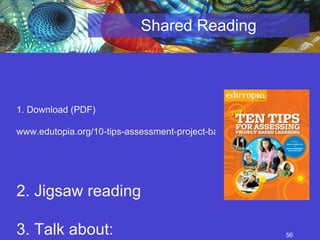
Shared Reading 1. Download (PDF) www.edutopia.org/10-tips-assessment-project-based-learning-resource-guide   2. Jigsaw reading  3. Talk about: Which idea(s) will you try?
discussion
Team Strategies Discuss: What’s a real-world example of something that wouldn’t have been possible without a team effort?
Team Activity As a group, use cards to create teams of four students. Talk about: Why are you making these choices? What are your expectations about effective teamwork?
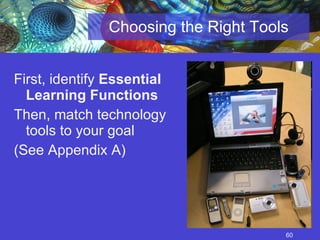
Choosing the Right Tools First, identify  Essential   Learning Functions Then, match technology tools to your goal (See Appendix A)
Critical Friends Present your project brief at your table. Table mates listen without responding or questioning.    (3 minutes) 2. Participants ask clarifying questions.    (2 minutes) 3. Participants offer warm feedback. “I Like …”    (2 minutes) 4. Participants offer cool (not cruel) feedback. “I Wonder if …”    (2 minutes) 5. Together, discuss ideas for improvement. “A Good Next Step Might Be …”  (2 minutes) Choose a time keeper/moderator
Facilitate, Guide, Coach “ For the teacher, there's this giant Letting Go. Now, that requires some effort. I can see it in my mind—it's me walking away, not allowing myself to hover. It's me communicating, ‘I'm at your service,’ and, ‘May the force be with you.' It's me utterly and totally handing over the reins. The project is  theirs .”
Day 3 Reminders Use Critical Friends Protocol Be Ready for Project Plan Showcase Elevator pitch Visual representation
[end of day 2]
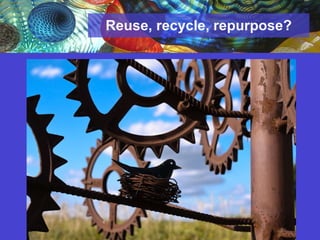
Reuse, recycle, repurpose?
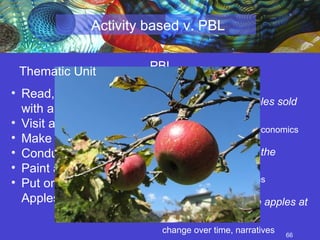
Read, write, do math with apples Visit an orchard Make apple sauce Conduct a taste test Paint and draw apples Put on a Johnny Appleseed play PBL Why these apples?   Activity based v. PBL “ Why are these the apples sold in our store?” geography, agriculture, economics  “ How did they get from the tree to here?” labor, distribution systems “ Did grandma eat these apples at my age?” change over time, narratives Thematic Unit
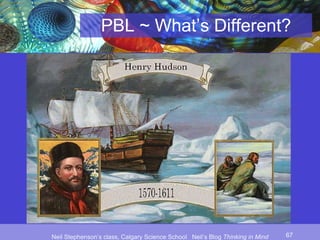
PBL ~ What’s Different? Neil Stephenson’s class, Calgary Science School   Neil’s Blog  Thinking in Mind
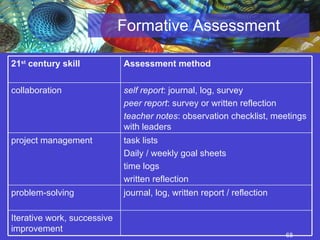
Formative Assessment 21 st  century skill Assessment method  collaboration self report : journal, log, survey peer report : survey or written reflection teacher notes : observation checklist, meetings with leaders project management task lists Daily / weekly goal sheets time logs written reflection problem-solving journal, log, written report / reflection Iterative work, successive improvement
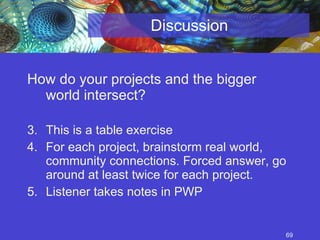
Discussion How do your projects and the bigger world intersect?   This is a table exercise For each project, brainstorm real world, community connections. Forced answer, go around at least twice for each project.  Listener takes notes in PWP

Pbl gwinnett5 30-11

  • 1.
    Project-Based Learning inthe Digital Age Jane Krauss and Suzie Boss June 1-3, 2011 Gwinnett County Public Schools
  • 2.
    About Your GuidesColleagues, co-authors, PBL advocates Jane Krauss Suzie Boss With your GCPS colleagues: Mike Reilly , Kyle Jones, Nic Carroll
  • 3.
    Where We’re GoingWednesday Getting Acquainted Intro to PBL PBL in Practice From Ideas to Design Draft a Project Sketch Thursday Peer Feedback Entry Event/Driving Question Evidence of Learning/Assessment Implementation Strategies Tools to Support Projects Tuning Protocol Demo
  • 4.
    Day 3 andBeyond Friday Morning: Work time to complete your project plan Afternoon Project Plan Showcase Beyond these days: Seek partnerships, plan to involve experts Conference calls for ongoing support PBL Showcase, Spring 2012
  • 5.
    Tools in ContextGoogle Sites (wiki) blogs Google apps Skype Wordle Wallwisher Embeddable media Flickr Delicious, Diigo social bookmarking Ning Network Classroom 2.0 PollEverywhere
  • 6.
    About You Whenit comes to PBL, you are: Armchair traveler: curious from afar % N Tenderfoot: setting out on first journey % N Explorer: finding your way % N Scout: can guide and teach others % N
  • 7.
    About You Don’tforget: You can copy-paste this slide into other presentations, and move or resize the poll.
  • 8.
    About You (3x 5) Side 1: Picture yourself as the high school student you once were. How would your teachers have described you back then? (a phrase or two) Side 2: What is your “super power”? (What are you really, really good at?) Please give cards to us—no need for names .
  • 9.
    About You Projectsare life. Life is a series of projects.
  • 10.
    About You Think: Project Capabilities you drew on, developed along the way
  • 11.
  • 12.
    Let’s Hear fromKids “ It Really, Actually Changed My Life”
  • 13.
    PBL: In YourWords Finish this sentence: In my classroom, PBL means… Think, write notes to yourself for 2 min. (you will be sharing soon)
  • 14.
    Let’s Define PBL…In project-based learning, students learn important subject matter by investigating open-ended questions and “making meaning” that they transmit in purposeful ways. Projects allow students a degree of choice, setting the stage for active engagement and teamwork. Technology helps it happen
  • 15.
    PBL: In GCPSClassrooms Let’s hear from Kyle, Nic, and Mike … Each will share a project brief … and describe his PBL journey
  • 16.
    Conditions that SupportPBL What supports do you have in place? What barriers do you want to remove?
  • 17.
    Activity-Based Learning Project-BasedLearning Teacher-Directed Student-Driven Giving Answers Making Meaning Useful to Know Enduring Understanding School-World Real-World Curricular Enhancement Curricular Focus Activity-Based v. Project-Based Learning Continuum of Practice Fun Captivating (or not) Thematic 
  • 18.
    Effective Projects Probematters of importance Mirror authentic work Are designed for “optimal ambiguity” allowing students multiple points of entry and directions for learning, creativity and outcomes Develop knowledge, skills and dispositions Go beyond understanding and studying to some kind of action or resolve Are right-sized Cause kids to teach and learn from one another
  • 19.
    What Research TellsUs PBL offers benefits for: Student engagement Academic achievement 21 st -century skills Equity Find research summary on our Google site.
  • 20.
    Where Projects LeadScience Leadership Academy core values of Inquiry , Research , Collaboration , Presentation , and Reflection are embedded in PBL + outside school experiences to gradually build student competencies. Grade 9: mentoring @ Franklin Museum Grade 10: Individualized Learning Grade 11: Individualized Learning Grade 12: Senior Capstone
  • 21.
    The Project SpiralProjects get better and better Common practices emerge Traditions develop Expectations grow
  • 22.
    Why do westudy the Renaissance? Reinventing a Research Project: Key Figures of the Renaissance
  • 23.
  • 24.
    Study amajor figure of the Renaissance period. Create a digital slideshow that informs others about this person’s most significant accomplishments. Demonstrate clear organization and cite all sources of information and images. Original Assignment: Key Figures of the Renaissance
  • 25.
    Reconsidered Project: Mingling at the Renaissance Ball With 1-2 partners, study several notable individuals in a shared field (art, science, medicine, architecture, philosophy, music, literature) during the Renaissance period. Develop a defensible set of criteria for an award in this field, and identify the individual most deserving. Design a badge that signifies the meaning of the award and be ready to present it during a public event. Modified from Kim DiBiase - NBCT, Apple Learning Exchange
  • 26.
    Reconsidered project: Mingling at the Renaissance Ball With 1-2 partners, study several notable individuals in a shared field (art, science, medicine, architecture, philosophy, music, literature) during the Renaissance period. Develop a defensible set of criteria for an award in this field, and identify the individual most deserving. Design a badge that signifies the meaning of the award and be ready to present it during a public event. Collaboration Interest, Big ideas Research, Experts Creativity Argument, Negotiation Synthesis Presentation Judgment
  • 27.
    Project Sketch ConceptualFramework Write : Project sketch Include elements that help reader understand subject matter, student interaction, learning outcomes Idea Idea Idea
  • 28.
    Project Sketches Pick2-3 to analyze, improve --adjust for grade level, rigor, content, scale (too broad/too narrow?) --ensure student voice and choice --expand real-world connections, authenticity, interdisciplinary features
  • 29.
    Project Planning Establishkey concepts Establish conceptual framework Seek natural connections Design backward Imagine outcomes See: Project Planning on the Wiki Sketch Plan
  • 30.
    Project Planning TodayEstablish a conceptual framework. Test several project ideas against it before selecting. (attachment) Write a project sketch on which you will seek input. Include elements that help reader understand subject matter student interaction learning outcomes. Complete in your personal wiki page. Tomorrow 3. Get input from others early. 4. Complete a project plan using the Project Plan Form Refer to 5 A’s rubric for project design as you go.
  • 31.
    Need Ideas? ScanProjects Buck Institute—Project Libraries http://www.bie.org/tools/links/pbl_in_practice Individual projects: “ Give Me Shelter” project www.edutopia.org/maine-project- learning-expedition-homeless-video “ D-1” project http://plpnetwork.com/pbl.html
  • 32.
    For Tomorrow Havesketch ready to share
  • 33.
    Thinking Routines “Thinking routines are short, easy-to-learn mini-strategies that extend and deepen students’ thinking and become part of the fabric of everyday classroom life.” -- Artful Classroom website http://pzweb.harvard.edu/tc/overview.cfm
  • 34.
    Turn to aPartner Talk briefly about thinking routines. List any that come to mind.
  • 35.
    What just happened?Anyone mention… Think – Pair – Share? Brainstorming?
  • 36.
    Routines for PowerTeams Stock your PBL toolkit with: Think-Pair-Share Two Questions The Perfect Brainstorm Know-Wonder-Learn Focus Group Headline (+ What else?)
  • 37.
    Two Questions Ask: What’s going on here? Ask: What do you see that makes you say so? When to use: during investigations Benefit: better reasoning skills Credit: David Perkins and Artful Learning
  • 38.
    The Perfect BrainstormDefer judgment Encourage wild ideas (more=better) Stay focused on the topic Build on the ideas of others When to use: throughout project cycle Benefit: more innovative thinking Credit: Tim Brown, Change by Design
  • 39.
    Know-Wonder-Learn What dowe K now? What do we W ant to know? What did we L earn? When to use: refining driving question, developing need-to-know list to guide research Benefit: activate and build on prior knowledge
  • 40.
    Focus GroupEach person represents a particular perspective (assign each one a “character”). Everyone weighs in on a specific question. There are no right answers. Everyone’s opinions and ideas matter equally. When to use: when identifying problems, during research, for soliciting feedback Benefits: build empathy for other points of view, collaborate for more innovative solutions
  • 41.
    Headline This justin… Soggy Oregon Visitors Discover Sun in Georgia
  • 42.
    Why Use Headlines?Captures the essence of your thinking, suggests future implications When to use: at project launch, when preparing for presentations, as reflection Benefits: summarize key ideas, create talking points, solicit feedback
  • 43.
    Your Turn Writea headline to… … sum up Day 1 OR … capture your reflections about PBL as of right now [END OF DAY 1]
  • 44.
  • 45.
    Good Morning! ThursdayPeer Feedback Entry Event/Driving Question Evidence of Learning, Assessment Implementation Strategies Team Strategies Facilitate, Guide, Coach Tools to Support Projects Tuning Protocol Demonstration
  • 46.
  • 47.
    From Sketch to Plan Essential, driving question Entry event Kids craft subordinate questions they can investigate (anticipate)
  • 48.
    Entry Events: Makingit GO How have you launched projects? What happened? Results?
  • 49.
    Begging the Questionhttp://blog.mrmeyer.com
  • 50.
    Guest Speaker www.clevelandclinic.org/civiceducation/eXpressionsGallery/expressionsGallery10/
  • 51.
    Another Day@Manor NThttp://www.youtube.com/user/ManorNewTechHigh
  • 52.
    Mini-Expedition: 10 min.http://elschools.org/our-results/gallery
  • 53.
    Assessment How doyou assess learning?
  • 54.
    Assessment How dowe assess learning? Traditional Instruction F S Project Learning F S
  • 55.
    When Do WeAssess? http://educate.intel.com/en/AssessingProjects/ AssessmentStrategies/ap_sample_assessment_plans1.htm  
  • 56.
    Shared Reading 1.Download (PDF) www.edutopia.org/10-tips-assessment-project-based-learning-resource-guide 2. Jigsaw reading 3. Talk about: Which idea(s) will you try?
  • 57.
  • 58.
    Team Strategies Discuss:What’s a real-world example of something that wouldn’t have been possible without a team effort?
  • 59.
    Team Activity Asa group, use cards to create teams of four students. Talk about: Why are you making these choices? What are your expectations about effective teamwork?
  • 60.
    Choosing the RightTools First, identify Essential Learning Functions Then, match technology tools to your goal (See Appendix A)
  • 61.
    Critical Friends Presentyour project brief at your table. Table mates listen without responding or questioning. (3 minutes) 2. Participants ask clarifying questions. (2 minutes) 3. Participants offer warm feedback. “I Like …” (2 minutes) 4. Participants offer cool (not cruel) feedback. “I Wonder if …” (2 minutes) 5. Together, discuss ideas for improvement. “A Good Next Step Might Be …” (2 minutes) Choose a time keeper/moderator
  • 62.
    Facilitate, Guide, Coach“ For the teacher, there's this giant Letting Go. Now, that requires some effort. I can see it in my mind—it's me walking away, not allowing myself to hover. It's me communicating, ‘I'm at your service,’ and, ‘May the force be with you.' It's me utterly and totally handing over the reins. The project is theirs .”
  • 63.
    Day 3 RemindersUse Critical Friends Protocol Be Ready for Project Plan Showcase Elevator pitch Visual representation
  • 64.
  • 65.
  • 66.
    Read, write, domath with apples Visit an orchard Make apple sauce Conduct a taste test Paint and draw apples Put on a Johnny Appleseed play PBL Why these apples? Activity based v. PBL “ Why are these the apples sold in our store?” geography, agriculture, economics “ How did they get from the tree to here?” labor, distribution systems “ Did grandma eat these apples at my age?” change over time, narratives Thematic Unit
  • 67.
    PBL ~ What’sDifferent? Neil Stephenson’s class, Calgary Science School Neil’s Blog Thinking in Mind
  • 68.
    Formative Assessment 21st century skill Assessment method collaboration self report : journal, log, survey peer report : survey or written reflection teacher notes : observation checklist, meetings with leaders project management task lists Daily / weekly goal sheets time logs written reflection problem-solving journal, log, written report / reflection Iterative work, successive improvement
  • 69.
    Discussion How doyour projects and the bigger world intersect? This is a table exercise For each project, brainstorm real world, community connections. Forced answer, go around at least twice for each project. Listener takes notes in PWP

Editor's Notes

  • #3 How about you? HS? MS? ELEM? Instr leader, …Distance traveled?
  • #4 Ongoing support/ building toward a showcase / tbd
  • #6 Suzie: Using wikis right away, who’s familiar?
  • #7 Suzie: Tell results of Survey (make em guess first, these fly in 1 by 1)
  • #8 Press F5 or use the tool bar to enter presentation mode in order to see the poll. http://www.polleverywhere.com/multiple_choice_polls/MTIwNTEzNzY2OQ If you like, you can use this slide as a template for your own voting slides. You might use a slide like this if you feel your audience would benefit from the picture showing a text message on a phone. In an emergency during your presentation, if the poll isn't showing, navigate to this link in your web browser:
  • #9 Suzie -
  • #10 Jane
  • #12 Discussion then Suzie
  • #13 PBL entry video/BIE “It Really, Actually Changed My Life” (reveal a truth about race)
  • #15 Jane: how close are we? Key words? Other elements you’ve included?
  • #18 Jane: Prompt? Do you make distinction between activity-based and project-based? If so, what? When you look at continuum, is your practice more to left, to right, or somewhere in middle?
  • #19 Jane At end ask: How do teacher and students’ roles change?
  • #21 For you to think about…what does this mean for GCPS?
  • #22 Suzie: English teachers Anne Smith and Maura Moritz asked ninth graders to make their best case for why the school board should approve or ban certain controversial titles such as I, Robot , Anthem , and 1984 . Enterprising ninth graders tracked down the author via email and invited him to chat in real time. It's the kind of thing that happens naturally, Karl Fisch says, "when students expect to be connected learners." Tech tools: Skype, email, Ustream, blog, Twitter for promotion +backchannel (all free tools) Tie back to Christian and George and how their projects have spiraled. Rethink the poll: Imagine where you are from progression from armchair traveler to scout. If you’re at armchair, we hope we’ve helped you move toward Tenderfoot. We’ll have some suggestions to help you move, from wherever you find yourself.
  • #23 Jane: Why do we study the Renaissance? Think what people might imagine as a project. Might have some characteristics (in left column) of thematic instruction. Might well use technology. What would traditional tech-rich project look like?
  • #24 Discussion
  • #25 Jane: Tech probably used for research and presentation. We say: This is not an uncommon “project”. Would it get at the reasons why we want kids to know about the Renaissance? Further: Where is the emphasis placed in this project? How will technology likely to be used? Is there any chance unoriginal work could creep in here? Is there a chance the final presentations could become tedious? Is it likely kids will learn significantly from one another?
  • #26 Jane: How is this different? Would it get at the reasons why we want kids to know about the Renaissance? Further: Where is the emphasis placed in this project? How will technology likely to be used? Is there any chance unoriginal work could creep in here? Is there a chance the final presentations could become tedious? Is it likely kids will learn significantly from one another? This has two features that get at critical thinking: Asking kids to COMPARE and MAKE A JUDGEMENT. Creating a sound set of criteria and then using it scaffolds these two.
  • #27 Jane Krauss says: Talk about the NETS a little. They really embody the 21st C skills everyone touts as being important. (The bubbles are key words from the NETS as well as statements of what higher-order thinking looks like.) Talk about the process by which I remodeled this lesson, using knowledge of the NETS to make it stronger.
  • #28 Jane
  • #30 Jane
  • #46 With Tools: value of reflection, teacher blogging (Mike speak to that)
  • #50 Finding the question in a picture
  • #51 Cleveland example: students present research; who wants to interpret it? how tell the story of this work?
  • #52 New Tech: scale of launch / investment match scope/weight of project (what if students made the trailer?) YouTube: http://www.youtube.com/user/ManorNewTechHigh#p/search/2/XqQFKnO8YcE
  • #53 Discuss in groups of 3-4; wrap up with group discussion about qualities of good entry events
  • #58 Discussion
  • #61 Suzie: Introduce ELFs—for example, making things visible and discussable. In chat: What do you imagine a couple might be? have PDF available as handout on NCTE Ning
  • #62 We model at end of the day
  • #63 Reflection: What has to happen before you’re ready to “let go”?
  • #67 Backup: In project based-learning there’s often an initiating event to get kids’ attention, then a driving or essential question that sparks kids’ need to know. We’ll focus on the question here. Ask a question then prompt for more angles or go deeper with the question. Help kids shape them so significant learning will happen. Let’s look at three subordinate questions kids might pursue: What key subject matter might be addressed in the process of answering these questions?
  • #68 Backup: Jane: Describe: Project exemplar bc - teacher accessible, student work on the web, mashes up old and new technologies, looks at history as historians do. Commercial Art; critical evaluation of imagery/symbols to capture the story; like curating an exhibit; new and old world techniques (goes into a digital museum); connection to experts
  • #70 30 minutes until lunch.