Sheryl Nussbaum-Beach
Co-Founder & CEO
Powerful Learning Practice, LLC
http://plpnetwork.com
sheryl@plpnetwork.com
President
21st Century Collaborative, LLC
http://21stcenturycollaborative.com
Follow me on Twitter
@snbeach
My community work
In Phillip Schlechty's book
Leading for Learning: How to Transform Schools into
Learning Organizations
He makes a case for transformation of schools.
Reform- installing innovations that will
work within the context of the existing culture
and structure of schools. It usually means
changing procedures, processes, and
technologies with the intent of improving
performance of existing operation systems.
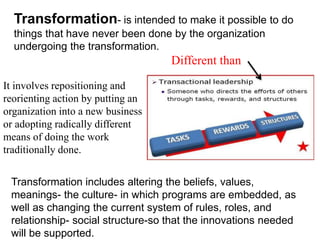
It involves repositioning and
reorienting action by putting an
organization into a new business
or adopting radically different
means of doing the work
traditionally done.
Transformation includes altering the beliefs, values,
meanings- the culture- in which programs are embedded, as
well as changing the current system of rules, roles, and
relationship- social structure-so that the innovations needed
will be supported.
Transformation- is intended to make it possible to do
things that have never been done by the organization
undergoing the transformation.
Different than
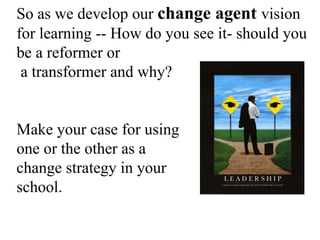
So as we develop our change agent vision
for learning -- How do you see it- should you
be a reformer or
a transformer and why?
Make your case for using
one or the other as a
change strategy in your
school.
The world is changing...
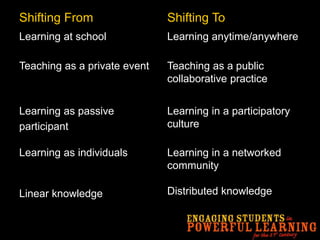
Shifting From Shifting To
Learning at school Learning anytime/anywhere
Teaching as a private event Teaching as a public
collaborative practice
Learning as passive
participant
Learning in a participatory
culture
Learning as individuals
Linear knowledge
Learning in a networked
community
Distributed knowledge
By the year 2011 80% of all Fortune 500
companies will be using immersive worlds –
Gartner Vice President Jackie Fenn
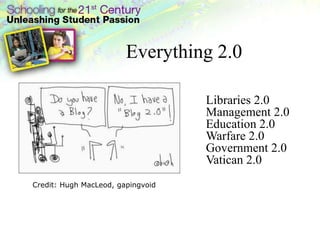
Libraries 2.0
Management 2.0
Education 2.0
Warfare 2.0
Government 2.0
Vatican 2.0
Credit: Hugh MacLeod, gapingvoid
Everything 2.0
dangerouslyirrelevant.org
Our kids have tasted the honey.
http://www.dangerouslyirrelevant.org/2009/02/a-taste-of-honey.html
13
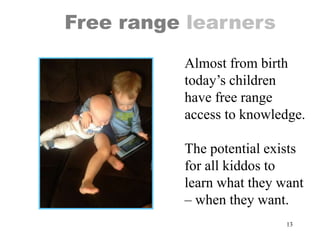
Free range learners
Almost from birth
today’s children
have free range
access to knowledge.
The potential exists
for all kiddos to
learn what they want
– when they want.
• THE CONNECTED EDUCATOR
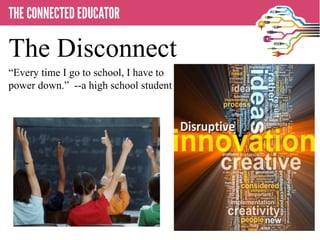
The Disconnect
“Every time I go to school, I have to
power down.” --a high school student
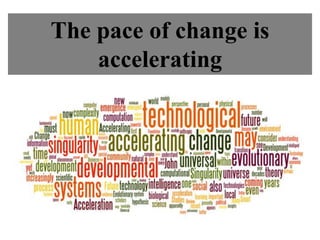
The pace of change is
accelerating
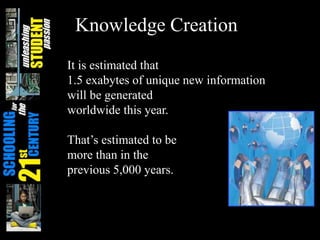
It is estimated that
1.5 exabytes of unique new information
will be generated
worldwide this year.
That’s estimated to be
more than in the
previous 5,000 years.
Knowledge Creation
For students starting a four-year
education degree, this means that . . .
half of what they learn in their first year
of study will be outdated by their third
year of study.
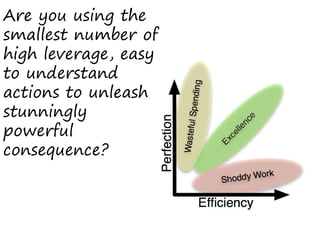
Are you using the
smallest number of
high leverage, easy
to understand
actions to unleash
stunningly
powerful
consequence?
What do you wonder?
•About connected learning?
•How do you define the terms?
• What questions are percolating
up for you?
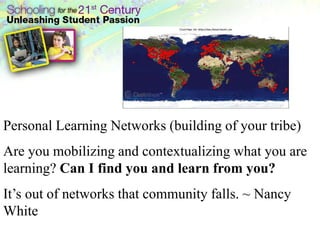
Personal Learning Networks (building of your tribe)
Are you mobilizing and contextualizing what you are
learning? Can I find you and learn from you?
It’s out of networks that community falls. ~ Nancy
White
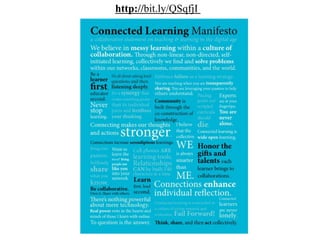
http://bit.ly/QSqfjI
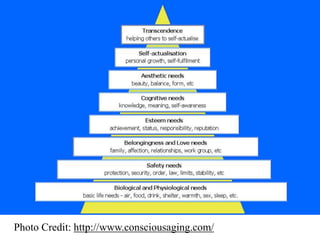
Photo Credit: http://www.consciousaging.com/
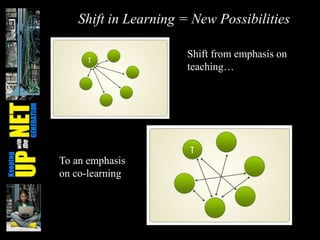
Shift in Learning = New Possibilities
Shift from emphasis on
teaching…
To an emphasis
on co-learning
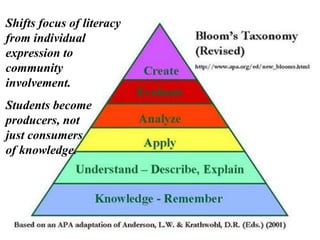
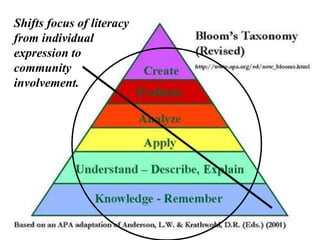
Shifts focus of literacy
from individual
expression to
community
involvement.
Students become
producers, not
just consumers
of knowledge.
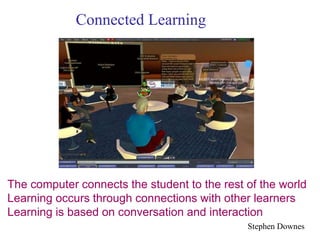
Connected Learning
The computer connects the student to the rest of the world
Learning occurs through connections with other learners
Learning is based on conversation and interaction
Stephen Downes
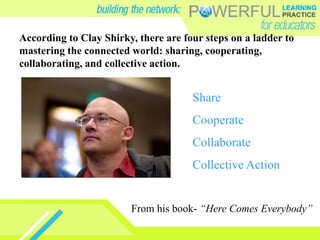
Share
Cooperate
Collaborate
Collective Action
According to Clay Shirky, there are four steps on a ladder to
mastering the connected world: sharing, cooperating,
collaborating, and collective action.
From his book- “Here Comes Everybody”
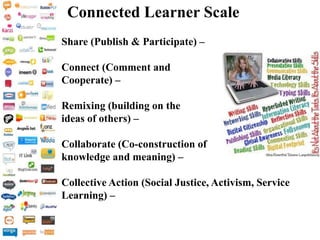
Connected Learner Scale
Share (Publish & Participate) –
Connect (Comment and
Cooperate) –
Remixing (building on the
ideas of others) –
Collaborate (Co-construction of
knowledge and meaning) –
Collective Action (Social Justice, Activism, Service
Learning) –
Shifts focus of literacy
from individual
expression to
community
involvement.
30
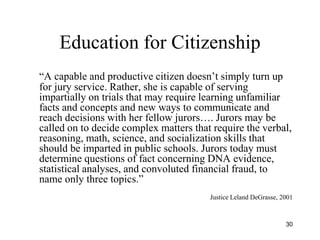
Education for Citizenship
“A capable and productive citizen doesn’t simply turn up
for jury service. Rather, she is capable of serving
impartially on trials that may require learning unfamiliar
facts and concepts and new ways to communicate and
reach decisions with her fellow jurors…. Jurors may be
called on to decide complex matters that require the verbal,
reasoning, math, science, and socialization skills that
should be imparted in public schools. Jurors today must
determine questions of fact concerning DNA evidence,
statistical analyses, and convoluted financial fraud, to
name only three topics.”
Justice Leland DeGrasse, 2001
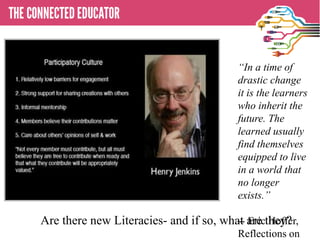
Are there new Literacies- and if so, what are they?
“In a time of
drastic change
it is the learners
who inherit the
future. The
learned usually
find themselves
equipped to live
in a world that
no longer
exists.”
-- Eric Hoffer,
Reflections on
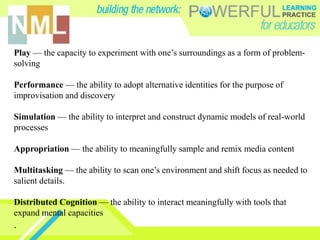
Play — the capacity to experiment with one’s surroundings as a form of problem-
solving
Performance — the ability to adopt alternative identities for the purpose of
improvisation and discovery
Simulation — the ability to interpret and construct dynamic models of real-world
processes
Appropriation — the ability to meaningfully sample and remix media content
Multitasking — the ability to scan one’s environment and shift focus as needed to
salient details.
Distributed Cognition — the ability to interact meaningfully with tools that
expand mental capacities
.
Collective Intelligence — the ability to pool knowledge and compare notes with
others toward a common goal
Judgment — the ability to evaluate the reliability and credibility of different
information sources
Transmedia Navigation — the ability to follow the flow of stories and
information across multiple modalities
Networking — the ability to search for, synthesize, and disseminate information
Negotiation — the ability to travel across diverse communities, discerning and
respecting multiple perspectives, and grasping and following alternative norms.
.
Will the future of education include broad-
based, global reflection and inquiry?
Will your current level of new media literacy
skills allow you to take part in leading learning
through these mediums? Does it matter?
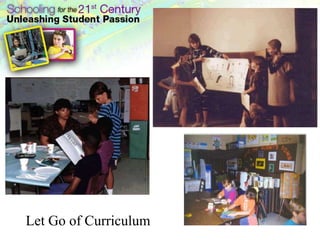
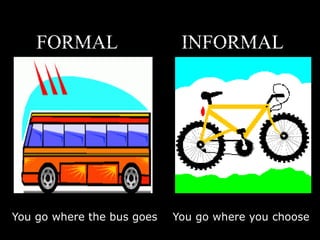
Let Go of Curriculum
FORMAL INFORMAL
You go where the bus goes You go where you choose
Jay Cross – Internet Time
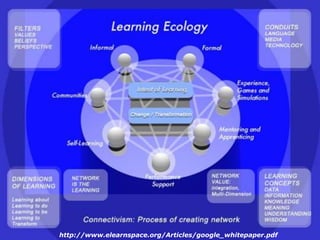
http://www.elearnspace.org/Articles/google_whitepaper.pdf
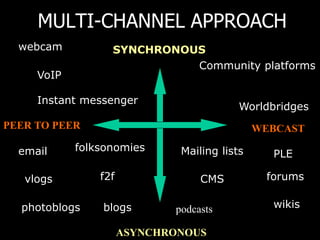
MULTI-CHANNEL APPROACH
SYNCHRONOUS
ASYNCHRONOUS
PEER TO PEER WEBCAST
Instant messenger
forumsf2f
blogsphotoblogs
vlogs
wikis
folksonomies
Conference rooms
email Mailing lists
CMS
Community platforms
VoIP
webcam
podcasts
PLE
Worldbridges
What does the Day in the Life of a Connected Educator
Look Like? Let’s look at some examples…
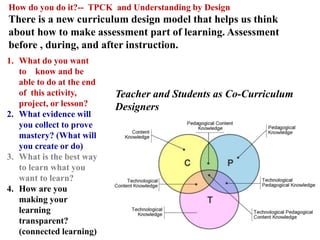
How do you do it?-- TPCK and Understanding by Design
There is a new curriculum design model that helps us think
about how to make assessment part of learning. Assessment
before , during, and after instruction.
Teacher and Students as Co-Curriculum
Designers
1. What do you want
to know and be
able to do at the end
of this activity,
project, or lesson?
2. What evidence will
you collect to prove
mastery? (What will
you create or do)
3. What is the best way
to learn what you
want to learn?
4. How are you
making your
learning
transparent?
(connected learning)
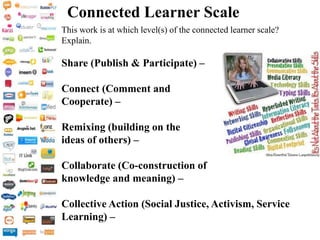
Connected Learner Scale
This work is at which level(s) of the connected learner scale?
Explain.
Share (Publish & Participate) –
Connect (Comment and
Cooperate) –
Remixing (building on the
ideas of others) –
Collaborate (Co-construction of
knowledge and meaning) –
Collective Action (Social Justice, Activism, Service
Learning) –
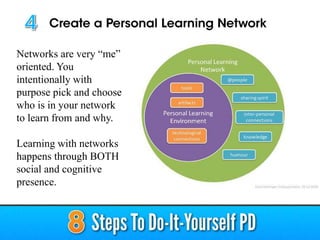
Networks are very “me”
oriented. You
intentionally with
purpose pick and choose
who is in your network
to learn from and why.
Learning with networks
happens through BOTH
social and cognitive
presence.
responsive
responsive
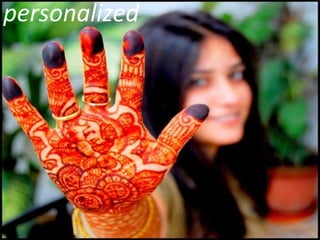
personalized
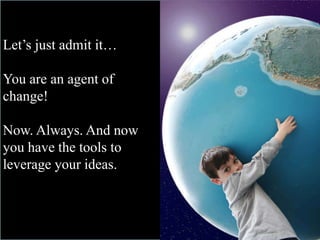
Let’s just admit it…
You are an agent of
change!
Now. Always. And now
you have the tools to
leverage your ideas.
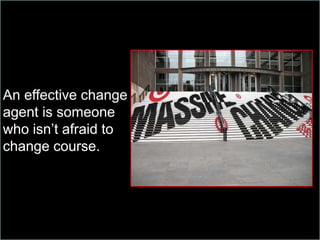
An effective change
agent is someone
who isn’t afraid to
change course.
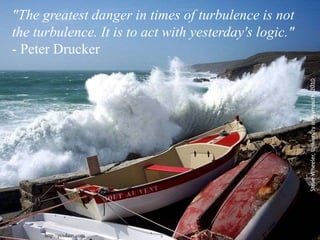
"The greatest danger in times of turbulence is not
the turbulence. It is to act with yesterday's logic."
- Peter Drucker
http://pixdaus.com
SteveWheeler,UniversityofPlymouth,2010

Ce keystone

  • 2.
    Sheryl Nussbaum-Beach Co-Founder &CEO Powerful Learning Practice, LLC http://plpnetwork.com sheryl@plpnetwork.com President 21st Century Collaborative, LLC http://21stcenturycollaborative.com Follow me on Twitter @snbeach
  • 4.
  • 5.
    In Phillip Schlechty'sbook Leading for Learning: How to Transform Schools into Learning Organizations He makes a case for transformation of schools.
  • 6.
    Reform- installing innovationsthat will work within the context of the existing culture and structure of schools. It usually means changing procedures, processes, and technologies with the intent of improving performance of existing operation systems.
  • 7.
    It involves repositioningand reorienting action by putting an organization into a new business or adopting radically different means of doing the work traditionally done. Transformation includes altering the beliefs, values, meanings- the culture- in which programs are embedded, as well as changing the current system of rules, roles, and relationship- social structure-so that the innovations needed will be supported. Transformation- is intended to make it possible to do things that have never been done by the organization undergoing the transformation. Different than
  • 8.
    So as wedevelop our change agent vision for learning -- How do you see it- should you be a reformer or a transformer and why? Make your case for using one or the other as a change strategy in your school.
  • 9.
    The world ischanging...
  • 10.
    Shifting From ShiftingTo Learning at school Learning anytime/anywhere Teaching as a private event Teaching as a public collaborative practice Learning as passive participant Learning in a participatory culture Learning as individuals Linear knowledge Learning in a networked community Distributed knowledge
  • 11.
    By the year2011 80% of all Fortune 500 companies will be using immersive worlds – Gartner Vice President Jackie Fenn Libraries 2.0 Management 2.0 Education 2.0 Warfare 2.0 Government 2.0 Vatican 2.0 Credit: Hugh MacLeod, gapingvoid Everything 2.0
  • 12.
    dangerouslyirrelevant.org Our kids havetasted the honey. http://www.dangerouslyirrelevant.org/2009/02/a-taste-of-honey.html
  • 13.
    13 Free range learners Almostfrom birth today’s children have free range access to knowledge. The potential exists for all kiddos to learn what they want – when they want.
  • 14.
    • THE CONNECTEDEDUCATOR The Disconnect “Every time I go to school, I have to power down.” --a high school student
  • 15.
    The pace ofchange is accelerating
  • 16.
    It is estimatedthat 1.5 exabytes of unique new information will be generated worldwide this year. That’s estimated to be more than in the previous 5,000 years. Knowledge Creation
  • 17.
    For students startinga four-year education degree, this means that . . . half of what they learn in their first year of study will be outdated by their third year of study.
  • 18.
    Are you usingthe smallest number of high leverage, easy to understand actions to unleash stunningly powerful consequence?
  • 19.
    What do youwonder? •About connected learning? •How do you define the terms? • What questions are percolating up for you?
  • 20.
    Personal Learning Networks(building of your tribe) Are you mobilizing and contextualizing what you are learning? Can I find you and learn from you? It’s out of networks that community falls. ~ Nancy White
  • 21.
  • 22.
  • 24.
    Shift in Learning= New Possibilities Shift from emphasis on teaching… To an emphasis on co-learning
  • 25.
    Shifts focus ofliteracy from individual expression to community involvement. Students become producers, not just consumers of knowledge.
  • 26.
    Connected Learning The computerconnects the student to the rest of the world Learning occurs through connections with other learners Learning is based on conversation and interaction Stephen Downes
  • 27.
    Share Cooperate Collaborate Collective Action According toClay Shirky, there are four steps on a ladder to mastering the connected world: sharing, cooperating, collaborating, and collective action. From his book- “Here Comes Everybody”
  • 28.
    Connected Learner Scale Share(Publish & Participate) – Connect (Comment and Cooperate) – Remixing (building on the ideas of others) – Collaborate (Co-construction of knowledge and meaning) – Collective Action (Social Justice, Activism, Service Learning) –
  • 29.
    Shifts focus ofliteracy from individual expression to community involvement.
  • 30.
    30 Education for Citizenship “Acapable and productive citizen doesn’t simply turn up for jury service. Rather, she is capable of serving impartially on trials that may require learning unfamiliar facts and concepts and new ways to communicate and reach decisions with her fellow jurors…. Jurors may be called on to decide complex matters that require the verbal, reasoning, math, science, and socialization skills that should be imparted in public schools. Jurors today must determine questions of fact concerning DNA evidence, statistical analyses, and convoluted financial fraud, to name only three topics.” Justice Leland DeGrasse, 2001
  • 31.
    Are there newLiteracies- and if so, what are they? “In a time of drastic change it is the learners who inherit the future. The learned usually find themselves equipped to live in a world that no longer exists.” -- Eric Hoffer, Reflections on
  • 32.
    Play — thecapacity to experiment with one’s surroundings as a form of problem- solving Performance — the ability to adopt alternative identities for the purpose of improvisation and discovery Simulation — the ability to interpret and construct dynamic models of real-world processes Appropriation — the ability to meaningfully sample and remix media content Multitasking — the ability to scan one’s environment and shift focus as needed to salient details. Distributed Cognition — the ability to interact meaningfully with tools that expand mental capacities .
  • 33.
    Collective Intelligence —the ability to pool knowledge and compare notes with others toward a common goal Judgment — the ability to evaluate the reliability and credibility of different information sources Transmedia Navigation — the ability to follow the flow of stories and information across multiple modalities Networking — the ability to search for, synthesize, and disseminate information Negotiation — the ability to travel across diverse communities, discerning and respecting multiple perspectives, and grasping and following alternative norms. .
  • 34.
    Will the futureof education include broad- based, global reflection and inquiry? Will your current level of new media literacy skills allow you to take part in leading learning through these mediums? Does it matter?
  • 35.
    Let Go ofCurriculum
  • 36.
    FORMAL INFORMAL You gowhere the bus goes You go where you choose Jay Cross – Internet Time
  • 37.
  • 38.
    MULTI-CHANNEL APPROACH SYNCHRONOUS ASYNCHRONOUS PEER TOPEER WEBCAST Instant messenger forumsf2f blogsphotoblogs vlogs wikis folksonomies Conference rooms email Mailing lists CMS Community platforms VoIP webcam podcasts PLE Worldbridges
  • 39.
    What does theDay in the Life of a Connected Educator Look Like? Let’s look at some examples…
  • 40.
    How do youdo it?-- TPCK and Understanding by Design There is a new curriculum design model that helps us think about how to make assessment part of learning. Assessment before , during, and after instruction. Teacher and Students as Co-Curriculum Designers 1. What do you want to know and be able to do at the end of this activity, project, or lesson? 2. What evidence will you collect to prove mastery? (What will you create or do) 3. What is the best way to learn what you want to learn? 4. How are you making your learning transparent? (connected learning)
  • 41.
    Connected Learner Scale Thiswork is at which level(s) of the connected learner scale? Explain. Share (Publish & Participate) – Connect (Comment and Cooperate) – Remixing (building on the ideas of others) – Collaborate (Co-construction of knowledge and meaning) – Collective Action (Social Justice, Activism, Service Learning) –
  • 42.
    Networks are very“me” oriented. You intentionally with purpose pick and choose who is in your network to learn from and why. Learning with networks happens through BOTH social and cognitive presence.
  • 44.
  • 45.
  • 46.
    Let’s just admitit… You are an agent of change! Now. Always. And now you have the tools to leverage your ideas.
  • 47.
    An effective change agentis someone who isn’t afraid to change course.
  • 48.
    "The greatest dangerin times of turbulence is not the turbulence. It is to act with yesterday's logic." - Peter Drucker http://pixdaus.com SteveWheeler,UniversityofPlymouth,2010