PROJECT-BASED LEARNING
     IU 13, December 15, 2010
“I was the one doing most of the reading,
reflecting and synthesizing of historic material.
I thought my job was to distill it all and
simplify for consumption by my students.”
                           Peter Pappas, Copy/Paste Blog
                                 November 24, 2009
                            http://peterpappas.blogs.com/
Are these your projects?

   •Teacher Designed
   •One Product
   •Created for the teacher
   •One Assessment
Why PBL Now?

 Revolution in learning theory in the last 25 years.


 The world has changed.
Project-based
      or
Problem-based?
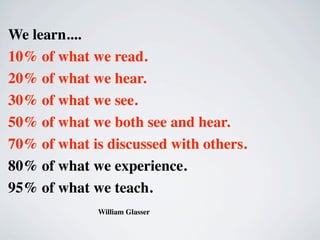
We learn....
10% of what we read.
20% of what we hear.
30% of what we see.
50% of what we both see and hear.
70% of what is discussed with others.
80% of what we experience.
95% of what we teach.
                        William Glasser
Projects that develop 21st century skills
Authenticity

   •Where in the “real world” might an adult tackle the
    problem or question?
   •Does the problem or question have meaning to the
    students?
   •Is there an audience for the work that will be created?


                                 Buck Institute
Academic Rigor


  •What is the essential question addressed?
  •What are the knowledge and skills addressed?
  •Will student develop behaviors of an efficient, effective
   problem solver?
  •What learning standards are addressed?


                                     Buck Institute
Applied Learning

 •How will they apply what they learn to the problem?
 •What workplace skills will be developed?
 •What self-management skills will be developed?


                                 Buck Institute
Active Exploration


 •What outside-the-classroom activities will be required?
 •What methods and sources of information are students
  expected to use?


                                  Buck Institute
Adult Relationships


  •Do students have access to outside adult experts?
  •Does the project allow students to observe an adult expert?
  •Does the adult have access to the student work to provide
   guidance in its development?


                                  Buck Institute
Assessment
   •What are the criteria for measuring student outcomes?
   •Are students involved in helping to establish assessment
    criteria?
   •Is there student reflection throughout the project?
   •Are there methods for timely feedback throughout the
    project - from the teacher, peers, and the adult expert?
   •What artifacts/work requirements are students expected to
    complete?
   •Is there a culminating presentation that allows students to
    demonstrate the knowledge they have gained?

                                  Buck Institute
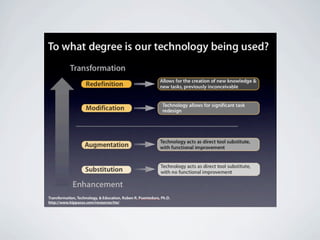
USING TECHNOLOGY IN PBL
•   Makes the learning more authentic

•   Provides access to data and information otherwise
    unaccessible

•   Expands interaction and collaboration with others

•   Promotes investigation/questioning

•   Provides tools experts use to produce artifacts
Poetry Anthology
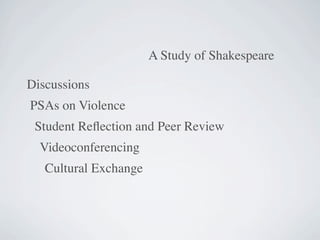
A Study of Shakespeare

Discussions
PSAs on Violence
 Student Reflection and Peer Review
  Videoconferencing
   Cultural Exchange
Creating A Study Guide
               for a Class Book

Wikispace
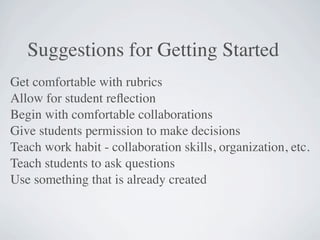
Suggestions for Getting Started
Get comfortable with rubrics
Allow for student reflection
Begin with comfortable collaborations
Give students permission to make decisions
Teach work habit - collaboration skills, organization, etc.
Teach students to ask questions
Use something that is already created
http://centralpbl.wikispaces.com
http://foreverlearning.wikispaces.com


            Sue Sheffer
    Central York School District
      ssheffer@cysd.k12.pa.us
     ssheffer501@comcast.net

Project-Based Learning

  • 1.
    PROJECT-BASED LEARNING IU 13, December 15, 2010
  • 3.
    “I was theone doing most of the reading, reflecting and synthesizing of historic material. I thought my job was to distill it all and simplify for consumption by my students.” Peter Pappas, Copy/Paste Blog November 24, 2009 http://peterpappas.blogs.com/
  • 4.
    Are these yourprojects? •Teacher Designed •One Product •Created for the teacher •One Assessment
  • 5.
    Why PBL Now? Revolution in learning theory in the last 25 years. The world has changed.
  • 7.
    Project-based or Problem-based?
  • 8.
    We learn.... 10% ofwhat we read. 20% of what we hear. 30% of what we see. 50% of what we both see and hear. 70% of what is discussed with others. 80% of what we experience. 95% of what we teach.                         William Glasser
  • 9.
    Projects that develop21st century skills
  • 10.
    Authenticity •Where in the “real world” might an adult tackle the problem or question? •Does the problem or question have meaning to the students? •Is there an audience for the work that will be created? Buck Institute
  • 11.
    Academic Rigor •What is the essential question addressed? •What are the knowledge and skills addressed? •Will student develop behaviors of an efficient, effective problem solver? •What learning standards are addressed? Buck Institute
  • 12.
    Applied Learning •Howwill they apply what they learn to the problem? •What workplace skills will be developed? •What self-management skills will be developed? Buck Institute
  • 13.
    Active Exploration •Whatoutside-the-classroom activities will be required? •What methods and sources of information are students expected to use? Buck Institute
  • 14.
    Adult Relationships •Do students have access to outside adult experts? •Does the project allow students to observe an adult expert? •Does the adult have access to the student work to provide guidance in its development? Buck Institute
  • 15.
    Assessment •What are the criteria for measuring student outcomes? •Are students involved in helping to establish assessment criteria? •Is there student reflection throughout the project? •Are there methods for timely feedback throughout the project - from the teacher, peers, and the adult expert? •What artifacts/work requirements are students expected to complete? •Is there a culminating presentation that allows students to demonstrate the knowledge they have gained? Buck Institute
  • 16.
    USING TECHNOLOGY INPBL • Makes the learning more authentic • Provides access to data and information otherwise unaccessible • Expands interaction and collaboration with others • Promotes investigation/questioning • Provides tools experts use to produce artifacts
  • 18.
  • 19.
    A Study ofShakespeare Discussions PSAs on Violence Student Reflection and Peer Review Videoconferencing Cultural Exchange
  • 20.
    Creating A StudyGuide for a Class Book Wikispace
  • 21.
    Suggestions for GettingStarted Get comfortable with rubrics Allow for student reflection Begin with comfortable collaborations Give students permission to make decisions Teach work habit - collaboration skills, organization, etc. Teach students to ask questions Use something that is already created
  • 22.
    http://centralpbl.wikispaces.com http://foreverlearning.wikispaces.com Sue Sheffer Central York School District ssheffer@cysd.k12.pa.us ssheffer501@comcast.net