Final Design Case for Guidely
Natalya Buchwald, Amanda Johnson, Miki Nobumori, Yilin Ying
Introduction Research Ideation Prototype and Test Value
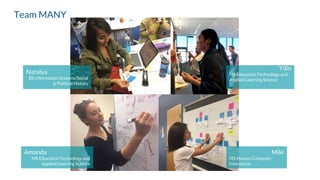
Team MANY
Natalya
BS Information Systems/Social
& Political History
Amanda
MS Education Technology and
Applied Learning Science
Yilin
MS Education Technology and
Applied Learning Science
Miki
MS Human Computer
Interaction
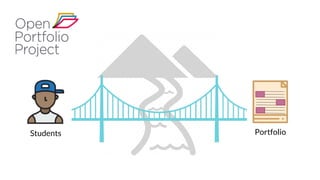
Students Portfolio
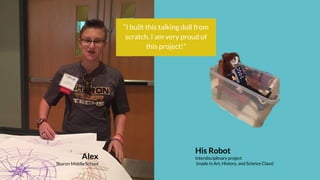
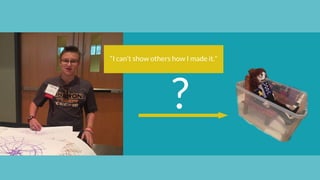
Alex
Sharon Middle School
His Robot
Interdisciplinary project
(made in Art, History, and Science Class)
“I built this talking doll from
scratch. I am very proud of
this project!”
“I can’t show others how I made it.”
?
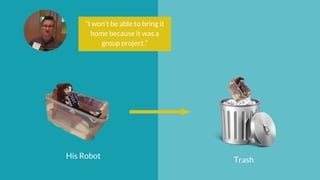
His Robot Trash
“I won’t be able to bring it
home because it was a
group project.”
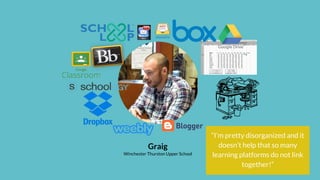
Graig
Winchester Thurston Upper School
“I’m pretty disorganized and it
doesn’t help that so many
learning platforms do not link
together!”
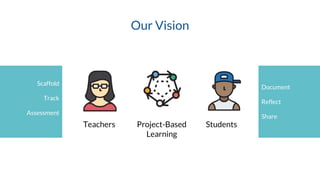
Our Vision
Project-Based
Learning
Scaffold
Track
Assessment
Teachers
Document
Reflect
Share
Students
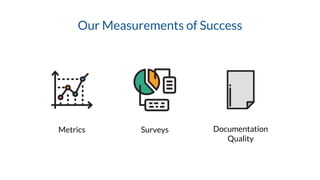
Our Measurements of Success
Metrics Documentation
Quality
Surveys
Research
Introduction Research Ideation Prototype and Test Value
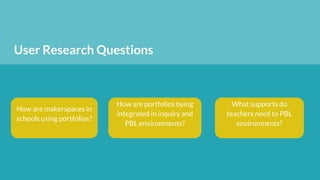
How are portfolios being
integrated in inquiry and
PBL environments?
How are makerspaces in
schools using portfolios?
What supports do
teachers need to PBL
environments?
User Research Questions
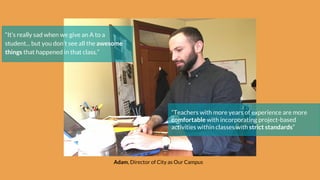
Adam, Director of City as Our Campus
“It’s really sad when we give an A to a
student... but you don’t see all the awesome
things that happened in that class.”
“Teachers with more years of experience are more
comfortable with incorporating project-based
activities within classes with strict standards”
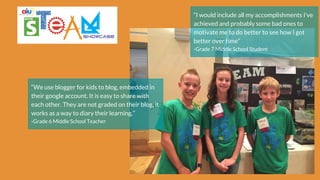
“I would include all my accomplishments I’ve
achieved and probably some bad ones to
motivate me to do better to see how I got
better over time”
-Grade 7 Middle School Student
“We use blogger for kids to blog, embedded in
their google account. It is easy to share with
each other. They are not graded on their blog, it
works as a way to diary their learning.”
-Grade 6 Middle School Teacher
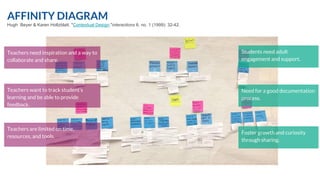
AFFINITY DIAGRAM
Hugh Beyer & Karen Holtzblatt. "Contextual Design."interactions 6, no. 1 (1999): 32-42.
Teachers need inspiration and a way to
collaborate and share.
Teachers want to track student’s
learning and be able to provide
feedback.
Teachers are limited on time,
resources, and tools.
Students need adult
engagement and support.
Need for a good documentation
process.
Foster growth and curiosity
through sharing.
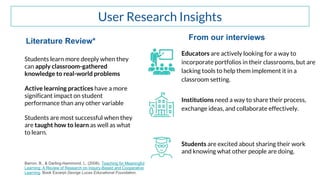
User Research Insights
Students learn more deeply when they
can apply classroom-gathered
knowledge to real-world problems
Active learning practices have a more
significant impact on student
performance than any other variable
Students are most successful when they
are taught how to learn as well as what
to learn.
Literature Review* From our interviews
Students are excited about sharing their work
and knowing what other people are doing.
Educators are actively looking for a way to
incorporate portfolios in their classrooms, but are
lacking tools to help them implement it in a
classroom setting.
Institutions need a way to share their process,
exchange ideas, and collaborate effectively.
Barron, B., & Darling-Hammond, L. (2008). Teaching for Meaningful
Learning: A Review of Research on Inquiry-Based and Cooperative
Learning. Book Excerpt.George Lucas Educational Foundation.
Ideation
Introduction Research Ideation Prototype and Test Value
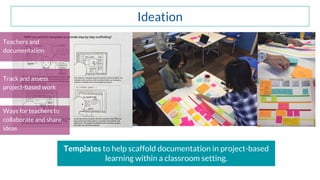
Templates to help scaffold documentation in project-based
learning within a classroom setting.
Ideation
Teachers and
documentation
Track and assess
project-based work
Ways for teachers to
collaborate and share
ideas
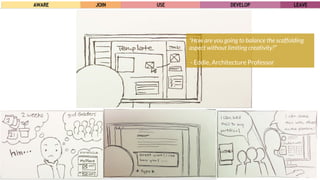
“How are you going to balance the scaffolding
aspect without limiting creativity?”
- Eddie, Architecture Professor
Prototype and Test
Introduction Research Ideation Prototype and Test Value
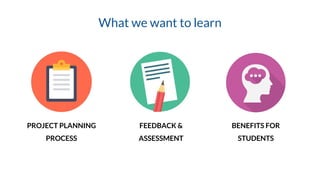
PROJECT PLANNING
PROCESS
FEEDBACK &
ASSESSMENT
BENEFITS FOR
STUDENTS
What we want to learn
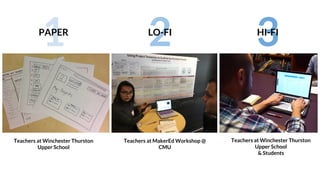
1 2PAPER
3
Teachers at Winchester Thurston
Upper School
LO-FI HI-FI
Teachers at MakerEd Workshop @
CMU
Teachers at Winchester Thurston
Upper School
& Students
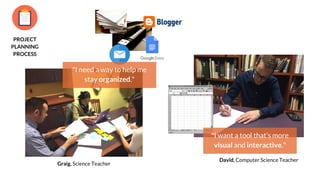
PROJECT
PLANNING
PROCESS
Graig, Science Teacher
"I need a way to help me
stay organized."
David, Computer Science Teacher
"I want a tool that’s more
visual and interactive."
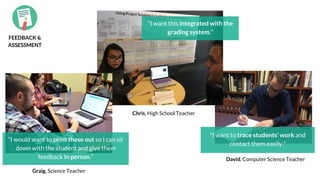
FEEDBACK &
ASSESSMENT
Graig, Science Teacher
David, Computer Science Teacher
"I want to trace students' work and
contact them easily."
“I would want to print these out so I can sit
down with the student and give them
feedback in person.”
"I want this integrated with the
grading system.”
Chris, High School Teacher
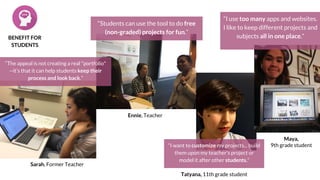
BENEFIT FOR
STUDENTS
Sarah, Former Teacher
“The appeal is not creating a real "portfolio"
--it’s that it can help students keep their
process and look back.”
“I use too many apps and websites.
I like to keep different projects and
subjects all in one place.”
“I want to customize my projects... build
them upon my teacher’s project or
model it after other students.”
Tatyana, 11th grade student
Maya,
9th grade student
Ennie, Teacher
“Students can use the tool to do free
(non-graded) projects for fun.”
Values
Introduction Research Ideation Prototype and Test Value
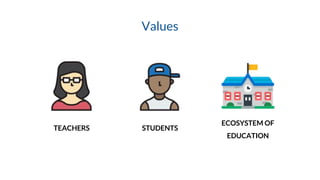
Values
ECOSYSTEM OF
EDUCATION
STUDENTSTEACHERS
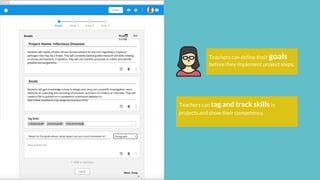
Teachers can define their goals
before they implement project steps.
Teachers can tag and track skills in
projects and show their competency.
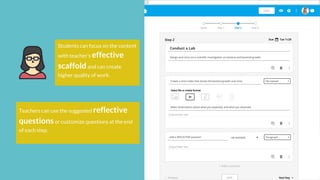
Students can focus on the content
with teacher’s effective
scaffold and can create
higher quality of work.
Teachers can use the suggested reflective
questionsor customize questions at the end
of each step.
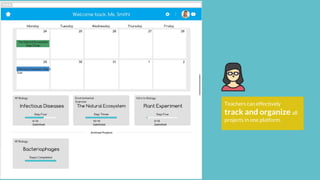
Teachers can effectively
track and organize all
projects in one platform.
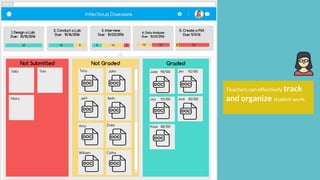
Teachers can effectively track
and organize student work.
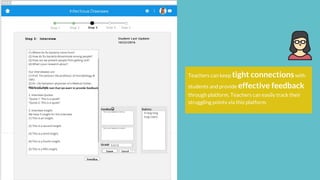
Teachers can keep tight connectionswith
students and provide effective feedback
through platform. Teachers can easily track their
struggling points via this platform.
Students can view project in multiple steps.
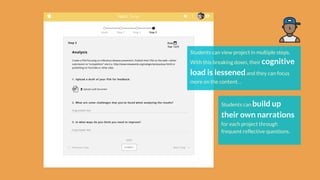
With this breaking down, their cognitive
load is lessenedand they can focus
more on the content. .
Students can build up
their own narrations
for each project through
frequent reflective questions.
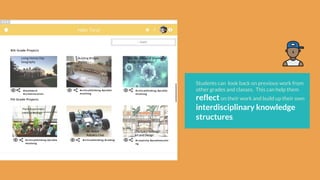
Students can look back on previous work from
other grades and classes. This can help them
reflecton their work and build up their own
interdisciplinary knowledge
structures.
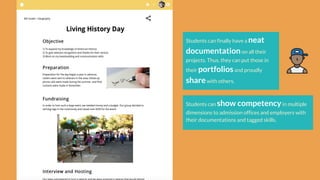
Students can finally have a neat
documentationon all their
projects. Thus, they can put those in
their portfoliosand proudly
sharewith others.
Students can show competencyin multiple
dimensions to admission offices and employers with
their documentations and tagged skills.
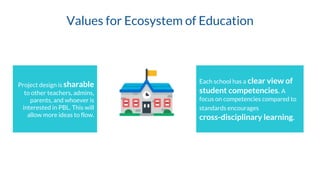
Project design is sharable
to other teachers, admins,
parents, and whoever is
interested in PBL. This will
allow more ideas to flow.
Each school has a clear view of
student competencies. A
focus on competencies compared to
standards encourages
cross-disciplinary learning.
Values for Ecosystem of Education
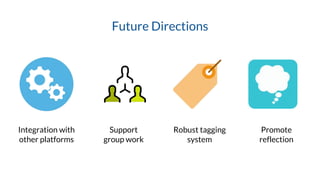
Future Directions
Integration with
other platforms
Robust tagging
system
Promote
reflection
Support
group work
Thank you!
Questions or Comments?

Final Design Case for Guidely

  • 1.
    Final Design Casefor Guidely Natalya Buchwald, Amanda Johnson, Miki Nobumori, Yilin Ying Introduction Research Ideation Prototype and Test Value
  • 2.
    Team MANY Natalya BS InformationSystems/Social & Political History Amanda MS Education Technology and Applied Learning Science Yilin MS Education Technology and Applied Learning Science Miki MS Human Computer Interaction
  • 3.
  • 4.
    Alex Sharon Middle School HisRobot Interdisciplinary project (made in Art, History, and Science Class) “I built this talking doll from scratch. I am very proud of this project!”
  • 5.
    “I can’t showothers how I made it.” ?
  • 6.
    His Robot Trash “Iwon’t be able to bring it home because it was a group project.”
  • 7.
    Graig Winchester Thurston UpperSchool “I’m pretty disorganized and it doesn’t help that so many learning platforms do not link together!”
  • 8.
  • 9.
    Our Measurements ofSuccess Metrics Documentation Quality Surveys
  • 11.
  • 12.
    How are portfoliosbeing integrated in inquiry and PBL environments? How are makerspaces in schools using portfolios? What supports do teachers need to PBL environments? User Research Questions
  • 13.
    Adam, Director ofCity as Our Campus “It’s really sad when we give an A to a student... but you don’t see all the awesome things that happened in that class.” “Teachers with more years of experience are more comfortable with incorporating project-based activities within classes with strict standards”
  • 14.
    “I would includeall my accomplishments I’ve achieved and probably some bad ones to motivate me to do better to see how I got better over time” -Grade 7 Middle School Student “We use blogger for kids to blog, embedded in their google account. It is easy to share with each other. They are not graded on their blog, it works as a way to diary their learning.” -Grade 6 Middle School Teacher
  • 15.
    AFFINITY DIAGRAM Hugh Beyer& Karen Holtzblatt. "Contextual Design."interactions 6, no. 1 (1999): 32-42. Teachers need inspiration and a way to collaborate and share. Teachers want to track student’s learning and be able to provide feedback. Teachers are limited on time, resources, and tools. Students need adult engagement and support. Need for a good documentation process. Foster growth and curiosity through sharing.
  • 16.
    User Research Insights Studentslearn more deeply when they can apply classroom-gathered knowledge to real-world problems Active learning practices have a more significant impact on student performance than any other variable Students are most successful when they are taught how to learn as well as what to learn. Literature Review* From our interviews Students are excited about sharing their work and knowing what other people are doing. Educators are actively looking for a way to incorporate portfolios in their classrooms, but are lacking tools to help them implement it in a classroom setting. Institutions need a way to share their process, exchange ideas, and collaborate effectively. Barron, B., & Darling-Hammond, L. (2008). Teaching for Meaningful Learning: A Review of Research on Inquiry-Based and Cooperative Learning. Book Excerpt.George Lucas Educational Foundation.
  • 17.
  • 18.
    Templates to helpscaffold documentation in project-based learning within a classroom setting. Ideation Teachers and documentation Track and assess project-based work Ways for teachers to collaborate and share ideas
  • 19.
    “How are yougoing to balance the scaffolding aspect without limiting creativity?” - Eddie, Architecture Professor
  • 20.
    Prototype and Test IntroductionResearch Ideation Prototype and Test Value
  • 21.
  • 22.
    1 2PAPER 3 Teachers atWinchester Thurston Upper School LO-FI HI-FI Teachers at MakerEd Workshop @ CMU Teachers at Winchester Thurston Upper School & Students
  • 23.
    PROJECT PLANNING PROCESS Graig, Science Teacher "Ineed a way to help me stay organized." David, Computer Science Teacher "I want a tool that’s more visual and interactive."
  • 24.
    FEEDBACK & ASSESSMENT Graig, ScienceTeacher David, Computer Science Teacher "I want to trace students' work and contact them easily." “I would want to print these out so I can sit down with the student and give them feedback in person.” "I want this integrated with the grading system.” Chris, High School Teacher
  • 25.
    BENEFIT FOR STUDENTS Sarah, FormerTeacher “The appeal is not creating a real "portfolio" --it’s that it can help students keep their process and look back.” “I use too many apps and websites. I like to keep different projects and subjects all in one place.” “I want to customize my projects... build them upon my teacher’s project or model it after other students.” Tatyana, 11th grade student Maya, 9th grade student Ennie, Teacher “Students can use the tool to do free (non-graded) projects for fun.”
  • 26.
    Values Introduction Research IdeationPrototype and Test Value
  • 27.
  • 28.
    Teachers can definetheir goals before they implement project steps. Teachers can tag and track skills in projects and show their competency.
  • 29.
    Students can focuson the content with teacher’s effective scaffold and can create higher quality of work. Teachers can use the suggested reflective questionsor customize questions at the end of each step.
  • 30.
    Teachers can effectively trackand organize all projects in one platform.
  • 31.
    Teachers can effectivelytrack and organize student work.
  • 32.
    Teachers can keeptight connectionswith students and provide effective feedback through platform. Teachers can easily track their struggling points via this platform.
  • 33.
    Students can viewproject in multiple steps. With this breaking down, their cognitive load is lessenedand they can focus more on the content. . Students can build up their own narrations for each project through frequent reflective questions.
  • 34.
    Students can lookback on previous work from other grades and classes. This can help them reflecton their work and build up their own interdisciplinary knowledge structures.
  • 35.
    Students can finallyhave a neat documentationon all their projects. Thus, they can put those in their portfoliosand proudly sharewith others. Students can show competencyin multiple dimensions to admission offices and employers with their documentations and tagged skills.
  • 36.
    Project design issharable to other teachers, admins, parents, and whoever is interested in PBL. This will allow more ideas to flow. Each school has a clear view of student competencies. A focus on competencies compared to standards encourages cross-disciplinary learning. Values for Ecosystem of Education
  • 37.
    Future Directions Integration with otherplatforms Robust tagging system Promote reflection Support group work
  • 38.