1
Program Office Foundations
“The place where optimism most flourishes is the
lunatic asylum.”
— Henry Havelock Ellis, British psychologist
2
What is Program Management?
♦ The coordinated management of a portfolio of
projects to achieve a set of business objectives.
♦ The directing of a portfolio of projects which
benefit from a consolidated management
approach.
♦ The management of a portfolio of projects
towards one specific objective.
♦ The coordinated support, planning, prioritization
and monitoring of projects to meet changing
business needs.
♦ The planning and monitoring of a number of
simultaneous related projects.
3
Why have a Program Office?
♦ Reduce project management costs
♦ Reduce project management cycle times
♦ Coordinate project management activities across
the enterprise
♦ Improve reporting activities
♦ Improve resource utilization across the
enterprise
♦ Increase project delivery quality
4
Program Office Mission
♦ Provide the assessment, measurement,
analysis, support, and reporting of enterprise
wide IT project performance and departmental
process improvement activities.
5
Responsibilities of the PMO
♦ Facilitate communication and coordination
between Project Managers, Functional
Managers, and Customers.
♦ Integrate project management methods with the
functional departments.
♦ Report schedule and budget status for projects
through a single tool set.
6
PMO’s Scope
♦ Enable and support project management
disciplines.
♦ Provide enterprise wide project visibility,
assessment, and reporting.
♦ Project management guidelines.
♦ Serve as a catalyst to develop an integrated
multidisciplinary approach to project management.
7
PMO’s Scope …
♦ Develop a methodology framework for
professional project management.
♦ Provide this methodology to IT PM’s.
♦ Provide support in deploying the PM
methodologies across the enterprise.
♦ Tie project activities with budget and forecast
processes.
♦ Provide data and processes to support budget
management.
8
Customer Relationship Managers (When)
PMO Scope
CIO
(Why)
Line Activities
ü PMs
ü Developers
ü Technicians
Functional
Managers
(What)
PMO
Processes
(How)
9
Principles of Program Management [†]
Organization
Planning
Benefits
Management
Stakeholder
Management
Issue Management &
Risk Management
Quality
Management
Configuration
Management
Audit
[†] “Managing Success Programmes,” Office of Government Commerce, UK
10
Principles of Program Management
♦ Organization
– Defining clear roles, responsibilities, leadership and
lines of communication.
♦ Planning
– Using a Program Plan to ensure that control is
established and maintained for all projects in the
portfolio.
♦ Benefits Management
– Identifying, optimizing, and tracking expected benefits
to ensure they are achieved for each project.
♦ Stakeholder Management
– Ensuring all interested parties are appropriately
involved in the program and the supporting projects.
11
Principles of Program Management …
♦ Issue Management and Risk Management
– Defining a strategy to deal with current and anticipated
problems.
♦ Quality Management
– Ensuring that the end products of the program or
portfolio of projects are fit for their purpose.
♦ Configuration Management
– Keeping information about the projects up-to-date and
accurate.
♦ Audit
– Ensuring that technical, statutory, contract and
accounting standards are used for reporting project
information.
12
Stakeholders of the PMO [†]
♦ Sponsors
– Office of the CIO
♦ Customers
– IT Functional managers
– IT Staff
– Site Project participants
♦ Customers customers
– Site Building and Project managers
[†] “Defining the Services of the PMO,” Mark E. Mullaly, www.gantthed.com
13
Building the PMO
What questions need to be answered while building the PMO
♦ Strategy
– What are the strategic initiatives supported in the PMO?
– What departments will be effected?
– What parts of the organization will benefit?
♦ Process
– What is the core project management methodology?
– Can the PMO be syndicated across the entire organization?
– What metrics will be used to measure success?
♦ Organization
– What groups are impacted?
– What departments participate?
– Who oversees the PMO?
14
Building the PMO …
♦ Technology
– What enterprise systems are used?
– How will initiatives be defined and constrained?
– What economies of scale can be realized by the PMO?
– Project tracking tools?
• Earned value
• Simple budget and schedule
– Communication mechanisms?
• Processes
• Metrics
• Status
15
Projects and the PMO
The “products” of the Program Management
Office are “projects”
These “products” have all the measures of
normal products – quality, cost, benefit, user
acceptance.
16
Four Types of PMO [†]
FacilitatorScorekeeper
PerfectionistQuarterback
Manage Improve
Support
Control
[†] “The Four Archetypes of the PMO,” Mark E. Mullaly, www.gantthed.com
17
Four Types of PMO …
♦ Scorekeeper
– Monitor and report progress of project portfolio
– Program and project information conduit
– Clearing house for consolidated status updates
♦ Facilitator
– Enable improvement efforts
– Source of best practices
♦ Quarterback
– Focus on project delivery
– PMs report to the PMO
– Central point of accountability
♦ Perfectionist
– Control focused improvement
– PMO is the “center of excellence”
– Agent for change regarding how the organization does projects.
18
PMO Risks
♦ Emphasis of technology over process and their
results
♦ Roles and responsibilities either not developed
or are worked out “on the fly.”
♦ Reluctance to share information between all
participants
♦ Mixed messages sent to stakeholders
♦ Emphasis on defining “roles” before discovering
the problem domain
19
A Successful PMO …
♦ Eliminates duplication of data and processes among
Project Managers.
♦ Establishes processes for managing all IT projects.
♦ Cultivates “unnatural” levels of cooperation.
♦ Institutes new operating mode with detailed definition
of process, roles, and measures.
♦ Maintains a balanced scorecard to reward new skills
and roles for process owners.
♦ Promotes change from status–quo, upstream and
downstream of IT mission.
♦ Nurtures organizational neutrality.
♦ Instills a passion for the profession of project
management’s processes, practices, and tools.
20
4 Attributes of Project Success
♦ Did the project meet the goals of:
– Functionality?
– Cost?
– Time?
– Quality?
– Performance?
♦ Was the project run in an effective and efficient
manner?
♦ Did the project meet its business goals?
♦ What did the organization learn?
21
Interactions within the PMO
"We can't all be heroes, because someone has to
sit on the curb and clap as they go by."
— Will Rogers (1879-1935)
22
Roles of Program Management Office
♦ Project Manager is responsible for coordinating
project direction, progress, and resource
management.
♦ Functional Manager is responsible for work
definition and management of resources to
accomplish this work.
♦ Program Management Office is responsible for
coordinating projects within a portfolio for the
betterment of each project.
23
Roles of the Project Manager
Competency
♦ Competency is the
elimination of
dissatisfactions
– On schedule
– On budget
– Meets needs
Contribution
♦ Contribution is realizing
satisfiers
Competency ContributionCredibility
24
Program and Project Manager Agility
♦ Access to information in context.
♦ Capacity to create new knowledge and insights.
♦ Resource reconfiguration.
♦ Predictive “estimation at completion.”
♦ Project performance metrics as the basis fro
future estimates.
25
The Agile PM Should Exhibit a …
♦ Sophistication and domain knowledge.
♦ Willingness to operate in real–time.
♦ Propensity and preference for dialogue.
♦ Willingness to experiment.
♦ Preference for managerial risk.
26
Agile PM and PMO Infrastructure Creates …
♦ Ability to create contextual information from
multiple data sources.
♦ Support for heterogeneous functional managers.
♦ Support for evolving business and technical
processes.
♦ Collaboration in a value network of peers and
functional managers.
27
Practical Implementation Processes
Pareto’s Law – The 80/20 Rule
The law of the trivial many and the critical few.
In many business activities, 80% of the potential
value can be achieved from 20% of the effort,
and that one can spend the remaining 80% of
effort for relatively little return
28
What is Project Management?
♦ Management
– The act of managing
– The persons controlling and directing an enterprise
♦ Project
– Something that is planned or devised
– A plan or scheme
– A large or important undertaking, especially one
involving considerably expense, personnel, and
equipment
29
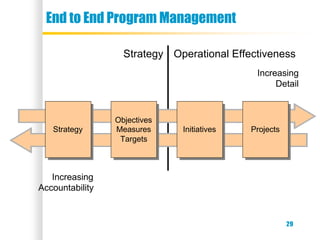
End to End Program Management
StrategyStrategy
Objectives
Measures
Targets
Objectives
Measures
Targets
InitiativesInitiatives ProjectsProjects
Operational EffectivenessStrategy
Increasing
Accountability
Increasing
Detail
30
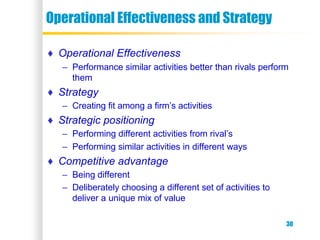
Operational Effectiveness and Strategy
♦ Operational Effectiveness
– Performance similar activities better than rivals perform
them
♦ Strategy
– Creating fit among a firm’s activities
♦ Strategic positioning
– Performing different activities from rival’s
– Performing similar activities in different ways
♦ Competitive advantage
– Being different
– Deliberately choosing a different set of activities to
deliver a unique mix of value
31
Building a Collaborative Culture, by …
♦ Making responsibilities overlap
♦ Basing rewards on unit performance
♦ Changing the physical layout
♦ Redesigning the work procedures and processes
32
Improving the Project Success Rate
♦ Develop a process for evaluating the feasibility of
projects
♦ Develop professional project management skills
♦ Implement development and deployment
methodologies
♦ Encourage user participation directly or through
CRMs
♦ Use “quality management” principles
33
Five Practices for Every Project Manager
♦ Focus on the direct business benefits
♦ Balance roles and responsibilities
♦ Mange by deliverables
♦ Manage risk through releases
♦ Manage risk in phases

Program Office Background

  • 1.
    1 Program Office Foundations “Theplace where optimism most flourishes is the lunatic asylum.” — Henry Havelock Ellis, British psychologist
  • 2.
    2 What is ProgramManagement? ♦ The coordinated management of a portfolio of projects to achieve a set of business objectives. ♦ The directing of a portfolio of projects which benefit from a consolidated management approach. ♦ The management of a portfolio of projects towards one specific objective. ♦ The coordinated support, planning, prioritization and monitoring of projects to meet changing business needs. ♦ The planning and monitoring of a number of simultaneous related projects.
  • 3.
    3 Why have aProgram Office? ♦ Reduce project management costs ♦ Reduce project management cycle times ♦ Coordinate project management activities across the enterprise ♦ Improve reporting activities ♦ Improve resource utilization across the enterprise ♦ Increase project delivery quality
  • 4.
    4 Program Office Mission ♦Provide the assessment, measurement, analysis, support, and reporting of enterprise wide IT project performance and departmental process improvement activities.
  • 5.
    5 Responsibilities of thePMO ♦ Facilitate communication and coordination between Project Managers, Functional Managers, and Customers. ♦ Integrate project management methods with the functional departments. ♦ Report schedule and budget status for projects through a single tool set.
  • 6.
    6 PMO’s Scope ♦ Enableand support project management disciplines. ♦ Provide enterprise wide project visibility, assessment, and reporting. ♦ Project management guidelines. ♦ Serve as a catalyst to develop an integrated multidisciplinary approach to project management.
  • 7.
    7 PMO’s Scope … ♦Develop a methodology framework for professional project management. ♦ Provide this methodology to IT PM’s. ♦ Provide support in deploying the PM methodologies across the enterprise. ♦ Tie project activities with budget and forecast processes. ♦ Provide data and processes to support budget management.
  • 8.
    8 Customer Relationship Managers(When) PMO Scope CIO (Why) Line Activities ü PMs ü Developers ü Technicians Functional Managers (What) PMO Processes (How)
  • 9.
    9 Principles of ProgramManagement [†] Organization Planning Benefits Management Stakeholder Management Issue Management & Risk Management Quality Management Configuration Management Audit [†] “Managing Success Programmes,” Office of Government Commerce, UK
  • 10.
    10 Principles of ProgramManagement ♦ Organization – Defining clear roles, responsibilities, leadership and lines of communication. ♦ Planning – Using a Program Plan to ensure that control is established and maintained for all projects in the portfolio. ♦ Benefits Management – Identifying, optimizing, and tracking expected benefits to ensure they are achieved for each project. ♦ Stakeholder Management – Ensuring all interested parties are appropriately involved in the program and the supporting projects.
  • 11.
    11 Principles of ProgramManagement … ♦ Issue Management and Risk Management – Defining a strategy to deal with current and anticipated problems. ♦ Quality Management – Ensuring that the end products of the program or portfolio of projects are fit for their purpose. ♦ Configuration Management – Keeping information about the projects up-to-date and accurate. ♦ Audit – Ensuring that technical, statutory, contract and accounting standards are used for reporting project information.
  • 12.
    12 Stakeholders of thePMO [†] ♦ Sponsors – Office of the CIO ♦ Customers – IT Functional managers – IT Staff – Site Project participants ♦ Customers customers – Site Building and Project managers [†] “Defining the Services of the PMO,” Mark E. Mullaly, www.gantthed.com
  • 13.
    13 Building the PMO Whatquestions need to be answered while building the PMO ♦ Strategy – What are the strategic initiatives supported in the PMO? – What departments will be effected? – What parts of the organization will benefit? ♦ Process – What is the core project management methodology? – Can the PMO be syndicated across the entire organization? – What metrics will be used to measure success? ♦ Organization – What groups are impacted? – What departments participate? – Who oversees the PMO?
  • 14.
    14 Building the PMO… ♦ Technology – What enterprise systems are used? – How will initiatives be defined and constrained? – What economies of scale can be realized by the PMO? – Project tracking tools? • Earned value • Simple budget and schedule – Communication mechanisms? • Processes • Metrics • Status
  • 15.
    15 Projects and thePMO The “products” of the Program Management Office are “projects” These “products” have all the measures of normal products – quality, cost, benefit, user acceptance.
  • 16.
    16 Four Types ofPMO [†] FacilitatorScorekeeper PerfectionistQuarterback Manage Improve Support Control [†] “The Four Archetypes of the PMO,” Mark E. Mullaly, www.gantthed.com
  • 17.
    17 Four Types ofPMO … ♦ Scorekeeper – Monitor and report progress of project portfolio – Program and project information conduit – Clearing house for consolidated status updates ♦ Facilitator – Enable improvement efforts – Source of best practices ♦ Quarterback – Focus on project delivery – PMs report to the PMO – Central point of accountability ♦ Perfectionist – Control focused improvement – PMO is the “center of excellence” – Agent for change regarding how the organization does projects.
  • 18.
    18 PMO Risks ♦ Emphasisof technology over process and their results ♦ Roles and responsibilities either not developed or are worked out “on the fly.” ♦ Reluctance to share information between all participants ♦ Mixed messages sent to stakeholders ♦ Emphasis on defining “roles” before discovering the problem domain
  • 19.
    19 A Successful PMO… ♦ Eliminates duplication of data and processes among Project Managers. ♦ Establishes processes for managing all IT projects. ♦ Cultivates “unnatural” levels of cooperation. ♦ Institutes new operating mode with detailed definition of process, roles, and measures. ♦ Maintains a balanced scorecard to reward new skills and roles for process owners. ♦ Promotes change from status–quo, upstream and downstream of IT mission. ♦ Nurtures organizational neutrality. ♦ Instills a passion for the profession of project management’s processes, practices, and tools.
  • 20.
    20 4 Attributes ofProject Success ♦ Did the project meet the goals of: – Functionality? – Cost? – Time? – Quality? – Performance? ♦ Was the project run in an effective and efficient manner? ♦ Did the project meet its business goals? ♦ What did the organization learn?
  • 21.
    21 Interactions within thePMO "We can't all be heroes, because someone has to sit on the curb and clap as they go by." — Will Rogers (1879-1935)
  • 22.
    22 Roles of ProgramManagement Office ♦ Project Manager is responsible for coordinating project direction, progress, and resource management. ♦ Functional Manager is responsible for work definition and management of resources to accomplish this work. ♦ Program Management Office is responsible for coordinating projects within a portfolio for the betterment of each project.
  • 23.
    23 Roles of theProject Manager Competency ♦ Competency is the elimination of dissatisfactions – On schedule – On budget – Meets needs Contribution ♦ Contribution is realizing satisfiers Competency ContributionCredibility
  • 24.
    24 Program and ProjectManager Agility ♦ Access to information in context. ♦ Capacity to create new knowledge and insights. ♦ Resource reconfiguration. ♦ Predictive “estimation at completion.” ♦ Project performance metrics as the basis fro future estimates.
  • 25.
    25 The Agile PMShould Exhibit a … ♦ Sophistication and domain knowledge. ♦ Willingness to operate in real–time. ♦ Propensity and preference for dialogue. ♦ Willingness to experiment. ♦ Preference for managerial risk.
  • 26.
    26 Agile PM andPMO Infrastructure Creates … ♦ Ability to create contextual information from multiple data sources. ♦ Support for heterogeneous functional managers. ♦ Support for evolving business and technical processes. ♦ Collaboration in a value network of peers and functional managers.
  • 27.
    27 Practical Implementation Processes Pareto’sLaw – The 80/20 Rule The law of the trivial many and the critical few. In many business activities, 80% of the potential value can be achieved from 20% of the effort, and that one can spend the remaining 80% of effort for relatively little return
  • 28.
    28 What is ProjectManagement? ♦ Management – The act of managing – The persons controlling and directing an enterprise ♦ Project – Something that is planned or devised – A plan or scheme – A large or important undertaking, especially one involving considerably expense, personnel, and equipment
  • 29.
    29 End to EndProgram Management StrategyStrategy Objectives Measures Targets Objectives Measures Targets InitiativesInitiatives ProjectsProjects Operational EffectivenessStrategy Increasing Accountability Increasing Detail
  • 30.
    30 Operational Effectiveness andStrategy ♦ Operational Effectiveness – Performance similar activities better than rivals perform them ♦ Strategy – Creating fit among a firm’s activities ♦ Strategic positioning – Performing different activities from rival’s – Performing similar activities in different ways ♦ Competitive advantage – Being different – Deliberately choosing a different set of activities to deliver a unique mix of value
  • 31.
    31 Building a CollaborativeCulture, by … ♦ Making responsibilities overlap ♦ Basing rewards on unit performance ♦ Changing the physical layout ♦ Redesigning the work procedures and processes
  • 32.
    32 Improving the ProjectSuccess Rate ♦ Develop a process for evaluating the feasibility of projects ♦ Develop professional project management skills ♦ Implement development and deployment methodologies ♦ Encourage user participation directly or through CRMs ♦ Use “quality management” principles
  • 33.
    33 Five Practices forEvery Project Manager ♦ Focus on the direct business benefits ♦ Balance roles and responsibilities ♦ Mange by deliverables ♦ Manage risk through releases ♦ Manage risk in phases