‫المنافع‬ ‫تحقيق‬ ‫إدارة‬
Benefits Realization Management
Abdelrahman Elsheikh Seedahmed , M.sc, PMOC,CBAP, PMP, RMP, ACP, PMI-SP,
KPI-A, EVM,CPRE, MCITP, MCTS, OCP, OCA, ITIL v3, CTFL, ISO20000, ISO27002
Abdelrahman Elsheikh Bio
 15 experience as Strategic PMO Director, Strategy Execution Consultant,
PMO Consultant, Project Manager, Business Analyst and Software
Engineer.
• Master Degree in Software Engineering.
• Project Management Office Certification (PMOC).
• Certified Project Management Professional (PMP).
• Agile Certified Practitioner (PMI-ACP).
• Risk Management Professional (PMI-RMP).
• Schedule Professional (PMI-SP).
• Certified Business Analyst Professional (CBAP).
• Microsoft Certified IT Professional (MCITP).
• Key Performance Indicator Associate (KPI-A).
• OCP and OCA.
• Certified Professional for Requirement Engineer (CPRE).
• Certified Tester Foundation Level (CTFL).
• Earned Value Project Management (EVM).
• ISO/IEC 20000 Foundation.
• ISO/IEC 27002 Foundation.
• Certified ITIL Foundation Level.
Agenda
• Benefits Realization Management Definition.
• Why Benefits Realization Management?
• Benefits Realization Management Framework.
• Benefits Identification.
• Benefits Execution.
• Benefits Sustainment.
• EPMO, PMs Role in Benefits Realization Management.
• Conclusion.
Agenda
• Benefits Realization Management Definition.
• Why Benefits Realization Management?
• Benefits Realization Management Framework.
• Benefits Identification.
• Benefits Execution.
• Benefits Sustainment.
• EPMO, PMs Role in Benefits Realization Management.
• Conclusion.
Benefits Realization Management Definition
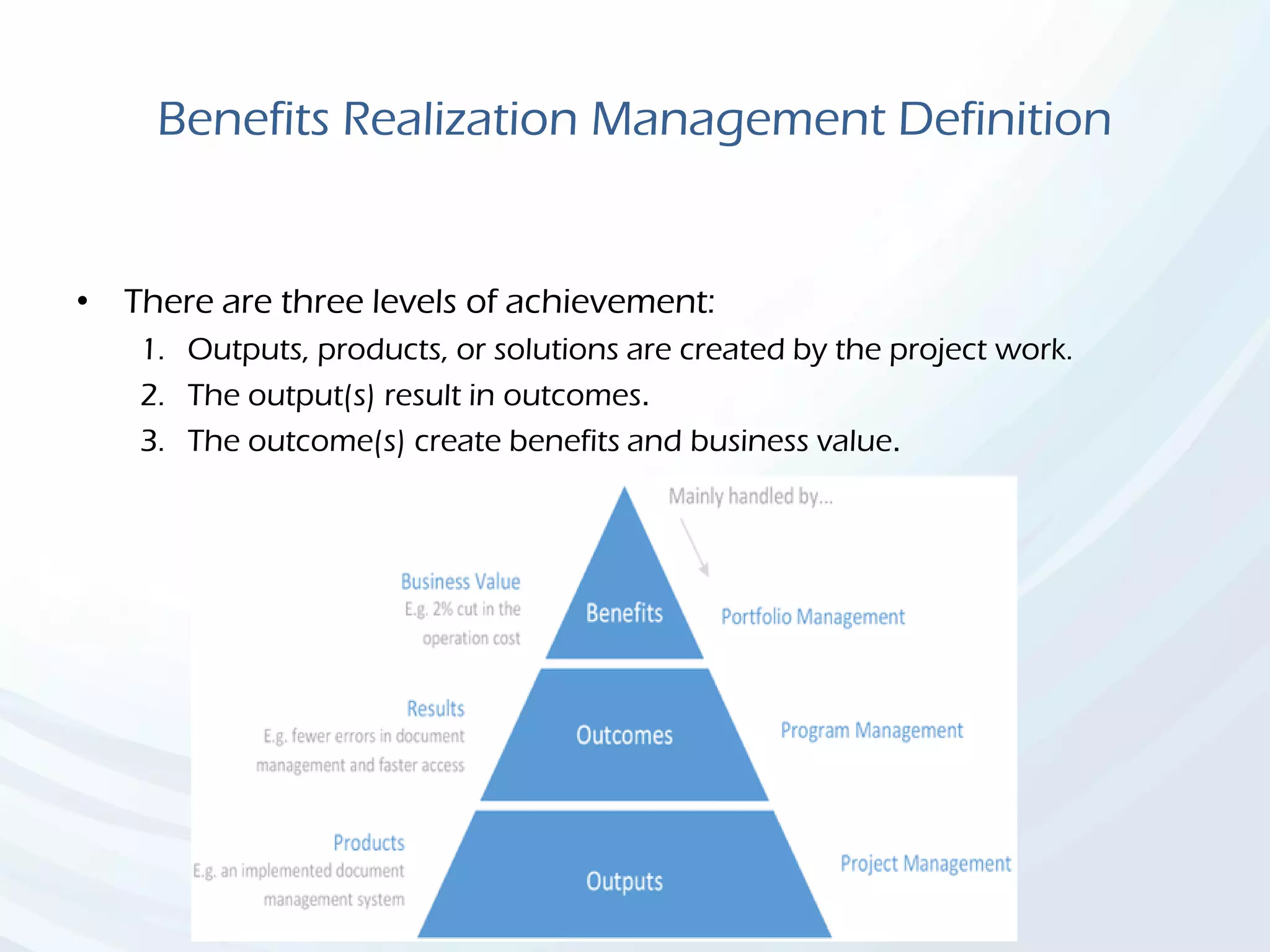
• There are three levels of achievement:
1. Outputs, products, or solutions are created by the project work.
2. The output(s) result in outcomes.
3. The outcome(s) create benefits and business value.
Benefits Realization Management Definition
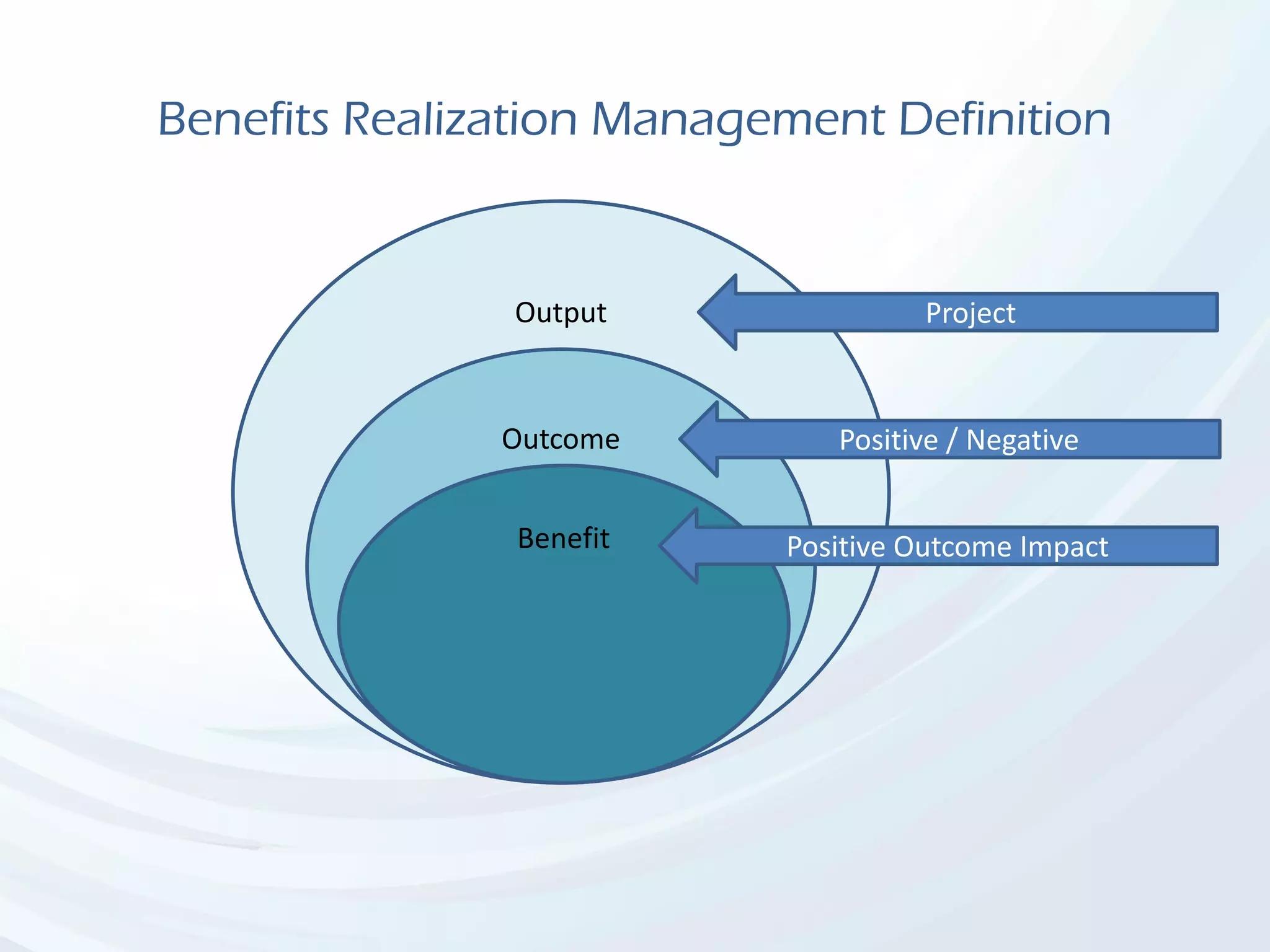
Output
Outcome
Benefit
Project
Positive / Negative
Positive Outcome Impact
Example
• As an example in a project designed to implement a document
management system:
• The implemented document management system that users can
actually use is the output.
• This output results in certain outcomes, for example:
– faster and easier access to the documents.
– fewer mistakes in archiving and retrieving documents.
– ability to control versions and having access to the latest revisions.
– ability to have reports that help us find solutions for other business
problems.
• And finally, those outcomes create benefits, or in other words,
business value:
– 2% cut in the operation cost.
Benefits
• An outcomes whose nature and value are considered advantageous
by an organization.
• An outcomes which is perceived as positive by Stakeholders.
Benefits Realization
• Benefits realization is the means to ensuring that benefits are
derived from outputs and outcomes.
• Benefit realization has been maturing since the 1990's and aims to
address a single problem:
– "Change (Project) and investment do not consistently deliver enough
benefits.“
Benefits Realization Management
• Collective set of processes and practices for identifying benefits and
aligning them with formal strategy, ensuring benefits are realized as
project implementation progresses and finishes, and that the
benefits are sustainable—and sustained—after project
implementation is complete.
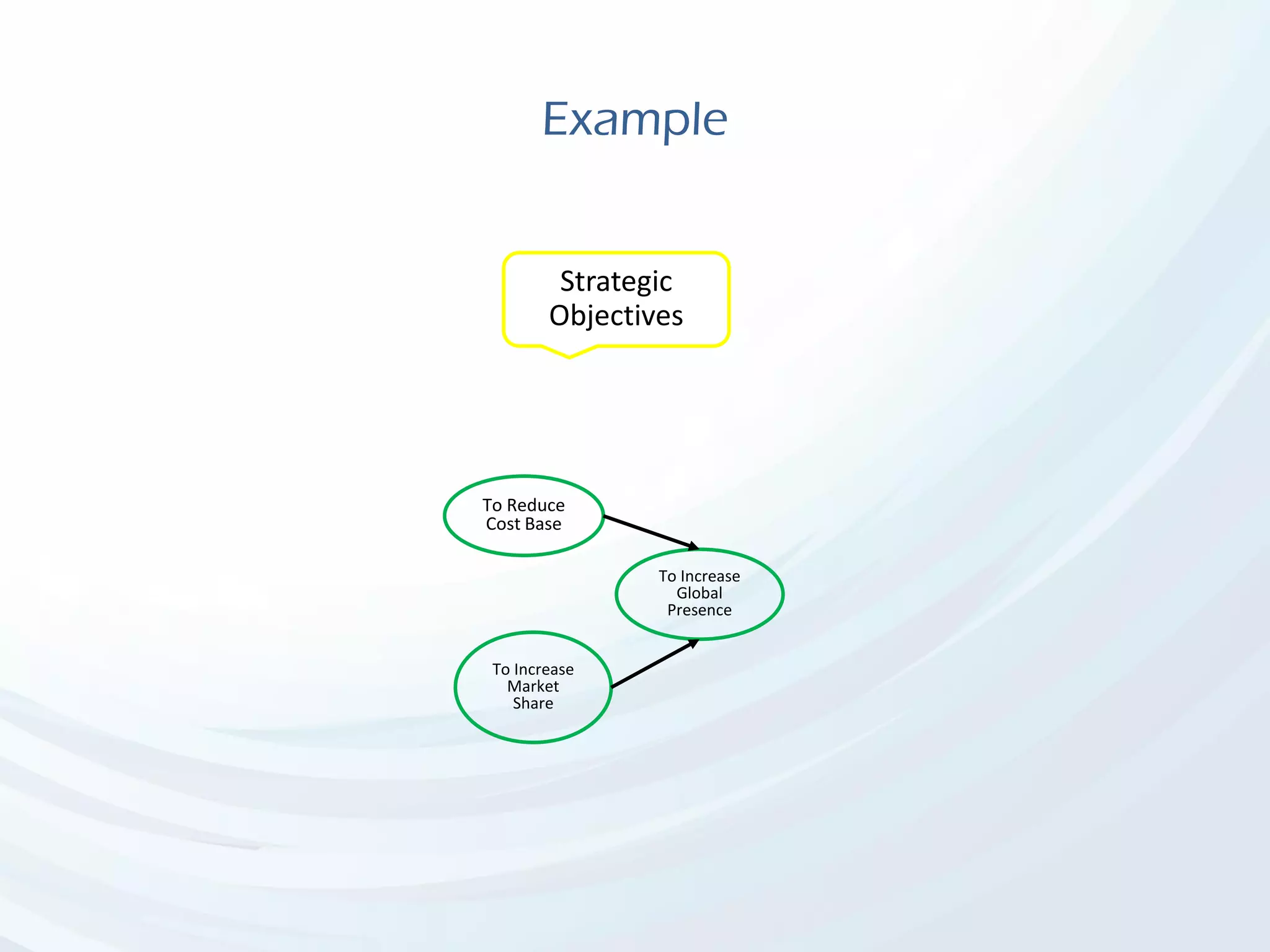
Example
To Increase
Global
Presence
To Increase
Market
Share
To Reduce
Cost Base
Strategic
Objectives
To Increase
Global
Presence
To Increase
Market
Share
To Reduce
Cost Base
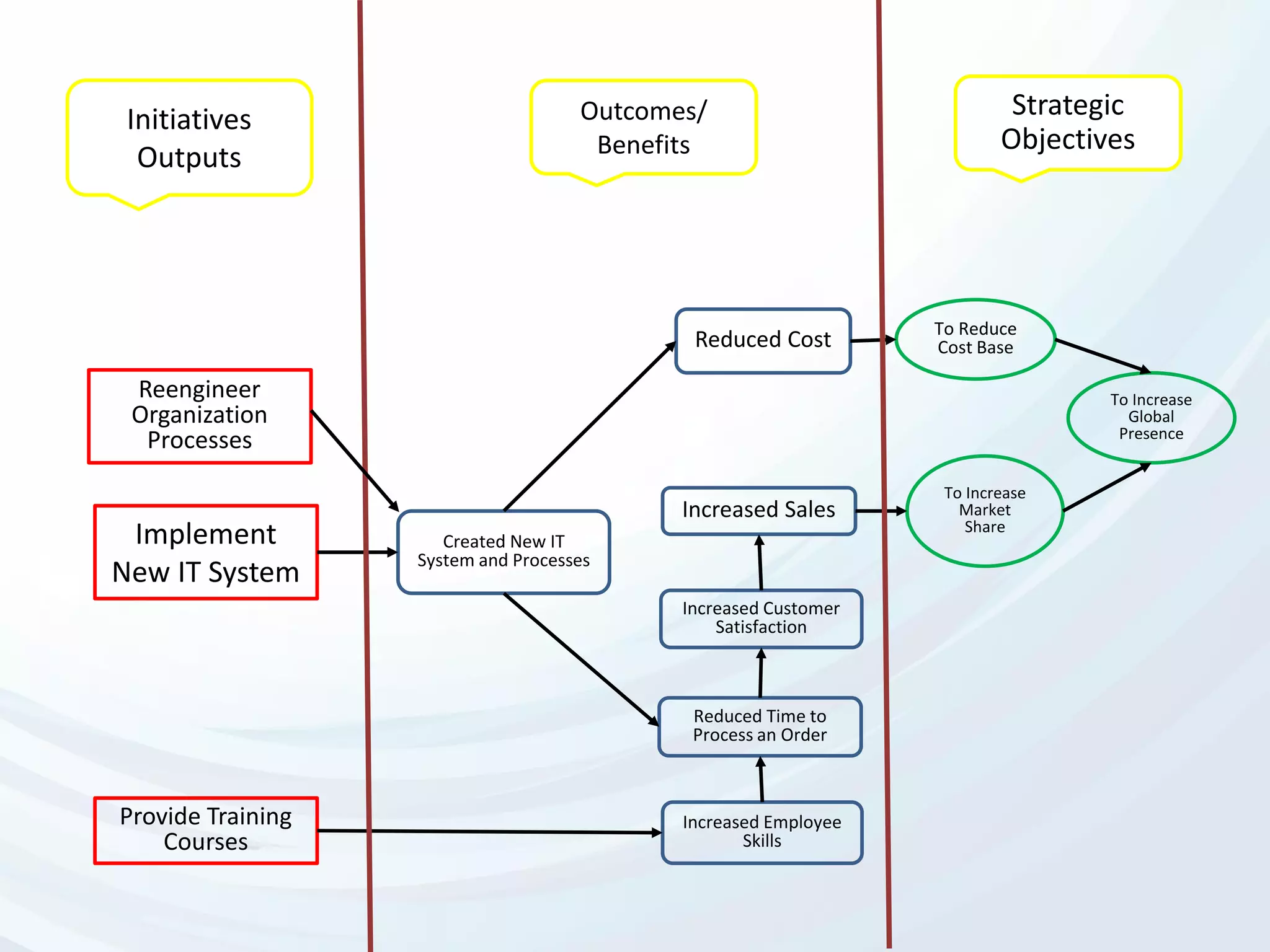
Increased Customer
Satisfaction
Increased Sales
Reduced Time to
Process an Order
Reduced Cost
Increased Employee
Skills
Created New IT
System and Processes
Outcomes/
Benefits
Strategic
Objectives
To Increase
Global
Presence
To Increase
Market
Share
To Reduce
Cost Base
Increased Customer
Satisfaction
Increased Sales
Reduced Time to
Process an Order
Reduced Cost
Increased Employee
Skills
Created New IT
System and Processes
Implement
New IT System
Provide Training
Courses
Initiatives
Outputs
Outcomes/
Benefits
Strategic
Objectives
Reengineer
Organization
Processes
Agenda
• Benefits Realization Management Definition.
• Why Benefits Realization Management?
• Benefits Realization Management Framework.
• Benefits Identification.
• Benefits Execution.
• Benefits Sustainment.
• PMO, PMs Role in Benefits Realization Management.
• Conclusion.
Why Benefits Realization Management?
• Projects and programs deliver benefits and drive strategy.
• This is a fact not always recognized by organizational leaders who
are more focused on issues of cost and ROI than on the execution of
projects.
• Benefits realization is a way to change that thinking, underline how
projects and programs deliver benefits to the business, and enable
the necessary change.
To Increase
Global
Presence
To Increase
Market
Share
To Reduce
Cost Base
Increased Customer
Satisfaction
Increased Sales
Reduced Time to
Process an Order
Reduced Cost
Increased Employee
Skills
Created New IT
System and Processes
Implement
New IT System
Provide Training
Courses
Initiatives
Outputs
Outcomes/
Benefits
Strategic
Objectives
Reengineer
Organization
Processes
Why Benefits Realization Management?
• It’s central to use benefits to decide which project ideas to invest in.
• They need to be part of the concept brief and business case.
• A temporary project will deliver the outputs, the permanent part of
the organization needs to own benefits, be accountable, be
measuring, then actively use those measures to make adjustments or
to even terminate a project that will not create the desired value.
Why Benefits Realization Management?
• Adopting benefits management can help organizations increase the
value of their investments.
• It requires purposeful attention to which projects and programs are
approved—and why.
• It facilitates more effective decision making about investments.
Why Benefits Realization Management?
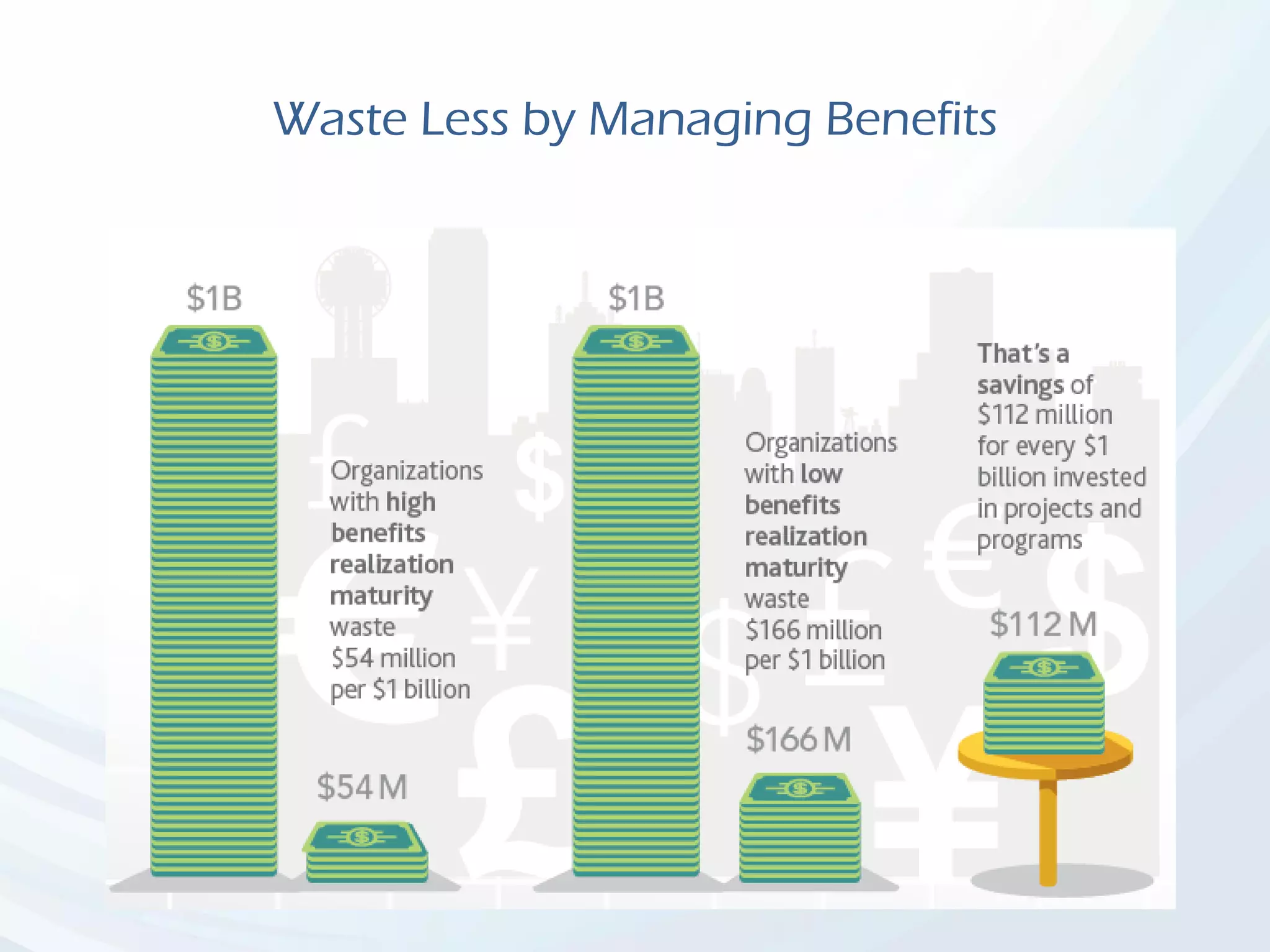
• In fact, organizations with high benefits realization maturity waste
67 percent less money than those with low maturity, because they
have better project performance.
• Despite the proven value of benefits management, the data from
PMI 2016 Pulse of the Profession® reveals that a staggering 83
percent of organizations lack maturity with benefits realization,
raising myriad questions about how they understand the business
value of projects and programs.
Waste Less by Managing Benefits
Why Benefits Realization Management?
• PMI research further confirms that this lack of Benefits Realization
Management maturity may be contributing to projects—including
strategic initiatives—failing to achieve their original goals and
business intent.
• And that identifying benefits as part of the business case, even
before the start of a project, improves outcomes.
Why Benefits Realization Management?
• Specifically, 45 percent more projects meet original goals and
business intent in organizations with high maturity in benefits
realization, compared to those with low maturity.
• This translates to significantly fewer dollars wasted.
Improve Project Outcomes with Identifying Benefits
Agenda
• Benefits Realization Management (BRM)Definition.
• Why Benefits Realization Management?
• Benefits Realization Management Framework.
• Benefits Identification.
• Benefits Execution.
• Benefits Sustainment.
• EPMO, PMs Role in Benefits Realization Management.
• Conclusion.
Benefits Realization Management Framework
• Benefits realization management provides organizations with a way
to measure how projects and programs add true value to the
enterprise.
Benefits Realization Management Framework
• IDENTIFY BENEFITS to determine whether projects, programs, and
portfolios can produce the intended business results.
• EXECUTE BENEFITS to minimize risks to future benefits and
maximize the opportunity to gain additional benefits.
• SUSTAIN BENEFITS to ensure that whatever the project or program
produces continues to create value.
Agenda
• Benefits Realization Management Definition.
• Why Benefits Realization Management?
• Benefits Realization Management Framework.
• Benefits Identification.
• Benefits Execution.
• Benefits Sustainment.
• PMO, PMs Role in Benefits Realization Management.
• Conclusion.
Benefits Identification
• A look at the practices performed at the start of a project or program
that enable organizations to identify expected benefits.
Strengthen the Conversation
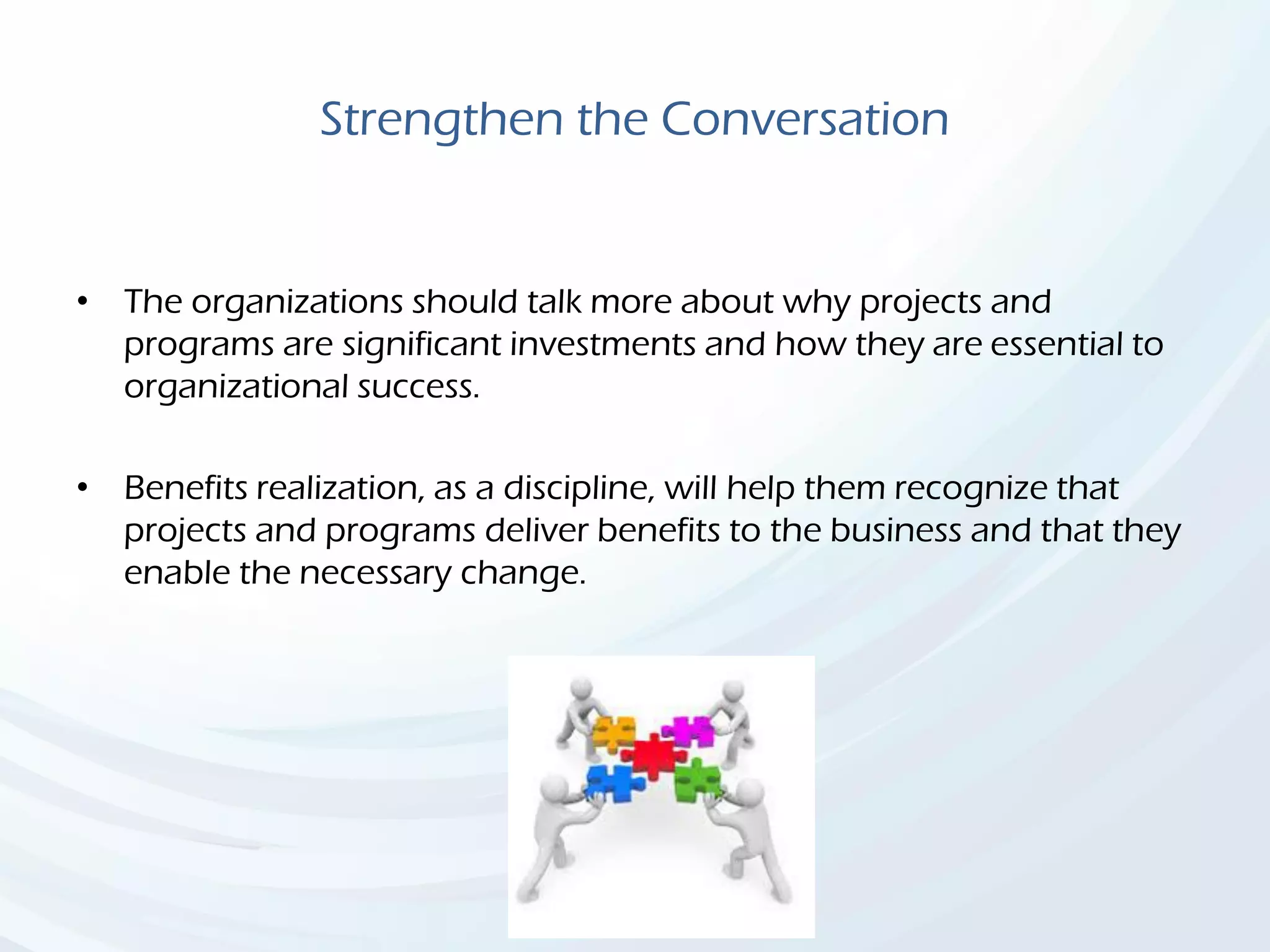
• The organizations should talk more about why projects and
programs are significant investments and how they are essential to
organizational success.
• Benefits realization, as a discipline, will help them recognize that
projects and programs deliver benefits to the business and that they
enable the necessary change.
Strengthen the Conversation
• So when project and program benefits are identified as integral
parts of the business case, and tracked from project initiation
through transfer to the business and beyond, organizations can
better ensure they’re delivering value.
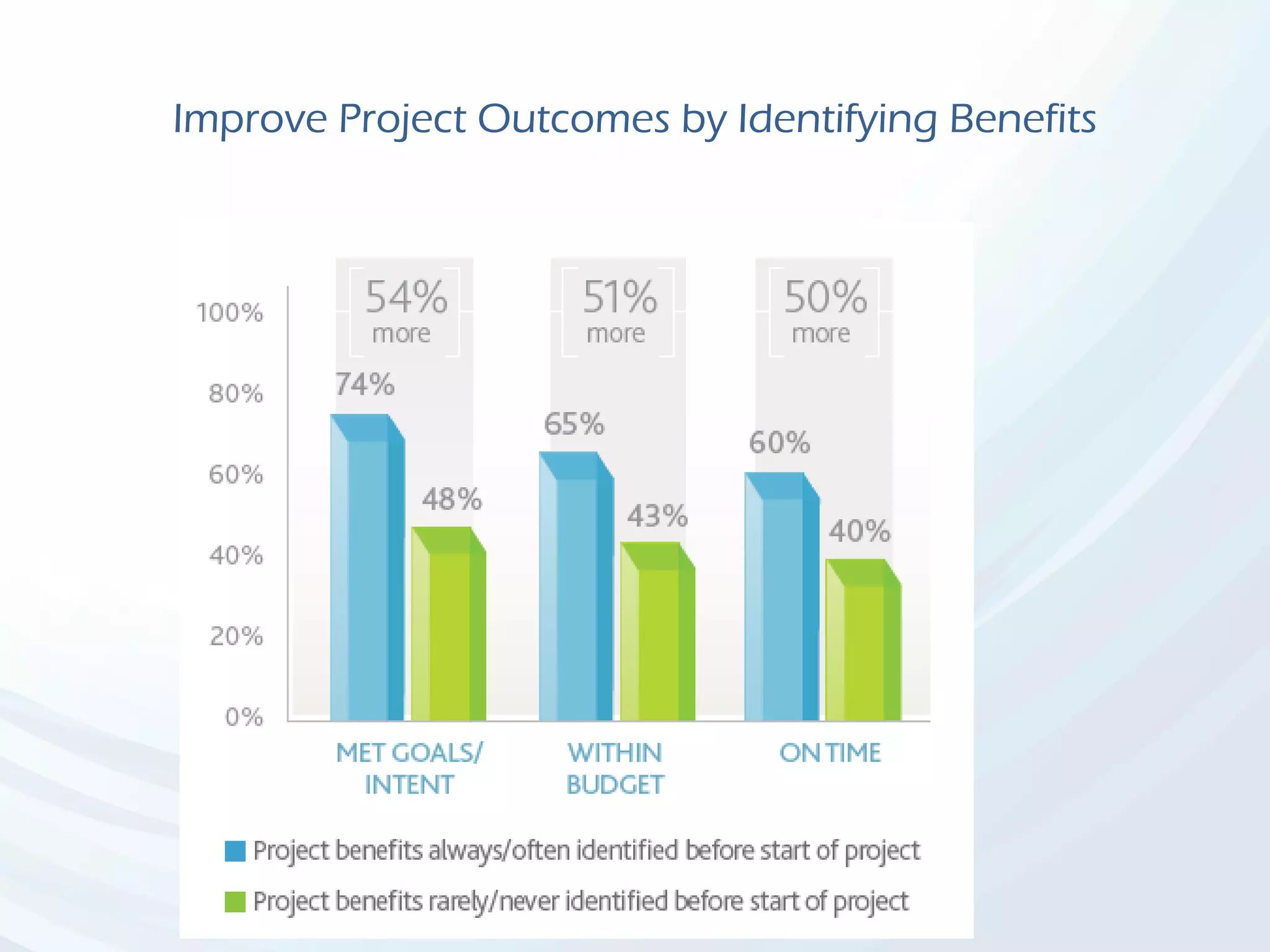
• As we discovered, when project benefits are identified before the
start of a project, 54 percent more projects meet original goals and
business intent (see the Figure):
Improve Project Outcomes by Identifying Benefits
Accountability and Responsibility
• Benefits identification is a shared responsibility between leadership,
Business Owners, Functional Managers, EPMO and project teams.
Time to do benefits identification
• Developing or Updating Organization Strategic (Business) Plan.
• During Develop Business Case for Projects or Programs.
• According to Benefits Realization Plan.
Questions to ask during benefits identification
• Why are we doing the project or program?
• what are the business drivers?
• What are the measurable benefits?
• Who is accountable for the benefits?
• Who ensures the project benefits are aligned with strategic goals?
• Who signs off on the benefits?
Activities that make up benefits identification
• Defining the objectives and critical success factors.
• Recognizing and quantifying business benefits.
• Developing meaningful metrics and key performance indicators to
measure the actual delivery of benefits and planned benefits.
• Establishing processes for measuring progress against benefits plan.
• Creating a communications plan necessary to record progress and
report to stakeholders.
Deliverables Produced or Checked in the benefits
identification
• Defining the objectives and critical success factors.
– Strategic (Business Plan).
• Recognizing and quantifying business benefits.
– Benefits breakdown structure.
– Benefits realization Roadmap (Benefits Schedule).
– Benefits register.
– Benefits realization plan.
– Benefits sustainment plan.
Deliverables Produced or Checked in the benefits
identification
• Developing meaningful metrics and key performance indicators to
measure the actual delivery of benefits and planned benefits.
– BENEFITS KPI Cards that capture information like:
• KPI name.
• Unit.
• Equation.
• Baseline.
• Target
• Responsible.
• Process.
• Frequency.
• Communication ( Reports – Meeting).
• Stakeholders Involved.
• Business Owner.
Deliverables Produced or Checked in the benefits
identification
• Establishing processes for measuring progress against benefits plan.
– Benefits related Processes ( plan, measure, report, adopt) Manual.
– Benefits KPI cards.
• Creating a communications plan necessary to record progress and
report to stakeholders.
– Communication plan.
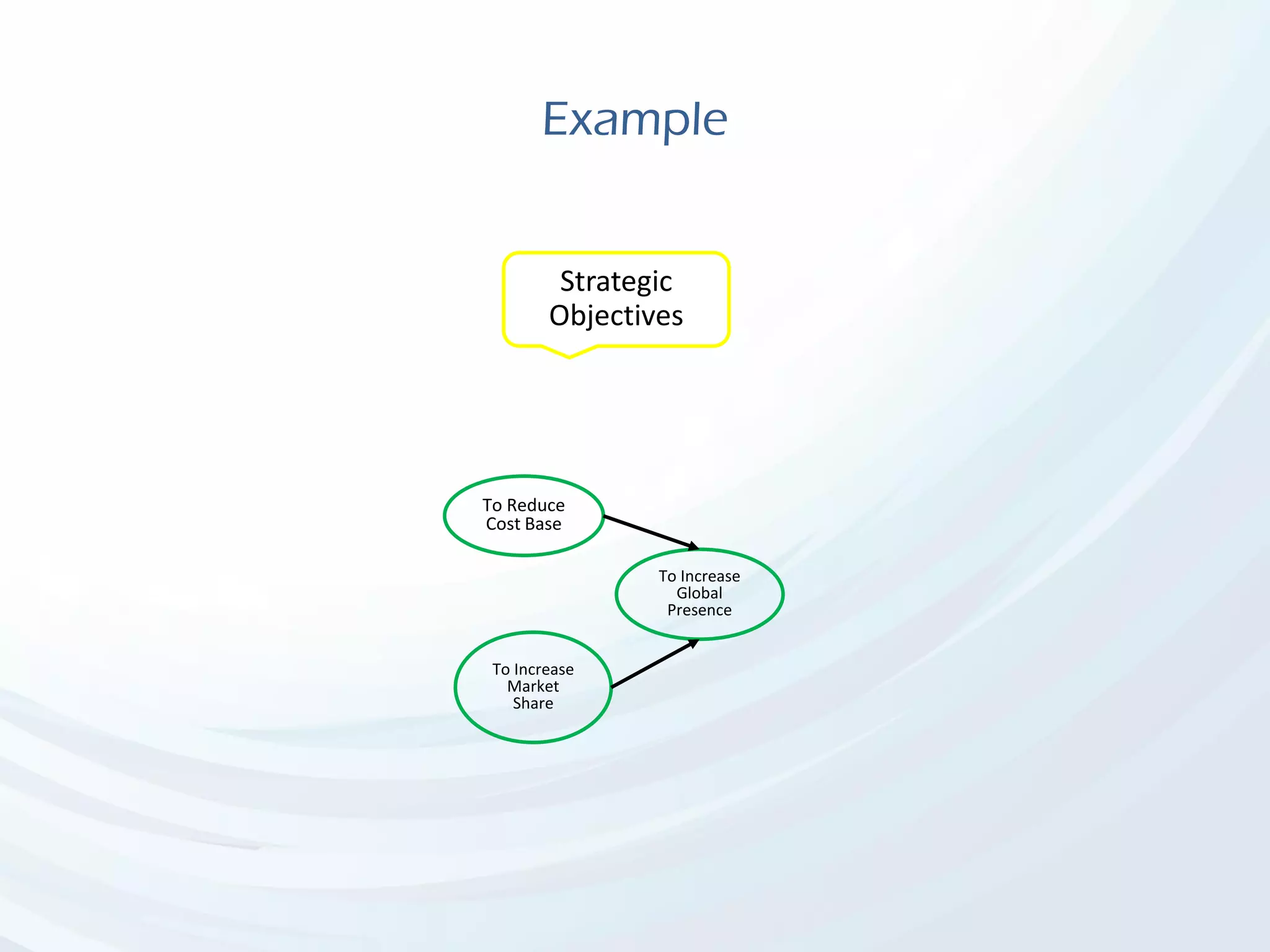
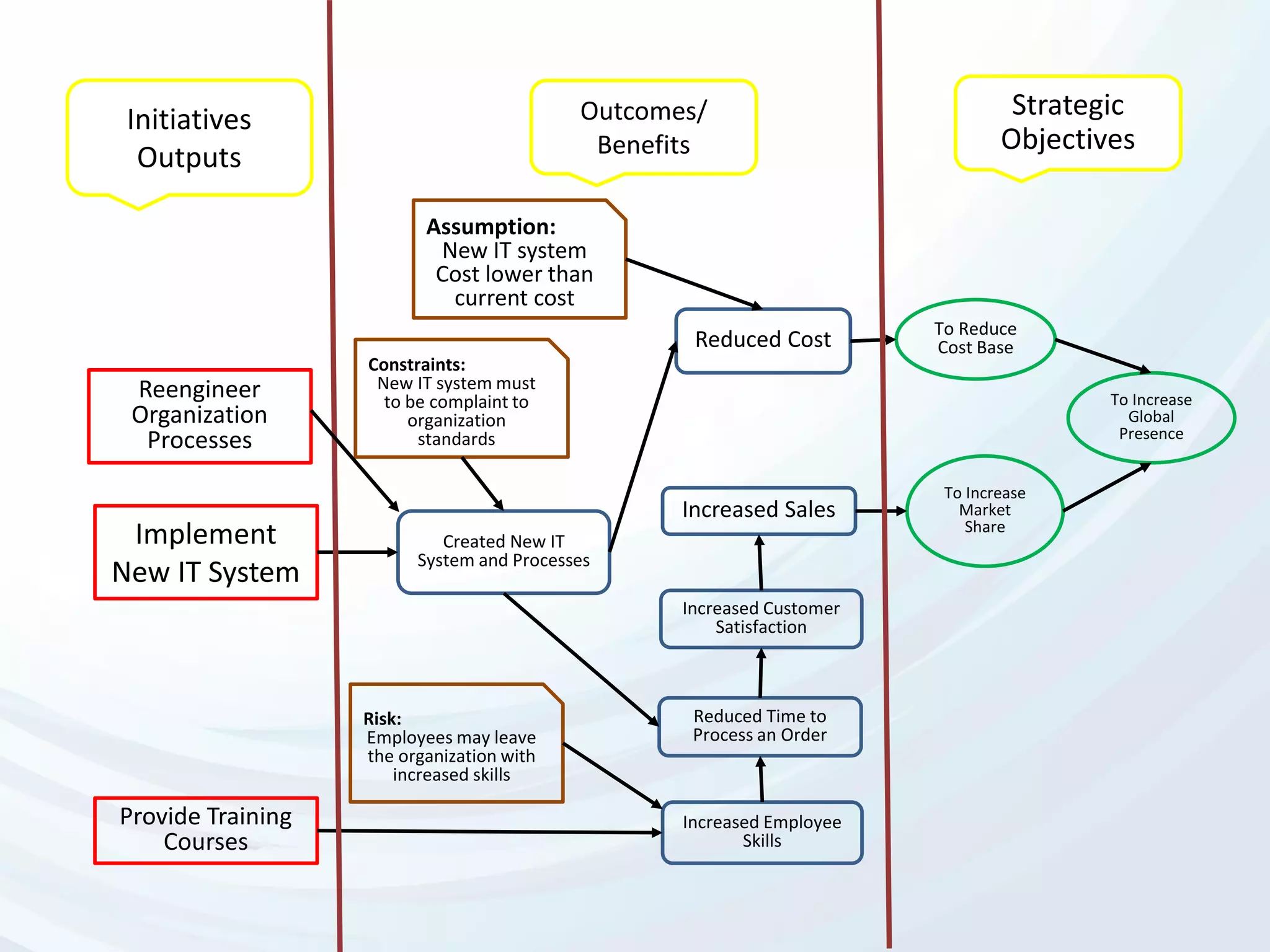
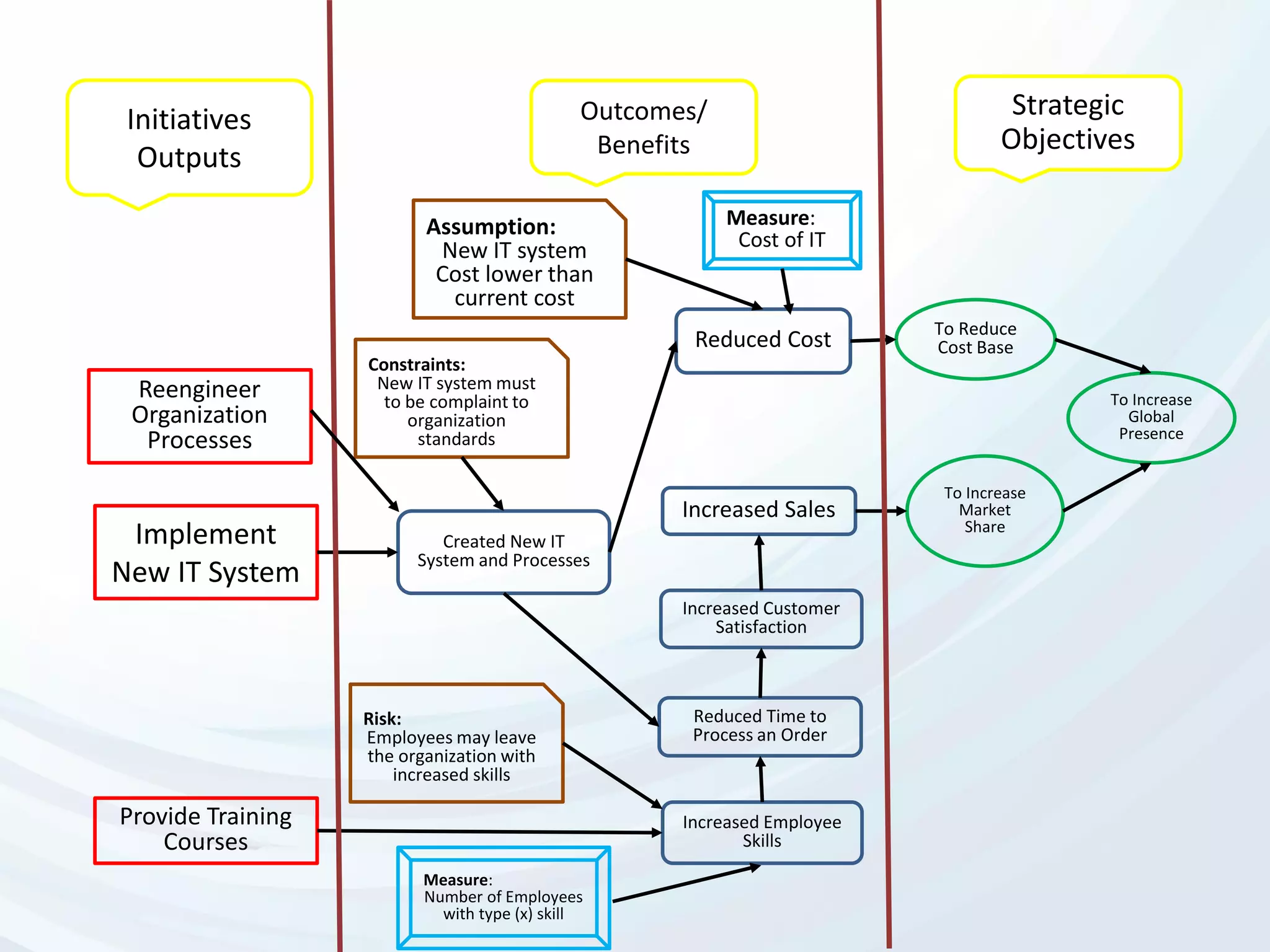
Example
To Increase
Global
Presence
To Increase
Market
Share
To Reduce
Cost Base
Strategic
Objectives
To Increase
Global
Presence
To Increase
Market
Share
To Reduce
Cost Base
Increased Customer
Satisfaction
Increased Sales
Reduced Time to
Process an Order
Reduced Cost
Increased Employee
Skills
Created New IT
System and Processes
Outcomes/
Benefits
Strategic
Objectives
To Increase
Global
Presence
To Increase
Market
Share
To Reduce
Cost Base
Increased Customer
Satisfaction
Increased Sales
Reduced Time to
Process an Order
Reduced Cost
Increased Employee
Skills
Created New IT
System and Processes
Implement
New IT System
Provide Training
Courses
Initiatives
Outputs
Outcomes/
Benefits
Strategic
Objectives
Reengineer
Organization
Processes
To Increase
Global
Presence
To Increase
Market
Share
To Reduce
Cost Base
Increased Customer
Satisfaction
Increased Sales
Reduced Time to
Process an Order
Reduced Cost
Increased Employee
Skills
Created New IT
System and Processes
Implement
New IT System
Provide Training
Courses
Initiatives
Outputs
Outcomes/
Benefits
Strategic
Objectives
Assumption:
New IT system
Cost lower than
current cost
Constraints:
New IT system must
to be complaint to
organization
standards
Risk:
Employees may leave
the organization with
increased skills
Reengineer
Organization
Processes
To Increase
Global
Presence
To Increase
Market
Share
To Reduce
Cost Base
Increased Customer
Satisfaction
Increased Sales
Reduced Time to
Process an Order
Reduced Cost
Increased Employee
Skills
Created New IT
System and Processes
Implement
New IT System
Provide Training
Courses
Initiatives
Outputs
Outcomes/
Benefits
Strategic
Objectives
Assumption:
New IT system
Cost lower than
current cost
Constraints:
New IT system must
to be complaint to
organization
standards
Risk:
Employees may leave
the organization with
increased skills
Measure:
Cost of IT
Measure:
Number of Employees
with type (x) skill
Reengineer
Organization
Processes
To Increase
Global
Presence
To Increase
Market
Share
To Reduce
Cost Base
Increased Customer
Satisfaction
Increased Sales
Reduced Time to
Process an Order
Reduced Cost
Increased Employee
Skills
Created New IT
System and Processes
Implement
New IT System
Provide Training
Courses
Initiatives
Outputs
Outcomes/
Benefits
Strategic
Objectives
Assumption:
New IT system
Cost lower than
current cost
Constraints:
New IT system must
to be complaint to
organization
standards
Risk:
Employees may leave
the organization with
increased skills
Measure:
Cost of IT
Measure:
Number of Employees
with type (x) skill
Reengineer
Organization
Processes
25%
100%
50%
50%
100%
70%
75%
100%
100%
100%
100%
30%
Agenda
• Benefits Realization Management Definition.
• Why Benefits Realization Management?
• Benefits Realization Management Framework.
• Benefits Identification.
• Benefits Execution.
• Benefits Sustainment.
• EPMO, PMs Role in Benefits Realization Management.
• Conclusion.
Benefits Execution
• A look at practices that enable organizations to deliver the expected
benefits.
Benefits Execution
• Organizations spend millions of dollars on projects that never meet
expectations to deliver intended benefits to the business.
• The paradox? Many of these projects are still considered a success.
Benefits Execution
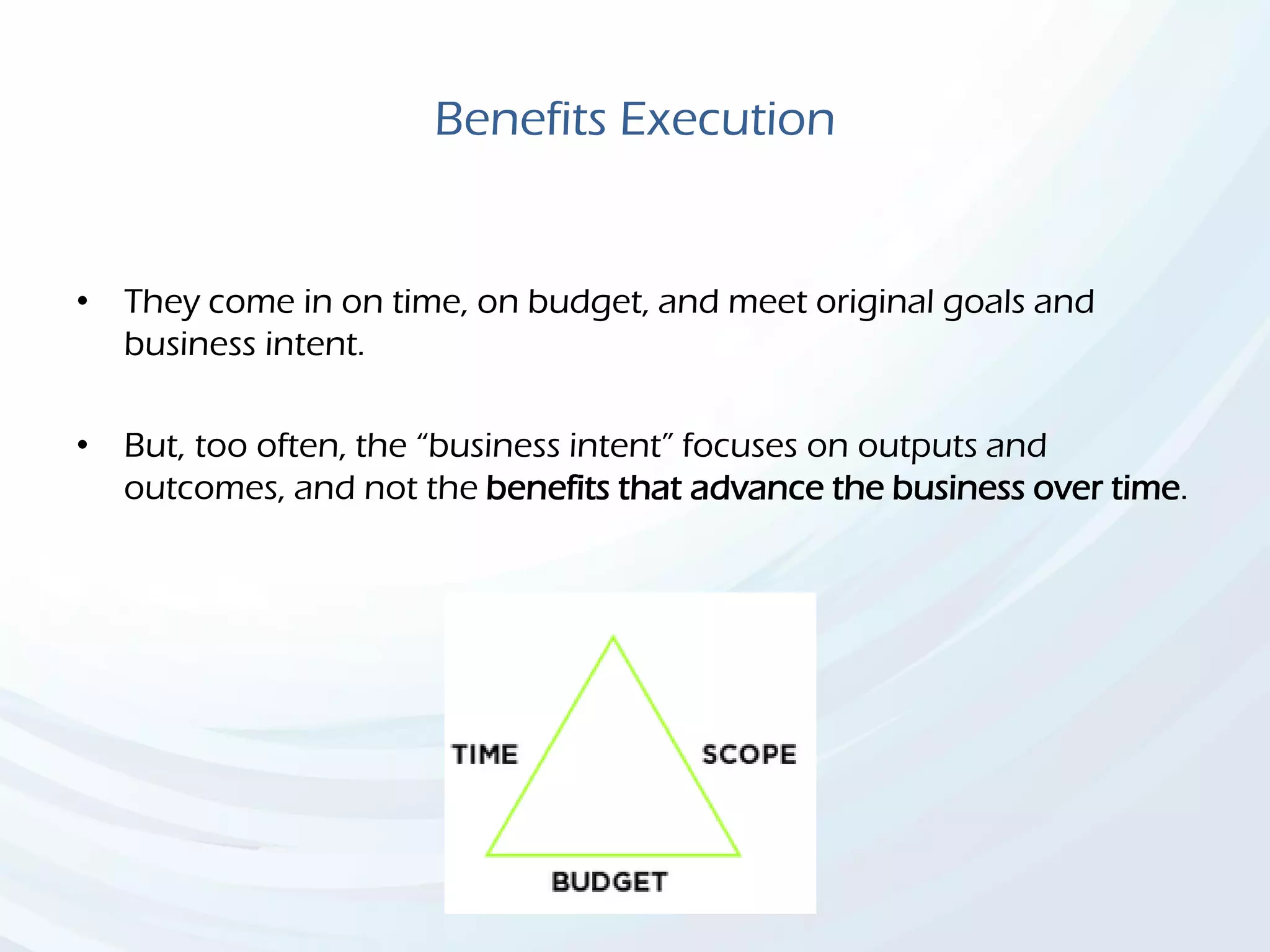
• They come in on time, on budget, and meet original goals and
business intent.
• But, too often, the “business intent” focuses on outputs and
outcomes, and not the benefits that advance the business over time.
Benefits Execution
• The reason seems clear : there is an ongoing disconnect in the
minds of executive leaders about the strategic value of projects.
• Too few recognize that all strategic initiatives are projects and
programs, and that the benefits they deliver justify their cost.
Benefits Execution
• So how can project teams, along with business owners, help
leadership recognize—and appreciate—this critical connection?
• The answers are found in benefits realization management.
Benefits Execution
• This requires aligning definitions of success, enabling project and
program management to deliver on that success, and measuring
and adjusting project benefits.
• Project managers are in the best position to monitor whether a
project is on course to deliver the expected benefits.
Benefits Execution
• During the life cycle of a project, they have a first-hand opportunity
to track metrics, flag and manage emerging risks, and deliver the
type of information executive leaders need.
• All this helps executives decide the future of a project and the
business if targeted benefits—both tangible and intangible—are in
risk or no longer relevant.
Benefits Execution
• The role for project managers in ensuring an organization’s
expected benefits are delivered when a project is complete.
Benefits Execution
• That role is especially important during project execution, where
benefits can be derailed due to:
– Changes in the business.
– Resource challenges.
– External forces such as sudden shifts in customer demands,
which no longer align with the project’s original goals.
Accountability and Responsibility
• Many organizations simply find the discipline difficult.
• They struggle with the fact that project-driven benefits are not fully
realized for weeks, months, or even years after a project ends, so
they don’t always know who’s responsible for managing the
benefits.
Accountability and Responsibility
• Since many anticipated benefits will not be seen until after the
project has been delivered, it’s critical to have an owner for ongoing
benefits measurement.
• Assigning an owner puts someone in charge of consciously and
deliberately monitoring and measuring benefits.
Accountability and Responsibility
• Benefits management as a solution process that requires a dedicated
function in charge of benefits realization, keeping it separate from
delivery.
• That “owner” works directly with the project manager, EPMO and
their relationship bridges the responsibility for benefits
management, from project execution to operations.
Accountability and Responsibility
• During project execution project managers are primarily responsible
for:
– Measuring identified benefits.
– Revisiting expected benefits.
– Communicating with business owners EPMO to keep them
informed about benefits-related issues.
– Ensuring project benefits stay aligned to the organization’s
strategic objectives.
Questions to ask during the Execution
• Have benefits been developed and agreed upon?
• Have key stakeholders been consulted?
• Are report structures and benefits monitoring processes in place?
• Have the benefits been reviewed and updated?
• Are benefits aligned to the organization’s strategic objectives?
Agenda
• Benefits Realization Management Definition.
• Why Benefits Realization Management?
• Benefits Realization Management Framework.
• Benefits Identification.
• Benefits Execution.
• Benefits Sustainment.
• EPMO, PMs Role in Benefits Realization Management.
• Conclusion.
Benefits Sustainment
• A look at the practices that enable organizations to sustain benefits
and achieve strategic objectives.
• Benefits sustainment identifies the processes, measures, metrics, and
tools necessary to ensure the continued realization of the intended
benefits.
Benefits Sustainment
• Benefits sustainment—the post-project phase of the benefits
realization cycle—ensures that whatever the project produces
continues to create value once those outputs and outcomes
transition back to the business.
• It’s a way for organizations to realize a greater return on their
investments, but it doesn’t happen by chance.
Benefits Sustainment
• The work after the project—the benefits sustainment phase—is just as
vital as the work during the project.
• It requires the same attention, including leadership support, as
project level activity.
• It also requires a commitment to monitoring and measuring
progress—and responding to any problems that interfere with
benefits realization.
Accountability and Responsibility
• Once a project ends, its outputs and outcomes enter the transition
and sustainment phases, which is an especially challenging part of
benefits realization management.
• During that time, the project team hands off its deliverables to the
business owner and operations team, who have the responsibility to
stay focused on the associated benefits over time—often for a
considerable period.
Questions to Answer
Activities during Benefits Sustainment
• Redefine and reorder benefits roles and responsibilities after the formal
transition when benefits sustainment is largely an operations responsibility.
• Carrying out post-project evaluations.
• Capturing and sharing of lessons learned.
• Maintaining strong cross-functional communications and engagement.
• Monitoring and measuring benefits performance and reporting results to
key stakeholders.
• Supporting evolving user needs and product improvements.
• Developing business cases for future initiatives to address operational needs.
Agenda
• Benefits Realization Management Definition.
• Why Benefits Realization Management?
• Benefits Realization Management Framework.
• Benefits Identification.
• Benefits Execution.
• Benefits Sustainment.
• EPMO, PMs Role in Benefits Realization Management.
• Conclusion.
The Role of the EPMO in Benefits Realization Management
• As organizations mature their project, program, and portfolio
management practices to better align work with strategic goals and
to place a focus on confirming and realizing value from
organizational investments through effective benefits realization
management, the EPMO has many opportunities to capitalize on as
a leader and significant contributor to advancing critical topics, such
as the notion of value management.
The Role of the EPMO in Benefits Realization Management
• We see from the PMI 2016 Pulse report that organizations with high
benefits realization maturity are nearly twice as likely to report
having an EPMO and that organizational performance tends to track
higher.
• This puts the EPMO in the ideal position to fully embrace value
management and the related benefits capturing.
The Role of the EPMO in Benefits Realization Management
• The data from PMI research points to the opportunity for the EPMO
to mature the role of helping organizations align their strategic goals
and objectives to better outputs from programs of work and related
projects.
• These outputs, in turn, are the catalysts for deriving outcomes—
benefits that are captured and confirmed.
The Role of the EPMO in Benefits Realization Management
• This is a fantastic opportunity for EPMOs and for the profession, as
currently there is confusion around responsibility and even
authority.
• EPMOs can be the champions of benefits on behalf of every
organization.
Agenda
• Benefits Realization Management Definition.
• Why Benefits Realization Management?
• Benefits Realization Management Framework.
• Benefits Identification.
• Benefits Execution.
• Benefits Sustainment.
• EPMO, PMs Role in Benefits Realization Management.
• Conclusion.
Path to Greater Benefits Realization Management Maturity
Conclusion
• When benefits are managed well, organizations realize the greatest
possible return on their investments.
• But far too few organizations have effective benefits realization
management processes in place.
• In fact, many have no benefits management approaches at all.
Conclusion
• And they are missing an opportunity to ensure that their projects
deliver the expected strategic impact and drive organizational
success.
• We already know that when organizations embrace project,
program, and portfolio management practices, they have better
results.
• Yet even those organizations that are high performers rarely pay
enough attention to benefits management.
Conclusion
• They might be good at completing projects and programs
successfully, but rarely connect those projects back to the business
purpose—often because they have failed to identify the expected
benefits before the start of the project—and that leaves value
unrealized.
Conclusion
• Organizations that value project management as the strategic
capability that drives change already perform better than their
counterparts.
• When benefits realization management is part of a disciplined
approach to project management, that performance gets even
better.
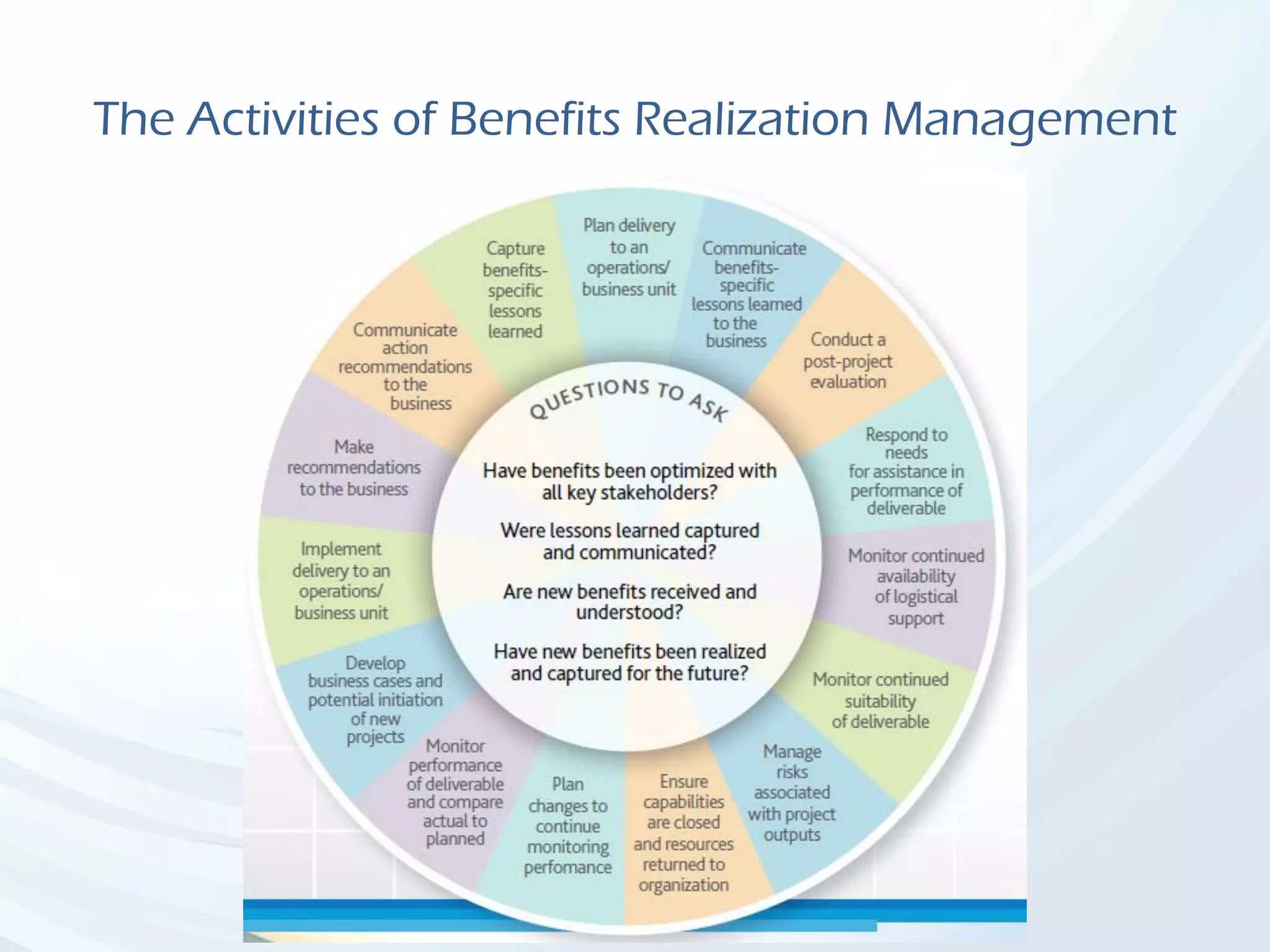
The Activities of Benefits Realization Management
Agenda
• Benefits Realization Management Definition.
• Why Benefits Realization Management?
• Benefits Realization Management Framework.
• Benefits Identification.
• Benefits Execution.
• Benefits Sustainment.
• EPMO, PMs Role in Benefits Realization Management.
• Conclusion.
https://www.facebook.com/abdelrahmansida/
https://www.youtube.com/c/abdelrahmanelsheikh
https://www.linkedin.com/in/abdelrahmanelsheikh/
https://twitter.com/AbdelrahmanSida
https://www.slideshare.net/abdelrahmanelsheikh1
Benefits Realization Management  إدارة تحقيق المنافع

Benefits Realization Management إدارة تحقيق المنافع

  • 1.
    ‫المنافع‬ ‫تحقيق‬ ‫إدارة‬ BenefitsRealization Management Abdelrahman Elsheikh Seedahmed , M.sc, PMOC,CBAP, PMP, RMP, ACP, PMI-SP, KPI-A, EVM,CPRE, MCITP, MCTS, OCP, OCA, ITIL v3, CTFL, ISO20000, ISO27002
  • 2.
    Abdelrahman Elsheikh Bio 15 experience as Strategic PMO Director, Strategy Execution Consultant, PMO Consultant, Project Manager, Business Analyst and Software Engineer. • Master Degree in Software Engineering. • Project Management Office Certification (PMOC). • Certified Project Management Professional (PMP). • Agile Certified Practitioner (PMI-ACP). • Risk Management Professional (PMI-RMP). • Schedule Professional (PMI-SP). • Certified Business Analyst Professional (CBAP). • Microsoft Certified IT Professional (MCITP). • Key Performance Indicator Associate (KPI-A). • OCP and OCA. • Certified Professional for Requirement Engineer (CPRE). • Certified Tester Foundation Level (CTFL). • Earned Value Project Management (EVM). • ISO/IEC 20000 Foundation. • ISO/IEC 27002 Foundation. • Certified ITIL Foundation Level.
  • 3.
    Agenda • Benefits RealizationManagement Definition. • Why Benefits Realization Management? • Benefits Realization Management Framework. • Benefits Identification. • Benefits Execution. • Benefits Sustainment. • EPMO, PMs Role in Benefits Realization Management. • Conclusion.
  • 4.
    Agenda • Benefits RealizationManagement Definition. • Why Benefits Realization Management? • Benefits Realization Management Framework. • Benefits Identification. • Benefits Execution. • Benefits Sustainment. • EPMO, PMs Role in Benefits Realization Management. • Conclusion.
  • 5.
    Benefits Realization ManagementDefinition • There are three levels of achievement: 1. Outputs, products, or solutions are created by the project work. 2. The output(s) result in outcomes. 3. The outcome(s) create benefits and business value.
  • 6.
    Benefits Realization ManagementDefinition Output Outcome Benefit Project Positive / Negative Positive Outcome Impact
  • 7.
    Example • As anexample in a project designed to implement a document management system: • The implemented document management system that users can actually use is the output. • This output results in certain outcomes, for example: – faster and easier access to the documents. – fewer mistakes in archiving and retrieving documents. – ability to control versions and having access to the latest revisions. – ability to have reports that help us find solutions for other business problems. • And finally, those outcomes create benefits, or in other words, business value: – 2% cut in the operation cost.
  • 8.
    Benefits • An outcomeswhose nature and value are considered advantageous by an organization. • An outcomes which is perceived as positive by Stakeholders.
  • 9.
    Benefits Realization • Benefitsrealization is the means to ensuring that benefits are derived from outputs and outcomes. • Benefit realization has been maturing since the 1990's and aims to address a single problem: – "Change (Project) and investment do not consistently deliver enough benefits.“
  • 10.
    Benefits Realization Management •Collective set of processes and practices for identifying benefits and aligning them with formal strategy, ensuring benefits are realized as project implementation progresses and finishes, and that the benefits are sustainable—and sustained—after project implementation is complete.
  • 11.
  • 12.
    To Increase Global Presence To Increase Market Share ToReduce Cost Base Increased Customer Satisfaction Increased Sales Reduced Time to Process an Order Reduced Cost Increased Employee Skills Created New IT System and Processes Outcomes/ Benefits Strategic Objectives
  • 13.
    To Increase Global Presence To Increase Market Share ToReduce Cost Base Increased Customer Satisfaction Increased Sales Reduced Time to Process an Order Reduced Cost Increased Employee Skills Created New IT System and Processes Implement New IT System Provide Training Courses Initiatives Outputs Outcomes/ Benefits Strategic Objectives Reengineer Organization Processes
  • 14.
    Agenda • Benefits RealizationManagement Definition. • Why Benefits Realization Management? • Benefits Realization Management Framework. • Benefits Identification. • Benefits Execution. • Benefits Sustainment. • PMO, PMs Role in Benefits Realization Management. • Conclusion.
  • 15.
    Why Benefits RealizationManagement? • Projects and programs deliver benefits and drive strategy. • This is a fact not always recognized by organizational leaders who are more focused on issues of cost and ROI than on the execution of projects. • Benefits realization is a way to change that thinking, underline how projects and programs deliver benefits to the business, and enable the necessary change.
  • 16.
    To Increase Global Presence To Increase Market Share ToReduce Cost Base Increased Customer Satisfaction Increased Sales Reduced Time to Process an Order Reduced Cost Increased Employee Skills Created New IT System and Processes Implement New IT System Provide Training Courses Initiatives Outputs Outcomes/ Benefits Strategic Objectives Reengineer Organization Processes
  • 17.
    Why Benefits RealizationManagement? • It’s central to use benefits to decide which project ideas to invest in. • They need to be part of the concept brief and business case. • A temporary project will deliver the outputs, the permanent part of the organization needs to own benefits, be accountable, be measuring, then actively use those measures to make adjustments or to even terminate a project that will not create the desired value.
  • 18.
    Why Benefits RealizationManagement? • Adopting benefits management can help organizations increase the value of their investments. • It requires purposeful attention to which projects and programs are approved—and why. • It facilitates more effective decision making about investments.
  • 19.
    Why Benefits RealizationManagement? • In fact, organizations with high benefits realization maturity waste 67 percent less money than those with low maturity, because they have better project performance. • Despite the proven value of benefits management, the data from PMI 2016 Pulse of the Profession® reveals that a staggering 83 percent of organizations lack maturity with benefits realization, raising myriad questions about how they understand the business value of projects and programs.
  • 20.
    Waste Less byManaging Benefits
  • 21.
    Why Benefits RealizationManagement? • PMI research further confirms that this lack of Benefits Realization Management maturity may be contributing to projects—including strategic initiatives—failing to achieve their original goals and business intent. • And that identifying benefits as part of the business case, even before the start of a project, improves outcomes.
  • 22.
    Why Benefits RealizationManagement? • Specifically, 45 percent more projects meet original goals and business intent in organizations with high maturity in benefits realization, compared to those with low maturity. • This translates to significantly fewer dollars wasted.
  • 23.
    Improve Project Outcomeswith Identifying Benefits
  • 24.
    Agenda • Benefits RealizationManagement (BRM)Definition. • Why Benefits Realization Management? • Benefits Realization Management Framework. • Benefits Identification. • Benefits Execution. • Benefits Sustainment. • EPMO, PMs Role in Benefits Realization Management. • Conclusion.
  • 25.
    Benefits Realization ManagementFramework • Benefits realization management provides organizations with a way to measure how projects and programs add true value to the enterprise.
  • 26.
    Benefits Realization ManagementFramework • IDENTIFY BENEFITS to determine whether projects, programs, and portfolios can produce the intended business results. • EXECUTE BENEFITS to minimize risks to future benefits and maximize the opportunity to gain additional benefits. • SUSTAIN BENEFITS to ensure that whatever the project or program produces continues to create value.
  • 27.
    Agenda • Benefits RealizationManagement Definition. • Why Benefits Realization Management? • Benefits Realization Management Framework. • Benefits Identification. • Benefits Execution. • Benefits Sustainment. • PMO, PMs Role in Benefits Realization Management. • Conclusion.
  • 28.
    Benefits Identification • Alook at the practices performed at the start of a project or program that enable organizations to identify expected benefits.
  • 29.
    Strengthen the Conversation •The organizations should talk more about why projects and programs are significant investments and how they are essential to organizational success. • Benefits realization, as a discipline, will help them recognize that projects and programs deliver benefits to the business and that they enable the necessary change.
  • 30.
    Strengthen the Conversation •So when project and program benefits are identified as integral parts of the business case, and tracked from project initiation through transfer to the business and beyond, organizations can better ensure they’re delivering value. • As we discovered, when project benefits are identified before the start of a project, 54 percent more projects meet original goals and business intent (see the Figure):
  • 31.
    Improve Project Outcomesby Identifying Benefits
  • 32.
    Accountability and Responsibility •Benefits identification is a shared responsibility between leadership, Business Owners, Functional Managers, EPMO and project teams.
  • 33.
    Time to dobenefits identification • Developing or Updating Organization Strategic (Business) Plan. • During Develop Business Case for Projects or Programs. • According to Benefits Realization Plan.
  • 34.
    Questions to askduring benefits identification • Why are we doing the project or program? • what are the business drivers? • What are the measurable benefits? • Who is accountable for the benefits? • Who ensures the project benefits are aligned with strategic goals? • Who signs off on the benefits?
  • 35.
    Activities that makeup benefits identification • Defining the objectives and critical success factors. • Recognizing and quantifying business benefits. • Developing meaningful metrics and key performance indicators to measure the actual delivery of benefits and planned benefits. • Establishing processes for measuring progress against benefits plan. • Creating a communications plan necessary to record progress and report to stakeholders.
  • 36.
    Deliverables Produced orChecked in the benefits identification • Defining the objectives and critical success factors. – Strategic (Business Plan). • Recognizing and quantifying business benefits. – Benefits breakdown structure. – Benefits realization Roadmap (Benefits Schedule). – Benefits register. – Benefits realization plan. – Benefits sustainment plan.
  • 37.
    Deliverables Produced orChecked in the benefits identification • Developing meaningful metrics and key performance indicators to measure the actual delivery of benefits and planned benefits. – BENEFITS KPI Cards that capture information like: • KPI name. • Unit. • Equation. • Baseline. • Target • Responsible. • Process. • Frequency. • Communication ( Reports – Meeting). • Stakeholders Involved. • Business Owner.
  • 38.
    Deliverables Produced orChecked in the benefits identification • Establishing processes for measuring progress against benefits plan. – Benefits related Processes ( plan, measure, report, adopt) Manual. – Benefits KPI cards. • Creating a communications plan necessary to record progress and report to stakeholders. – Communication plan.
  • 39.
  • 40.
    To Increase Global Presence To Increase Market Share ToReduce Cost Base Increased Customer Satisfaction Increased Sales Reduced Time to Process an Order Reduced Cost Increased Employee Skills Created New IT System and Processes Outcomes/ Benefits Strategic Objectives
  • 41.
    To Increase Global Presence To Increase Market Share ToReduce Cost Base Increased Customer Satisfaction Increased Sales Reduced Time to Process an Order Reduced Cost Increased Employee Skills Created New IT System and Processes Implement New IT System Provide Training Courses Initiatives Outputs Outcomes/ Benefits Strategic Objectives Reengineer Organization Processes
  • 42.
    To Increase Global Presence To Increase Market Share ToReduce Cost Base Increased Customer Satisfaction Increased Sales Reduced Time to Process an Order Reduced Cost Increased Employee Skills Created New IT System and Processes Implement New IT System Provide Training Courses Initiatives Outputs Outcomes/ Benefits Strategic Objectives Assumption: New IT system Cost lower than current cost Constraints: New IT system must to be complaint to organization standards Risk: Employees may leave the organization with increased skills Reengineer Organization Processes
  • 43.
    To Increase Global Presence To Increase Market Share ToReduce Cost Base Increased Customer Satisfaction Increased Sales Reduced Time to Process an Order Reduced Cost Increased Employee Skills Created New IT System and Processes Implement New IT System Provide Training Courses Initiatives Outputs Outcomes/ Benefits Strategic Objectives Assumption: New IT system Cost lower than current cost Constraints: New IT system must to be complaint to organization standards Risk: Employees may leave the organization with increased skills Measure: Cost of IT Measure: Number of Employees with type (x) skill Reengineer Organization Processes
  • 44.
    To Increase Global Presence To Increase Market Share ToReduce Cost Base Increased Customer Satisfaction Increased Sales Reduced Time to Process an Order Reduced Cost Increased Employee Skills Created New IT System and Processes Implement New IT System Provide Training Courses Initiatives Outputs Outcomes/ Benefits Strategic Objectives Assumption: New IT system Cost lower than current cost Constraints: New IT system must to be complaint to organization standards Risk: Employees may leave the organization with increased skills Measure: Cost of IT Measure: Number of Employees with type (x) skill Reengineer Organization Processes 25% 100% 50% 50% 100% 70% 75% 100% 100% 100% 100% 30%
  • 45.
    Agenda • Benefits RealizationManagement Definition. • Why Benefits Realization Management? • Benefits Realization Management Framework. • Benefits Identification. • Benefits Execution. • Benefits Sustainment. • EPMO, PMs Role in Benefits Realization Management. • Conclusion.
  • 46.
    Benefits Execution • Alook at practices that enable organizations to deliver the expected benefits.
  • 47.
    Benefits Execution • Organizationsspend millions of dollars on projects that never meet expectations to deliver intended benefits to the business. • The paradox? Many of these projects are still considered a success.
  • 48.
    Benefits Execution • Theycome in on time, on budget, and meet original goals and business intent. • But, too often, the “business intent” focuses on outputs and outcomes, and not the benefits that advance the business over time.
  • 49.
    Benefits Execution • Thereason seems clear : there is an ongoing disconnect in the minds of executive leaders about the strategic value of projects. • Too few recognize that all strategic initiatives are projects and programs, and that the benefits they deliver justify their cost.
  • 50.
    Benefits Execution • Sohow can project teams, along with business owners, help leadership recognize—and appreciate—this critical connection? • The answers are found in benefits realization management.
  • 51.
    Benefits Execution • Thisrequires aligning definitions of success, enabling project and program management to deliver on that success, and measuring and adjusting project benefits. • Project managers are in the best position to monitor whether a project is on course to deliver the expected benefits.
  • 52.
    Benefits Execution • Duringthe life cycle of a project, they have a first-hand opportunity to track metrics, flag and manage emerging risks, and deliver the type of information executive leaders need. • All this helps executives decide the future of a project and the business if targeted benefits—both tangible and intangible—are in risk or no longer relevant.
  • 53.
    Benefits Execution • Therole for project managers in ensuring an organization’s expected benefits are delivered when a project is complete.
  • 54.
    Benefits Execution • Thatrole is especially important during project execution, where benefits can be derailed due to: – Changes in the business. – Resource challenges. – External forces such as sudden shifts in customer demands, which no longer align with the project’s original goals.
  • 55.
    Accountability and Responsibility •Many organizations simply find the discipline difficult. • They struggle with the fact that project-driven benefits are not fully realized for weeks, months, or even years after a project ends, so they don’t always know who’s responsible for managing the benefits.
  • 56.
    Accountability and Responsibility •Since many anticipated benefits will not be seen until after the project has been delivered, it’s critical to have an owner for ongoing benefits measurement. • Assigning an owner puts someone in charge of consciously and deliberately monitoring and measuring benefits.
  • 57.
    Accountability and Responsibility •Benefits management as a solution process that requires a dedicated function in charge of benefits realization, keeping it separate from delivery. • That “owner” works directly with the project manager, EPMO and their relationship bridges the responsibility for benefits management, from project execution to operations.
  • 58.
    Accountability and Responsibility •During project execution project managers are primarily responsible for: – Measuring identified benefits. – Revisiting expected benefits. – Communicating with business owners EPMO to keep them informed about benefits-related issues. – Ensuring project benefits stay aligned to the organization’s strategic objectives.
  • 59.
    Questions to askduring the Execution • Have benefits been developed and agreed upon? • Have key stakeholders been consulted? • Are report structures and benefits monitoring processes in place? • Have the benefits been reviewed and updated? • Are benefits aligned to the organization’s strategic objectives?
  • 60.
    Agenda • Benefits RealizationManagement Definition. • Why Benefits Realization Management? • Benefits Realization Management Framework. • Benefits Identification. • Benefits Execution. • Benefits Sustainment. • EPMO, PMs Role in Benefits Realization Management. • Conclusion.
  • 61.
    Benefits Sustainment • Alook at the practices that enable organizations to sustain benefits and achieve strategic objectives. • Benefits sustainment identifies the processes, measures, metrics, and tools necessary to ensure the continued realization of the intended benefits.
  • 62.
    Benefits Sustainment • Benefitssustainment—the post-project phase of the benefits realization cycle—ensures that whatever the project produces continues to create value once those outputs and outcomes transition back to the business. • It’s a way for organizations to realize a greater return on their investments, but it doesn’t happen by chance.
  • 63.
    Benefits Sustainment • Thework after the project—the benefits sustainment phase—is just as vital as the work during the project. • It requires the same attention, including leadership support, as project level activity. • It also requires a commitment to monitoring and measuring progress—and responding to any problems that interfere with benefits realization.
  • 64.
    Accountability and Responsibility •Once a project ends, its outputs and outcomes enter the transition and sustainment phases, which is an especially challenging part of benefits realization management. • During that time, the project team hands off its deliverables to the business owner and operations team, who have the responsibility to stay focused on the associated benefits over time—often for a considerable period.
  • 65.
  • 66.
    Activities during BenefitsSustainment • Redefine and reorder benefits roles and responsibilities after the formal transition when benefits sustainment is largely an operations responsibility. • Carrying out post-project evaluations. • Capturing and sharing of lessons learned. • Maintaining strong cross-functional communications and engagement. • Monitoring and measuring benefits performance and reporting results to key stakeholders. • Supporting evolving user needs and product improvements. • Developing business cases for future initiatives to address operational needs.
  • 67.
    Agenda • Benefits RealizationManagement Definition. • Why Benefits Realization Management? • Benefits Realization Management Framework. • Benefits Identification. • Benefits Execution. • Benefits Sustainment. • EPMO, PMs Role in Benefits Realization Management. • Conclusion.
  • 68.
    The Role ofthe EPMO in Benefits Realization Management • As organizations mature their project, program, and portfolio management practices to better align work with strategic goals and to place a focus on confirming and realizing value from organizational investments through effective benefits realization management, the EPMO has many opportunities to capitalize on as a leader and significant contributor to advancing critical topics, such as the notion of value management.
  • 69.
    The Role ofthe EPMO in Benefits Realization Management • We see from the PMI 2016 Pulse report that organizations with high benefits realization maturity are nearly twice as likely to report having an EPMO and that organizational performance tends to track higher. • This puts the EPMO in the ideal position to fully embrace value management and the related benefits capturing.
  • 70.
    The Role ofthe EPMO in Benefits Realization Management • The data from PMI research points to the opportunity for the EPMO to mature the role of helping organizations align their strategic goals and objectives to better outputs from programs of work and related projects. • These outputs, in turn, are the catalysts for deriving outcomes— benefits that are captured and confirmed.
  • 71.
    The Role ofthe EPMO in Benefits Realization Management • This is a fantastic opportunity for EPMOs and for the profession, as currently there is confusion around responsibility and even authority. • EPMOs can be the champions of benefits on behalf of every organization.
  • 73.
    Agenda • Benefits RealizationManagement Definition. • Why Benefits Realization Management? • Benefits Realization Management Framework. • Benefits Identification. • Benefits Execution. • Benefits Sustainment. • EPMO, PMs Role in Benefits Realization Management. • Conclusion.
  • 74.
    Path to GreaterBenefits Realization Management Maturity
  • 75.
    Conclusion • When benefitsare managed well, organizations realize the greatest possible return on their investments. • But far too few organizations have effective benefits realization management processes in place. • In fact, many have no benefits management approaches at all.
  • 76.
    Conclusion • And theyare missing an opportunity to ensure that their projects deliver the expected strategic impact and drive organizational success. • We already know that when organizations embrace project, program, and portfolio management practices, they have better results. • Yet even those organizations that are high performers rarely pay enough attention to benefits management.
  • 77.
    Conclusion • They mightbe good at completing projects and programs successfully, but rarely connect those projects back to the business purpose—often because they have failed to identify the expected benefits before the start of the project—and that leaves value unrealized.
  • 78.
    Conclusion • Organizations thatvalue project management as the strategic capability that drives change already perform better than their counterparts. • When benefits realization management is part of a disciplined approach to project management, that performance gets even better.
  • 79.
    The Activities ofBenefits Realization Management
  • 80.
    Agenda • Benefits RealizationManagement Definition. • Why Benefits Realization Management? • Benefits Realization Management Framework. • Benefits Identification. • Benefits Execution. • Benefits Sustainment. • EPMO, PMs Role in Benefits Realization Management. • Conclusion.
  • 81.