PMO–BSC.PPT
1
Program Management Office
The Program Office is the “glue” between corporate strategy and
projects.
Here’s the Balanced Scorecard for deploying the PMO
Glen B. Alleman
VP Program Management
Kaiser‒Hill ‒ Rocky Flats Environment Technology Site
National Nuclear Security Agency, US Department of Energy
14 October 2011
2
Program Office Mission
 Provide the assessment,
measurement, analysis, support, and
reporting of enterprise wide IT project
performance and departmental
process improvement activities.
3
PMO’s Scope
 Enable and support project
management disciplines.
 Provide enterprise wide project
visibility, assessment, and reporting.
 Project management guidelines.
 Serve as a catalyst to develop an
integrated multidisciplinary approach
to project management.
4
PMO’s Scope …
 Develop a framework methodology for
project management.
 Provide project management
methodologies to IT PM’s.
 Provide support in deploying the PM
methodologies.
 Tie project activities with budget and
forecast processes.
 Provide data and processes to support
budget management.
5
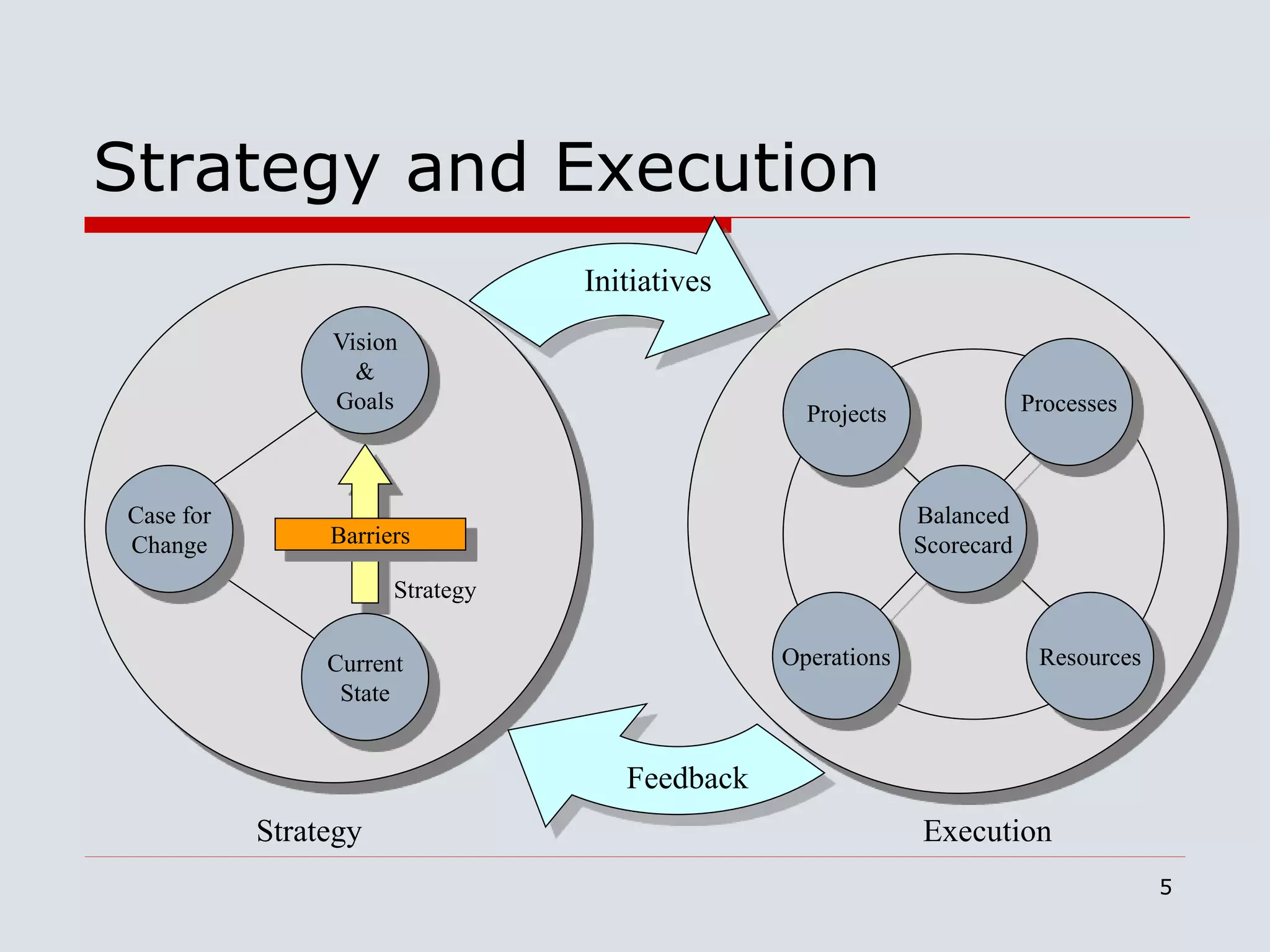
Strategy and Execution
Barriers
Feedback
Initiatives
ExecutionStrategy
Strategy
Balanced
Scorecard
Resources
ProcessesProjects
Operations
Case for
Change
Vision
&
Goals
Current
State
6
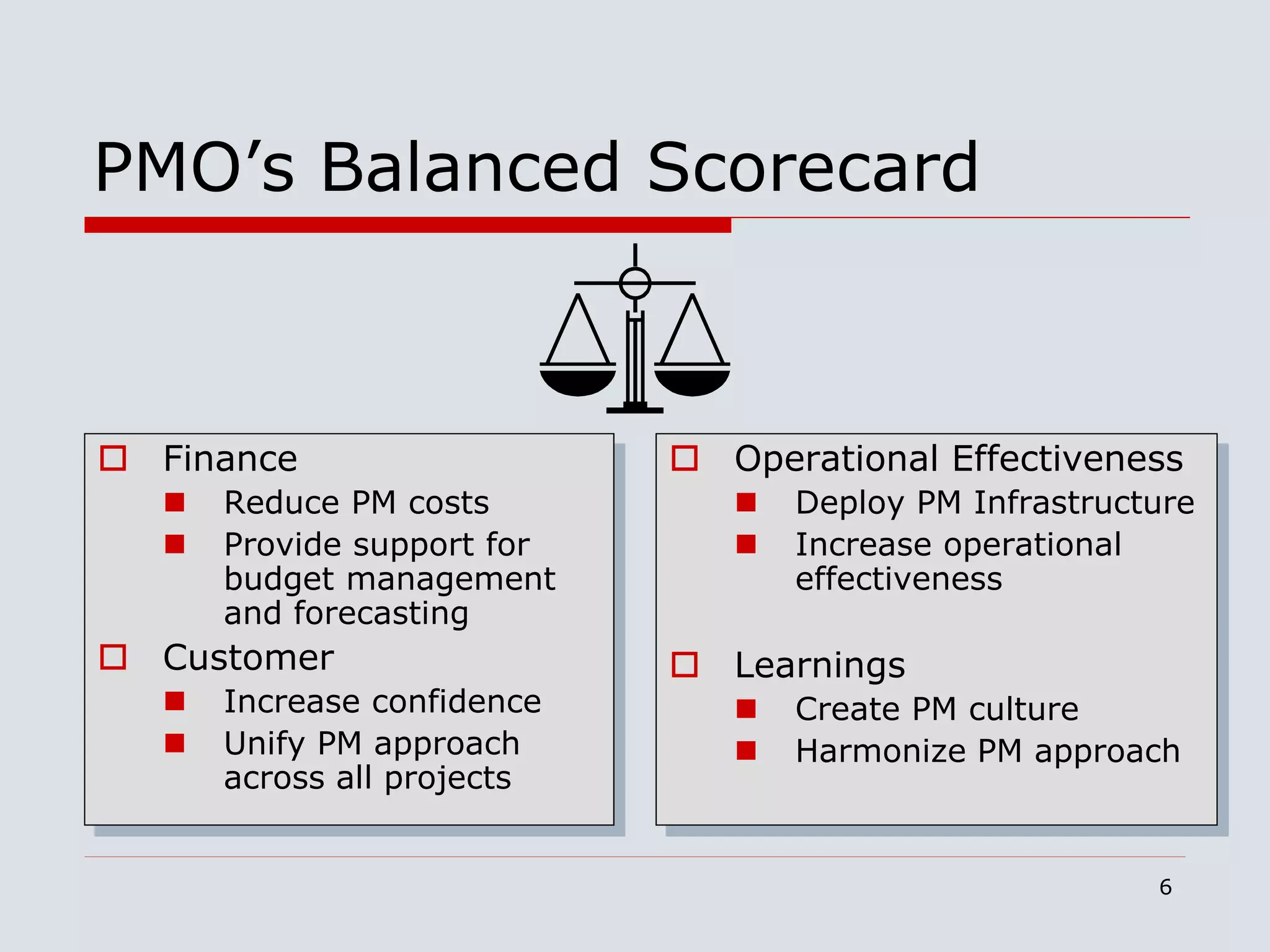
PMO’s Balanced Scorecard
 Finance
 Reduce PM costs
 Provide support for
budget management
and forecasting
 Customer
 Increase confidence
 Unify PM approach
across all projects
 Operational Effectiveness
 Deploy PM Infrastructure
 Increase operational
effectiveness
 Learnings
 Create PM culture
 Harmonize PM approach
7
Financial Prespective
 Reduce project:
 Labor cost,
 Resource utilization, and
 Cost and Schedule variance
by increasing visibility and oversight into
project performance.
 Budget Management
 Forecast
 Budgeted cost for projects performed
 Budgeted cost for value delivered
8
Customer Prespective
 Increase visibility of project
performance for stakeholders.
 Increase confidence in deliverable
commitments.
 Insure project management activities
enable a seamless management
process between participating groups.
 Make visible the cost, benefits, and
value of IT.
9
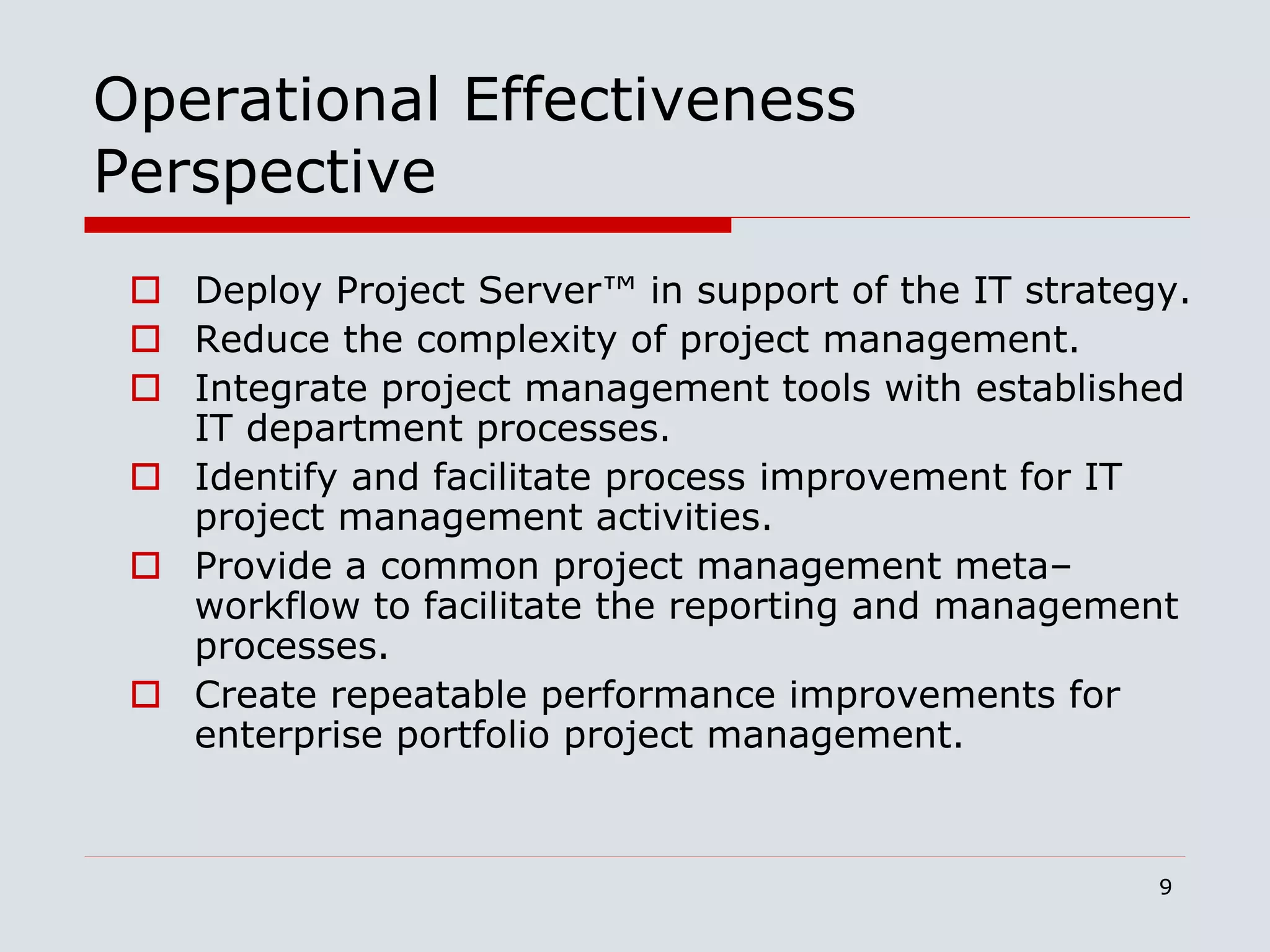
Operational Effectiveness
Perspective
 Deploy Project Server™ in support of the IT strategy.
 Reduce the complexity of project management.
 Integrate project management tools with established
IT department processes.
 Identify and facilitate process improvement for IT
project management activities.
 Provide a common project management meta–
workflow to facilitate the reporting and management
processes.
 Create repeatable performance improvements for
enterprise portfolio project management.
10
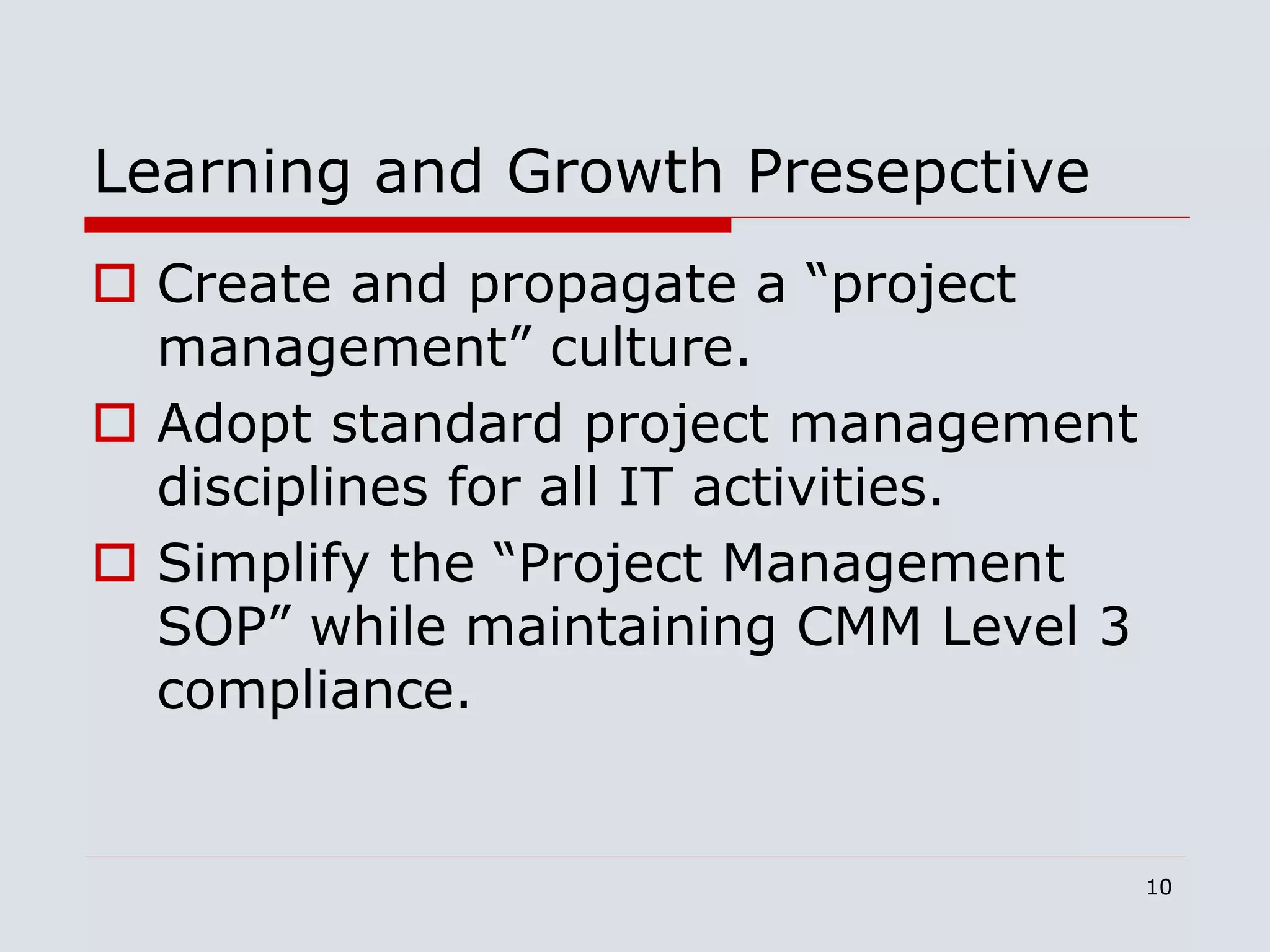
Learning and Growth Presepctive
 Create and propagate a “project
management” culture.
 Adopt standard project management
disciplines for all IT activities.
 Simplify the “Project Management
SOP” while maintaining CMM Level 3
compliance.
11
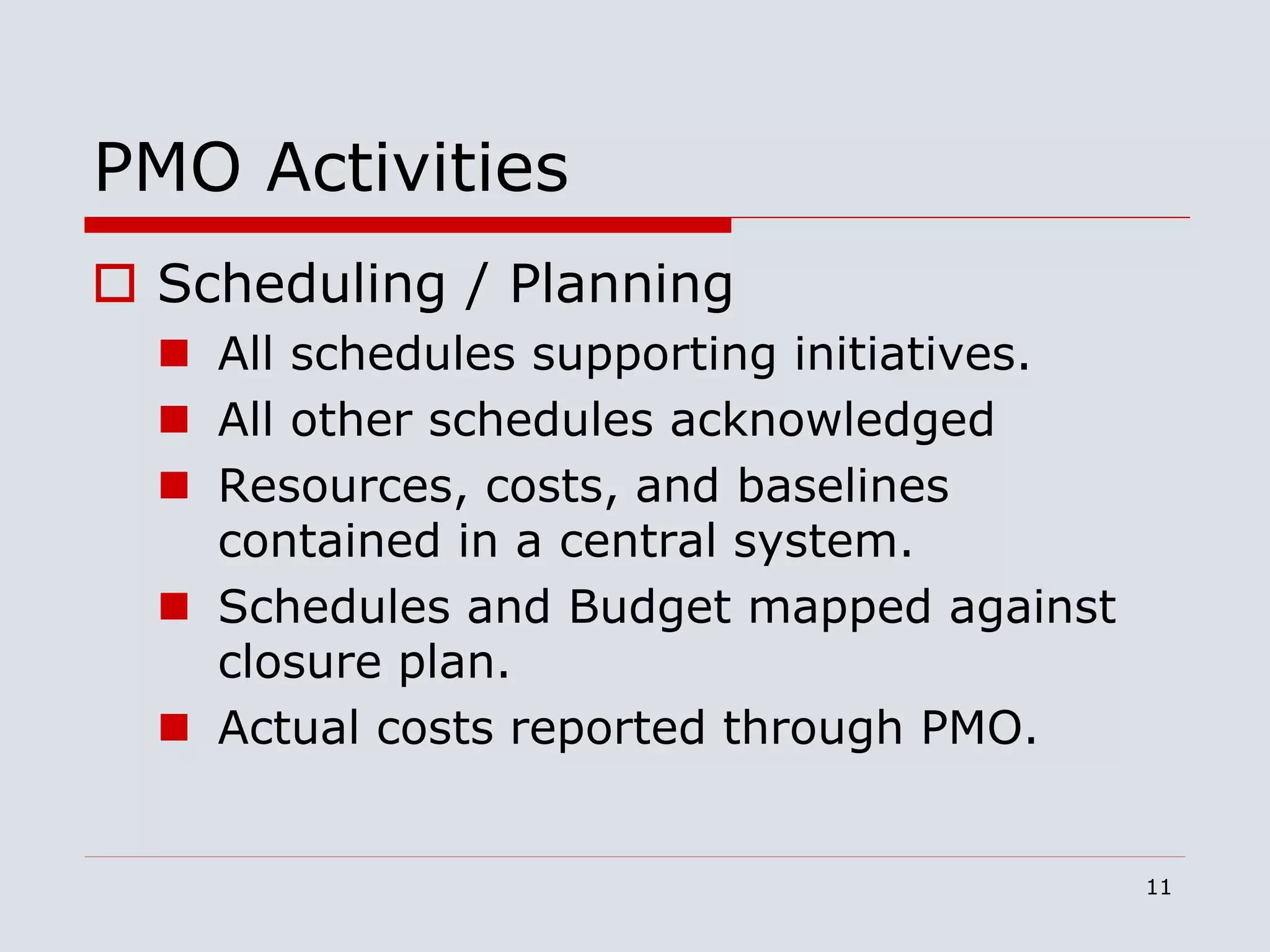
PMO Activities
 Scheduling / Planning
 All schedules supporting initiatives.
 All other schedules acknowledged
 Resources, costs, and baselines
contained in a central system.
 Schedules and Budget mapped against
closure plan.
 Actual costs reported through PMO.
12
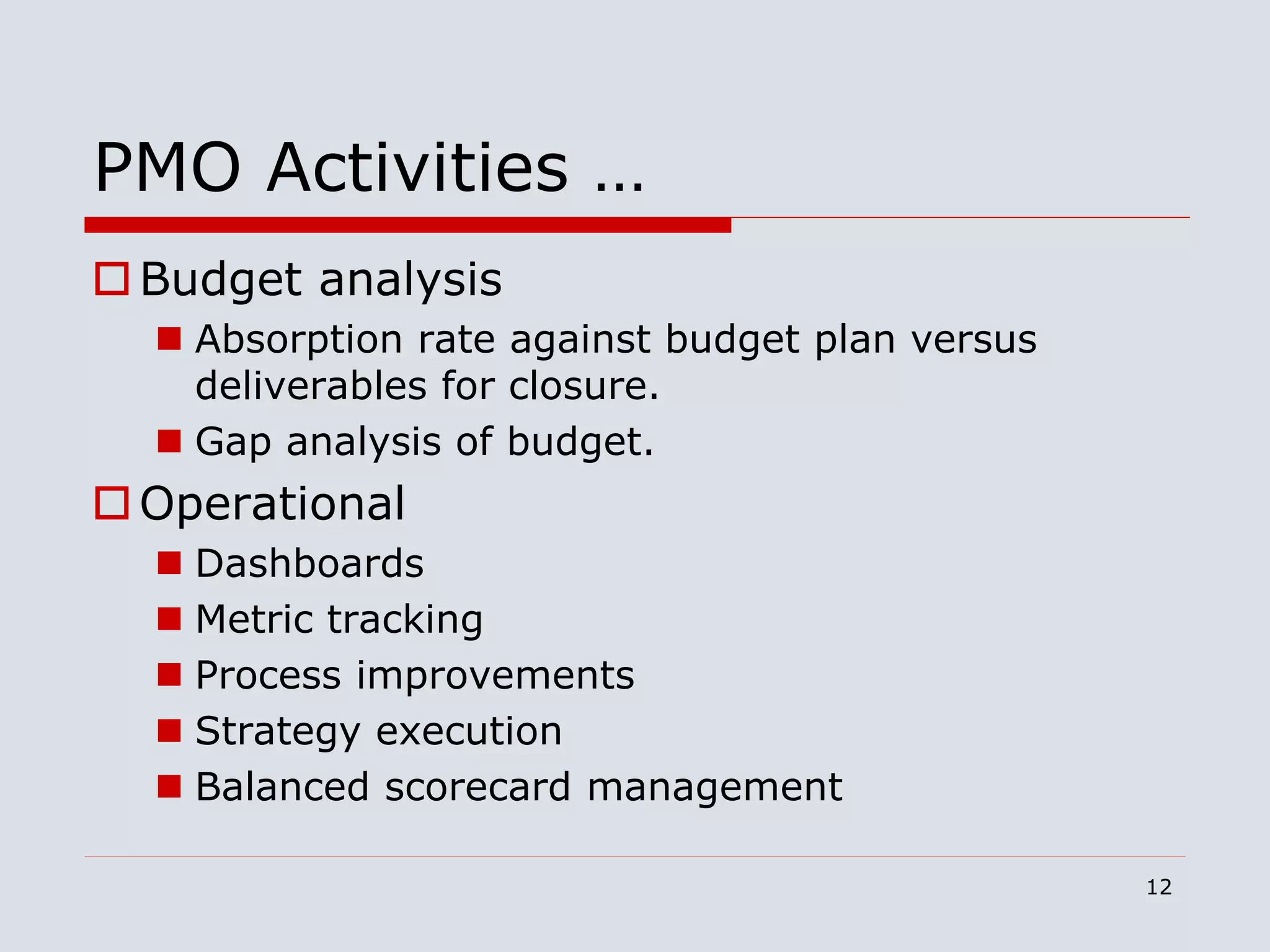
PMO Activities …
Budget analysis
 Absorption rate against budget plan versus
deliverables for closure.
 Gap analysis of budget.
Operational
 Dashboards
 Metric tracking
 Process improvements
 Strategy execution
 Balanced scorecard management
13
Success Criteria for the PMO
 Project assessment
The project intervention effort is one that
never occurs.
Real–time project assessments provided
by the system.
 Project Management
Assist PM for all strategic and cross–
functional projects.
14
Success Criteria for the PMO
 Portfolio management and decision
support
Resource plans
Skill inventories
Inter–project dependencies
Cross functional project constraints
Time and cost estimates
Risk management plans
Issues and change requests
PMO–BSC.PPT
15
Creating a Project
Management Culture
An effective project management culture
enhances the creation and delivery of value to
our customers.
It delivers this value by improving the functional
competencies and processes, without
diminishing the roles, knowledge, skills, or
control of functional managers.
It allows the functional managers to
continuously improve their technical expertise
and knowledge in a way that contributes to
present and future project activities.
16
A Culture is created by. …
 Creating reliance “on?”
 Motivation and desire “to do?”
 Converging values “for?”
 Shared vision “of?”
 Repetition “of?”
 Participation and recognition “in?”
 Commitment “to?”
17
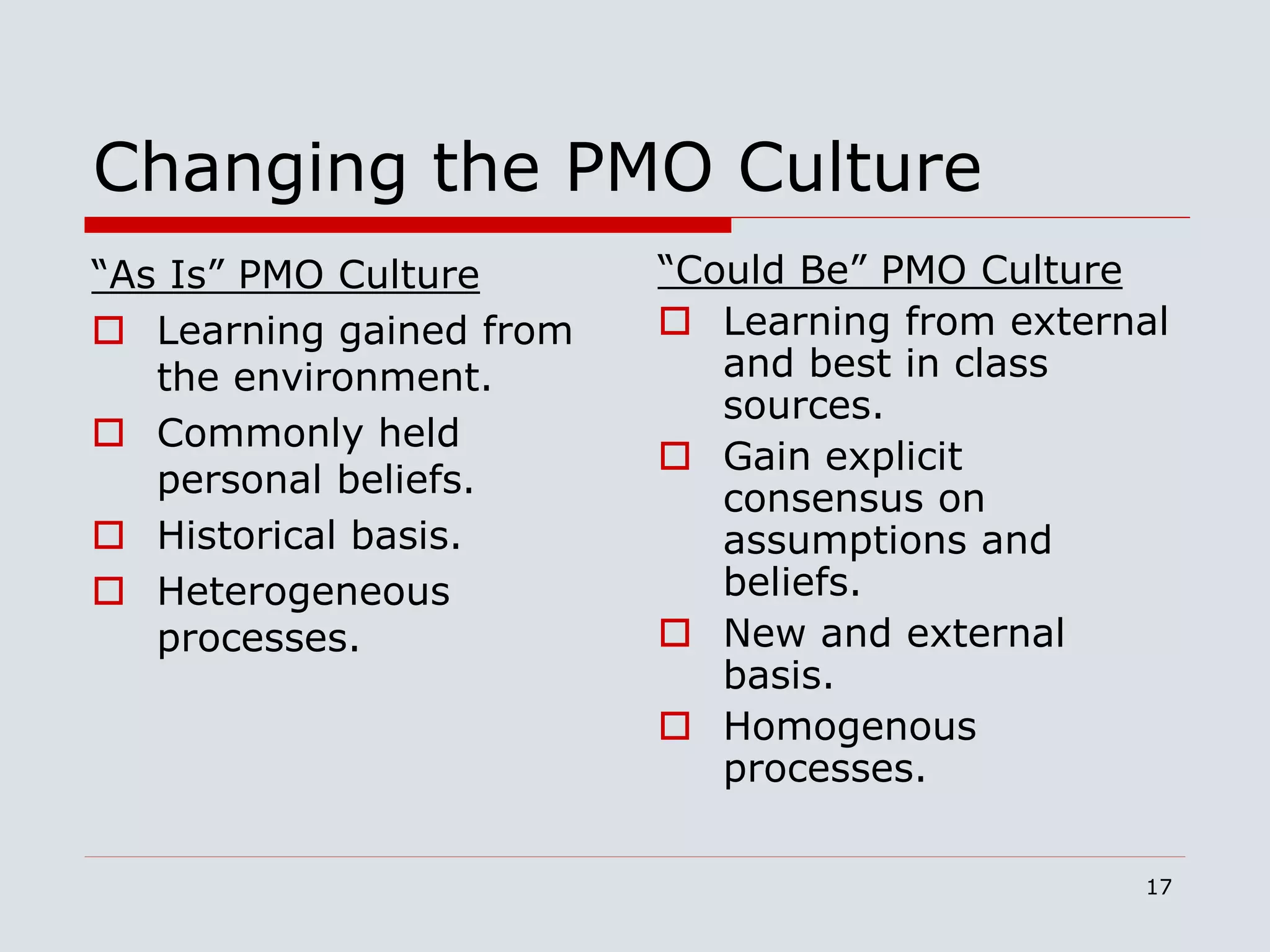
Changing the PMO Culture
“As Is” PMO Culture
 Learning gained from
the environment.
 Commonly held
personal beliefs.
 Historical basis.
 Heterogeneous
processes.
“Could Be” PMO Culture
 Learning from external
and best in class
sources.
 Gain explicit
consensus on
assumptions and
beliefs.
 New and external
basis.
 Homogenous
processes.
18
Changing the Culture
 Culture change is essential for
strategic change.
 Culture change can:
 Revitalize and reenergize the
organization
 Improve organizational performance
 Realign the organization with a new
vision and goals
19
How to Change the PM Culture
 Understand and characterize the
current culture
 Identify and analyze driving and
restraining forces
 Find ways to measure and strengthen
drives forces
 Find ways to measure and weaken
restraining forces
 Prioritize measures
20
How to Change the PM Culture …
 Identify and choose “change agents”
 Gain management approval for
deploying change agents
 Prepare action plan for change
process
 Implement, assess, and evaluate
change process
21
1st Steps in Implementing a
Project Management Culture
 Gap analysis:
 What initiatives are in place today?
 Do they support the IT strategy?
 Key PM components in support of these
initiatives?
 Use and impact of methodologies to
improve project delivery?
 Customer relationship gaps and closure
initiatives?
22
1st Steps in Implementing a
Project Management Culture …
 Best practices comparison
 Management expectations
23
Mechanics of Creating a
Project Management Culture
 Document the project management
environment and expectations.
 Define the roles and responsibilities.
 Integrate and coordinate the project
management methodologies.
24
Mechanics of Creating a
Project Management Culture …
 Identify the project management
templates and tools.
 Train and coach the project managers
on how to apply the practices of
managing projects to a successful
conclusion.
25
A Project Management Culture
Contains …
 Repeatable process.
 Timely access to information.
 Development of a knowledgeable and
skilled team.
 Customer commitment to project
management.
26
Repeatable Processes
 Project management approach for
managing projects project is
documented, understood, and
followed.
 Project management approach for
identifying and managing the work of
the project is documented,
understood, and followed.
27
Repeatable Processes
 Management approaches are flexible
in order to accommodate the needs of
the:
Customers
Regulatory requirements and directives
New and emerging requirements,
technology, and processes
28
Timely Access to Information
 Project related information: planning
templates, project plan and
supporting detail, status information,
lessons learned from previous
projects, available in the project
management repository.
PMO–BSC.PPT
29
Portfolio Management
30
Portfolio Management Objectives
 Develop the strategic plan, the
annual budget, and the integrated
project portfolio.
 Project selection criteria derived from
and supportive of the strategic plan.
31
Portfolio Management Objectives
 Project selection criteria documented
and communicated in an objective
and consistent manner.
 Project selection decisions are
communicated broadly.
PMO–BSC.PPT
32
Project Management
Methodologies
Possessing the tools alone are not
sufficient for the success of the PMO.
Processes, culture, people, and the
will to participate in the change
process are also needed.
33
The Project Management
Method Must Be …
 Rapidly developed and deployed.
 Aligned with the IT Strategy.
 Aligned with organizational
requirements.
 Practical.
 Flexible.
 Adapted and changed to meet the
needs of the participants.
34
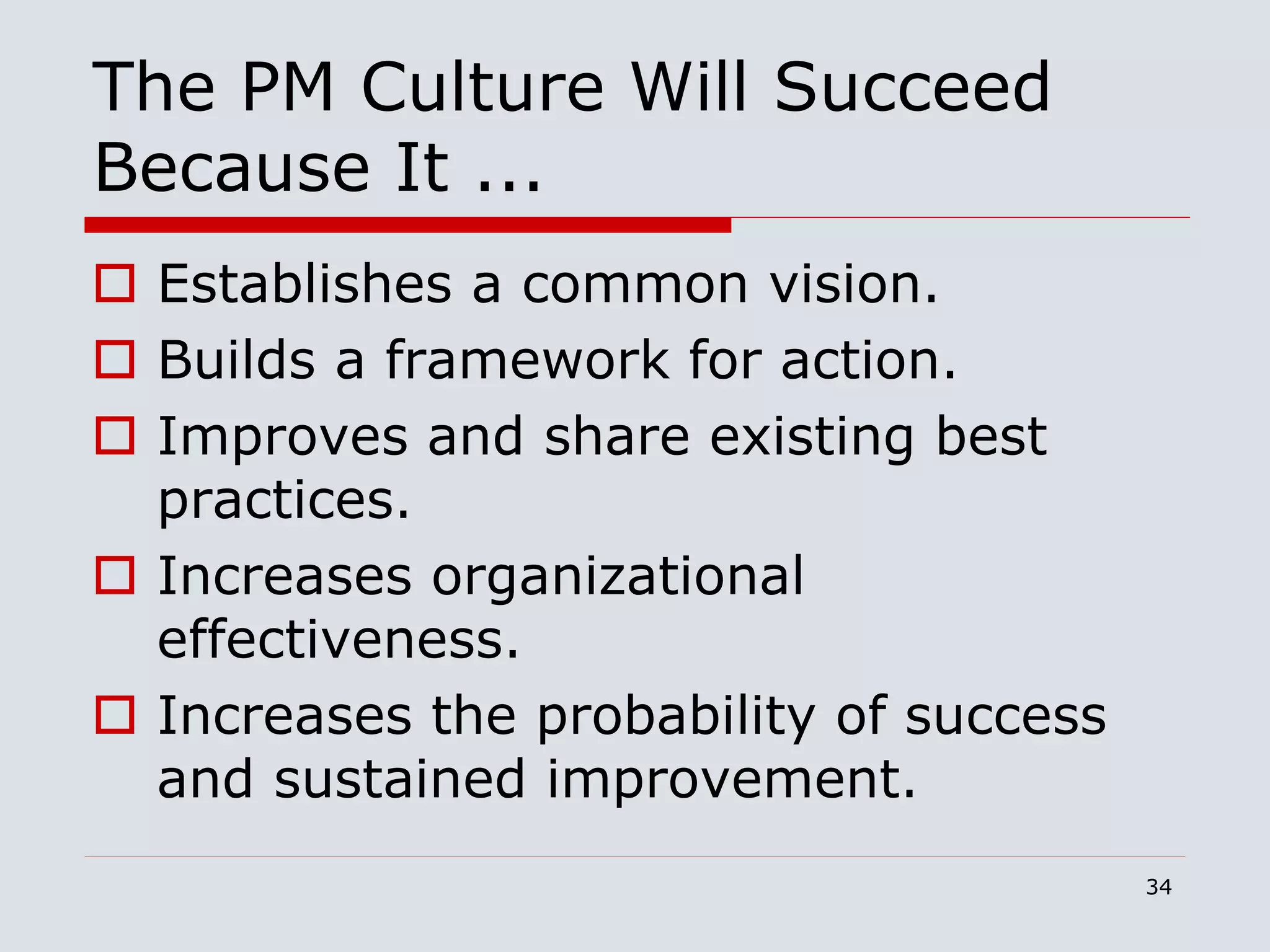
The PM Culture Will Succeed
Because It ...
 Establishes a common vision.
 Builds a framework for action.
 Improves and share existing best
practices.
 Increases organizational
effectiveness.
 Increases the probability of success
and sustained improvement.
PMO–BSC.PPT
35
PMO Tools and Technologies
“The plan is nothing: the planning is
everything.”
– Dwight Eisenhower
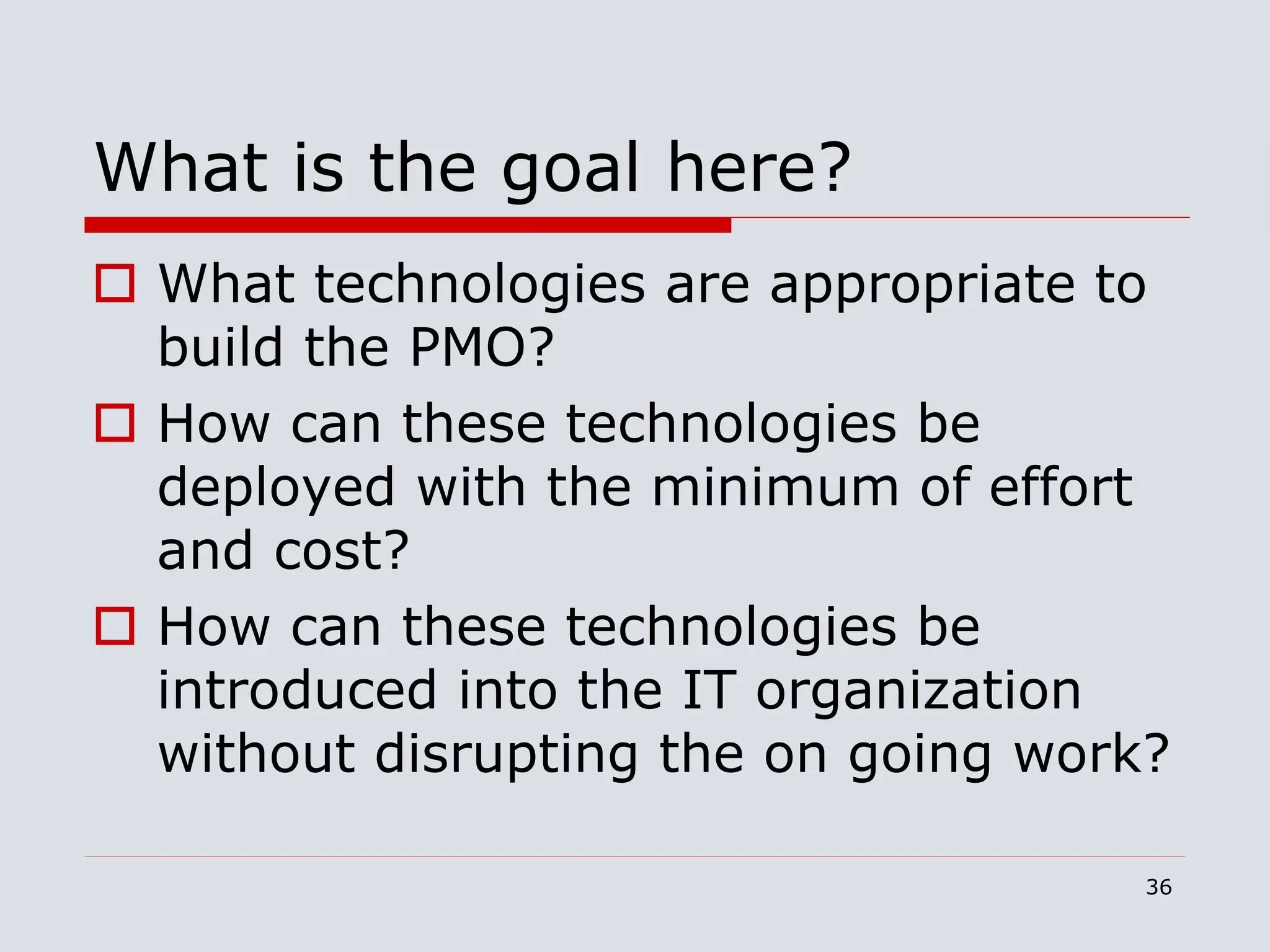
36
What is the goal here?
 What technologies are appropriate to
build the PMO?
 How can these technologies be
deployed with the minimum of effort
and cost?
 How can these technologies be
introduced into the IT organization
without disrupting the on going work?
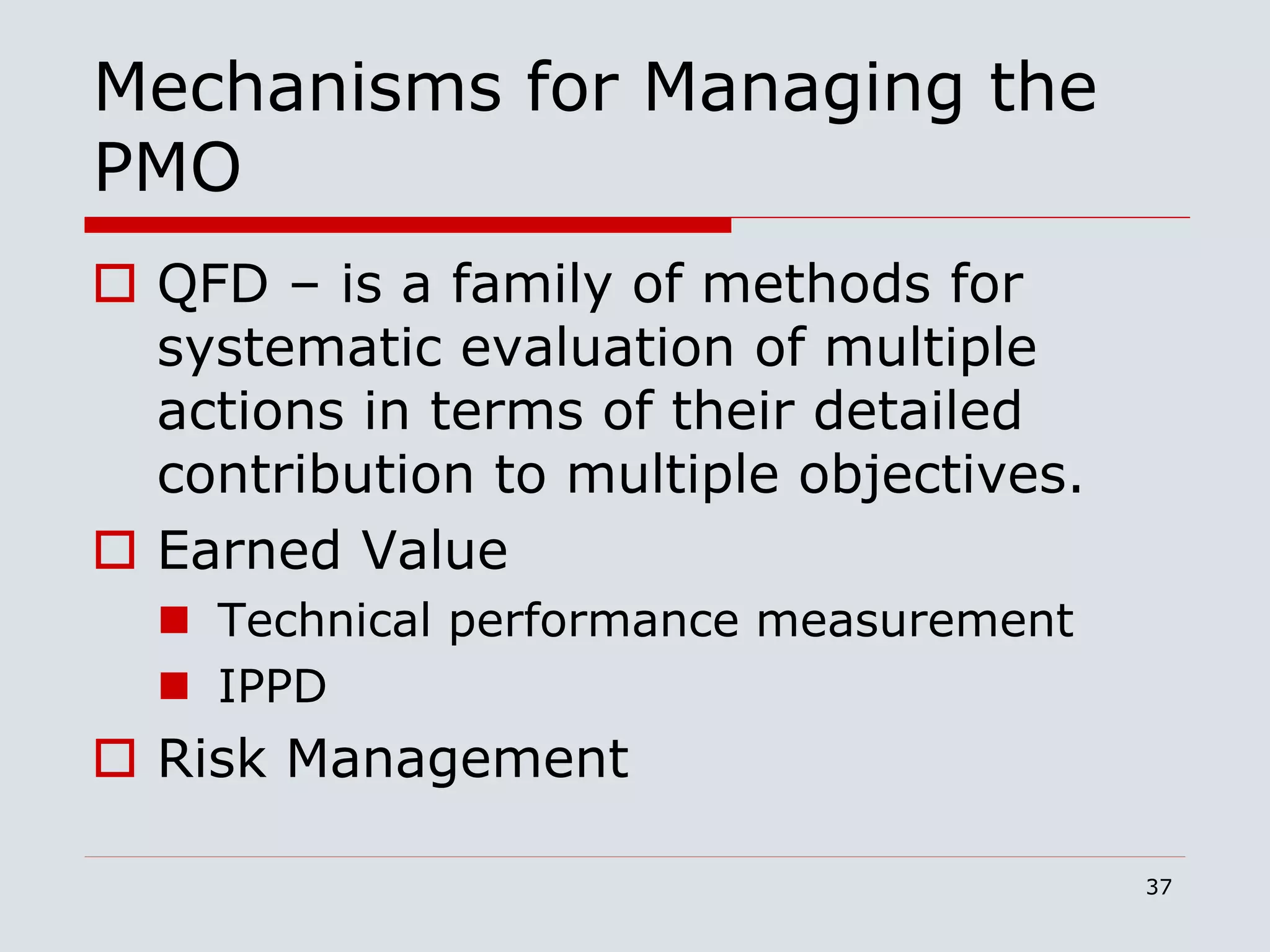
37
Mechanisms for Managing the
PMO
 QFD – is a family of methods for
systematic evaluation of multiple
actions in terms of their detailed
contribution to multiple objectives.
 Earned Value
 Technical performance measurement
 IPPD
 Risk Management
38
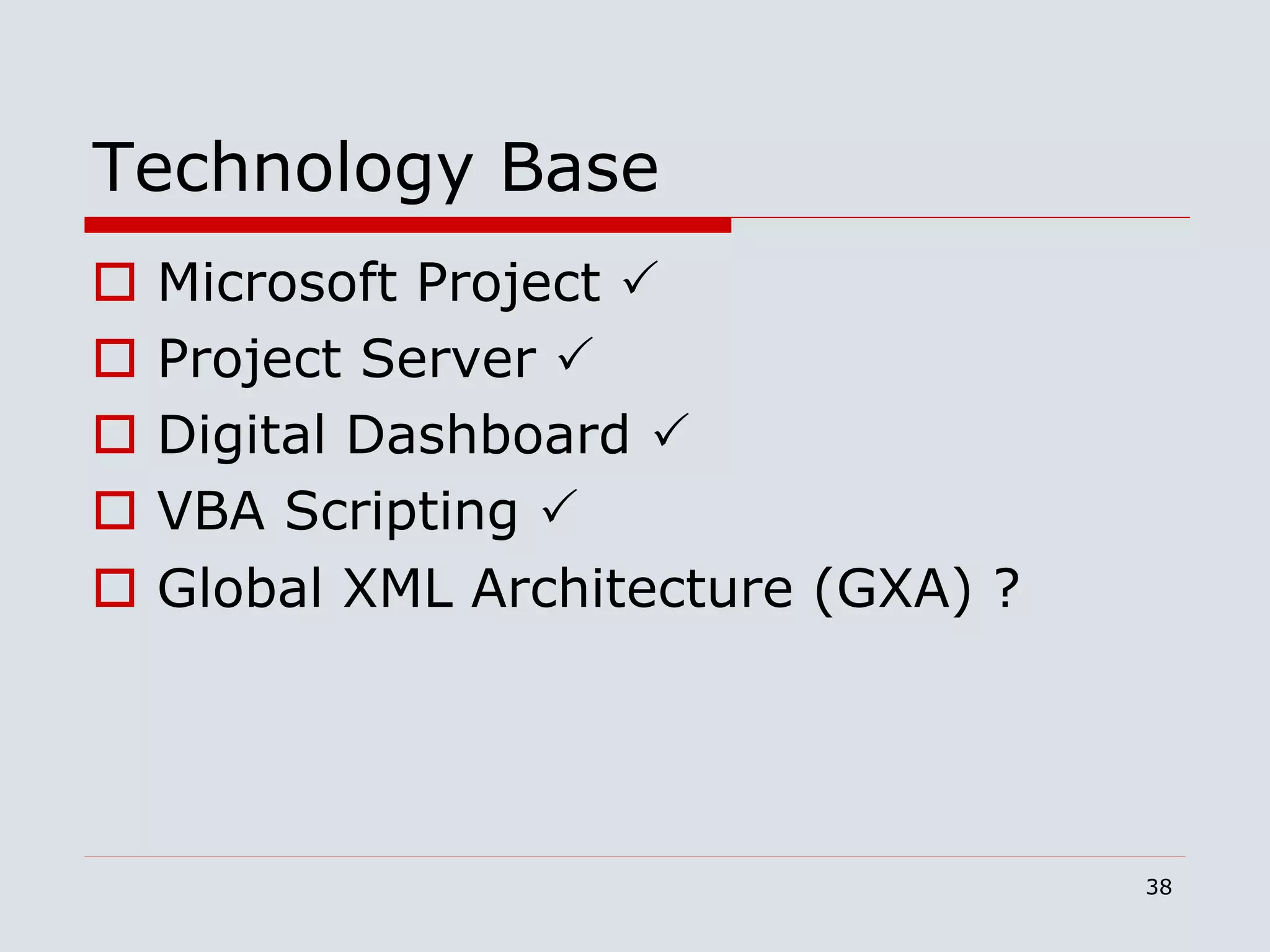
Technology Base
 Microsoft Project 
 Project Server 
 Digital Dashboard 
 VBA Scripting 
 Global XML Architecture (GXA) ?
39
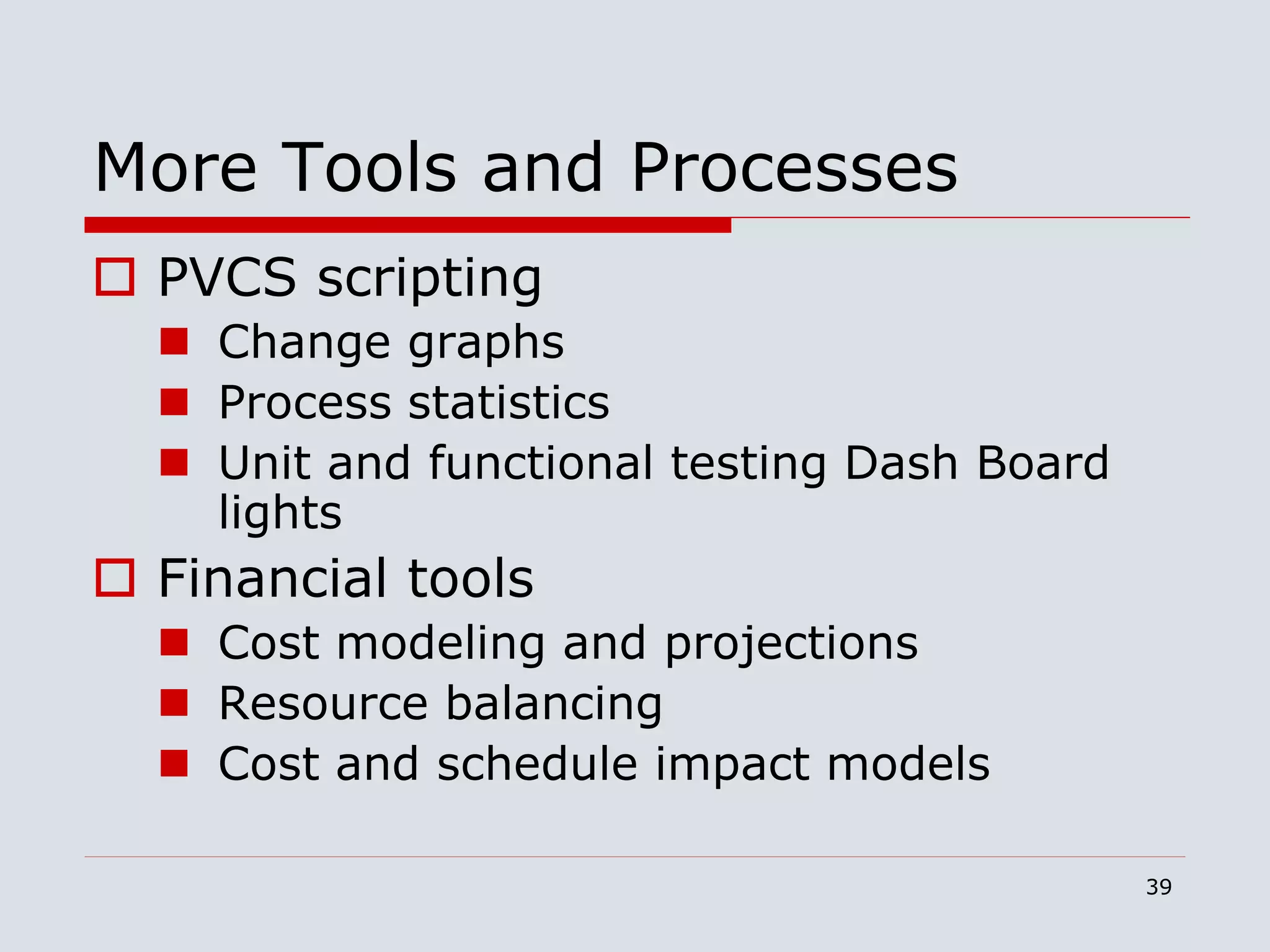
More Tools and Processes
 PVCS scripting
 Change graphs
 Process statistics
 Unit and functional testing Dash Board
lights
 Financial tools
 Cost modeling and projections
 Resource balancing
 Cost and schedule impact models

Program Management Office

  • 1.
    PMO–BSC.PPT 1 Program Management Office TheProgram Office is the “glue” between corporate strategy and projects. Here’s the Balanced Scorecard for deploying the PMO Glen B. Alleman VP Program Management Kaiser‒Hill ‒ Rocky Flats Environment Technology Site National Nuclear Security Agency, US Department of Energy 14 October 2011
  • 2.
    2 Program Office Mission Provide the assessment, measurement, analysis, support, and reporting of enterprise wide IT project performance and departmental process improvement activities.
  • 3.
    3 PMO’s Scope  Enableand support project management disciplines.  Provide enterprise wide project visibility, assessment, and reporting.  Project management guidelines.  Serve as a catalyst to develop an integrated multidisciplinary approach to project management.
  • 4.
    4 PMO’s Scope … Develop a framework methodology for project management.  Provide project management methodologies to IT PM’s.  Provide support in deploying the PM methodologies.  Tie project activities with budget and forecast processes.  Provide data and processes to support budget management.
  • 5.
  • 6.
    6 PMO’s Balanced Scorecard Finance  Reduce PM costs  Provide support for budget management and forecasting  Customer  Increase confidence  Unify PM approach across all projects  Operational Effectiveness  Deploy PM Infrastructure  Increase operational effectiveness  Learnings  Create PM culture  Harmonize PM approach
  • 7.
    7 Financial Prespective  Reduceproject:  Labor cost,  Resource utilization, and  Cost and Schedule variance by increasing visibility and oversight into project performance.  Budget Management  Forecast  Budgeted cost for projects performed  Budgeted cost for value delivered
  • 8.
    8 Customer Prespective  Increasevisibility of project performance for stakeholders.  Increase confidence in deliverable commitments.  Insure project management activities enable a seamless management process between participating groups.  Make visible the cost, benefits, and value of IT.
  • 9.
    9 Operational Effectiveness Perspective  DeployProject Server™ in support of the IT strategy.  Reduce the complexity of project management.  Integrate project management tools with established IT department processes.  Identify and facilitate process improvement for IT project management activities.  Provide a common project management meta– workflow to facilitate the reporting and management processes.  Create repeatable performance improvements for enterprise portfolio project management.
  • 10.
    10 Learning and GrowthPresepctive  Create and propagate a “project management” culture.  Adopt standard project management disciplines for all IT activities.  Simplify the “Project Management SOP” while maintaining CMM Level 3 compliance.
  • 11.
    11 PMO Activities  Scheduling/ Planning  All schedules supporting initiatives.  All other schedules acknowledged  Resources, costs, and baselines contained in a central system.  Schedules and Budget mapped against closure plan.  Actual costs reported through PMO.
  • 12.
    12 PMO Activities … Budgetanalysis  Absorption rate against budget plan versus deliverables for closure.  Gap analysis of budget. Operational  Dashboards  Metric tracking  Process improvements  Strategy execution  Balanced scorecard management
  • 13.
    13 Success Criteria forthe PMO  Project assessment The project intervention effort is one that never occurs. Real–time project assessments provided by the system.  Project Management Assist PM for all strategic and cross– functional projects.
  • 14.
    14 Success Criteria forthe PMO  Portfolio management and decision support Resource plans Skill inventories Inter–project dependencies Cross functional project constraints Time and cost estimates Risk management plans Issues and change requests
  • 15.
    PMO–BSC.PPT 15 Creating a Project ManagementCulture An effective project management culture enhances the creation and delivery of value to our customers. It delivers this value by improving the functional competencies and processes, without diminishing the roles, knowledge, skills, or control of functional managers. It allows the functional managers to continuously improve their technical expertise and knowledge in a way that contributes to present and future project activities.
  • 16.
    16 A Culture iscreated by. …  Creating reliance “on?”  Motivation and desire “to do?”  Converging values “for?”  Shared vision “of?”  Repetition “of?”  Participation and recognition “in?”  Commitment “to?”
  • 17.
    17 Changing the PMOCulture “As Is” PMO Culture  Learning gained from the environment.  Commonly held personal beliefs.  Historical basis.  Heterogeneous processes. “Could Be” PMO Culture  Learning from external and best in class sources.  Gain explicit consensus on assumptions and beliefs.  New and external basis.  Homogenous processes.
  • 18.
    18 Changing the Culture Culture change is essential for strategic change.  Culture change can:  Revitalize and reenergize the organization  Improve organizational performance  Realign the organization with a new vision and goals
  • 19.
    19 How to Changethe PM Culture  Understand and characterize the current culture  Identify and analyze driving and restraining forces  Find ways to measure and strengthen drives forces  Find ways to measure and weaken restraining forces  Prioritize measures
  • 20.
    20 How to Changethe PM Culture …  Identify and choose “change agents”  Gain management approval for deploying change agents  Prepare action plan for change process  Implement, assess, and evaluate change process
  • 21.
    21 1st Steps inImplementing a Project Management Culture  Gap analysis:  What initiatives are in place today?  Do they support the IT strategy?  Key PM components in support of these initiatives?  Use and impact of methodologies to improve project delivery?  Customer relationship gaps and closure initiatives?
  • 22.
    22 1st Steps inImplementing a Project Management Culture …  Best practices comparison  Management expectations
  • 23.
    23 Mechanics of Creatinga Project Management Culture  Document the project management environment and expectations.  Define the roles and responsibilities.  Integrate and coordinate the project management methodologies.
  • 24.
    24 Mechanics of Creatinga Project Management Culture …  Identify the project management templates and tools.  Train and coach the project managers on how to apply the practices of managing projects to a successful conclusion.
  • 25.
    25 A Project ManagementCulture Contains …  Repeatable process.  Timely access to information.  Development of a knowledgeable and skilled team.  Customer commitment to project management.
  • 26.
    26 Repeatable Processes  Projectmanagement approach for managing projects project is documented, understood, and followed.  Project management approach for identifying and managing the work of the project is documented, understood, and followed.
  • 27.
    27 Repeatable Processes  Managementapproaches are flexible in order to accommodate the needs of the: Customers Regulatory requirements and directives New and emerging requirements, technology, and processes
  • 28.
    28 Timely Access toInformation  Project related information: planning templates, project plan and supporting detail, status information, lessons learned from previous projects, available in the project management repository.
  • 29.
  • 30.
    30 Portfolio Management Objectives Develop the strategic plan, the annual budget, and the integrated project portfolio.  Project selection criteria derived from and supportive of the strategic plan.
  • 31.
    31 Portfolio Management Objectives Project selection criteria documented and communicated in an objective and consistent manner.  Project selection decisions are communicated broadly.
  • 32.
    PMO–BSC.PPT 32 Project Management Methodologies Possessing thetools alone are not sufficient for the success of the PMO. Processes, culture, people, and the will to participate in the change process are also needed.
  • 33.
    33 The Project Management MethodMust Be …  Rapidly developed and deployed.  Aligned with the IT Strategy.  Aligned with organizational requirements.  Practical.  Flexible.  Adapted and changed to meet the needs of the participants.
  • 34.
    34 The PM CultureWill Succeed Because It ...  Establishes a common vision.  Builds a framework for action.  Improves and share existing best practices.  Increases organizational effectiveness.  Increases the probability of success and sustained improvement.
  • 35.
    PMO–BSC.PPT 35 PMO Tools andTechnologies “The plan is nothing: the planning is everything.” – Dwight Eisenhower
  • 36.
    36 What is thegoal here?  What technologies are appropriate to build the PMO?  How can these technologies be deployed with the minimum of effort and cost?  How can these technologies be introduced into the IT organization without disrupting the on going work?
  • 37.
    37 Mechanisms for Managingthe PMO  QFD – is a family of methods for systematic evaluation of multiple actions in terms of their detailed contribution to multiple objectives.  Earned Value  Technical performance measurement  IPPD  Risk Management
  • 38.
    38 Technology Base  MicrosoftProject   Project Server   Digital Dashboard   VBA Scripting   Global XML Architecture (GXA) ?
  • 39.
    39 More Tools andProcesses  PVCS scripting  Change graphs  Process statistics  Unit and functional testing Dash Board lights  Financial tools  Cost modeling and projections  Resource balancing  Cost and schedule impact models