Enterprise Program Dependency and Risk
Management Strategy
Lenny Shields
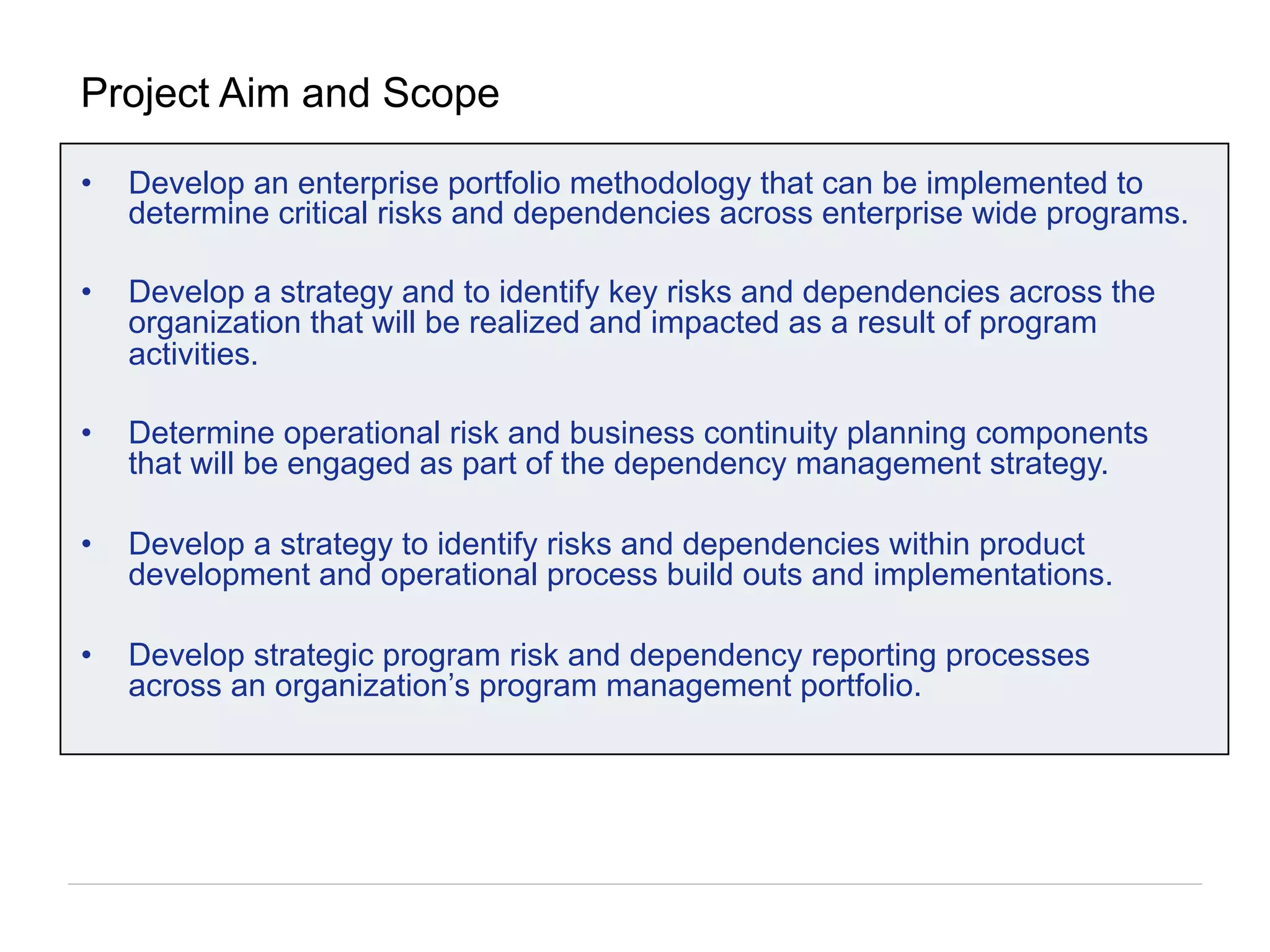
•  Develop an enterprise portfolio methodology that can be implemented to
determine critical risks and dependencies across enterprise wide programs.
•  Develop a strategy and to identify key risks and dependencies across the
organization that will be realized and impacted as a result of program
activities.
•  Determine operational risk and business continuity planning components
that will be engaged as part of the dependency management strategy.
•  Develop a strategy to identify risks and dependencies within product
development and operational process build outs and implementations.
•  Develop strategic program risk and dependency reporting processes
across an organization’s program management portfolio.
Project Aim and Scope
Strategy Intention Description:
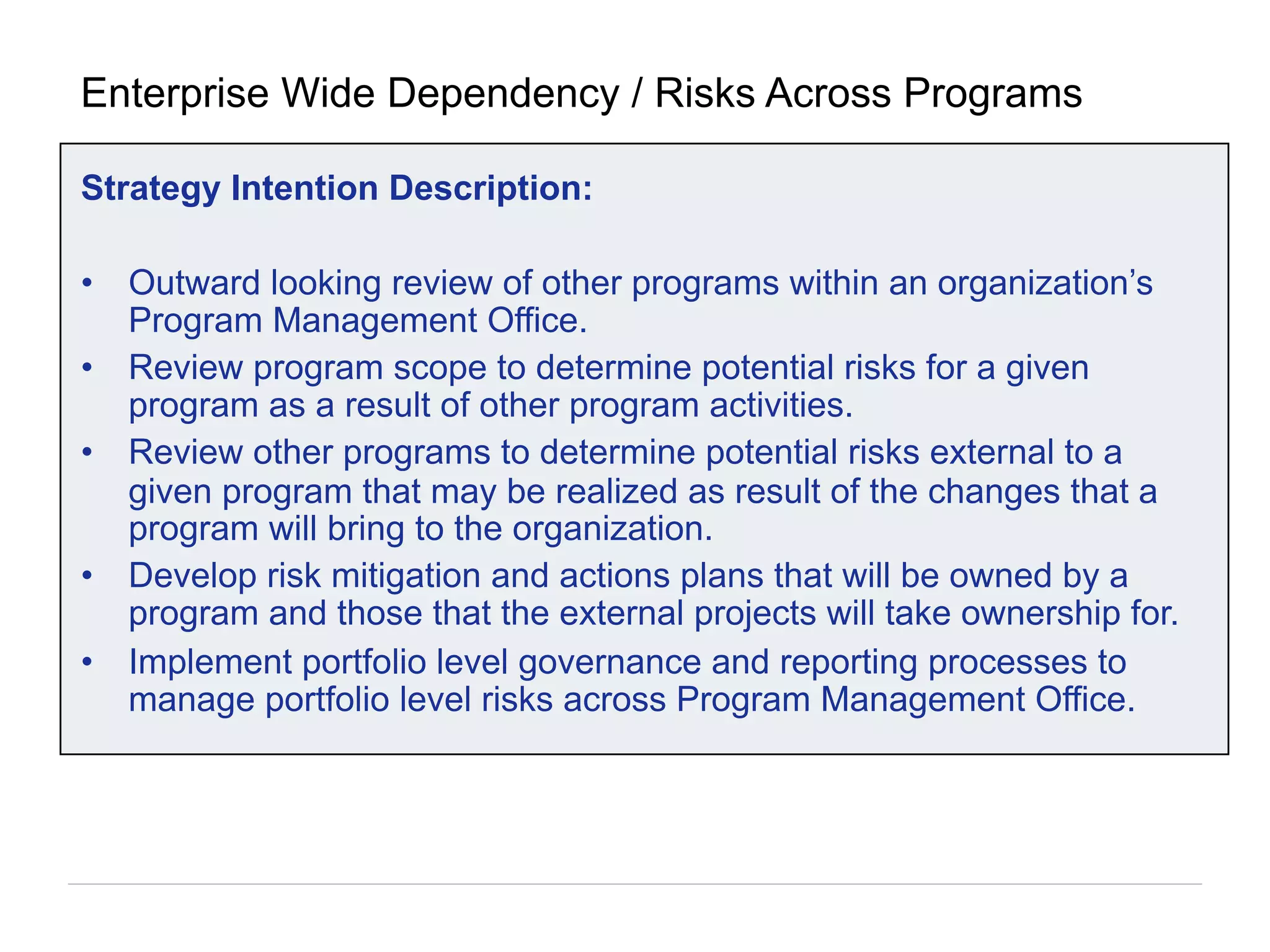
•  Outward looking review of other programs within an organization’s
Program Management Office.
•  Review program scope to determine potential risks for a given
program as a result of other program activities.
•  Review other programs to determine potential risks external to a
given program that may be realized as result of the changes that a
program will bring to the organization.
•  Develop risk mitigation and actions plans that will be owned by a
program and those that the external projects will take ownership for.
•  Implement portfolio level governance and reporting processes to
manage portfolio level risks across Program Management Office.
Enterprise Wide Dependency / Risks Across Programs
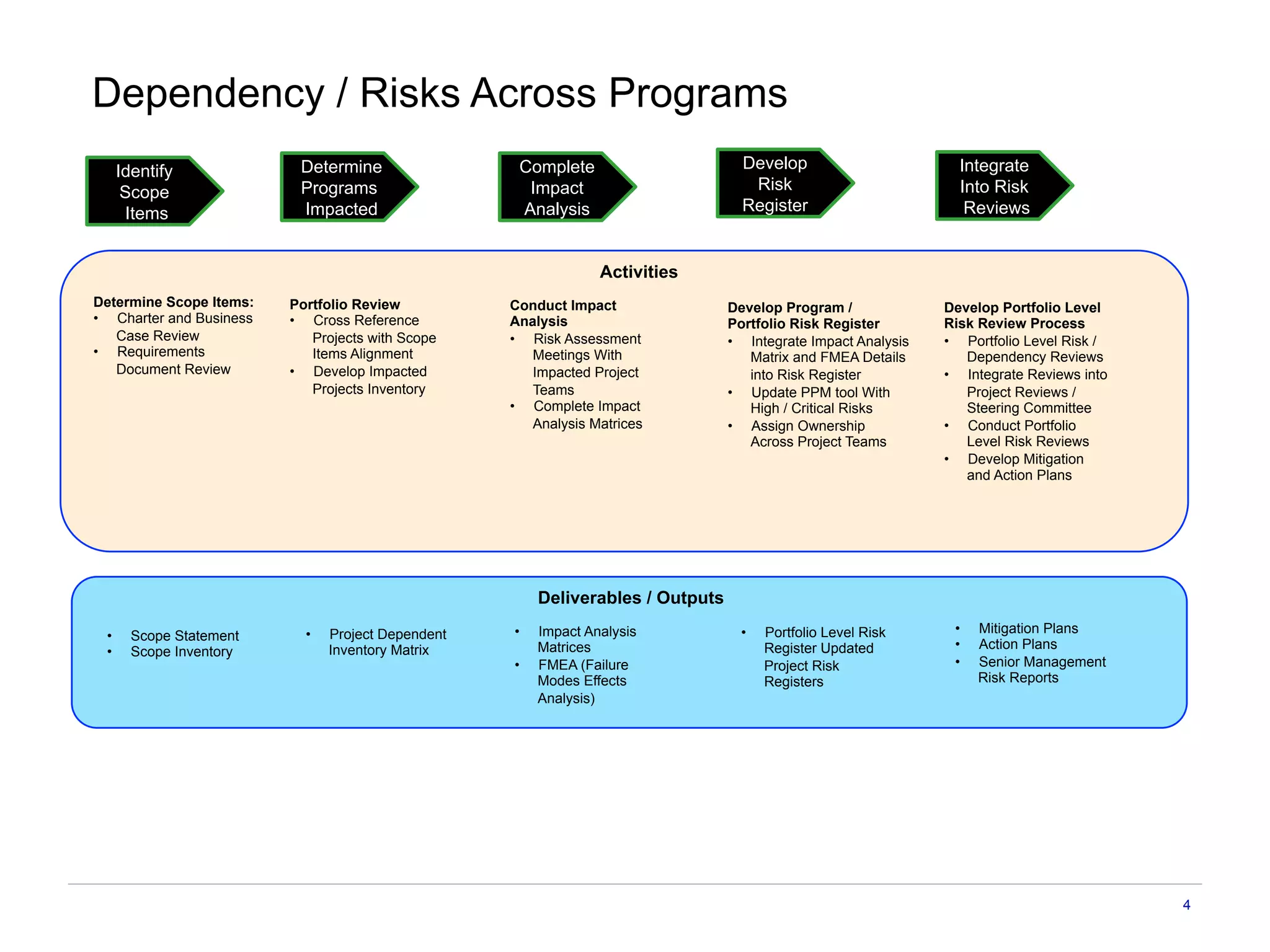
Dependency / Risks Across Programs
4
Identify
Scope
Items
Determine
Programs
Impacted
Complete
Impact
Analysis
Develop
Risk
Register
Integrate
Into Risk
Reviews
Determine Scope Items:
•  Charter and Business
Case Review
•  Requirements
Document Review
•  Scope Statement
•  Scope Inventory
Portfolio Review
•  Cross Reference
Projects with Scope
Items Alignment
•  Develop Impacted
Projects Inventory
•  Project Dependent
Inventory Matrix
Conduct Impact
Analysis
•  Risk Assessment
Meetings With
Impacted Project
Teams
•  Complete Impact
Analysis Matrices
•  Impact Analysis
Matrices
•  FMEA (Failure
Modes Effects
Analysis)
Develop Program /
Portfolio Risk Register
•  Integrate Impact Analysis
Matrix and FMEA Details
into Risk Register
•  Update PPM tool With
High / Critical Risks
•  Assign Ownership
Across Project Teams
•  Portfolio Level Risk
Register Updated
Project Risk
Registers
Develop Portfolio Level
Risk Review Process
•  Portfolio Level Risk /
Dependency Reviews
•  Integrate Reviews into
Project Reviews /
Steering Committee
•  Conduct Portfolio
Level Risk Reviews
•  Develop Mitigation
and Action Plans
•  Mitigation Plans
•  Action Plans
•  Senior Management
Risk Reports
Activities
Deliverables / Outputs
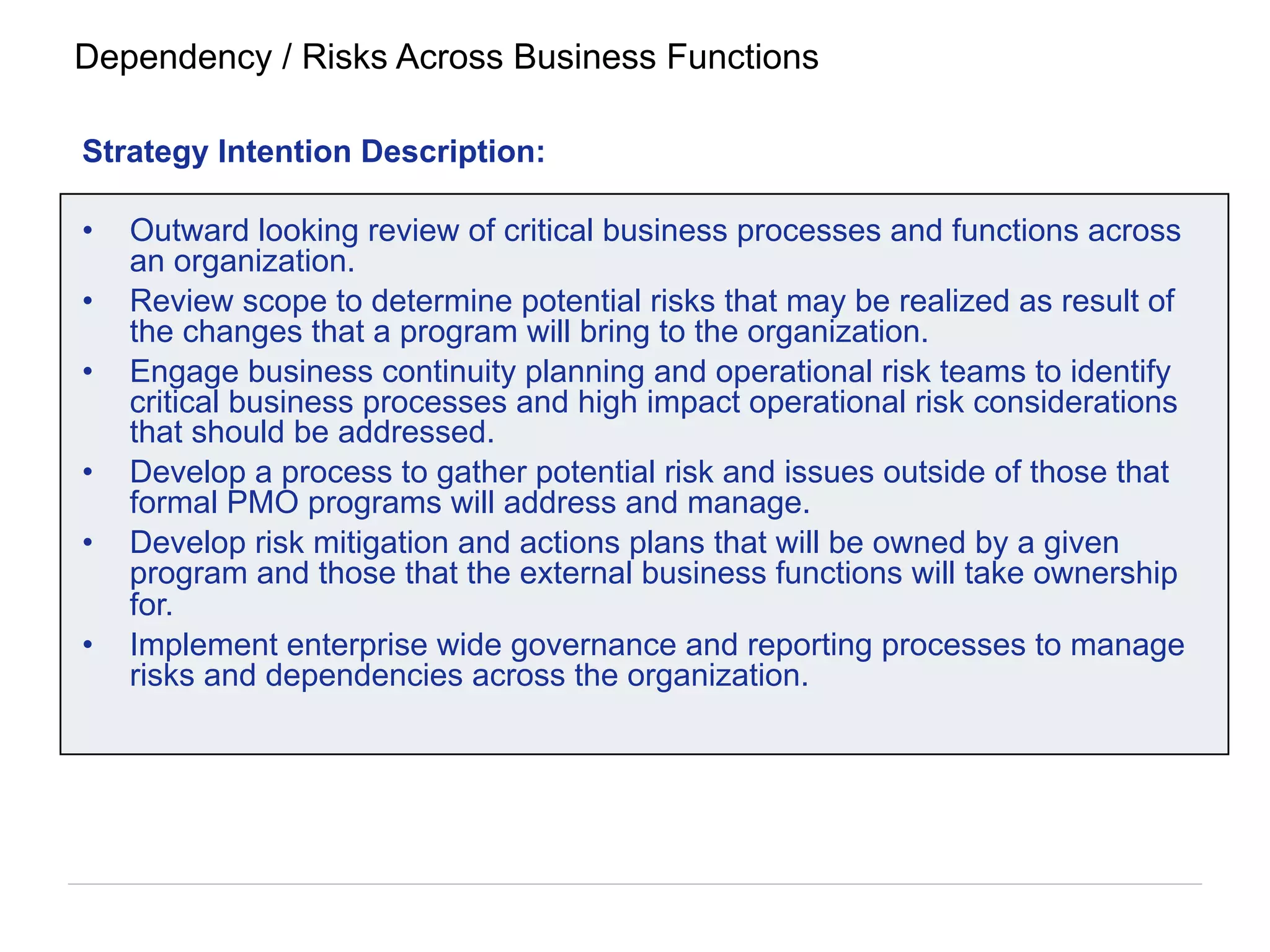
Strategy Intention Description:
•  Outward looking review of critical business processes and functions across
an organization.
•  Review scope to determine potential risks that may be realized as result of
the changes that a program will bring to the organization.
•  Engage business continuity planning and operational risk teams to identify
critical business processes and high impact operational risk considerations
that should be addressed.
•  Develop a process to gather potential risk and issues outside of those that
formal PMO programs will address and manage.
•  Develop risk mitigation and actions plans that will be owned by a given
program and those that the external business functions will take ownership
for.
•  Implement enterprise wide governance and reporting processes to manage
risks and dependencies across the organization.
Dependency / Risks Across Business Functions
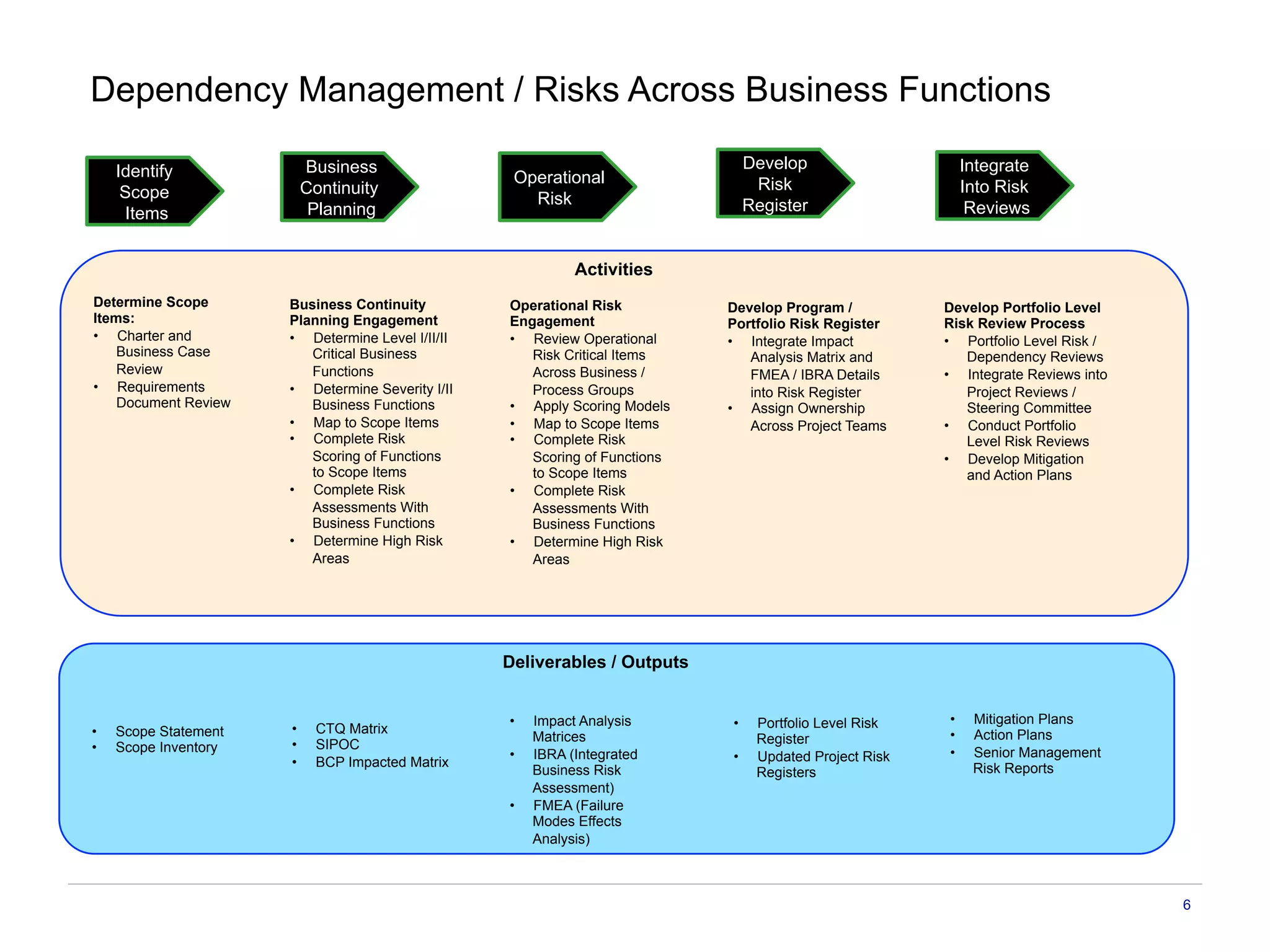
Dependency Management / Risks Across Business Functions
6
Identify
Scope
Items
Business
Continuity
Planning
Operational
Risk
Develop
Risk
Register
Integrate
Into Risk
Reviews
Determine Scope
Items:
•  Charter and
Business Case
Review
•  Requirements
Document Review
•  Scope Statement
•  Scope Inventory
Business Continuity
Planning Engagement
•  Determine Level I/II/II
Critical Business
Functions
•  Determine Severity I/II
Business Functions
•  Map to Scope Items
•  Complete Risk
Scoring of Functions
to Scope Items
•  Complete Risk
Assessments With
Business Functions
•  Determine High Risk
Areas
•  CTQ Matrix
•  SIPOC
•  BCP Impacted Matrix
Operational Risk
Engagement
•  Review Operational
Risk Critical Items
Across Business /
Process Groups
•  Apply Scoring Models
•  Map to Scope Items
•  Complete Risk
Scoring of Functions
to Scope Items
•  Complete Risk
Assessments With
Business Functions
•  Determine High Risk
Areas
•  Impact Analysis
Matrices
•  IBRA (Integrated
Business Risk
Assessment)
•  FMEA (Failure
Modes Effects
Analysis)
Develop Program /
Portfolio Risk Register
•  Integrate Impact
Analysis Matrix and
FMEA / IBRA Details
into Risk Register
•  Assign Ownership
Across Project Teams
•  Portfolio Level Risk
Register
•  Updated Project Risk
Registers
Develop Portfolio Level
Risk Review Process
•  Portfolio Level Risk /
Dependency Reviews
•  Integrate Reviews into
Project Reviews /
Steering Committee
•  Conduct Portfolio
Level Risk Reviews
•  Develop Mitigation
and Action Plans
•  Mitigation Plans
•  Action Plans
•  Senior Management
Risk Reports
Activities
Deliverables / Outputs
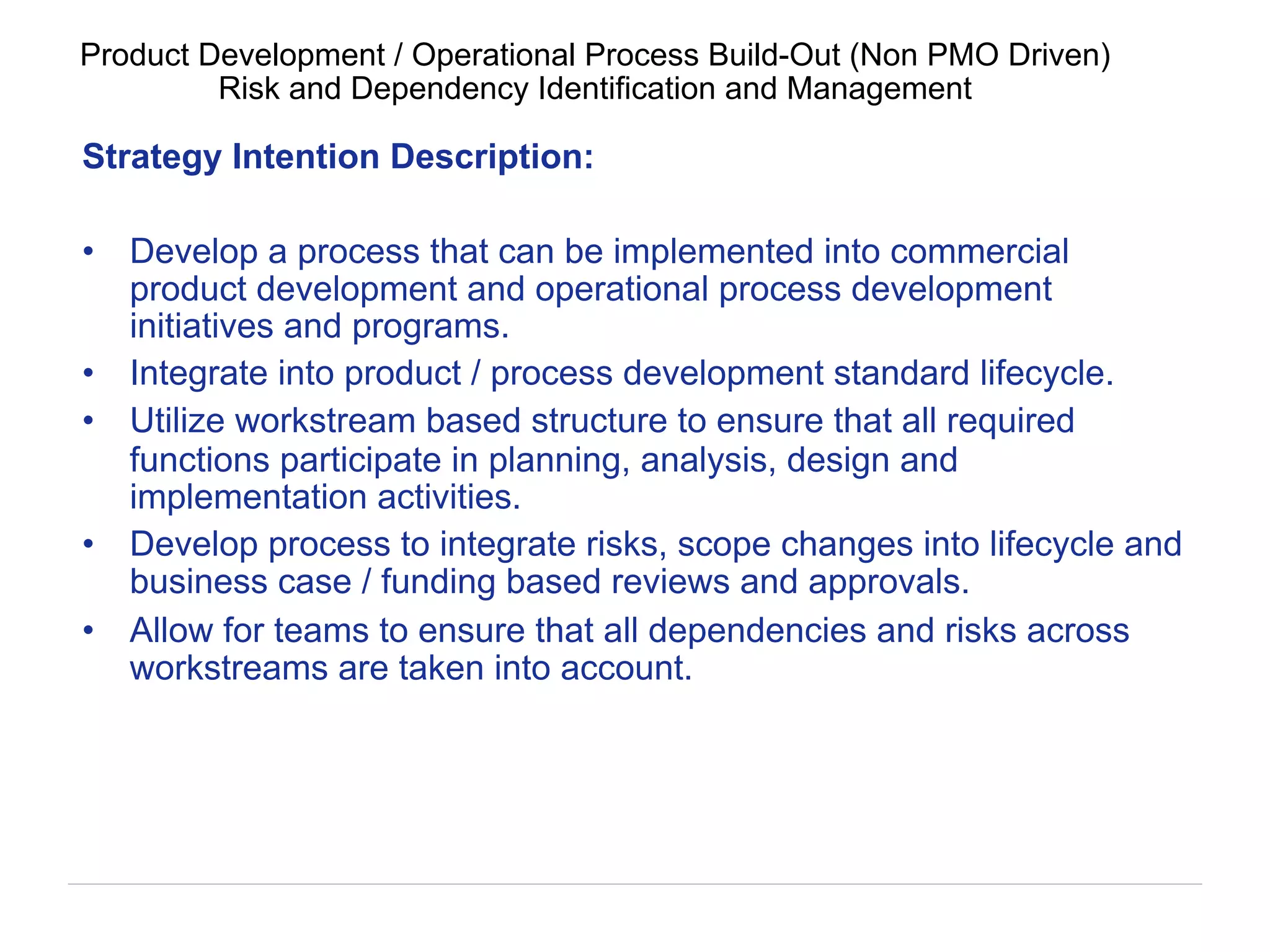
Strategy Intention Description:
•  Develop a process that can be implemented into commercial
product development and operational process development
initiatives and programs.
•  Integrate into product / process development standard lifecycle.
•  Utilize workstream based structure to ensure that all required
functions participate in planning, analysis, design and
implementation activities.
•  Develop process to integrate risks, scope changes into lifecycle and
business case / funding based reviews and approvals.
•  Allow for teams to ensure that all dependencies and risks across
workstreams are taken into account.
Product Development / Operational Process Build-Out (Non PMO Driven)
Risk and Dependency Identification and Management
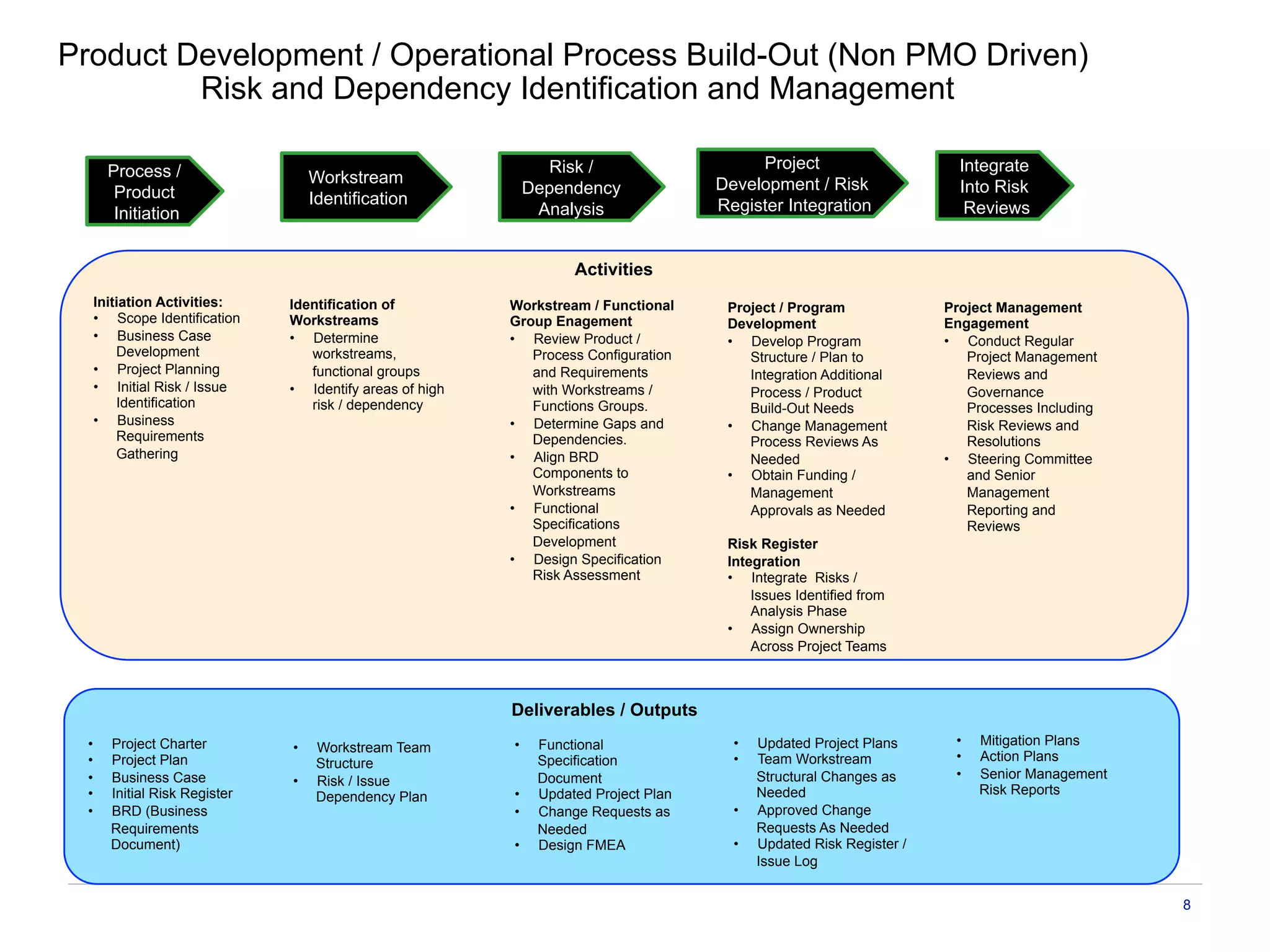
Product Development / Operational Process Build-Out (Non PMO Driven)
Risk and Dependency Identification and Management
8
Process /
Product
Initiation
Workstream
Identification
Risk /
Dependency
Analysis
Project
Development / Risk
Register Integration
Integrate
Into Risk
Reviews
Initiation Activities:
•  Scope Identification
•  Business Case
Development
•  Project Planning
•  Initial Risk / Issue
Identification
•  Business
Requirements
Gathering
•  Project Charter
•  Project Plan
•  Business Case
•  Initial Risk Register
•  BRD (Business
Requirements
Document)
Identification of
Workstreams
•  Determine
workstreams,
functional groups
•  Identify areas of high
risk / dependency
•  Workstream Team
Structure
•  Risk / Issue
Dependency Plan
Workstream / Functional
Group Enagement
•  Review Product /
Process Configuration
and Requirements
with Workstreams /
Functions Groups.
•  Determine Gaps and
Dependencies.
•  Align BRD
Components to
Workstreams
•  Functional
Specifications
Development
•  Design Specification
Risk Assessment
•  Functional
Specification
Document
•  Updated Project Plan
•  Change Requests as
Needed
•  Design FMEA
Project / Program
Development
•  Develop Program
Structure / Plan to
Integration Additional
Process / Product
Build-Out Needs
•  Change Management
Process Reviews As
Needed
•  Obtain Funding /
Management
Approvals as Needed
Risk Register
Integration
•  Integrate Risks /
Issues Identified from
Analysis Phase
•  Assign Ownership
Across Project Teams
•  Updated Project Plans
•  Team Workstream
Structural Changes as
Needed
•  Approved Change
Requests As Needed
•  Updated Risk Register /
Issue Log
Project Management
Engagement
•  Conduct Regular
Project Management
Reviews and
Governance
Processes Including
Risk Reviews and
Resolutions
•  Steering Committee
and Senior
Management
Reporting and
Reviews
•  Mitigation Plans
•  Action Plans
•  Senior Management
Risk Reports
Activities
Deliverables / Outputs

Enterprise PMO Dependency and Risk Management

  • 1.
    Enterprise Program Dependencyand Risk Management Strategy Lenny Shields
  • 2.
    •  Develop anenterprise portfolio methodology that can be implemented to determine critical risks and dependencies across enterprise wide programs. •  Develop a strategy and to identify key risks and dependencies across the organization that will be realized and impacted as a result of program activities. •  Determine operational risk and business continuity planning components that will be engaged as part of the dependency management strategy. •  Develop a strategy to identify risks and dependencies within product development and operational process build outs and implementations. •  Develop strategic program risk and dependency reporting processes across an organization’s program management portfolio. Project Aim and Scope
  • 3.
    Strategy Intention Description: • Outward looking review of other programs within an organization’s Program Management Office. •  Review program scope to determine potential risks for a given program as a result of other program activities. •  Review other programs to determine potential risks external to a given program that may be realized as result of the changes that a program will bring to the organization. •  Develop risk mitigation and actions plans that will be owned by a program and those that the external projects will take ownership for. •  Implement portfolio level governance and reporting processes to manage portfolio level risks across Program Management Office. Enterprise Wide Dependency / Risks Across Programs
  • 4.
    Dependency / RisksAcross Programs 4 Identify Scope Items Determine Programs Impacted Complete Impact Analysis Develop Risk Register Integrate Into Risk Reviews Determine Scope Items: •  Charter and Business Case Review •  Requirements Document Review •  Scope Statement •  Scope Inventory Portfolio Review •  Cross Reference Projects with Scope Items Alignment •  Develop Impacted Projects Inventory •  Project Dependent Inventory Matrix Conduct Impact Analysis •  Risk Assessment Meetings With Impacted Project Teams •  Complete Impact Analysis Matrices •  Impact Analysis Matrices •  FMEA (Failure Modes Effects Analysis) Develop Program / Portfolio Risk Register •  Integrate Impact Analysis Matrix and FMEA Details into Risk Register •  Update PPM tool With High / Critical Risks •  Assign Ownership Across Project Teams •  Portfolio Level Risk Register Updated Project Risk Registers Develop Portfolio Level Risk Review Process •  Portfolio Level Risk / Dependency Reviews •  Integrate Reviews into Project Reviews / Steering Committee •  Conduct Portfolio Level Risk Reviews •  Develop Mitigation and Action Plans •  Mitigation Plans •  Action Plans •  Senior Management Risk Reports Activities Deliverables / Outputs
  • 5.
    Strategy Intention Description: • Outward looking review of critical business processes and functions across an organization. •  Review scope to determine potential risks that may be realized as result of the changes that a program will bring to the organization. •  Engage business continuity planning and operational risk teams to identify critical business processes and high impact operational risk considerations that should be addressed. •  Develop a process to gather potential risk and issues outside of those that formal PMO programs will address and manage. •  Develop risk mitigation and actions plans that will be owned by a given program and those that the external business functions will take ownership for. •  Implement enterprise wide governance and reporting processes to manage risks and dependencies across the organization. Dependency / Risks Across Business Functions
  • 6.
    Dependency Management /Risks Across Business Functions 6 Identify Scope Items Business Continuity Planning Operational Risk Develop Risk Register Integrate Into Risk Reviews Determine Scope Items: •  Charter and Business Case Review •  Requirements Document Review •  Scope Statement •  Scope Inventory Business Continuity Planning Engagement •  Determine Level I/II/II Critical Business Functions •  Determine Severity I/II Business Functions •  Map to Scope Items •  Complete Risk Scoring of Functions to Scope Items •  Complete Risk Assessments With Business Functions •  Determine High Risk Areas •  CTQ Matrix •  SIPOC •  BCP Impacted Matrix Operational Risk Engagement •  Review Operational Risk Critical Items Across Business / Process Groups •  Apply Scoring Models •  Map to Scope Items •  Complete Risk Scoring of Functions to Scope Items •  Complete Risk Assessments With Business Functions •  Determine High Risk Areas •  Impact Analysis Matrices •  IBRA (Integrated Business Risk Assessment) •  FMEA (Failure Modes Effects Analysis) Develop Program / Portfolio Risk Register •  Integrate Impact Analysis Matrix and FMEA / IBRA Details into Risk Register •  Assign Ownership Across Project Teams •  Portfolio Level Risk Register •  Updated Project Risk Registers Develop Portfolio Level Risk Review Process •  Portfolio Level Risk / Dependency Reviews •  Integrate Reviews into Project Reviews / Steering Committee •  Conduct Portfolio Level Risk Reviews •  Develop Mitigation and Action Plans •  Mitigation Plans •  Action Plans •  Senior Management Risk Reports Activities Deliverables / Outputs
  • 7.
    Strategy Intention Description: • Develop a process that can be implemented into commercial product development and operational process development initiatives and programs. •  Integrate into product / process development standard lifecycle. •  Utilize workstream based structure to ensure that all required functions participate in planning, analysis, design and implementation activities. •  Develop process to integrate risks, scope changes into lifecycle and business case / funding based reviews and approvals. •  Allow for teams to ensure that all dependencies and risks across workstreams are taken into account. Product Development / Operational Process Build-Out (Non PMO Driven) Risk and Dependency Identification and Management
  • 8.
    Product Development /Operational Process Build-Out (Non PMO Driven) Risk and Dependency Identification and Management 8 Process / Product Initiation Workstream Identification Risk / Dependency Analysis Project Development / Risk Register Integration Integrate Into Risk Reviews Initiation Activities: •  Scope Identification •  Business Case Development •  Project Planning •  Initial Risk / Issue Identification •  Business Requirements Gathering •  Project Charter •  Project Plan •  Business Case •  Initial Risk Register •  BRD (Business Requirements Document) Identification of Workstreams •  Determine workstreams, functional groups •  Identify areas of high risk / dependency •  Workstream Team Structure •  Risk / Issue Dependency Plan Workstream / Functional Group Enagement •  Review Product / Process Configuration and Requirements with Workstreams / Functions Groups. •  Determine Gaps and Dependencies. •  Align BRD Components to Workstreams •  Functional Specifications Development •  Design Specification Risk Assessment •  Functional Specification Document •  Updated Project Plan •  Change Requests as Needed •  Design FMEA Project / Program Development •  Develop Program Structure / Plan to Integration Additional Process / Product Build-Out Needs •  Change Management Process Reviews As Needed •  Obtain Funding / Management Approvals as Needed Risk Register Integration •  Integrate Risks / Issues Identified from Analysis Phase •  Assign Ownership Across Project Teams •  Updated Project Plans •  Team Workstream Structural Changes as Needed •  Approved Change Requests As Needed •  Updated Risk Register / Issue Log Project Management Engagement •  Conduct Regular Project Management Reviews and Governance Processes Including Risk Reviews and Resolutions •  Steering Committee and Senior Management Reporting and Reviews •  Mitigation Plans •  Action Plans •  Senior Management Risk Reports Activities Deliverables / Outputs