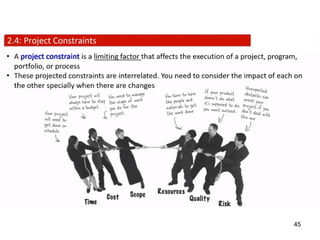
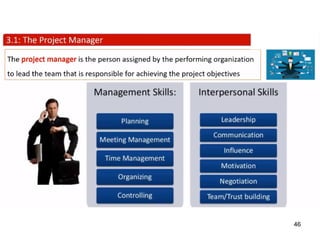
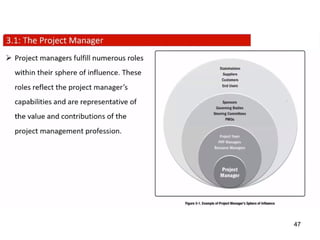
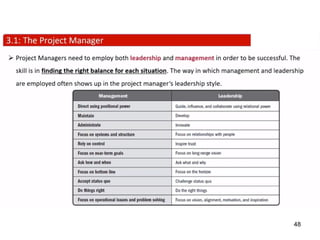
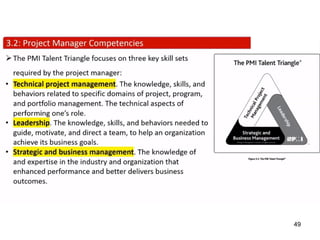
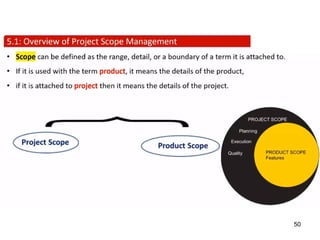
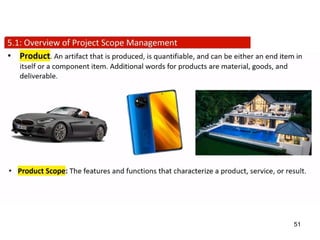
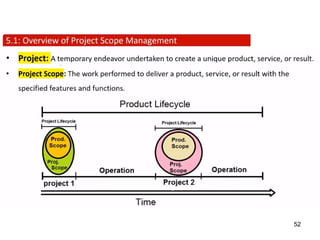
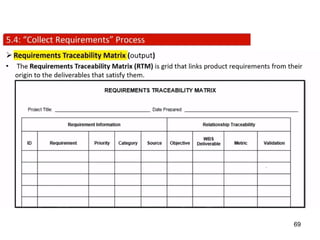
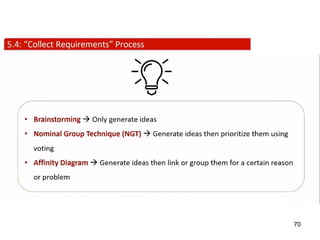
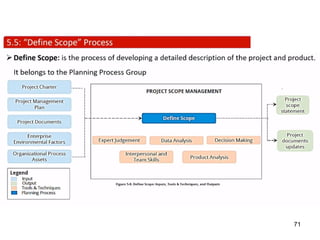
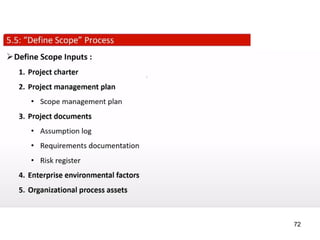
1
The Project Management Framework
2
Introduction
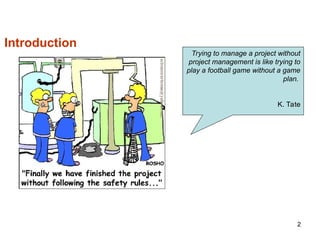
Trying to manage a project without
project management is like trying to
play a football game without a game
plan.
K. Tate
3
What is a Project ?
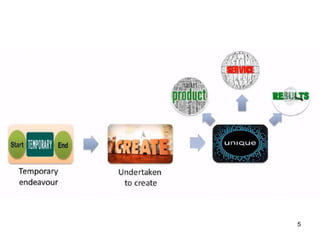
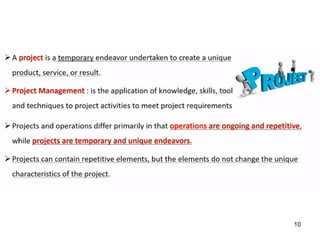
 A Project is a temporary endeavor undertaken to create a
unique, product, service, or result.
 Temporary endeavor with a beginning and an end.
 Creates unique product, service or result.
 Is Progressively Elaborated.
 Distinguishing characteristics of each unique project will be
progressively detailed as the project is better understood.
Another definition of a Project
 "A project is a finite endeavor - having specific start and
completion dates - undertaken to create a unique product or
service which brings about beneficial change or added value.
This finite characteristic of projects stands in sharp contrast to
processes, or operations, which are permanent or semi-
permanent functional work to repetitively produce the same
product or service." -- Wikipedia
4
5
6
7
8
9
What is Project Management?
 The application of knowledge, skills, tools and technique to
project activities to meet project requirements
 Project Management is accomplished through the application and
integration of the processes such as
 Initiating
 Planning
 Executing
 Monitoring and Controlling
 Closing
Why Project Management ?
10
11
Advantages of Using Formal Project Management
 Better control of financial, physical, and human resources
 Improved customer relations
 Shorter development times
 Lower costs
 Higher quality and increased reliability
 Higher profit margins
 Improved productivity
 Better internal coordination
 Higher worker morale (less stress)
12
Managing Projects
 The Project Manager is the person responsible for achieve the
project objectives.
 Managing a project includes:
 Identifying requirements.
 Establishing clear and achievable objectives.
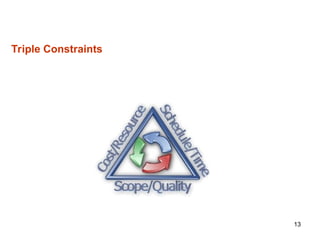
 Balancing the competing demand of quality, scope, time and cost.
 Adapting the specifications, plans, and approach to the different
concerns and expectations of the various stakeholders.
13
Triple Constraints
14
Organizational / Managerial Approach
 Management by Objective
 Management by Objectives (MBO) is a process of agreeing
upon objectives within an organization so that management
and employees agree to the objectives and understand what
they are in the organization.
15
Organizational / Managerial Approach
 The essence of MBO is participative goal setting, choosing
course of actions and decision making. An important part of
the MBO is the measurement and the comparison of the
employee’s actual performance with the standards set.
Ideally, when employees themselves have been involved with
the goal setting and the choosing the course of action to be
followed by them, they are more likely to succeed in their
responsibilities
16
Organizational / Managerial Approach
Project management is the control of planning, organizing, and
managing resources to bring about the successful completion
of specific project goals and objectives. It is sometimes
conflated with program management, however technically a
program is actually a higher level construct: a group of related
and somehow interdependent projects
17
Project Management Context
 Program Management
 Portfolio Management
 Project Management Office
18
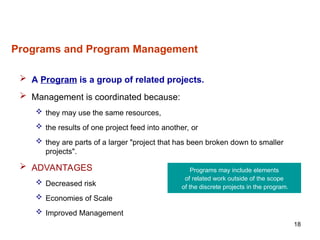
Programs and Program Management
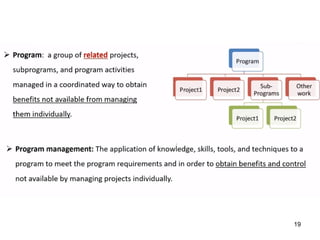
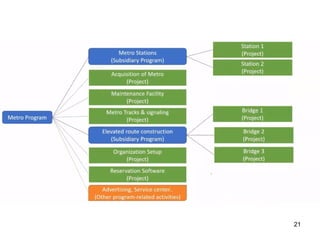
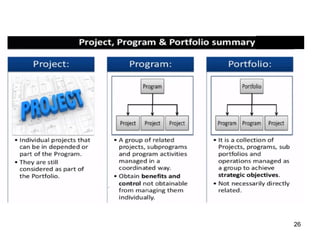
 A Program is a group of related projects.
 Management is coordinated because:
 they may use the same resources,
 the results of one project feed into another, or
 they are parts of a larger "project that has been broken down to smaller
projects".
 ADVANTAGES
 Decreased risk
 Economies of Scale
 Improved Management
Programs may include elements
of related work outside of the scope
of the discrete projects in the program.
19
20
21
22
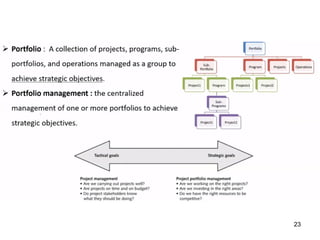
Portfolios and Portfolio Management
 A Portfolio is a collection of projects or programs and
other work that are grouped together to facilitate effective
management of that work to meet strategic business
objectives.
The projects or programs in the portfolio may not
necessarily be interdependent or directly related.
23
24
25
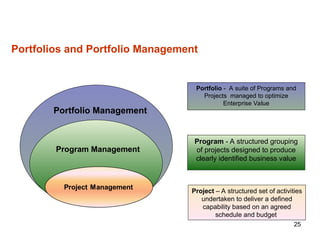
Portfolios and Portfolio Management
Portfolio Management
Program Management
Portfolio - A suite of Programs and
Projects managed to optimize
Enterprise Value
Program - A structured grouping
of projects designed to produce
clearly identified business value
Project – A structured set of activities
undertaken to deliver a defined
capability based on an agreed
schedule and budget
26
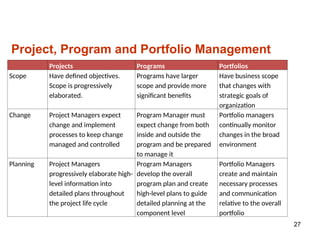
Project, Program and Portfolio Management
27
Projects Programs Portfolios
Scope Have defined objectives.
Scope is progressively
elaborated.
Programs have larger
scope and provide more
significant benefits
Have business scope
that changes with
strategic goals of
organization
Change Project Managers expect
change and implement
processes to keep change
managed and controlled
Program Manager must
expect change from both
inside and outside the
program and be prepared
to manage it
Portfolio managers
continually monitor
changes in the broad
environment
Planning Project Managers
progressively elaborate high-
level information into
detailed plans throughout
the project life cycle
Program Managers
develop the overall
program plan and create
high-level plans to guide
detailed planning at the
component level
Portfolio Managers
create and maintain
necessary processes
and communication
relative to the overall
portfolio
28
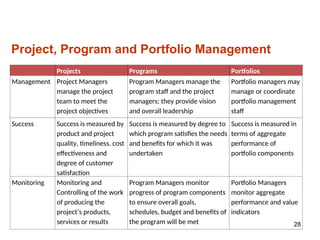
Projects Programs Portfolios
Management Project Managers
manage the project
team to meet the
project objectives
Program Managers manage the
program staff and the project
managers; they provide vision
and overall leadership
Portfolio managers may
manage or coordinate
portfolio management
staff
Success Success is measured by
product and project
quality, timeliness, cost
effectiveness and
degree of customer
satisfaction
Success is measured by degree to
which program satisfies the needs
and benefits for which it was
undertaken
Success is measured in
terms of aggregate
performance of
portfolio components
Monitoring Monitoring and
Controlling of the work
of producing the
project’s products,
services or results
Program Managers monitor
progress of program components
to ensure overall goals,
schedules, budget and benefits of
the program will be met
Portfolio Managers
monitor aggregate
performance and value
indicators
Project, Program and Portfolio Management
29
 Projects are frequently divided into more manageable
components or subprojects.
 Subproject are often contracted to an external enterprise or to
another functional unit in the performing organization.
 Sub projects can be referred to as projects and managed as such.
Subprojects
30
Project Management Office (PMO)
 An organizational entity that centralizes and coordinates the
management of projects.
 Responsibility of a PMO can range from providing project
management support functions to actually being responsible
for the direct management of a project.
Functions of a PMO
 A PMO performs a number of functions that may include but
are not limited to:
 Managing shared resources across projects
 Project Management Process/Methodology: Develop and
implement a consistent and standardized process.
 Coaching, mentoring, training and oversight
 Developing and managing project policies, procedures, templates
and other shared documentation (Organizational Process Assets)
 Monitoring compliance with PM standards, policies, procedures and
templates
31
32
 Home for project managers: In some cases, maintain a
centralized office from which project managers are loaned out to
work on projects.
 Project management software tools: Select and maintain project
management tools for use by employees. Also manage the Project
Management Knowledge base.
 Portfolio management: Establish a staff of program managers who
can manage multiple projects that are related, such as infrastructure
technologies, desktop applications and so on, and allocate
resources accordingly.
Project Management Office (PMO)
33
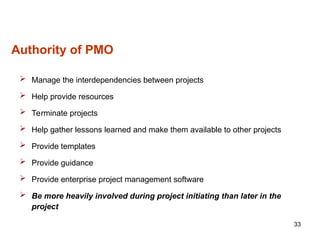
Authority of PMO
 Manage the interdependencies between projects
 Help provide resources
 Terminate projects
 Help gather lessons learned and make them available to other projects
 Provide templates
 Provide guidance
 Provide enterprise project management software
 Be more heavily involved during project initiating than later in the
project
34
Differences between role of a Project Managers
and PMO
 Project manager focuses on the specified project objectives ,
while the PMO manages major program scope changes which
may be seen as potential opportunities to better achieve
business objectives
 The project manager controls the assigned project resources
to best meet project objectives while the PMO optimizes the
use of shared organizational resources across all the projects
35
Making PMO Work
 The role of the PMO must be clearly defined.
 Preferably all those who are in the PMO must be qualified on
Project Management e.g. PMP certified.
 The commitment of executive (top) management is required.
 The PMO will not improve your project performance without
the use of proper project management processes and
technique. So professional project management must be
encouraged.
36
37
38
39
40
41
42
43
44
45
46
47
48
49
50
51
52
53
54
55
56
57
58
59
60
61
62
63
64
65
66
67
68
69
70
71
72
73
74
75
76
77
78
79
80
81
82
83
84
85
86
87
88
89
90
91
92
93
94
95
Project Life Cycle and Organization
96
Session Objective
2.1 The Project Life Cycle - Overview
2.2 Projects vs. Operational Work
2.3 Project Stakeholders
2.3 Organizational Influences
97
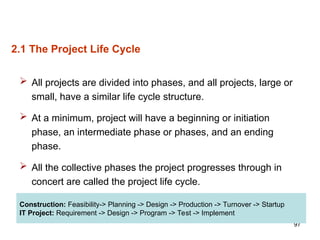
2.1 The Project Life Cycle
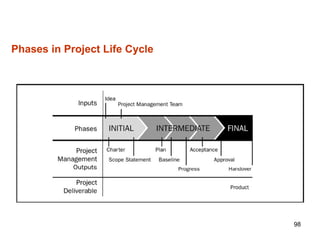
 All projects are divided into phases, and all projects, large or
small, have a similar life cycle structure.
 At a minimum, project will have a beginning or initiation
phase, an intermediate phase or phases, and an ending
phase.
 All the collective phases the project progresses through in
concert are called the project life cycle.
Construction: Feasibility-> Planning -> Design -> Production -> Turnover -> Startup
IT Project: Requirement -> Design -> Program -> Test -> Implement
98
Phases in Project Life Cycle
99
Handoffs
 Project phases evolve through the life cycle in a series of
phases sequences called handoffs, or technical transfers. The
end of one phase sequence may mark the beginning of the
next.
The completion of one phase does not automatically
signals the beginning of next phase.
100
Phase Completion
 You will recognize phase completion because each phase
has a specific deliverable, or multiple deliverables, that
marks the end of the phase.
A deliverable is an output that must be produced,
reviewed, and approved to bring the phase or project to completion.
Deliverables are tangible and can be measured and easily proved.
A Guide to the PMBOK states that phase ending reviews are also known
by a new other names: Phase Exits, Phase Gates, or Kill Points.
101
Phase-to-Phase Relationships
There are three basic types of phase – to – phase relationships :
A Sequential relationship : where a phase can only start once the previous
phase is complete
An Overlapping relationship : where the phase starts prior to completion
of the previous one (Fastracking ). Overlapping phase may increase risk
and can result in rework .
An Iterative relationship : where only one phase is planned at any given
time and the planning for the next is carried out as work progresses on
the current phase and deliverables
102
More on Project Phases
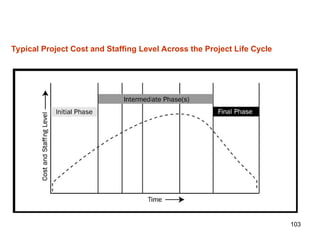
 In early phases of a project life cycle:
Resource needs are usually lowest
The level of uncertainty (risk) is highest
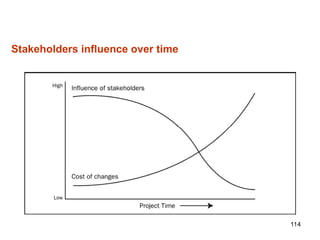
Project stakeholders have the greatest opportunity to influence the project
 In middle phases of a project life cycle:
The certainty of completing a project improves
More resources are needed
 The final phase of a project life cycle focuses on:
Ensuring that project requirements were met
The sponsor approves completion of the project
103
Typical Project Cost and Staffing Level Across the Project Life Cycle
104
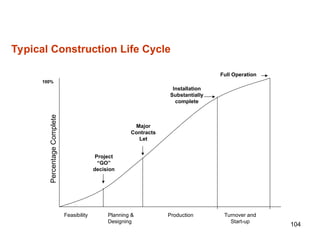
Typical Construction Life Cycle
Percentage
Complete
Feasibility Planning &
Designing
Production Turnover and
Start-up
Project
“GO”
decision
Major
Contracts
Let
Installation
Substantially
complete
Full Operation
100%
105
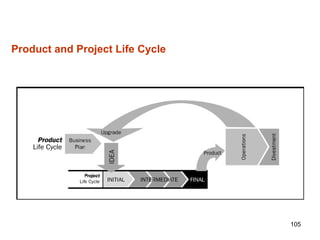
Product and Project Life Cycle
106
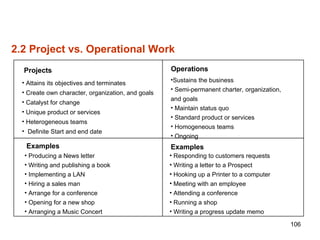
2.2 Project vs. Operational Work
• Attains its objectives and terminates
• Create own character, organization, and goals
• Catalyst for change
• Unique product or services
• Heterogeneous teams
• Definite Start and end date
Projects
• Producing a News letter
• Writing and publishing a book
• Implementing a LAN
• Hiring a sales man
• Arrange for a conference
• Opening for a new shop
• Arranging a Music Concert
Examples
•Sustains the business
• Semi-permanent charter, organization,
and goals
• Maintain status quo
• Standard product or services
• Homogeneous teams
• Ongoing
Operations
• Responding to customers requests
• Writing a letter to a Prospect
• Hooking up a Printer to a computer
• Meeting with an employee
• Attending a conference
• Running a shop
• Writing a progress update memo
Examples
107
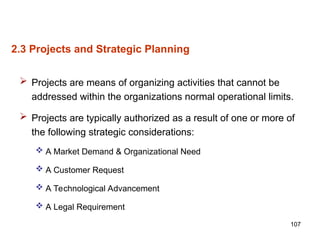
2.3 Projects and Strategic Planning
 Projects are means of organizing activities that cannot be
addressed within the organizations normal operational limits.
 Projects are typically authorized as a result of one or more of
the following strategic considerations:
 A Market Demand & Organizational Need
 A Customer Request
 A Technological Advancement
 A Legal Requirement
108
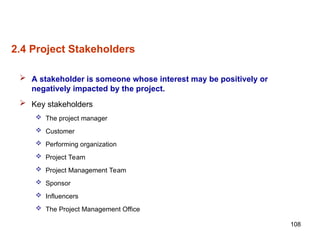
2.4 Project Stakeholders
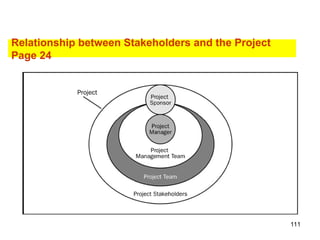
 A stakeholder is someone whose interest may be positively or
negatively impacted by the project.
 Key stakeholders
 The project manager
 Customer
 Performing organization
 Project Team
 Project Management Team
 Sponsor
 Influencers
 The Project Management Office
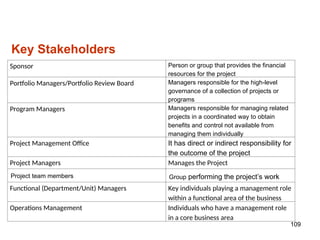
Key Stakeholders
Sponsor Person or group that provides the financial
resources for the project
Portfolio Managers/Portfolio Review Board Managers responsible for the high-level
governance of a collection of projects or
programs
Program Managers Managers responsible for managing related
projects in a coordinated way to obtain
benefits and control not available from
managing them individually
Project Management Office It has direct or indirect responsibility for
the outcome of the project
Project Managers Manages the Project
Project team members Group performing the project’s work
Functional (Department/Unit) Managers Key individuals playing a management role
within a functional area of the business
Operations Management Individuals who have a management role
in a core business area
109
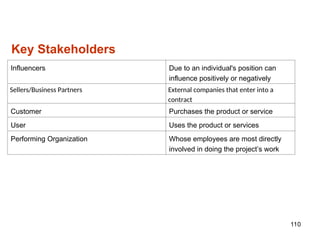
Key Stakeholders
Influencers Due to an individual's position can
influence positively or negatively
Sellers/Business Partners External companies that enter into a
contract
Customer Purchases the product or service
User Uses the product or services
Performing Organization Whose employees are most directly
involved in doing the project’s work
110
111
Relationship between Stakeholders and the Project
Page 24
112
What we do with the Stakeholders ?
 Identify ALL of them
 Determine ALL of their requirements
 Determine their expectations
 Communicate with them
 Manage their influence
113
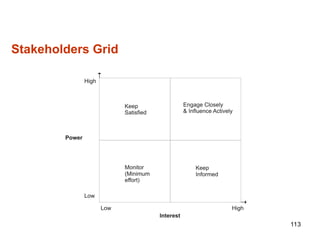
Stakeholders Grid
114
Stakeholders influence over time
115
Organizational Influence
 Projects are typically part of an organization that is larger than
the project.
 The maturity of the organization with respect to its project
management system, culture, style, organizational structure
and project management office can also influence the project.
 Organizational Systems
 Organizational Cultures and Styles
 Organizational Structure
116
Organizational System
 Project-based organizations are those whose operations
consist primarily of projects. These organizational falls into
two categories:
 Organizations that derive their revenue primarily from performing
projects for others under contract - architectural firms, engineering
firms, consultants, construction contractors, and government
contractors.
 Organizations that have adopted management by projects.
117
Organizational Cultures and Styles
 These cultures are reflected in numerous factors:
 Shared values, norms, beliefs, and expectations
 Policies and procedures
 View of authority relationships
 Work ethics and work hours
118
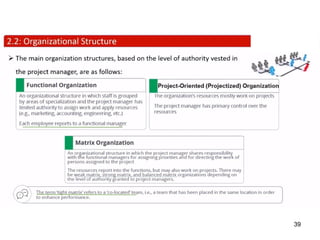
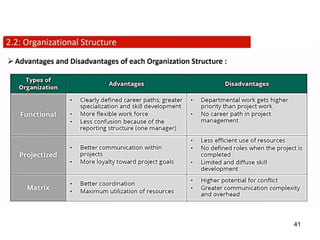
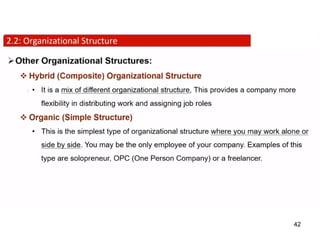
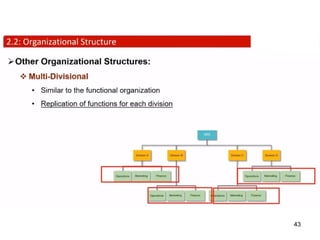
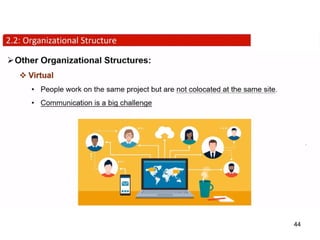
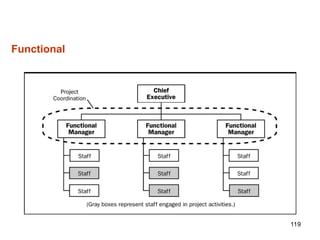
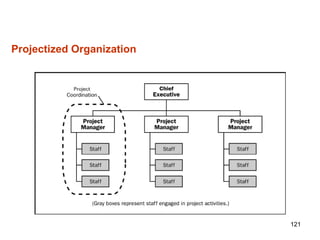
Organizational Structure
 The structure of the performing organization often constraints
the availability of resources in a spectrum from Functional to
Projectized, with a variety of matrix structure in between.
119
Functional
120
Functional Organization - Key Points
 The organization is grouped by areas of specialization within
different functional areas.
 Projects generally occur within a single department.
 Information required from other department will be routed
through departmental heads.
 Team members complete project work in addition to normal
department work.
121
Projectized Organization
122
Projectized Organization – Key Points
 The entire company is organized by projects.
 The project manager has control of projects.
 Personnel are assigned and report to a project manager.
 Team members complete only project work and when its over
they don't have HOME.
 Communication generally occurs only within the project.
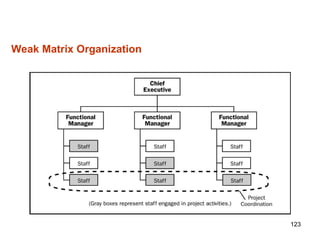
123
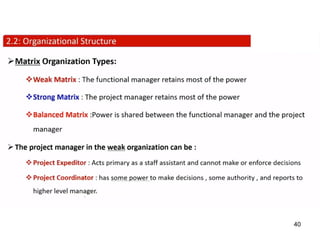
Weak Matrix Organization
124
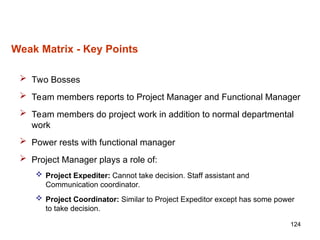
Weak Matrix - Key Points
 Two Bosses
 Team members reports to Project Manager and Functional Manager
 Team members do project work in addition to normal departmental
work
 Power rests with functional manager
 Project Manager plays a role of:
 Project Expediter: Cannot take decision. Staff assistant and
Communication coordinator.
 Project Coordinator: Similar to Project Expeditor except has some power
to take decision.
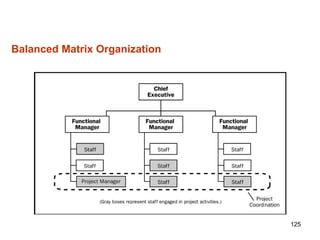
125
Balanced Matrix Organization
126
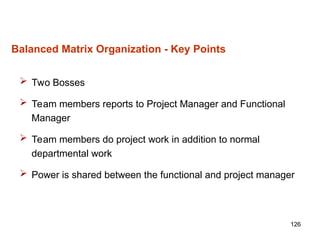
Balanced Matrix Organization - Key Points
 Two Bosses
 Team members reports to Project Manager and Functional
Manager
 Team members do project work in addition to normal
departmental work
 Power is shared between the functional and project manager
127
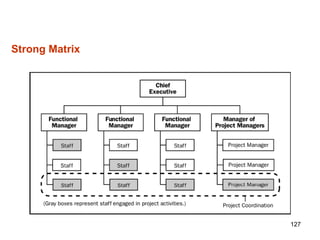
Strong Matrix
128
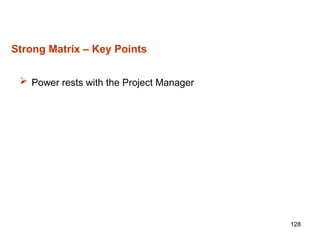
Strong Matrix – Key Points
 Power rests with the Project Manager
129
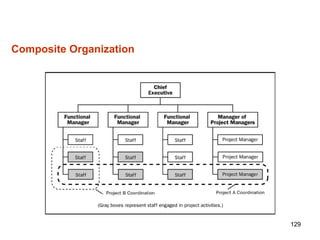
Composite Organization
130
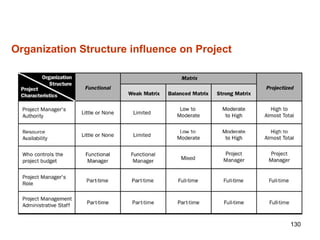
Organization Structure influence on Project
131
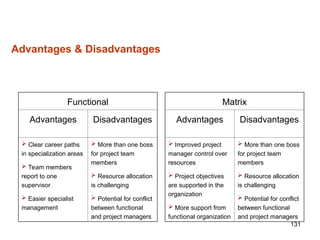
Advantages & Disadvantages
Functional
Advantages Disadvantages
 Clear career paths
in specialization areas
 Team members
report to one
supervisor
 Easier specialist
management
 More than one boss
for project team
members
 Resource allocation
is challenging
 Potential for conflict
between functional
and project managers
Matrix
Advantages Disadvantages
 Improved project
manager control over
resources
 Project objectives
are supported in the
organization
 More support from
functional organization
 More than one boss
for project team
members
 Resource allocation
is challenging
 Potential for conflict
between functional
and project managers
132
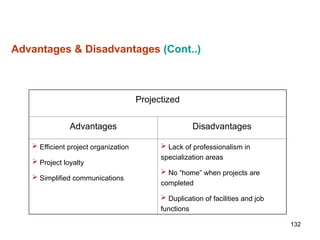
Advantages & Disadvantages (Cont..)
Projectized
Advantages Disadvantages
 Efficient project organization
 Project loyalty
 Simplified communications
 Lack of professionalism in
specialization areas
 No “home” when projects are
completed
 Duplication of facilities and job
functions
133
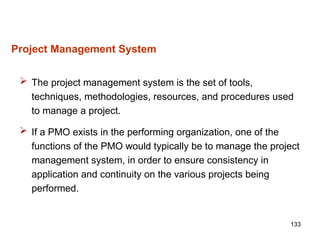
Project Management System
 The project management system is the set of tools,
techniques, methodologies, resources, and procedures used
to manage a project.
 If a PMO exists in the performing organization, one of the
functions of the PMO would typically be to manage the project
management system, in order to ensure consistency in
application and continuity on the various projects being
performed.
134
Project Management Processes for a Project
Unit 1
135
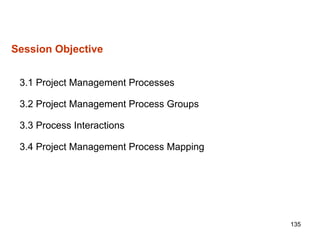
Session Objective
3.1 Project Management Processes
3.2 Project Management Process Groups
3.3 Process Interactions
3.4 Project Management Process Mapping
136
Processes for a Project
 Recall the definition of Project Management !
 Project Management is accomplished through processes.
 It uses Project Management Knowledge, Skills, Tools & Technique
 It receives Inputs and generates Outputs
 Select appropriate processes within the PM process group that are
required to meet the project objectives
 Use a defined approach to adapt the product specifications and plans to
meet project and product requirements.
 Comply with Stakeholders needs, wants and expectations.
 Balance the competing demand.
137
What is a process ?
 A Process is a set of interrelated actions and activities that
are performed to achieve a pre-specified set of products,
results, or services.
138
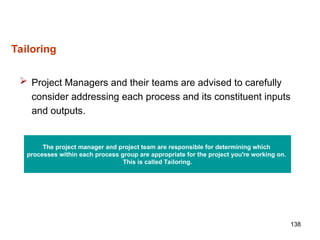
Tailoring
 Project Managers and their teams are advised to carefully
consider addressing each process and its constituent inputs
and outputs.
The project manager and project team are responsible for determining which
processes within each process group are appropriate for the project you're working on.
This is called Tailoring.
139
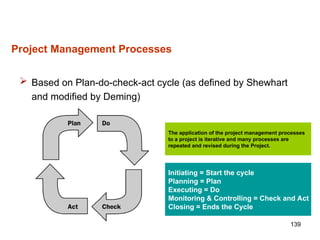
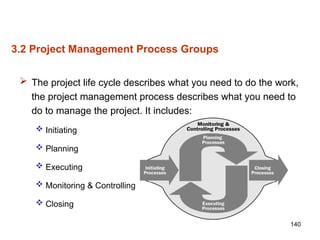
Project Management Processes
 Based on Plan-do-check-act cycle (as defined by Shewhart
and modified by Deming)
The application of the project management processes
to a project is iterative and many processes are
repeated and revised during the Project.
Initiating = Start the cycle
Planning = Plan
Executing = Do
Monitoring & Controlling = Check and Act
Closing = Ends the Cycle
140
3.2 Project Management Process Groups
 The project life cycle describes what you need to do the work,
the project management process describes what you need to
do to manage the project. It includes:
 Initiating
 Planning
 Executing
 Monitoring & Controlling
 Closing
141
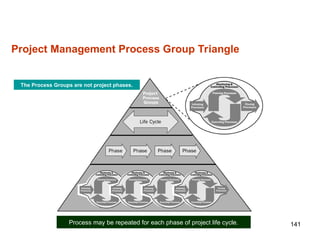
Project Management Process Group Triangle
The Process Groups are not project phases.
Process may be repeated for each phase of project life cycle.
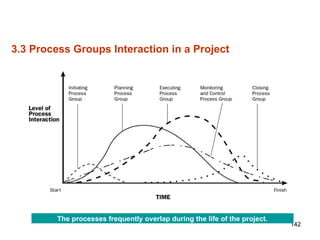
142
3.3 Process Groups Interaction in a Project
The processes frequently overlap during the life of the project.

Mastering the Five Basic Requirements of a Good Project Plan -.ppt

  • 1.
  • 2.
    2 Introduction Trying to managea project without project management is like trying to play a football game without a game plan. K. Tate
  • 3.
    3 What is aProject ?  A Project is a temporary endeavor undertaken to create a unique, product, service, or result.  Temporary endeavor with a beginning and an end.  Creates unique product, service or result.  Is Progressively Elaborated.  Distinguishing characteristics of each unique project will be progressively detailed as the project is better understood.
  • 4.
    Another definition ofa Project  "A project is a finite endeavor - having specific start and completion dates - undertaken to create a unique product or service which brings about beneficial change or added value. This finite characteristic of projects stands in sharp contrast to processes, or operations, which are permanent or semi- permanent functional work to repetitively produce the same product or service." -- Wikipedia 4
  • 5.
  • 6.
  • 7.
  • 8.
  • 9.
    9 What is ProjectManagement?  The application of knowledge, skills, tools and technique to project activities to meet project requirements  Project Management is accomplished through the application and integration of the processes such as  Initiating  Planning  Executing  Monitoring and Controlling  Closing Why Project Management ?
  • 10.
  • 11.
    11 Advantages of UsingFormal Project Management  Better control of financial, physical, and human resources  Improved customer relations  Shorter development times  Lower costs  Higher quality and increased reliability  Higher profit margins  Improved productivity  Better internal coordination  Higher worker morale (less stress)
  • 12.
    12 Managing Projects  TheProject Manager is the person responsible for achieve the project objectives.  Managing a project includes:  Identifying requirements.  Establishing clear and achievable objectives.  Balancing the competing demand of quality, scope, time and cost.  Adapting the specifications, plans, and approach to the different concerns and expectations of the various stakeholders.
  • 13.
  • 14.
    14 Organizational / ManagerialApproach  Management by Objective  Management by Objectives (MBO) is a process of agreeing upon objectives within an organization so that management and employees agree to the objectives and understand what they are in the organization.
  • 15.
    15 Organizational / ManagerialApproach  The essence of MBO is participative goal setting, choosing course of actions and decision making. An important part of the MBO is the measurement and the comparison of the employee’s actual performance with the standards set. Ideally, when employees themselves have been involved with the goal setting and the choosing the course of action to be followed by them, they are more likely to succeed in their responsibilities
  • 16.
    16 Organizational / ManagerialApproach Project management is the control of planning, organizing, and managing resources to bring about the successful completion of specific project goals and objectives. It is sometimes conflated with program management, however technically a program is actually a higher level construct: a group of related and somehow interdependent projects
  • 17.
    17 Project Management Context Program Management  Portfolio Management  Project Management Office
  • 18.
    18 Programs and ProgramManagement  A Program is a group of related projects.  Management is coordinated because:  they may use the same resources,  the results of one project feed into another, or  they are parts of a larger "project that has been broken down to smaller projects".  ADVANTAGES  Decreased risk  Economies of Scale  Improved Management Programs may include elements of related work outside of the scope of the discrete projects in the program.
  • 19.
  • 20.
  • 21.
  • 22.
    22 Portfolios and PortfolioManagement  A Portfolio is a collection of projects or programs and other work that are grouped together to facilitate effective management of that work to meet strategic business objectives. The projects or programs in the portfolio may not necessarily be interdependent or directly related.
  • 23.
  • 24.
  • 25.
    25 Portfolios and PortfolioManagement Portfolio Management Program Management Portfolio - A suite of Programs and Projects managed to optimize Enterprise Value Program - A structured grouping of projects designed to produce clearly identified business value Project – A structured set of activities undertaken to deliver a defined capability based on an agreed schedule and budget
  • 26.
  • 27.
    Project, Program andPortfolio Management 27 Projects Programs Portfolios Scope Have defined objectives. Scope is progressively elaborated. Programs have larger scope and provide more significant benefits Have business scope that changes with strategic goals of organization Change Project Managers expect change and implement processes to keep change managed and controlled Program Manager must expect change from both inside and outside the program and be prepared to manage it Portfolio managers continually monitor changes in the broad environment Planning Project Managers progressively elaborate high- level information into detailed plans throughout the project life cycle Program Managers develop the overall program plan and create high-level plans to guide detailed planning at the component level Portfolio Managers create and maintain necessary processes and communication relative to the overall portfolio
  • 28.
    28 Projects Programs Portfolios ManagementProject Managers manage the project team to meet the project objectives Program Managers manage the program staff and the project managers; they provide vision and overall leadership Portfolio managers may manage or coordinate portfolio management staff Success Success is measured by product and project quality, timeliness, cost effectiveness and degree of customer satisfaction Success is measured by degree to which program satisfies the needs and benefits for which it was undertaken Success is measured in terms of aggregate performance of portfolio components Monitoring Monitoring and Controlling of the work of producing the project’s products, services or results Program Managers monitor progress of program components to ensure overall goals, schedules, budget and benefits of the program will be met Portfolio Managers monitor aggregate performance and value indicators Project, Program and Portfolio Management
  • 29.
    29  Projects arefrequently divided into more manageable components or subprojects.  Subproject are often contracted to an external enterprise or to another functional unit in the performing organization.  Sub projects can be referred to as projects and managed as such. Subprojects
  • 30.
    30 Project Management Office(PMO)  An organizational entity that centralizes and coordinates the management of projects.  Responsibility of a PMO can range from providing project management support functions to actually being responsible for the direct management of a project.
  • 31.
    Functions of aPMO  A PMO performs a number of functions that may include but are not limited to:  Managing shared resources across projects  Project Management Process/Methodology: Develop and implement a consistent and standardized process.  Coaching, mentoring, training and oversight  Developing and managing project policies, procedures, templates and other shared documentation (Organizational Process Assets)  Monitoring compliance with PM standards, policies, procedures and templates 31
  • 32.
    32  Home forproject managers: In some cases, maintain a centralized office from which project managers are loaned out to work on projects.  Project management software tools: Select and maintain project management tools for use by employees. Also manage the Project Management Knowledge base.  Portfolio management: Establish a staff of program managers who can manage multiple projects that are related, such as infrastructure technologies, desktop applications and so on, and allocate resources accordingly. Project Management Office (PMO)
  • 33.
    33 Authority of PMO Manage the interdependencies between projects  Help provide resources  Terminate projects  Help gather lessons learned and make them available to other projects  Provide templates  Provide guidance  Provide enterprise project management software  Be more heavily involved during project initiating than later in the project
  • 34.
    34 Differences between roleof a Project Managers and PMO  Project manager focuses on the specified project objectives , while the PMO manages major program scope changes which may be seen as potential opportunities to better achieve business objectives  The project manager controls the assigned project resources to best meet project objectives while the PMO optimizes the use of shared organizational resources across all the projects
  • 35.
    35 Making PMO Work The role of the PMO must be clearly defined.  Preferably all those who are in the PMO must be qualified on Project Management e.g. PMP certified.  The commitment of executive (top) management is required.  The PMO will not improve your project performance without the use of proper project management processes and technique. So professional project management must be encouraged.
  • 36.
  • 37.
  • 38.
  • 39.
  • 40.
  • 41.
  • 42.
  • 43.
  • 44.
  • 45.
  • 46.
  • 47.
  • 48.
  • 49.
  • 50.
  • 51.
  • 52.
  • 53.
  • 54.
  • 55.
  • 56.
  • 57.
  • 58.
  • 59.
  • 60.
  • 61.
  • 62.
  • 63.
  • 64.
  • 65.
  • 66.
  • 67.
  • 68.
  • 69.
  • 70.
  • 71.
  • 72.
  • 73.
  • 74.
  • 75.
  • 76.
  • 77.
  • 78.
  • 79.
  • 80.
  • 81.
  • 82.
  • 83.
  • 84.
  • 85.
  • 86.
  • 87.
  • 88.
  • 89.
  • 90.
  • 91.
  • 92.
  • 93.
  • 94.
  • 95.
    95 Project Life Cycleand Organization
  • 96.
    96 Session Objective 2.1 TheProject Life Cycle - Overview 2.2 Projects vs. Operational Work 2.3 Project Stakeholders 2.3 Organizational Influences
  • 97.
    97 2.1 The ProjectLife Cycle  All projects are divided into phases, and all projects, large or small, have a similar life cycle structure.  At a minimum, project will have a beginning or initiation phase, an intermediate phase or phases, and an ending phase.  All the collective phases the project progresses through in concert are called the project life cycle. Construction: Feasibility-> Planning -> Design -> Production -> Turnover -> Startup IT Project: Requirement -> Design -> Program -> Test -> Implement
  • 98.
  • 99.
    99 Handoffs  Project phasesevolve through the life cycle in a series of phases sequences called handoffs, or technical transfers. The end of one phase sequence may mark the beginning of the next. The completion of one phase does not automatically signals the beginning of next phase.
  • 100.
    100 Phase Completion  Youwill recognize phase completion because each phase has a specific deliverable, or multiple deliverables, that marks the end of the phase. A deliverable is an output that must be produced, reviewed, and approved to bring the phase or project to completion. Deliverables are tangible and can be measured and easily proved. A Guide to the PMBOK states that phase ending reviews are also known by a new other names: Phase Exits, Phase Gates, or Kill Points.
  • 101.
    101 Phase-to-Phase Relationships There arethree basic types of phase – to – phase relationships : A Sequential relationship : where a phase can only start once the previous phase is complete An Overlapping relationship : where the phase starts prior to completion of the previous one (Fastracking ). Overlapping phase may increase risk and can result in rework . An Iterative relationship : where only one phase is planned at any given time and the planning for the next is carried out as work progresses on the current phase and deliverables
  • 102.
    102 More on ProjectPhases  In early phases of a project life cycle: Resource needs are usually lowest The level of uncertainty (risk) is highest Project stakeholders have the greatest opportunity to influence the project  In middle phases of a project life cycle: The certainty of completing a project improves More resources are needed  The final phase of a project life cycle focuses on: Ensuring that project requirements were met The sponsor approves completion of the project
  • 103.
    103 Typical Project Costand Staffing Level Across the Project Life Cycle
  • 104.
    104 Typical Construction LifeCycle Percentage Complete Feasibility Planning & Designing Production Turnover and Start-up Project “GO” decision Major Contracts Let Installation Substantially complete Full Operation 100%
  • 105.
  • 106.
    106 2.2 Project vs.Operational Work • Attains its objectives and terminates • Create own character, organization, and goals • Catalyst for change • Unique product or services • Heterogeneous teams • Definite Start and end date Projects • Producing a News letter • Writing and publishing a book • Implementing a LAN • Hiring a sales man • Arrange for a conference • Opening for a new shop • Arranging a Music Concert Examples •Sustains the business • Semi-permanent charter, organization, and goals • Maintain status quo • Standard product or services • Homogeneous teams • Ongoing Operations • Responding to customers requests • Writing a letter to a Prospect • Hooking up a Printer to a computer • Meeting with an employee • Attending a conference • Running a shop • Writing a progress update memo Examples
  • 107.
    107 2.3 Projects andStrategic Planning  Projects are means of organizing activities that cannot be addressed within the organizations normal operational limits.  Projects are typically authorized as a result of one or more of the following strategic considerations:  A Market Demand & Organizational Need  A Customer Request  A Technological Advancement  A Legal Requirement
  • 108.
    108 2.4 Project Stakeholders A stakeholder is someone whose interest may be positively or negatively impacted by the project.  Key stakeholders  The project manager  Customer  Performing organization  Project Team  Project Management Team  Sponsor  Influencers  The Project Management Office
  • 109.
    Key Stakeholders Sponsor Personor group that provides the financial resources for the project Portfolio Managers/Portfolio Review Board Managers responsible for the high-level governance of a collection of projects or programs Program Managers Managers responsible for managing related projects in a coordinated way to obtain benefits and control not available from managing them individually Project Management Office It has direct or indirect responsibility for the outcome of the project Project Managers Manages the Project Project team members Group performing the project’s work Functional (Department/Unit) Managers Key individuals playing a management role within a functional area of the business Operations Management Individuals who have a management role in a core business area 109
  • 110.
    Key Stakeholders Influencers Dueto an individual's position can influence positively or negatively Sellers/Business Partners External companies that enter into a contract Customer Purchases the product or service User Uses the product or services Performing Organization Whose employees are most directly involved in doing the project’s work 110
  • 111.
  • 112.
    112 What we dowith the Stakeholders ?  Identify ALL of them  Determine ALL of their requirements  Determine their expectations  Communicate with them  Manage their influence
  • 113.
  • 114.
  • 115.
    115 Organizational Influence  Projectsare typically part of an organization that is larger than the project.  The maturity of the organization with respect to its project management system, culture, style, organizational structure and project management office can also influence the project.  Organizational Systems  Organizational Cultures and Styles  Organizational Structure
  • 116.
    116 Organizational System  Project-basedorganizations are those whose operations consist primarily of projects. These organizational falls into two categories:  Organizations that derive their revenue primarily from performing projects for others under contract - architectural firms, engineering firms, consultants, construction contractors, and government contractors.  Organizations that have adopted management by projects.
  • 117.
    117 Organizational Cultures andStyles  These cultures are reflected in numerous factors:  Shared values, norms, beliefs, and expectations  Policies and procedures  View of authority relationships  Work ethics and work hours
  • 118.
    118 Organizational Structure  Thestructure of the performing organization often constraints the availability of resources in a spectrum from Functional to Projectized, with a variety of matrix structure in between.
  • 119.
  • 120.
    120 Functional Organization -Key Points  The organization is grouped by areas of specialization within different functional areas.  Projects generally occur within a single department.  Information required from other department will be routed through departmental heads.  Team members complete project work in addition to normal department work.
  • 121.
  • 122.
    122 Projectized Organization –Key Points  The entire company is organized by projects.  The project manager has control of projects.  Personnel are assigned and report to a project manager.  Team members complete only project work and when its over they don't have HOME.  Communication generally occurs only within the project.
  • 123.
  • 124.
    124 Weak Matrix -Key Points  Two Bosses  Team members reports to Project Manager and Functional Manager  Team members do project work in addition to normal departmental work  Power rests with functional manager  Project Manager plays a role of:  Project Expediter: Cannot take decision. Staff assistant and Communication coordinator.  Project Coordinator: Similar to Project Expeditor except has some power to take decision.
  • 125.
  • 126.
    126 Balanced Matrix Organization- Key Points  Two Bosses  Team members reports to Project Manager and Functional Manager  Team members do project work in addition to normal departmental work  Power is shared between the functional and project manager
  • 127.
  • 128.
    128 Strong Matrix –Key Points  Power rests with the Project Manager
  • 129.
  • 130.
  • 131.
    131 Advantages & Disadvantages Functional AdvantagesDisadvantages  Clear career paths in specialization areas  Team members report to one supervisor  Easier specialist management  More than one boss for project team members  Resource allocation is challenging  Potential for conflict between functional and project managers Matrix Advantages Disadvantages  Improved project manager control over resources  Project objectives are supported in the organization  More support from functional organization  More than one boss for project team members  Resource allocation is challenging  Potential for conflict between functional and project managers
  • 132.
    132 Advantages & Disadvantages(Cont..) Projectized Advantages Disadvantages  Efficient project organization  Project loyalty  Simplified communications  Lack of professionalism in specialization areas  No “home” when projects are completed  Duplication of facilities and job functions
  • 133.
    133 Project Management System The project management system is the set of tools, techniques, methodologies, resources, and procedures used to manage a project.  If a PMO exists in the performing organization, one of the functions of the PMO would typically be to manage the project management system, in order to ensure consistency in application and continuity on the various projects being performed.
  • 134.
  • 135.
    135 Session Objective 3.1 ProjectManagement Processes 3.2 Project Management Process Groups 3.3 Process Interactions 3.4 Project Management Process Mapping
  • 136.
    136 Processes for aProject  Recall the definition of Project Management !  Project Management is accomplished through processes.  It uses Project Management Knowledge, Skills, Tools & Technique  It receives Inputs and generates Outputs  Select appropriate processes within the PM process group that are required to meet the project objectives  Use a defined approach to adapt the product specifications and plans to meet project and product requirements.  Comply with Stakeholders needs, wants and expectations.  Balance the competing demand.
  • 137.
    137 What is aprocess ?  A Process is a set of interrelated actions and activities that are performed to achieve a pre-specified set of products, results, or services.
  • 138.
    138 Tailoring  Project Managersand their teams are advised to carefully consider addressing each process and its constituent inputs and outputs. The project manager and project team are responsible for determining which processes within each process group are appropriate for the project you're working on. This is called Tailoring.
  • 139.
    139 Project Management Processes Based on Plan-do-check-act cycle (as defined by Shewhart and modified by Deming) The application of the project management processes to a project is iterative and many processes are repeated and revised during the Project. Initiating = Start the cycle Planning = Plan Executing = Do Monitoring & Controlling = Check and Act Closing = Ends the Cycle
  • 140.
    140 3.2 Project ManagementProcess Groups  The project life cycle describes what you need to do the work, the project management process describes what you need to do to manage the project. It includes:  Initiating  Planning  Executing  Monitoring & Controlling  Closing
  • 141.
    141 Project Management ProcessGroup Triangle The Process Groups are not project phases. Process may be repeated for each phase of project life cycle.
  • 142.
    142 3.3 Process GroupsInteraction in a Project The processes frequently overlap during the life of the project.

Editor's Notes

  • #3 المشروع هو مسعى مؤقت يتم القيام به لإنشاء منتج أو خدمة أو نتيجة فريدة. مسعى مؤقت له بداية ونهاية. إنشاء منتج أو خدمة أو نتيجة فريدة. يتم إعداده بشكل تدريجي. سيتم تفصيل الخصائص المميزة لكل مشروع فريد بشكل تدريجي مع فهم المشروع بشكل أفضل.
  • #4 المشروع هو مسعى محدود - له تواريخ بداية وانتهاء محددة - يتم تنفيذه لإنشاء منتج أو خدمة فريدة من نوعها تؤدي إلى تغيير مفيد أو قيمة مضافة. هذه الخاصية المحدودة للمشاريع تتناقض بشكل حاد مع العمليات، أو العمليات، التي تعتبر عمل وظيفي دائم أو شبه دائم لإنتاج نفس المنتج أو الخدمة بشكل متكرر.
  • #9 تطبيق المعرفة والمهارات والأدوات والتقنيات على أنشطة المشروع لتلبية متطلبات المشروع يتم إنجاز إدارة المشروع من خلال تطبيق وتكامل العمليات مثل اعداد – تخطيط – تنفيذ - رصد ومراقبة - إغلاق
  • #11 مزايا استخدام إدارة المشاريع الرسمية تحسين السيطرة على الموارد المالية والمادية والبشرية تحسين العلاقات مع العملاء أوقات تطوير أقصر تكاليف أقل جودة أعلى وزيادة الموثوقية هوامش ربح أعلى وتحسين الإنتاجية تنسيق داخلي أفضل ارتفاع معنويات العمال (ضغط أقل)
  • #12 إدارة المشاريع مدير المشروع هو الشخص المسؤول عن تحقيق أهداف المشروع إدارة المشروع تشمل: تحديد المتطلبات. وضع أهداف واضحة وقابلة للتحقيق .تحقيق التوازن بين الطلب المتنافس من الجودة، والنطاق والوقت والتكلفة. تكييف المواصفات والخطط والنهج مع الاهتمامات والتوقعات المختلفة لأصحاب المصلحة المختلفين.
  • #14 النهج التنظيمي / الإداري الإدارة حسب الهدف الإدارة بالأهداف هي عملية الاتفاق على الأهداف داخل المنظمة بحيث توافق الإدارة والموظفين على الأهداف ويفهمون ماهيتها في المنظمة.
  • #15 جوهر MBO هو تحديد الأهداف التشاركية، واختيار مسار العمل واتخاذ القرار. جزء مهم من MBO هو قياس ومقارنة الأداء الفعلي للموظف مع المعايير المحددة. من المثالية، عندما يشارك الموظفون أنفسهم في تحديد الأهداف واختيار مسار العمل الذي سيتبعونه، فمن المرجح أن يفيوا بمسؤولياتهم
  • #16 إدارة المشروع هي السيطرة على تخطيط وتنظيم وإدارة الموارد لتحقيق نجاح أهداف وغايات المشروع المحددة. يتم في بعض الأحيان الخلط بينه وبين إدارة البرامج، إلا أن البرنامج من الناحية الفنية هو في الواقع بناء ذو مستوى أعلى: مجموعة من المشاريع المترابطة والمترابطة إلى حد ما
  • #17 سياق إدارة المشروع
  • #18 البرنامج عبارة عن مجموعة من المشاريع ذات الصلة. يتم تنسيق الإدارة للأسباب التالية: يمكنهم استخدام نفس الموارد، نتائج مشروع واحد تتغذى على آخر، أو إنها أجزاء من "مشروع أكبر تم تقسيمه إلى مشاريع أصغر". مزايا انخفاض المخاطر مقياس اقتصادي تحسين الإدارة
  • #22 المحفظة عبارة عن مجموعة من المشاريع أو البرامج والأعمال الأخرى التي يتم تجميعها معًا لتسهيل الإدارة الفعالة لذلك العمل لتحقيق أهداف العمل الإستراتيجية. قد لا تكون المشاريع أو البرامج الموجودة في المحفظة بالضرورة أن تكون مترابطة أو مرتبطة بشكل مباشر.
  • #25 المحفظة - مجموعة من البرامج والمشاريع التي تم إدارتها لتحسين قيمة المؤسسة البرنامج - مجموعة منظمة من المشاريع المصممة لإنتاج قيمة تجارية محددة بوضوح المشروع – مجموعة منظمة من الأنشطة التي يتم تنفيذها لتوفير قدرة محددة بناءً على جدول زمني وميزانية متفق عليهما
  • #27 لها أهداف محددة. يتم تطوير النطاق بشكل تدريجي. البرامج لها نطاق أوسع وتوفر فوائد أكثر أهمية لديك نطاق عمل يتغير مع الأهداف الإستراتيجية للمنظمة يتوقع مديرو المشاريع التغيير وتنفيذ العمليات للحفاظ على إدارة التغيير والتحكم فيه يجب أن يتوقع مدير البرنامج التغيير من داخل البرنامج وخارجه وأن يكون مستعدًا لإدارته يقوم مديرو المحافظ بمراقبة التغيرات في البيئة العامة باستمرار يقوم مديرو المشاريع بتطوير المعلومات عالية المستوى بشكل تدريجي إلى خطط تفصيلية طوال دورة حياة المشروع يقوم مديرو البرامج بتطوير خطة البرنامج الشاملة وإنشاء خطط عالية المستوى لتوجيه التخطيط التفصيلي على مستوى المكونات يقوم مديرو المحفظة بإنشاء وصيانة العمليات والاتصالات اللازمة فيما يتعلق بالمحفظة الإجمالية
  • #28 يقوم مديرو المشروع بإدارة فريق المشروع لتحقيق أهداف المشروع يقوم مديرو البرامج بإدارة موظفي البرنامج ومديري المشاريع؛ أنها توفر الرؤية والقيادة الشاملة يمكن لمديري المحافظ إدارة أو تنسيق موظفي إدارة المحافظ يتم قياس النجاح من خلال جودة المنتج والمشروع، وحسن التوقيت، وفعالية التكلفة، ودرجة رضا العملاء يتم قياس النجاح بمدى تلبية البرنامج للاحتياجات والفوائد التي تم تنفيذها من أجلها يتم قياس النجاح من حيث الأداء الإجمالي لمكونات المحفظة المراقبة والتحكم في أعمال إنتاج منتجات المشروع أو خدماته أو نتائجه يقوم مديرو البرامج بمراقبة التقدم المحرز في مكونات البرنامج لضمان تحقيق الأهداف العامة والجداول الزمنية والميزانية وفوائد البرنامج يقوم مديرو المحافظ بمراقبة مؤشرات الأداء والقيمة الإجمالية
  • #29 يتم تقسيم المشاريع في كثير من الأحيان إلى مكونات أو مشاريع فرعية أكثر قابلية للإدارة. غالبًا ما يتم التعاقد على المشروع الفرعي مع مؤسسة خارجية أو مع وحدة وظيفية أخرى في المؤسسة المنفذة. يمكن الإشارة إلى المشاريع الفرعية كمشاريع وإدارتها على هذا النحو.
  • #30 كيان تنظيمي يقوم بمركزية وتنسيق إدارة المشاريع. يمكن أن تتراوح مسؤولية مكتب إدارة المشاريع من توفير وظائف دعم إدارة المشروع إلى كونه مسؤولاً فعليًا عن الإدارة المباشرة للمشروع.
  • #31 يقوم مكتب إدارة المشاريع (PMO) بعدد من الوظائف التي قد تشمل على سبيل المثال لا الحصر: إدارة الموارد المشتركة عبر المشاريع عملية/منهجية إدارة المشروع: تطوير وتنفيذ عملية متسقة وموحدة. التدريب والتوجيه والتدريب والإشراف تطوير وإدارة سياسات المشروع وإجراءاته وقوالبه والوثائق المشتركة الأخرى (أصول العمليات التنظيمية) مراقبة الامتثال لمعايير وسياسات وإجراءات وقوالب PM
  • #32 منزل مديري المشاريع: في بعض الحالات، احتفظ بمكتب مركزي يتم من خلاله إعارة مديري المشاريع للعمل في المشاريع. أدوات برامج إدارة المشاريع: حدد أدوات إدارة المشاريع وصيانتها ليستخدمها الموظفون. قم أيضًا بإدارة قاعدة معارف إدارة المشاريع. إدارة المحافظ الاستثمارية: إنشاء فريق عمل من مديري البرامج الذين يمكنهم إدارة مشاريع متعددة مترابطة، مثل تقنيات البنية التحتية وتطبيقات سطح المكتب وما إلى ذلك، وتخصيص الموارد وفقًا لذلك.
  • #33 إدارة الترابط بين المشاريع المساعدة في توفير الموارد إنهاء المشاريع ساعد في جمع الدروس المستفادة وإتاحتها لمشاريع أخرى توفير القوالب تقديم التوجيه توفير برامج إدارة المشاريع للمؤسسات كن أكثر مشاركة خلال بدء المشروع من وقت لاحق في المشروع
  • #34 يركز مدير المشروع على أهداف المشروع المحددة، بينما يدير مكتب إدارة المشاريع التغييرات الرئيسية في نطاق البرنامج والتي يمكن اعتبارها فرصًا محتملة لتحقيق أهداف العمل بشكل أفضل يتحكم مدير المشروع في موارد المشروع المخصصة لتحقيق أهداف المشروع على أفضل وجه بينما يقوم مكتب إدارة المشاريع بتحسين استخدام الموارد التنظيمية المشتركة عبر جميع المشاريع
  • #35 يجب أن يتم تحديد دور مكتب إدارة المشروع بشكل واضح. ويفضل أن يكون جميع العاملين في مكتب إدارة المشاريع (PMO) مؤهلين في إدارة المشاريع على سبيل المثال. شهادة PMP. مطلوب التزام الإدارة التنفيذية (العليا). لن يقوم مكتب إدارة المشاريع (PMO) بتحسين أداء مشروعك دون استخدام عمليات وتقنيات إدارة المشروع المناسبة. لذلك يجب تشجيع إدارة المشاريع الاحترافية.
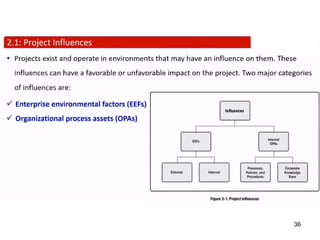
  • #36 توجد المشاريع وتعمل في بيئات قد يكون لها تأثير عليها. يمكن أن يكون لهذه التأثيرات تأثير إيجابي أو سلبي على المشروع. فئتان رئيسيتان
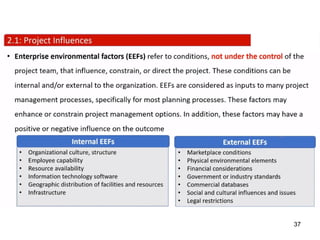
  • #37 تشير العوامل البيئية للمؤسسة (EEFs) إلى الظروف التي لا تخضع لسيطرة فريق المشروع والتي تؤثر على المشروع أو تقيده أو توجهه. يمكن أن تكون هذه الشروط داخلية و/أو خارجية للمنظمة. تعتبر EEFs بمثابة مدخلات للعديد من عمليات إدارة المشاريع، وخاصة بالنسبة لمعظم عمليات التخطيط. هذه العوامل قد تعزز أو تقيد خيارات إدارة المشروع. بالإضافة إلى ذلك، قد يكون لهذه العوامل تأثير إيجابي أو سلبي على النتيجة الثقافة التنظيمية، الهيكل قدرة الموظف توافر الموارد برامج تكنولوجيا المعلومات التوزيع الجغرافي للمرافق والموارد بنية تحتية ظروف السوق العناصر البيئية المادية الاعتبارات المالية معايير الحكومة أو الصناعة قواعد البيانات التجارية التأثيرات والقضايا الاجتماعية والثقافية القيود القانونية
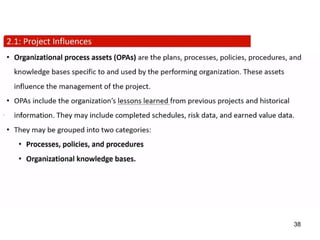
  • #38 أصول العمليات التنظيمية (OPAs) هي الخطط والعمليات والسياسات والإجراءات وقواعد المعرفة الخاصة والمستخدمة من قبل المنظمة المنفذة. تؤثر هذه الأصول على إدارة المشروع. تشمل OPAs المشاريع السابقة والتاريخية للمنظمة معلومة. وقد تتضمن الجداول الزمنية المكتملة وبيانات المخاطر وبيانات القيمة المكتسبة. ويمكن تجميعها في فئتين: • العمليات والسياسات والإجراءات • قواعد المعرفة التنظيمية.
  • #40 المصفوفة الضعيفة: يحتفظ المدير الوظيفي بمعظم السلطة المصفوفة القوية: يحتفظ مدير المشروع بمعظم السلطة المصفوفة المتوازنة: يتم تقاسم السلطة بين المدير الوظيفي ومدير المشروع مدير المشروع في المنظمة الضعيفة يمكن أن يكون :معجل المشروع: يعمل بشكل أساسي كمساعد للموظفين ولا يمكنه اتخاذ القرارات أو تنفيذها منسق المشروع: يتمتع بسلطة اتخاذ القرارات، وبعض السلطة، ويقدم تقاريره إلى مدير المستوى الأعلى.
  • #41 مسارات وظيفية محددة بوضوح؛ أكبر التخصص وتنمية المهارات قوة عمل أكثر مرونة ارتباك أقل بسبب هيكل إعداد التقارير (مدير واحد) العيوب يحظى عمل الأقسام بأولوية أعلى من عمل المشروع لا يوجد مسار وظيفي في إدارة المشاريع مزايا تواصل أفضل داخل المشاريع المزيد من الولاء تجاه أهداف المشروع العيوب استخدام أقل كفاءة للموارد لا توجد أدوار محددة عند اكتمال المشروع تنمية المهارات محدودة مزايا تنسيق أفضل الاستفادة القصوى من الموارد عيوب احتمالية أعلى للصراع زيادة تعقيد الاتصالات والنفقات العامة
  • #46 مدير المشروع هو الشخص المعين من قبل المنظمة المنفذة لقيادة الفريق المسؤول عن تحقيق أهداف المشروع
  • #47 يقوم مديرو المشاريع بأدوار عديدة ضمن نطاق نفوذهم. تعكس هذه الأدوار قدرات مدير المشروع وتمثل قيمة ومساهمات مهنة إدارة المشروع.
  • #48 يحتاج مديرو المشاريع إلى توظيف كل من القيادة والإدارة لتحقيق النجاح. المهارة هي في إيجاد التوازن الصحيح لكل حالة. غالبًا ما تظهر الطريقة التي يتم بها توظيف الإدارة والقيادة في أسلوب قيادة مدير المشروع.
  • #50 يمكن تعريف النطاق على أنه النطاق أو التفاصيل أو حدود المصطلح المرتبط به. إذا تم استخدامه مع مصطلح المنتج، فهذا يعني تفاصيل المنتج، إذا كان مرفقا بالمشروع فهذا يعني تفاصيل المشروع.
  • #51 منتج. القطعة الأثرية التي يتم إنتاجها قابلة للقياس الكمي، ويمكن أن تكون إما عنصرًا نهائيًا في حد ذاته أو عنصرًا مكونًا. الكلمات الإضافية للمنتجات هي المواد والسلع والتسليم. نطاق المنتج: الميزات والوظائف التي تميز المنتج أو الخدمة أو النتيجة.
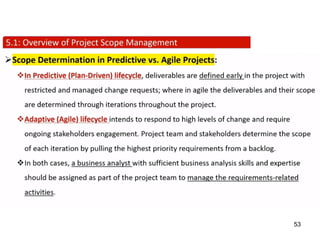
  • #53 في دورة الحياة التنبؤية (المعتمدة على الخطة)، يتم تحديد التسليمات في وقت مبكر من المشروع مع طلبات التغيير المقيدة والمدارة؛ حيث يتم تحديد التسليمات ونطاقها بشكل رشيق من خلال التكرارات في جميع أنحاء المشروع. تهدف دورة الحياة التكيفية (الرشيقة) إلى الاستجابة لمستويات عالية من التغيير وتتطلب مشاركة مستمرة من أصحاب المصلحة. يحدد فريق المشروع وأصحاب المصلحة نطاق كل تكرار عن طريق سحب المتطلبات ذات الأولوية القصوى من الأعمال المتراكمة. في كلتا الحالتين، يجب أن يكون لديك محلل أعمال يتمتع بمهارات وخبرة كافية في تحليل الأعمال يجب تعيينه كجزء من فريق المشروع لإدارة الأنشطة المتعلقة بالمتطلبات.
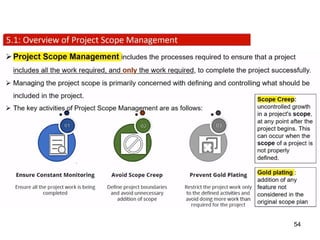
  • #54 تتضمن إدارة نطاق المشروع العمليات المطلوبة للتأكد من أن المشروع يتضمن جميع الأعمال المطلوبة. والعمل المطلوب فقط. لإكمال المشروع بنجاح. ضمان المراقبة المستمرة التأكد من اكتمال جميع أعمال المشروع تجنب زحف النطاق حدد حدود المشروع وتجنب إضافة النطاق غير الضروري منع طلاء الذهب قصر عمل المشروع فقط على الأنشطة المحددة و تجنب القيام بعمل أكثر مما هو مطلوب للمشروع زحف النطاق: النمو غير المنضبط في نطاق المشروع، في أي وقت بعد بدء المشروع. يمكن أن يحدث هذا عندما لا يتم تحديد نطاق المشروع بشكل صحيح. صفيحة ذهبية إضافة أي ميزة لم يتم أخذها بعين الاعتبار في خطة النطاق الأصلية
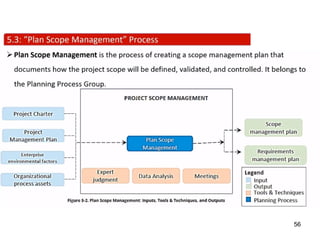
  • #56 خطة إدارة النطاق هي عملية إنشاء خطة إدارة النطاق التي توثق كيفية تحديد نطاق المشروع والتحقق من صحته والتحكم فيه. إنه ينتمي إلى مجموعة عمليات التخطيط.
  • #97 تنقسم جميع المشاريع إلى مراحل، وجميع المشاريع، كبيرة كانت أم صغيرة، لها هيكل دورة حياة مماثل. كحد أدنى، سيكون للمشروع مرحلة بداية أو بداية، ومرحلة أو مراحل متوسطة، ومرحلة نهاية. جميع المراحل الجماعية التي يتقدم بها المشروع بشكل متضافر تسمى دورة حياة المشروع.