Program Management Office Services
Version 1.2 10/6/20
Scope management – capture scope in project schedules and
supporting documents. Provide scope control through regular project
management meetings and intervention. Provide scope review and
concurrence through meeting with stakeholders and other participants.
Change Management – provide formal mechanism for control of
scope change. Publish and notify impacts of scope change on
stakeholders and service providers. Providing tracking and notification
of scope as well as resources changes.
Resource Planning – provide central repository for resources. Assign
resources to projects and notify managers of resource loading.
Cost Management and Reporting – identify labor and direct costs
for project execution. Report cost absorption as a function of time to
stakeholders and functional managers. Provide other project and
program management reports for internal and external use.
Project Review – provide real time labor and direct cost information.
Conduct periodic review of project progress according to the project
type milestone template.
Issue Management – provide centralized issue management system.
Maintain the issues, coordinate with assigned staff for resolving issues,
and report removal of issues from the system.
Risk Management – provide centralized risk assessment and
management service. Assess project risks through standard reporting
processes. Maintain a centralized database of risks and mitigation
actions for “lessons learned.”
Earned Value Management – provide earned value reporting for
individual projects and portfolios of projects.
Portfolio Management – provide centralized portfolio management
system.
Scheduling – provide detailed project scheduling processes. Gather
and maintain schedule information from functional managers. Maintain
the integrity of this information through periodic reviews and project
updates.
Program Management Office Services
Version 1.2 10/6/20
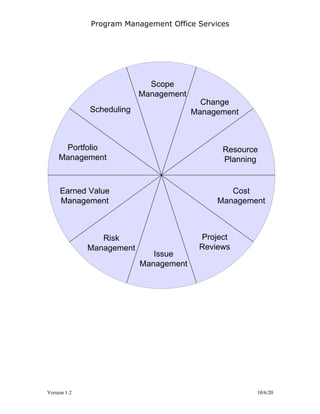
Scheduling
Portfolio
Management
Earned Value
Management
Risk
Management
Issue
Management
Project
Reviews
Cost
Management
Resource
Planning
Change
Management
Scope
Management
Program Management Office Services
Version 1.2 10/6/20
Knowledge Broker
Ensures all project critical data and information necessary for process
implementation and decision making are available to all stakeholders.
This includes analysis and reporting of project metrics and quantitative
and qualitative analyses: variance analysis, critical path analysis, and
trend analysis.
Facilitator
Work directly with project teams and conduct project workshops
design to gain consensus on key parameters such as scope, resource
requirements, plans, and schedule dependencies.
Mentor and Coach
Assume an active role in promoting knowledge, understanding
processes, and achieving buy-in from stakeholders. Focus on
promoting an understanding of relevant PMO processes. Provide
resources for the general understanding of project management and
its relevance to the stakeholder. Develop and implement project
management training.
Process Champion
Develop, implement, and continuously improve project management
processes based on organizational feedback, management
requirements, and industry best practices. Project value to project and
senior management stakeholders.

Program Management Office Services

  • 1.
    Program Management OfficeServices Version 1.2 10/6/20 Scope management – capture scope in project schedules and supporting documents. Provide scope control through regular project management meetings and intervention. Provide scope review and concurrence through meeting with stakeholders and other participants. Change Management – provide formal mechanism for control of scope change. Publish and notify impacts of scope change on stakeholders and service providers. Providing tracking and notification of scope as well as resources changes. Resource Planning – provide central repository for resources. Assign resources to projects and notify managers of resource loading. Cost Management and Reporting – identify labor and direct costs for project execution. Report cost absorption as a function of time to stakeholders and functional managers. Provide other project and program management reports for internal and external use. Project Review – provide real time labor and direct cost information. Conduct periodic review of project progress according to the project type milestone template. Issue Management – provide centralized issue management system. Maintain the issues, coordinate with assigned staff for resolving issues, and report removal of issues from the system. Risk Management – provide centralized risk assessment and management service. Assess project risks through standard reporting processes. Maintain a centralized database of risks and mitigation actions for “lessons learned.” Earned Value Management – provide earned value reporting for individual projects and portfolios of projects. Portfolio Management – provide centralized portfolio management system. Scheduling – provide detailed project scheduling processes. Gather and maintain schedule information from functional managers. Maintain the integrity of this information through periodic reviews and project updates.
  • 2.
    Program Management OfficeServices Version 1.2 10/6/20 Scheduling Portfolio Management Earned Value Management Risk Management Issue Management Project Reviews Cost Management Resource Planning Change Management Scope Management
  • 3.
    Program Management OfficeServices Version 1.2 10/6/20 Knowledge Broker Ensures all project critical data and information necessary for process implementation and decision making are available to all stakeholders. This includes analysis and reporting of project metrics and quantitative and qualitative analyses: variance analysis, critical path analysis, and trend analysis. Facilitator Work directly with project teams and conduct project workshops design to gain consensus on key parameters such as scope, resource requirements, plans, and schedule dependencies. Mentor and Coach Assume an active role in promoting knowledge, understanding processes, and achieving buy-in from stakeholders. Focus on promoting an understanding of relevant PMO processes. Provide resources for the general understanding of project management and its relevance to the stakeholder. Develop and implement project management training. Process Champion Develop, implement, and continuously improve project management processes based on organizational feedback, management requirements, and industry best practices. Project value to project and senior management stakeholders.