15 years experience in practice management consulting: Project Management Change Management Process and workflow Design
PROFESSIONAL PROFILE &  HIGHLIGHTS   Proven excellent experience in working with and negotiating with third party vendors as part of creating a Request for Proposal ( RFP ) and establishing the evaluation criteria. Demonstrated ability in all phases of project management from pre-engineering/pre-tender to implementation/handover. Also demonstrated ability in managing multiple projects and complex projects. Training includes a Bachelor Degree of Science in Biochemistry; Six Sigma Introduction (e-green belt DMAIC - Six Sigma course) and extensive professional development through continuing education. Has a strong understanding of PMBOK and is  Prince2 (Project in Controlled Environment) Foundation  Certified .  Able to champion change, sell the vision and create business/IT stakeholder buy-in using professional,  discreet communication strategies and managing information flow to key personnel. Using both PMBOK & Prince2 methodologies ( project life cycle, project planning, project documentation,  change management, quality control, testing, phase exit, training, project issues/ resolve conflicts, risk  assessment, and post implementation ).
Ability to work with a team of over 20 business stakeholders and Specialists (project mangers, engineers, integration specialist, application specialist, marketing and sales  support teams). Strong leadership skills – ambitious, focused, committed and team-oriented. Applied a structured change management approach and methodology (CAP model, six sigma based  methodology) for the people/staff side change caused by projects and change efforts. Developed a change management strategy based on a situational awareness of the details of the change and the groups being impacted by the change.  Identified potential people-side risks and anticipated points of resistance, and develop specific plans to mitigate or address the concerns. Conducted readiness assessments, evaluated results and present findings in a logical and easy-to- understand manner.
Developed a set of actionable and targeted change management plans – including communication plan, sponsor roadmap, coaching plan, training plan and resistance management plan.  Supported the execution of plans by employee-facing managers and business leaders.  Be an active and visible coach to executives leaders who are change sponsors.  Created and managed measurement systems to track adoption, utilization and proficiency of individual changes. Identified resistance and performance gaps, and worked to develop and implement corrective actions Created and enabled reinforcement mechanisms and celebrations of success. Worked with project teams to integrate change management activities into the overall project plan. Worked with communication, training, and other specialists in the formulation of particular plans and  activities to support project implementation.
Independent IT and Project Management   Consultant ( June 2009 – present) Victoria, B.C. Canada 15 years experience as a healthcare specialist and a project management consultant.  Utilizing extensive  industry experience within medical equipment, IT healthcare (PACS/RIS/CIS & CVIS), pharma, biotech,  clinical research and healthcare environments to execute and implement certain processes as well as  methodologies into diverse operational roles at all organizational levels. Skilled in: Project Initiation, Planning, Execution and Closing Project Controlling and Monitoring Project Change Management Project Risk Assessment Project Training Plan and materials Build up to Technical RFP and evaluation process Business Planning Quality Control Process Time and Budget Management Product Management Vendor Management IT project Management Design of project life cycle
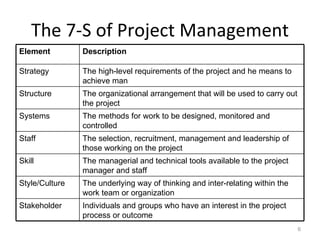
The 7-S of Project Management Element Description Strategy The high-level requirements of the project and he means to achieve man Structure The organizational arrangement that will be used to carry out the project  Systems The methods for work to be designed, monitored and controlled Staff The selection, recruitment, management and leadership of those working on the project Skill The managerial and technical tools available to the project manager and staff Style/Culture The underlying way of thinking and inter-relating within the work team or organization Stakeholder Individuals and groups who have an interest in the project process or outcome
The Project Management is about ……. Project management is about influencing tomorrow. Today has already happened and yesterday is gone. (’PROACTIVE’ which means plan well) Decisions affecting tomorrow can only be made on information available today. Project management is about delivering a set of relationships over time and about understanding people. Project management is widely recognized as a practical way (throughout certain approach) of ensuring that projects meet objectives and products are delivered on  time , within  budget  and to correct  quality  specification, while at the same time  controlling  or maintaining the  scope  of the project at the correct level.
PMBOK Approach The PMBOK  is an inclusive term that describes the sum of knowledge w ithin the profession of project management PMBOK is applied and advanced by both practitioners and academics PMBOK can be and is being used for projects  in  various fields of professions including Software engineering
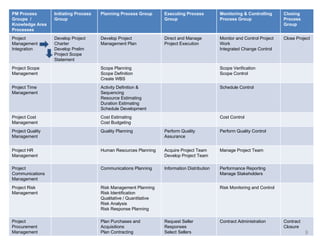
PM Process Groups  /  Knowledge Area Processes Initiating Process Group Planning Process Group Executing Process Group Monitoring & Controlling Process Group Closing Process Group Project Management Integration Develop Project Charter  Develop Prelim Project Scope Statement Develop Project Management Plan Direct and Manage Project Execution Monitor and Control Project Work Integrated Change Control Close Project Project Scope Management Scope Planning Scope Definition Create WBS Scope Verification Scope Control Project Time Management Activity Definition &  Sequencing Resource Estimating Duration Estimating Schedule Development Schedule Control Project Cost Management Cost Estimating Cost Budgeting Cost Control Project Quality Management Quality Planning Perform Quality Assurance Perform Quality Control Project HR Management Human Resources Planning Acquire Project Team Develop Project Team Manage Project Team Project Communications Management Communications Planning Information Distribution Performance Reporting Manage Stakeholders Project Risk Management Risk Management Planning Risk Identification Qualitative / Quantitative Risk Analysis Risk Response Planning Risk Monitoring and Control Project Procurement Management Plan Purchases and Acquisitions Plan Contracting Request Seller Responses Select Sellers Contract Administration Contract Closure
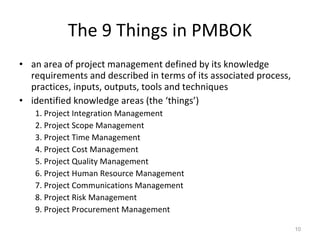
The 9 Things in PMBOK an area of project management defined by its knowledge requirements and described in terms of its associated process, practices, inputs, outputs, tools and techniques identified knowledge areas (the ‘things’) 1. Project Integration Management 2. Project Scope Management 3. Project Time Management 4. Project Cost Management 5. Project Quality Management 6. Project Human Resource Management 7. Project Communications Management 8. Project Risk Management 9. Project Procurement Management
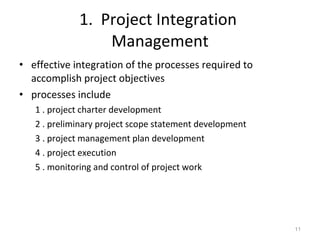
1.  Project Integration  Management effective integration of the processes required to accomplish project objectives processes include 1 . project charter development 2 . preliminary project scope statement development 3 . project management plan development 4 . project execution 5 . monitoring and control of project work
2.  Project Scope  Management defines and controls what is and is not included in the project processes include 1 . scope planning 2 . scope definition 3 . creation of a Work Breakdown Schedule 4 . scope verification 5 . scope control
3.  Project Time  Management includes processes required for the timely completion of a project processes include 1 . defining activities 2 . sequencing activities 3 . estimating resource activities 4 . estimating duration of activities 5 . developing the project schedule 6 . controlling the project schedule
4.  Project Cost Management planning, estimating, budgeting and controlling costs to ensure the project can be completed within the approved budget processes include 1 . cost estimating 2 . cost budgeting 3 . cost control
5.  Project Quality  Management all activities that determine quality policies, objectives and responsibilities for the project to satisfy the needs for which it was undertaken processes include 1 . quality planning 2 . performing quality assurance 3 . performing quality control
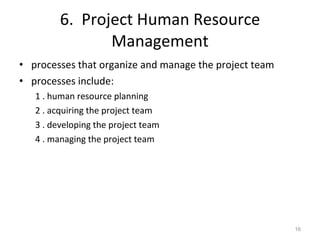
6.  Project Human Resource Management processes that organize and manage the project team processes include: 1 . human resource planning 2 . acquiring the project team 3 . developing the project team 4 . managing the project team
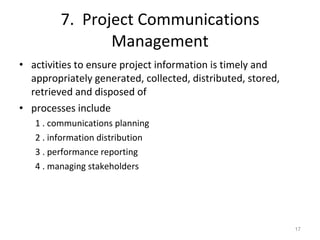
7.  Project Communications Management activities to ensure project information is timely and appropriately generated, collected, distributed, stored, retrieved and disposed of processes include 1 . communications planning 2 . information distribution 3 . performance reporting 4 . managing stakeholders
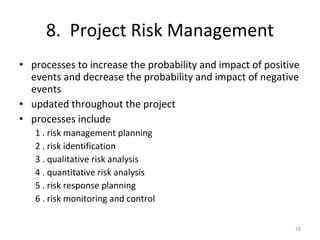
8.  Project Risk Management processes to increase the probability and impact of positive events and decrease the probability and impact of negative events updated throughout the project processes include 1 . risk management planning 2 . risk identification 3 . qualitative risk analysis 4 . quantitative risk analysis 5 . risk response planning 6 . risk monitoring and control
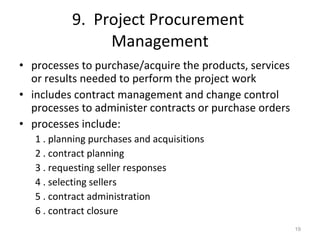
9.  Project Procurement  Management processes to purchase/acquire the products, services or results needed to perform the project work includes contract management and change control processes to administer contracts or purchase orders processes include: 1 . planning purchases and acquisitions 2 . contract planning 3 . requesting seller responses 4 . selecting sellers 5 . contract administration 6 . contract closure
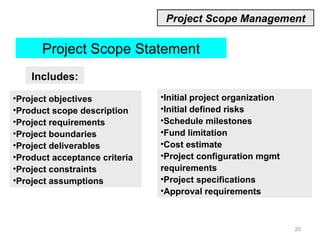
Includes: Project Scope Statement Project objectives Product scope description Project requirements Project boundaries Project deliverables Product acceptance criteria Project constraints Project assumptions Initial project organization Initial defined risks Schedule milestones Fund limitation Cost estimate Project configuration mgmt requirements Project specifications Approval requirements Project Scope Management
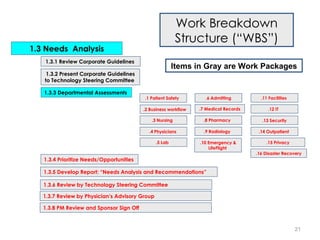
Work Breakdown Structure (“WBS”) 1.3 Needs  Analysis 1.3.1 Review Corporate Guidelines   1.3.2 Present Corporate Guidelines to Technology Steering Committee   1.3.3 Departmental Assessments   .1 Patient Safety  .2 Business workflow   .3 Nursing  .4 Physicians   .5 Lab  .8 Pharmacy  .9 Radiology  .10 Emergency & LifeFlight   .11 Facilities   .12 IT  .16 Disaster Recovery .13 Security .6 Admitting .14 Outpatient   .7 Medical Records .15 Privacy 1.3.4 Prioritize Needs/Opportunities   1.3.5 Develop Report: “Needs Analysis and Recommendations”   1.3.6 Review by Technology Steering Committee   1.3.7 Review by Physician’s Advisory Group 1.3.8 PM Review and Sponsor Sign Off Items in Gray are Work Packages
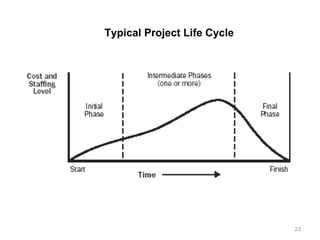
Project Life Cycle   The collection of phases that are performed in completing a project. Each project phase is marked by completion of one or more deliverables. The conclusion of a project phase is generally marked by a review of both key deliverables and project performance to date. Determine if the project should continue into its next phase. Detect and correct errors.  The project life cycle defines the beginning and the end of a project. Project life cycles generally define: What technical work should be done in each phase. Who should be involved in each phase.
Typical Project Life Cycle
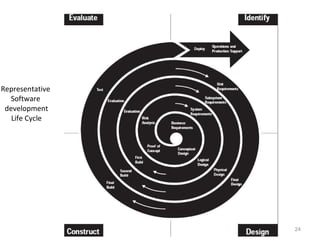
Representative  Software  development Life Cycle
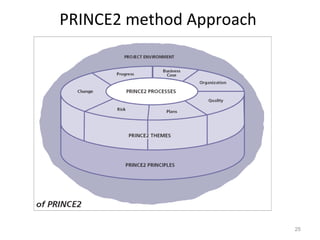
PRINCE2  method Approach
7  principles  7  themes 7  processes 8 duties and behaviours for the project board 8 project roles 2 guides 2 detailed techniques 33 referenced techniques 26 management products 6 performance targets More than 20 pages of guidance on tailoring PRINCE2  method
PRINCE2 Principles  Business Justification A PRINCE2 project has continued business justification Learn from experience PRINCE2 project teams learn from previous experience (lessons are sought, recorded and acted upon throughout the life of the project) Roles & Responsibilities A PRINCE2 project has defined and agreed roles and responsibilities with an organisation structure that engages the business, user and supplier stakeholder interests Manage by Stages A PRINCE2 project is planned, monitored and controlled on a stage by stage basis  Manage by Exception A PRINCE2 project has defined tolerances for each project objective to establish limits of delegated authority  Product Focus A PRINCE2 project focuses on the definition and delivery of products, in particular their quality requirements Tailor PRINCE2 is tailored to suit the project’s size, environment, complexity, importance, capability and risk
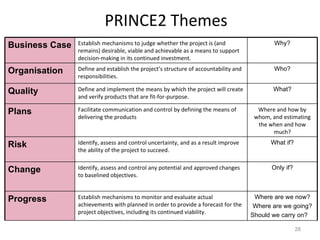
PRINCE2 Themes  Business Case Establish mechanisms to judge whether the project is (and remains) desirable, viable and achievable as a means to support decision-making in its continued investment. Why? Organisation Define and establish the project’s structure of accountability and responsibilities. Who? Quality Define and implement the means by which the project will create and verify products that are fit-for-purpose. What? Plans Facilitate communication and control by defining the means of delivering the products Where and how by whom, and estimating the when and how much? Risk Identify, assess and control uncertainty, and as a result improve the ability of the project to succeed. What if? Change Identify, assess and control any potential and approved changes to baselined objectives. Only if? Progress Establish mechanisms to monitor and evaluate actual achievements with planned in order to provide a forecast for the project objectives, including its continued viability.  Where are we now? Where are we going? Should we carry on?
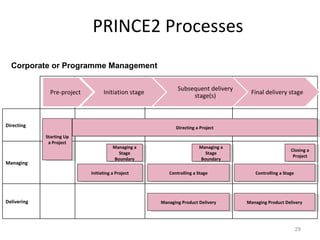
PRINCE2 Processes Starting Up a Project Directing a Project Managing a Stage Boundary Managing a Stage Boundary Closing a Project Initiating a Project Controlling a Stage Controlling a Stage Managing Product Delivery Managing Product Delivery Corporate or Programme Management Directing Managing Delivering Pre-project Initiation stage Subsequent delivery stage(s) Final delivery stage
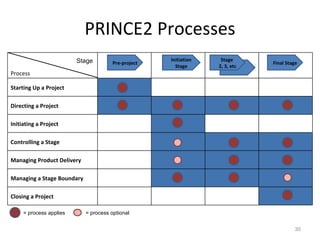
PRINCE2 Processes = process applies = process optional Pre-project Initiation Stage Stage  2, 3, etc Final Stage Stage Process Starting Up a Project Directing a Project Initiating a Project Controlling a Stage Managing Product Delivery Managing a Stage Boundary Closing a Project
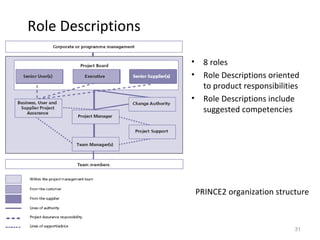
Role Descriptions 8 roles Role Descriptions oriented to product responsibilities Role Descriptions include suggested competencies PRINCE2 organization structure
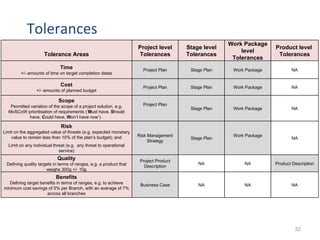
Tolerances Tolerance Areas Project level Tolerances Stage level Tolerances Work Package level Tolerances Product level  Tolerances Time +/- amounts of time on target completion dates Project Plan Stage Plan Work Package NA Cost +/- amounts of planned budget Project Plan Stage Plan Work Package NA Scope Permitted variation of the scope of a project solution, e.g. MoSCoW prioritisation of requirements (‘ M ust have,  S hould have,  C ould have,  W on’t have now’).  Project Plan Stage Plan Work Package NA Risk Limit on the aggregated value of threats (e.g. expected monetary value to remain less than 10% of the plan’s budget); and Limit on any individual threat (e.g.  any threat to operational service) Risk Management Strategy Stage Plan Work Package NA Quality Defining quality targets in terms of ranges, e.g. a product that weighs 300g +/- 10g Project Product Description NA NA Product Description Benefits Defining target benefits in terms of ranges, e.g. to achieve minimum cost savings of 5% per Branch, with an average of 7% across all branches Business Case NA NA NA
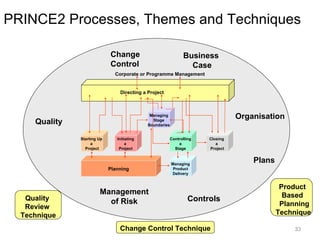
PRINCE2 Processes, Themes and Techniques Product  Based  Planning Technique Change Control Technique Quality  Review  Technique Business  Case Change Control Quality Management of Risk Controls Plans Organisation Managing Product Delivery Planning Corporate or Programme Management Directing a Project Starting Up  a  Project Initiating a  Project Controlling a Stage Managing Stage Boundaries Closing  a  Project
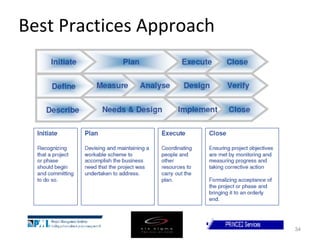
Best Practices Approach
We want a system or a solution that enables us to provide the best quality of care to our patients and assist us in making decisions. We want a system or a solution modeled on how we work that provides access to comprehensive, real-time information from anywhere. We want a system or a solution that will help us reduce our costs and be easy to maintain and update.
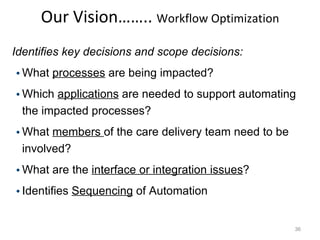
Our Vision……..  Workflow Optimization Identifies key decisions and scope decisions:   What  processes  are being impacted? Which  applications  are needed to support automating the impacted processes? What  members  of the care delivery team need to be involved? What are the  interface or integration issues ? Identifies  Sequencing  of Automation
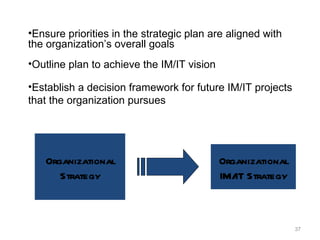
Organizational Strategy Organizational IM/IT Strategy Ensure priorities in the strategic plan are aligned with the organization’s overall goals Outline plan to achieve the IM/IT vision Establish a decision framework for future IM/IT projects that the organization pursues
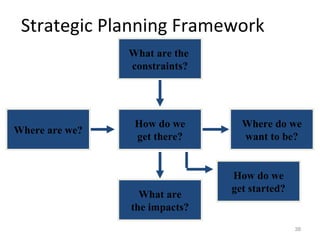
What are the  constraints? How do we get there? Where are we? Where do we want to be? How do we get started? What are the impacts? Strategic Planning Framework
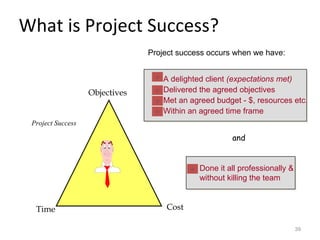
What is Project Success? Project success occurs when we have: and Objectives Time Cost Project Success     A delighted client  (expectations met) Delivered the agreed objectives Met an agreed budget - $, resources etc. Within an agreed time frame  Done it all professionally & without killing the team
Why Do Projects Fail? Changing scope Insufficient planning No  risk or issues management Poor communication Lack of commitment and responsibility by stakeholders
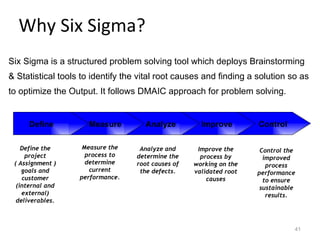
Six Sigma is a structured problem solving tool which deploys Brainstorming  & Statistical tools to identify the vital root causes and finding a solution so as  to optimize the Output. It follows DMAIC approach for problem solving. Why Six Sigma? Define the project ( Assignment ) goals and customer (internal and external) deliverables. Measure the process to determine current performance. Analyze and determine the root causes of the defects. Improve the process by working on the validated root causes Control the improved process performance to ensure sustainable results. Define Measure Analyze Improve Control
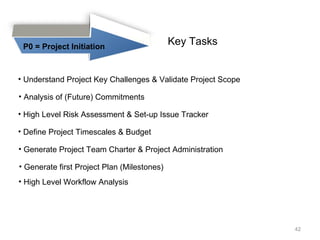
P0 = Project Initiation Understand Project Key Challenges & Validate Project Scope Analysis of (Future) Commitments High Level Risk Assessment & Set-up Issue Tracker Define Project Timescales & Budget Generate Project Team Charter & Project Administration Generate first Project Plan (Milestones) High Level Workflow Analysis Key Tasks
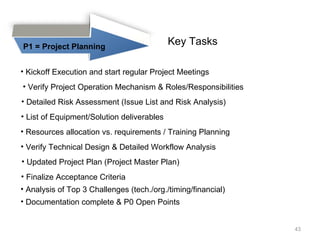
P1 = Project Planning Key Tasks Kickoff Execution and start regular Project Meetings Verify Project Operation Mechanism & Roles/Responsibilities Detailed Risk Assessment (Issue List and Risk Analysis) List of Equipment/Solution deliverables Resources allocation vs. requirements / Training Planning Verify Technical Design & Detailed Workflow Analysis Updated Project Plan (Project Master Plan) Finalize Acceptance Criteria Analysis of Top 3 Challenges (tech./org./timing/financial) Documentation complete & P0 Open Points
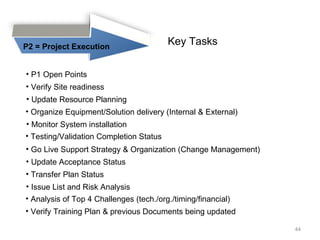
P2 = Project Execution Key Tasks P1 Open Points Verify Site readiness Update Resource Planning Organize Equipment/Solution delivery (Internal & External) Monitor System installation Testing/Validation Completion Status Go Live Support Strategy & Organization (Change Management) Update Acceptance Status Transfer Plan Status Issue List and Risk Analysis Analysis of Top 4 Challenges (tech./org./timing/financial) Verify Training Plan & previous Documents being updated
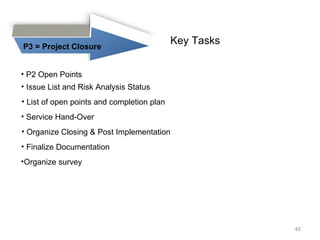
P3 = Project Closure Key Tasks P2 Open Points Issue List and Risk Analysis Status List of open points and completion plan Service Hand-Over Organize Closing & Post Implementation Finalize Documentation Organize survey
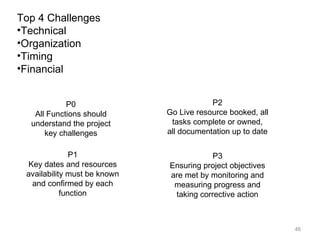
Top 4 Challenges Technical Organization Timing Financial P0 All Functions should understand the project key challenges P1 Key dates and resources availability must be known and confirmed by each function P2 Go Live resource booked, all tasks complete or owned, all documentation up to date P3 Ensuring project objectives are met by monitoring and measuring progress and taking corrective action
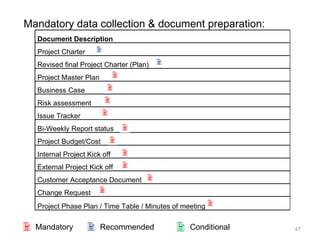
Mandatory  Recommended  Conditional Mandatory data collection & document preparation: Document Description Project Charter Revised final Project Charter (Plan) Project Master Plan Business Case Risk assessment Issue Tracker Bi-Weekly Report status Project Budget/Cost Internal Project Kick off External Project Kick off Customer Acceptance Document Change Request Project Phase Plan / Time Table / Minutes of meeting
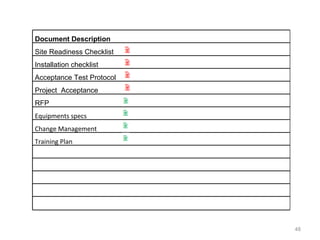
Document Description Site Readiness Checklist Installation checklist Acceptance Test Protocol Project  Acceptance RFP Equipments specs  Change Management Training Plan
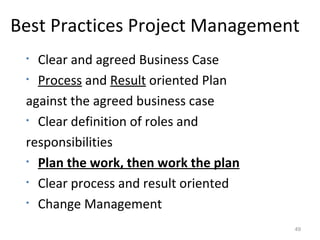
Clear and agreed Business Case Process  and  Result  oriented Plan  against the agreed business case Clear definition of roles and responsibilities Plan the work, then work the plan Clear process and result oriented Change Management Best Practices Project Management
Plan the work , then work  the plan
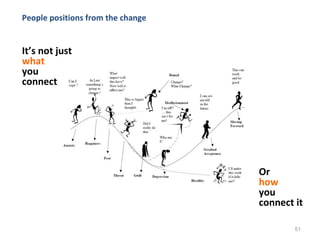
It’s not just   what you  connect Or  how you  connect it People positions from the change
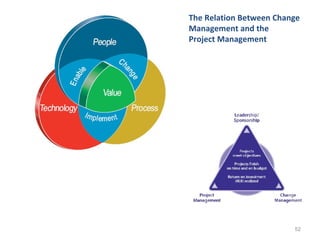
The Relation Between Change Management and the  Project Management
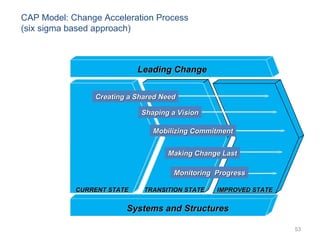
CAP Model: Change Acceleration Process (six sigma based approach) CURRENT   STATE TRANSITION STATE IMPROVED STATE Leading Change Systems and Structures Monitoring  Progress Mobilizing Commitment Shaping a Vision Creating a Shared Need Making Change Last
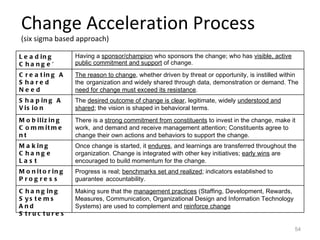
Change Acceleration Process (six sigma based approach) Leading Change’ Having a  sponsor/champion  who sponsors the change; who has  visible, active public commitment and support  of change. Creating A Shared Need The reason to change , whether driven by threat or opportunity, is instilled within the   organization and widely shared through data, demonstration or demand. The  need for change must exceed its resistance . Shaping A Vision The  desired outcome of change is clear , legitimate, widely  understood and shared ; the vision is shaped in behavioral terms. Mobilizing Commitment There is a  strong commitment from constituents  to invest in the change, make it work,   and demand and receive management attention; Constituents agree to change their own actions and behaviors to support the change. Making Change Last Once change is started, it  endures , and learnings are transferred throughout the   organization. Change is integrated with other key initiatives;  early wins  are encouraged to build momentum for the change. Monitoring Progress Progress is real;  benchmarks set and realized ; indicators established to guarantee   accountability. Changing Systems And Structures Making sure that the  management practices  (Staffing, Development, Rewards, Measures, Communication, Organizational Design and Information Technology Systems) are used to complement and  reinforce change
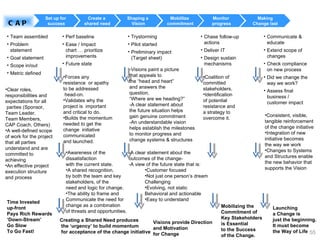
CAP Set up for  success Create a  shared need Shaping a  Vision Mobillize  commitment Monitor  progress Making Change last Team assembled Problem statement Goal statement Scope in/out Metric defined Clear roles,  responsibilities and expectations for all parties (Sponsor, Team Leader,  Team Members,  CAP Coach, Others) A well-defined scope of work for the project  that all parties  understand and are  committed to  achieving An effective project  execution structure  and process Time Invested  up-front  Pays Rich Rewards  ‘ Down-Stream’  Go Slow  To Go Fast! Perf baseline Ease / Impact chart … prioritize improvements Future state Forces any  resistance  or apathy  to be addressed head-on. Validates why the  project is  important  and critical to do. Builds the momentum  needed to get the  change  initiative communicated  and launched. Awareness of the  dissatisfaction with the current state. A shared recognition,  by both the team and key stakeholders, of the  need and logic for change. The ability to frame and Communicate the need for change as a combination of threats and opportunities. Creating a Shared Need produces   the ‘urgency’ to build momentum   for acceptance of the change initiative Trystorming Pilot started Preliminary impact (Target sheet) -A clear statement about the  outcomes of the change- -A view of the future state that is: Customer focused Not just one person’s dream Challenging Evolving, not static Behavioral and actionable Easy to understand -Visions paint a picture that appeals to the “head and heart”  and answers the question,  “ Where are we heading?” -A clear statement about the future situation helps gain genuine commitment -An understandable vision helps establish the milestones to monitor progress and  change systems & structures Visions provide Direction and Motivation  for Change Chase follow-up actions Deliver IT Design sustain mechanisms Coalition of  committed  stakeholders. Identification  of potential  resistance and  a strategy to  overcome it. Mobilizing the  Commitment of  Key Stakeholders is Essential to the Success of the Change. Communicate & educate Extend scope of changes Check compliance on new process Did we change the way we work? Assess final business / customer impact Consistent, visible,  tangible reinforcement  of the change initiative Integration of new  initiative becomes  the way we work Changes to Systems  and Structures enable  the new behavior that  supports the Vision Launching  a Change is  just the beginning.  It must become  the Way of Life

Project Management Methodologies

  • 1.
    15 years experiencein practice management consulting: Project Management Change Management Process and workflow Design
  • 2.
    PROFESSIONAL PROFILE & HIGHLIGHTS Proven excellent experience in working with and negotiating with third party vendors as part of creating a Request for Proposal ( RFP ) and establishing the evaluation criteria. Demonstrated ability in all phases of project management from pre-engineering/pre-tender to implementation/handover. Also demonstrated ability in managing multiple projects and complex projects. Training includes a Bachelor Degree of Science in Biochemistry; Six Sigma Introduction (e-green belt DMAIC - Six Sigma course) and extensive professional development through continuing education. Has a strong understanding of PMBOK and is Prince2 (Project in Controlled Environment) Foundation Certified . Able to champion change, sell the vision and create business/IT stakeholder buy-in using professional, discreet communication strategies and managing information flow to key personnel. Using both PMBOK & Prince2 methodologies ( project life cycle, project planning, project documentation, change management, quality control, testing, phase exit, training, project issues/ resolve conflicts, risk assessment, and post implementation ).
  • 3.
    Ability to workwith a team of over 20 business stakeholders and Specialists (project mangers, engineers, integration specialist, application specialist, marketing and sales support teams). Strong leadership skills – ambitious, focused, committed and team-oriented. Applied a structured change management approach and methodology (CAP model, six sigma based methodology) for the people/staff side change caused by projects and change efforts. Developed a change management strategy based on a situational awareness of the details of the change and the groups being impacted by the change. Identified potential people-side risks and anticipated points of resistance, and develop specific plans to mitigate or address the concerns. Conducted readiness assessments, evaluated results and present findings in a logical and easy-to- understand manner.
  • 4.
    Developed a setof actionable and targeted change management plans – including communication plan, sponsor roadmap, coaching plan, training plan and resistance management plan. Supported the execution of plans by employee-facing managers and business leaders. Be an active and visible coach to executives leaders who are change sponsors. Created and managed measurement systems to track adoption, utilization and proficiency of individual changes. Identified resistance and performance gaps, and worked to develop and implement corrective actions Created and enabled reinforcement mechanisms and celebrations of success. Worked with project teams to integrate change management activities into the overall project plan. Worked with communication, training, and other specialists in the formulation of particular plans and activities to support project implementation.
  • 5.
    Independent IT andProject Management Consultant ( June 2009 – present) Victoria, B.C. Canada 15 years experience as a healthcare specialist and a project management consultant. Utilizing extensive industry experience within medical equipment, IT healthcare (PACS/RIS/CIS & CVIS), pharma, biotech, clinical research and healthcare environments to execute and implement certain processes as well as methodologies into diverse operational roles at all organizational levels. Skilled in: Project Initiation, Planning, Execution and Closing Project Controlling and Monitoring Project Change Management Project Risk Assessment Project Training Plan and materials Build up to Technical RFP and evaluation process Business Planning Quality Control Process Time and Budget Management Product Management Vendor Management IT project Management Design of project life cycle
  • 6.
    The 7-S ofProject Management Element Description Strategy The high-level requirements of the project and he means to achieve man Structure The organizational arrangement that will be used to carry out the project Systems The methods for work to be designed, monitored and controlled Staff The selection, recruitment, management and leadership of those working on the project Skill The managerial and technical tools available to the project manager and staff Style/Culture The underlying way of thinking and inter-relating within the work team or organization Stakeholder Individuals and groups who have an interest in the project process or outcome
  • 7.
    The Project Managementis about ……. Project management is about influencing tomorrow. Today has already happened and yesterday is gone. (’PROACTIVE’ which means plan well) Decisions affecting tomorrow can only be made on information available today. Project management is about delivering a set of relationships over time and about understanding people. Project management is widely recognized as a practical way (throughout certain approach) of ensuring that projects meet objectives and products are delivered on time , within budget and to correct quality specification, while at the same time controlling or maintaining the scope of the project at the correct level.
  • 8.
    PMBOK Approach ThePMBOK is an inclusive term that describes the sum of knowledge w ithin the profession of project management PMBOK is applied and advanced by both practitioners and academics PMBOK can be and is being used for projects in various fields of professions including Software engineering
  • 9.
    PM Process Groups / Knowledge Area Processes Initiating Process Group Planning Process Group Executing Process Group Monitoring & Controlling Process Group Closing Process Group Project Management Integration Develop Project Charter Develop Prelim Project Scope Statement Develop Project Management Plan Direct and Manage Project Execution Monitor and Control Project Work Integrated Change Control Close Project Project Scope Management Scope Planning Scope Definition Create WBS Scope Verification Scope Control Project Time Management Activity Definition & Sequencing Resource Estimating Duration Estimating Schedule Development Schedule Control Project Cost Management Cost Estimating Cost Budgeting Cost Control Project Quality Management Quality Planning Perform Quality Assurance Perform Quality Control Project HR Management Human Resources Planning Acquire Project Team Develop Project Team Manage Project Team Project Communications Management Communications Planning Information Distribution Performance Reporting Manage Stakeholders Project Risk Management Risk Management Planning Risk Identification Qualitative / Quantitative Risk Analysis Risk Response Planning Risk Monitoring and Control Project Procurement Management Plan Purchases and Acquisitions Plan Contracting Request Seller Responses Select Sellers Contract Administration Contract Closure
  • 10.
    The 9 Thingsin PMBOK an area of project management defined by its knowledge requirements and described in terms of its associated process, practices, inputs, outputs, tools and techniques identified knowledge areas (the ‘things’) 1. Project Integration Management 2. Project Scope Management 3. Project Time Management 4. Project Cost Management 5. Project Quality Management 6. Project Human Resource Management 7. Project Communications Management 8. Project Risk Management 9. Project Procurement Management
  • 11.
    1. ProjectIntegration Management effective integration of the processes required to accomplish project objectives processes include 1 . project charter development 2 . preliminary project scope statement development 3 . project management plan development 4 . project execution 5 . monitoring and control of project work
  • 12.
    2. ProjectScope Management defines and controls what is and is not included in the project processes include 1 . scope planning 2 . scope definition 3 . creation of a Work Breakdown Schedule 4 . scope verification 5 . scope control
  • 13.
    3. ProjectTime Management includes processes required for the timely completion of a project processes include 1 . defining activities 2 . sequencing activities 3 . estimating resource activities 4 . estimating duration of activities 5 . developing the project schedule 6 . controlling the project schedule
  • 14.
    4. ProjectCost Management planning, estimating, budgeting and controlling costs to ensure the project can be completed within the approved budget processes include 1 . cost estimating 2 . cost budgeting 3 . cost control
  • 15.
    5. ProjectQuality Management all activities that determine quality policies, objectives and responsibilities for the project to satisfy the needs for which it was undertaken processes include 1 . quality planning 2 . performing quality assurance 3 . performing quality control
  • 16.
    6. ProjectHuman Resource Management processes that organize and manage the project team processes include: 1 . human resource planning 2 . acquiring the project team 3 . developing the project team 4 . managing the project team
  • 17.
    7. ProjectCommunications Management activities to ensure project information is timely and appropriately generated, collected, distributed, stored, retrieved and disposed of processes include 1 . communications planning 2 . information distribution 3 . performance reporting 4 . managing stakeholders
  • 18.
    8. ProjectRisk Management processes to increase the probability and impact of positive events and decrease the probability and impact of negative events updated throughout the project processes include 1 . risk management planning 2 . risk identification 3 . qualitative risk analysis 4 . quantitative risk analysis 5 . risk response planning 6 . risk monitoring and control
  • 19.
    9. ProjectProcurement Management processes to purchase/acquire the products, services or results needed to perform the project work includes contract management and change control processes to administer contracts or purchase orders processes include: 1 . planning purchases and acquisitions 2 . contract planning 3 . requesting seller responses 4 . selecting sellers 5 . contract administration 6 . contract closure
  • 20.
    Includes: Project ScopeStatement Project objectives Product scope description Project requirements Project boundaries Project deliverables Product acceptance criteria Project constraints Project assumptions Initial project organization Initial defined risks Schedule milestones Fund limitation Cost estimate Project configuration mgmt requirements Project specifications Approval requirements Project Scope Management
  • 21.
    Work Breakdown Structure(“WBS”) 1.3 Needs Analysis 1.3.1 Review Corporate Guidelines 1.3.2 Present Corporate Guidelines to Technology Steering Committee 1.3.3 Departmental Assessments .1 Patient Safety .2 Business workflow .3 Nursing .4 Physicians .5 Lab .8 Pharmacy .9 Radiology .10 Emergency & LifeFlight .11 Facilities .12 IT .16 Disaster Recovery .13 Security .6 Admitting .14 Outpatient .7 Medical Records .15 Privacy 1.3.4 Prioritize Needs/Opportunities 1.3.5 Develop Report: “Needs Analysis and Recommendations” 1.3.6 Review by Technology Steering Committee 1.3.7 Review by Physician’s Advisory Group 1.3.8 PM Review and Sponsor Sign Off Items in Gray are Work Packages
  • 22.
    Project Life Cycle The collection of phases that are performed in completing a project. Each project phase is marked by completion of one or more deliverables. The conclusion of a project phase is generally marked by a review of both key deliverables and project performance to date. Determine if the project should continue into its next phase. Detect and correct errors. The project life cycle defines the beginning and the end of a project. Project life cycles generally define: What technical work should be done in each phase. Who should be involved in each phase.
  • 23.
  • 24.
    Representative Software development Life Cycle
  • 25.
  • 26.
    7 principles 7 themes 7 processes 8 duties and behaviours for the project board 8 project roles 2 guides 2 detailed techniques 33 referenced techniques 26 management products 6 performance targets More than 20 pages of guidance on tailoring PRINCE2 method
  • 27.
    PRINCE2 Principles Business Justification A PRINCE2 project has continued business justification Learn from experience PRINCE2 project teams learn from previous experience (lessons are sought, recorded and acted upon throughout the life of the project) Roles & Responsibilities A PRINCE2 project has defined and agreed roles and responsibilities with an organisation structure that engages the business, user and supplier stakeholder interests Manage by Stages A PRINCE2 project is planned, monitored and controlled on a stage by stage basis Manage by Exception A PRINCE2 project has defined tolerances for each project objective to establish limits of delegated authority Product Focus A PRINCE2 project focuses on the definition and delivery of products, in particular their quality requirements Tailor PRINCE2 is tailored to suit the project’s size, environment, complexity, importance, capability and risk
  • 28.
    PRINCE2 Themes Business Case Establish mechanisms to judge whether the project is (and remains) desirable, viable and achievable as a means to support decision-making in its continued investment. Why? Organisation Define and establish the project’s structure of accountability and responsibilities. Who? Quality Define and implement the means by which the project will create and verify products that are fit-for-purpose. What? Plans Facilitate communication and control by defining the means of delivering the products Where and how by whom, and estimating the when and how much? Risk Identify, assess and control uncertainty, and as a result improve the ability of the project to succeed. What if? Change Identify, assess and control any potential and approved changes to baselined objectives. Only if? Progress Establish mechanisms to monitor and evaluate actual achievements with planned in order to provide a forecast for the project objectives, including its continued viability. Where are we now? Where are we going? Should we carry on?
  • 29.
    PRINCE2 Processes StartingUp a Project Directing a Project Managing a Stage Boundary Managing a Stage Boundary Closing a Project Initiating a Project Controlling a Stage Controlling a Stage Managing Product Delivery Managing Product Delivery Corporate or Programme Management Directing Managing Delivering Pre-project Initiation stage Subsequent delivery stage(s) Final delivery stage
  • 30.
    PRINCE2 Processes =process applies = process optional Pre-project Initiation Stage Stage 2, 3, etc Final Stage Stage Process Starting Up a Project Directing a Project Initiating a Project Controlling a Stage Managing Product Delivery Managing a Stage Boundary Closing a Project
  • 31.
    Role Descriptions 8roles Role Descriptions oriented to product responsibilities Role Descriptions include suggested competencies PRINCE2 organization structure
  • 32.
    Tolerances Tolerance AreasProject level Tolerances Stage level Tolerances Work Package level Tolerances Product level Tolerances Time +/- amounts of time on target completion dates Project Plan Stage Plan Work Package NA Cost +/- amounts of planned budget Project Plan Stage Plan Work Package NA Scope Permitted variation of the scope of a project solution, e.g. MoSCoW prioritisation of requirements (‘ M ust have, S hould have, C ould have, W on’t have now’). Project Plan Stage Plan Work Package NA Risk Limit on the aggregated value of threats (e.g. expected monetary value to remain less than 10% of the plan’s budget); and Limit on any individual threat (e.g. any threat to operational service) Risk Management Strategy Stage Plan Work Package NA Quality Defining quality targets in terms of ranges, e.g. a product that weighs 300g +/- 10g Project Product Description NA NA Product Description Benefits Defining target benefits in terms of ranges, e.g. to achieve minimum cost savings of 5% per Branch, with an average of 7% across all branches Business Case NA NA NA
  • 33.
    PRINCE2 Processes, Themesand Techniques Product Based Planning Technique Change Control Technique Quality Review Technique Business Case Change Control Quality Management of Risk Controls Plans Organisation Managing Product Delivery Planning Corporate or Programme Management Directing a Project Starting Up a Project Initiating a Project Controlling a Stage Managing Stage Boundaries Closing a Project
  • 34.
  • 35.
    We want asystem or a solution that enables us to provide the best quality of care to our patients and assist us in making decisions. We want a system or a solution modeled on how we work that provides access to comprehensive, real-time information from anywhere. We want a system or a solution that will help us reduce our costs and be easy to maintain and update.
  • 36.
    Our Vision…….. Workflow Optimization Identifies key decisions and scope decisions: What processes are being impacted? Which applications are needed to support automating the impacted processes? What members of the care delivery team need to be involved? What are the interface or integration issues ? Identifies Sequencing of Automation
  • 37.
    Organizational Strategy OrganizationalIM/IT Strategy Ensure priorities in the strategic plan are aligned with the organization’s overall goals Outline plan to achieve the IM/IT vision Establish a decision framework for future IM/IT projects that the organization pursues
  • 38.
    What are the constraints? How do we get there? Where are we? Where do we want to be? How do we get started? What are the impacts? Strategic Planning Framework
  • 39.
    What is ProjectSuccess? Project success occurs when we have: and Objectives Time Cost Project Success     A delighted client (expectations met) Delivered the agreed objectives Met an agreed budget - $, resources etc. Within an agreed time frame  Done it all professionally & without killing the team
  • 40.
    Why Do ProjectsFail? Changing scope Insufficient planning No risk or issues management Poor communication Lack of commitment and responsibility by stakeholders
  • 41.
    Six Sigma isa structured problem solving tool which deploys Brainstorming & Statistical tools to identify the vital root causes and finding a solution so as to optimize the Output. It follows DMAIC approach for problem solving. Why Six Sigma? Define the project ( Assignment ) goals and customer (internal and external) deliverables. Measure the process to determine current performance. Analyze and determine the root causes of the defects. Improve the process by working on the validated root causes Control the improved process performance to ensure sustainable results. Define Measure Analyze Improve Control
  • 42.
    P0 = ProjectInitiation Understand Project Key Challenges & Validate Project Scope Analysis of (Future) Commitments High Level Risk Assessment & Set-up Issue Tracker Define Project Timescales & Budget Generate Project Team Charter & Project Administration Generate first Project Plan (Milestones) High Level Workflow Analysis Key Tasks
  • 43.
    P1 = ProjectPlanning Key Tasks Kickoff Execution and start regular Project Meetings Verify Project Operation Mechanism & Roles/Responsibilities Detailed Risk Assessment (Issue List and Risk Analysis) List of Equipment/Solution deliverables Resources allocation vs. requirements / Training Planning Verify Technical Design & Detailed Workflow Analysis Updated Project Plan (Project Master Plan) Finalize Acceptance Criteria Analysis of Top 3 Challenges (tech./org./timing/financial) Documentation complete & P0 Open Points
  • 44.
    P2 = ProjectExecution Key Tasks P1 Open Points Verify Site readiness Update Resource Planning Organize Equipment/Solution delivery (Internal & External) Monitor System installation Testing/Validation Completion Status Go Live Support Strategy & Organization (Change Management) Update Acceptance Status Transfer Plan Status Issue List and Risk Analysis Analysis of Top 4 Challenges (tech./org./timing/financial) Verify Training Plan & previous Documents being updated
  • 45.
    P3 = ProjectClosure Key Tasks P2 Open Points Issue List and Risk Analysis Status List of open points and completion plan Service Hand-Over Organize Closing & Post Implementation Finalize Documentation Organize survey
  • 46.
    Top 4 ChallengesTechnical Organization Timing Financial P0 All Functions should understand the project key challenges P1 Key dates and resources availability must be known and confirmed by each function P2 Go Live resource booked, all tasks complete or owned, all documentation up to date P3 Ensuring project objectives are met by monitoring and measuring progress and taking corrective action
  • 47.
    Mandatory Recommended Conditional Mandatory data collection & document preparation: Document Description Project Charter Revised final Project Charter (Plan) Project Master Plan Business Case Risk assessment Issue Tracker Bi-Weekly Report status Project Budget/Cost Internal Project Kick off External Project Kick off Customer Acceptance Document Change Request Project Phase Plan / Time Table / Minutes of meeting
  • 48.
    Document Description SiteReadiness Checklist Installation checklist Acceptance Test Protocol Project Acceptance RFP Equipments specs Change Management Training Plan
  • 49.
    Clear and agreedBusiness Case Process and Result oriented Plan against the agreed business case Clear definition of roles and responsibilities Plan the work, then work the plan Clear process and result oriented Change Management Best Practices Project Management
  • 50.
    Plan the work, then work the plan
  • 51.
    It’s not just what you connect Or how you connect it People positions from the change
  • 52.
    The Relation BetweenChange Management and the Project Management
  • 53.
    CAP Model: ChangeAcceleration Process (six sigma based approach) CURRENT STATE TRANSITION STATE IMPROVED STATE Leading Change Systems and Structures Monitoring Progress Mobilizing Commitment Shaping a Vision Creating a Shared Need Making Change Last
  • 54.
    Change Acceleration Process(six sigma based approach) Leading Change’ Having a sponsor/champion who sponsors the change; who has visible, active public commitment and support of change. Creating A Shared Need The reason to change , whether driven by threat or opportunity, is instilled within the organization and widely shared through data, demonstration or demand. The need for change must exceed its resistance . Shaping A Vision The desired outcome of change is clear , legitimate, widely understood and shared ; the vision is shaped in behavioral terms. Mobilizing Commitment There is a strong commitment from constituents to invest in the change, make it work, and demand and receive management attention; Constituents agree to change their own actions and behaviors to support the change. Making Change Last Once change is started, it endures , and learnings are transferred throughout the organization. Change is integrated with other key initiatives; early wins are encouraged to build momentum for the change. Monitoring Progress Progress is real; benchmarks set and realized ; indicators established to guarantee accountability. Changing Systems And Structures Making sure that the management practices (Staffing, Development, Rewards, Measures, Communication, Organizational Design and Information Technology Systems) are used to complement and reinforce change
  • 55.
    CAP Set upfor success Create a shared need Shaping a Vision Mobillize commitment Monitor progress Making Change last Team assembled Problem statement Goal statement Scope in/out Metric defined Clear roles, responsibilities and expectations for all parties (Sponsor, Team Leader, Team Members, CAP Coach, Others) A well-defined scope of work for the project that all parties understand and are committed to achieving An effective project execution structure and process Time Invested up-front Pays Rich Rewards ‘ Down-Stream’ Go Slow To Go Fast! Perf baseline Ease / Impact chart … prioritize improvements Future state Forces any resistance or apathy to be addressed head-on. Validates why the project is important and critical to do. Builds the momentum needed to get the change initiative communicated and launched. Awareness of the dissatisfaction with the current state. A shared recognition, by both the team and key stakeholders, of the need and logic for change. The ability to frame and Communicate the need for change as a combination of threats and opportunities. Creating a Shared Need produces the ‘urgency’ to build momentum for acceptance of the change initiative Trystorming Pilot started Preliminary impact (Target sheet) -A clear statement about the outcomes of the change- -A view of the future state that is: Customer focused Not just one person’s dream Challenging Evolving, not static Behavioral and actionable Easy to understand -Visions paint a picture that appeals to the “head and heart” and answers the question, “ Where are we heading?” -A clear statement about the future situation helps gain genuine commitment -An understandable vision helps establish the milestones to monitor progress and change systems & structures Visions provide Direction and Motivation for Change Chase follow-up actions Deliver IT Design sustain mechanisms Coalition of committed stakeholders. Identification of potential resistance and a strategy to overcome it. Mobilizing the Commitment of Key Stakeholders is Essential to the Success of the Change. Communicate & educate Extend scope of changes Check compliance on new process Did we change the way we work? Assess final business / customer impact Consistent, visible, tangible reinforcement of the change initiative Integration of new initiative becomes the way we work Changes to Systems and Structures enable the new behavior that supports the Vision Launching a Change is just the beginning. It must become the Way of Life

Editor's Notes

  • #10 Process groups align with UofC metholodogy
  • #12 Project Charter (PMBOK) includes: Requirements that satisfy customer, sponsor and stakeholder need, wants and expectations Business needs, HL project description or product requirements Purpose or justification Assigned PM Summary Milestone Schedule Stakeholder influences Functional org and their participation Assumptions / constraints Business Case Summary budget Prelim Scope Statement Objectives Requirements Acceptance criteria Boundaries Requirements and deliverables Assumptions / constraints Project Org Risks, Milestone, initial WS, Order of Mag cost estimate, confi management requirements Project Execution – execute the project management plan to accomplish the work defined in the scope statement M& C: Compare actual performance to plan, determine actions required if any, information for status reporting, progress measurement and forecasting, monitor implementation of approved changes when they occur
  • #13 Scope Planning – document how scope will be defined, verified, controlled and how the WBS will be created and defined Definition: Develop a detailed scope statement WBS: Work into smaller manageable components Verification: Formalizing acceptance of the completed project deliverables Control: control changes to the scope
  • #14 Defining the activities: List of all schedule activities that are planned to be performed on the project Sequencing: logical relationships among schedule activities (create network diagrams) Resources: estimating what resources are required and quantities Estimating Activity durations: three point estimates (most likely, opt, pessimistic) Schedule – start and end dates for activities Controlling – schedule management plan establishes how the schedule will be managed and controlled, schedule baseline, performance reports
  • #15 Estimating: approximation of costs Budgeting: aggregating the estimated costs of individual activities or work pkgs to establish a cost baseline Control: influencing the factors that create cost variances and control changes to budget
  • #16 Planning – which quality standards are relevant and determine how to satisfy them QA – applying the planned quality activities to ensure quality requirements are met QC – monitor project results to determine if they comply to quality standards, ID way to eliminate causes of unsatisfactory performance.
  • #17 Develop: improve competencies and interaction of team members to enhance project performance Manage: track performance, provide feedback, resolve issues
  • #18 Performance reporting: status reports, progress measurement, forecasting Manage stakeholders: manage communications to satisfy the requirement of stakeholders
  • #19 Qualitative: Prioritizing risks for further analysis or action (prob of occurance / impact) Quantitative: numerically analyzing the effect of overall objectives of id’d risks Control: tracking, monitoring, ID new ones, execute risks response plan
  • #20 Plan – what to purchase, when and how Contract Planning: Document products, services and results requirement and and ID potential sellers RFI, RFP, RFQ Admin – manage the contract Closure – settle each contract, close
  • #34 PRINCE2 Introduction V3.5 © 2008 Rational Management Pty Ltd