

Project Management
Key Definitions Project management is the process of planning and controlling the development of a system within a specified timeframe at a minimum cost with the right functionality. A project manager has the primary responsibility for managing the hundreds of tasks and roles that need to be carefully coordinated.
CREATING THE WORK PLAN
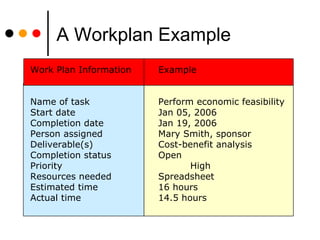
A Workplan Example Work Plan Information Example Name of task Perform economic feasibility Start date Jan 05, 200 6 Completion date Jan 19, 200 6 Person assigned Mary Smith, sponsor Deliverable(s) Cost-benefit analysis Completion status Open Priority High Resources needed Spreadsheet Estimated time 16 hours Actual time 14.5 hours
Identifying Tasks Top-down approach Identify highest level tasks Break them into increasingly smaller units Methodology Using standard list of tasks
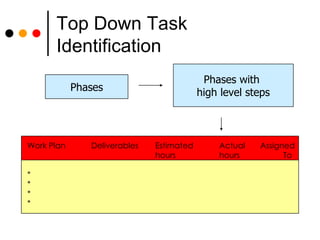
Top Down Task  Identification Phases Phases with  high level steps Work Plan Deliverables Estimated Actual   Assigned hours hours To * * * *
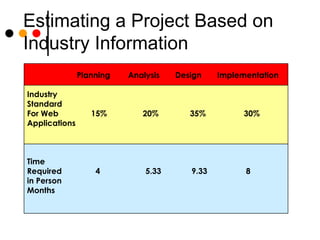
Estimating a Project Based on Industry Information   Planning  Analysis  Design  Implementation Industry Standard For Web 15%  20%  35%  30% Applications Time Required   4   5.33   9.33   8 in Person Months
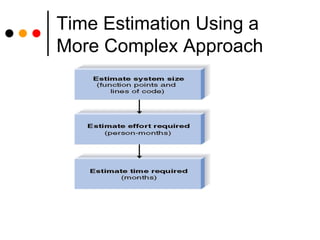
Time Estimation Using a More Complex Approach
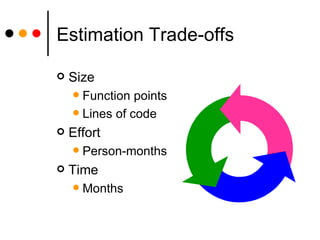
Estimation Trade-offs Size Function points Lines of code Effort Person-months Time Months
Getting the Right Numbers for Estimation Prior projects Past experience Industry standards Detailed analysis
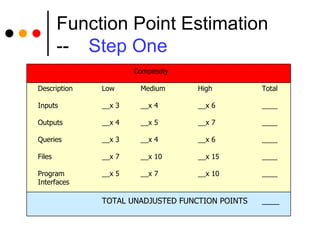
Function Point Estimation -- Step One Complexity Description Low   Medium High Total Inputs __x 3   __x 4   __x 6 ____ Outputs __x 4   __x 5 __x 7 ____ Queries __x 3   __x 4 __x 6 ____ Files __x 7   __x 10 __x 15 ____ Program __x 5   __x 7 __x 10 ____ Interfaces TOTAL UNADJUSTED FUNCTION POINTS ____
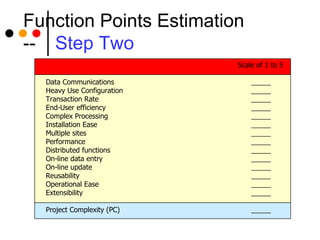
Function Points Estimation -- Step Two Scale of 1 to 5 Data Communications   _____ Heavy Use Configuration   _____ Transaction Rate     _____ End-User efficiency   _____ Complex Processing   _____ Installation Ease   _____ Multiple sites   _____ Performance   _____ Distributed functions   _____ On-line data entry   _____ On-line update   _____ Reusability   _____ Operational Ease   _____ Extensibility   _____ Project Complexity (PC)   _____
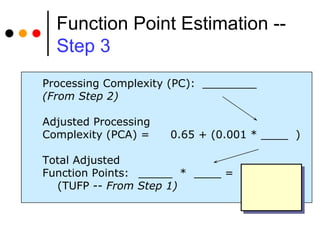
Function Point Estimation --  Step 3 Processing Complexity (PC): ________ (From Step 2) Adjusted Processing  Complexity (PCA) = 0.65 + (0.001 * ____  ) Total Adjusted  Function Points: _____  *  ____ =  (TUFP --  From Step 1)
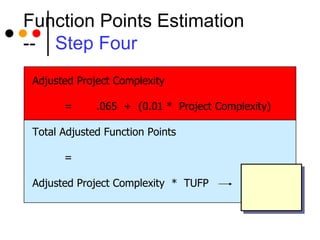
Function Points Estimation -- Step Four Adjusted Project Complexity = .065  +  (0.01 *  Project Complexity) Total Adjusted Function Points = Adjusted Project Complexity  *  TUFP
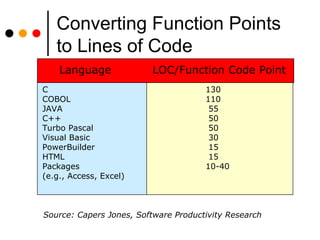
Converting Function Points to Lines of Code Source: Capers Jones, Software Productivity Research Language LOC/Function Code Point C COBOL JAVA C++ Turbo Pascal Visual Basic PowerBuilder HTML Packages  (e.g., Access, Excel) 130 110 55 50 50 30 15 15 10-40
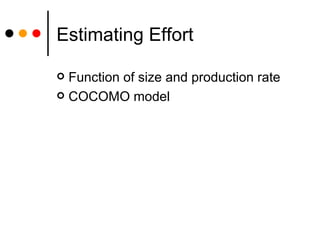
Estimating Effort Function of size and production rate COCOMO model
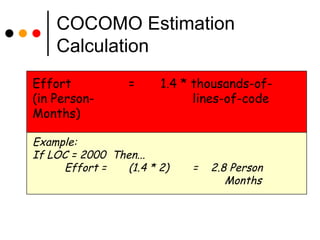
COCOMO Estimation Calculation Effort  = 1.4 * thousands-of- (in Person- lines-of-code Months) Example: If LOC = 2000  Then... Effort = (1.4 * 2) =  2.8 Person  Months
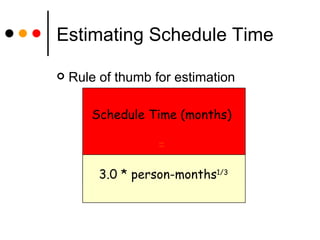
Estimating Schedule Time Rule of thumb for estimation Schedule Time (months) = 3.0 * person-months 1/3
Problem Calculate TUFP, TAFP, estimate effort, schedule time, and average number of staff for a complex system developed in (a) Java, and (b) Visual Basic with these characteristics: INPUTS: 1 low, 2 medium, 3 high OUTPUTS: 4 med QUERIES: 1 low, 4 medium, 2 high FILES: 3 medium PI: 2 medium
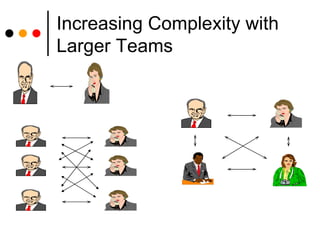
Staffing Attributes Staffing levels will change over a project’s lifetime Adding staff may add more overhead than additional labo u r Using teams of 8-10 reporting in a hierarchical structure can reduce complexity
Increasing Complexity with Larger Teams
Timeboxing Fixed deadline Reduced functionality, if necessary Fewer “finishing touches”
Timeboxing Steps Set delivery date Deadline should not be impossible Should be set by development group Prioritize features by importance Build the system core Postpone unfinished functionality Deliver the system with core functionality Repeat steps 3-5 to add refinements and enhancements
STAFFING THE PROJECT
Key Definitions The staffing plan describes the kinds of people working on the project The project charter describes the project’s objectives and rules A functional lead manages a group of analysts A technical lead oversees progress of programmers and technical staff members
Motivation Use monetary rewards cautiously Use intrinsic rewards Recognition Achievement The work itself Responsibility Advancement Chance to learn new skills
Conflict Avoidance Strategies Clearly define roles and project plans Hold individuals accountable Project charter listing norms and groundrules Develop schedule commitments ahead of time Forecast other priorities and their possible impact on the project
CONTROLLING AND DIRECTING THE PROJECT
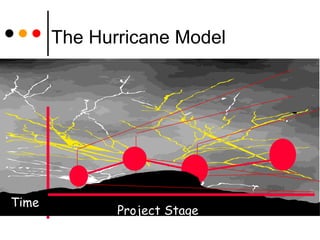
The Hurricane Model Project Stage Time
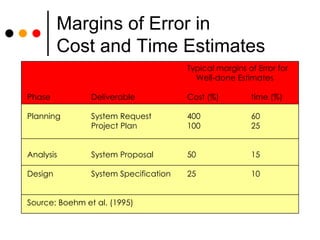
Margins of Error in  Cost and Time Estimates Typical margins of Error for   Well-done Estimates Phase Deliverable Cost (%) time (%) Planning System Request 400 60 Project Plan 100 25 Analysis System Proposal 50 15 Design System Specification 25 10 Source: Boehm et al. (1995)
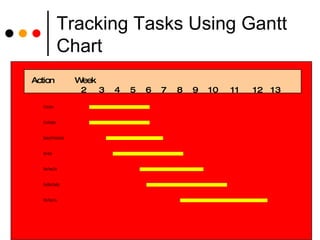
Tracking Tasks Using Gantt Chart Action   Week 2  3  4  5  6  7  8  9  10  11  12  13
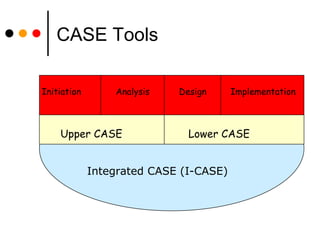
CASE Tools Initiation  Analysis  Design  Implementation Upper CASE Lower CASE Integrated CASE (I-CASE)
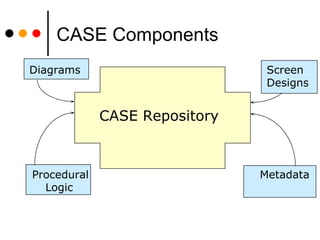
CASE Components Procedural    Metadata Logic Diagrams Screen Designs CASE Repository
Standards Examples Formal rules for naming files Forms indicating goals reached Programming guidelines
Documentation Project binder Table of contents Continual updating
Managing Scope Scope creep -- a major cause of development problems JAD and prototyping Formal change approval Charging for changes
Managing Risk Risk assessment Actions to reduce risk Revised assessment
Classic Mistakes Overly optimistic schedule Failing to monitor schedule Failing to update schedule Adding people to a late project
Summary Project management is critical to successful development of new systems Project management involves planning, controlling and reporting on time, labo u r, and costs.
Expanding the Domain For more detail on project management, visit the project management institute and its special interest group on information systems: www.pmi.org www.pmi-issig.org

Project Management

  • 1.
  • 2.
    Key Definitions Projectmanagement is the process of planning and controlling the development of a system within a specified timeframe at a minimum cost with the right functionality. A project manager has the primary responsibility for managing the hundreds of tasks and roles that need to be carefully coordinated.
  • 3.
  • 4.
    A Workplan ExampleWork Plan Information Example Name of task Perform economic feasibility Start date Jan 05, 200 6 Completion date Jan 19, 200 6 Person assigned Mary Smith, sponsor Deliverable(s) Cost-benefit analysis Completion status Open Priority High Resources needed Spreadsheet Estimated time 16 hours Actual time 14.5 hours
  • 5.
    Identifying Tasks Top-downapproach Identify highest level tasks Break them into increasingly smaller units Methodology Using standard list of tasks
  • 6.
    Top Down Task Identification Phases Phases with high level steps Work Plan Deliverables Estimated Actual Assigned hours hours To * * * *
  • 7.
    Estimating a ProjectBased on Industry Information Planning Analysis Design Implementation Industry Standard For Web 15% 20% 35% 30% Applications Time Required 4 5.33 9.33 8 in Person Months
  • 8.
    Time Estimation Usinga More Complex Approach
  • 9.
    Estimation Trade-offs SizeFunction points Lines of code Effort Person-months Time Months
  • 10.
    Getting the RightNumbers for Estimation Prior projects Past experience Industry standards Detailed analysis
  • 11.
    Function Point Estimation-- Step One Complexity Description Low Medium High Total Inputs __x 3 __x 4 __x 6 ____ Outputs __x 4 __x 5 __x 7 ____ Queries __x 3 __x 4 __x 6 ____ Files __x 7 __x 10 __x 15 ____ Program __x 5 __x 7 __x 10 ____ Interfaces TOTAL UNADJUSTED FUNCTION POINTS ____
  • 12.
    Function Points Estimation-- Step Two Scale of 1 to 5 Data Communications _____ Heavy Use Configuration _____ Transaction Rate _____ End-User efficiency _____ Complex Processing _____ Installation Ease _____ Multiple sites _____ Performance _____ Distributed functions _____ On-line data entry _____ On-line update _____ Reusability _____ Operational Ease _____ Extensibility _____ Project Complexity (PC) _____
  • 13.
    Function Point Estimation-- Step 3 Processing Complexity (PC): ________ (From Step 2) Adjusted Processing Complexity (PCA) = 0.65 + (0.001 * ____ ) Total Adjusted Function Points: _____ * ____ = (TUFP -- From Step 1)
  • 14.
    Function Points Estimation-- Step Four Adjusted Project Complexity = .065 + (0.01 * Project Complexity) Total Adjusted Function Points = Adjusted Project Complexity * TUFP
  • 15.
    Converting Function Pointsto Lines of Code Source: Capers Jones, Software Productivity Research Language LOC/Function Code Point C COBOL JAVA C++ Turbo Pascal Visual Basic PowerBuilder HTML Packages (e.g., Access, Excel) 130 110 55 50 50 30 15 15 10-40
  • 16.
    Estimating Effort Functionof size and production rate COCOMO model
  • 17.
    COCOMO Estimation CalculationEffort = 1.4 * thousands-of- (in Person- lines-of-code Months) Example: If LOC = 2000 Then... Effort = (1.4 * 2) = 2.8 Person Months
  • 18.
    Estimating Schedule TimeRule of thumb for estimation Schedule Time (months) = 3.0 * person-months 1/3
  • 19.
    Problem Calculate TUFP,TAFP, estimate effort, schedule time, and average number of staff for a complex system developed in (a) Java, and (b) Visual Basic with these characteristics: INPUTS: 1 low, 2 medium, 3 high OUTPUTS: 4 med QUERIES: 1 low, 4 medium, 2 high FILES: 3 medium PI: 2 medium
  • 20.
    Staffing Attributes Staffinglevels will change over a project’s lifetime Adding staff may add more overhead than additional labo u r Using teams of 8-10 reporting in a hierarchical structure can reduce complexity
  • 21.
  • 22.
    Timeboxing Fixed deadlineReduced functionality, if necessary Fewer “finishing touches”
  • 23.
    Timeboxing Steps Setdelivery date Deadline should not be impossible Should be set by development group Prioritize features by importance Build the system core Postpone unfinished functionality Deliver the system with core functionality Repeat steps 3-5 to add refinements and enhancements
  • 24.
  • 25.
    Key Definitions Thestaffing plan describes the kinds of people working on the project The project charter describes the project’s objectives and rules A functional lead manages a group of analysts A technical lead oversees progress of programmers and technical staff members
  • 26.
    Motivation Use monetaryrewards cautiously Use intrinsic rewards Recognition Achievement The work itself Responsibility Advancement Chance to learn new skills
  • 27.
    Conflict Avoidance StrategiesClearly define roles and project plans Hold individuals accountable Project charter listing norms and groundrules Develop schedule commitments ahead of time Forecast other priorities and their possible impact on the project
  • 28.
  • 29.
    The Hurricane ModelProject Stage Time
  • 30.
    Margins of Errorin Cost and Time Estimates Typical margins of Error for Well-done Estimates Phase Deliverable Cost (%) time (%) Planning System Request 400 60 Project Plan 100 25 Analysis System Proposal 50 15 Design System Specification 25 10 Source: Boehm et al. (1995)
  • 31.
    Tracking Tasks UsingGantt Chart Action Week 2 3 4 5 6 7 8 9 10 11 12 13
  • 32.
    CASE Tools Initiation Analysis Design Implementation Upper CASE Lower CASE Integrated CASE (I-CASE)
  • 33.
    CASE Components Procedural Metadata Logic Diagrams Screen Designs CASE Repository
  • 34.
    Standards Examples Formalrules for naming files Forms indicating goals reached Programming guidelines
  • 35.
    Documentation Project binderTable of contents Continual updating
  • 36.
    Managing Scope Scopecreep -- a major cause of development problems JAD and prototyping Formal change approval Charging for changes
  • 37.
    Managing Risk Riskassessment Actions to reduce risk Revised assessment
  • 38.
    Classic Mistakes Overlyoptimistic schedule Failing to monitor schedule Failing to update schedule Adding people to a late project
  • 39.
    Summary Project managementis critical to successful development of new systems Project management involves planning, controlling and reporting on time, labo u r, and costs.
  • 40.
    Expanding the DomainFor more detail on project management, visit the project management institute and its special interest group on information systems: www.pmi.org www.pmi-issig.org