Dr. Saima Baig
Asst. Professor
Social Sciences
1
Project
Implementation/Execution
Management
Project Implementation
 Process whereby “project inputs are converted to project outputs”. May
be looked at as:
Putting in action the activities of the
project.
Putting into practice what was proposed in
the project document (i.e. transforming the
project proposal into the actual project.)
Management of the project or executing the
project intentions.
2
Project Implementation
(cont.)
Implementation usually done by implementing
agency (organization) that prepared the project
and received funding for it.
Other organizations that participate in the
implementation of the project
by way of collaboration, say by according good
working relationship, extending technical advice or
seconding their staff to the project
are referred to as co-operating agencies.
3
Project Implementation
phase involves:
 Project activation, and
 Project operation
Project activation
 This means making arrangements to have the
project started. It involves coordination and
allocation of resources to make project
operational.
Project operation
 This is practical management of a project. Here,
project inputs are transformed into outputs to
achieve immediate objectives.
4
Project operation and
maintenance
Operation and maintenance
 To attain value and maximum returns, the
district/municipality or the beneficiaries
organize for the facility to have the project
properly managed and maintained regularly.
 An operation and maintenance manual is
prepared by the contractor and handed to the
district / beneficiaries.
5
Approaches to project
implementation
Top-down approach
 Implementation mainly done by agencies from
outside the community with limited involvement by
the beneficiaries.
Bottom-up approach
 Beneficiaries implement the project. Outside
agencies may provide the financial resources and
technical assistance.
Collaborative participatory approach
 Both top-down and bottom-up approaches to project
implementation are applied in the process.
6
Project implementation plan
(PIP)
 If PIP not carried out during the project design process and
embodied in the project documents, it is carried out at the
project activation stage.
 This is Similar to a Work plan / Action Plan or a Gantt. Chart.
7
Project implementation plan
includes:
8
a) The project implementation schedule
This is concerned with:
What activities can produce expected
project outputs?
What is the sequence of these activities?
What is the time frame for these
activities?
Who will be responsible for carrying out
each activity?
Project implementation plan
includes:
9
 The following methods may be used to answer the above questions:
 Gantt chart
 Critical Path Method (CPM) or Net work analysis
 Project Evaluation and Review Techniques
(PERT)
 Simple formats
What is a GANTT Chart?
 The Gantt chart is also referred to as the progress chart/ A tabulated
Action Plan/ Work plan showing Tasks to achieve and timelines.
 It is a chart showing the timing of project activities using horizontal bars.
 It is one of the techniques of project scheduling, which depicts the
frequency of activities and determines the period of time for
implementation.
10
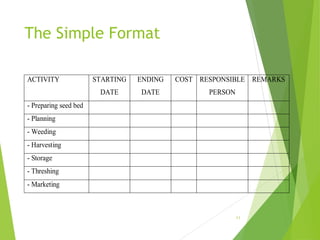
The Simple Format
11
ACTIVITY STARTING
DATE
ENDING
DATE
COST RESPONSIBLE
PERSON
REMARKS
- Preparing seed bed
- Planning
- Weeding
- Harvesting
- Storage
- Threshing
- Marketing
Project implementation plan
(cont.)
d) Organizational structure and staffing
Here the following are sought:
 Project structure for purposes of management
 Qualifications and skills for the staff
 Job descriptions and specifications for the staff
 Technical assistance if needed
e) Financial management
This looks at funds management, accounting
period, financial reports and statements and how
often they will be made?
12
Project implementation plan
(cont.)
f) Reporting system
This looks at who will be reporting to whom and how
often. There is need to design standard reporting
formats.
g) Sustainability
The concept of sustainability is based on belief that
project should result in benefits that have lasting
effect. Project should be sustained beyond the life of
funding - especially if it is a grant.
Project should not exhaust the available resources like
raw materials and labor.
13
Project implementation plan
(cont.)
Time control and remedial action
Time taken to implement project activities is
one measure of successfulness of supervision or
monitoring of project implementation.
Supervisor pays particular attention to time
control measures, time scheduling and its
supervision, time extension and postponement,
damages for non-completion and defect or
warranty period.
14
Project implementation plan
(cont.)
Supervision of implementation of project schedule
This involves a set of checks and balances to
ensure that the schedule is being adhered to.
To ensure that the time schedule is being
adhered to, the project activity time listing can
be of great importance.
15
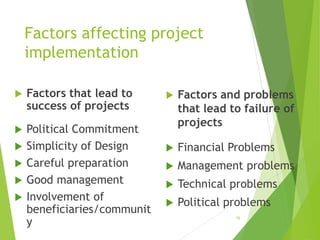
Factors affecting project
implementation
 Factors that lead to
success of projects
 Political Commitment
 Simplicity of Design
 Careful preparation
 Good management
 Involvement of
beneficiaries/communit
y
 Factors and problems
that lead to failure of
projects
 Financial Problems
 Management problems
 Technical problems
 Political problems
16
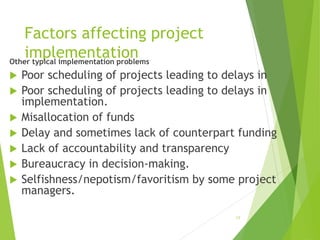
Factors affecting project
implementationOther typical implementation problems
 Poor scheduling of projects leading to delays in
implementation.
 Misallocation of funds
 Delay and sometimes lack of counterpart funding
 Lack of accountability and transparency
 Bureaucracy in decision-making.
 Selfishness/nepotism/favoritism by some project
managers.
17
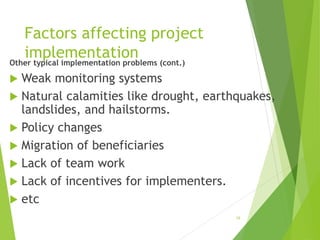
Factors affecting project
implementationOther typical implementation problems (cont.)
 Weak monitoring systems
 Natural calamities like drought, earthquakes,
landslides, and hailstorms.
 Policy changes
 Migration of beneficiaries
 Lack of team work
 Lack of incentives for implementers.
 etc
18
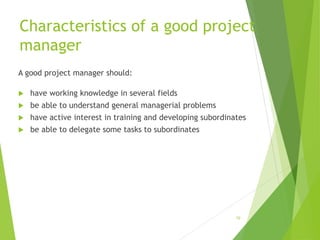
Characteristics of a good project
manager
A good project manager should:
 have working knowledge in several fields
 be able to understand general managerial problems
 have active interest in training and developing subordinates
 be able to delegate some tasks to subordinates
19
Characteristics of a good project
manager (cont.)
A good project manager should:
 know the project and understand its objectives
 know the systematic process for managing projects
 be able to answer the following questions:
What is the project for?
Why is it required?
Whom does it serve?
How is it justified?
How is it going to be used?
20
Thanks
21

Project execution and implementation

  • 1.
    Dr. Saima Baig Asst.Professor Social Sciences 1 Project Implementation/Execution Management
  • 2.
    Project Implementation  Processwhereby “project inputs are converted to project outputs”. May be looked at as: Putting in action the activities of the project. Putting into practice what was proposed in the project document (i.e. transforming the project proposal into the actual project.) Management of the project or executing the project intentions. 2
  • 3.
    Project Implementation (cont.) Implementation usuallydone by implementing agency (organization) that prepared the project and received funding for it. Other organizations that participate in the implementation of the project by way of collaboration, say by according good working relationship, extending technical advice or seconding their staff to the project are referred to as co-operating agencies. 3
  • 4.
    Project Implementation phase involves: Project activation, and  Project operation Project activation  This means making arrangements to have the project started. It involves coordination and allocation of resources to make project operational. Project operation  This is practical management of a project. Here, project inputs are transformed into outputs to achieve immediate objectives. 4
  • 5.
    Project operation and maintenance Operationand maintenance  To attain value and maximum returns, the district/municipality or the beneficiaries organize for the facility to have the project properly managed and maintained regularly.  An operation and maintenance manual is prepared by the contractor and handed to the district / beneficiaries. 5
  • 6.
    Approaches to project implementation Top-downapproach  Implementation mainly done by agencies from outside the community with limited involvement by the beneficiaries. Bottom-up approach  Beneficiaries implement the project. Outside agencies may provide the financial resources and technical assistance. Collaborative participatory approach  Both top-down and bottom-up approaches to project implementation are applied in the process. 6
  • 7.
    Project implementation plan (PIP) If PIP not carried out during the project design process and embodied in the project documents, it is carried out at the project activation stage.  This is Similar to a Work plan / Action Plan or a Gantt. Chart. 7
  • 8.
    Project implementation plan includes: 8 a)The project implementation schedule This is concerned with: What activities can produce expected project outputs? What is the sequence of these activities? What is the time frame for these activities? Who will be responsible for carrying out each activity?
  • 9.
    Project implementation plan includes: 9 The following methods may be used to answer the above questions:  Gantt chart  Critical Path Method (CPM) or Net work analysis  Project Evaluation and Review Techniques (PERT)  Simple formats
  • 10.
    What is aGANTT Chart?  The Gantt chart is also referred to as the progress chart/ A tabulated Action Plan/ Work plan showing Tasks to achieve and timelines.  It is a chart showing the timing of project activities using horizontal bars.  It is one of the techniques of project scheduling, which depicts the frequency of activities and determines the period of time for implementation. 10
  • 11.
    The Simple Format 11 ACTIVITYSTARTING DATE ENDING DATE COST RESPONSIBLE PERSON REMARKS - Preparing seed bed - Planning - Weeding - Harvesting - Storage - Threshing - Marketing
  • 12.
    Project implementation plan (cont.) d)Organizational structure and staffing Here the following are sought:  Project structure for purposes of management  Qualifications and skills for the staff  Job descriptions and specifications for the staff  Technical assistance if needed e) Financial management This looks at funds management, accounting period, financial reports and statements and how often they will be made? 12
  • 13.
    Project implementation plan (cont.) f)Reporting system This looks at who will be reporting to whom and how often. There is need to design standard reporting formats. g) Sustainability The concept of sustainability is based on belief that project should result in benefits that have lasting effect. Project should be sustained beyond the life of funding - especially if it is a grant. Project should not exhaust the available resources like raw materials and labor. 13
  • 14.
    Project implementation plan (cont.) Timecontrol and remedial action Time taken to implement project activities is one measure of successfulness of supervision or monitoring of project implementation. Supervisor pays particular attention to time control measures, time scheduling and its supervision, time extension and postponement, damages for non-completion and defect or warranty period. 14
  • 15.
    Project implementation plan (cont.) Supervisionof implementation of project schedule This involves a set of checks and balances to ensure that the schedule is being adhered to. To ensure that the time schedule is being adhered to, the project activity time listing can be of great importance. 15
  • 16.
    Factors affecting project implementation Factors that lead to success of projects  Political Commitment  Simplicity of Design  Careful preparation  Good management  Involvement of beneficiaries/communit y  Factors and problems that lead to failure of projects  Financial Problems  Management problems  Technical problems  Political problems 16
  • 17.
    Factors affecting project implementationOthertypical implementation problems  Poor scheduling of projects leading to delays in  Poor scheduling of projects leading to delays in implementation.  Misallocation of funds  Delay and sometimes lack of counterpart funding  Lack of accountability and transparency  Bureaucracy in decision-making.  Selfishness/nepotism/favoritism by some project managers. 17
  • 18.
    Factors affecting project implementationOthertypical implementation problems (cont.)  Weak monitoring systems  Natural calamities like drought, earthquakes, landslides, and hailstorms.  Policy changes  Migration of beneficiaries  Lack of team work  Lack of incentives for implementers.  etc 18
  • 19.
    Characteristics of agood project manager A good project manager should:  have working knowledge in several fields  be able to understand general managerial problems  have active interest in training and developing subordinates  be able to delegate some tasks to subordinates 19
  • 20.
    Characteristics of agood project manager (cont.) A good project manager should:  know the project and understand its objectives  know the systematic process for managing projects  be able to answer the following questions: What is the project for? Why is it required? Whom does it serve? How is it justified? How is it going to be used? 20
  • 21.

Editor's Notes