ME751 Project Management CHAPTER 5

COORDINATION AND CONTROL
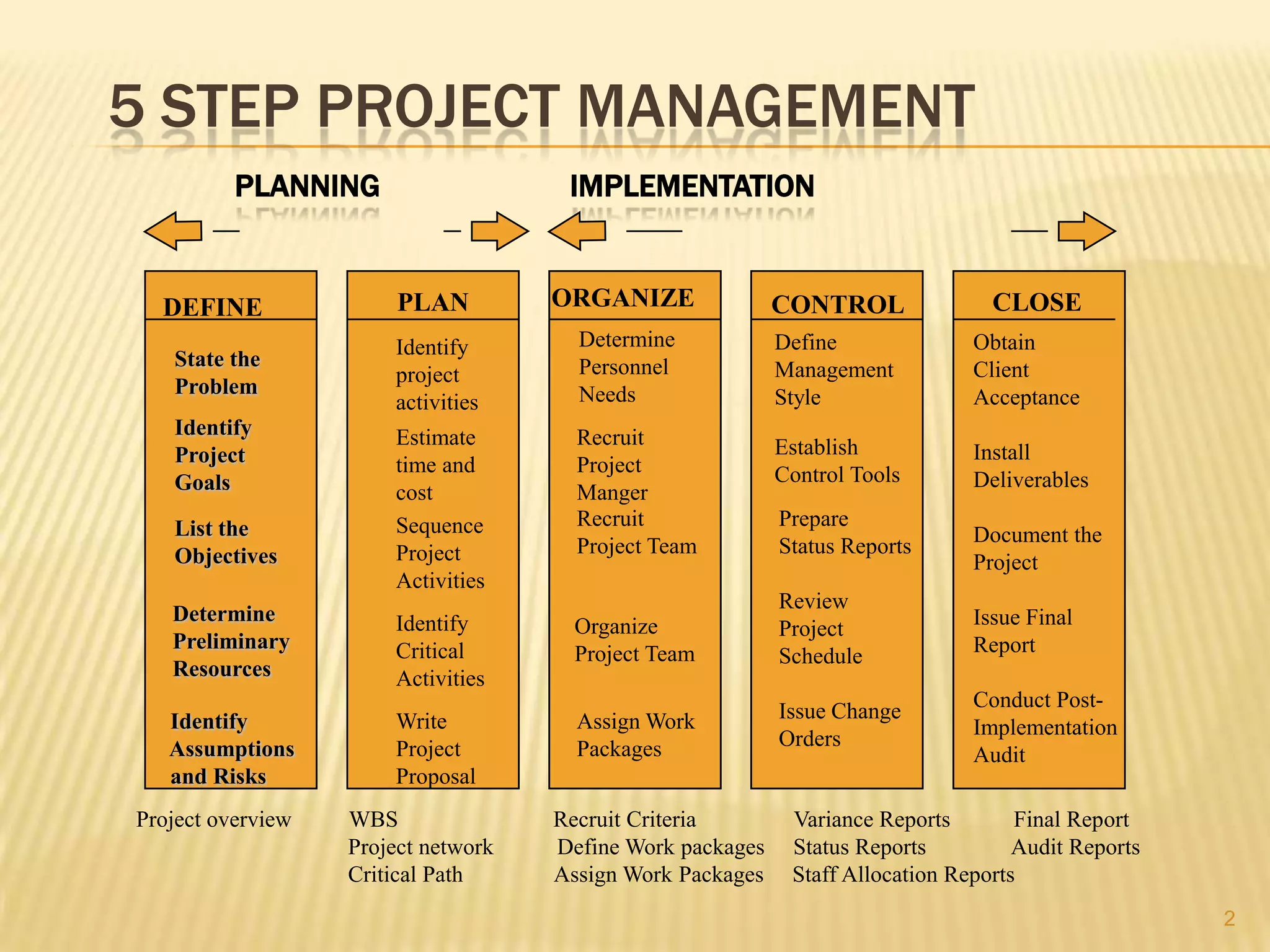
5 STEP PROJECT MANAGEMENT
PLANNING

IMPLEMENTATION

DEFINE

PLAN

ORGANIZE

CONTROL

State the
Problem

Identify
project
activities

Determine
Personnel
Needs

Define
Management
Style

Obtain
Client
Acceptance

Estimate
time and
cost
Sequence
Project
Activities

Recruit
Project
Manger
Recruit
Project Team

Establish
Control Tools

Install
Deliverables

Determine
Preliminary
Resources

Identify
Critical
Activities

Organize
Project Team

Review
Project
Schedule

Issue Final
Report

Identify
Assumptions
and Risks

Write
Project
Proposal

Assign Work
Packages

Issue Change
Orders

Conduct PostImplementation
Audit

Identify
Project
Goals
List the
Objectives

Project overview

WBS
Project network
Critical Path

Recruit Criteria
Define Work packages
Assign Work Packages

Prepare
Status Reports

CLOSE

Document the
Project

Variance Reports
Final Report
Status Reports
Audit Reports
Staff Allocation Reports
2
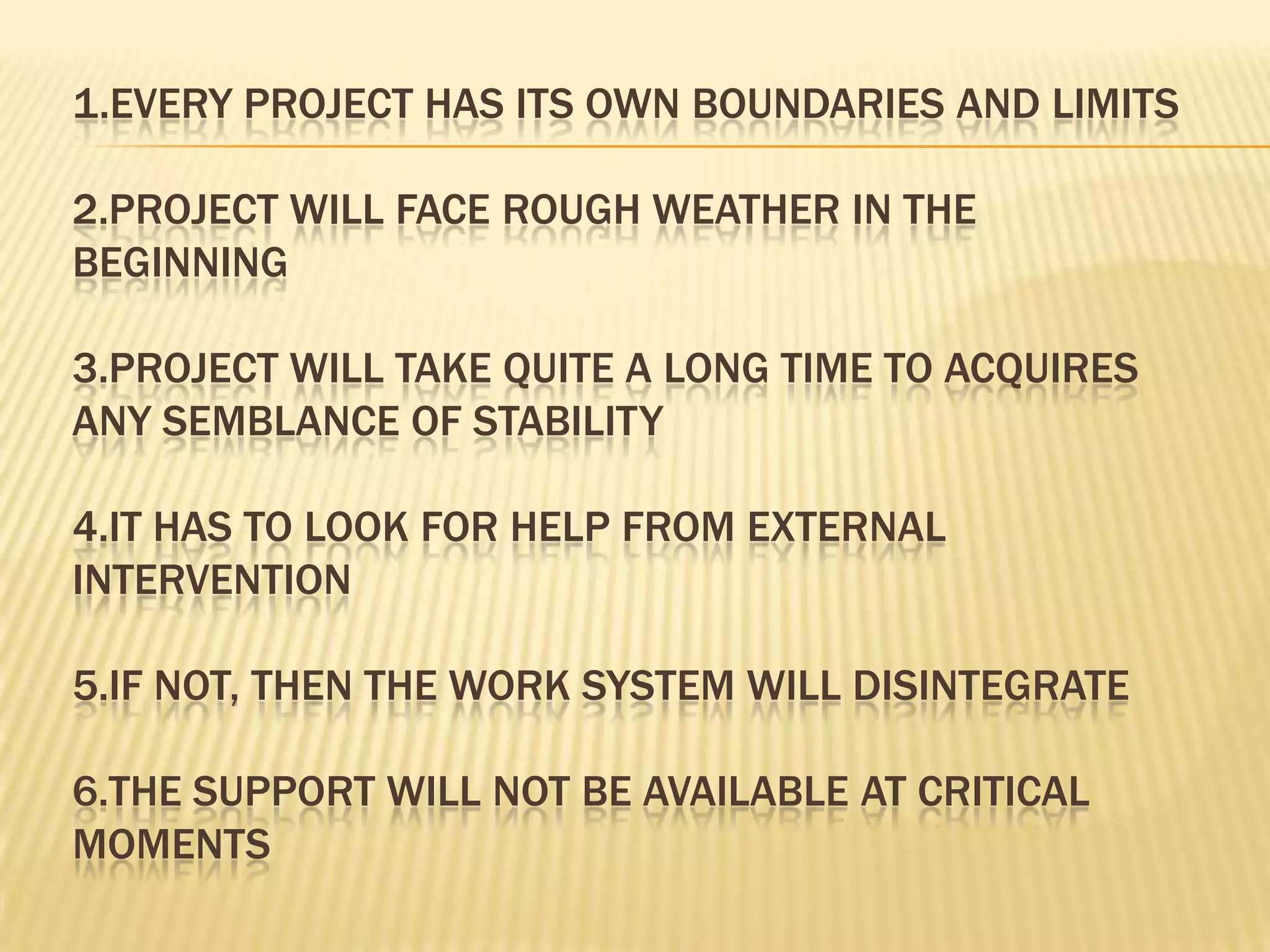
1.EVERY PROJECT HAS ITS OWN BOUNDARIES AND LIMITS
2.PROJECT WILL FACE ROUGH WEATHER IN THE
BEGINNING
3.PROJECT WILL TAKE QUITE A LONG TIME TO ACQUIRES
ANY SEMBLANCE OF STABILITY
4.IT HAS TO LOOK FOR HELP FROM EXTERNAL
INTERVENTION
5.IF NOT, THEN THE WORK SYSTEM WILL DISINTEGRATE
6.THE SUPPORT WILL NOT BE AVAILABLE AT CRITICAL
MOMENTS
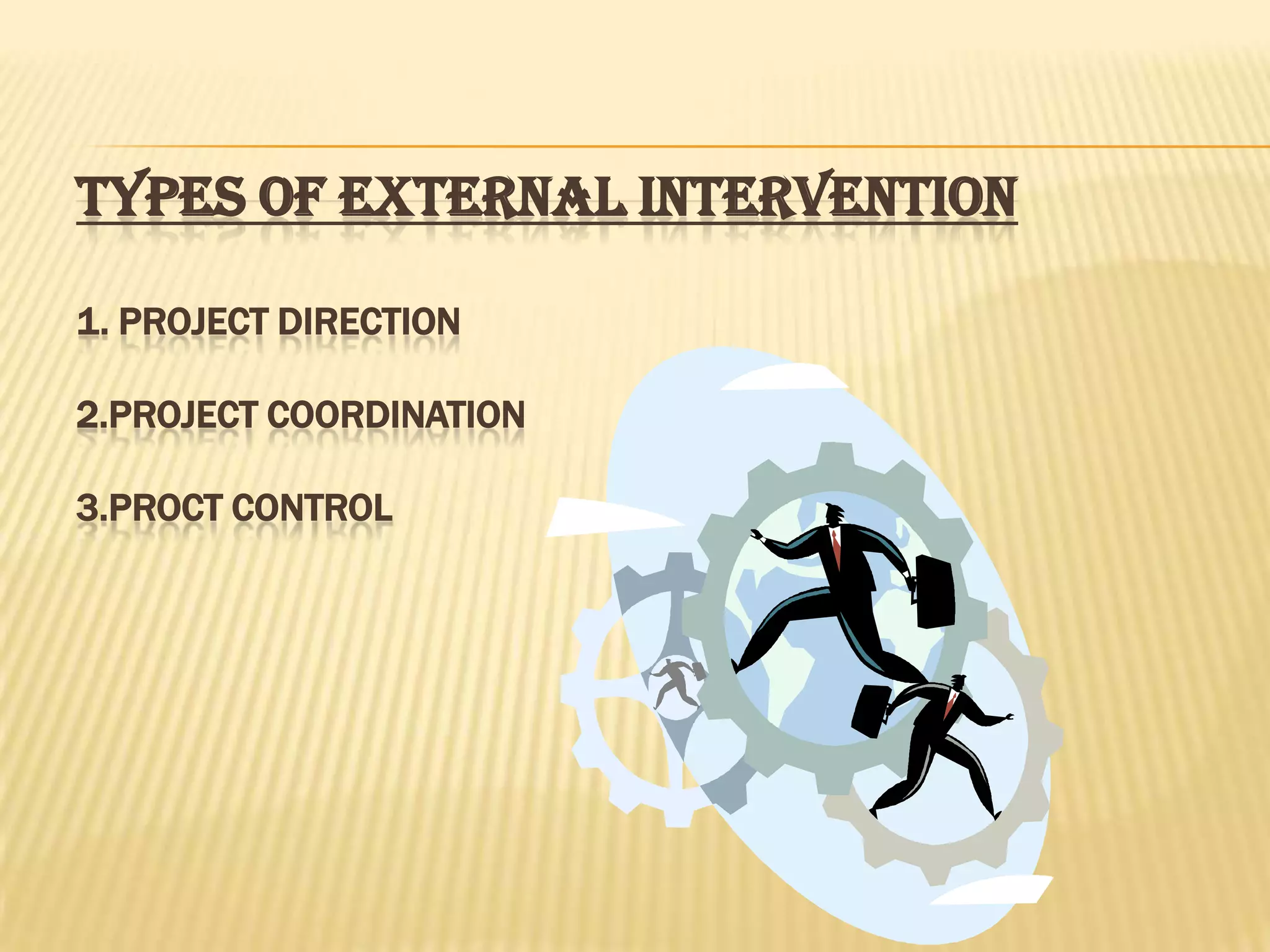
TYPES OF EXTERNAL INTERVENTION
1. PROJECT DIRECTION
2.PROJECT COORDINATION
3.PROCT CONTROL
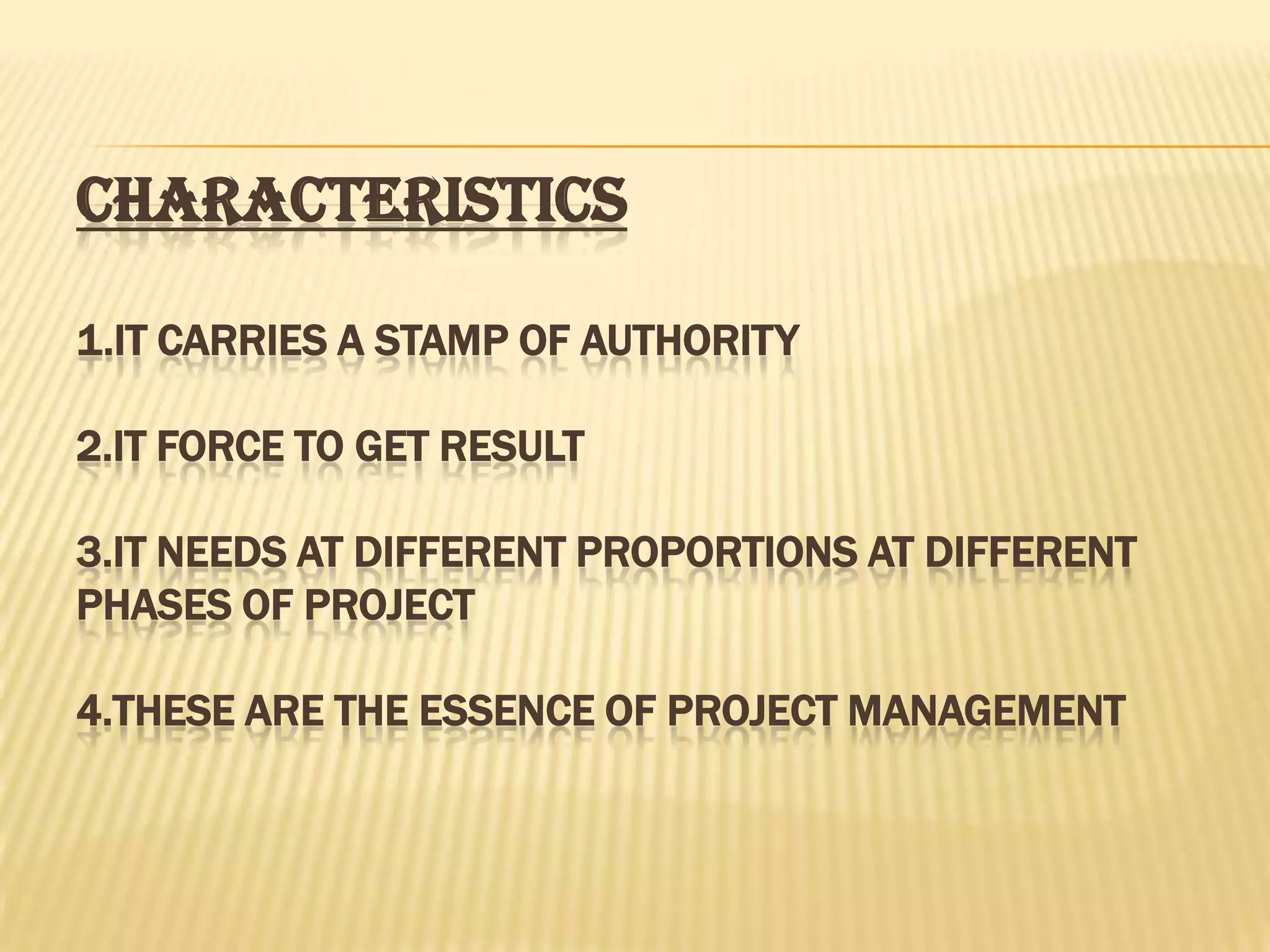
CHARACTERISTICS
1.IT CARRIES A STAMP OF AUTHORITY

2.IT FORCE TO GET RESULT
3.IT NEEDS AT DIFFERENT PROPORTIONS AT DIFFERENT
PHASES OF PROJECT
4.THESE ARE THE ESSENCE OF PROJECT MANAGEMENT
WHAT IS PROJECT DIRECTION?
PROJECT DIRECTION REFERS TO THE USE OF AUTHORITY
TO CHANNELISE THE VARIOUS ACTIVITIES OF THE PROJECT
ON DESIRED LINES….
1. IT IS MAINLY CONCERNED WITH THE IMPLEMENTATION
PHASE OF THE PROJECT
2.WHEN SCHEDULES ARE AUTHORISED, THEY BECOME
WORKING DOCUMENTS
3.EXECUTIVE AGENCIES OR INDIVIDUALS WILL THEN
STRICTLY FOLLOW THE PLANS AND SCHEDULES
PROJECT INITIATION PERIOD
1.SCOPE OF WORK
2.SPECIFICATION OF RESULTS OF COMPLETED WORK
3.BASIS OF WORK
4.DIVISION OF WORK
5.SCHEDULE OF WORK
6.BUDGET OF WORK
7.SYSTEM AND PROCEDURE FOR WORK
8.COORDINATION OF WORK
8.AUTHORITY AND ACCOUNTABILITY OF WORK
9.CONTROL OF WORK
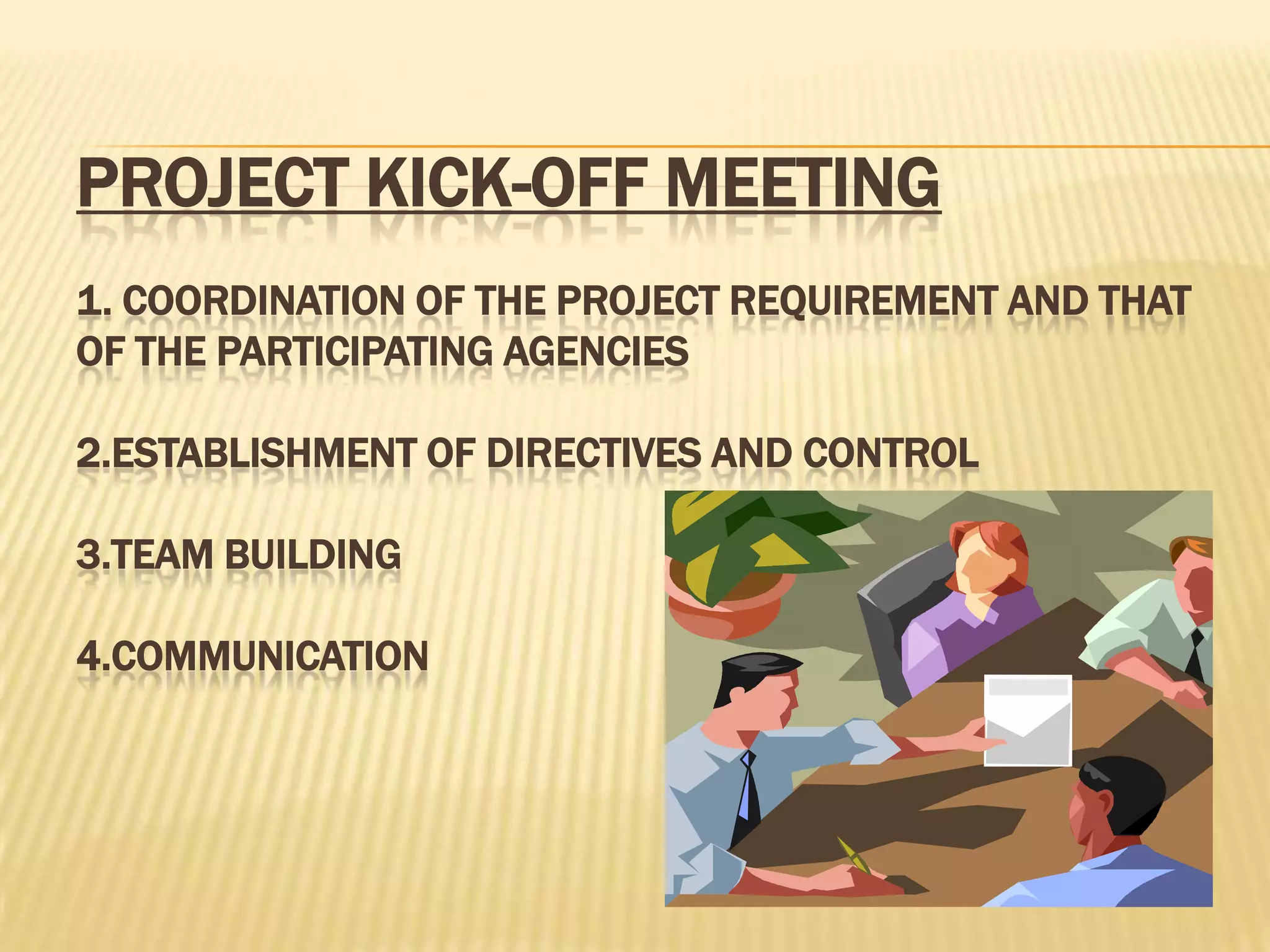
PROJECT KICK-OFF MEETING
1. COORDINATION OF THE PROJECT REQUIREMENT AND THAT
OF THE PARTICIPATING AGENCIES

2.ESTABLISHMENT OF DIRECTIVES AND CONTROL
3.TEAM BUILDING

4.COMMUNICATION
DIRECTION DURING PRODUCTION PHASE
1.DIRECTION IS PROVIDED ON A CASE TO CASE
BASIS THROUGH FORMAL DOCUMENT

2.DESIGN REVIEW MEETING
3.VALUE ENGINEERING REVIEW
DESIGN REVIEW MEETINGS
1.REVIEW MEETINGS PROVIDE A FORUM FOR
PARTICIPATIVE DECISION MAKING AND COMMUNICATION
OF DIRECTION
2.A DESIGN REVIEW MEETINGS ARE HELD TO CRITICALLY
EXAMINE AND AUTHORISE THE BASIC DESIGN WHICH HAS
TO TAKE OF ALL SUBSEQUENT WORK ON PROJECT
HARDWARE
3.SINCE THE BASIC DESIGN IS SO IMPORTANT FOR THE
PROJECT, A CRITICAL REVIEW BY TOP SPECIALISTS AND
APPROVAL FROM APPROPRIATE AUTHORITIES ARE
ESSENTIAL BEFORE IT IS ISSUED DOWN THE LINE FOR
IMPLEMENTATION
CONTINUED:
4.A DESIGN REVIEW MEETING CHECKS THE PROJECT
DESIGN FROM ALL ANGLES (FUNCTIONAL UTILITY, ENERGY
OPTIMISATION, HANDLING
MINIMISATION, CONSTRUCTABILITY, SAFETY, ENVIRONMEN
TAL IMPACTS AND ECONOMY)
5.THE RESULTANT EFFECT OF ANY GOOD OR BAD DESIGN
IS COST, THE DESIGN FINALLY TO BE RELEASED FOR
IMPLEMENTATION MUST BE COST EFFECTIVE
VALUE ENGINEERING REVIEW
1.A VALUE ENGINEERING REVIEW USES COST AS THE
BASIS OF REVIEW AND ENSURES THAT VALUE IS INCLUDED
IN DESIGN
2.VALUE OF AN ITEM, IN THIS CONTEXT WOULD MEAN THE
MINIMUM COST AT WHICH THE FUNCTION PROVIDED BY
THE ITEM UNDER REVIEW COULD BE OBTAINED FROM ANY
OTHER ITEM. THUS WHEN NON FUNCTIONAL COST IS
REMOVED FROM AN ITEM, ITS VALUE INCREASES
3.IN VALUE ENGINEERING REVIEW ONE WOULD COMPARE
THE HARDWARE COST OF AN ITEM WITH ITS VALUE
MAJOR FUNCTIONS
1. OPERATION
2. TRANSPORTATION

3.PERMANENT STORAGE
4.TEMPORARY STORAGE

5.INSPECTION/CONTROL
STAGES OF VALUE ENGINEERING
REVIEW
1.BASIC PACKAGE REVIEW
2.TENDER OR WORK PACKAGE REVIEW
3.POST CONTRACT ENGINEERING REVIEW
PURCHASE ORDERS AND WORK ORDERS
1.TECHNICAL DIRECTIONS

2.COMMERCIAL DIRECTION
3.MANAGERIAL DIRECTION

4.ADMINISTRATIVE DIRECTION
ONGOING DIRECTIONS
1.UNDERSTANDING THE DECISION ENVIRONMENT.
2.ESTABLISHING THE DECISION ALTERNATIVES.
3.EVALUATION OF ALTERNATIVES AND SELECTION.
4.COMMUNICATING THE DECISION .
5.CHECKING UP IF THE DECISION IS WORKING OR NOT.
COMMUNICATIONS MANAGEMENT


Develop the project communication plan






Stakeholder analysis
Information to be shared (to who, what, how, when, why)
Technology

Distribute information



Project databases, filing system, software / hardware
Report up, down and across the firm

17
COMMUNICATIONS MANAGEMENT


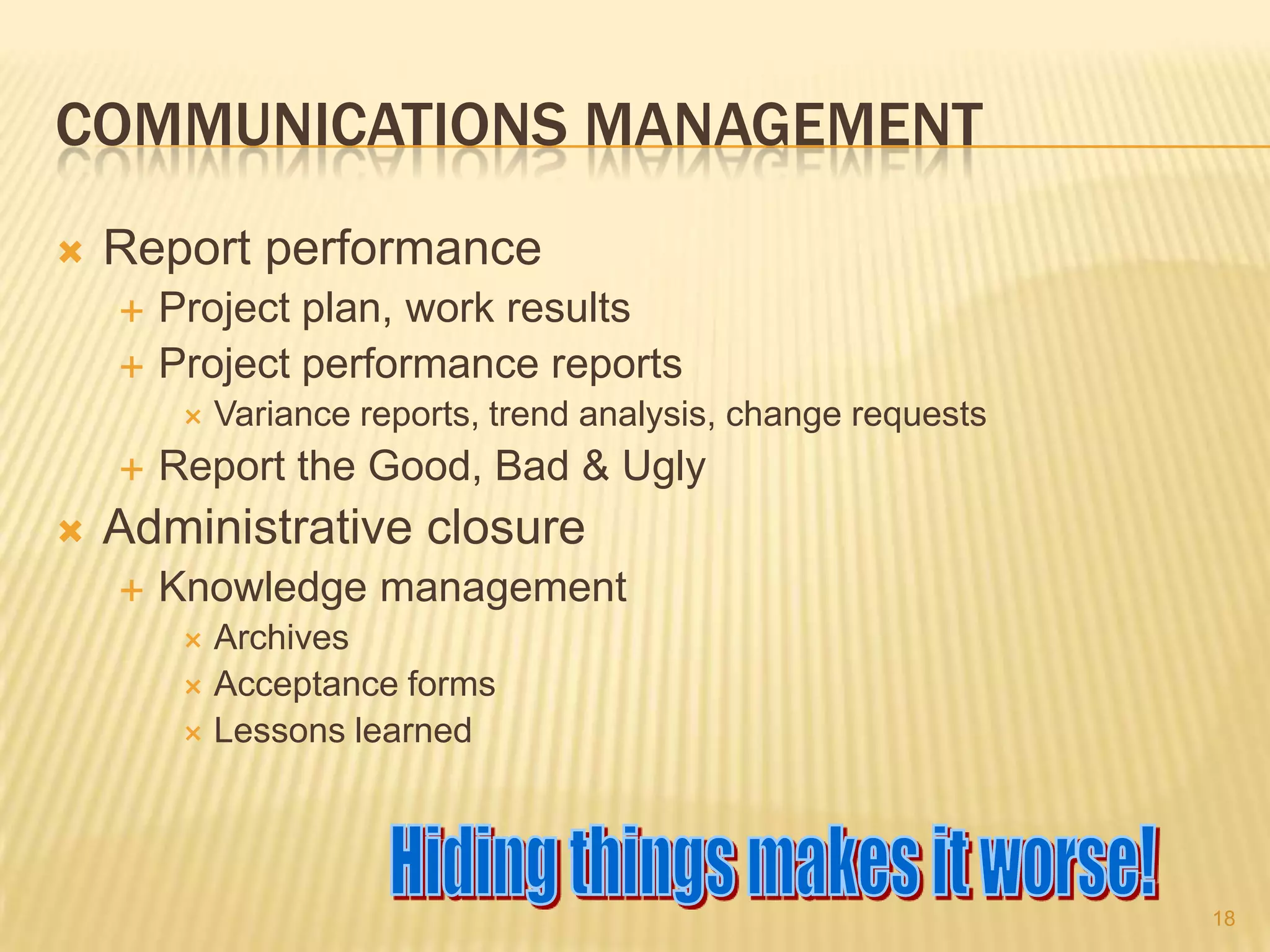
Report performance



Project plan, work results
Project performance reports






Variance reports, trend analysis, change requests

Report the Good, Bad & Ugly

Administrative closure


Knowledge management
Archives
 Acceptance forms
 Lessons learned


18
SAMPLE COMMUNICATION FORMATS












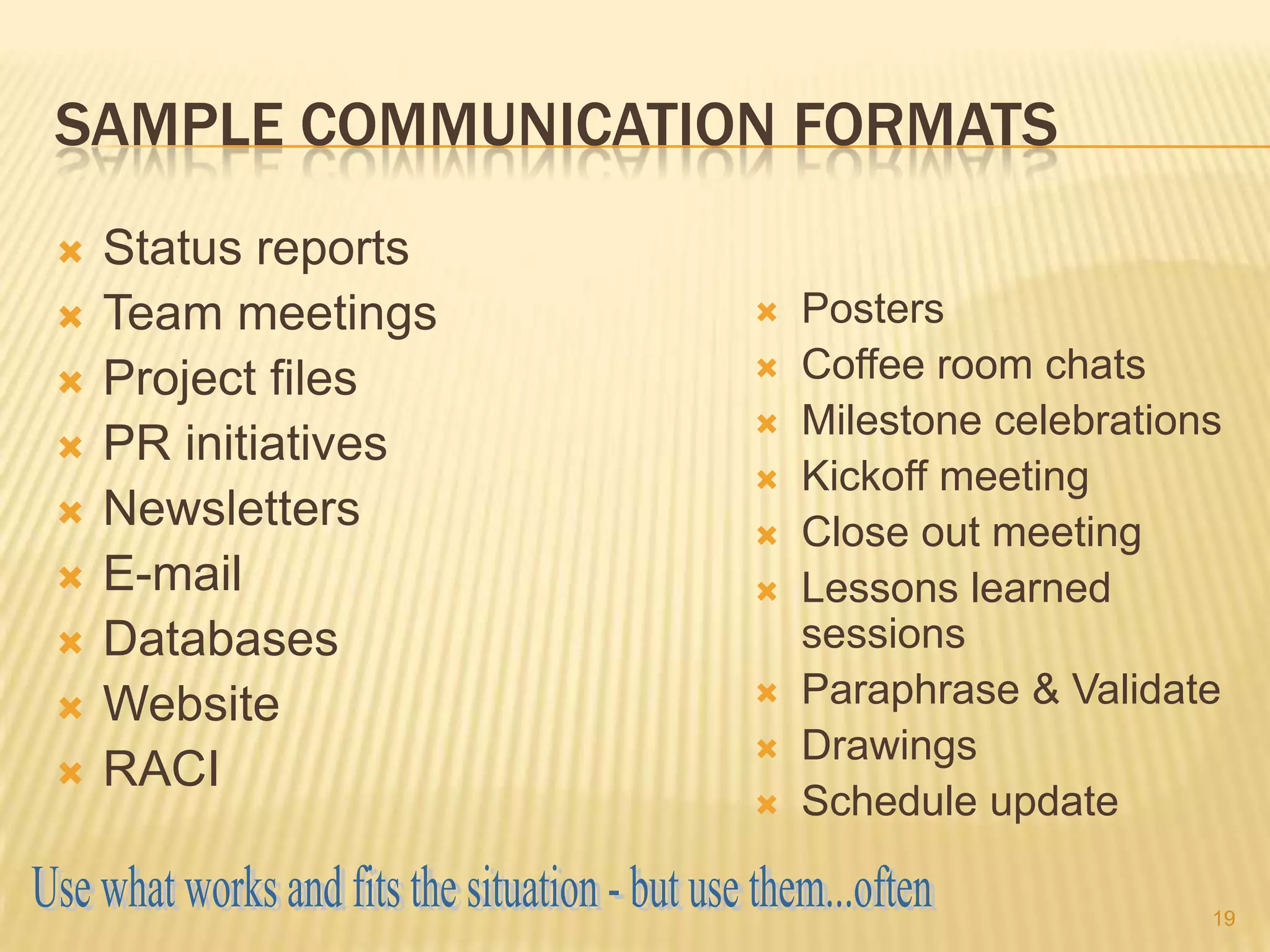
Status reports
Team meetings
Project files
PR initiatives
Newsletters
E-mail
Databases
Website
RACI













Posters
Coffee room chats
Milestone celebrations
Kickoff meeting
Close out meeting
Lessons learned
sessions
Paraphrase & Validate
Drawings
Schedule update
19
COMMUNICATIONS MANAGEMENT TIPS
If you think you have communicated
enough…go back and do it again
 Use different formats
 Frequently use modes of communication that
allow you to “see the whites of their eyes”


20
Role of MIS in Project Management
 Why

Do People Need Information?

 Individuals

- Entertainment and
enlightenment

 Businesses

- Decision making, problem
solving and control


Information system allows managers to
make effective and timely decisions.



will supply the managers, information from
which to base their decision on.



These are known as Management
Information Systems (MIS).
MIS - DEFINITIONS
Definitions – vary in the literature
“…MIS is an integrated computer based usermachine system that provides information for
supporting operations and decision making
functions”
Awad (1988)
MIS DEFINED
“..It [MIS] is a system using formalised
procedures to provide management at all
levels in all functions with appropriate
information based on data from both internal
and external sources, to enable them to
make timely and effective decisions for
planning, directing, and controlling the
activities for which they are responsible..”

Lucey (1997)
MIS DEFINED
“..Organized approach to the study of information
needs of management at every level in making
operational, tactical, and strategic decisions. Its
objective is to design and implement manmachine procedures, processes, and routines
that provide suitably detailed reports in an
accurate, consistent, and timely manner..”

www.Businessdictionary.com (2009)
Terminology Confusion
 MIS

= the study of information
technology in business settings

 But,

MIS is also a term often used to
refer class of systems which support
operational and tactical decision making
Basic Requirements for a Project
Management Information System:
Each project header must be able to
update his project on a monthly basis.
 The project leader must be able to
manually device the information needed to
measure the progress of the project.
 The analysis reports must be then typed
up for distribution.

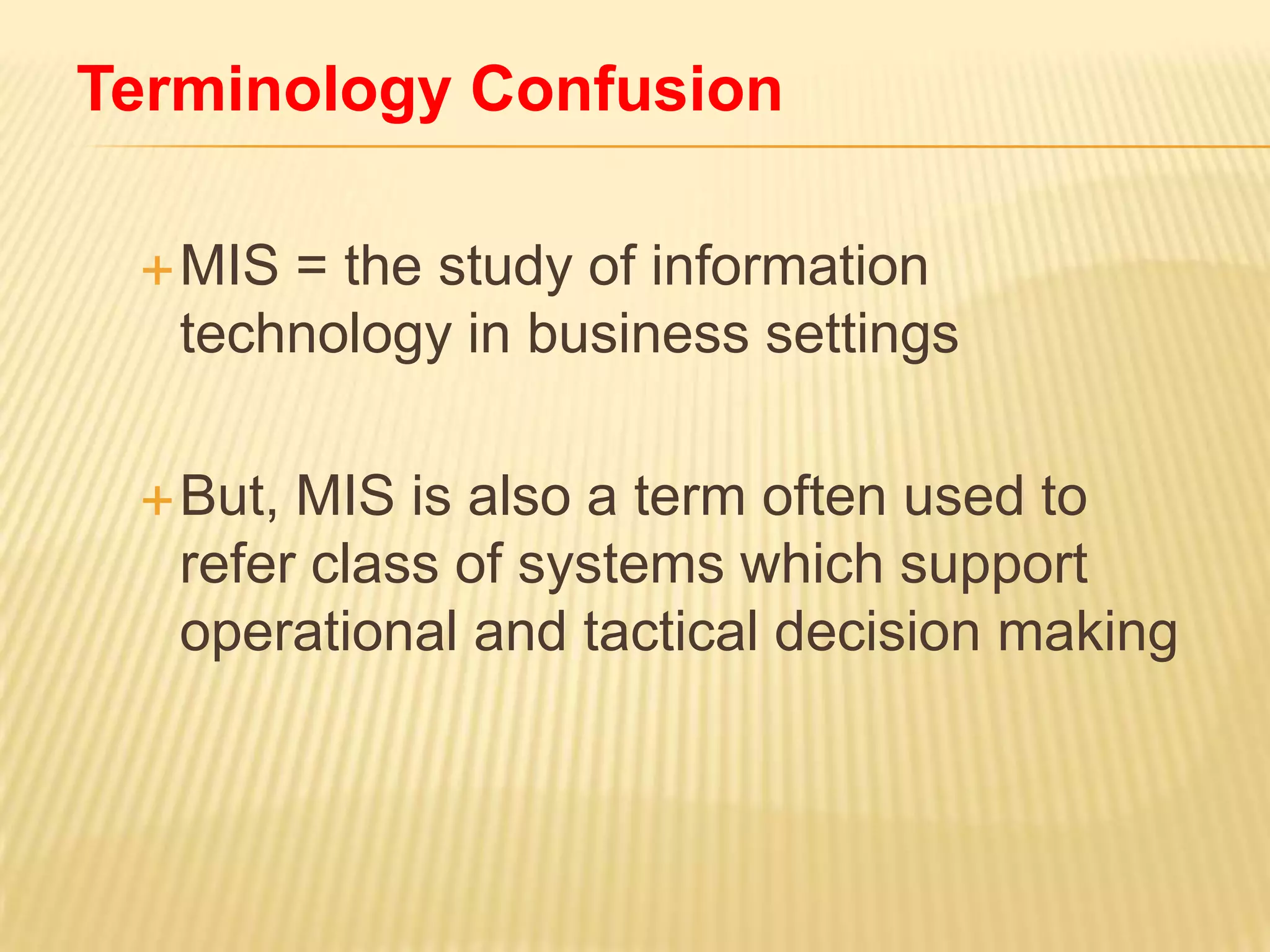
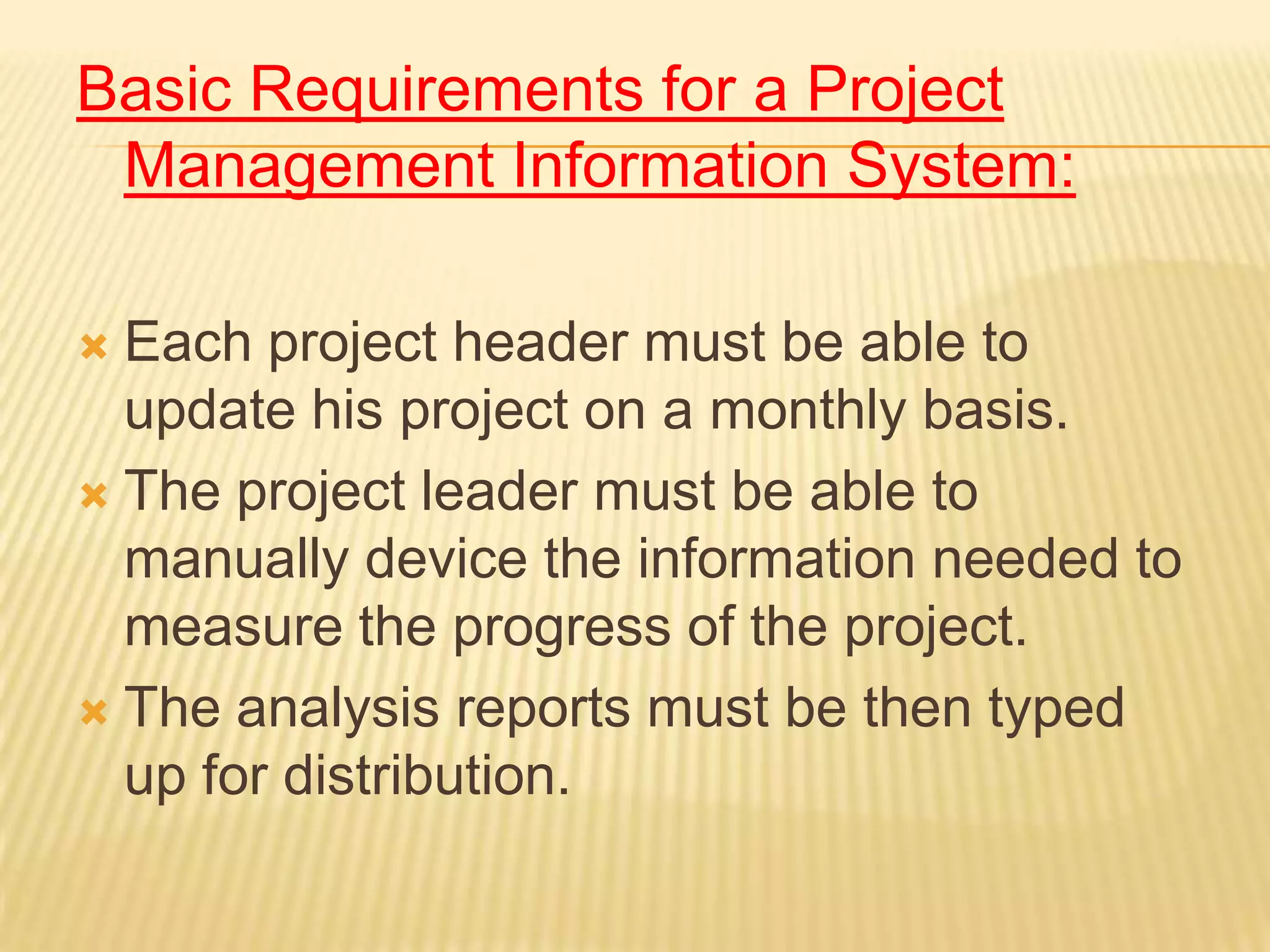
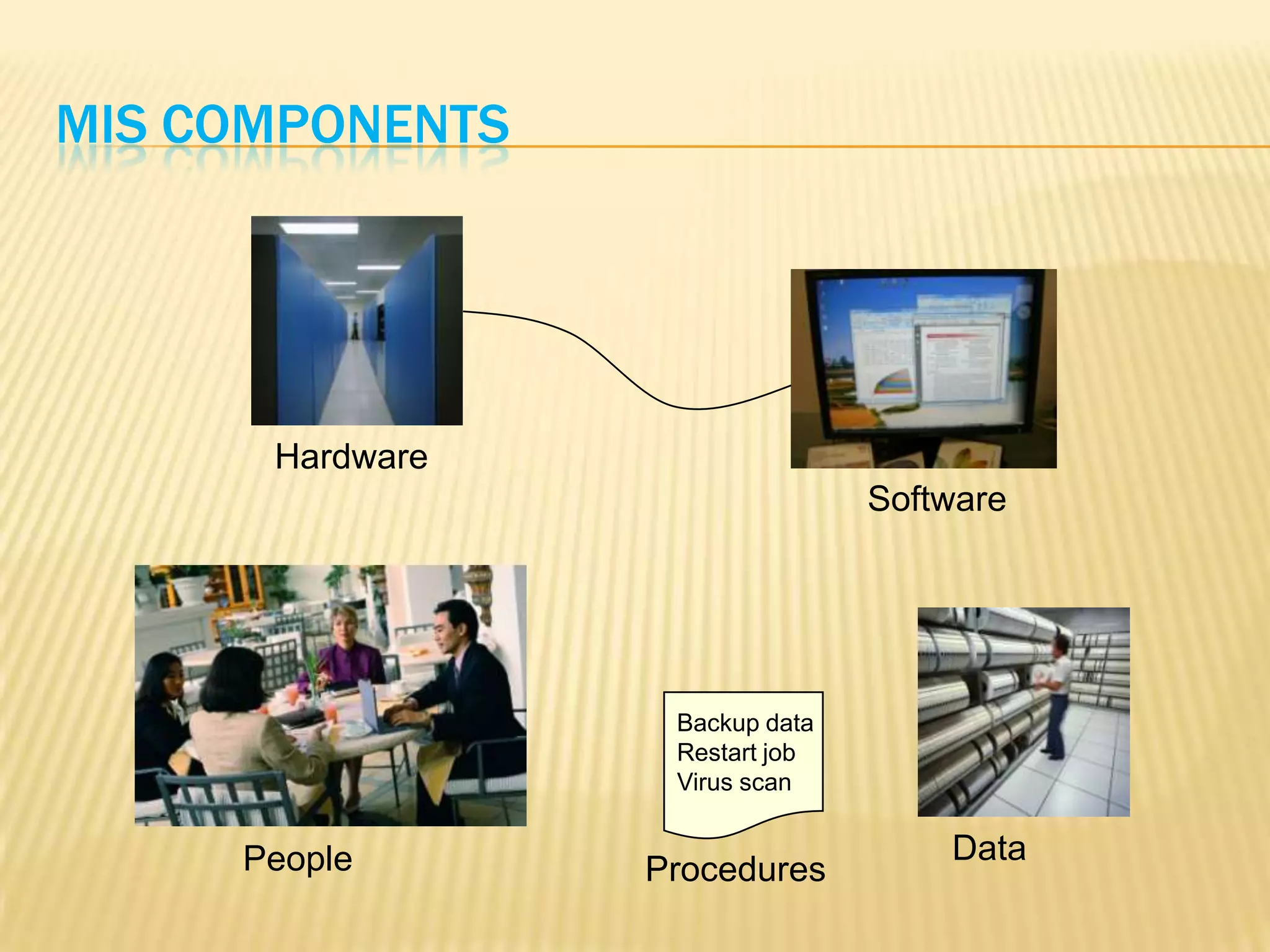
MIS COMPONENTS

Hardware
Software

Backup data
Restart job
Virus scan

People

Procedures

Data
Components of MIS


Scheduled reports




Produced periodically, or on a schedule
(daily, weekly, monthly)

Key-indicator report
Summarizes the previous day’s critical activities
 Typically available at the beginning of each day




Demand report




Gives certain information at a manager’s request

Exception report


Automatically produced when a situation is unusual or
requires management action
Optimum Project MIS may be described as follows:




The existing information system are reduced to three
elements
human resources
financial resources
material resources
Direct entry of data is via terminals with CRT’S



Individual reports may be generated for other than
project needs.



Information is formulated along with estimates supplied
by the project leader to display a current summary.


Additional reports could be generated from this
information such as facilities scheduling , work
planning , manufacturing engineering etc…..



Project plans can be transferred by project
leaders to line management via a CRT.



The system will have the capability to access
central pertinent files.



The system will have the capability for data
correction at the original source, thus reducing
the labour required.
MIS Should be..
Flexible: for different ways of analysing
data, and evaluating information.
 Range of skills and knowledge catered for.
 Assist the operational process through
communication between staff.
 Easy to extract the relevant information
i.e., it is presented in an appropriate way.

PERFORMANCE CONTROL
•

When do we say that the performance of
any project is good or not ?



The performance of a project is good
when it is completed based on time
constraints, specified budget and project
specifications.



Otherwise the project ends up with failure.
Some of the reasons for the poor
performance of a project are:
If it is abandoned at half the way.
 If it is not producing a specified quality of a
product.
 If it becomes sick soon after going in to the
commercial production.

PERFORMANCE INDICATORS:


The investor, project manager and also the
public must be given with some indications
about the management while the project is
still in progress.
Some of the performance indicators are:
Time over-run
 Cost over-run
 Project sickness
 Productivity
 Value

1) TIME OVER-RUN:





This basically means not sticking to a pre-planned time schedule of
the project. In order to get the job cleared through the approving
authorities, a schedule may be fixed which can be far away from
realistic.
The vendors and contractors may just add to the confusion by
promising deliveries which can make anything possible on paper.
Besides, some subsequent modifications or changes have to be
made to suit the project requirements which in turn increases time
and cost.

2)COST OVER-RUN:




Anything done to a project including time over-run would be reflected
in the cost.
Cost estimates in a project are to be revised at various stages to
improve their accuracy.
Cost over-run is used to represent the variance between the original
cost and the final cost incurred.
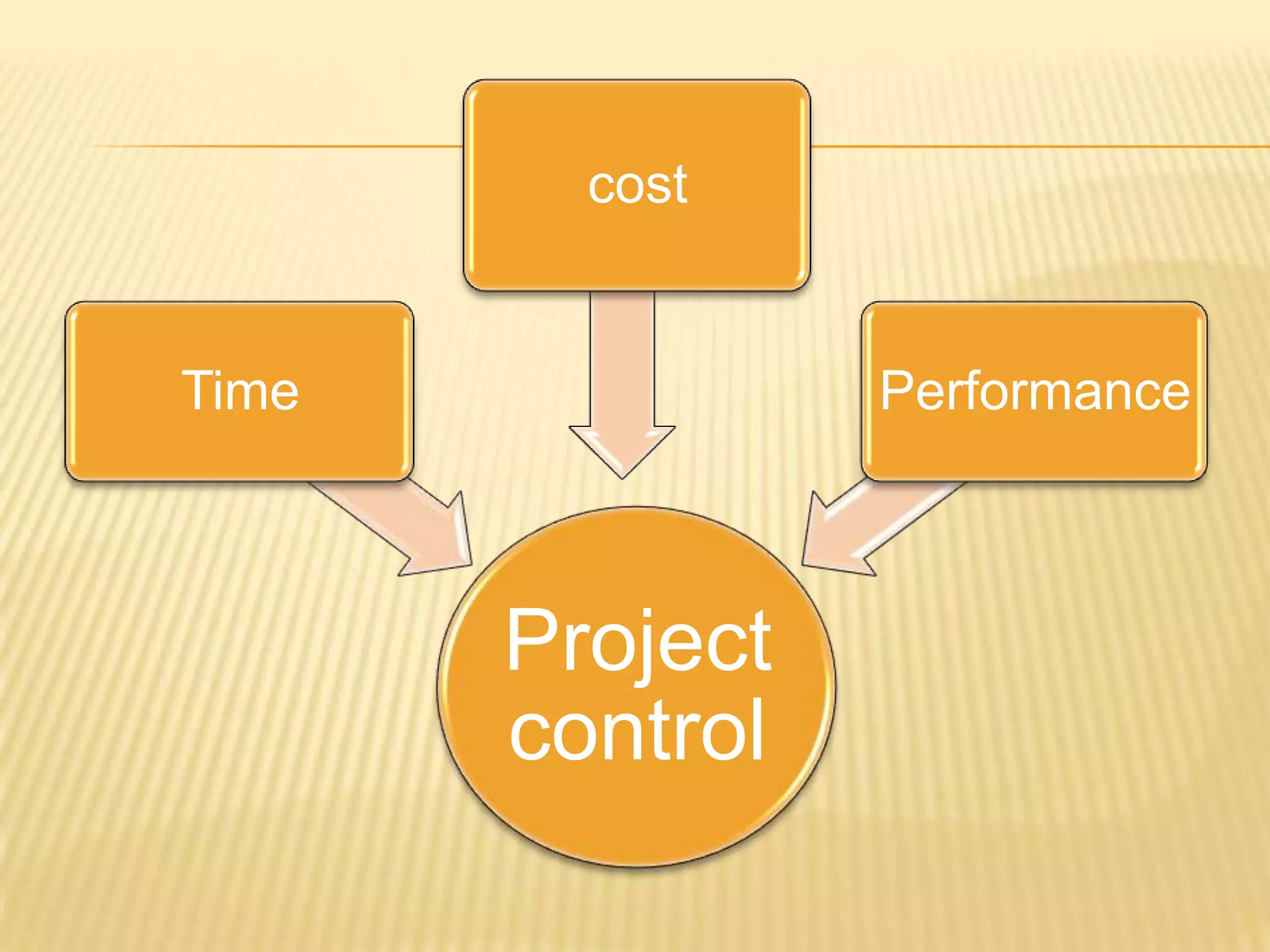
cost

Time

Performance

Project
control
3)PROJECT SICKNESS:






An efficient project manager is the one who makes the best possible
use of resources for achieving the project objectives.
What ever the project manager does w.r.t the resources will be
reflected in the cost and what the project manager provides in return
to justify this cost is a plan which is to be called successful and must
provide a saleable output.
The ratio of this output to the cost incurred for putting up the plan
could be an indicator of a project management performance.

4)PRODUCTIVITY:




A productivity indicator reflects how the resources have been utilized
either for production of goods and services or for creation of facilities
for the same.
Productivity is mainly measured to ensure the profitability of the
plant and to ward of the sickness.
5)VALUE:
 Value in this context, indicates the quality of the
products or services that are the final outcome of a
project.
 If the product or services do not meet customers
requirement, then the ideas such as time overrun, cost over-run, high productivity, all become
redundant.




PROGRESS CONTROL:
It requires a continuous monitoring during the
production phase.
There must be a right contractual stipulations
regarding warranties and guarantees.
PERFORMANCE PARAMETERS:
 These are the parameters which are required to
be identified in a project.
• Some of the critical performance parameters are;
 Raw materials
 Power consumption per unit of production
 Outcome etc….
 How ever the design and specifications must be
made to meet these performance requirements.
 Thus the critical performance parameters must be
tracked through all the stages of project execution
till the final performance guarantee confirms the
achievement of the performance.
COST OF A PROJECT
This includes the total amount spent
on all items associated with a project which
are supported by funds, investments etc..
The amount spent on the following
constitutes the project cost:
 Land and site development
 Building and civil works
 Plant and machinery
 Technical know-how & engineering fees
 Pre-operative costs
 Maintenance costs & others


COST CONTROL

This involves the monitoring of costs,
recording information in different areas
and analyzing these massive quantities of
data – in order to take the corrective
action before it is too late.
Anything done to a project including time
& performance factors, will be reflected in
the cost - they are interrelated.
 Hence, the cost control is of prime
importance in the success of a project.




If the project cost can be brought down
without compromising on the time and
performance parameters, then that would
indicate an excellent cost management.
It includes the following factors Cost estimation
When creating a budget for a job, project
management must be able to engage properly in
the process of cost estimating. This is a calculated
projection of the cost for the materials required by
the project. The materials considered in cost
estimating can be any resources required for the job
such as raw materials or employee wages. Too high
an estimate, and the bid could be lost to another
company.


Cost accounting

“ The language of business “
it is the art of recording, classifying and
summarizing the transactions of money
and different events in a significant manner.
 Maintenance of project ledgers
- showing WBS budget-line items
- expenditures & forecasts.


Direct costs



The costs that are directly attributed to the
project work. These are also called
variable costs because their rate of
expenditure depends on the intensity of
the project activity.
If no work is done, then no direct costs.


Indirect costs

-these are the costs that must be incurred
by the organization to provide
heat, light, rent, insurance, maintenance
costs and others. These costs do not vary
from day to day, hence they are called
Fixed costs, also known as Overhead
costs.


Cost escalation
- increase in all costs above their original
estimate in case of national cost inflation
and increase in wages & salaries.
This is expressed as a percentage
and only significant in times of high
inflation and for projects planned to last for
several years.
COST CONTROL METHODS:- cost can be
controlled under the following stages of a
project (ex:construction project)
 At zero date
- control estimate, budgeting & network
plan should be implemented. Time control
and hence cost control by budgetary
restrictions.
 During detailed engg.
- the cost control estimates prepared
before zero date will soon overrun unless
design & engineering procedures are cont.
reviewed. It includes-
- Over all plot plan
- Building designs
-Specifications & drawings


During procurement phase : - competitive bidding is
the most common practice for procuring a technically
feasible item at lowest cost. In addition to this, following
steps are taken for cost control :
1.
2.
3.

4.

Vendor association in specification
Detailed scope and specifications
General conditions of contract (GCC)
Delivery in erectable sequence
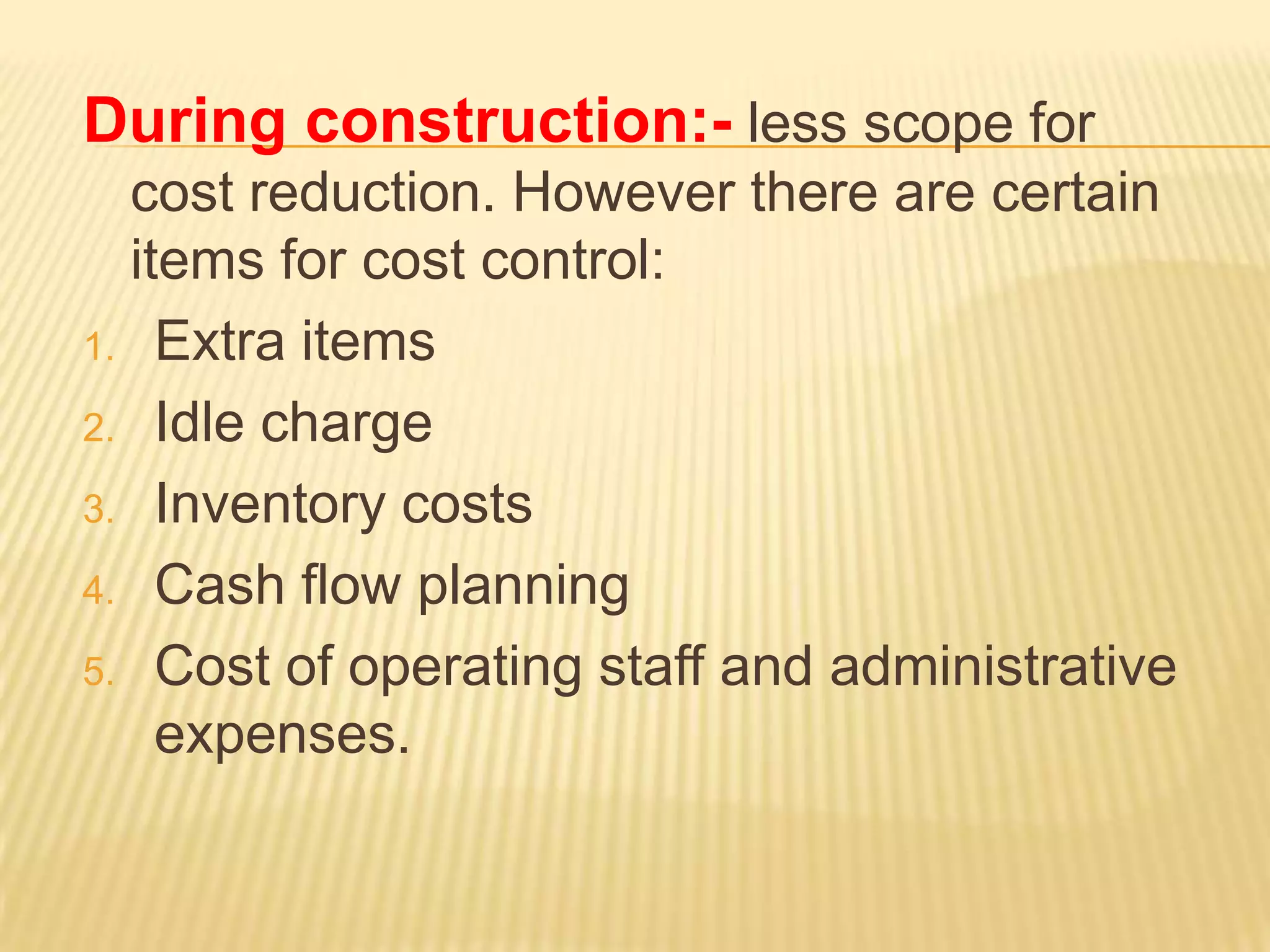
During construction:- less scope for
cost reduction. However there are certain
items for cost control:
1. Extra items
2. Idle charge
3. Inventory costs
4. Cash flow planning
5. Cost of operating staff and administrative
expenses.
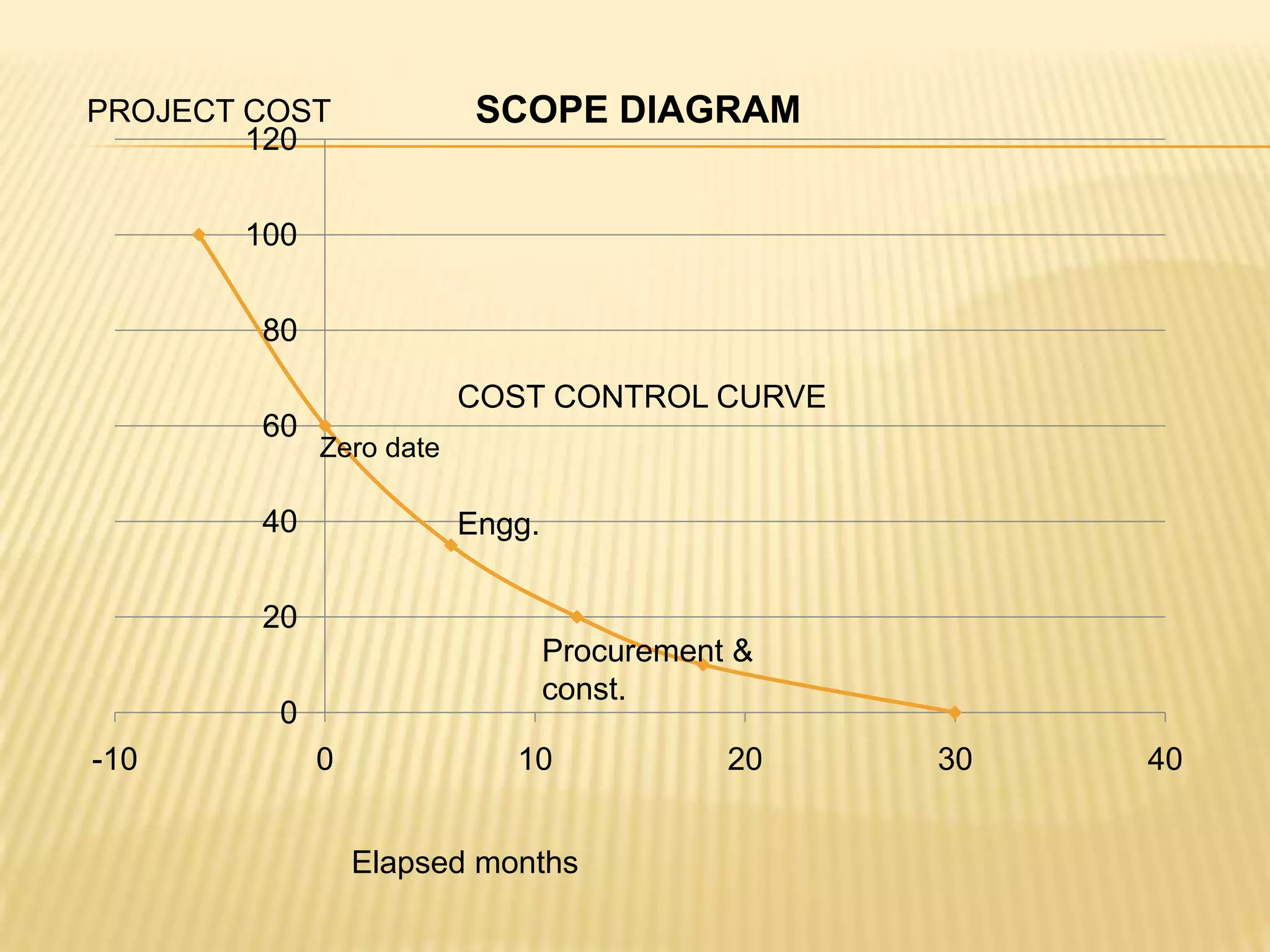
SCOPE DIAGRAM

PROJECT COST
120
100
80
60

COST CONTROL CURVE
Zero date

40

Engg.

20
Procurement &
const.

0
-10

0

10
Elapsed months

20

30

40

10 me667 chap5 coordination and control

  • 1.
    ME751 Project ManagementCHAPTER 5 COORDINATION AND CONTROL
  • 2.
    5 STEP PROJECTMANAGEMENT PLANNING IMPLEMENTATION DEFINE PLAN ORGANIZE CONTROL State the Problem Identify project activities Determine Personnel Needs Define Management Style Obtain Client Acceptance Estimate time and cost Sequence Project Activities Recruit Project Manger Recruit Project Team Establish Control Tools Install Deliverables Determine Preliminary Resources Identify Critical Activities Organize Project Team Review Project Schedule Issue Final Report Identify Assumptions and Risks Write Project Proposal Assign Work Packages Issue Change Orders Conduct PostImplementation Audit Identify Project Goals List the Objectives Project overview WBS Project network Critical Path Recruit Criteria Define Work packages Assign Work Packages Prepare Status Reports CLOSE Document the Project Variance Reports Final Report Status Reports Audit Reports Staff Allocation Reports 2
  • 3.
    1.EVERY PROJECT HASITS OWN BOUNDARIES AND LIMITS 2.PROJECT WILL FACE ROUGH WEATHER IN THE BEGINNING 3.PROJECT WILL TAKE QUITE A LONG TIME TO ACQUIRES ANY SEMBLANCE OF STABILITY 4.IT HAS TO LOOK FOR HELP FROM EXTERNAL INTERVENTION 5.IF NOT, THEN THE WORK SYSTEM WILL DISINTEGRATE 6.THE SUPPORT WILL NOT BE AVAILABLE AT CRITICAL MOMENTS
  • 4.
    TYPES OF EXTERNALINTERVENTION 1. PROJECT DIRECTION 2.PROJECT COORDINATION 3.PROCT CONTROL
  • 5.
    CHARACTERISTICS 1.IT CARRIES ASTAMP OF AUTHORITY 2.IT FORCE TO GET RESULT 3.IT NEEDS AT DIFFERENT PROPORTIONS AT DIFFERENT PHASES OF PROJECT 4.THESE ARE THE ESSENCE OF PROJECT MANAGEMENT
  • 6.
    WHAT IS PROJECTDIRECTION? PROJECT DIRECTION REFERS TO THE USE OF AUTHORITY TO CHANNELISE THE VARIOUS ACTIVITIES OF THE PROJECT ON DESIRED LINES…. 1. IT IS MAINLY CONCERNED WITH THE IMPLEMENTATION PHASE OF THE PROJECT 2.WHEN SCHEDULES ARE AUTHORISED, THEY BECOME WORKING DOCUMENTS 3.EXECUTIVE AGENCIES OR INDIVIDUALS WILL THEN STRICTLY FOLLOW THE PLANS AND SCHEDULES
  • 7.
    PROJECT INITIATION PERIOD 1.SCOPEOF WORK 2.SPECIFICATION OF RESULTS OF COMPLETED WORK 3.BASIS OF WORK 4.DIVISION OF WORK 5.SCHEDULE OF WORK 6.BUDGET OF WORK 7.SYSTEM AND PROCEDURE FOR WORK 8.COORDINATION OF WORK 8.AUTHORITY AND ACCOUNTABILITY OF WORK 9.CONTROL OF WORK
  • 8.
    PROJECT KICK-OFF MEETING 1.COORDINATION OF THE PROJECT REQUIREMENT AND THAT OF THE PARTICIPATING AGENCIES 2.ESTABLISHMENT OF DIRECTIVES AND CONTROL 3.TEAM BUILDING 4.COMMUNICATION
  • 9.
    DIRECTION DURING PRODUCTIONPHASE 1.DIRECTION IS PROVIDED ON A CASE TO CASE BASIS THROUGH FORMAL DOCUMENT 2.DESIGN REVIEW MEETING 3.VALUE ENGINEERING REVIEW
  • 10.
    DESIGN REVIEW MEETINGS 1.REVIEWMEETINGS PROVIDE A FORUM FOR PARTICIPATIVE DECISION MAKING AND COMMUNICATION OF DIRECTION 2.A DESIGN REVIEW MEETINGS ARE HELD TO CRITICALLY EXAMINE AND AUTHORISE THE BASIC DESIGN WHICH HAS TO TAKE OF ALL SUBSEQUENT WORK ON PROJECT HARDWARE 3.SINCE THE BASIC DESIGN IS SO IMPORTANT FOR THE PROJECT, A CRITICAL REVIEW BY TOP SPECIALISTS AND APPROVAL FROM APPROPRIATE AUTHORITIES ARE ESSENTIAL BEFORE IT IS ISSUED DOWN THE LINE FOR IMPLEMENTATION
  • 11.
    CONTINUED: 4.A DESIGN REVIEWMEETING CHECKS THE PROJECT DESIGN FROM ALL ANGLES (FUNCTIONAL UTILITY, ENERGY OPTIMISATION, HANDLING MINIMISATION, CONSTRUCTABILITY, SAFETY, ENVIRONMEN TAL IMPACTS AND ECONOMY) 5.THE RESULTANT EFFECT OF ANY GOOD OR BAD DESIGN IS COST, THE DESIGN FINALLY TO BE RELEASED FOR IMPLEMENTATION MUST BE COST EFFECTIVE
  • 12.
    VALUE ENGINEERING REVIEW 1.AVALUE ENGINEERING REVIEW USES COST AS THE BASIS OF REVIEW AND ENSURES THAT VALUE IS INCLUDED IN DESIGN 2.VALUE OF AN ITEM, IN THIS CONTEXT WOULD MEAN THE MINIMUM COST AT WHICH THE FUNCTION PROVIDED BY THE ITEM UNDER REVIEW COULD BE OBTAINED FROM ANY OTHER ITEM. THUS WHEN NON FUNCTIONAL COST IS REMOVED FROM AN ITEM, ITS VALUE INCREASES 3.IN VALUE ENGINEERING REVIEW ONE WOULD COMPARE THE HARDWARE COST OF AN ITEM WITH ITS VALUE
  • 13.
    MAJOR FUNCTIONS 1. OPERATION 2.TRANSPORTATION 3.PERMANENT STORAGE 4.TEMPORARY STORAGE 5.INSPECTION/CONTROL
  • 14.
    STAGES OF VALUEENGINEERING REVIEW 1.BASIC PACKAGE REVIEW 2.TENDER OR WORK PACKAGE REVIEW 3.POST CONTRACT ENGINEERING REVIEW
  • 15.
    PURCHASE ORDERS ANDWORK ORDERS 1.TECHNICAL DIRECTIONS 2.COMMERCIAL DIRECTION 3.MANAGERIAL DIRECTION 4.ADMINISTRATIVE DIRECTION
  • 16.
    ONGOING DIRECTIONS 1.UNDERSTANDING THEDECISION ENVIRONMENT. 2.ESTABLISHING THE DECISION ALTERNATIVES. 3.EVALUATION OF ALTERNATIVES AND SELECTION. 4.COMMUNICATING THE DECISION . 5.CHECKING UP IF THE DECISION IS WORKING OR NOT.
  • 17.
    COMMUNICATIONS MANAGEMENT  Develop theproject communication plan     Stakeholder analysis Information to be shared (to who, what, how, when, why) Technology Distribute information   Project databases, filing system, software / hardware Report up, down and across the firm 17
  • 18.
    COMMUNICATIONS MANAGEMENT  Report performance   Projectplan, work results Project performance reports    Variance reports, trend analysis, change requests Report the Good, Bad & Ugly Administrative closure  Knowledge management Archives  Acceptance forms  Lessons learned  18
  • 19.
    SAMPLE COMMUNICATION FORMATS          Statusreports Team meetings Project files PR initiatives Newsletters E-mail Databases Website RACI          Posters Coffee room chats Milestone celebrations Kickoff meeting Close out meeting Lessons learned sessions Paraphrase & Validate Drawings Schedule update 19
  • 20.
    COMMUNICATIONS MANAGEMENT TIPS Ifyou think you have communicated enough…go back and do it again  Use different formats  Frequently use modes of communication that allow you to “see the whites of their eyes”  20
  • 21.
    Role of MISin Project Management  Why Do People Need Information?  Individuals - Entertainment and enlightenment  Businesses - Decision making, problem solving and control
  • 22.
     Information system allowsmanagers to make effective and timely decisions.  will supply the managers, information from which to base their decision on.  These are known as Management Information Systems (MIS).
  • 23.
    MIS - DEFINITIONS Definitions– vary in the literature “…MIS is an integrated computer based usermachine system that provides information for supporting operations and decision making functions” Awad (1988)
  • 24.
    MIS DEFINED “..It [MIS]is a system using formalised procedures to provide management at all levels in all functions with appropriate information based on data from both internal and external sources, to enable them to make timely and effective decisions for planning, directing, and controlling the activities for which they are responsible..” Lucey (1997)
  • 25.
    MIS DEFINED “..Organized approachto the study of information needs of management at every level in making operational, tactical, and strategic decisions. Its objective is to design and implement manmachine procedures, processes, and routines that provide suitably detailed reports in an accurate, consistent, and timely manner..” www.Businessdictionary.com (2009)
  • 26.
    Terminology Confusion  MIS =the study of information technology in business settings  But, MIS is also a term often used to refer class of systems which support operational and tactical decision making
  • 27.
    Basic Requirements fora Project Management Information System: Each project header must be able to update his project on a monthly basis.  The project leader must be able to manually device the information needed to measure the progress of the project.  The analysis reports must be then typed up for distribution. 
  • 28.
    MIS COMPONENTS Hardware Software Backup data Restartjob Virus scan People Procedures Data
  • 29.
    Components of MIS  Scheduledreports   Produced periodically, or on a schedule (daily, weekly, monthly) Key-indicator report Summarizes the previous day’s critical activities  Typically available at the beginning of each day   Demand report   Gives certain information at a manager’s request Exception report  Automatically produced when a situation is unusual or requires management action
  • 30.
    Optimum Project MISmay be described as follows:   The existing information system are reduced to three elements human resources financial resources material resources Direct entry of data is via terminals with CRT’S  Individual reports may be generated for other than project needs.  Information is formulated along with estimates supplied by the project leader to display a current summary.
  • 31.
     Additional reports couldbe generated from this information such as facilities scheduling , work planning , manufacturing engineering etc…..  Project plans can be transferred by project leaders to line management via a CRT.  The system will have the capability to access central pertinent files.  The system will have the capability for data correction at the original source, thus reducing the labour required.
  • 32.
    MIS Should be.. Flexible:for different ways of analysing data, and evaluating information.  Range of skills and knowledge catered for.  Assist the operational process through communication between staff.  Easy to extract the relevant information i.e., it is presented in an appropriate way. 
  • 33.
  • 34.
    • When do wesay that the performance of any project is good or not ?  The performance of a project is good when it is completed based on time constraints, specified budget and project specifications.  Otherwise the project ends up with failure.
  • 35.
    Some of thereasons for the poor performance of a project are: If it is abandoned at half the way.  If it is not producing a specified quality of a product.  If it becomes sick soon after going in to the commercial production. 
  • 36.
    PERFORMANCE INDICATORS:  The investor,project manager and also the public must be given with some indications about the management while the project is still in progress.
  • 37.
    Some of theperformance indicators are: Time over-run  Cost over-run  Project sickness  Productivity  Value 
  • 38.
    1) TIME OVER-RUN:    Thisbasically means not sticking to a pre-planned time schedule of the project. In order to get the job cleared through the approving authorities, a schedule may be fixed which can be far away from realistic. The vendors and contractors may just add to the confusion by promising deliveries which can make anything possible on paper. Besides, some subsequent modifications or changes have to be made to suit the project requirements which in turn increases time and cost. 2)COST OVER-RUN:    Anything done to a project including time over-run would be reflected in the cost. Cost estimates in a project are to be revised at various stages to improve their accuracy. Cost over-run is used to represent the variance between the original cost and the final cost incurred.
  • 39.
  • 40.
    3)PROJECT SICKNESS:    An efficientproject manager is the one who makes the best possible use of resources for achieving the project objectives. What ever the project manager does w.r.t the resources will be reflected in the cost and what the project manager provides in return to justify this cost is a plan which is to be called successful and must provide a saleable output. The ratio of this output to the cost incurred for putting up the plan could be an indicator of a project management performance. 4)PRODUCTIVITY:   A productivity indicator reflects how the resources have been utilized either for production of goods and services or for creation of facilities for the same. Productivity is mainly measured to ensure the profitability of the plant and to ward of the sickness.
  • 41.
    5)VALUE:  Value inthis context, indicates the quality of the products or services that are the final outcome of a project.  If the product or services do not meet customers requirement, then the ideas such as time overrun, cost over-run, high productivity, all become redundant.    PROGRESS CONTROL: It requires a continuous monitoring during the production phase. There must be a right contractual stipulations regarding warranties and guarantees.
  • 42.
    PERFORMANCE PARAMETERS:  Theseare the parameters which are required to be identified in a project. • Some of the critical performance parameters are;  Raw materials  Power consumption per unit of production  Outcome etc….  How ever the design and specifications must be made to meet these performance requirements.  Thus the critical performance parameters must be tracked through all the stages of project execution till the final performance guarantee confirms the achievement of the performance.
  • 43.
    COST OF APROJECT This includes the total amount spent on all items associated with a project which are supported by funds, investments etc..
  • 44.
    The amount spenton the following constitutes the project cost:  Land and site development  Building and civil works  Plant and machinery  Technical know-how & engineering fees  Pre-operative costs  Maintenance costs & others
  • 45.
     COST CONTROL This involvesthe monitoring of costs, recording information in different areas and analyzing these massive quantities of data – in order to take the corrective action before it is too late.
  • 46.
    Anything done toa project including time & performance factors, will be reflected in the cost - they are interrelated.  Hence, the cost control is of prime importance in the success of a project.   If the project cost can be brought down without compromising on the time and performance parameters, then that would indicate an excellent cost management.
  • 47.
    It includes thefollowing factors Cost estimation When creating a budget for a job, project management must be able to engage properly in the process of cost estimating. This is a calculated projection of the cost for the materials required by the project. The materials considered in cost estimating can be any resources required for the job such as raw materials or employee wages. Too high an estimate, and the bid could be lost to another company.
  • 48.
     Cost accounting “ Thelanguage of business “ it is the art of recording, classifying and summarizing the transactions of money and different events in a significant manner.  Maintenance of project ledgers - showing WBS budget-line items - expenditures & forecasts.
  • 49.
     Direct costs  The coststhat are directly attributed to the project work. These are also called variable costs because their rate of expenditure depends on the intensity of the project activity. If no work is done, then no direct costs.
  • 50.
     Indirect costs -these arethe costs that must be incurred by the organization to provide heat, light, rent, insurance, maintenance costs and others. These costs do not vary from day to day, hence they are called Fixed costs, also known as Overhead costs.
  • 51.
     Cost escalation - increasein all costs above their original estimate in case of national cost inflation and increase in wages & salaries. This is expressed as a percentage and only significant in times of high inflation and for projects planned to last for several years.
  • 52.
    COST CONTROL METHODS:-cost can be controlled under the following stages of a project (ex:construction project)  At zero date - control estimate, budgeting & network plan should be implemented. Time control and hence cost control by budgetary restrictions.  During detailed engg. - the cost control estimates prepared before zero date will soon overrun unless design & engineering procedures are cont. reviewed. It includes-
  • 53.
    - Over allplot plan - Building designs -Specifications & drawings  During procurement phase : - competitive bidding is the most common practice for procuring a technically feasible item at lowest cost. In addition to this, following steps are taken for cost control : 1. 2. 3. 4. Vendor association in specification Detailed scope and specifications General conditions of contract (GCC) Delivery in erectable sequence
  • 54.
    During construction:- lessscope for cost reduction. However there are certain items for cost control: 1. Extra items 2. Idle charge 3. Inventory costs 4. Cash flow planning 5. Cost of operating staff and administrative expenses.
  • 55.
    SCOPE DIAGRAM PROJECT COST 120 100 80 60 COSTCONTROL CURVE Zero date 40 Engg. 20 Procurement & const. 0 -10 0 10 Elapsed months 20 30 40