1
Welcome to PMP Exam Preparation
(Based on Guide to PMBoK 4th
Edition)
Introduction
2
General Information
 Parking
 Refreshment
 No-Smoking
 Copyrighted Slides
 Key Contact Details
 Support: Mr. Krish 050-2459498 Email. krish@chicagomti.com
 Suggestions & Complaints: info@chicagomti.com
3
Ground rules for this training program
 On Time all the Time
 Tolerance Limit - 10 Minutes / 80% of the class strength
 Interactive Class
 Everyone has to participate
 No Criticism
 Bring Highlighter
 Keep an open mind & do not always link the concepts with your job
4
Project Management Institute
Building Professional in Project Management
Project Management Institute
 Established in 1969 and headquartered outside Philadelphia, Pennsylvania USA ,the
Project Management Institute (PMI) is the world’s leading non-for-project
management professional association with over 260,000 members in more than 171
countries and 180,000 PMP’s worldwide.
®
5
Types of Questions
 Situational Questions
 Questions with two or more right answers
 Questions with extraneous information
 Out of the blue questions
 Questions where understanding is important
 Questions with new approach to known topic.
6
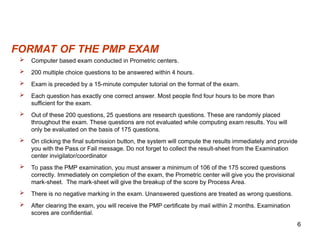
FORMAT OF THE PMP EXAM
 Computer based exam conducted in Prometric centers.
 200 multiple choice questions to be answered within 4 hours.
 Exam is preceded by a 15-minute computer tutorial on the format of the exam.
 Each question has exactly one correct answer. Most people find four hours to be more than
sufficient for the exam.
 Out of these 200 questions, 25 questions are research questions. These are randomly placed
throughout the exam. These questions are not evaluated while computing exam results. You will
only be evaluated on the basis of 175 questions.
 On clicking the final submission button, the system will compute the results immediately and provide
you with the Pass or Fail message. Do not forget to collect the result-sheet from the Examination
center invigilator/coordinator
 To pass the PMP examination, you must answer a minimum of 106 of the 175 scored questions
correctly. Immediately on completion of the exam, the Prometric center will give you the provisional
mark-sheet. The mark-sheet will give the breakup of the score by Process Area.
 There is no negative marking in the exam. Unanswered questions are treated as wrong questions.
 After clearing the exam, you will receive the PMP certificate by mail within 2 months. Examination
scores are confidential.
7
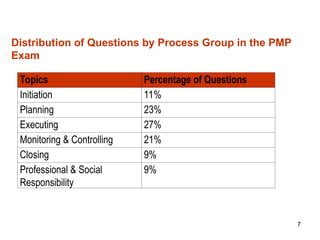
Distribution of Questions by Process Group in the PMP
Exam
Topics Percentage of Questions
Initiation 11%
Planning 23%
Executing 27%
Monitoring & Controlling 21%
Closing 9%
Professional & Social
Responsibility
9%
8
The Project Management Framework
9
Introduction
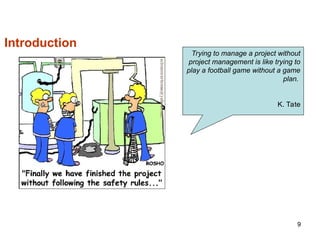
Trying to manage a project without
project management is like trying to
play a football game without a game
plan.
K. Tate
10
Advantages of Using Formal Project Management
 Better control of financial, physical, and human resources
 Improved customer relations
 Shorter development times
 Lower costs
 Higher quality and increased reliability
 Higher profit margins
 Improved productivity
 Better internal coordination
 Higher worker morale (less stress)
11
What is a Project ?
 A Project is a temporary endeavor undertaken to create a
unique, product, service, or result.
 Temporary endeavor with a beginning and an end.
 Creates unique product, service or result.
 Is Progressively Elaborated.
 Distinguishing characteristics of each unique project will be
progressively detailed as the project is better understood.
Another definition of a Project
 "A project is a finite endeavor - having specific start and
completion dates - undertaken to create a unique product or
service which brings about beneficial change or added value.
This finite characteristic of projects stands in sharp contrast to
processes, or operations, which are permanent or semi-
permanent functional work to repetitively produce the same
product or service." -- Wikipedia
12
13
What is Project Management?
 The application of knowledge, skills, tools and technique to
project activities to meet project requirements
 Project Management is accomplished through the application and
integration of the processes such as
 Initiating
 Planning
 Executing
 Monitoring and Controlling
 Closing
Why Project Management ?
14
Managing Projects
 The Project Manager is the person responsible for
accomplishing the project objectives.
 Managing a project includes:
 Identifying requirements.
 Establishing clear and achievable objectives.
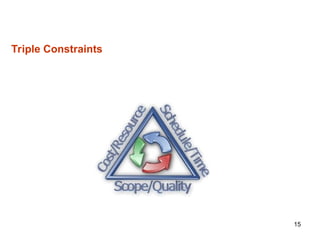
 Balancing the competing demand of quality, scope, time and cost.
 Adapting the specifications, plans, and approach to the different
concerns and expectations of the various stakeholders.
15
Triple Constraints
16
Organizational / Managerial Approach
 Management by Objective
 Management by Objectives (MBO) is a process of agreeing
upon objectives within an organization so that management
and employees agree to the objectives and understand what
they are in the organization.
17
Organizational / Managerial Approach
 The essence of MBO is participative goal setting, choosing
course of actions and decision making. An important part of
the MBO is the measurement and the comparison of the
employee’s actual performance with the standards set.
Ideally, when employees themselves have been involved with
the goal setting and the choosing the course of action to be
followed by them, they are more likely to fulfill their
responsibilities
18
Organizational / Managerial Approach
 Management by Project
19
Organizational / Managerial Approach
Project management is the discipline of planning, organizing,
and managing resources to bring about the successful
completion of specific project goals and objectives. It is
sometimes conflated with program management, however
technically a program is actually a higher level construct: a
group of related and somehow interdependent projects
20
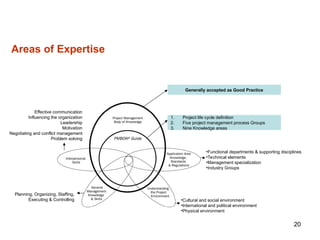
Areas of Expertise
Generally accepted as Good Practice
1. Project life cycle definition
2. Five project management process Groups
3. Nine Knowledge areas
•Functional departments & supporting disciplines
•Technical elements
•Management specialization
•Industry Groups
•Cultural and social environment
•International and political environment
•Physical environment
Planning, Organizing, Staffing,
Executing & Controlling
Effective communication
Influencing the organization
Leadership
Motivation
Negotiating and conflict management
Problem solving
21
Project Management Context
 Program Management
 Portfolio Management
 Project Management Office
22
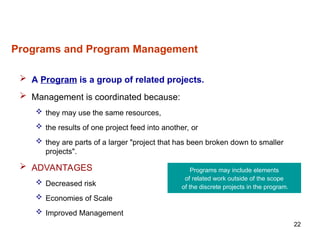
Programs and Program Management
 A Program is a group of related projects.
 Management is coordinated because:
 they may use the same resources,
 the results of one project feed into another, or
 they are parts of a larger "project that has been broken down to smaller
projects".
 ADVANTAGES
 Decreased risk
 Economies of Scale
 Improved Management
Programs may include elements
of related work outside of the scope
of the discrete projects in the program.
23
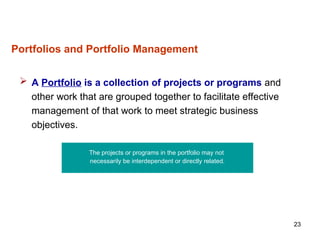
Portfolios and Portfolio Management
 A Portfolio is a collection of projects or programs and
other work that are grouped together to facilitate effective
management of that work to meet strategic business
objectives.
The projects or programs in the portfolio may not
necessarily be interdependent or directly related.
24
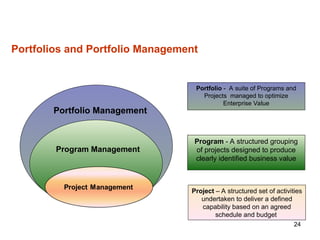
Portfolios and Portfolio Management
Portfolio Management
Program Management
Portfolio - A suite of Programs and
Projects managed to optimize
Enterprise Value
Program - A structured grouping
of projects designed to produce
clearly identified business value
Project – A structured set of activities
undertaken to deliver a defined
capability based on an agreed
schedule and budget
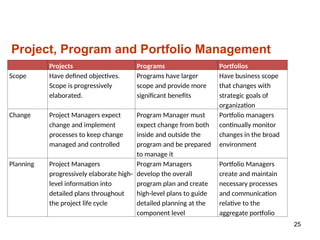
Project, Program and Portfolio Management
25
Projects Programs Portfolios
Scope Have defined objectives.
Scope is progressively
elaborated.
Programs have larger
scope and provide more
significant benefits
Have business scope
that changes with
strategic goals of
organization
Change Project Managers expect
change and implement
processes to keep change
managed and controlled
Program Manager must
expect change from both
inside and outside the
program and be prepared
to manage it
Portfolio managers
continually monitor
changes in the broad
environment
Planning Project Managers
progressively elaborate high-
level information into
detailed plans throughout
the project life cycle
Program Managers
develop the overall
program plan and create
high-level plans to guide
detailed planning at the
component level
Portfolio Managers
create and maintain
necessary processes
and communication
relative to the
aggregate portfolio
26
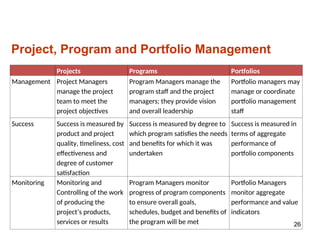
Projects Programs Portfolios
Management Project Managers
manage the project
team to meet the
project objectives
Program Managers manage the
program staff and the project
managers; they provide vision
and overall leadership
Portfolio managers may
manage or coordinate
portfolio management
staff
Success Success is measured by
product and project
quality, timeliness, cost
effectiveness and
degree of customer
satisfaction
Success is measured by degree to
which program satisfies the needs
and benefits for which it was
undertaken
Success is measured in
terms of aggregate
performance of
portfolio components
Monitoring Monitoring and
Controlling of the work
of producing the
project’s products,
services or results
Program Managers monitor
progress of program components
to ensure overall goals,
schedules, budget and benefits of
the program will be met
Portfolio Managers
monitor aggregate
performance and value
indicators
Project, Program and Portfolio Management
27
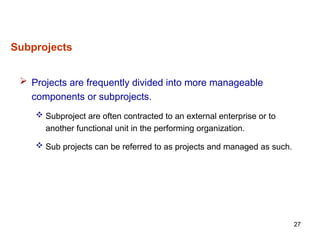
 Projects are frequently divided into more manageable
components or subprojects.
 Subproject are often contracted to an external enterprise or to
another functional unit in the performing organization.
 Sub projects can be referred to as projects and managed as such.
Subprojects
28
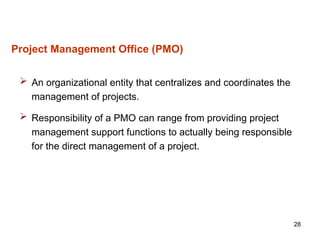
Project Management Office (PMO)
 An organizational entity that centralizes and coordinates the
management of projects.
 Responsibility of a PMO can range from providing project
management support functions to actually being responsible
for the direct management of a project.
Functions of a PMO
 A PMO performs a number of functions that may include but are not
limited to:
 Managing shared resources across projects
 Project Management Process/Methodology: Develop and implement a
consistent and standardized process.
 Coaching, mentoring, training and oversight
 Developing and managing project policies, procedures, templates and other
shared documentation (Organizational Process Assets)
 Monitoring compliance with PM standards, policies, procedures and templates
29
30
 Home for project managers: In some cases, maintain a
centralized office from which project managers are loaned out to
work on projects.
 Project management software tools: Select and maintain project
management tools for use by employees. Also manage the Project
Management Knowledge base.
 Portfolio management: Establish a staff of program managers who
can manage multiple projects that are related, such as infrastructure
technologies, desktop applications and so on, and allocate
resources accordingly.
Project Management Office (PMO)
31
Authority of PMO
 Manage the interdependencies between projects
 Help provide resources
 Terminate projects
 Help gather lessons learned and make them available to other projects
 Provide templates
 Provide guidance
 Provide enterprise project management software
 Be more heavily involved during project initiating than later in the
project
32
Differences between role of a Project Managers
and PMO
 Project manager focuses on the specified project objectives ,
while the PMO manages major program scope changes which
may be seen as potential opportunities to better achieve
business objectives
 The project manager controls the assigned project resources
to best meet project objectives while the PMO optimizes the
use of shared organizational resources across all the projects
33
Making PMO Work
 The role of the PMO must be clearly defined.
 Preferably all those who are in the PMO must be qualified on
Project Management e.g. PMP certified.
 The commitment of executive (top) management is required.
 The PMO will not improve your project performance without
the use of proper project management processes and
technique. So professional project management must be
encouraged.
34
Project Life Cycle and Organization
35
Session Objective
2.1 The Project Life Cycle - Overview
2.2 Projects vs. Operational Work
2.3 Project Stakeholders
2.3 Organizational Influences
36
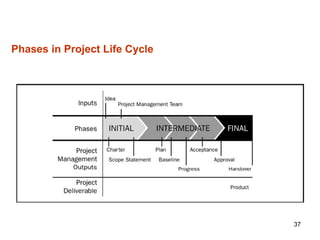
2.1 The Project Life Cycle
 All projects are divided into phases, and all projects, large or
small, have a similar life cycle structure.
 At a minimum, project will have a beginning or initiation
phase, an intermediate phase or phases, and an ending
phase.
 All the collective phases the project progresses through in
concert are called the project life cycle.
Construction: Feasibility-> Planning -> Design -> Production -> Turnover -> Startup
IT Project: Requirement -> Design -> Program -> Test -> Implement
37
Phases in Project Life Cycle
38
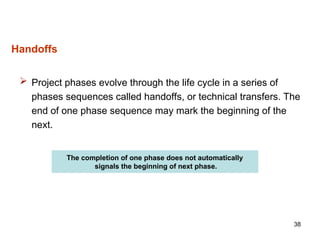
Handoffs
 Project phases evolve through the life cycle in a series of
phases sequences called handoffs, or technical transfers. The
end of one phase sequence may mark the beginning of the
next.
The completion of one phase does not automatically
signals the beginning of next phase.
39
Phase Completion
 You will recognize phase completion because each phase
has a specific deliverable, or multiple deliverables, that
marks the end of the phase.
A deliverable is an output that must be produced,
reviewed, and approved to bring the phase or project to completion.
Deliverables are tangible and can be measured and easily proved.
A Guide to the PMBOK states that phase ending reviews are also known
by a new other names: Phase Exits, Phase Gates, or Kill Points.
40
Phase-to-Phase Relationships
There are three basic types of phase – to – phase relationships :
A Sequential relationship : where a phase can only start once the previous
phase is complete
An Overlapping relationship : where the phase starts prior to completion
of the previous one (Fastracking ). Overlapping phase may increase risk
and can result in rework .
An Iterative relationship : where only one phase is planned at any given
time and the planning for the next is carried out as work progresses on
the current phase and deliverables
41
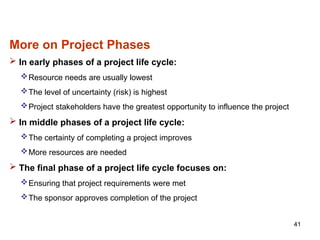
More on Project Phases
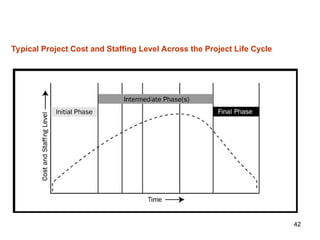
 In early phases of a project life cycle:
Resource needs are usually lowest
The level of uncertainty (risk) is highest
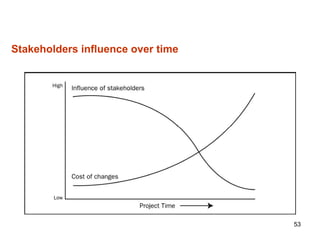
Project stakeholders have the greatest opportunity to influence the project
 In middle phases of a project life cycle:
The certainty of completing a project improves
More resources are needed
 The final phase of a project life cycle focuses on:
Ensuring that project requirements were met
The sponsor approves completion of the project
42
Typical Project Cost and Staffing Level Across the Project Life Cycle
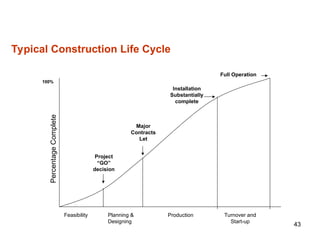
43
Typical Construction Life Cycle
Percentage
Complete
Feasibility Planning &
Designing
Production Turnover and
Start-up
Project
“GO”
decision
Major
Contracts
Let
Installation
Substantially
complete
Full Operation
100%
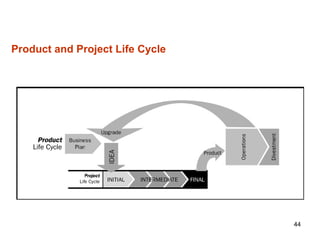
44
Product and Project Life Cycle
45
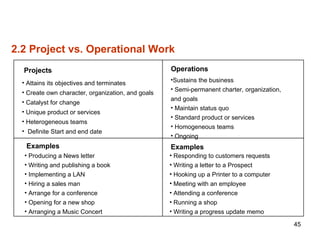
2.2 Project vs. Operational Work
• Attains its objectives and terminates
• Create own character, organization, and goals
• Catalyst for change
• Unique product or services
• Heterogeneous teams
• Definite Start and end date
Projects
• Producing a News letter
• Writing and publishing a book
• Implementing a LAN
• Hiring a sales man
• Arrange for a conference
• Opening for a new shop
• Arranging a Music Concert
Examples
•Sustains the business
• Semi-permanent charter, organization,
and goals
• Maintain status quo
• Standard product or services
• Homogeneous teams
• Ongoing
Operations
• Responding to customers requests
• Writing a letter to a Prospect
• Hooking up a Printer to a computer
• Meeting with an employee
• Attending a conference
• Running a shop
• Writing a progress update memo
Examples
46
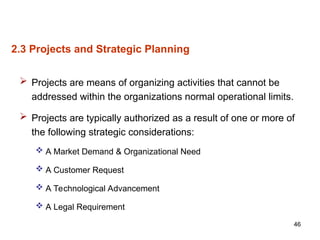
2.3 Projects and Strategic Planning
 Projects are means of organizing activities that cannot be
addressed within the organizations normal operational limits.
 Projects are typically authorized as a result of one or more of
the following strategic considerations:
 A Market Demand & Organizational Need
 A Customer Request
 A Technological Advancement
 A Legal Requirement
47
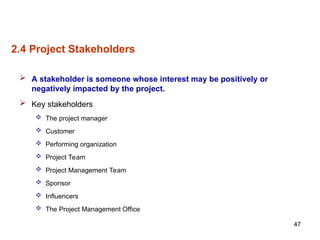
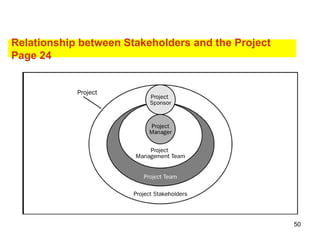
2.4 Project Stakeholders
 A stakeholder is someone whose interest may be positively or
negatively impacted by the project.
 Key stakeholders
 The project manager
 Customer
 Performing organization
 Project Team
 Project Management Team
 Sponsor
 Influencers
 The Project Management Office
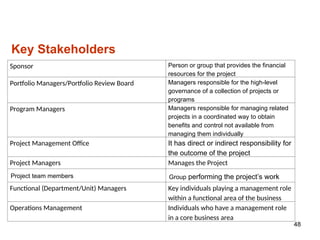
Key Stakeholders
Sponsor Person or group that provides the financial
resources for the project
Portfolio Managers/Portfolio Review Board Managers responsible for the high-level
governance of a collection of projects or
programs
Program Managers Managers responsible for managing related
projects in a coordinated way to obtain
benefits and control not available from
managing them individually
Project Management Office It has direct or indirect responsibility for
the outcome of the project
Project Managers Manages the Project
Project team members Group performing the project’s work
Functional (Department/Unit) Managers Key individuals playing a management role
within a functional area of the business
Operations Management Individuals who have a management role
in a core business area
48
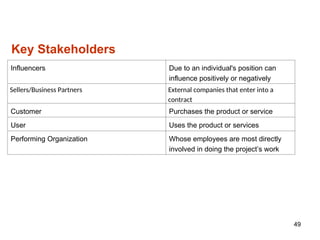
Key Stakeholders
Influencers Due to an individual's position can
influence positively or negatively
Sellers/Business Partners External companies that enter into a
contract
Customer Purchases the product or service
User Uses the product or services
Performing Organization Whose employees are most directly
involved in doing the project’s work
49
50
Relationship between Stakeholders and the Project
Page 24
51
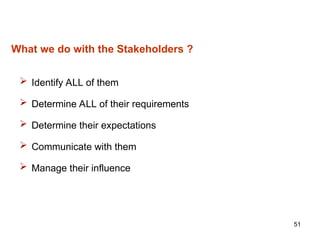
What we do with the Stakeholders ?
 Identify ALL of them
 Determine ALL of their requirements
 Determine their expectations
 Communicate with them
 Manage their influence
52
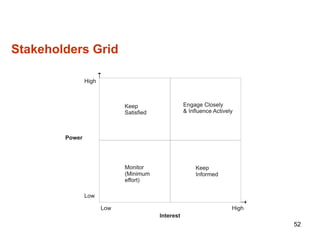
Stakeholders Grid
53
Stakeholders influence over time
54
Organizational Influence
 Projects are typically part of an organization that is larger than
the project.
 The maturity of the organization with respect to its project
management system, culture, style, organizational structure
and project management office can also influence the project.
 Organizational Systems
 Organizational Cultures and Styles
 Organizational Structure
55
Organizational System
 Project-based organizations are those whose operations
consist primarily of projects. These organizational falls into
two categories:
 Organizations that derive their revenue primarily from performing
projects for others under contract - architectural firms, engineering
firms, consultants, construction contractors, and government
contractors.
 Organizations that have adopted management by projects.
56
Organizational Cultures and Styles
 These cultures are reflected in numerous factors:
 Shared values, norms, beliefs, and expectations
 Policies and procedures
 View of authority relationships
 Work ethics and work hours
57
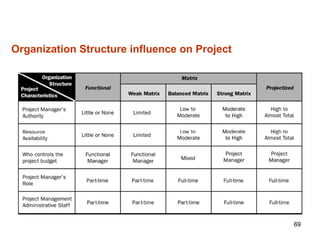
Organizational Structure
 The structure of the performing organization often constraints
the availability of resources in a spectrum from Functional to
Projectized, with a variety of matrix structure in between.
58
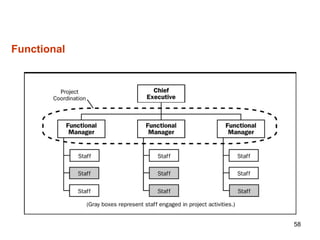
Functional
59
Functional Organization - Key Points
 The organization is grouped by areas of specialization within
different functional areas.
 Projects generally occur within a single department.
 Information required from other department will be routed
through departmental heads.
 Team members complete project work in addition to normal
department work.
60
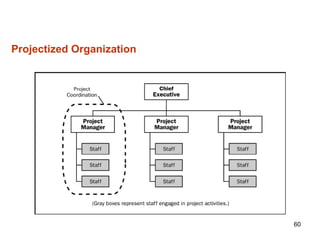
Projectized Organization
61
Projectized Organization – Key Points
 The entire company is organized by projects.
 The project manager has control of projects.
 Personnel are assigned and report to a project manager.
 Team members complete only project work and when its over
they don't have HOME.
 Communication generally occurs only within the project.
62
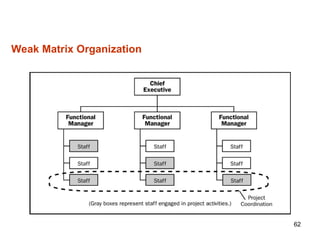
Weak Matrix Organization
63
Weak Matrix - Key Points
 Two Bosses
 Team members reports to Project Manager and Functional Manager
 Team members do project work in addition to normal departmental
work
 Power rests with functional manager
 Project Manager plays a role of:
 Project Expediter: Cannot take decision. Staff assistant and
Communication coordinator.
 Project Coordinator: Similar to Project Expeditor except has some power
to take decision.
64
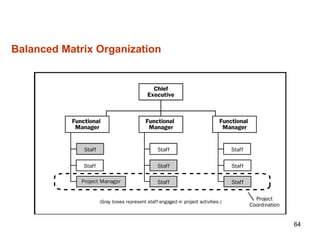
Balanced Matrix Organization
65
Balanced Matrix Organization - Key Points
 Two Bosses
 Team members reports to Project Manager and Functional
Manager
 Team members do project work in addition to normal
departmental work
 Power is shared between the functional and project manager
66
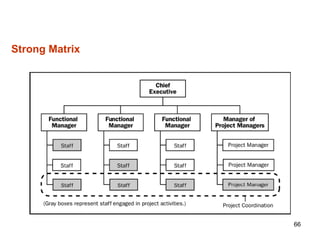
Strong Matrix
67
Strong Matrix – Key Points
 Power rests with the Project Manager
68
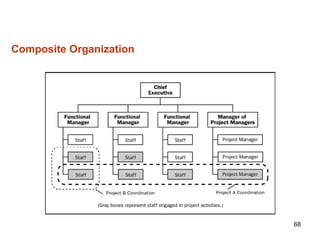
Composite Organization
69
Organization Structure influence on Project
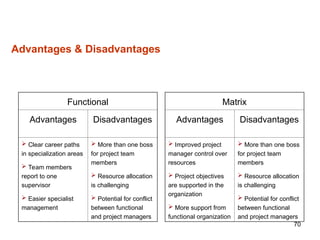
70
Advantages & Disadvantages
Functional
Advantages Disadvantages
 Clear career paths
in specialization areas
 Team members
report to one
supervisor
 Easier specialist
management
 More than one boss
for project team
members
 Resource allocation
is challenging
 Potential for conflict
between functional
and project managers
Matrix
Advantages Disadvantages
 Improved project
manager control over
resources
 Project objectives
are supported in the
organization
 More support from
functional organization
 More than one boss
for project team
members
 Resource allocation
is challenging
 Potential for conflict
between functional
and project managers
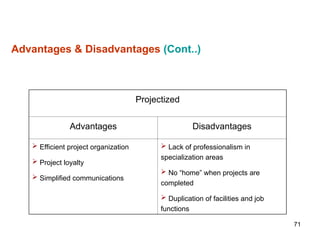
71
Advantages & Disadvantages (Cont..)
Projectized
Advantages Disadvantages
 Efficient project organization
 Project loyalty
 Simplified communications
 Lack of professionalism in
specialization areas
 No “home” when projects are
completed
 Duplication of facilities and job
functions
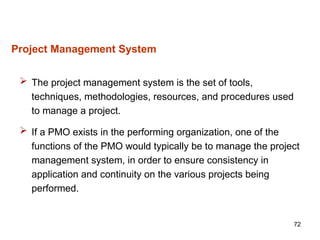
72
Project Management System
 The project management system is the set of tools,
techniques, methodologies, resources, and procedures used
to manage a project.
 If a PMO exists in the performing organization, one of the
functions of the PMO would typically be to manage the project
management system, in order to ensure consistency in
application and continuity on the various projects being
performed.
73
Project Management Processes for a Project
Unit 1
74
Session Objective
3.1 Project Management Processes
3.2 Project Management Process Groups
3.3 Process Interactions
3.4 Project Management Process Mapping
75
Processes for a Project
 Recall the definition of Project Management !
 Project Management is accomplished through processes.
 It uses Project Management Knowledge, Skills, Tools & Technique
 It receives Inputs and generates Outputs
 Select appropriate processes within the PM process group that are
required to meet the project objectives
 Use a defined approach to adapt the product specifications and plans to
meet project and product requirements.
 Comply with Stakeholders needs, wants and expectations.
 Balance the competing demand.
76
What is a process ?
 A Process is a set of interrelated actions and activities that
are performed to achieve a pre-specified set of products,
results, or services.
77
Tailoring
 Project Managers and their teams are advised to carefully
consider addressing each process and its constituent inputs
and outputs.
The project manager and project team are responsible for determining which
processes within each process group are appropriate for the project you're working on.
This is called Tailoring.
78
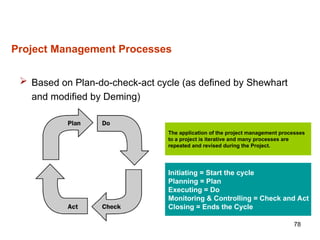
Project Management Processes
 Based on Plan-do-check-act cycle (as defined by Shewhart
and modified by Deming)
The application of the project management processes
to a project is iterative and many processes are
repeated and revised during the Project.
Initiating = Start the cycle
Planning = Plan
Executing = Do
Monitoring & Controlling = Check and Act
Closing = Ends the Cycle
79
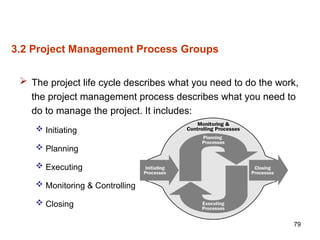
3.2 Project Management Process Groups
 The project life cycle describes what you need to do the work,
the project management process describes what you need to
do to manage the project. It includes:
 Initiating
 Planning
 Executing
 Monitoring & Controlling
 Closing
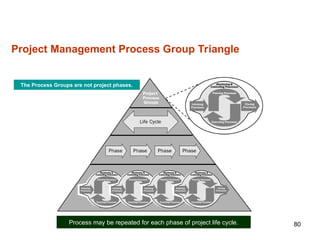
80
Project Management Process Group Triangle
The Process Groups are not project phases.
Process may be repeated for each phase of project life cycle.
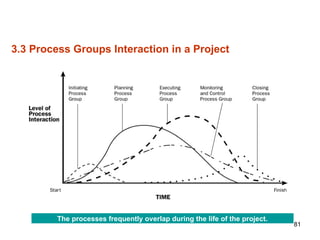
81
3.3 Process Groups Interaction in a Project
The processes frequently overlap during the life of the project.

31908778-PMP-Training-my-PPT-Document.ppt

  • 1.
    1 Welcome to PMPExam Preparation (Based on Guide to PMBoK 4th Edition) Introduction
  • 2.
    2 General Information  Parking Refreshment  No-Smoking  Copyrighted Slides  Key Contact Details  Support: Mr. Krish 050-2459498 Email. krish@chicagomti.com  Suggestions & Complaints: info@chicagomti.com
  • 3.
    3 Ground rules forthis training program  On Time all the Time  Tolerance Limit - 10 Minutes / 80% of the class strength  Interactive Class  Everyone has to participate  No Criticism  Bring Highlighter  Keep an open mind & do not always link the concepts with your job
  • 4.
    4 Project Management Institute BuildingProfessional in Project Management Project Management Institute  Established in 1969 and headquartered outside Philadelphia, Pennsylvania USA ,the Project Management Institute (PMI) is the world’s leading non-for-project management professional association with over 260,000 members in more than 171 countries and 180,000 PMP’s worldwide. ®
  • 5.
    5 Types of Questions Situational Questions  Questions with two or more right answers  Questions with extraneous information  Out of the blue questions  Questions where understanding is important  Questions with new approach to known topic.
  • 6.
    6 FORMAT OF THEPMP EXAM  Computer based exam conducted in Prometric centers.  200 multiple choice questions to be answered within 4 hours.  Exam is preceded by a 15-minute computer tutorial on the format of the exam.  Each question has exactly one correct answer. Most people find four hours to be more than sufficient for the exam.  Out of these 200 questions, 25 questions are research questions. These are randomly placed throughout the exam. These questions are not evaluated while computing exam results. You will only be evaluated on the basis of 175 questions.  On clicking the final submission button, the system will compute the results immediately and provide you with the Pass or Fail message. Do not forget to collect the result-sheet from the Examination center invigilator/coordinator  To pass the PMP examination, you must answer a minimum of 106 of the 175 scored questions correctly. Immediately on completion of the exam, the Prometric center will give you the provisional mark-sheet. The mark-sheet will give the breakup of the score by Process Area.  There is no negative marking in the exam. Unanswered questions are treated as wrong questions.  After clearing the exam, you will receive the PMP certificate by mail within 2 months. Examination scores are confidential.
  • 7.
    7 Distribution of Questionsby Process Group in the PMP Exam Topics Percentage of Questions Initiation 11% Planning 23% Executing 27% Monitoring & Controlling 21% Closing 9% Professional & Social Responsibility 9%
  • 8.
  • 9.
    9 Introduction Trying to managea project without project management is like trying to play a football game without a game plan. K. Tate
  • 10.
    10 Advantages of UsingFormal Project Management  Better control of financial, physical, and human resources  Improved customer relations  Shorter development times  Lower costs  Higher quality and increased reliability  Higher profit margins  Improved productivity  Better internal coordination  Higher worker morale (less stress)
  • 11.
    11 What is aProject ?  A Project is a temporary endeavor undertaken to create a unique, product, service, or result.  Temporary endeavor with a beginning and an end.  Creates unique product, service or result.  Is Progressively Elaborated.  Distinguishing characteristics of each unique project will be progressively detailed as the project is better understood.
  • 12.
    Another definition ofa Project  "A project is a finite endeavor - having specific start and completion dates - undertaken to create a unique product or service which brings about beneficial change or added value. This finite characteristic of projects stands in sharp contrast to processes, or operations, which are permanent or semi- permanent functional work to repetitively produce the same product or service." -- Wikipedia 12
  • 13.
    13 What is ProjectManagement?  The application of knowledge, skills, tools and technique to project activities to meet project requirements  Project Management is accomplished through the application and integration of the processes such as  Initiating  Planning  Executing  Monitoring and Controlling  Closing Why Project Management ?
  • 14.
    14 Managing Projects  TheProject Manager is the person responsible for accomplishing the project objectives.  Managing a project includes:  Identifying requirements.  Establishing clear and achievable objectives.  Balancing the competing demand of quality, scope, time and cost.  Adapting the specifications, plans, and approach to the different concerns and expectations of the various stakeholders.
  • 15.
  • 16.
    16 Organizational / ManagerialApproach  Management by Objective  Management by Objectives (MBO) is a process of agreeing upon objectives within an organization so that management and employees agree to the objectives and understand what they are in the organization.
  • 17.
    17 Organizational / ManagerialApproach  The essence of MBO is participative goal setting, choosing course of actions and decision making. An important part of the MBO is the measurement and the comparison of the employee’s actual performance with the standards set. Ideally, when employees themselves have been involved with the goal setting and the choosing the course of action to be followed by them, they are more likely to fulfill their responsibilities
  • 18.
    18 Organizational / ManagerialApproach  Management by Project
  • 19.
    19 Organizational / ManagerialApproach Project management is the discipline of planning, organizing, and managing resources to bring about the successful completion of specific project goals and objectives. It is sometimes conflated with program management, however technically a program is actually a higher level construct: a group of related and somehow interdependent projects
  • 20.
    20 Areas of Expertise Generallyaccepted as Good Practice 1. Project life cycle definition 2. Five project management process Groups 3. Nine Knowledge areas •Functional departments & supporting disciplines •Technical elements •Management specialization •Industry Groups •Cultural and social environment •International and political environment •Physical environment Planning, Organizing, Staffing, Executing & Controlling Effective communication Influencing the organization Leadership Motivation Negotiating and conflict management Problem solving
  • 21.
    21 Project Management Context Program Management  Portfolio Management  Project Management Office
  • 22.
    22 Programs and ProgramManagement  A Program is a group of related projects.  Management is coordinated because:  they may use the same resources,  the results of one project feed into another, or  they are parts of a larger "project that has been broken down to smaller projects".  ADVANTAGES  Decreased risk  Economies of Scale  Improved Management Programs may include elements of related work outside of the scope of the discrete projects in the program.
  • 23.
    23 Portfolios and PortfolioManagement  A Portfolio is a collection of projects or programs and other work that are grouped together to facilitate effective management of that work to meet strategic business objectives. The projects or programs in the portfolio may not necessarily be interdependent or directly related.
  • 24.
    24 Portfolios and PortfolioManagement Portfolio Management Program Management Portfolio - A suite of Programs and Projects managed to optimize Enterprise Value Program - A structured grouping of projects designed to produce clearly identified business value Project – A structured set of activities undertaken to deliver a defined capability based on an agreed schedule and budget
  • 25.
    Project, Program andPortfolio Management 25 Projects Programs Portfolios Scope Have defined objectives. Scope is progressively elaborated. Programs have larger scope and provide more significant benefits Have business scope that changes with strategic goals of organization Change Project Managers expect change and implement processes to keep change managed and controlled Program Manager must expect change from both inside and outside the program and be prepared to manage it Portfolio managers continually monitor changes in the broad environment Planning Project Managers progressively elaborate high- level information into detailed plans throughout the project life cycle Program Managers develop the overall program plan and create high-level plans to guide detailed planning at the component level Portfolio Managers create and maintain necessary processes and communication relative to the aggregate portfolio
  • 26.
    26 Projects Programs Portfolios ManagementProject Managers manage the project team to meet the project objectives Program Managers manage the program staff and the project managers; they provide vision and overall leadership Portfolio managers may manage or coordinate portfolio management staff Success Success is measured by product and project quality, timeliness, cost effectiveness and degree of customer satisfaction Success is measured by degree to which program satisfies the needs and benefits for which it was undertaken Success is measured in terms of aggregate performance of portfolio components Monitoring Monitoring and Controlling of the work of producing the project’s products, services or results Program Managers monitor progress of program components to ensure overall goals, schedules, budget and benefits of the program will be met Portfolio Managers monitor aggregate performance and value indicators Project, Program and Portfolio Management
  • 27.
    27  Projects arefrequently divided into more manageable components or subprojects.  Subproject are often contracted to an external enterprise or to another functional unit in the performing organization.  Sub projects can be referred to as projects and managed as such. Subprojects
  • 28.
    28 Project Management Office(PMO)  An organizational entity that centralizes and coordinates the management of projects.  Responsibility of a PMO can range from providing project management support functions to actually being responsible for the direct management of a project.
  • 29.
    Functions of aPMO  A PMO performs a number of functions that may include but are not limited to:  Managing shared resources across projects  Project Management Process/Methodology: Develop and implement a consistent and standardized process.  Coaching, mentoring, training and oversight  Developing and managing project policies, procedures, templates and other shared documentation (Organizational Process Assets)  Monitoring compliance with PM standards, policies, procedures and templates 29
  • 30.
    30  Home forproject managers: In some cases, maintain a centralized office from which project managers are loaned out to work on projects.  Project management software tools: Select and maintain project management tools for use by employees. Also manage the Project Management Knowledge base.  Portfolio management: Establish a staff of program managers who can manage multiple projects that are related, such as infrastructure technologies, desktop applications and so on, and allocate resources accordingly. Project Management Office (PMO)
  • 31.
    31 Authority of PMO Manage the interdependencies between projects  Help provide resources  Terminate projects  Help gather lessons learned and make them available to other projects  Provide templates  Provide guidance  Provide enterprise project management software  Be more heavily involved during project initiating than later in the project
  • 32.
    32 Differences between roleof a Project Managers and PMO  Project manager focuses on the specified project objectives , while the PMO manages major program scope changes which may be seen as potential opportunities to better achieve business objectives  The project manager controls the assigned project resources to best meet project objectives while the PMO optimizes the use of shared organizational resources across all the projects
  • 33.
    33 Making PMO Work The role of the PMO must be clearly defined.  Preferably all those who are in the PMO must be qualified on Project Management e.g. PMP certified.  The commitment of executive (top) management is required.  The PMO will not improve your project performance without the use of proper project management processes and technique. So professional project management must be encouraged.
  • 34.
    34 Project Life Cycleand Organization
  • 35.
    35 Session Objective 2.1 TheProject Life Cycle - Overview 2.2 Projects vs. Operational Work 2.3 Project Stakeholders 2.3 Organizational Influences
  • 36.
    36 2.1 The ProjectLife Cycle  All projects are divided into phases, and all projects, large or small, have a similar life cycle structure.  At a minimum, project will have a beginning or initiation phase, an intermediate phase or phases, and an ending phase.  All the collective phases the project progresses through in concert are called the project life cycle. Construction: Feasibility-> Planning -> Design -> Production -> Turnover -> Startup IT Project: Requirement -> Design -> Program -> Test -> Implement
  • 37.
  • 38.
    38 Handoffs  Project phasesevolve through the life cycle in a series of phases sequences called handoffs, or technical transfers. The end of one phase sequence may mark the beginning of the next. The completion of one phase does not automatically signals the beginning of next phase.
  • 39.
    39 Phase Completion  Youwill recognize phase completion because each phase has a specific deliverable, or multiple deliverables, that marks the end of the phase. A deliverable is an output that must be produced, reviewed, and approved to bring the phase or project to completion. Deliverables are tangible and can be measured and easily proved. A Guide to the PMBOK states that phase ending reviews are also known by a new other names: Phase Exits, Phase Gates, or Kill Points.
  • 40.
    40 Phase-to-Phase Relationships There arethree basic types of phase – to – phase relationships : A Sequential relationship : where a phase can only start once the previous phase is complete An Overlapping relationship : where the phase starts prior to completion of the previous one (Fastracking ). Overlapping phase may increase risk and can result in rework . An Iterative relationship : where only one phase is planned at any given time and the planning for the next is carried out as work progresses on the current phase and deliverables
  • 41.
    41 More on ProjectPhases  In early phases of a project life cycle: Resource needs are usually lowest The level of uncertainty (risk) is highest Project stakeholders have the greatest opportunity to influence the project  In middle phases of a project life cycle: The certainty of completing a project improves More resources are needed  The final phase of a project life cycle focuses on: Ensuring that project requirements were met The sponsor approves completion of the project
  • 42.
    42 Typical Project Costand Staffing Level Across the Project Life Cycle
  • 43.
    43 Typical Construction LifeCycle Percentage Complete Feasibility Planning & Designing Production Turnover and Start-up Project “GO” decision Major Contracts Let Installation Substantially complete Full Operation 100%
  • 44.
  • 45.
    45 2.2 Project vs.Operational Work • Attains its objectives and terminates • Create own character, organization, and goals • Catalyst for change • Unique product or services • Heterogeneous teams • Definite Start and end date Projects • Producing a News letter • Writing and publishing a book • Implementing a LAN • Hiring a sales man • Arrange for a conference • Opening for a new shop • Arranging a Music Concert Examples •Sustains the business • Semi-permanent charter, organization, and goals • Maintain status quo • Standard product or services • Homogeneous teams • Ongoing Operations • Responding to customers requests • Writing a letter to a Prospect • Hooking up a Printer to a computer • Meeting with an employee • Attending a conference • Running a shop • Writing a progress update memo Examples
  • 46.
    46 2.3 Projects andStrategic Planning  Projects are means of organizing activities that cannot be addressed within the organizations normal operational limits.  Projects are typically authorized as a result of one or more of the following strategic considerations:  A Market Demand & Organizational Need  A Customer Request  A Technological Advancement  A Legal Requirement
  • 47.
    47 2.4 Project Stakeholders A stakeholder is someone whose interest may be positively or negatively impacted by the project.  Key stakeholders  The project manager  Customer  Performing organization  Project Team  Project Management Team  Sponsor  Influencers  The Project Management Office
  • 48.
    Key Stakeholders Sponsor Personor group that provides the financial resources for the project Portfolio Managers/Portfolio Review Board Managers responsible for the high-level governance of a collection of projects or programs Program Managers Managers responsible for managing related projects in a coordinated way to obtain benefits and control not available from managing them individually Project Management Office It has direct or indirect responsibility for the outcome of the project Project Managers Manages the Project Project team members Group performing the project’s work Functional (Department/Unit) Managers Key individuals playing a management role within a functional area of the business Operations Management Individuals who have a management role in a core business area 48
  • 49.
    Key Stakeholders Influencers Dueto an individual's position can influence positively or negatively Sellers/Business Partners External companies that enter into a contract Customer Purchases the product or service User Uses the product or services Performing Organization Whose employees are most directly involved in doing the project’s work 49
  • 50.
    50 Relationship between Stakeholdersand the Project Page 24
  • 51.
    51 What we dowith the Stakeholders ?  Identify ALL of them  Determine ALL of their requirements  Determine their expectations  Communicate with them  Manage their influence
  • 52.
  • 53.
  • 54.
    54 Organizational Influence  Projectsare typically part of an organization that is larger than the project.  The maturity of the organization with respect to its project management system, culture, style, organizational structure and project management office can also influence the project.  Organizational Systems  Organizational Cultures and Styles  Organizational Structure
  • 55.
    55 Organizational System  Project-basedorganizations are those whose operations consist primarily of projects. These organizational falls into two categories:  Organizations that derive their revenue primarily from performing projects for others under contract - architectural firms, engineering firms, consultants, construction contractors, and government contractors.  Organizations that have adopted management by projects.
  • 56.
    56 Organizational Cultures andStyles  These cultures are reflected in numerous factors:  Shared values, norms, beliefs, and expectations  Policies and procedures  View of authority relationships  Work ethics and work hours
  • 57.
    57 Organizational Structure  Thestructure of the performing organization often constraints the availability of resources in a spectrum from Functional to Projectized, with a variety of matrix structure in between.
  • 58.
  • 59.
    59 Functional Organization -Key Points  The organization is grouped by areas of specialization within different functional areas.  Projects generally occur within a single department.  Information required from other department will be routed through departmental heads.  Team members complete project work in addition to normal department work.
  • 60.
  • 61.
    61 Projectized Organization –Key Points  The entire company is organized by projects.  The project manager has control of projects.  Personnel are assigned and report to a project manager.  Team members complete only project work and when its over they don't have HOME.  Communication generally occurs only within the project.
  • 62.
  • 63.
    63 Weak Matrix -Key Points  Two Bosses  Team members reports to Project Manager and Functional Manager  Team members do project work in addition to normal departmental work  Power rests with functional manager  Project Manager plays a role of:  Project Expediter: Cannot take decision. Staff assistant and Communication coordinator.  Project Coordinator: Similar to Project Expeditor except has some power to take decision.
  • 64.
  • 65.
    65 Balanced Matrix Organization- Key Points  Two Bosses  Team members reports to Project Manager and Functional Manager  Team members do project work in addition to normal departmental work  Power is shared between the functional and project manager
  • 66.
  • 67.
    67 Strong Matrix –Key Points  Power rests with the Project Manager
  • 68.
  • 69.
  • 70.
    70 Advantages & Disadvantages Functional AdvantagesDisadvantages  Clear career paths in specialization areas  Team members report to one supervisor  Easier specialist management  More than one boss for project team members  Resource allocation is challenging  Potential for conflict between functional and project managers Matrix Advantages Disadvantages  Improved project manager control over resources  Project objectives are supported in the organization  More support from functional organization  More than one boss for project team members  Resource allocation is challenging  Potential for conflict between functional and project managers
  • 71.
    71 Advantages & Disadvantages(Cont..) Projectized Advantages Disadvantages  Efficient project organization  Project loyalty  Simplified communications  Lack of professionalism in specialization areas  No “home” when projects are completed  Duplication of facilities and job functions
  • 72.
    72 Project Management System The project management system is the set of tools, techniques, methodologies, resources, and procedures used to manage a project.  If a PMO exists in the performing organization, one of the functions of the PMO would typically be to manage the project management system, in order to ensure consistency in application and continuity on the various projects being performed.
  • 73.
    73 Project Management Processesfor a Project Unit 1
  • 74.
    74 Session Objective 3.1 ProjectManagement Processes 3.2 Project Management Process Groups 3.3 Process Interactions 3.4 Project Management Process Mapping
  • 75.
    75 Processes for aProject  Recall the definition of Project Management !  Project Management is accomplished through processes.  It uses Project Management Knowledge, Skills, Tools & Technique  It receives Inputs and generates Outputs  Select appropriate processes within the PM process group that are required to meet the project objectives  Use a defined approach to adapt the product specifications and plans to meet project and product requirements.  Comply with Stakeholders needs, wants and expectations.  Balance the competing demand.
  • 76.
    76 What is aprocess ?  A Process is a set of interrelated actions and activities that are performed to achieve a pre-specified set of products, results, or services.
  • 77.
    77 Tailoring  Project Managersand their teams are advised to carefully consider addressing each process and its constituent inputs and outputs. The project manager and project team are responsible for determining which processes within each process group are appropriate for the project you're working on. This is called Tailoring.
  • 78.
    78 Project Management Processes Based on Plan-do-check-act cycle (as defined by Shewhart and modified by Deming) The application of the project management processes to a project is iterative and many processes are repeated and revised during the Project. Initiating = Start the cycle Planning = Plan Executing = Do Monitoring & Controlling = Check and Act Closing = Ends the Cycle
  • 79.
    79 3.2 Project ManagementProcess Groups  The project life cycle describes what you need to do the work, the project management process describes what you need to do to manage the project. It includes:  Initiating  Planning  Executing  Monitoring & Controlling  Closing
  • 80.
    80 Project Management ProcessGroup Triangle The Process Groups are not project phases. Process may be repeated for each phase of project life cycle.
  • 81.
    81 3.3 Process GroupsInteraction in a Project The processes frequently overlap during the life of the project.

Editor's Notes

  • #10 تحسين السيطرة على الموارد المالية والمادية والبشرية تحسين العلاقات مع العملاء أوقات تطوير أقصر تكاليف أقل جودة أعلى وزيادة الموثوقية هوامش ربح أعلى وتحسين الإنتاجية تنسيق داخلي أفضل ارتفاع معنويات العمال (ضغط أقل)