BY
DR.MAIMOON SULTHAN
The project execution plan (PEP) is the
governing document that establishes the means
to execute, monitor, and control projects.
The plan serves as the main communication
vehicle to ensure that everyone is aware and
knowledgeable of project objectives and how
they will be accomplished.
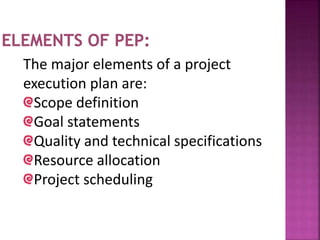
The major elements of a project
execution plan are:
Scope definition
Goal statements
Quality and technical specifications
Resource allocation
Project scheduling
Scope Definition
Scope definition entails defining what the project intends
to achieve in specific terms.
For instance, if the aim of the project is to “upgrade the
information technology infrastructure in the organization"
the scope definition in the project execution plan example
translates this broad and vague objective into a specific
scope based on output.
As “to provide a new computer on every desk, with all
appropriate software installed and ready to operate, and
each computer linked through a network."
Statement of Goals
The statement of goals lists out specific project
requirements such as key project deliverables,
milestones, and the project life cycle.
The goal statement also explains:
Why the project is carried out, the purpose
served by the project, and the expected benefits
from the project
The unique challenges that the project
overcomes.
The risks associated with the project and how the
project plan will overcome such risks.
Quality and Technical
Specifications
one important element that needs inclusion
in the project execution plan is quality or
technical specifications of the work processes
and output.
The achievement of such stipulated
standards determine the successful execution
of the project.
The parameters of quality and
technical specifications include the
use of:
Clear and precise definitions for
concepts and terms.
Measurable descriptions. For instance,
“latest computers" are not measurable,
whereas “computers with 2GB of
memory" is a measurable quality
standard.
Attainable standards. For instance,
“upgrade all the computers in the office to
Dual Core Processors and 2 GB memory
within two weeks" is an attainable goal, but
“upgrade all the computers in the office to
Dual Core and 2 GB memory overnight to
ensure non-interrupted service" may be
impossible in large companies
Time bound definitions. For instance,
“upgrade the computers soon" is vague,
whereas “upgrade the computers within
two weeks" is a precise and time bound
specification.
The level of quality desired in the project
usually depends on the project budget,
which is usually determined by the
customer.
Allocation of Resources
The elements of scope, goals, and
quality define in clear terms what the
project hopes to achieve.
The next element of a project
execution plan is the allocation of
resources to achieve the stated goals
and quality standards.
Resources include
Staff with knowledge or skill sets
Money to buy equipment and
Time considerations.
Project Scheduling
Scheduling the project is a very important
element in a project execution plan.
The best approach is to divide the project
into small units or chunks and set time bound
milestones of achievements, mutually
acceptable to all stakeholders.
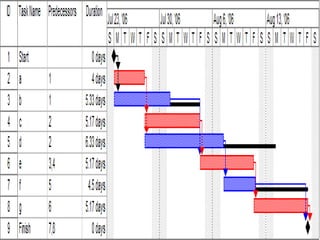
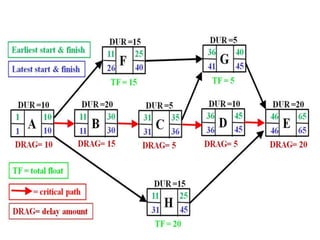
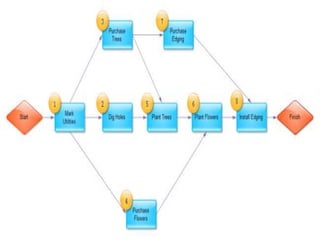
Examples: Gantt Charts that list what will
happen and when , Critical Path Method
(CPM) and PERT charts.
One important consideration with
project scheduling is the need to be
ready for exceptions.
In practice, schedules rarely stick to
their planned courses and go awry owing
to many reasons such as late supply of
input data or raw materials, disruptions
in resources, faulty planning,
underestimating the time requires, and
forced changes to the schedule owing to
external factors.
The project manager needs to make
floor level adjustments to return the
schedule to track.
Very often, meeting agreed
delivery schedules require project
acceleration by working tasks in
parallel modes.
This depends on the state on
dependencies, or the extent to which
the start of one function depends on
the completion of another task.
Another important consideration
when scheduling projects is setting
tolerances for risks, quality
standards, budgets, and even
deadlines. This does away with the
need to continually seek guidance
from the customer.
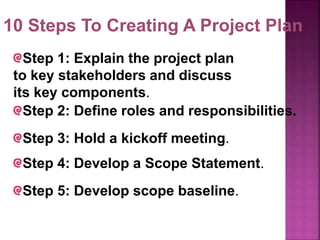
10 Steps To Creating A Project Plan
Step 1: Explain the project plan
to key stakeholders and discuss
its key components.
Step 2: Define roles and responsibilities.
Step 3: Hold a kickoff meeting.
Step 4: Develop a Scope Statement.
Step 5: Develop scope baseline.
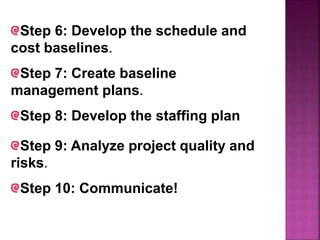
Step 6: Develop the schedule and
cost baselines.
Step 7: Create baseline
management plans.
Step 8: Develop the staffing plan
Step 9: Analyze project quality and
risks.
Step 10: Communicate!
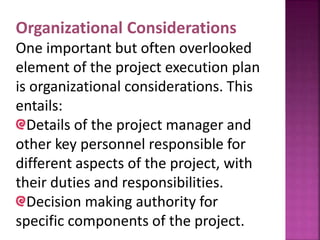
Organizational Considerations
One important but often overlooked
element of the project execution plan
is organizational considerations. This
entails:
Details of the project manager and
other key personnel responsible for
different aspects of the project, with
their duties and responsibilities.
Decision making authority for
specific components of the project.
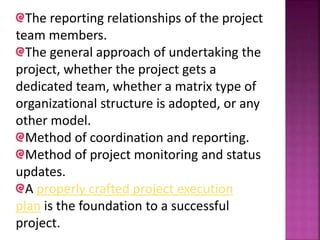
The reporting relationships of the project
team members.
The general approach of undertaking the
project, whether the project gets a
dedicated team, whether a matrix type of
organizational structure is adopted, or any
other model.
Method of coordination and reporting.
Method of project monitoring and status
updates.
A properly crafted project execution
plan is the foundation to a successful
project.
THANK YOU

Pep

  • 1.
  • 2.
    The project executionplan (PEP) is the governing document that establishes the means to execute, monitor, and control projects. The plan serves as the main communication vehicle to ensure that everyone is aware and knowledgeable of project objectives and how they will be accomplished.
  • 3.
    The major elementsof a project execution plan are: Scope definition Goal statements Quality and technical specifications Resource allocation Project scheduling
  • 5.
    Scope Definition Scope definitionentails defining what the project intends to achieve in specific terms. For instance, if the aim of the project is to “upgrade the information technology infrastructure in the organization" the scope definition in the project execution plan example translates this broad and vague objective into a specific scope based on output. As “to provide a new computer on every desk, with all appropriate software installed and ready to operate, and each computer linked through a network."
  • 6.
    Statement of Goals Thestatement of goals lists out specific project requirements such as key project deliverables, milestones, and the project life cycle. The goal statement also explains: Why the project is carried out, the purpose served by the project, and the expected benefits from the project The unique challenges that the project overcomes. The risks associated with the project and how the project plan will overcome such risks.
  • 7.
    Quality and Technical Specifications oneimportant element that needs inclusion in the project execution plan is quality or technical specifications of the work processes and output. The achievement of such stipulated standards determine the successful execution of the project.
  • 8.
    The parameters ofquality and technical specifications include the use of: Clear and precise definitions for concepts and terms. Measurable descriptions. For instance, “latest computers" are not measurable, whereas “computers with 2GB of memory" is a measurable quality standard.
  • 9.
    Attainable standards. Forinstance, “upgrade all the computers in the office to Dual Core Processors and 2 GB memory within two weeks" is an attainable goal, but “upgrade all the computers in the office to Dual Core and 2 GB memory overnight to ensure non-interrupted service" may be impossible in large companies
  • 10.
    Time bound definitions.For instance, “upgrade the computers soon" is vague, whereas “upgrade the computers within two weeks" is a precise and time bound specification. The level of quality desired in the project usually depends on the project budget, which is usually determined by the customer.
  • 11.
    Allocation of Resources Theelements of scope, goals, and quality define in clear terms what the project hopes to achieve. The next element of a project execution plan is the allocation of resources to achieve the stated goals and quality standards.
  • 12.
    Resources include Staff withknowledge or skill sets Money to buy equipment and Time considerations.
  • 13.
    Project Scheduling Scheduling theproject is a very important element in a project execution plan. The best approach is to divide the project into small units or chunks and set time bound milestones of achievements, mutually acceptable to all stakeholders. Examples: Gantt Charts that list what will happen and when , Critical Path Method (CPM) and PERT charts.
  • 17.
    One important considerationwith project scheduling is the need to be ready for exceptions. In practice, schedules rarely stick to their planned courses and go awry owing to many reasons such as late supply of input data or raw materials, disruptions in resources, faulty planning, underestimating the time requires, and forced changes to the schedule owing to external factors.
  • 18.
    The project managerneeds to make floor level adjustments to return the schedule to track. Very often, meeting agreed delivery schedules require project acceleration by working tasks in parallel modes. This depends on the state on dependencies, or the extent to which the start of one function depends on the completion of another task.
  • 19.
    Another important consideration whenscheduling projects is setting tolerances for risks, quality standards, budgets, and even deadlines. This does away with the need to continually seek guidance from the customer.
  • 21.
    10 Steps ToCreating A Project Plan Step 1: Explain the project plan to key stakeholders and discuss its key components. Step 2: Define roles and responsibilities. Step 3: Hold a kickoff meeting. Step 4: Develop a Scope Statement. Step 5: Develop scope baseline.
  • 22.
    Step 6: Developthe schedule and cost baselines. Step 7: Create baseline management plans. Step 8: Develop the staffing plan Step 9: Analyze project quality and risks. Step 10: Communicate!
  • 23.
    Organizational Considerations One importantbut often overlooked element of the project execution plan is organizational considerations. This entails: Details of the project manager and other key personnel responsible for different aspects of the project, with their duties and responsibilities. Decision making authority for specific components of the project.
  • 24.
    The reporting relationshipsof the project team members. The general approach of undertaking the project, whether the project gets a dedicated team, whether a matrix type of organizational structure is adopted, or any other model. Method of coordination and reporting. Method of project monitoring and status updates. A properly crafted project execution plan is the foundation to a successful project.
  • 25.