The problem
When a business has a problem to fix or an opportunity to leverage they will most likely follow a
four-step cycle:
1. Create a strategy
2. Define objectives
3. Execute through initiatives
4. Measure results
The impact
Without a means of communicating strategy into a language that everyone in the business can
understand it is very difficult to align to a common goal resulting in investments producing less
than expected returns let alone maximizing their full potential.
The projects that are spun up within the business units lose their connectedness to the overall
strategy and to each other, resulting in initiatives that may be individually successful but fail to
deliver on the overall objective. There is a lack of visibility into the workload of critical business
units, leading to change saturation, poor engagement and low adoption.
Where we are seeing success
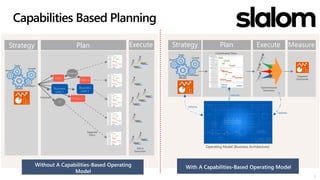
Some of our clients have found great success by incorporating business capabilities into the
planning process and execution framework to create a tight linkage between “what” they
want to achieve and “how” they will achieve it. By defining their operating model in terms of
business capabilities they create a shared understanding and alignment across the business
on what is needed to accomplish their strategic objectives.
We have seen our clients use business architecture in a variety of ways to great effect:
1. Executives driving new initiatives
2. New executives needing a clear view of their business
3. Obtaining a customer-centric organizational view
4. Merger and acquisition analysis
5. Change in business model
6. New product or service rollout
7. Runaway growth or stalled growth
8. Outsourcing
9. Regulatory Compliance
Capabilities Based Planning
Strategy
Objectives
Initiatives
Key
Performance
Indicators
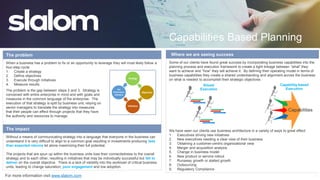
The problem is the gap between steps 2 and 3. Strategy is
conceived with entire enterprise in mind and with goals and
measures in the common language of the enterprise. The
execution of that strategy is split by business unit, relying on
senior managers to translate the strategy into measures
that their people can effect through projects that they have
the authority and resources to manage.
Siloed
Execution
Capability-based
Execution
www.slalom.com
2
Business
Unit 1
Business
Unit 2
Sales
Sales 2
Product 1
Finance
IT
Informs
Strategy Plan Execute Strategy Plan
Informs
Execute Measure
Updates

Capabilities Based Planning

  • 1.
    The problem When abusiness has a problem to fix or an opportunity to leverage they will most likely follow a four-step cycle: 1. Create a strategy 2. Define objectives 3. Execute through initiatives 4. Measure results The impact Without a means of communicating strategy into a language that everyone in the business can understand it is very difficult to align to a common goal resulting in investments producing less than expected returns let alone maximizing their full potential. The projects that are spun up within the business units lose their connectedness to the overall strategy and to each other, resulting in initiatives that may be individually successful but fail to deliver on the overall objective. There is a lack of visibility into the workload of critical business units, leading to change saturation, poor engagement and low adoption. Where we are seeing success Some of our clients have found great success by incorporating business capabilities into the planning process and execution framework to create a tight linkage between “what” they want to achieve and “how” they will achieve it. By defining their operating model in terms of business capabilities they create a shared understanding and alignment across the business on what is needed to accomplish their strategic objectives. We have seen our clients use business architecture in a variety of ways to great effect: 1. Executives driving new initiatives 2. New executives needing a clear view of their business 3. Obtaining a customer-centric organizational view 4. Merger and acquisition analysis 5. Change in business model 6. New product or service rollout 7. Runaway growth or stalled growth 8. Outsourcing 9. Regulatory Compliance Capabilities Based Planning Strategy Objectives Initiatives Key Performance Indicators The problem is the gap between steps 2 and 3. Strategy is conceived with entire enterprise in mind and with goals and measures in the common language of the enterprise. The execution of that strategy is split by business unit, relying on senior managers to translate the strategy into measures that their people can effect through projects that they have the authority and resources to manage. Siloed Execution Capability-based Execution www.slalom.com
  • 2.
    2 Business Unit 1 Business Unit 2 Sales Sales2 Product 1 Finance IT Informs Strategy Plan Execute Strategy Plan Informs Execute Measure Updates