Mr. Harsha C Mathad
Introduction, meaning & definition,
Classification, Objectives and scope of
production and operation management,
Automation – Introduction, meaning, definition,
need, types, advantages & disadvantages.
Plant Location - Introduction, meaning,
definition, factors affecting location, theory and
practices, cost factor in location.
Plant layout – Meaning, principles, space
requirement, different types of facilities,
organization of physical facilities, building,
sanitation, lighting, air conditioning and safety.
Introduction, meaning, definition, Purchasing
selection of suppliers, Inventory management,
materials handling, principles & practices,
economic consideration, criteria for selection of
materials handling equipment, standardization,
codifications, simplification inventory control,
techniques of inventory control, value analysis,
value engineering, human engineering, inter
relationship of plant layout and material
handlings.
Objectives and concepts, capacity planning,
corresponding production planning,
controlling, scheduling routing, quality
control, statistical quality control, quality
management, control charts and operating,
characteristics curves, acceptance sampling
procedures, quality circle, meaning of ISO and
TQM.
Introduction, meaning, objectives, types of
maintenance, breakdown, space planning &
control, preventive practice, relative advantage
maintenance scheduling, equipment reliability
and modern scientific maintenance methods,
waste management, scope & surplus disposal,
salvage & recovery.
Production is the process by which
raw materials and other inputs are converted
into finished products.
Operations management
is a systematic approach to
addressing issues and
resolving issues in the
transformation process that
converts inputs into useful
revenue generating outputs.
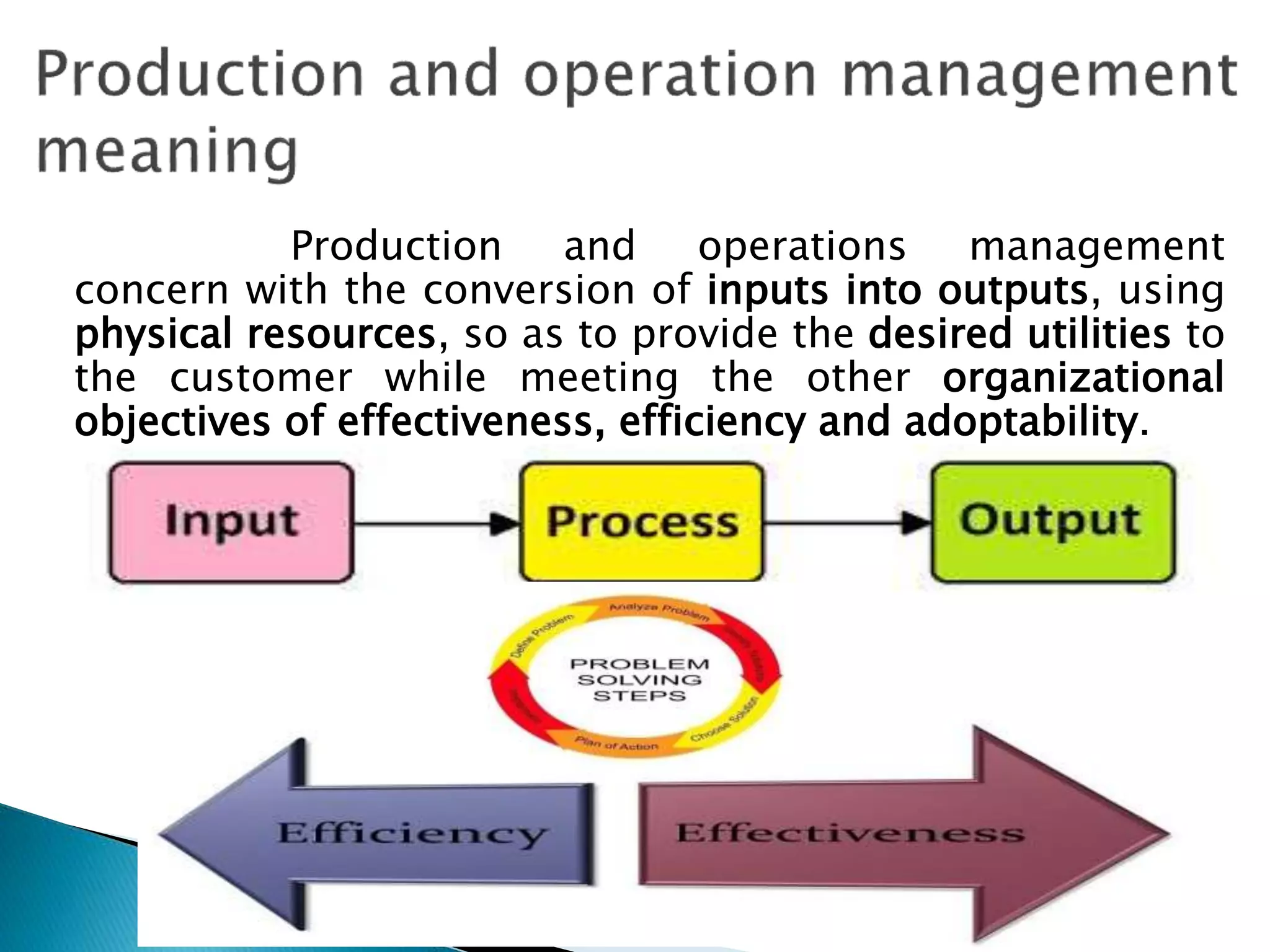
Production and operations management
concern with the conversion of inputs into outputs, using
physical resources, so as to provide the desired utilities to
the customer while meeting the other organizational
objectives of effectiveness, efficiency and adoptability.
• Maximum possible productivity with best quality, quantity
and cost.
• Maximum customer satisfaction through quality, reliability,
cost and delivery time.
• Minimum scrap/rework resulting in better product quality.
• Minimum possible inventory levels (i.e., optimum inventory
levels).
• Maximum utilization of all kinds of resources
needed.
• Minimum cash outflow and maximum employee
satisfaction.
• Maximum possible production (i.e., outputs) with
higher operating efficiency.
• Minimum production cycle(Lead time) time with
protection of employees and environment.
• Maximum possible profit or return on investment.
Production systems can be classified as
Job Shop, Batch, Mass and Continuous
Production systems.
• Job shop production
• Batch production
• Mass production
Job shop production
are characterized by
manufacturing of one or
few quantity of products
designed and produced as
per the specification of
customers within prefixed
time and cost. The
distinguishing feature of
this is low volume and
high variety of products.
Advantages
Following are the advantages of job shop production:
1. Because of general purpose machines and facilities variety of
products can be produced.
2. Operators will become more skilled and competent, as each
job gives them learning opportunities.
3. Full potential of operators can be utilized.
4. Opportunity exists for creative methods and innovative ideas.
Limitations
Following are the limitations of job shop production:
1. Higher cost due to frequent set up changes.
2. Higher level of inventory at all levels and hence higher
inventory cost.
3. Production planning is complicated.
4. Larger space requirements.
Batch production is
defined by American Production and
Inventory Control Society (APICS) “as
a form of manufacturing in which
the job passes through the
functional departments in lots or
batches and each lot may have a
different routing.”
It is characterized by the
manufacture of limited number of
products produced at regular
intervals and stocked awaiting
sales.
Advantages
Following are the advantages of batch production:
1. Better utilization of plant and machinery.
2. Promotes functional specialization.
3. Cost per unit is lower as compared to job order production.
4. Lower investment in plant and machinery.
5. Flexibility to accommodate and process number of
products.
6. Job satisfaction exists for operators.
Limitations
Following are the limitations of batch production:
1. Material handling is complex because of irregular and
longer flows.
2. Production planning and control is complex.
3. Work in process inventory is higher compared to continuous
production.
4. Higher set up costs due to frequent changes in set up.
Manufacture of discrete parts or
assemblies using a continuous process are called
mass production.
This production system is justified by
very large volume of production. The machines
are arranged in a line or product layout. Product
and process standardization exists and all
outputs follow the same path.
Advantages
Following are the advantages of mass production:
1. Higher rate of production with reduced cycle time.
2. Higher capacity utilization due to line balancing.
3. Less skilled operators are required.
4. Low process inventory.
5. Manufacturing cost per unit is low.
Limitations
Following are the limitations of mass production:
1. Breakdown of one machine will stop an entire
production line.
2. High investment in production facilities.
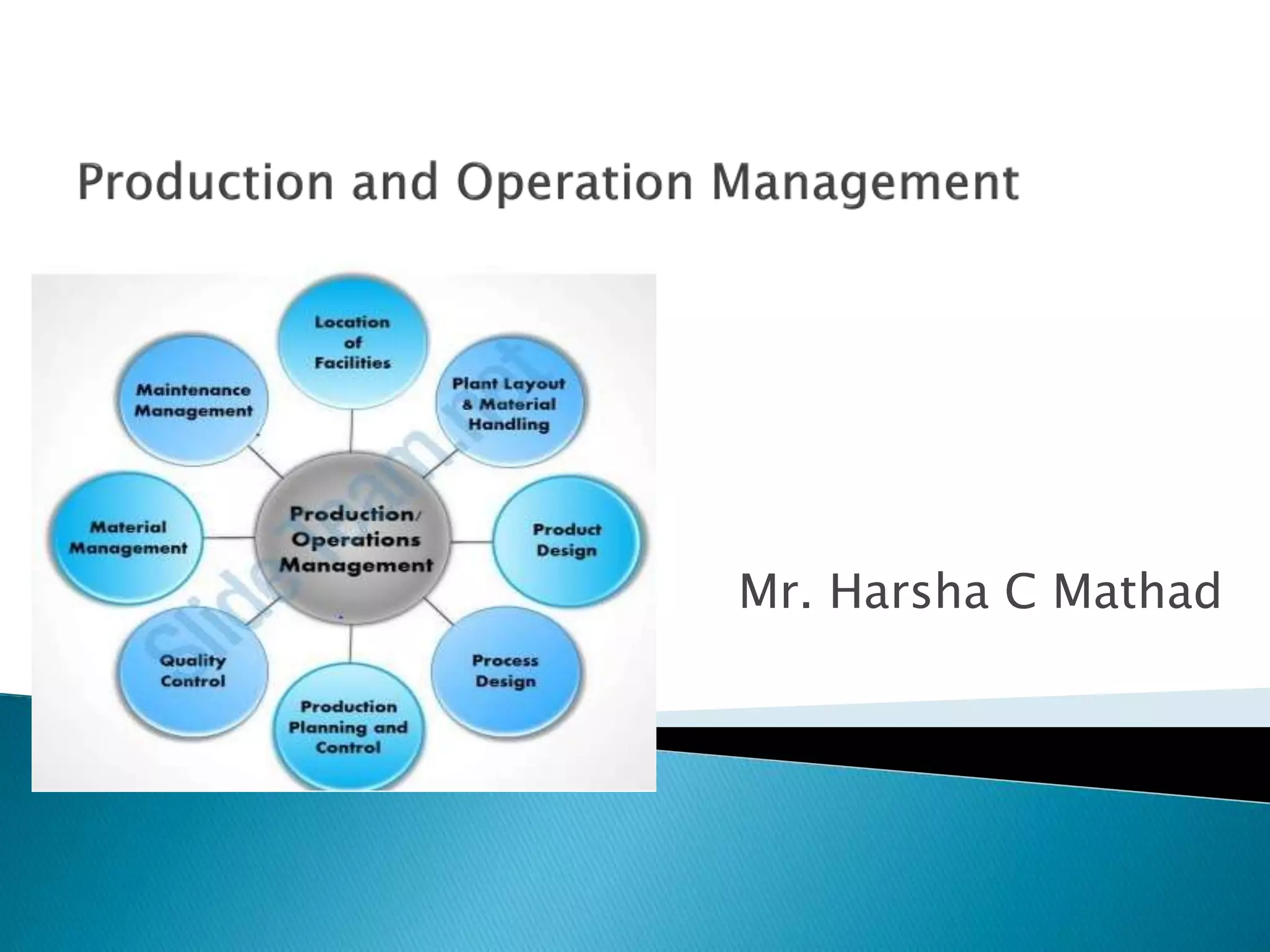
 Location.
 Plant layouts and material handling.
 Product design.
 Process design.
 Production and planning control.
 Routing
 Scheduling
 Dispatching
 Quality control.
 Materials management.
 Maintenance management.
Automation means adopting technology
with the collaboration of mechanical, electronic,
and computer based systems to operate and
control production.
1. Fixed automation.
2. Programmable automation.
3. Flexible automation.
It is a system in which the sequence of
processing (or assembly) operations is fixed by
the equipment configuration. The operations in
the sequence are usually simple.
In this the production equipment is
designed with the capability to change the
sequence of operations to accommodate
different product configurations. The operation
sequence is controlled by a program, which is a
set of instructions coded so that the system can
read and interpret them.
It is an extension of programmable
automation. A flexible automated system is one
that is capable of producing a variety of products
(or parts) with virtually no time lost for
changeovers from one product to the next.
• To Increasing productivity.
• To Reducing cost of labour.
• To over come labour shortages.
• To increase Safety.
• To Improve product quality.
• To Reduced manufacturing lead time.
• To Reduction of in-process inventory.
• It increases productivity and quality of the production.
• It helps in reducing cost of labour and bring efficiency in
production process.
• It create safety in the production activity.
• The growth of the automation industry will itself provide
employment opportunities. This has been especially true in
the computer industry, as the companies in this industry
have grown (IBM, Digital Equipment Corp., Honeywell, etc.),
new jobs have been created.
• It increases the standard of living.
• There will be a reduction in the labour force,
with resulting unemployment.
• Automation will reduce purchasing power. As
machines replace workers and these workers
join the unemployment ranks, they will not
receive the wages necessary to buy the products
brought by automation.

Production and operation management

  • 1.
  • 2.
    Introduction, meaning &definition, Classification, Objectives and scope of production and operation management, Automation – Introduction, meaning, definition, need, types, advantages & disadvantages.
  • 3.
    Plant Location -Introduction, meaning, definition, factors affecting location, theory and practices, cost factor in location. Plant layout – Meaning, principles, space requirement, different types of facilities, organization of physical facilities, building, sanitation, lighting, air conditioning and safety.
  • 4.
    Introduction, meaning, definition,Purchasing selection of suppliers, Inventory management, materials handling, principles & practices, economic consideration, criteria for selection of materials handling equipment, standardization, codifications, simplification inventory control, techniques of inventory control, value analysis, value engineering, human engineering, inter relationship of plant layout and material handlings.
  • 5.
    Objectives and concepts,capacity planning, corresponding production planning, controlling, scheduling routing, quality control, statistical quality control, quality management, control charts and operating, characteristics curves, acceptance sampling procedures, quality circle, meaning of ISO and TQM.
  • 6.
    Introduction, meaning, objectives,types of maintenance, breakdown, space planning & control, preventive practice, relative advantage maintenance scheduling, equipment reliability and modern scientific maintenance methods, waste management, scope & surplus disposal, salvage & recovery.
  • 7.
    Production is theprocess by which raw materials and other inputs are converted into finished products.
  • 10.
    Operations management is asystematic approach to addressing issues and resolving issues in the transformation process that converts inputs into useful revenue generating outputs.
  • 11.
    Production and operationsmanagement concern with the conversion of inputs into outputs, using physical resources, so as to provide the desired utilities to the customer while meeting the other organizational objectives of effectiveness, efficiency and adoptability.
  • 12.
    • Maximum possibleproductivity with best quality, quantity and cost. • Maximum customer satisfaction through quality, reliability, cost and delivery time. • Minimum scrap/rework resulting in better product quality. • Minimum possible inventory levels (i.e., optimum inventory levels).
  • 13.
    • Maximum utilizationof all kinds of resources needed. • Minimum cash outflow and maximum employee satisfaction. • Maximum possible production (i.e., outputs) with higher operating efficiency. • Minimum production cycle(Lead time) time with protection of employees and environment. • Maximum possible profit or return on investment.
  • 14.
    Production systems canbe classified as Job Shop, Batch, Mass and Continuous Production systems. • Job shop production • Batch production • Mass production
  • 16.
    Job shop production arecharacterized by manufacturing of one or few quantity of products designed and produced as per the specification of customers within prefixed time and cost. The distinguishing feature of this is low volume and high variety of products.
  • 17.
    Advantages Following are theadvantages of job shop production: 1. Because of general purpose machines and facilities variety of products can be produced. 2. Operators will become more skilled and competent, as each job gives them learning opportunities. 3. Full potential of operators can be utilized. 4. Opportunity exists for creative methods and innovative ideas. Limitations Following are the limitations of job shop production: 1. Higher cost due to frequent set up changes. 2. Higher level of inventory at all levels and hence higher inventory cost. 3. Production planning is complicated. 4. Larger space requirements.
  • 18.
    Batch production is definedby American Production and Inventory Control Society (APICS) “as a form of manufacturing in which the job passes through the functional departments in lots or batches and each lot may have a different routing.” It is characterized by the manufacture of limited number of products produced at regular intervals and stocked awaiting sales.
  • 19.
    Advantages Following are theadvantages of batch production: 1. Better utilization of plant and machinery. 2. Promotes functional specialization. 3. Cost per unit is lower as compared to job order production. 4. Lower investment in plant and machinery. 5. Flexibility to accommodate and process number of products. 6. Job satisfaction exists for operators. Limitations Following are the limitations of batch production: 1. Material handling is complex because of irregular and longer flows. 2. Production planning and control is complex. 3. Work in process inventory is higher compared to continuous production. 4. Higher set up costs due to frequent changes in set up.
  • 20.
    Manufacture of discreteparts or assemblies using a continuous process are called mass production. This production system is justified by very large volume of production. The machines are arranged in a line or product layout. Product and process standardization exists and all outputs follow the same path.
  • 21.
    Advantages Following are theadvantages of mass production: 1. Higher rate of production with reduced cycle time. 2. Higher capacity utilization due to line balancing. 3. Less skilled operators are required. 4. Low process inventory. 5. Manufacturing cost per unit is low. Limitations Following are the limitations of mass production: 1. Breakdown of one machine will stop an entire production line. 2. High investment in production facilities.
  • 22.
     Location.  Plantlayouts and material handling.  Product design.  Process design.  Production and planning control.  Routing  Scheduling  Dispatching  Quality control.  Materials management.  Maintenance management.
  • 23.
    Automation means adoptingtechnology with the collaboration of mechanical, electronic, and computer based systems to operate and control production.
  • 24.
    1. Fixed automation. 2.Programmable automation. 3. Flexible automation.
  • 25.
    It is asystem in which the sequence of processing (or assembly) operations is fixed by the equipment configuration. The operations in the sequence are usually simple.
  • 26.
    In this theproduction equipment is designed with the capability to change the sequence of operations to accommodate different product configurations. The operation sequence is controlled by a program, which is a set of instructions coded so that the system can read and interpret them.
  • 27.
    It is anextension of programmable automation. A flexible automated system is one that is capable of producing a variety of products (or parts) with virtually no time lost for changeovers from one product to the next.
  • 28.
    • To Increasingproductivity. • To Reducing cost of labour. • To over come labour shortages. • To increase Safety. • To Improve product quality. • To Reduced manufacturing lead time. • To Reduction of in-process inventory.
  • 29.
    • It increasesproductivity and quality of the production. • It helps in reducing cost of labour and bring efficiency in production process. • It create safety in the production activity. • The growth of the automation industry will itself provide employment opportunities. This has been especially true in the computer industry, as the companies in this industry have grown (IBM, Digital Equipment Corp., Honeywell, etc.), new jobs have been created. • It increases the standard of living.
  • 30.
    • There willbe a reduction in the labour force, with resulting unemployment. • Automation will reduce purchasing power. As machines replace workers and these workers join the unemployment ranks, they will not receive the wages necessary to buy the products brought by automation.