Techniques of Production
By
Naeem Akram
Noor College of Business & Sciences
Techniques of Production
There are a number of established techniques of
production. We consider here some general themes
and trends.
Automation and cybernetics
Ergonomics
Computer Aided Design and Manufacture
Smoothing the flow of production
• Production engineering
• Just-in-time techniques
• Mathematical and statistical techniques
• Lean production
• Cell production
Techniques of Production
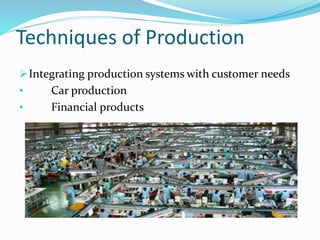
Integrating production systems with customer needs
• Car production
• Financial products
Automation and cybernetics
Automation is the use of machines and technology to
make processes run on their own without manpower.
Automation offers firms numerous advantages.
Production lines can be run continuously, there is less
need for inspection, manpower can be reduced and
hence productivity is increased.
However, automation is costly to introduce and there
are costs in training workers for the new system.
As automation has progressed there has been some
conflict with workers, who see their existing skills
being made redundant (surplus).
Automation and cybernetics
Cybernetic is the branch of science concerned with
control systems in electronic and mechanical devices
and the extent to which useful comparisons can be
made between man-made and biological systems.
Cybernetics is sometimes described as the basis of
automation in that it is concerned with the ways in
which computers can replace the functions of the
human brain (just as mechanisation is concerned with
the way machines replace the functions of the human
body).
So, mechanisation plus cybernetics equals automation,
which has advanced into robotics.
Ergonomics
Ergonomics is a science that deals with designing and
arranging things so that people can use them easily and
safely.
This approach sets out to achieve the best possible
relationship between workers and their environment.
As automation develops, this relationship changes with
mechanisation taking over the physical energy input
and cybernetic systems taking over the control
functions.
Ergonomics is also important so that the right
conditions of heating, light and work layout are
available for the performance of the workers' functions.
Computer Aided Design and Manufacture
Production departments are making ever-growing use of
Computer Aided Design and Computer Assisted
Manufacture (CAD/CAM) to develop flexible
manufacturing systems.
As the name implies, this technique embraces the
design, inspection and quality control of goods being
produced.
It goes beyond automation by bringing into use cost-
effective computers to link together design, production
and quality control functions.
CAD/CAM can be extended to include the final
packaging and sending out of goods to customers.
CAD/CAM offers a number of benefits
 The linking of the various production functions and steps
allows for immediate access to evaluate the state of
production at a given time, thus assisting effective control.
 There is less likelihood of breakdown or errors of
communication between the various stages of design,
production, inspection and dispatch of goods.
 In major projects, integrated sophisticated computer systems
have been developed with CAD/CAM as a subsystem of the
network. Clients and major suppliers are linked with
compatible systems which supply up-to-date information on
supplies, stores, design, design changes, progress and costs.
The data is monitored to identify changes to the critical path
analysis or a budget overrun.
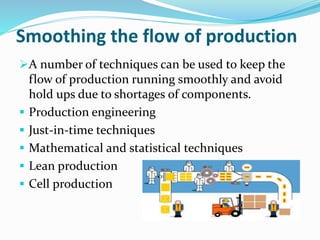
Smoothing the flow of production
A number of techniques can be used to keep the
flow of production running smoothly and avoid
hold ups due to shortages of components.
 Production engineering
 Just-in-time techniques
 Mathematical and statistical techniques
 Lean production
 Cell production
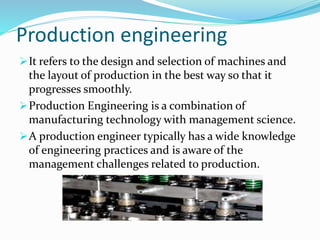
Production engineering
It refers to the design and selection of machines and
the layout of production in the best way so that it
progresses smoothly.
Production Engineering is a combination of
manufacturing technology with management science.
A production engineer typically has a wide knowledge
of engineering practices and is aware of the
management challenges related to production.
Just-in-time techniques
Just-in-time (JIT) manufacturing, also known as just-in-
time production s a methodology aimed primarily at
reducing flow times within production as well as
response times from suppliers and to customers.
It aims to ensure continuous production through
harmonization between the supply of components and
their use or assembly.
Holding large stocks of components ties up capital and is
costly. Just-in-time techniques set out to integrate the
use of components by a manufacturer with the
production of these items by suppliers, so that neither
carries surplus stocks.
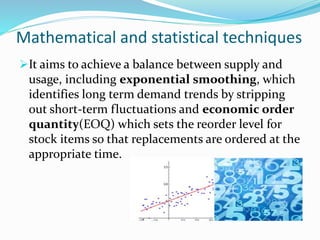
Mathematical and statistical techniques
It aims to achieve a balance between supply and
usage, including exponential smoothing, which
identifies long term demand trends by stripping
out short-term fluctuations and economic order
quantity(EOQ) which sets the reorder level for
stock items so that replacements are ordered at the
appropriate time.
Lean production
It is a series of management techniques intended to make
more efficient use of limited resources, thereby limiting
waste.
Techniques might include kaizen, just-in-time and
benchmarking in order to maximise productivity while at
the same time minimising the resources used.
Lean production requires multi-skilled workers who are
committed to producing high quality at all times.
Such a production process produces to order, rather than
for stock –demand "pulls" products through the system
with the minimum of storage or waiting.
This has been used very effectively by car manufacturers
and companies such as Dell computers.
Cell production
It is where the production system is divided into
independent teams or "cells", each of which is
responsible for a group of goods or a major part of
the manufacturing process.
Teams are given devolved responsibility and
control over their area. This helps to improve
motivation and productivity.
Cell production is a form of team working and
helps ensure worker commitment, as each cell is
responsible for a complete unit of work, which
Herzberg would view as part of job enrichment.
Techniques of production

Techniques of production

  • 1.
    Techniques of Production By NaeemAkram Noor College of Business & Sciences
  • 2.
    Techniques of Production Thereare a number of established techniques of production. We consider here some general themes and trends. Automation and cybernetics Ergonomics Computer Aided Design and Manufacture Smoothing the flow of production • Production engineering • Just-in-time techniques • Mathematical and statistical techniques • Lean production • Cell production
  • 3.
    Techniques of Production Integratingproduction systems with customer needs • Car production • Financial products
  • 4.
    Automation and cybernetics Automationis the use of machines and technology to make processes run on their own without manpower. Automation offers firms numerous advantages. Production lines can be run continuously, there is less need for inspection, manpower can be reduced and hence productivity is increased. However, automation is costly to introduce and there are costs in training workers for the new system. As automation has progressed there has been some conflict with workers, who see their existing skills being made redundant (surplus).
  • 5.
    Automation and cybernetics Cyberneticis the branch of science concerned with control systems in electronic and mechanical devices and the extent to which useful comparisons can be made between man-made and biological systems. Cybernetics is sometimes described as the basis of automation in that it is concerned with the ways in which computers can replace the functions of the human brain (just as mechanisation is concerned with the way machines replace the functions of the human body). So, mechanisation plus cybernetics equals automation, which has advanced into robotics.
  • 6.
    Ergonomics Ergonomics is ascience that deals with designing and arranging things so that people can use them easily and safely. This approach sets out to achieve the best possible relationship between workers and their environment. As automation develops, this relationship changes with mechanisation taking over the physical energy input and cybernetic systems taking over the control functions. Ergonomics is also important so that the right conditions of heating, light and work layout are available for the performance of the workers' functions.
  • 7.
    Computer Aided Designand Manufacture Production departments are making ever-growing use of Computer Aided Design and Computer Assisted Manufacture (CAD/CAM) to develop flexible manufacturing systems. As the name implies, this technique embraces the design, inspection and quality control of goods being produced. It goes beyond automation by bringing into use cost- effective computers to link together design, production and quality control functions. CAD/CAM can be extended to include the final packaging and sending out of goods to customers.
  • 8.
    CAD/CAM offers anumber of benefits  The linking of the various production functions and steps allows for immediate access to evaluate the state of production at a given time, thus assisting effective control.  There is less likelihood of breakdown or errors of communication between the various stages of design, production, inspection and dispatch of goods.  In major projects, integrated sophisticated computer systems have been developed with CAD/CAM as a subsystem of the network. Clients and major suppliers are linked with compatible systems which supply up-to-date information on supplies, stores, design, design changes, progress and costs. The data is monitored to identify changes to the critical path analysis or a budget overrun.
  • 9.
    Smoothing the flowof production A number of techniques can be used to keep the flow of production running smoothly and avoid hold ups due to shortages of components.  Production engineering  Just-in-time techniques  Mathematical and statistical techniques  Lean production  Cell production
  • 10.
    Production engineering It refersto the design and selection of machines and the layout of production in the best way so that it progresses smoothly. Production Engineering is a combination of manufacturing technology with management science. A production engineer typically has a wide knowledge of engineering practices and is aware of the management challenges related to production.
  • 11.
    Just-in-time techniques Just-in-time (JIT)manufacturing, also known as just-in- time production s a methodology aimed primarily at reducing flow times within production as well as response times from suppliers and to customers. It aims to ensure continuous production through harmonization between the supply of components and their use or assembly. Holding large stocks of components ties up capital and is costly. Just-in-time techniques set out to integrate the use of components by a manufacturer with the production of these items by suppliers, so that neither carries surplus stocks.
  • 12.
    Mathematical and statisticaltechniques It aims to achieve a balance between supply and usage, including exponential smoothing, which identifies long term demand trends by stripping out short-term fluctuations and economic order quantity(EOQ) which sets the reorder level for stock items so that replacements are ordered at the appropriate time.
  • 13.
    Lean production It isa series of management techniques intended to make more efficient use of limited resources, thereby limiting waste. Techniques might include kaizen, just-in-time and benchmarking in order to maximise productivity while at the same time minimising the resources used. Lean production requires multi-skilled workers who are committed to producing high quality at all times. Such a production process produces to order, rather than for stock –demand "pulls" products through the system with the minimum of storage or waiting. This has been used very effectively by car manufacturers and companies such as Dell computers.
  • 14.
    Cell production It iswhere the production system is divided into independent teams or "cells", each of which is responsible for a group of goods or a major part of the manufacturing process. Teams are given devolved responsibility and control over their area. This helps to improve motivation and productivity. Cell production is a form of team working and helps ensure worker commitment, as each cell is responsible for a complete unit of work, which Herzberg would view as part of job enrichment.