
OPERATIONS MANAGEMENT CONCEPTS
Introduction
Production/operations management is the process, which
combines and transforms various resources used in the
production/operations subsystem of the organization into value
added product/services in a controlled manner as per the policies
of the organization.
Therefore, it is that part of an organization, which is concerned with
the transformation of a range of inputs into the required
(products/services) having the requisite quality level.
Introduction
The set of interrelated management activities, which are involved in
manufacturing certain products, is called as production
management.
If the same concept is extended to services management, then the
corresponding set of management activities is called as operations
management.
Concept of production
Production function is ‘the part of an organisation, which is
concerned with the transformation of a range of inputs into the
required outputs (products) having the requisite quality level’.
Production is defined as ‘the step-by-step conversion of one form
of material into another form through chemical or mechanical
process to create or enhance the utility of the product to the user’.
Thus production is a value addition process. At each stage of
processing, there will be value addition.
Edwood Buffa defines production as ‘a process by which goods and
services are created’.
Concept of production
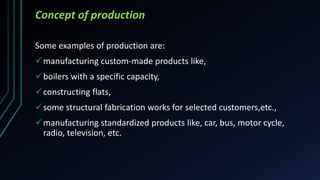
Some examples of production are:
manufacturing custom-made products like,
boilers with a specific capacity,
constructing flats,
some structural fabrication works for selected customers,etc.,
manufacturing standardized products like, car, bus, motor cycle,
radio, television, etc.
Production System
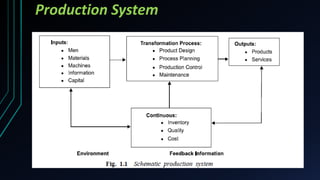
The production system of an organization is that part, which
produces products of an organization.
It is that activity whereby resources, flowing within a defined
system, are combined and transformed in a controlled manner to
add value in accordance with the policies communicated by
management.
Production System
Production System
The production system has the following characteristics:
Production is an organized activity, so every production system has
an objective.
The system transforms the various inputs to useful outputs.
It does not operate in isolation from the other organization system.
There exists a feedback about the activities, which is essential to
control and improve system performance.
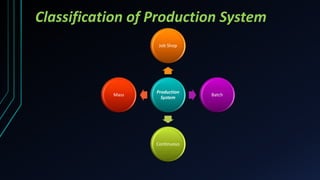
Classification of Production System
Production
System
Job Shop
Batch
Continuous
Mass
Job Shop Production
Job shop production are characterized by manufacturing of one or
few quantity of products designed and produced as per the
specification of customers within prefixed time and cost.
The distinguishing feature of this is low volume and high variety of
products.
A job shop comprises of general purpose machines arranged into
different departments.
Each job demands unique technological requirements, demands
processing on machines in a certain sequence.
Characteristics
High variety of products and low volume.
Use of general purpose machines and facilities.
Highly skilled operators who can take up each job as a challenge
because of uniqueness.
Large inventory of materials, tools, parts.
Detailed planning is essential for sequencing the requirements of
each product, capacities for each work centre and order priorities.
Advantages
Because of general purpose machines and facilities variety of
products can be produced.
Operators will become more skilled and competent, as each job
gives them learning opportunities.
Full potential of operators can be utilised.
Opportunity exists for creative methods and innovative ideas.
Limitations
Higher cost due to frequent set up changes.
Higher level of inventory at all levels and hence higher inventory
cost.
Production planning is complicated.
Larger space requirements.
Batch Production
Batch production is defined by American Production and Inventory
Control Society (APICS) “as a form of manufacturing in which the
job passes through the functional departments in lots or batches
and each lot may have a different routing.”
It is characterised by the manufacture of limited number of
products produced at regular intervals and stocked awaiting sales.
Characteristics
When there is shorter production runs.
When plant and machinery are flexible.
When plant and machinery set up is used for the production of item
in a batch and change of set up is required for processing the next
batch.
When manufacturing lead time and cost are lower as compared to
job order production.
Advantages
Better utilisation of plant and machinery.
Promotes functional specialisation.
Cost per unit is lower as compared to job order production.
Lower investment in plant and machinery.
Flexibility to accommodate and process number of products.
Job satisfaction exists for operators.
Limitations
Material handling is complex because of irregular and longer flows.
Production planning and control is complex.
Work in process inventory is higher compared to continuous
production.
Higher set up costs due to frequent changes in set up.
Mass Production
Manufacture of discrete parts or assemblies using a continuous
process are called mass production.
This production system is justified by very large volume of
production. The machines are arranged in a line or product layout.
Product and process standardization exists and all outputs follow
the same path.
Characteristics
 Standardization of product and process sequence.
 Dedicated special purpose machines having higher production capacities and output
rates.
 Large volume of products.
 Shorter cycle time of production.
 Lower in process inventory.
 Perfectly balanced production lines.
 Flow of materials, components and parts is continuous and without any back tracking.
 Production planning and control is easy.
 Material handling can be completely automatic.
Advantages
Higher rate of production with reduced cycle time.
Higher capacity utilization due to line balancing.
Less skilled operators are required.
Low process inventory.
Manufacturing cost per unit is low.
Limitations
Breakdown of one machine will stop an entire production line.
Line layout needs major change with the changes in the product
design.
High investment in production facilities.
The cycle time is determined by the slowest operation.
Continuous Production
Production facilities are arranged as per the sequence of
production operations from the first operations to the finished
product.
The items are made to flow through the sequence of operations
through material handling devices such as conveyors, transfer
devices, etc.
Characteristics
Dedicated plant and equipment with zero flexibility.
Material handling is fully automated.
Process follows a predetermined sequence of operations.
Component materials cannot be readily identified with final
product.
Planning and scheduling is a routine action.
Advantages
Standardisation of product and process sequence.
Higher rate of production with reduced cycle time.
Higher capacity utilisation due to line balancing.
Manpower is not required for material handling as it is completely
automatic.
Person with limited skills can be used on the production line.
Unit cost is lower due to high volume of production.
Limitations
Flexibility to accommodate and process number of products does
not exist.
Very high investment for setting flow lines.
Product differentiation is limited.
THANK YOU ALL

Operations management concepts

  • 1.
  • 2.
    Introduction Production/operations management isthe process, which combines and transforms various resources used in the production/operations subsystem of the organization into value added product/services in a controlled manner as per the policies of the organization. Therefore, it is that part of an organization, which is concerned with the transformation of a range of inputs into the required (products/services) having the requisite quality level.
  • 3.
    Introduction The set ofinterrelated management activities, which are involved in manufacturing certain products, is called as production management. If the same concept is extended to services management, then the corresponding set of management activities is called as operations management.
  • 4.
    Concept of production Productionfunction is ‘the part of an organisation, which is concerned with the transformation of a range of inputs into the required outputs (products) having the requisite quality level’. Production is defined as ‘the step-by-step conversion of one form of material into another form through chemical or mechanical process to create or enhance the utility of the product to the user’. Thus production is a value addition process. At each stage of processing, there will be value addition. Edwood Buffa defines production as ‘a process by which goods and services are created’.
  • 5.
    Concept of production Someexamples of production are: manufacturing custom-made products like, boilers with a specific capacity, constructing flats, some structural fabrication works for selected customers,etc., manufacturing standardized products like, car, bus, motor cycle, radio, television, etc.
  • 6.
    Production System The productionsystem of an organization is that part, which produces products of an organization. It is that activity whereby resources, flowing within a defined system, are combined and transformed in a controlled manner to add value in accordance with the policies communicated by management.
  • 7.
  • 8.
    Production System The productionsystem has the following characteristics: Production is an organized activity, so every production system has an objective. The system transforms the various inputs to useful outputs. It does not operate in isolation from the other organization system. There exists a feedback about the activities, which is essential to control and improve system performance.
  • 9.
    Classification of ProductionSystem Production System Job Shop Batch Continuous Mass
  • 10.
    Job Shop Production Jobshop production are characterized by manufacturing of one or few quantity of products designed and produced as per the specification of customers within prefixed time and cost. The distinguishing feature of this is low volume and high variety of products. A job shop comprises of general purpose machines arranged into different departments. Each job demands unique technological requirements, demands processing on machines in a certain sequence.
  • 11.
    Characteristics High variety ofproducts and low volume. Use of general purpose machines and facilities. Highly skilled operators who can take up each job as a challenge because of uniqueness. Large inventory of materials, tools, parts. Detailed planning is essential for sequencing the requirements of each product, capacities for each work centre and order priorities.
  • 12.
    Advantages Because of generalpurpose machines and facilities variety of products can be produced. Operators will become more skilled and competent, as each job gives them learning opportunities. Full potential of operators can be utilised. Opportunity exists for creative methods and innovative ideas.
  • 13.
    Limitations Higher cost dueto frequent set up changes. Higher level of inventory at all levels and hence higher inventory cost. Production planning is complicated. Larger space requirements.
  • 14.
    Batch Production Batch productionis defined by American Production and Inventory Control Society (APICS) “as a form of manufacturing in which the job passes through the functional departments in lots or batches and each lot may have a different routing.” It is characterised by the manufacture of limited number of products produced at regular intervals and stocked awaiting sales.
  • 15.
    Characteristics When there isshorter production runs. When plant and machinery are flexible. When plant and machinery set up is used for the production of item in a batch and change of set up is required for processing the next batch. When manufacturing lead time and cost are lower as compared to job order production.
  • 16.
    Advantages Better utilisation ofplant and machinery. Promotes functional specialisation. Cost per unit is lower as compared to job order production. Lower investment in plant and machinery. Flexibility to accommodate and process number of products. Job satisfaction exists for operators.
  • 17.
    Limitations Material handling iscomplex because of irregular and longer flows. Production planning and control is complex. Work in process inventory is higher compared to continuous production. Higher set up costs due to frequent changes in set up.
  • 18.
    Mass Production Manufacture ofdiscrete parts or assemblies using a continuous process are called mass production. This production system is justified by very large volume of production. The machines are arranged in a line or product layout. Product and process standardization exists and all outputs follow the same path.
  • 19.
    Characteristics  Standardization ofproduct and process sequence.  Dedicated special purpose machines having higher production capacities and output rates.  Large volume of products.  Shorter cycle time of production.  Lower in process inventory.  Perfectly balanced production lines.  Flow of materials, components and parts is continuous and without any back tracking.  Production planning and control is easy.  Material handling can be completely automatic.
  • 20.
    Advantages Higher rate ofproduction with reduced cycle time. Higher capacity utilization due to line balancing. Less skilled operators are required. Low process inventory. Manufacturing cost per unit is low.
  • 21.
    Limitations Breakdown of onemachine will stop an entire production line. Line layout needs major change with the changes in the product design. High investment in production facilities. The cycle time is determined by the slowest operation.
  • 22.
    Continuous Production Production facilitiesare arranged as per the sequence of production operations from the first operations to the finished product. The items are made to flow through the sequence of operations through material handling devices such as conveyors, transfer devices, etc.
  • 23.
    Characteristics Dedicated plant andequipment with zero flexibility. Material handling is fully automated. Process follows a predetermined sequence of operations. Component materials cannot be readily identified with final product. Planning and scheduling is a routine action.
  • 24.
    Advantages Standardisation of productand process sequence. Higher rate of production with reduced cycle time. Higher capacity utilisation due to line balancing. Manpower is not required for material handling as it is completely automatic. Person with limited skills can be used on the production line. Unit cost is lower due to high volume of production.
  • 25.
    Limitations Flexibility to accommodateand process number of products does not exist. Very high investment for setting flow lines. Product differentiation is limited.
  • 26.