1
Born in Moscow in 1863, Constantin Sergeyevich Stanislavsky had a more
profound effect on the process of acting than anyone else in the twentieth
century. It was his assertion that if the theater was going to be meaningful it
needed to move beyond the external representation that acting had primarily
been. Over forty years he created an approach that forefronted the
psychological and emotional aspects of acting. The Stanislavsky System, or
"the method," as it has become known, held that an actor’s main
responsibility was to be believed (rather than recognized or understood).
Today in the United States, Stanislavsky’s theories are the primary source of
study for many actors. Among the many great actors and teachers to use his
work are Marlon Brando and Gregory Peck. Many of artists have continued
experimentation with Stanislavsky’s ideas. Among the best known of these
proponents is the Actors Studio, an organization that has been home to some
of the most talented and successful actors of our time.
Stanislavsky saw that the difference between the good actor and the great
actor was the ability to be relaxed, and to be private in public.
We learn from Stanislavsky: As the students relax before the lecture start;
they clean the slate, going to a zero state, being ready for the best
performance in the learning process.
State Zero
2
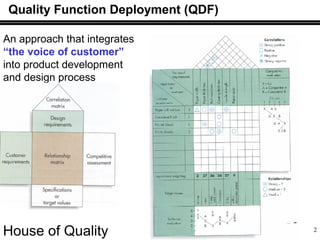
Quality Function Deployment (QDF)
An approach that integrates
“the voice of customer”
into product development
and design process
House of Quality
3
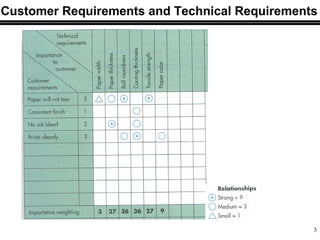
Customer Requirements and Technical Requirements
4
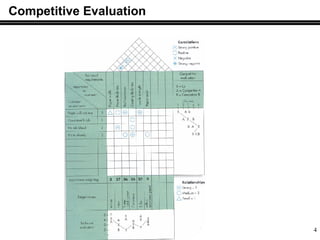
Competitive Evaluation
5
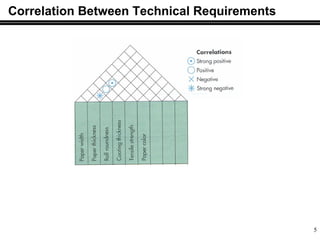
Correlation Between Technical Requirements
6
Ch 5(A) : Process Planning
7
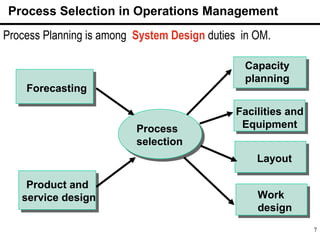
Process Planning is among System Design duties in OM.
Forecasting
Product and
service design
Capacity
planning
Facilities and
Equipment
Layout
Work
design
Process
selection
Process Selection in Operations Management
8
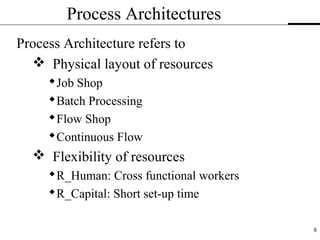
Process Architectures
Process Architecture refers to
 Physical layout of resources
Job Shop
Batch Processing
Flow Shop
Continuous Flow
 Flexibility of resources
R_Human: Cross functional workers
R_Capital: Short set-up time
9
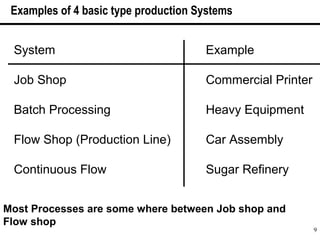
System Example
Job Shop Commercial Printer
Batch Processing Heavy Equipment
Flow Shop (Production Line) Car Assembly
Continuous Flow Sugar Refinery
Examples of 4 basic type production Systems
Most Processes are some where between Job shop and
Flow shop
10
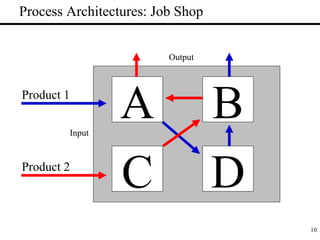
Process Architectures: Job Shop
A
C
B
D
Product 1
Output
Input
Product 2
11
Job Shop
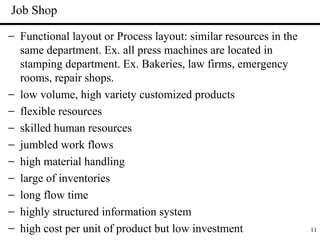
− Functional layout or Process layout: similar resources in the
same department. Ex. all press machines are located in
stamping department. Ex. Bakeries, law firms, emergency
rooms, repair shops.
− low volume, high variety customized products
− flexible resources
− skilled human resources
− jumbled work flows
− high material handling
− large of inventories
− long flow time
− highly structured information system
− high cost per unit of product but low investment
12
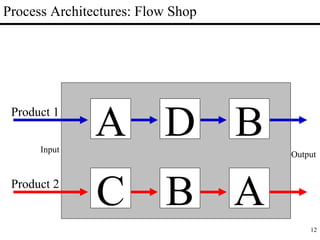
Process Architectures: Flow Shop
Output
Input
A
C
BD
B A
Product 1
Product 2
13
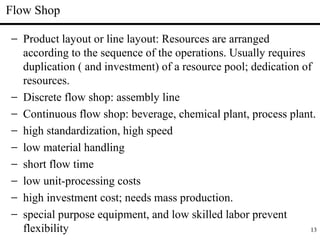
Flow Shop
− Product layout or line layout: Resources are arranged
according to the sequence of the operations. Usually requires
duplication ( and investment) of a resource pool; dedication of
resources.
− Discrete flow shop: assembly line
− Continuous flow shop: beverage, chemical plant, process plant.
− high standardization, high speed
− low material handling
− short flow time
− low unit-processing costs
− high investment cost; needs mass production.
− special purpose equipment, and low skilled labor prevent
flexibility
14
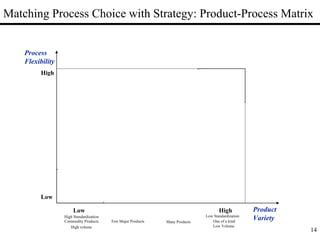
Process
Flexibility
Jumbled Flow.
Process segments
loosely linked.
Disconnected Line
Flow/Jumbled Flow
but a dominant flow
exists.
JOB SHOP
(Commercial Printer,
Architecture firm)
BATCH
(Heavy Equipment,
Auto Repair)
FLOW SHOP
(Auto Assembly,
Car lubrication shop)
CONTINUOUS
FLOW
(Oil Refinery)
Product
Variety
Low
Low Standardization
One of a kind
Low Volume
Many ProductsFew Major Products
High volume
High Standardization
Commodity Products
Connected Line
Flow (assembly line)
Continuous, automated,
rigid line flow.
Process segments tightly
linked.
O
pportunity
Costs
O
ut-of-pocket
Costs
High
Low
High
Matching Process Choice with Strategy: Product-Process Matrix
15
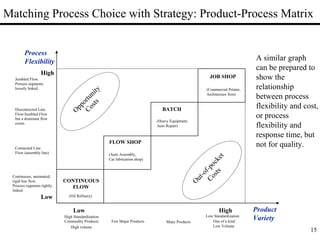
Process
Flexibility
Jumbled Flow.
Process segments
loosely linked.
Disconnected Line
Flow/Jumbled Flow
but a dominant flow
exists.
JOB SHOP
(Commercial Printer,
Architecture firm)
BATCH
(Heavy Equipment,
Auto Repair)
FLOW SHOP
(Auto Assembly,
Car lubrication shop)
CONTINUOUS
FLOW
(Oil Refinery)
Product
Variety
Low
Low Standardization
One of a kind
Low Volume
Many ProductsFew Major Products
High volume
High Standardization
Commodity Products
Connected Line
Flow (assembly line)
Continuous, automated,
rigid line flow.
Process segments tightly
linked.
O
pportunity
Costs
O
ut-of-pocket
Costs
High
Low
High
A similar graph
can be prepared to
show the
relationship
between process
flexibility and cost,
or process
flexibility and
response time, but
not for quality.
Matching Process Choice with Strategy: Product-Process Matrix
16
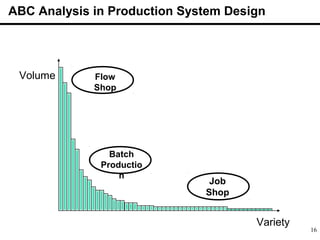
Volume
Variety
ABC Analysis in Production System Design
Job
Shop
Batch
Productio
n
Flow
Shop
17
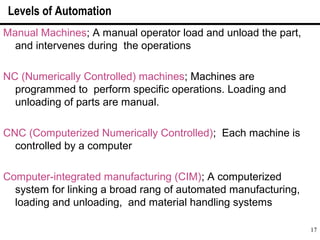
Manual Machines; A manual operator load and unload the part,
and intervenes during the operations
NC (Numerically Controlled) machines; Machines are
programmed to perform specific operations. Loading and
unloading of parts are manual.
CNC (Computerized Numerically Controlled); Each machine is
controlled by a computer
Computer-integrated manufacturing (CIM); A computerized
system for linking a broad rang of automated manufacturing,
loading and unloading, and material handling systems
Levels of Automation
18
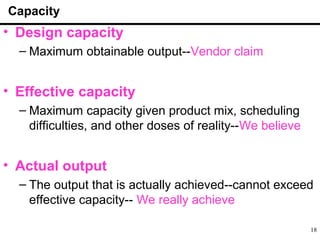
• Design capacity
– Maximum obtainable output--Vendor claim
• Effective capacity
– Maximum capacity given product mix, scheduling
difficulties, and other doses of reality--We believe
• Actual output
– The output that is actually achieved--cannot exceed
effective capacity-- We really achieve
Capacity
19
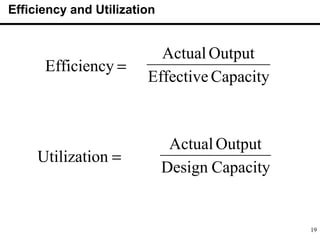
Efficiency and Utilization
Efficiency =
CapacityEffective
OutputActual
nUtilizatio =
CapacityDesign
OutputActual
20
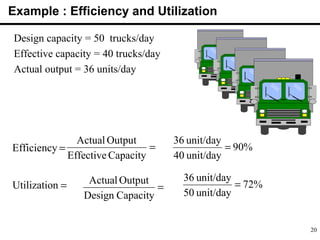
Design capacity = 50 trucks/day
Effective capacity = 40 trucks/day
Actual output = 36 units/day
Example : Efficiency and Utilization
Efficiency = =
CapacityEffective
OutputActual
nUtilizatio = =
CapacityDesign
OutputActual
%90
unit/day40
unit/day36
=
%72
unit/day50
unit/day36
=
21
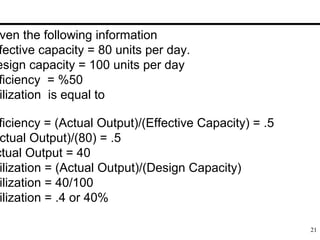
ven the following information
fective capacity = 80 units per day.
esign capacity = 100 units per day
ficiency = %50
ilization is equal to
ficiency = (Actual Output)/(Effective Capacity) = .5
ctual Output)/(80) = .5
ctual Output = 40
ilization = (Actual Output)/(Design Capacity)
ilization = 40/100
ilization = .4 or 40%

Ch5 1 process

  • 1.
    1 Born in Moscowin 1863, Constantin Sergeyevich Stanislavsky had a more profound effect on the process of acting than anyone else in the twentieth century. It was his assertion that if the theater was going to be meaningful it needed to move beyond the external representation that acting had primarily been. Over forty years he created an approach that forefronted the psychological and emotional aspects of acting. The Stanislavsky System, or "the method," as it has become known, held that an actor’s main responsibility was to be believed (rather than recognized or understood). Today in the United States, Stanislavsky’s theories are the primary source of study for many actors. Among the many great actors and teachers to use his work are Marlon Brando and Gregory Peck. Many of artists have continued experimentation with Stanislavsky’s ideas. Among the best known of these proponents is the Actors Studio, an organization that has been home to some of the most talented and successful actors of our time. Stanislavsky saw that the difference between the good actor and the great actor was the ability to be relaxed, and to be private in public. We learn from Stanislavsky: As the students relax before the lecture start; they clean the slate, going to a zero state, being ready for the best performance in the learning process. State Zero
  • 2.
    2 Quality Function Deployment(QDF) An approach that integrates “the voice of customer” into product development and design process House of Quality
  • 3.
    3 Customer Requirements andTechnical Requirements
  • 4.
  • 5.
  • 6.
    6 Ch 5(A) :Process Planning
  • 7.
    7 Process Planning isamong System Design duties in OM. Forecasting Product and service design Capacity planning Facilities and Equipment Layout Work design Process selection Process Selection in Operations Management
  • 8.
    8 Process Architectures Process Architecturerefers to  Physical layout of resources Job Shop Batch Processing Flow Shop Continuous Flow  Flexibility of resources R_Human: Cross functional workers R_Capital: Short set-up time
  • 9.
    9 System Example Job ShopCommercial Printer Batch Processing Heavy Equipment Flow Shop (Production Line) Car Assembly Continuous Flow Sugar Refinery Examples of 4 basic type production Systems Most Processes are some where between Job shop and Flow shop
  • 10.
    10 Process Architectures: JobShop A C B D Product 1 Output Input Product 2
  • 11.
    11 Job Shop − Functionallayout or Process layout: similar resources in the same department. Ex. all press machines are located in stamping department. Ex. Bakeries, law firms, emergency rooms, repair shops. − low volume, high variety customized products − flexible resources − skilled human resources − jumbled work flows − high material handling − large of inventories − long flow time − highly structured information system − high cost per unit of product but low investment
  • 12.
    12 Process Architectures: FlowShop Output Input A C BD B A Product 1 Product 2
  • 13.
    13 Flow Shop − Productlayout or line layout: Resources are arranged according to the sequence of the operations. Usually requires duplication ( and investment) of a resource pool; dedication of resources. − Discrete flow shop: assembly line − Continuous flow shop: beverage, chemical plant, process plant. − high standardization, high speed − low material handling − short flow time − low unit-processing costs − high investment cost; needs mass production. − special purpose equipment, and low skilled labor prevent flexibility
  • 14.
    14 Process Flexibility Jumbled Flow. Process segments looselylinked. Disconnected Line Flow/Jumbled Flow but a dominant flow exists. JOB SHOP (Commercial Printer, Architecture firm) BATCH (Heavy Equipment, Auto Repair) FLOW SHOP (Auto Assembly, Car lubrication shop) CONTINUOUS FLOW (Oil Refinery) Product Variety Low Low Standardization One of a kind Low Volume Many ProductsFew Major Products High volume High Standardization Commodity Products Connected Line Flow (assembly line) Continuous, automated, rigid line flow. Process segments tightly linked. O pportunity Costs O ut-of-pocket Costs High Low High Matching Process Choice with Strategy: Product-Process Matrix
  • 15.
    15 Process Flexibility Jumbled Flow. Process segments looselylinked. Disconnected Line Flow/Jumbled Flow but a dominant flow exists. JOB SHOP (Commercial Printer, Architecture firm) BATCH (Heavy Equipment, Auto Repair) FLOW SHOP (Auto Assembly, Car lubrication shop) CONTINUOUS FLOW (Oil Refinery) Product Variety Low Low Standardization One of a kind Low Volume Many ProductsFew Major Products High volume High Standardization Commodity Products Connected Line Flow (assembly line) Continuous, automated, rigid line flow. Process segments tightly linked. O pportunity Costs O ut-of-pocket Costs High Low High A similar graph can be prepared to show the relationship between process flexibility and cost, or process flexibility and response time, but not for quality. Matching Process Choice with Strategy: Product-Process Matrix
  • 16.
    16 Volume Variety ABC Analysis inProduction System Design Job Shop Batch Productio n Flow Shop
  • 17.
    17 Manual Machines; Amanual operator load and unload the part, and intervenes during the operations NC (Numerically Controlled) machines; Machines are programmed to perform specific operations. Loading and unloading of parts are manual. CNC (Computerized Numerically Controlled); Each machine is controlled by a computer Computer-integrated manufacturing (CIM); A computerized system for linking a broad rang of automated manufacturing, loading and unloading, and material handling systems Levels of Automation
  • 18.
    18 • Design capacity –Maximum obtainable output--Vendor claim • Effective capacity – Maximum capacity given product mix, scheduling difficulties, and other doses of reality--We believe • Actual output – The output that is actually achieved--cannot exceed effective capacity-- We really achieve Capacity
  • 19.
    19 Efficiency and Utilization Efficiency= CapacityEffective OutputActual nUtilizatio = CapacityDesign OutputActual
  • 20.
    20 Design capacity =50 trucks/day Effective capacity = 40 trucks/day Actual output = 36 units/day Example : Efficiency and Utilization Efficiency = = CapacityEffective OutputActual nUtilizatio = = CapacityDesign OutputActual %90 unit/day40 unit/day36 = %72 unit/day50 unit/day36 =
  • 21.
    21 ven the followinginformation fective capacity = 80 units per day. esign capacity = 100 units per day ficiency = %50 ilization is equal to ficiency = (Actual Output)/(Effective Capacity) = .5 ctual Output)/(80) = .5 ctual Output = 40 ilization = (Actual Output)/(Design Capacity) ilization = 40/100 ilization = .4 or 40%