Tuning the planning and control systems to
product and process design
Technology and Innovation
Contents
1 Introduction
2 The need for Production Planning
3 Planning
4 Aggregate Production Planning
5 Work Force Planning
6 Material Requirement Planning
7 Routing, Scheduling and Loading
8 Production Control and Production Control using JIT
9 Shop Floor control
10 Dispatching, Follow-up and Inspection
11 Corrective measures
© 2017. All Rights Reserved.
Introduction
• Production Planning may be said to be a technique of
forecasting ahead every step in the long process of
production, taking them at right time and in the right degree
and trying to complete operations at the maximum
efficiency.
• Production control is the process that keeps a watchful eye
on the production flow and size of resources along with the
location, of any deviation from the present action and to
arrange for the prompt adjustment so that the production
may run according to the original or revised schedule.
• Planned production is an important feature of the small
industry.
• Planning and control involve generally the organization and
planning of manufacturing process.
• The ultimate objective is the organization of the supply and
movement of materials and labor, machines utilization and
related activities.
© 2017. All Rights Reserved.
Need for production planning
Addresses decisions on
 Acquisition
 Utilization
 Allocation of limited
production
resources
 Resources include the production
facilities, labor and materials.
 Constraints include the availability
of resources, delivery times for the
products and management policies.
 Optimum Utilization of Capacity
 Inventory control
 Economy in production time
 Ensure quality
 To sum up we may say that PPC is of
immense value to the entrepreneur
in capacity utilization and inventory
control.
 More importantly it improves his
response time and quality. As such
effective PPC contributes to time,
quality and cost parameters of
entrepreneurial success.
© 2017. All Rights Reserved.
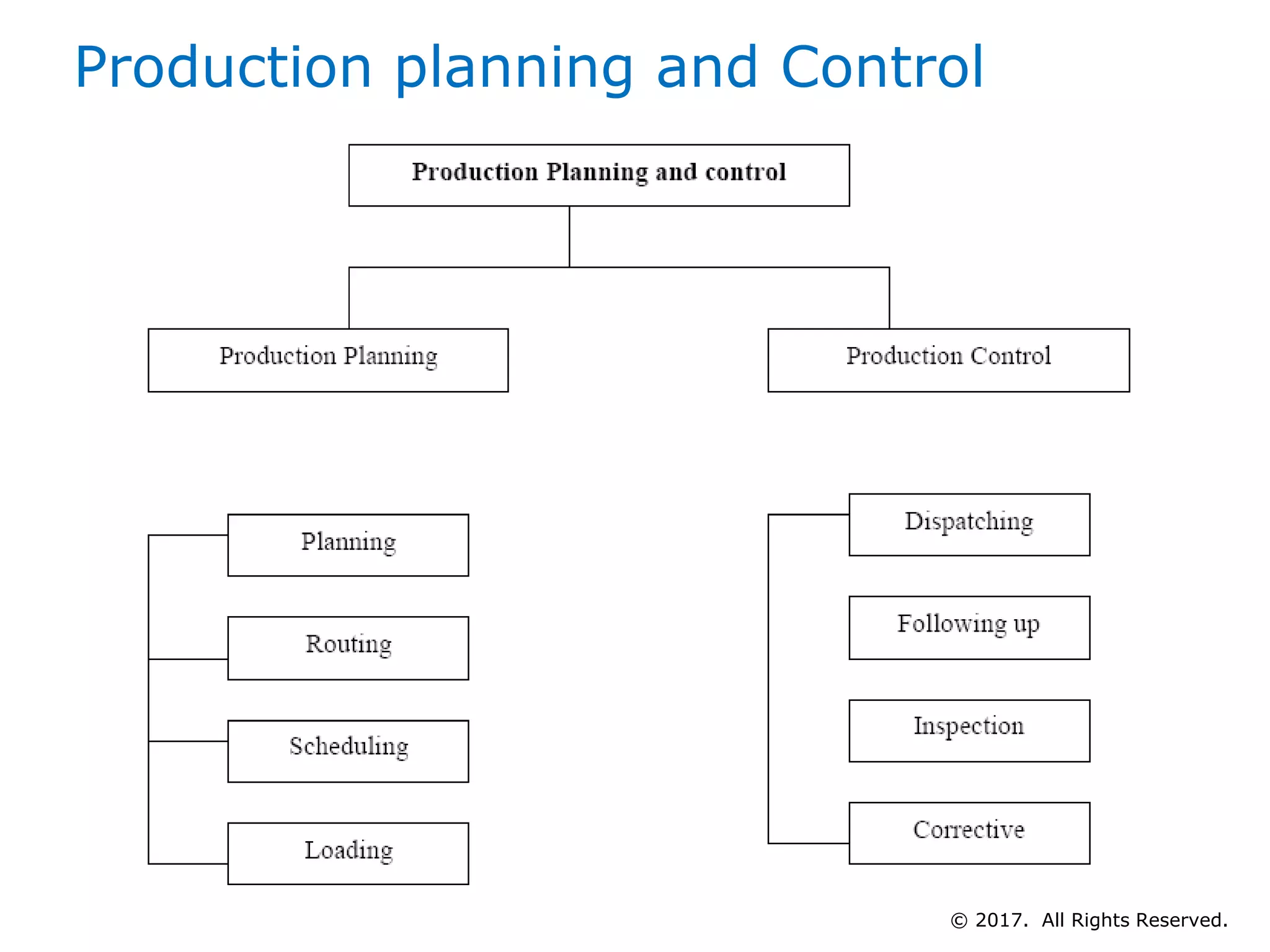
Production planning and Control
© 2017. All Rights Reserved.
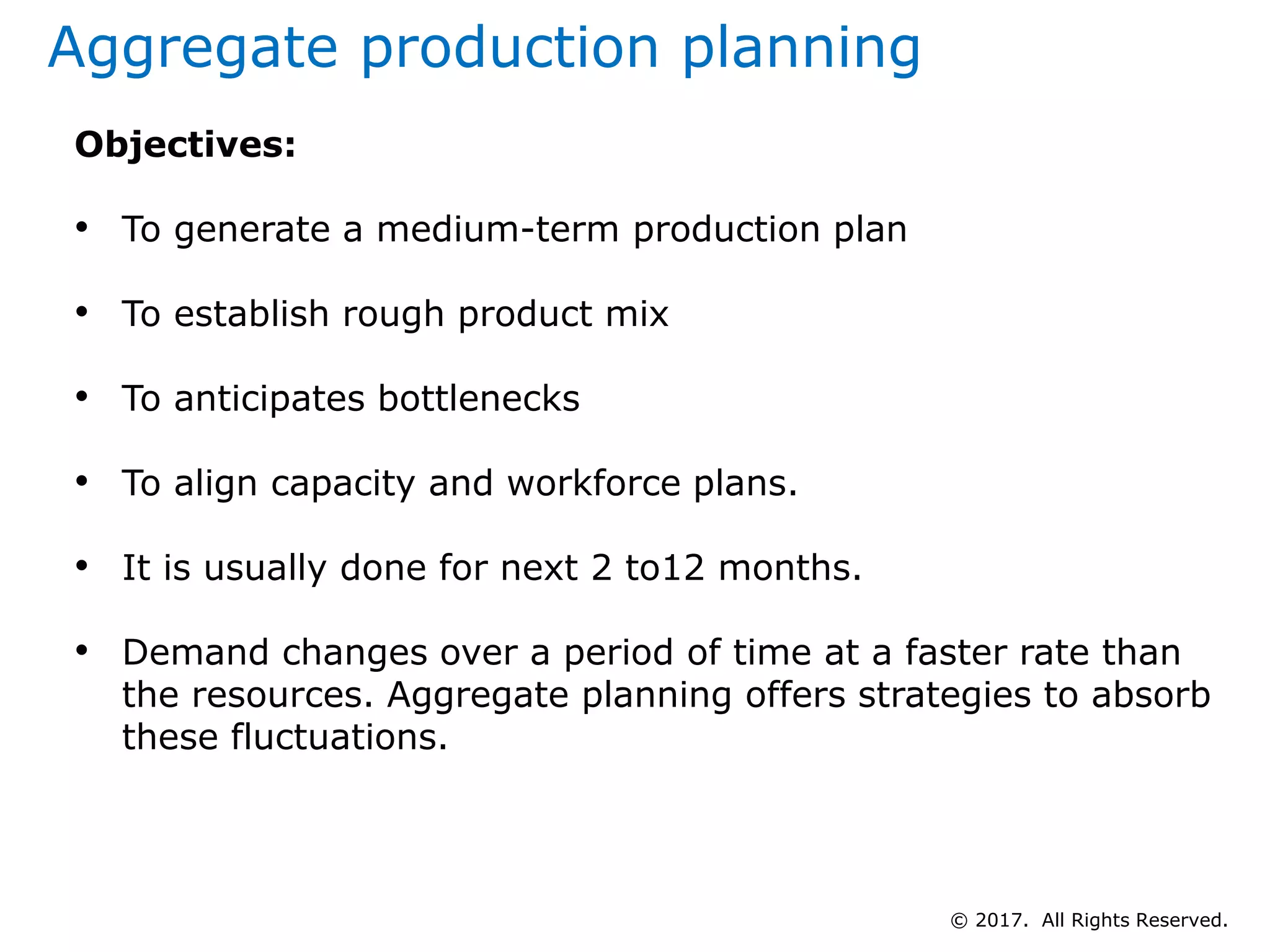
Aggregate production planning
Objectives:
• To generate a medium-term production plan
• To establish rough product mix
• To anticipates bottlenecks
• To align capacity and workforce plans.
• It is usually done for next 2 to12 months.
• Demand changes over a period of time at a faster rate than
the resources. Aggregate planning offers strategies to absorb
these fluctuations.
© 2017. All Rights Reserved.
Aggregate production planning
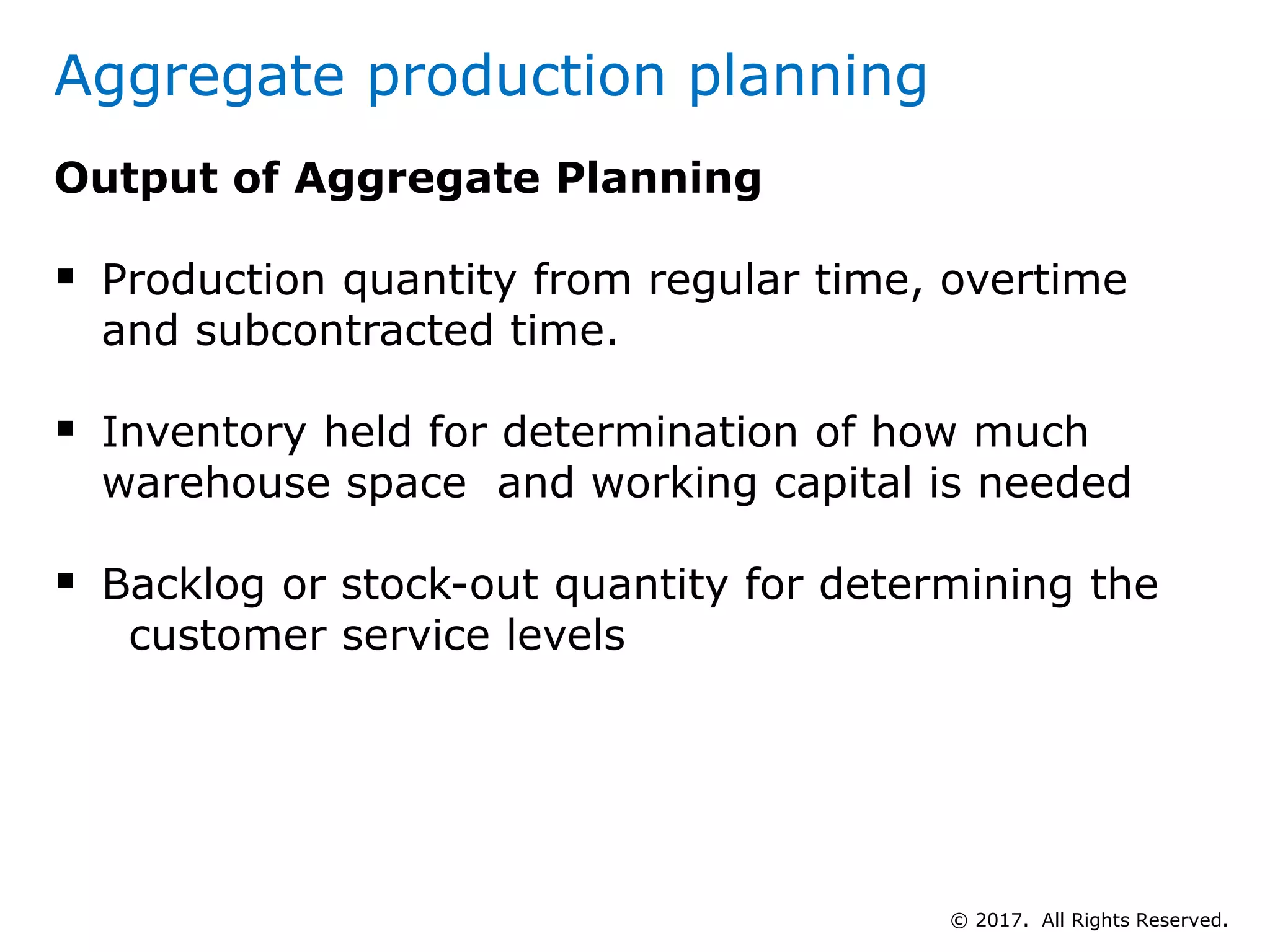
Output of Aggregate Planning
 Production quantity from regular time, overtime
and subcontracted time.
 Inventory held for determination of how much
warehouse space and working capital is needed
 Backlog or stock-out quantity for determining the
customer service levels
© 2017. All Rights Reserved.
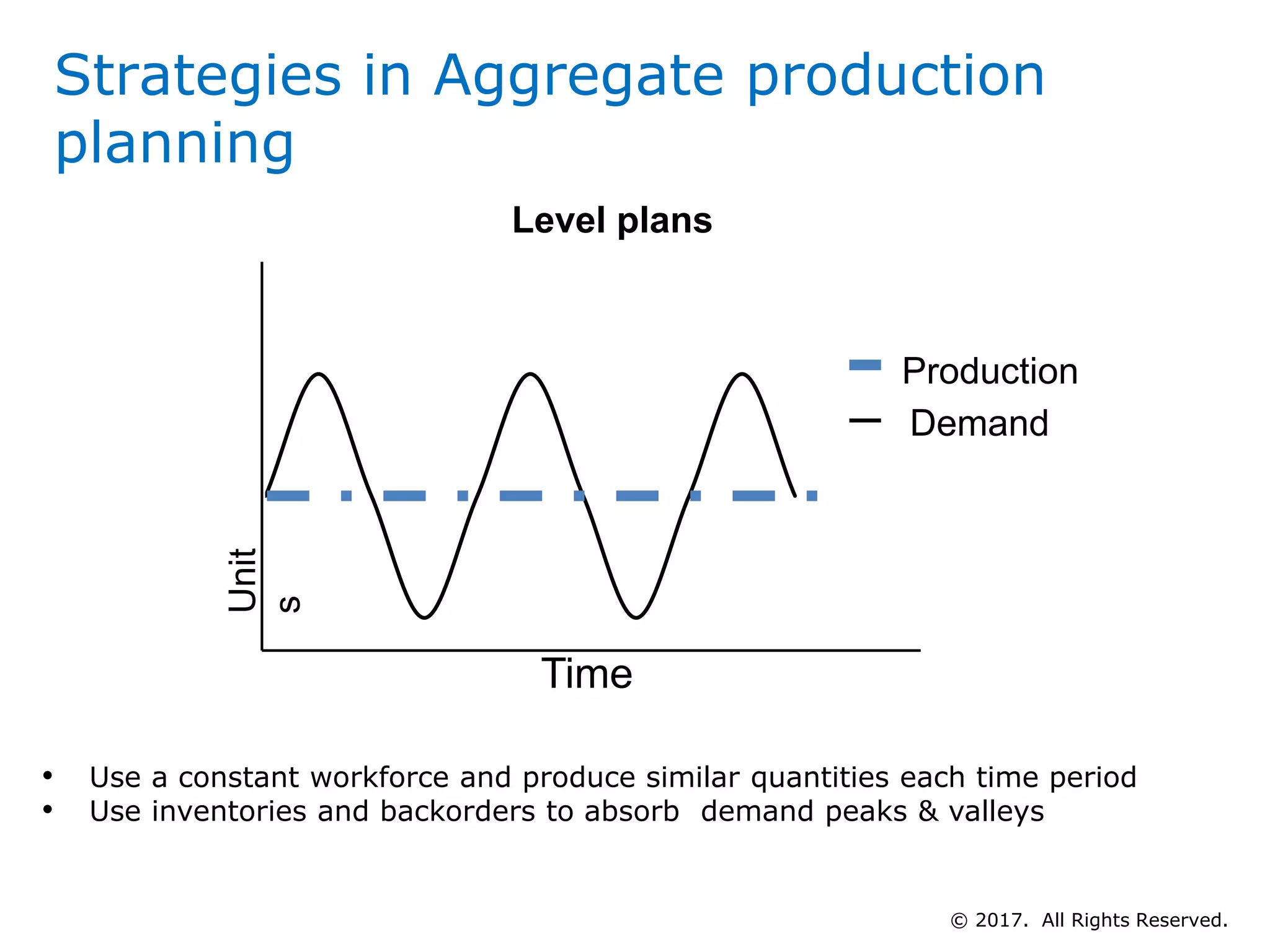
Production
Demand
Unit
s
Time
Level plans
• Use a constant workforce and produce similar quantities each time period
• Use inventories and backorders to absorb demand peaks & valleys
Strategies in Aggregate production
planning
© 2017. All Rights Reserved.
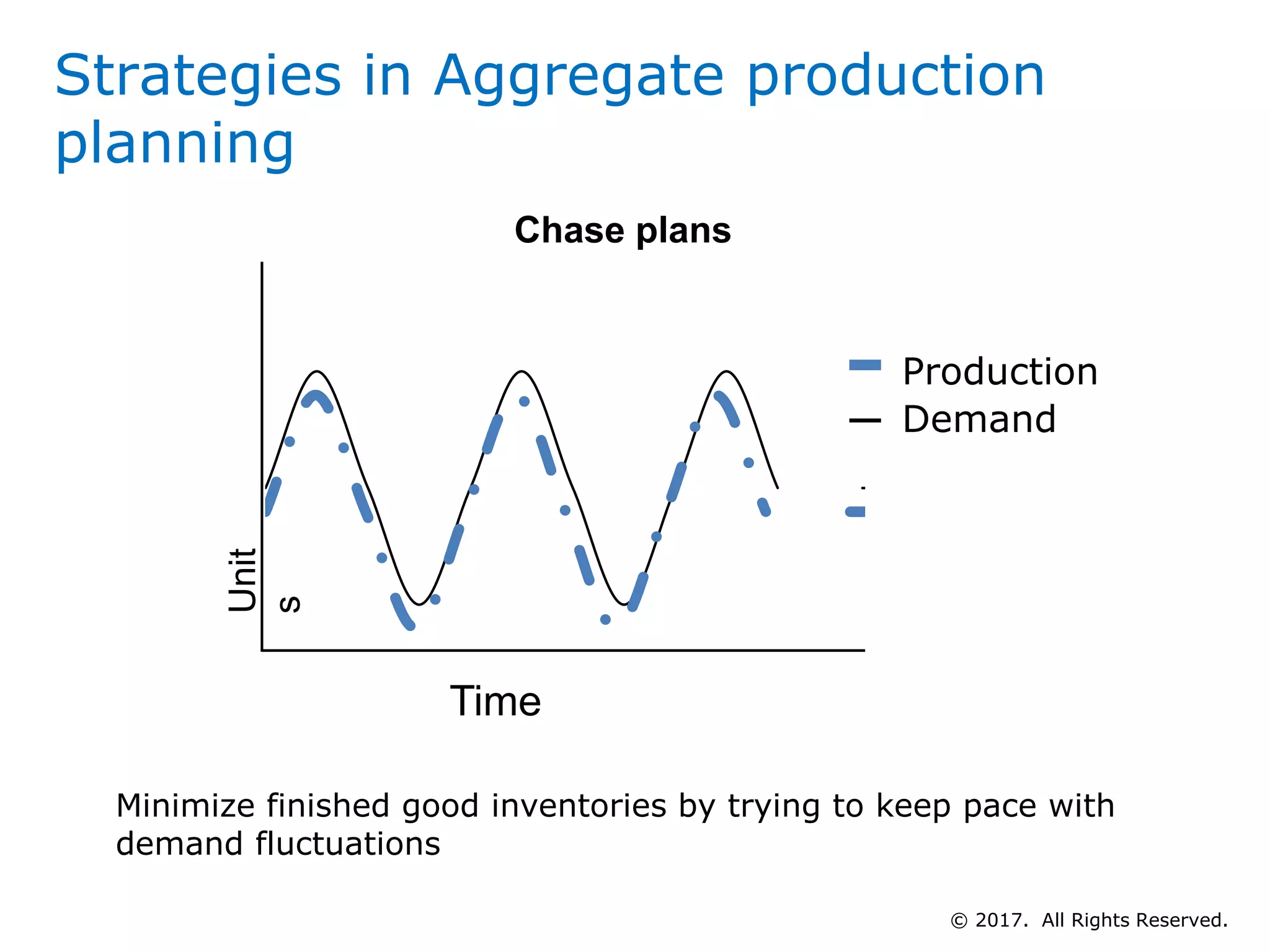
Unit
s
Time
Series1
Production
Demand
Chase plans
Series1
Minimize finished good inventories by trying to keep pace with
demand fluctuations
Strategies in Aggregate production
planning
© 2017. All Rights Reserved.
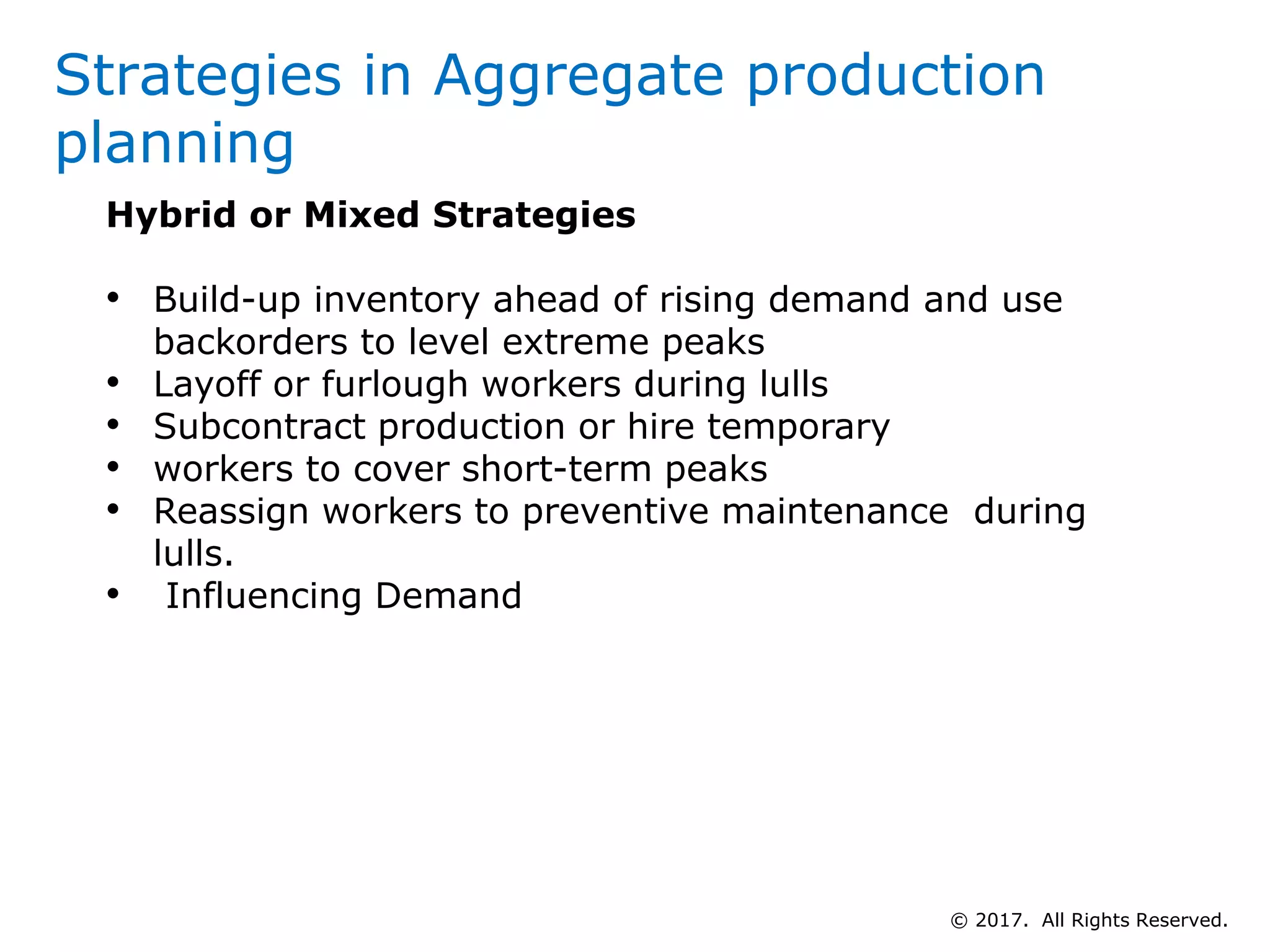
Hybrid or Mixed Strategies
• Build-up inventory ahead of rising demand and use
backorders to level extreme peaks
• Layoff or furlough workers during lulls
• Subcontract production or hire temporary
• workers to cover short-term peaks
• Reassign workers to preventive maintenance during
lulls.
• Influencing Demand
Strategies in Aggregate production
planning
© 2017. All Rights Reserved.
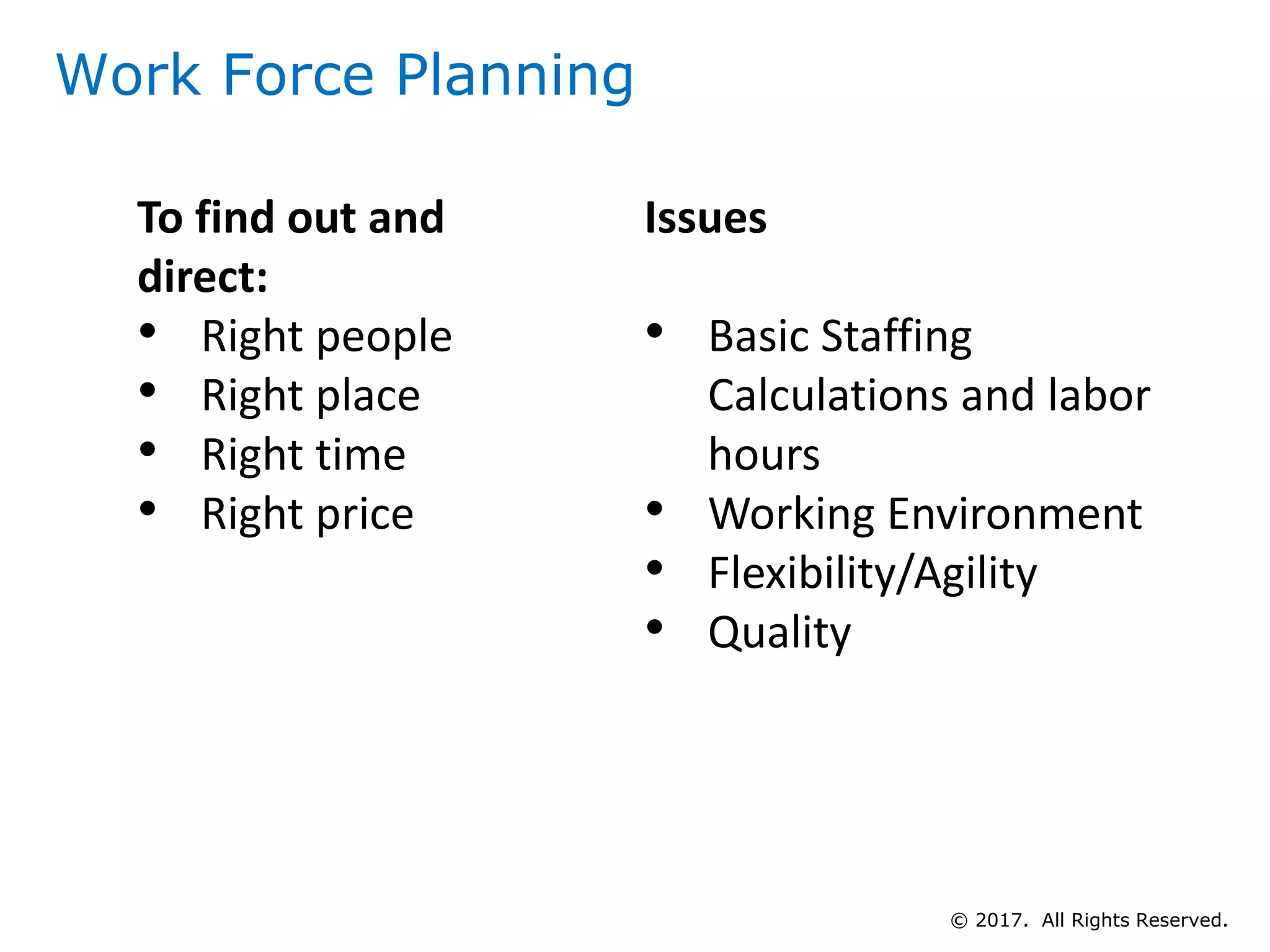
Work Force Planning
To find out and
direct:
• Right people
• Right place
• Right time
• Right price
Issues
• Basic Staffing
Calculations and labor
hours
• Working Environment
• Flexibility/Agility
• Quality
© 2017. All Rights Reserved.
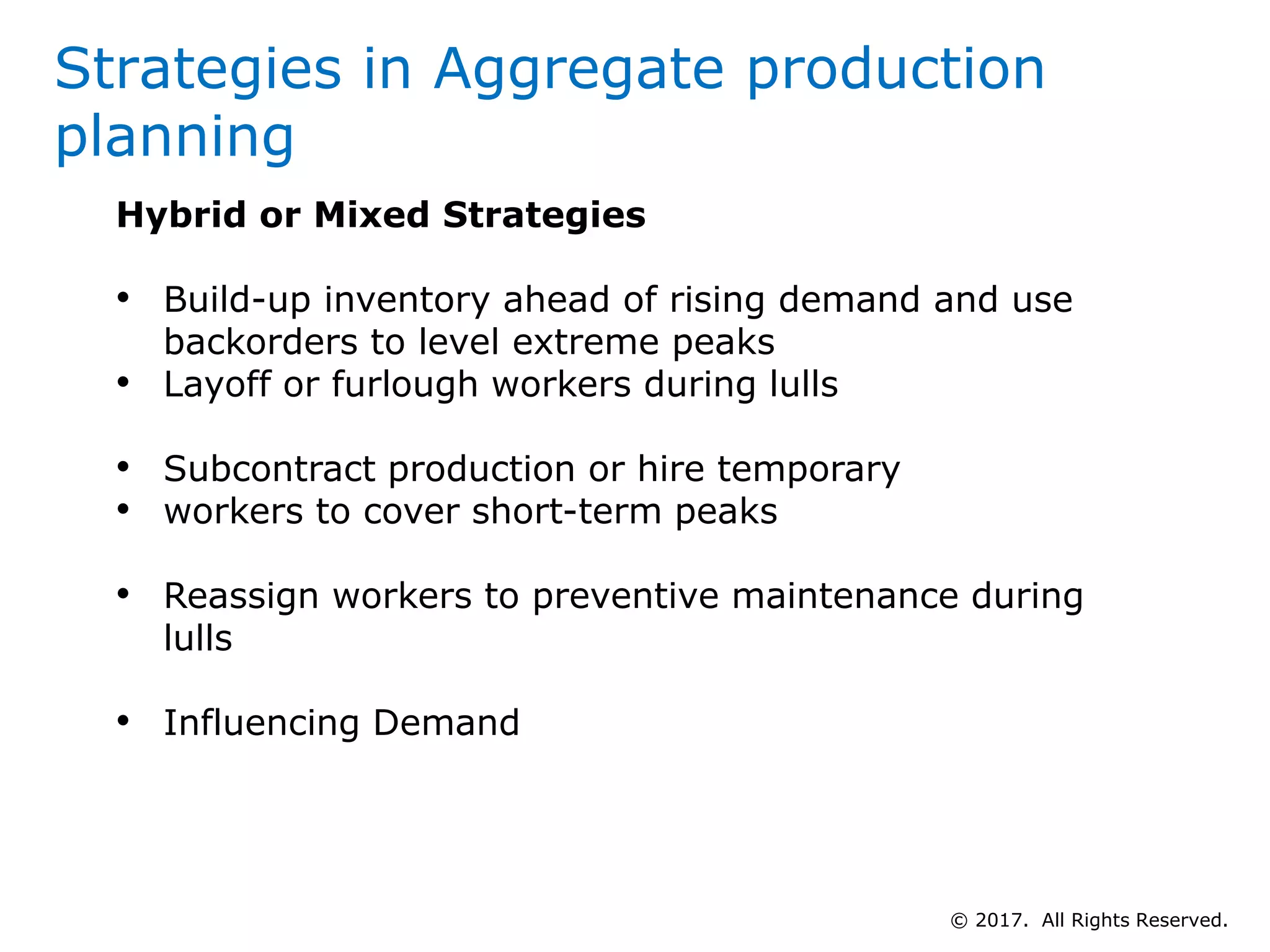
Hybrid or Mixed Strategies
• Build-up inventory ahead of rising demand and use
backorders to level extreme peaks
• Layoff or furlough workers during lulls
• Subcontract production or hire temporary
• workers to cover short-term peaks
• Reassign workers to preventive maintenance during
lulls
• Influencing Demand
Strategies in Aggregate production
planning
© 2017. All Rights Reserved.
Material Requirement Planning
MRP is a production planning and inventory control system
used to manage manufacturing processes.
An MRP system has 3 major objectives
 Ensure materials are available for production and products are
available for delivery to customers.
 Maintain the lowest possible level of inventory
 Plan manufacturing activities, delivery schedules
and purchasing activities
© 2017. All Rights Reserved.
Routing
• Under this, the operations, their path and sequence are
established.
• To perform these operations the proper class of machines
and personnel required are also worked out. The main
aim of routing is to determine the best and cheapest
sequence of operations and to ensure that this sequence
is strictly followed.
• Routing procedure involves following different activities.
• An analysis of the article to determine what to make and
what to buy.
• To determine the quality and type of material
• Determining the manufacturing operations and their
sequence.
• A determination of lot sizes
• Determination of scrap factors
• An analysis of cost of the article
• Organization of production control forms.
© 2017. All Rights Reserved.
Scheduling
Types of scheduling
 Forward scheduling
 Backward scheduling
The pattern of scheduling differs
from one job to another which is
explained as below.
 Master Schedule
 Production Schedule
 Manufacturing Schedule
 Scheduling of Job Order
manufacturing
© 2017. All Rights Reserved.
Production Control
“Production control is the process of planning
production in advance of operations,
establishing the exact route of each individual
item part or assembly, setting, starting and
finishing for each important item, assembly or
the finishing production and releasing the
necessary orders as well as initiating the
necessary follow-up to have the smooth
function of the enterprise.”
© 2017. All Rights Reserved.
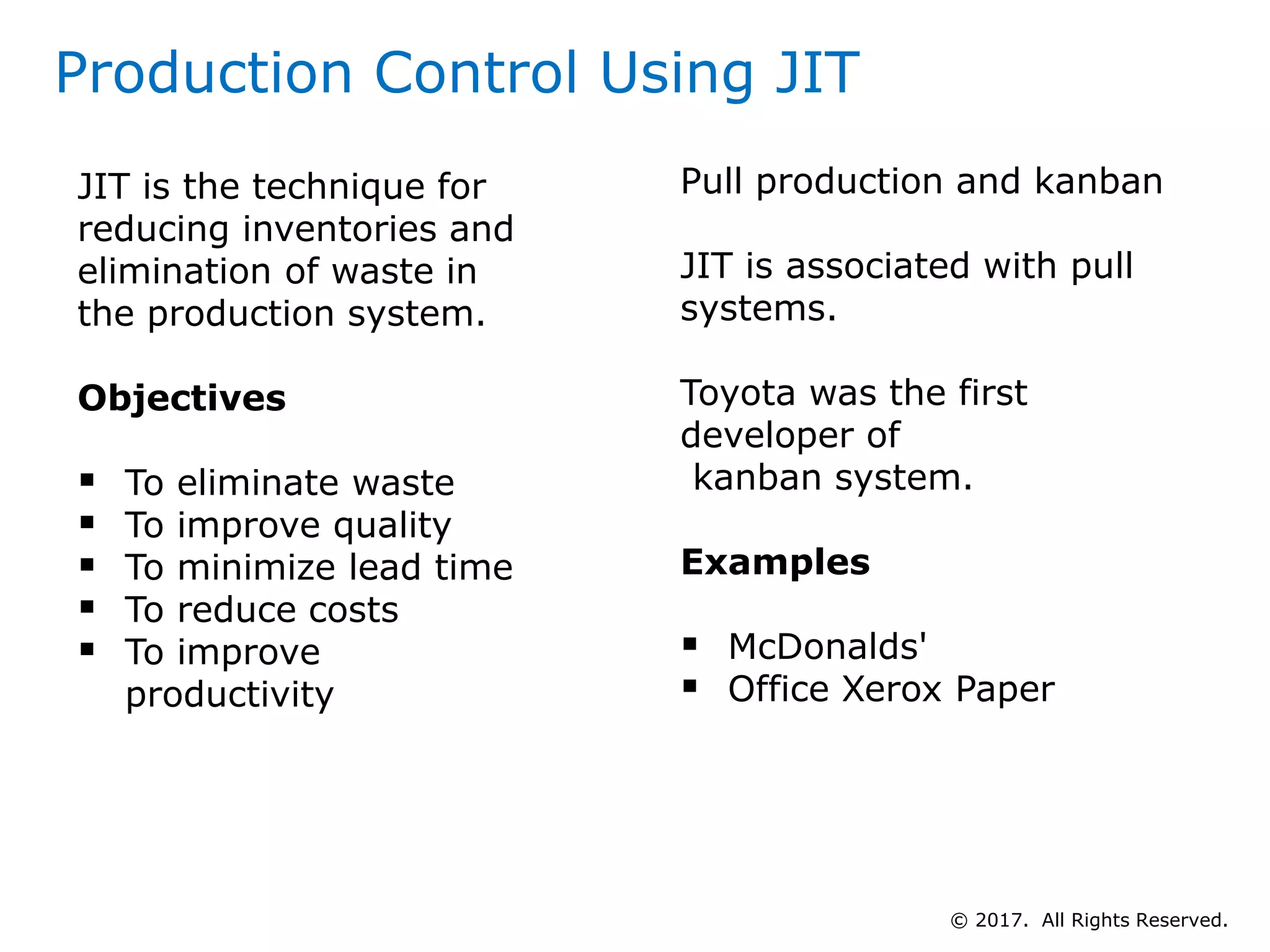
Production Control Using JIT
Pull production and kanban
JIT is associated with pull
systems.
Toyota was the first
developer of
kanban system.
Examples
 McDonalds'
 Office Xerox Paper
JIT is the technique for
reducing inventories and
elimination of waste in
the production system.
Objectives
 To eliminate waste
 To improve quality
 To minimize lead time
 To reduce costs
 To improve
productivity
© 2017. All Rights Reserved.
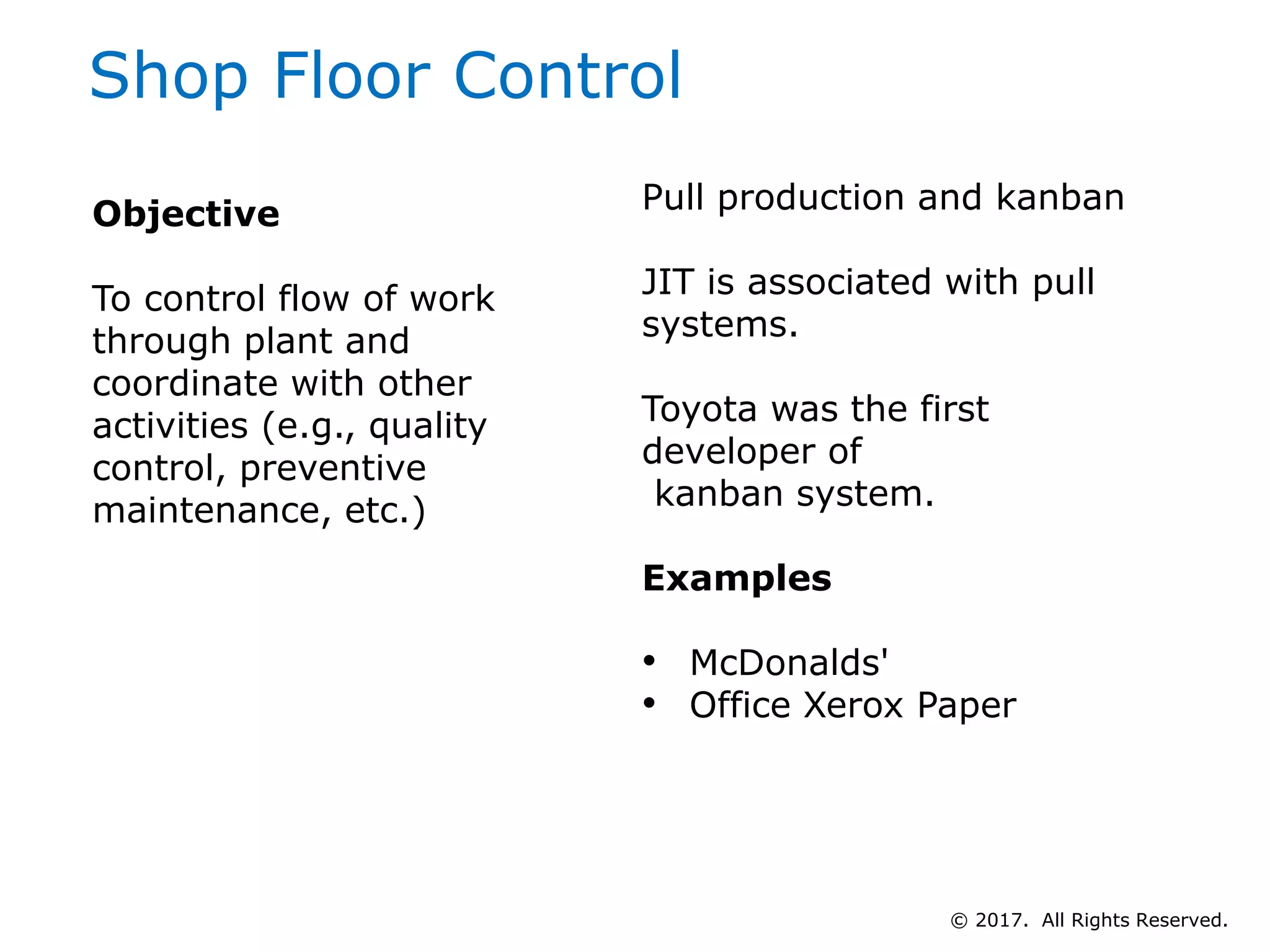
Shop Floor Control
Pull production and kanban
JIT is associated with pull
systems.
Toyota was the first
developer of
kanban system.
Examples
• McDonalds'
• Office Xerox Paper
Objective
To control flow of work
through plant and
coordinate with other
activities (e.g., quality
control, preventive
maintenance, etc.)
© 2017. All Rights Reserved.
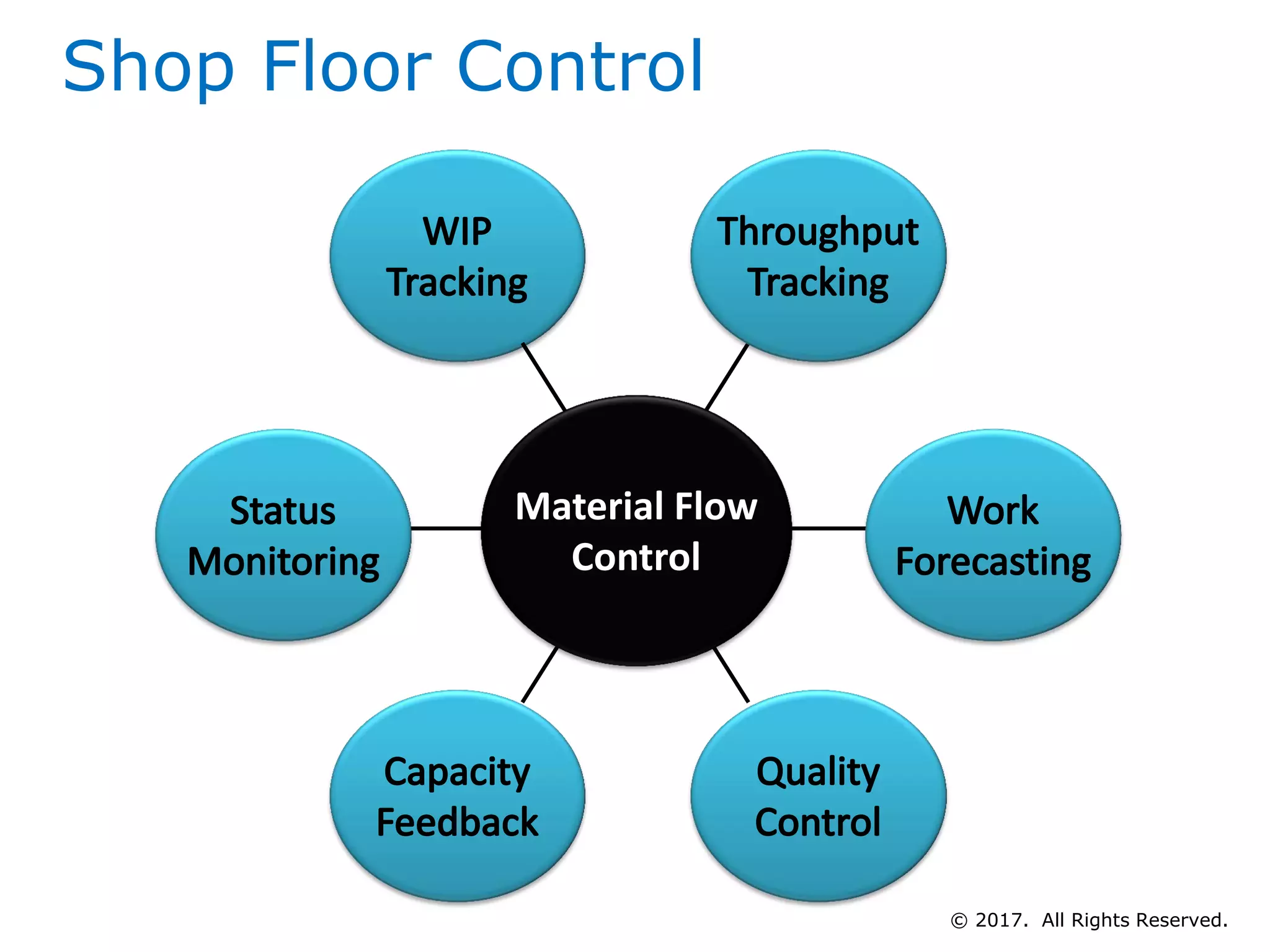
Shop Floor Control
Material Flow
Control
© 2017. All Rights Reserved.
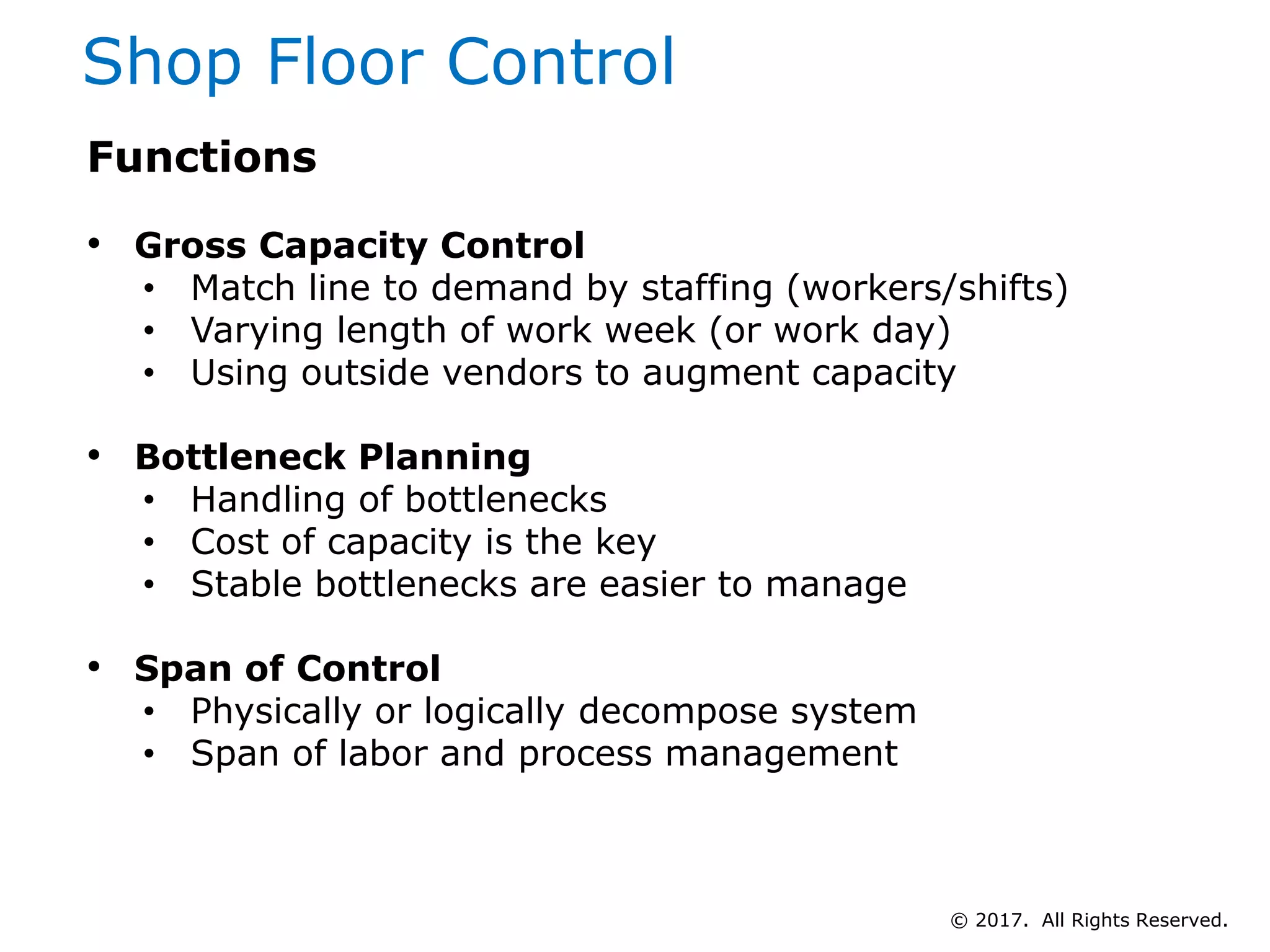
Shop Floor Control
Functions
• Gross Capacity Control
• Match line to demand by staffing (workers/shifts)
• Varying length of work week (or work day)
• Using outside vendors to augment capacity
• Bottleneck Planning
• Handling of bottlenecks
• Cost of capacity is the key
• Stable bottlenecks are easier to manage
• Span of Control
• Physically or logically decompose system
• Span of labor and process management
© 2017. All Rights Reserved.
Shop Floor Control
Issues:
• Customization
• SFC is often the most highly customized activity in
a plant.
• Information Collection
• SFC represents the interface with the actual
production processes and is therefore a good place
to collect data.
© 2017. All Rights Reserved.
Dispatching
Dispatching involves issue of production orders for starting the
operations. Necessary authority and conformation is given for:
• Movement of materials to different workstations.
• Movement of tools and fixtures necessary for each
operation.
• Beginning of work on each operation.
• Recording of time and cost involved in each operation.
• Movement of work from one operation to another in
accordance with the route sheet.
• Inspecting or supervision of work
© 2017. All Rights Reserved.
Follow Up and Inspection
• Every production program involves determination of
the progress of work, removing bottlenecks in the flow
of work and ensuring that the productive operations
are taking place in accordance with the plans.
• It spots delays or deviations from the production
plans. It helps to reveal detects in routing and
scheduling, misunderstanding of orders and
instruction, under loading or overloading of work etc.
• All problems or deviations are investigated and
remedial measurer are undertaken to ensure the
completion of work by the planned date.
• This is mainly to ensure the quality of goods. It can be
required as effective agency of production control.
© 2017. All Rights Reserved.
Corrective Measure
Corrective action may involve any of those activities of
adjusting the route:
• rescheduling of work
• changing the workloads
• repairs and maintenance of machinery or equipment
• control over inventories of the cause of deviation is the
poor performance of the employees.
• Certain personnel decisions like training, transfer,
demotion etc. may have to be taken. Alternate
methods may be suggested to handle peak loads.
© 2017. All Rights Reserved.
Tuning the planning and control system to product and process design: G3

Tuning the planning and control system to product and process design: G3

  • 1.
    Tuning the planningand control systems to product and process design Technology and Innovation
  • 2.
    Contents 1 Introduction 2 Theneed for Production Planning 3 Planning 4 Aggregate Production Planning 5 Work Force Planning 6 Material Requirement Planning 7 Routing, Scheduling and Loading 8 Production Control and Production Control using JIT 9 Shop Floor control 10 Dispatching, Follow-up and Inspection 11 Corrective measures © 2017. All Rights Reserved.
  • 3.
    Introduction • Production Planningmay be said to be a technique of forecasting ahead every step in the long process of production, taking them at right time and in the right degree and trying to complete operations at the maximum efficiency. • Production control is the process that keeps a watchful eye on the production flow and size of resources along with the location, of any deviation from the present action and to arrange for the prompt adjustment so that the production may run according to the original or revised schedule. • Planned production is an important feature of the small industry. • Planning and control involve generally the organization and planning of manufacturing process. • The ultimate objective is the organization of the supply and movement of materials and labor, machines utilization and related activities. © 2017. All Rights Reserved.
  • 4.
    Need for productionplanning Addresses decisions on  Acquisition  Utilization  Allocation of limited production resources  Resources include the production facilities, labor and materials.  Constraints include the availability of resources, delivery times for the products and management policies.  Optimum Utilization of Capacity  Inventory control  Economy in production time  Ensure quality  To sum up we may say that PPC is of immense value to the entrepreneur in capacity utilization and inventory control.  More importantly it improves his response time and quality. As such effective PPC contributes to time, quality and cost parameters of entrepreneurial success. © 2017. All Rights Reserved.
  • 5.
    Production planning andControl © 2017. All Rights Reserved.
  • 6.
    Aggregate production planning Objectives: •To generate a medium-term production plan • To establish rough product mix • To anticipates bottlenecks • To align capacity and workforce plans. • It is usually done for next 2 to12 months. • Demand changes over a period of time at a faster rate than the resources. Aggregate planning offers strategies to absorb these fluctuations. © 2017. All Rights Reserved.
  • 7.
    Aggregate production planning Outputof Aggregate Planning  Production quantity from regular time, overtime and subcontracted time.  Inventory held for determination of how much warehouse space and working capital is needed  Backlog or stock-out quantity for determining the customer service levels © 2017. All Rights Reserved.
  • 8.
    Production Demand Unit s Time Level plans • Usea constant workforce and produce similar quantities each time period • Use inventories and backorders to absorb demand peaks & valleys Strategies in Aggregate production planning © 2017. All Rights Reserved.
  • 9.
    Unit s Time Series1 Production Demand Chase plans Series1 Minimize finishedgood inventories by trying to keep pace with demand fluctuations Strategies in Aggregate production planning © 2017. All Rights Reserved.
  • 10.
    Hybrid or MixedStrategies • Build-up inventory ahead of rising demand and use backorders to level extreme peaks • Layoff or furlough workers during lulls • Subcontract production or hire temporary • workers to cover short-term peaks • Reassign workers to preventive maintenance during lulls. • Influencing Demand Strategies in Aggregate production planning © 2017. All Rights Reserved.
  • 11.
    Work Force Planning Tofind out and direct: • Right people • Right place • Right time • Right price Issues • Basic Staffing Calculations and labor hours • Working Environment • Flexibility/Agility • Quality © 2017. All Rights Reserved.
  • 12.
    Hybrid or MixedStrategies • Build-up inventory ahead of rising demand and use backorders to level extreme peaks • Layoff or furlough workers during lulls • Subcontract production or hire temporary • workers to cover short-term peaks • Reassign workers to preventive maintenance during lulls • Influencing Demand Strategies in Aggregate production planning © 2017. All Rights Reserved.
  • 13.
    Material Requirement Planning MRPis a production planning and inventory control system used to manage manufacturing processes. An MRP system has 3 major objectives  Ensure materials are available for production and products are available for delivery to customers.  Maintain the lowest possible level of inventory  Plan manufacturing activities, delivery schedules and purchasing activities © 2017. All Rights Reserved.
  • 14.
    Routing • Under this,the operations, their path and sequence are established. • To perform these operations the proper class of machines and personnel required are also worked out. The main aim of routing is to determine the best and cheapest sequence of operations and to ensure that this sequence is strictly followed. • Routing procedure involves following different activities. • An analysis of the article to determine what to make and what to buy. • To determine the quality and type of material • Determining the manufacturing operations and their sequence. • A determination of lot sizes • Determination of scrap factors • An analysis of cost of the article • Organization of production control forms. © 2017. All Rights Reserved.
  • 15.
    Scheduling Types of scheduling Forward scheduling  Backward scheduling The pattern of scheduling differs from one job to another which is explained as below.  Master Schedule  Production Schedule  Manufacturing Schedule  Scheduling of Job Order manufacturing © 2017. All Rights Reserved.
  • 16.
    Production Control “Production controlis the process of planning production in advance of operations, establishing the exact route of each individual item part or assembly, setting, starting and finishing for each important item, assembly or the finishing production and releasing the necessary orders as well as initiating the necessary follow-up to have the smooth function of the enterprise.” © 2017. All Rights Reserved.
  • 17.
    Production Control UsingJIT Pull production and kanban JIT is associated with pull systems. Toyota was the first developer of kanban system. Examples  McDonalds'  Office Xerox Paper JIT is the technique for reducing inventories and elimination of waste in the production system. Objectives  To eliminate waste  To improve quality  To minimize lead time  To reduce costs  To improve productivity © 2017. All Rights Reserved.
  • 18.
    Shop Floor Control Pullproduction and kanban JIT is associated with pull systems. Toyota was the first developer of kanban system. Examples • McDonalds' • Office Xerox Paper Objective To control flow of work through plant and coordinate with other activities (e.g., quality control, preventive maintenance, etc.) © 2017. All Rights Reserved.
  • 19.
    Shop Floor Control MaterialFlow Control © 2017. All Rights Reserved.
  • 20.
    Shop Floor Control Functions •Gross Capacity Control • Match line to demand by staffing (workers/shifts) • Varying length of work week (or work day) • Using outside vendors to augment capacity • Bottleneck Planning • Handling of bottlenecks • Cost of capacity is the key • Stable bottlenecks are easier to manage • Span of Control • Physically or logically decompose system • Span of labor and process management © 2017. All Rights Reserved.
  • 21.
    Shop Floor Control Issues: •Customization • SFC is often the most highly customized activity in a plant. • Information Collection • SFC represents the interface with the actual production processes and is therefore a good place to collect data. © 2017. All Rights Reserved.
  • 22.
    Dispatching Dispatching involves issueof production orders for starting the operations. Necessary authority and conformation is given for: • Movement of materials to different workstations. • Movement of tools and fixtures necessary for each operation. • Beginning of work on each operation. • Recording of time and cost involved in each operation. • Movement of work from one operation to another in accordance with the route sheet. • Inspecting or supervision of work © 2017. All Rights Reserved.
  • 23.
    Follow Up andInspection • Every production program involves determination of the progress of work, removing bottlenecks in the flow of work and ensuring that the productive operations are taking place in accordance with the plans. • It spots delays or deviations from the production plans. It helps to reveal detects in routing and scheduling, misunderstanding of orders and instruction, under loading or overloading of work etc. • All problems or deviations are investigated and remedial measurer are undertaken to ensure the completion of work by the planned date. • This is mainly to ensure the quality of goods. It can be required as effective agency of production control. © 2017. All Rights Reserved.
  • 24.
    Corrective Measure Corrective actionmay involve any of those activities of adjusting the route: • rescheduling of work • changing the workloads • repairs and maintenance of machinery or equipment • control over inventories of the cause of deviation is the poor performance of the employees. • Certain personnel decisions like training, transfer, demotion etc. may have to be taken. Alternate methods may be suggested to handle peak loads. © 2017. All Rights Reserved.