MANAGEMENT INFORMATION
SYSTEM AND CONTROL
SUBMITTED TO: SUBMITTED BY:
SHAVETA MAM SAKSHA SHARMA
5810, M.COM II
INTRODUCTION
• Business performance measurement is a
device which is used mostly to evaluate the
business processes and to control the
business operations in a manner traditional
accounting does not allow.
• Despite the growing use of BPM systems
there are a lot of limitations-
• a) excessive diversity in the field of study
• b) data quality
• c) information integration problem
• d) lack of linkage to strategy
• e) high levels of change in BPM systems
• f) judgment and decision bias etc.
MIS AND BPM
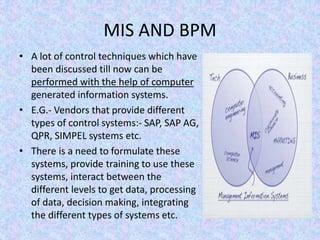
• A lot of control techniques which have
been discussed till now can be
performed with the help of computer
generated information systems.
• E.G.- Vendors that provide different
types of control systems:- SAP, SAP AG,
QPR, SIMPEL systems etc.
• There is a need to formulate these
systems, provide training to use these
systems, interact between the
different levels to get data, processing
of data, decision making, integrating
the different types of systems etc.
MIS AND CONTROL
• Information is required at every
level either to set up standards,
to know the actual performance,
to compare the results, find out
deviations and to take corrective
action, hence there is a need of a
management information
system.
• It also involves interactive
control i.e. communicating with
the employees directly and
hence information systems play a
significant role.
RELATION OF MIS AND BPM
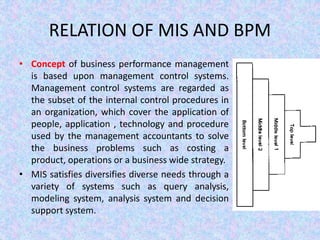
• Concept of business performance management
is based upon management control systems.
Management control systems are regarded as
the subset of the internal control procedures in
an organization, which cover the application of
people, application , technology and procedure
used by the management accountants to solve
the business problems such as costing a
product, operations or a business wide strategy.
• MIS satisfies diversifies diverse needs through a
variety of systems such as query analysis,
modeling system, analysis system and decision
support system.
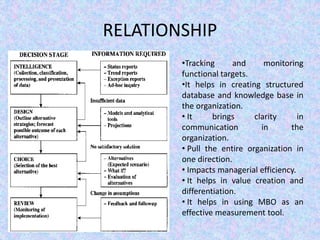
RELATIONSHIP
•Tracking and monitoring
functional targets.
•It helps in creating structured
database and knowledge base in
the organization.
• It brings clarity in
communication in the
organization.
• Pull the entire organization in
one direction.
• Impacts managerial efficiency.
• It helps in value creation and
differentiation.
• It helps in using MBO as an
effective measurement tool.
WHAT IS MIS
MANAGEMENT- Art of getting the things done effectively and efficiently
with the use of limited resources. It involves doing the right things in a
right manner.
INFORMATION- Processed form of data. It conveys a meaning to the user of
the same. It has an order, it is organized, precise, and is a result of
processing and refining data.
SYSTEM- It is a collection of people, machines, and methods organized to
accomplish set of specific tasks. It is a set of components that operate
together to achieve a common purpose.
DEFINITIONS
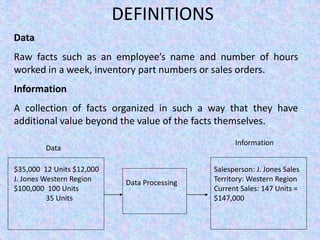
Data
Raw facts such as an employee’s name and number of hours
worked in a week, inventory part numbers or sales orders.
Information
A collection of facts organized in such a way that they have
additional value beyond the value of the facts themselves.
Data
Information
$35,000 12 Units $12,000
J. Jones Western Region
$100,000 100 Units
35 Units
Data Processing
Salesperson: J. Jones Sales
Territory: Western Region
Current Sales: 147 Units =
$147,000
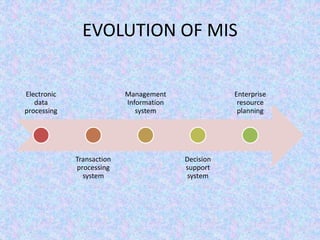
EVOLUTION OF MIS
Electronic
data
processing
Transaction
processing
system
Management
Information
system
Decision
support
system
Enterprise
resource
planning
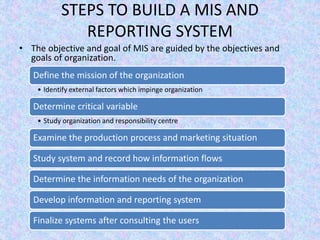
STEPS TO BUILD A MIS AND
REPORTING SYSTEM
• The objective and goal of MIS are guided by the objectives and
goals of organization.
Define the mission of the organization
• Identify external factors which impinge organization
Determine critical variable
• Study organization and responsibility centre
Examine the production process and marketing situation
Study system and record how information flows
Determine the information needs of the organization
Develop information and reporting system
Finalize systems after consulting the users
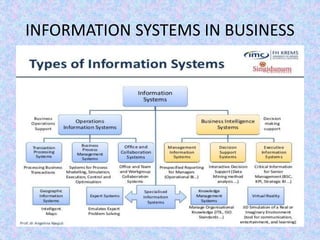
INFORMATION SYSTEMS IN BUSINESS
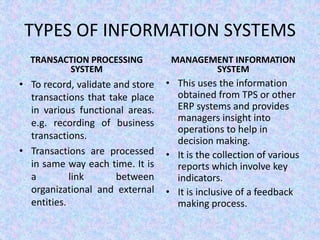
TYPES OF INFORMATION SYSTEMS
TRANSACTION PROCESSING
SYSTEM
• To record, validate and store
transactions that take place
in various functional areas.
e.g. recording of business
transactions.
• Transactions are processed
in same way each time. It is
a link between
organizational and external
entities.
MANAGEMENT INFORMATION
SYSTEM
• This uses the information
obtained from TPS or other
ERP systems and provides
managers insight into
operations to help in
decision making.
• It is the collection of various
reports which involve key
indicators.
• It is inclusive of a feedback
making process.
TYPES OF INFORMATION SYSTEMS
FINANCIAL MANAGEMENT
REPORTING SYSTEM
• It integrates both financial and
operational information from
both internal and external
systems. E.g. profit/loss and
cost accounting etc.
• An imp. Usage is fund
management, profit/loss and
cost systems and hence use
TPS information for enhancing
information quality for MIS.
DECISION SUPPORT SYSTEM
• Basic function is to track
and record costs and help in
it’s reduction. Also provide
drill down through data
facility.
• It involves what- if analysis,
goal seeking analysis,
simulation facility for all
types of decision makers.
• More flexible than MIS and
help in problem solving.
TYPES OF INFORMATION SYSTEMS
EXECUTIVE SUPPORT SYSTEM
• It helps executives in strategic
decision making and tracking
critical success factors. It is
specialized DSS and can be used
by employees and even BOD.
• They are tailored for particular
executives and involves mainly
external or internal data sources.
• Useful in situations having high
degree of uncertainty and is
future oriented. It is related to
value added business processes.
INFORMATION REPORTING
SYSTEM
• Also called management reporting
system. It obtains inputs from TPS
and produces feedback reports on
operations. It makes use of multiple
information systems for this
purpose.
• It is a planned , integrated system
for gathering data, converting it
into information and supplying to
executives for decision making.
• It generated periodic and exception
reports which support planning and
control function of the
organization. It minimizes
information overload.
TYPES OF INFORMATION SYSTEM
OFFICE AUTOMATION SYSTEM
• Aimed at improving the efficiency
and productivity of office
operations, include activities like
word processing, electronic filing,
dairy management,
communication, including
electronic mail, telex and fax.
• Activities like word processing,
preparing excel spreadsheets,
database management, desk-top
publishing, graphics, project
management, calendar, electronic
mails etc. are done through this.
• This reduces the clerical errors and
the effort required at rectification.
EXPERT SYSTEMS
• It captures and stores the
knowledge of the expert and
imitates human reasoning and
decision making process for those
who have less expertise . It has 2
components – a knowledge base
and inference rules.
• They fall under the artificial
intelligence branch of computers.
They use very specific domain and
special programming languages.
Mainly useful for problem solving.
• They attempt to process
knowledge. It is designed to model
problem solving ability of a human
expert.
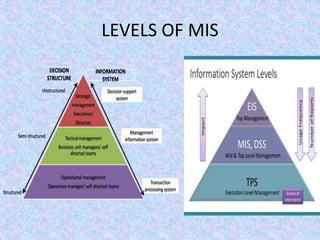
LEVELS OF MIS
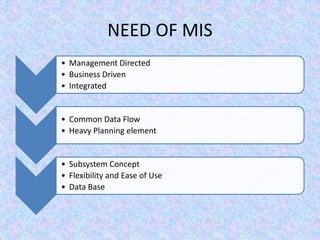
NEED OF MIS
• Management Directed
• Business Driven
• Integrated
• Common Data Flow
• Heavy Planning element
• Subsystem Concept
• Flexibility and Ease of Use
• Data Base
Management information system and control

Management information system and control

  • 1.
    MANAGEMENT INFORMATION SYSTEM ANDCONTROL SUBMITTED TO: SUBMITTED BY: SHAVETA MAM SAKSHA SHARMA 5810, M.COM II
  • 2.
    INTRODUCTION • Business performancemeasurement is a device which is used mostly to evaluate the business processes and to control the business operations in a manner traditional accounting does not allow. • Despite the growing use of BPM systems there are a lot of limitations- • a) excessive diversity in the field of study • b) data quality • c) information integration problem • d) lack of linkage to strategy • e) high levels of change in BPM systems • f) judgment and decision bias etc.
  • 3.
    MIS AND BPM •A lot of control techniques which have been discussed till now can be performed with the help of computer generated information systems. • E.G.- Vendors that provide different types of control systems:- SAP, SAP AG, QPR, SIMPEL systems etc. • There is a need to formulate these systems, provide training to use these systems, interact between the different levels to get data, processing of data, decision making, integrating the different types of systems etc.
  • 4.
    MIS AND CONTROL •Information is required at every level either to set up standards, to know the actual performance, to compare the results, find out deviations and to take corrective action, hence there is a need of a management information system. • It also involves interactive control i.e. communicating with the employees directly and hence information systems play a significant role.
  • 5.
    RELATION OF MISAND BPM • Concept of business performance management is based upon management control systems. Management control systems are regarded as the subset of the internal control procedures in an organization, which cover the application of people, application , technology and procedure used by the management accountants to solve the business problems such as costing a product, operations or a business wide strategy. • MIS satisfies diversifies diverse needs through a variety of systems such as query analysis, modeling system, analysis system and decision support system.
  • 6.
    RELATIONSHIP •Tracking and monitoring functionaltargets. •It helps in creating structured database and knowledge base in the organization. • It brings clarity in communication in the organization. • Pull the entire organization in one direction. • Impacts managerial efficiency. • It helps in value creation and differentiation. • It helps in using MBO as an effective measurement tool.
  • 7.
    WHAT IS MIS MANAGEMENT-Art of getting the things done effectively and efficiently with the use of limited resources. It involves doing the right things in a right manner. INFORMATION- Processed form of data. It conveys a meaning to the user of the same. It has an order, it is organized, precise, and is a result of processing and refining data. SYSTEM- It is a collection of people, machines, and methods organized to accomplish set of specific tasks. It is a set of components that operate together to achieve a common purpose.
  • 8.
    DEFINITIONS Data Raw facts suchas an employee’s name and number of hours worked in a week, inventory part numbers or sales orders. Information A collection of facts organized in such a way that they have additional value beyond the value of the facts themselves. Data Information $35,000 12 Units $12,000 J. Jones Western Region $100,000 100 Units 35 Units Data Processing Salesperson: J. Jones Sales Territory: Western Region Current Sales: 147 Units = $147,000
  • 9.
  • 10.
    STEPS TO BUILDA MIS AND REPORTING SYSTEM • The objective and goal of MIS are guided by the objectives and goals of organization. Define the mission of the organization • Identify external factors which impinge organization Determine critical variable • Study organization and responsibility centre Examine the production process and marketing situation Study system and record how information flows Determine the information needs of the organization Develop information and reporting system Finalize systems after consulting the users
  • 11.
  • 12.
    TYPES OF INFORMATIONSYSTEMS TRANSACTION PROCESSING SYSTEM • To record, validate and store transactions that take place in various functional areas. e.g. recording of business transactions. • Transactions are processed in same way each time. It is a link between organizational and external entities. MANAGEMENT INFORMATION SYSTEM • This uses the information obtained from TPS or other ERP systems and provides managers insight into operations to help in decision making. • It is the collection of various reports which involve key indicators. • It is inclusive of a feedback making process.
  • 13.
    TYPES OF INFORMATIONSYSTEMS FINANCIAL MANAGEMENT REPORTING SYSTEM • It integrates both financial and operational information from both internal and external systems. E.g. profit/loss and cost accounting etc. • An imp. Usage is fund management, profit/loss and cost systems and hence use TPS information for enhancing information quality for MIS. DECISION SUPPORT SYSTEM • Basic function is to track and record costs and help in it’s reduction. Also provide drill down through data facility. • It involves what- if analysis, goal seeking analysis, simulation facility for all types of decision makers. • More flexible than MIS and help in problem solving.
  • 14.
    TYPES OF INFORMATIONSYSTEMS EXECUTIVE SUPPORT SYSTEM • It helps executives in strategic decision making and tracking critical success factors. It is specialized DSS and can be used by employees and even BOD. • They are tailored for particular executives and involves mainly external or internal data sources. • Useful in situations having high degree of uncertainty and is future oriented. It is related to value added business processes. INFORMATION REPORTING SYSTEM • Also called management reporting system. It obtains inputs from TPS and produces feedback reports on operations. It makes use of multiple information systems for this purpose. • It is a planned , integrated system for gathering data, converting it into information and supplying to executives for decision making. • It generated periodic and exception reports which support planning and control function of the organization. It minimizes information overload.
  • 15.
    TYPES OF INFORMATIONSYSTEM OFFICE AUTOMATION SYSTEM • Aimed at improving the efficiency and productivity of office operations, include activities like word processing, electronic filing, dairy management, communication, including electronic mail, telex and fax. • Activities like word processing, preparing excel spreadsheets, database management, desk-top publishing, graphics, project management, calendar, electronic mails etc. are done through this. • This reduces the clerical errors and the effort required at rectification. EXPERT SYSTEMS • It captures and stores the knowledge of the expert and imitates human reasoning and decision making process for those who have less expertise . It has 2 components – a knowledge base and inference rules. • They fall under the artificial intelligence branch of computers. They use very specific domain and special programming languages. Mainly useful for problem solving. • They attempt to process knowledge. It is designed to model problem solving ability of a human expert.
  • 16.
  • 17.
    NEED OF MIS •Management Directed • Business Driven • Integrated • Common Data Flow • Heavy Planning element • Subsystem Concept • Flexibility and Ease of Use • Data Base