JAPAN
LOCATION
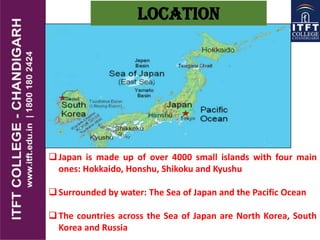
Japan is made up of over 4000 small islands with four main
ones: Hokkaido, Honshu, Shikoku and Kyushu
Surrounded by water: The Sea of Japan and the Pacific Ocean
The countries across the Sea of Japan are North Korea, South
Korea and Russia
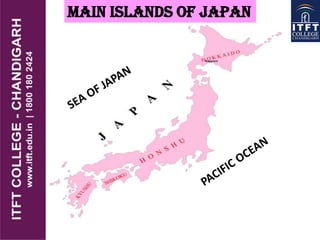
MAIN ISLANDS OF JAPAN
Capital And Population
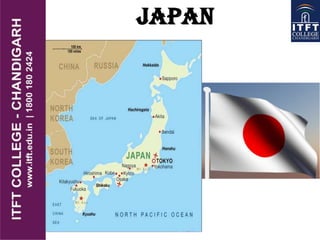
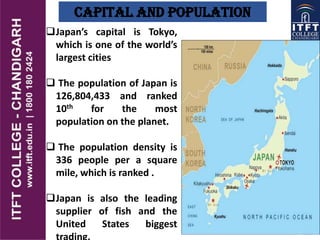
Japan’s capital is Tokyo,
which is one of the world’s
largest cities
 The population of Japan is
126,804,433 and ranked
10th for the most
population on the planet.
 The population density is
336 people per a square
mile, which is ranked .
32the
Japan is also the leading
supplier of fish and the
United States biggest
trading.
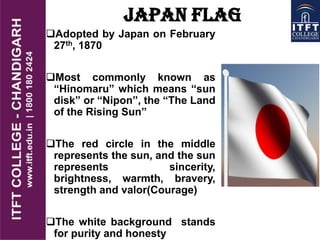
JAPAN FLAG
Adopted by Japan on February
27th, 1870
Most commonly known as
“Hinomaru” which means “sun
disk” or “Nipon”, the “The Land
of the Rising Sun”
The red circle in the middle
represents the sun, and the sun
represents sincerity,
brightness, warmth, bravery,
strength and valor(Courage)
The white background stands
for purity and honesty
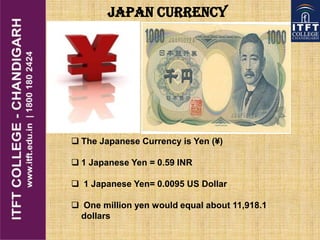
JAPAN CURRENCY
 The Japanese Currency is Yen (¥)
 1 Japanese Yen = 0.59 INR
 1 Japanese Yen= 0.0095 US Dollar
 One million yen would equal about 11,918.1
dollars
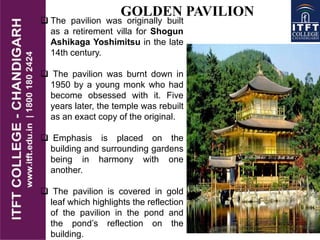
GOLDEN PAVILION
 The pavilion was originally built
as a retirement villa for Shogun
Ashikaga Yoshimitsu in the late
14th century.
 The pavilion was burnt down in
1950 by a young monk who had
become obsessed with it. Five
years later, the temple was rebuilt
as an exact copy of the original.
 Emphasis is placed on the
building and surrounding gardens
being in harmony with one
another.
 The pavilion is covered in gold
leaf which highlights the reflection
of the pavilion in the pond and
the pond’s reflection on the
building.
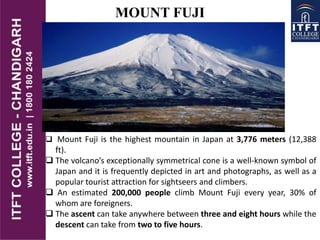
 Mount Fuji is the highest mountain in Japan at 3,776 meters (12,388
ft).
 The volcano’s exceptionally symmetrical cone is a well-known symbol of
Japan and it is frequently depicted in art and photographs, as well as a
popular tourist attraction for sightseers and climbers.
 An estimated 200,000 people climb Mount Fuji every year, 30% of
whom are foreigners.
 The ascent can take anywhere between three and eight hours while the
descent can take from two to five hours.
MOUNT FUJI
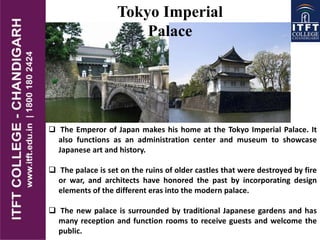
Tokyo Imperial
Palace
 The Emperor of Japan makes his home at the Tokyo Imperial Palace. It
also functions as an administration center and museum to showcase
Japanese art and history.
 The palace is set on the ruins of older castles that were destroyed by fire
or war, and architects have honored the past by incorporating design
elements of the different eras into the modern palace.
 The new palace is surrounded by traditional Japanese gardens and has
many reception and function rooms to receive guests and welcome the
public.
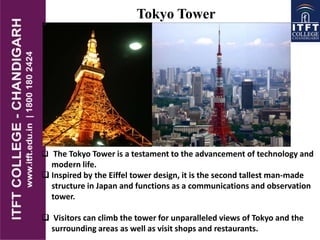
Tokyo Tower
 The Tokyo Tower is a testament to the advancement of technology and
modern life.
 Inspired by the Eiffel tower design, it is the second tallest man-made
structure in Japan and functions as a communications and observation
tower.
 Visitors can climb the tower for unparalleled views of Tokyo and the
surrounding areas as well as visit shops and restaurants.
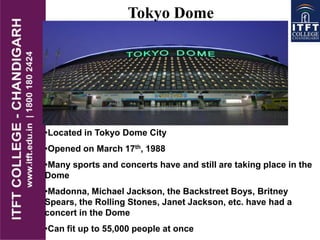
•Located in Tokyo Dome City
•Opened on March 17th, 1988
•Many sports and concerts have and still are taking place in the
Dome
•Madonna, Michael Jackson, the Backstreet Boys, Britney
Spears, the Rolling Stones, Janet Jackson, etc. have had a
concert in the Dome
•Can fit up to 55,000 people at once
Tokyo Dome
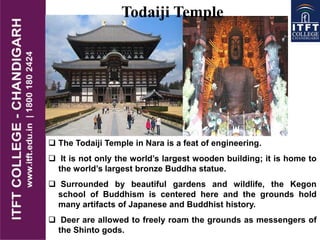
 The Todaiji Temple in Nara is a feat of engineering.
 It is not only the world’s largest wooden building; it is home to
the world’s largest bronze Buddha statue.
 Surrounded by beautiful gardens and wildlife, the Kegon
school of Buddhism is centered here and the grounds hold
many artifacts of Japanese and Buddhist history.
 Deer are allowed to freely roam the grounds as messengers of
the Shinto gods.
Todaiji Temple
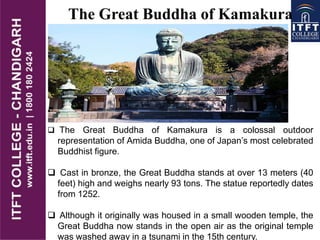
 The Great Buddha of Kamakura is a colossal outdoor
representation of Amida Buddha, one of Japan’s most celebrated
Buddhist figure.
 Cast in bronze, the Great Buddha stands at over 13 meters (40
feet) high and weighs nearly 93 tons. The statue reportedly dates
from 1252.
 Although it originally was housed in a small wooden temple, the
Great Buddha now stands in the open air as the original temple
was washed away in a tsunami in the 15th century.
The Great Buddha of Kamakura
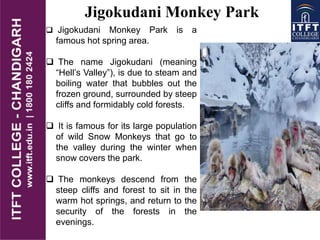
 Jigokudani Monkey Park is a
famous hot spring area.
 The name Jigokudani (meaning
“Hell’s Valley”), is due to steam and
boiling water that bubbles out the
frozen ground, surrounded by steep
cliffs and formidably cold forests.
 It is famous for its large population
of wild Snow Monkeys that go to
the valley during the winter when
snow covers the park.
 The monkeys descend from the
steep cliffs and forest to sit in the
warm hot springs, and return to the
security of the forests in the
evenings.
Jigokudani Monkey Park
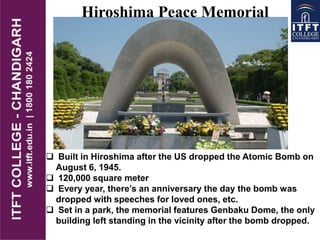
 Built in Hiroshima after the US dropped the Atomic Bomb on
August 6, 1945.
 120,000 square meter
 Every year, there’s an anniversary the day the bomb was
dropped with speeches for loved ones, etc.
 Set in a park, the memorial features Genbaku Dome, the only
building left standing in the vicinity after the bomb dropped.
Hiroshima Peace Memorial
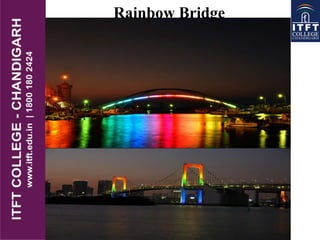
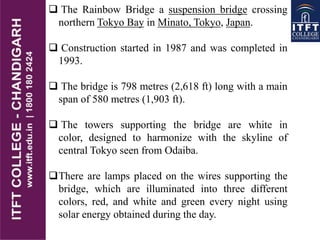
Rainbow Bridge
 The Rainbow Bridge a suspension bridge crossing
northern Tokyo Bay in Minato, Tokyo, Japan.
 Construction started in 1987 and was completed in
1993.
 The bridge is 798 metres (2,618 ft) long with a main
span of 580 metres (1,903 ft).
 The towers supporting the bridge are white in
color, designed to harmonize with the skyline of
central Tokyo seen from Odaiba.
There are lamps placed on the wires supporting the
bridge, which are illuminated into three different
colors, red, and white and green every night using
solar energy obtained during the day.

ITFT- case study japan

  • 1.
  • 2.
    LOCATION Japan is madeup of over 4000 small islands with four main ones: Hokkaido, Honshu, Shikoku and Kyushu Surrounded by water: The Sea of Japan and the Pacific Ocean The countries across the Sea of Japan are North Korea, South Korea and Russia
  • 3.
  • 4.
    Capital And Population Japan’scapital is Tokyo, which is one of the world’s largest cities  The population of Japan is 126,804,433 and ranked 10th for the most population on the planet.  The population density is 336 people per a square mile, which is ranked . 32the Japan is also the leading supplier of fish and the United States biggest trading.
  • 5.
    JAPAN FLAG Adopted byJapan on February 27th, 1870 Most commonly known as “Hinomaru” which means “sun disk” or “Nipon”, the “The Land of the Rising Sun” The red circle in the middle represents the sun, and the sun represents sincerity, brightness, warmth, bravery, strength and valor(Courage) The white background stands for purity and honesty
  • 6.
    JAPAN CURRENCY  TheJapanese Currency is Yen (¥)  1 Japanese Yen = 0.59 INR  1 Japanese Yen= 0.0095 US Dollar  One million yen would equal about 11,918.1 dollars
  • 8.
    GOLDEN PAVILION  Thepavilion was originally built as a retirement villa for Shogun Ashikaga Yoshimitsu in the late 14th century.  The pavilion was burnt down in 1950 by a young monk who had become obsessed with it. Five years later, the temple was rebuilt as an exact copy of the original.  Emphasis is placed on the building and surrounding gardens being in harmony with one another.  The pavilion is covered in gold leaf which highlights the reflection of the pavilion in the pond and the pond’s reflection on the building.
  • 9.
     Mount Fujiis the highest mountain in Japan at 3,776 meters (12,388 ft).  The volcano’s exceptionally symmetrical cone is a well-known symbol of Japan and it is frequently depicted in art and photographs, as well as a popular tourist attraction for sightseers and climbers.  An estimated 200,000 people climb Mount Fuji every year, 30% of whom are foreigners.  The ascent can take anywhere between three and eight hours while the descent can take from two to five hours. MOUNT FUJI
  • 10.
    Tokyo Imperial Palace  TheEmperor of Japan makes his home at the Tokyo Imperial Palace. It also functions as an administration center and museum to showcase Japanese art and history.  The palace is set on the ruins of older castles that were destroyed by fire or war, and architects have honored the past by incorporating design elements of the different eras into the modern palace.  The new palace is surrounded by traditional Japanese gardens and has many reception and function rooms to receive guests and welcome the public.
  • 11.
    Tokyo Tower  TheTokyo Tower is a testament to the advancement of technology and modern life.  Inspired by the Eiffel tower design, it is the second tallest man-made structure in Japan and functions as a communications and observation tower.  Visitors can climb the tower for unparalleled views of Tokyo and the surrounding areas as well as visit shops and restaurants.
  • 12.
    •Located in TokyoDome City •Opened on March 17th, 1988 •Many sports and concerts have and still are taking place in the Dome •Madonna, Michael Jackson, the Backstreet Boys, Britney Spears, the Rolling Stones, Janet Jackson, etc. have had a concert in the Dome •Can fit up to 55,000 people at once Tokyo Dome
  • 13.
     The TodaijiTemple in Nara is a feat of engineering.  It is not only the world’s largest wooden building; it is home to the world’s largest bronze Buddha statue.  Surrounded by beautiful gardens and wildlife, the Kegon school of Buddhism is centered here and the grounds hold many artifacts of Japanese and Buddhist history.  Deer are allowed to freely roam the grounds as messengers of the Shinto gods. Todaiji Temple
  • 14.
     The GreatBuddha of Kamakura is a colossal outdoor representation of Amida Buddha, one of Japan’s most celebrated Buddhist figure.  Cast in bronze, the Great Buddha stands at over 13 meters (40 feet) high and weighs nearly 93 tons. The statue reportedly dates from 1252.  Although it originally was housed in a small wooden temple, the Great Buddha now stands in the open air as the original temple was washed away in a tsunami in the 15th century. The Great Buddha of Kamakura
  • 15.
     Jigokudani MonkeyPark is a famous hot spring area.  The name Jigokudani (meaning “Hell’s Valley”), is due to steam and boiling water that bubbles out the frozen ground, surrounded by steep cliffs and formidably cold forests.  It is famous for its large population of wild Snow Monkeys that go to the valley during the winter when snow covers the park.  The monkeys descend from the steep cliffs and forest to sit in the warm hot springs, and return to the security of the forests in the evenings. Jigokudani Monkey Park
  • 16.
     Built inHiroshima after the US dropped the Atomic Bomb on August 6, 1945.  120,000 square meter  Every year, there’s an anniversary the day the bomb was dropped with speeches for loved ones, etc.  Set in a park, the memorial features Genbaku Dome, the only building left standing in the vicinity after the bomb dropped. Hiroshima Peace Memorial
  • 17.
  • 18.
     The RainbowBridge a suspension bridge crossing northern Tokyo Bay in Minato, Tokyo, Japan.  Construction started in 1987 and was completed in 1993.  The bridge is 798 metres (2,618 ft) long with a main span of 580 metres (1,903 ft).  The towers supporting the bridge are white in color, designed to harmonize with the skyline of central Tokyo seen from Odaiba. There are lamps placed on the wires supporting the bridge, which are illuminated into three different colors, red, and white and green every night using solar energy obtained during the day.