Module 2
Exploring Asia
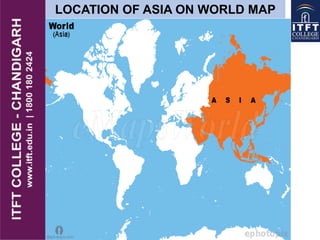
LOCATION OF ASIA ON WORLD MAP
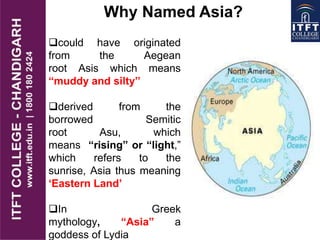
Why Named Asia?
could have originated
from the Aegean
root Asis which means
“muddy and silty‟‟
derived from the
borrowed Semitic
root Asu, which
means “rising” or “light,”
which refers to the
sunrise, Asia thus meaning
„Eastern Land‟
In Greek
mythology, “Asia” a
goddess of Lydia
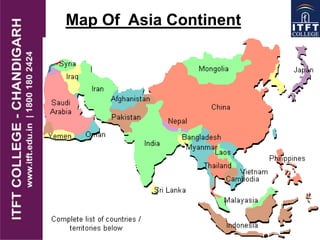
Map Of Asia Continent
Fact 1 - Definition: Asia is the largest continent with 60% of the earth's
population.
Fact 2 - Asia covers 29.9% of the land area of the earth
Fact 3 - There are approx 4 billion people who live in Asia
Fact 4 - There are 49 countries in Asia
Fact 5 - Asian people include Chinese, Japanese, Indians, and Arabs.
Fact 6 - The largest cities include
Tokyo, Seoul, Jakarta, Dehli, Mumbai, and Shanghai.
Fact 7 - The population of India is more than the overall population of
North, Central and South America
Fact 8 - Bangladesh is the most densely inhabited country in Asia
Fact 9 - Asian Religions include
Buddhism, Hinduism, Islam, Jainism, Christianity.
Fact 10 - Great Asian landmarks which are man-made include the Great
Wall of China and Taj Mahal
FAST FACTS
LOCATION
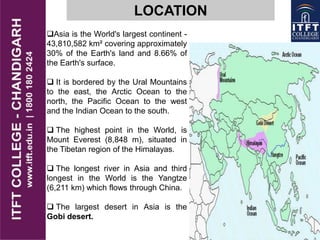
Asia is the World's largest continent -
43,810,582 km² covering approximately
30% of the Earth's land and 8.66% of
the Earth's surface.
 It is bordered by the Ural Mountains
to the east, the Arctic Ocean to the
north, the Pacific Ocean to the west
and the Indian Ocean to the south.
 The highest point in the World, is
Mount Everest (8,848 m), situated in
the Tibetan region of the Himalayas.
 The longest river in Asia and third
longest in the World is the Yangtze
(6,211 km) which flows through China.
 The largest desert in Asia is the
Gobi desert.
REGIONS & SEASONS
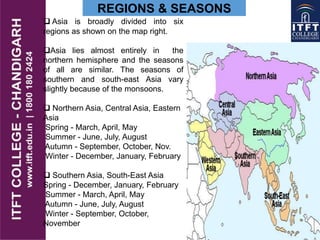
 Asia is broadly divided into six
regions as shown on the map right.
Asia lies almost entirely in the
northern hemisphere and the seasons
of all are similar. The seasons of
southern and south-east Asia vary
slightly because of the monsoons.
 Northern Asia, Central Asia, Eastern
Asia
Spring - March, April, May
Summer - June, July, August
Autumn - September, October, Nov.
Winter - December, January, February
 Southern Asia, South-East Asia
Spring - December, January, February
Summer - March, April, May
Autumn - June, July, August
Winter - September, October,
November
COUNTRIES
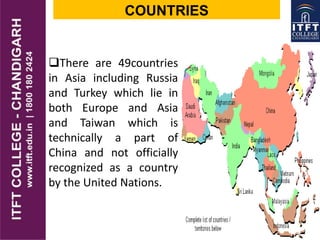
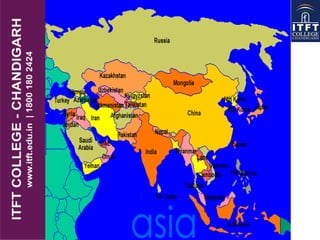
There are 49countries
in Asia including Russia
and Turkey which lie in
both Europe and Asia
and Taiwan which is
technically a part of
China and not officially
recognized as a country
by the United Nations.
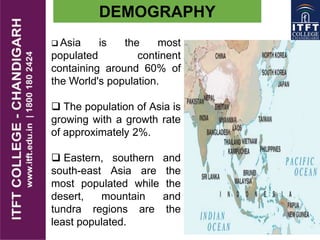
 Asia is the most
populated continent
containing around 60% of
the World's population.
 The population of Asia is
growing with a growth rate
of approximately 2%.
 Eastern, southern and
south-east Asia are the
most populated while the
desert, mountain and
tundra regions are the
least populated.
DEMOGRAPHY
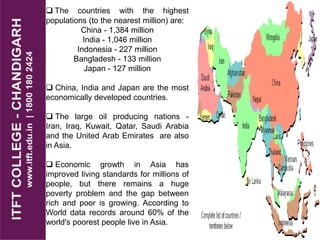
 The countries with the highest
populations (to the nearest million) are:
China - 1,384 million
India - 1,046 million
Indonesia - 227 million
Bangladesh - 133 million
Japan - 127 million
 China, India and Japan are the most
economically developed countries.
 The large oil producing nations -
Iran, Iraq, Kuwait, Qatar, Saudi Arabia
and the United Arab Emirates are also
in Asia.
 Economic growth in Asia has
improved living standards for millions of
people, but there remains a huge
poverty problem and the gap between
rich and poor is growing. According to
World data records around 60% of the
world's poorest people live in Asia.
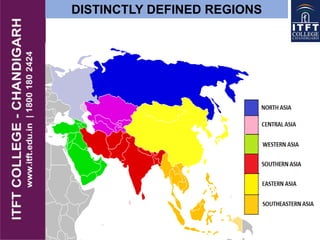
DISTINCTLY DEFINED REGIONS
CENTRAL ASIA
Kazakhstan, Uzbekistan, Tajikistan, Turkmenistan and
Kyrgyzstan, Afghanistan, Mongolia and the western regions
of China.
 EAST ASIA
China, Hong Kong, Macao, North Korea, South
Korea, Japan, Mongolia. Any other areas associated with the Far
East, such as Taiwan. Southeast Asia has been included in East
Asia on some occasions.
 NORTH ASIA
The Asian part of the Russian Federation (Siberia).
 SOUTHEAST ASIA
Myanmar (Burma), Thailand, Laos, Cambodia, Vietnam, Malaysia
Philippines, Singapore, Indonesia.
 WEST ASIA
Afghanistan Armenia, Azerbaijan, Bahrain, Cyprus, Georgia, Iraq, Isr
ael, Jordan, Kuwait, Lebanon, Palestinian Oman, Qatar, Saudi
Arabia, Syria, Turkey, United Arab Emirates, Yemen
 SOUTH ASIA
Pakistan, India, Maldives, SriLanka, Nepal, Bhutan, Bangladesh and
Iran
PHYSIOGRAPHIC DIVISIONS OF ASIA
1)MOUNTAIN SYSTEMS
2)PLATEAU
3)PLAIN, STEEPE AND DESERT
4) FRESHWATER
MOUNTAIN SYSTEMS
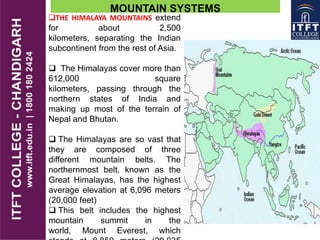
THE HIMALAYA MOUNTAINS extend
for about 2,500
kilometers, separating the Indian
subcontinent from the rest of Asia.
 The Himalayas cover more than
612,000 square
kilometers, passing through the
northern states of India and
making up most of the terrain of
Nepal and Bhutan.
 The Himalayas are so vast that
they are composed of three
different mountain belts. The
northernmost belt, known as the
Great Himalayas, has the highest
average elevation at 6,096 meters
(20,000 feet)
 This belt includes the highest
mountain summit in the
world, Mount Everest, which
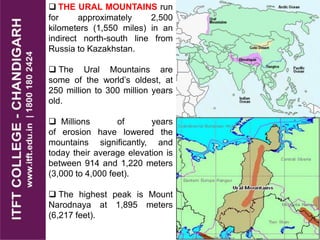
 THE URAL MOUNTAINS run
for approximately 2,500
kilometers (1,550 miles) in an
indirect north-south line from
Russia to Kazakhstan.
 The Ural Mountains are
some of the world’s oldest, at
250 million to 300 million years
old.
 Millions of years
of erosion have lowered the
mountains significantly, and
today their average elevation is
between 914 and 1,220 meters
(3,000 to 4,000 feet).
 The highest peak is Mount
Narodnaya at 1,895 meters
(6,217 feet).
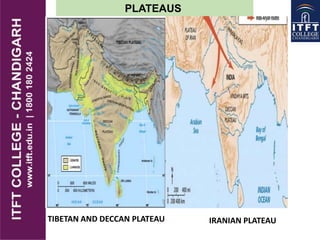
PLATEAUS
TIBETAN AND DECCAN PLATEAU IRANIAN PLATEAU
 Asia is home to many plateaus, areas of relatively level
high ground.
 The Iranian plateau covers more than 3.6 million
square kilometers (1.4 million square miles),
encompassing most of Iran, Afghanistan, and Pakistan.
 The plateau also has two large deserts, the Dasht-e
Kavir and Dasht-e Lut.
 The Deccan Plateau makes up most of the southern
part of India. The plateau’s average elevation is about
600 meters (2,000 feet).
 It is bordered by three mountain ranges: the Satpura
Range in the north, and the Eastern and Western Ghats
on either side. The plateau and its main waterways—the
Godavari and Krishna rivers—gently slope toward the
Eastern Ghats and the Bay of Bengal.
The Tibetan Plateau is usually considered the
largest and highest area ever to exist in the history
of Earth. Known as the “Rooftop of the World,” the
plateau covers an area about half the size of
theUnited States and averages more than 5,000
meters above sea level.
 The Tibetan Plateau is extremely important to
the world’s water cycle because of
its tremendous number of glaciers. These glaciers
contain the largest volume of ice outside
the poles. The ice and snow from these glaciers
feed Asia’s largest rivers. Approximately 2 billion
people depend on the rivers fed by the plateau’s
glaciers.
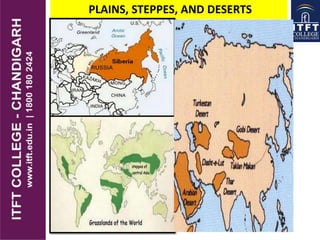
PLAINS, STEPPES, AND DESERTS
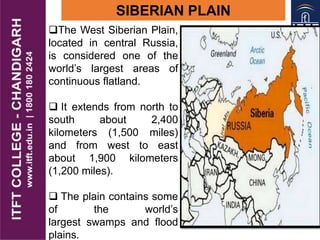
The West Siberian Plain,
located in central Russia,
is considered one of the
world’s largest areas of
continuous flatland.
 It extends from north to
south about 2,400
kilometers (1,500 miles)
and from west to east
about 1,900 kilometers
(1,200 miles).
 The plain contains some
of the world’s
largest swamps and flood
plains.
SIBERIAN PLAIN
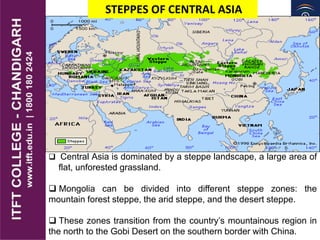
STEPPES OF CENTRAL ASIA
 Central Asia is dominated by a steppe landscape, a large area of
flat, unforested grassland.
 Mongolia can be divided into different steppe zones: the
mountain forest steppe, the arid steppe, and the desert steppe.
 These zones transition from the country’s mountainous region in
the north to the Gobi Desert on the southern border with China.
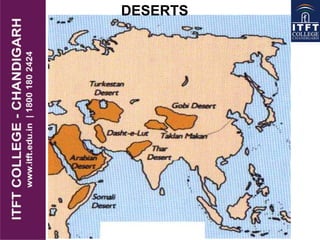
GOBI DESERT is on the southern border with China. The Gobi
Desert is the largest desert in Asia, covering 500,000 square miles.
Extending from northern China into Mongolia, the Gobi Desert
receives an average of 7 inches of rainfall each year because the
Himalaya mountains block rain clouds from reaching the region.
TAKLA MAKAN DESERT China's largest desert extends over
123,550 square miles. Taklamakan is one of the largest sandy
deserts in the world. Despite the inhospitable and unpredictable
nature of the desert sands, the Chinese government erected a road
across the desert in the mid-1990s. This feat of structural and
environmental engineering involved planting millions of trees to
keep the sand from covering the road and setting up families along
the road to water the trees.
 THAR DESERT covering 77,000 square miles in India and
Pakistan, the Thar Desert is Asia's only subtropical desert. Primarily
occupying the Indian state Rajasthan, the Thar has a high
population density for a desert. Thar inhabitants subsist on livestock
and agriculture. The western portion of the desert receives up to 20
inches of rain per year, primarily during the monsoon period from
July to September, and most crops are grown during this rainy
season.
DESERTS
FRESHWATER
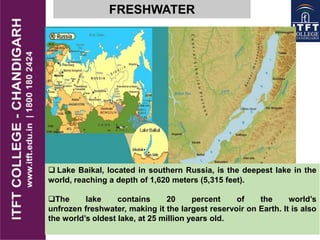
 Lake Baikal, located in southern Russia, is the deepest lake in the
world, reaching a depth of 1,620 meters (5,315 feet).
The lake contains 20 percent of the world‟s
unfrozen freshwater, making it the largest reservoir on Earth. It is also
the world‟s oldest lake, at 25 million years old.
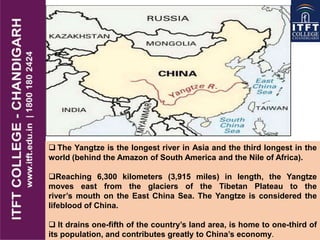
 The Yangtze is the longest river in Asia and the third longest in the
world (behind the Amazon of South America and the Nile of Africa).
Reaching 6,300 kilometers (3,915 miles) in length, the Yangtze
moves east from the glaciers of the Tibetan Plateau to the
river‟s mouth on the East China Sea. The Yangtze is considered the
lifeblood of China.
 It drains one-fifth of the country‟s land area, is home to one-third of
its population, and contributes greatly to China‟s economy.
VEGETATION/CLIMATE TYPES
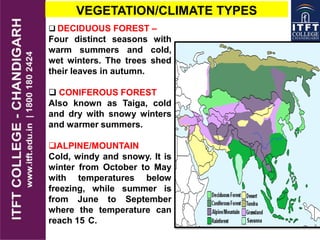
 DECIDUOUS FOREST –
Four distinct seasons with
warm summers and cold,
wet winters. The trees shed
their leaves in autumn.
 CONIFEROUS FOREST
Also known as Taiga, cold
and dry with snowy winters
and warmer summers.
ALPINE/MOUNTAIN
Cold, windy and snowy. It is
winter from October to May
with temperatures below
freezing, while summer is
from June to September
where the temperature can
reach 15 C.
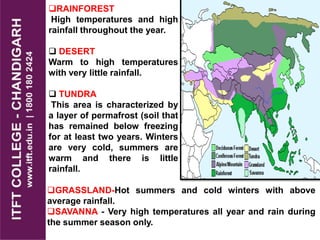
RAINFOREST
High temperatures and high
rainfall throughout the year.
 DESERT
Warm to high temperatures
with very little rainfall.
 TUNDRA
This area is characterized by
a layer of permafrost (soil that
has remained below freezing
for at least two years. Winters
are very cold, summers are
warm and there is little
rainfall.
GRASSLAND-Hot summers and cold winters with above
average rainfall.
SAVANNA - Very high temperatures all year and rain during
the summer season only.

ITFT- asia physical division

  • 1.
  • 2.
    LOCATION OF ASIAON WORLD MAP
  • 3.
    Why Named Asia? couldhave originated from the Aegean root Asis which means “muddy and silty‟‟ derived from the borrowed Semitic root Asu, which means “rising” or “light,” which refers to the sunrise, Asia thus meaning „Eastern Land‟ In Greek mythology, “Asia” a goddess of Lydia
  • 4.
    Map Of AsiaContinent
  • 5.
    Fact 1 -Definition: Asia is the largest continent with 60% of the earth's population. Fact 2 - Asia covers 29.9% of the land area of the earth Fact 3 - There are approx 4 billion people who live in Asia Fact 4 - There are 49 countries in Asia Fact 5 - Asian people include Chinese, Japanese, Indians, and Arabs. Fact 6 - The largest cities include Tokyo, Seoul, Jakarta, Dehli, Mumbai, and Shanghai. Fact 7 - The population of India is more than the overall population of North, Central and South America Fact 8 - Bangladesh is the most densely inhabited country in Asia Fact 9 - Asian Religions include Buddhism, Hinduism, Islam, Jainism, Christianity. Fact 10 - Great Asian landmarks which are man-made include the Great Wall of China and Taj Mahal FAST FACTS
  • 6.
    LOCATION Asia is theWorld's largest continent - 43,810,582 km² covering approximately 30% of the Earth's land and 8.66% of the Earth's surface.  It is bordered by the Ural Mountains to the east, the Arctic Ocean to the north, the Pacific Ocean to the west and the Indian Ocean to the south.  The highest point in the World, is Mount Everest (8,848 m), situated in the Tibetan region of the Himalayas.  The longest river in Asia and third longest in the World is the Yangtze (6,211 km) which flows through China.  The largest desert in Asia is the Gobi desert.
  • 7.
    REGIONS & SEASONS Asia is broadly divided into six regions as shown on the map right. Asia lies almost entirely in the northern hemisphere and the seasons of all are similar. The seasons of southern and south-east Asia vary slightly because of the monsoons.  Northern Asia, Central Asia, Eastern Asia Spring - March, April, May Summer - June, July, August Autumn - September, October, Nov. Winter - December, January, February  Southern Asia, South-East Asia Spring - December, January, February Summer - March, April, May Autumn - June, July, August Winter - September, October, November
  • 8.
    COUNTRIES There are 49countries inAsia including Russia and Turkey which lie in both Europe and Asia and Taiwan which is technically a part of China and not officially recognized as a country by the United Nations.
  • 9.
     Asia isthe most populated continent containing around 60% of the World's population.  The population of Asia is growing with a growth rate of approximately 2%.  Eastern, southern and south-east Asia are the most populated while the desert, mountain and tundra regions are the least populated. DEMOGRAPHY
  • 10.
     The countrieswith the highest populations (to the nearest million) are: China - 1,384 million India - 1,046 million Indonesia - 227 million Bangladesh - 133 million Japan - 127 million  China, India and Japan are the most economically developed countries.  The large oil producing nations - Iran, Iraq, Kuwait, Qatar, Saudi Arabia and the United Arab Emirates are also in Asia.  Economic growth in Asia has improved living standards for millions of people, but there remains a huge poverty problem and the gap between rich and poor is growing. According to World data records around 60% of the world's poorest people live in Asia.
  • 11.
  • 13.
    CENTRAL ASIA Kazakhstan, Uzbekistan,Tajikistan, Turkmenistan and Kyrgyzstan, Afghanistan, Mongolia and the western regions of China.  EAST ASIA China, Hong Kong, Macao, North Korea, South Korea, Japan, Mongolia. Any other areas associated with the Far East, such as Taiwan. Southeast Asia has been included in East Asia on some occasions.  NORTH ASIA The Asian part of the Russian Federation (Siberia).  SOUTHEAST ASIA Myanmar (Burma), Thailand, Laos, Cambodia, Vietnam, Malaysia Philippines, Singapore, Indonesia.  WEST ASIA Afghanistan Armenia, Azerbaijan, Bahrain, Cyprus, Georgia, Iraq, Isr ael, Jordan, Kuwait, Lebanon, Palestinian Oman, Qatar, Saudi Arabia, Syria, Turkey, United Arab Emirates, Yemen  SOUTH ASIA Pakistan, India, Maldives, SriLanka, Nepal, Bhutan, Bangladesh and Iran
  • 14.
    PHYSIOGRAPHIC DIVISIONS OFASIA 1)MOUNTAIN SYSTEMS 2)PLATEAU 3)PLAIN, STEEPE AND DESERT 4) FRESHWATER
  • 15.
    MOUNTAIN SYSTEMS THE HIMALAYAMOUNTAINS extend for about 2,500 kilometers, separating the Indian subcontinent from the rest of Asia.  The Himalayas cover more than 612,000 square kilometers, passing through the northern states of India and making up most of the terrain of Nepal and Bhutan.  The Himalayas are so vast that they are composed of three different mountain belts. The northernmost belt, known as the Great Himalayas, has the highest average elevation at 6,096 meters (20,000 feet)  This belt includes the highest mountain summit in the world, Mount Everest, which
  • 16.
     THE URALMOUNTAINS run for approximately 2,500 kilometers (1,550 miles) in an indirect north-south line from Russia to Kazakhstan.  The Ural Mountains are some of the world’s oldest, at 250 million to 300 million years old.  Millions of years of erosion have lowered the mountains significantly, and today their average elevation is between 914 and 1,220 meters (3,000 to 4,000 feet).  The highest peak is Mount Narodnaya at 1,895 meters (6,217 feet).
  • 17.
    PLATEAUS TIBETAN AND DECCANPLATEAU IRANIAN PLATEAU
  • 18.
     Asia ishome to many plateaus, areas of relatively level high ground.  The Iranian plateau covers more than 3.6 million square kilometers (1.4 million square miles), encompassing most of Iran, Afghanistan, and Pakistan.  The plateau also has two large deserts, the Dasht-e Kavir and Dasht-e Lut.  The Deccan Plateau makes up most of the southern part of India. The plateau’s average elevation is about 600 meters (2,000 feet).  It is bordered by three mountain ranges: the Satpura Range in the north, and the Eastern and Western Ghats on either side. The plateau and its main waterways—the Godavari and Krishna rivers—gently slope toward the Eastern Ghats and the Bay of Bengal.
  • 19.
    The Tibetan Plateauis usually considered the largest and highest area ever to exist in the history of Earth. Known as the “Rooftop of the World,” the plateau covers an area about half the size of theUnited States and averages more than 5,000 meters above sea level.  The Tibetan Plateau is extremely important to the world’s water cycle because of its tremendous number of glaciers. These glaciers contain the largest volume of ice outside the poles. The ice and snow from these glaciers feed Asia’s largest rivers. Approximately 2 billion people depend on the rivers fed by the plateau’s glaciers.
  • 20.
  • 21.
    The West SiberianPlain, located in central Russia, is considered one of the world’s largest areas of continuous flatland.  It extends from north to south about 2,400 kilometers (1,500 miles) and from west to east about 1,900 kilometers (1,200 miles).  The plain contains some of the world’s largest swamps and flood plains. SIBERIAN PLAIN
  • 22.
    STEPPES OF CENTRALASIA  Central Asia is dominated by a steppe landscape, a large area of flat, unforested grassland.  Mongolia can be divided into different steppe zones: the mountain forest steppe, the arid steppe, and the desert steppe.  These zones transition from the country’s mountainous region in the north to the Gobi Desert on the southern border with China.
  • 23.
    GOBI DESERT ison the southern border with China. The Gobi Desert is the largest desert in Asia, covering 500,000 square miles. Extending from northern China into Mongolia, the Gobi Desert receives an average of 7 inches of rainfall each year because the Himalaya mountains block rain clouds from reaching the region. TAKLA MAKAN DESERT China's largest desert extends over 123,550 square miles. Taklamakan is one of the largest sandy deserts in the world. Despite the inhospitable and unpredictable nature of the desert sands, the Chinese government erected a road across the desert in the mid-1990s. This feat of structural and environmental engineering involved planting millions of trees to keep the sand from covering the road and setting up families along the road to water the trees.  THAR DESERT covering 77,000 square miles in India and Pakistan, the Thar Desert is Asia's only subtropical desert. Primarily occupying the Indian state Rajasthan, the Thar has a high population density for a desert. Thar inhabitants subsist on livestock and agriculture. The western portion of the desert receives up to 20 inches of rain per year, primarily during the monsoon period from July to September, and most crops are grown during this rainy season.
  • 24.
  • 25.
    FRESHWATER  Lake Baikal,located in southern Russia, is the deepest lake in the world, reaching a depth of 1,620 meters (5,315 feet). The lake contains 20 percent of the world‟s unfrozen freshwater, making it the largest reservoir on Earth. It is also the world‟s oldest lake, at 25 million years old.
  • 26.
     The Yangtzeis the longest river in Asia and the third longest in the world (behind the Amazon of South America and the Nile of Africa). Reaching 6,300 kilometers (3,915 miles) in length, the Yangtze moves east from the glaciers of the Tibetan Plateau to the river‟s mouth on the East China Sea. The Yangtze is considered the lifeblood of China.  It drains one-fifth of the country‟s land area, is home to one-third of its population, and contributes greatly to China‟s economy.
  • 27.
    VEGETATION/CLIMATE TYPES  DECIDUOUSFOREST – Four distinct seasons with warm summers and cold, wet winters. The trees shed their leaves in autumn.  CONIFEROUS FOREST Also known as Taiga, cold and dry with snowy winters and warmer summers. ALPINE/MOUNTAIN Cold, windy and snowy. It is winter from October to May with temperatures below freezing, while summer is from June to September where the temperature can reach 15 C.
  • 28.
    RAINFOREST High temperatures andhigh rainfall throughout the year.  DESERT Warm to high temperatures with very little rainfall.  TUNDRA This area is characterized by a layer of permafrost (soil that has remained below freezing for at least two years. Winters are very cold, summers are warm and there is little rainfall. GRASSLAND-Hot summers and cold winters with above average rainfall. SAVANNA - Very high temperatures all year and rain during the summer season only.