STRATEGIC
INTENT
Shikha Sota
Strategic Intent
Shikha Sota
 Refers to the purpose that organisation
strive for
 What a firm should set out to achieve
 E.g. Reliance- being a global leader in its
field of activity by being the lowest cost
producer of Polyester products
Vision
Shikha Sota
 What a firm would ultimately like to
become
 Future aspirations that lead to an
inspiration
 It is more dreamt of than articulated
Example
Shikha Sota
Indian Oil Corporation
ā€œIndian Oil aims to achieve international
standards of excellence in all aspects of
energy and diversified business with focus on
customer delight through quality products and
services.ā€
Benefits of Having a Vision
Shikha Sota
 Inspiring and exhilarating
 Helps in creation of common identity and
a shared sense of purpose
 Foster risk taking and experimentation
 Foster long term thinking
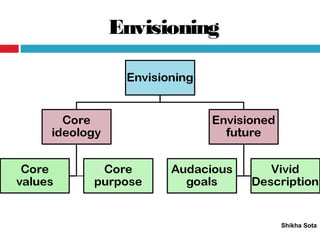
Envisioning
Shikha Sota
Mission
Shikha Sota
 Answers the following questions
 What an organisation is?
 Why it exists?
 What is should be?
 Purpose or reason for the organization’s
existance
Examples
Shikha Sota
• Indian Oil Corporation-Maintaining national
leadership in Oil refining, marketing, and
pipeline transportation
• HCL-To be a world class competitor
• Marico Industries-the Three P’s of Marico:
People, Products and Profits
Characteristics of Mission
statement
Shikha Sota
 Feasible
 Precise
 Clear
 Motivating
 Distinctive
 Indicate objectives to be accomplished
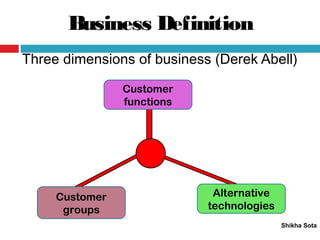
Business Definition
Shikha Sota
Three dimensions of business (Derek Abell)
Customer
functions
Alternative
technologies
Customer
groups
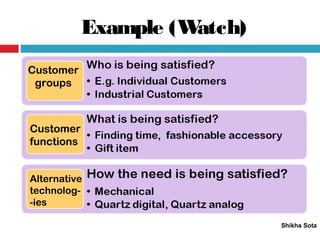
Example (Watch)
Shikha Sota
Customer
groups
Customer
functions
Alternative
technolog-
-ies
Goals
Shikha Sota
 What an oaganisation hopes to achieve
 Consists of various financial & non-
financial issues
 Generalised
 qualitative
Objectives
Shikha Sota
 Ends that state specifically how goals
should be achieved
 Objectives makes goals operational
 Concrete
 Generally quantitative
 Sometimes used interchangeably with
goals
Goals Vs. Objectives
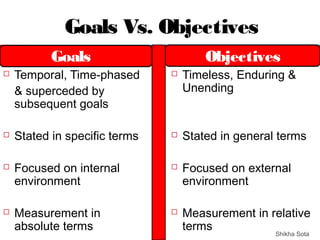
 Temporal, Time-phased
& superceded by
subsequent goals
 Stated in specific terms
 Focused on internal
environment
 Measurement in
absolute terms
 Timeless, Enduring &
Unending
 Stated in general terms
 Focused on external
environment
 Measurement in relative
terms
Shikha Sota
Goals Objectives
Role of objectives
Shikha Sota
 Define organization’s relationship with its
environment
 Help an organization to pursue its vision &
mission
 Provide the basis for strategic decision
making
 Provide standards for performance
appraisal
Characteristics of objectives
Shikha Sota
 Understandable
 Concrete and specific
 Related to time frame
 Measurable and controllable
 Challenging
 Correlate with each other
 Set with in constraints
Issues in objective setting
Shikha Sota
 Specificity
 Multiplicity
 Periodicity
 Verifiability
 Reality
 Quality
What objectives are set?
Shikha Sota
 Market standing
 Innovation
 Productivity
 Physical and financial resources
 Profitability
 Manager performance and development
 Worker performance and attitude
 Public responsibility
Peter F. Drucker
How are objectives formulated?
Shikha Sota
 The forces in the environment
 Realities of enterprise resources and
internal power relationships
 The value system of the top executive
 Awareness by management
Critical Success Factors
Shikha Sota
Refers to key factors to success
 CSF for Footwear industry
 High manufacturing quality
 Cost efficiency
 Sophisticated retailing
 CSF for Courier services
 Speedy dispatch
 Reliability
 Price

Strategic intent

  • 1.
  • 2.
    Strategic Intent Shikha Sota Refers to the purpose that organisation strive for  What a firm should set out to achieve  E.g. Reliance- being a global leader in its field of activity by being the lowest cost producer of Polyester products
  • 3.
    Vision Shikha Sota  Whata firm would ultimately like to become  Future aspirations that lead to an inspiration  It is more dreamt of than articulated
  • 4.
    Example Shikha Sota Indian OilCorporation ā€œIndian Oil aims to achieve international standards of excellence in all aspects of energy and diversified business with focus on customer delight through quality products and services.ā€
  • 5.
    Benefits of Havinga Vision Shikha Sota  Inspiring and exhilarating  Helps in creation of common identity and a shared sense of purpose  Foster risk taking and experimentation  Foster long term thinking
  • 6.
  • 7.
    Mission Shikha Sota  Answersthe following questions  What an organisation is?  Why it exists?  What is should be?  Purpose or reason for the organization’s existance
  • 8.
    Examples Shikha Sota • IndianOil Corporation-Maintaining national leadership in Oil refining, marketing, and pipeline transportation • HCL-To be a world class competitor • Marico Industries-the Three P’s of Marico: People, Products and Profits
  • 9.
    Characteristics of Mission statement ShikhaSota  Feasible  Precise  Clear  Motivating  Distinctive  Indicate objectives to be accomplished
  • 10.
    Business Definition Shikha Sota Threedimensions of business (Derek Abell) Customer functions Alternative technologies Customer groups
  • 11.
  • 12.
    Goals Shikha Sota  Whatan oaganisation hopes to achieve  Consists of various financial & non- financial issues  Generalised  qualitative
  • 13.
    Objectives Shikha Sota  Endsthat state specifically how goals should be achieved  Objectives makes goals operational  Concrete  Generally quantitative  Sometimes used interchangeably with goals
  • 14.
    Goals Vs. Objectives Temporal, Time-phased & superceded by subsequent goals  Stated in specific terms  Focused on internal environment  Measurement in absolute terms  Timeless, Enduring & Unending  Stated in general terms  Focused on external environment  Measurement in relative terms Shikha Sota Goals Objectives
  • 15.
    Role of objectives ShikhaSota  Define organization’s relationship with its environment  Help an organization to pursue its vision & mission  Provide the basis for strategic decision making  Provide standards for performance appraisal
  • 16.
    Characteristics of objectives ShikhaSota  Understandable  Concrete and specific  Related to time frame  Measurable and controllable  Challenging  Correlate with each other  Set with in constraints
  • 17.
    Issues in objectivesetting Shikha Sota  Specificity  Multiplicity  Periodicity  Verifiability  Reality  Quality
  • 18.
    What objectives areset? Shikha Sota  Market standing  Innovation  Productivity  Physical and financial resources  Profitability  Manager performance and development  Worker performance and attitude  Public responsibility Peter F. Drucker
  • 19.
    How are objectivesformulated? Shikha Sota  The forces in the environment  Realities of enterprise resources and internal power relationships  The value system of the top executive  Awareness by management
  • 20.
    Critical Success Factors ShikhaSota Refers to key factors to success  CSF for Footwear industry  High manufacturing quality  Cost efficiency  Sophisticated retailing  CSF for Courier services  Speedy dispatch  Reliability  Price

Editor's Notes

  • #15Ā 1.Time Frame Objectives are timeless, enduring, and unending; goals are tempo-ral, time-phased, and intended to be superceded by subsequent goals. Because objec-tives relate to the ongoing activities of an organization, their achievement tends to be open-ended in the sense of not being bounded by time. For example, the survival objective of a business organization is never completely attained since failure is always a future possibility. 2. Specificity Objectives are stated in broad, general terms, dealing with matters of image, style and self-perception. These are aspirations to be worked in the future. Goals are much more specific, stated in terms of a particular result that will be accomplished by a specific date. In the above example, survival as an objective is not very specific because it leads to different interpretation of the state of survival. On the other hand, goals can be expressed in terms of say achievement of 10 per cent growth in the net sales in the next year. This is more specific and time bound. 3. Focus Objectives are usually stated in terms of some relevant environment which is external to the organization; goals are more internally focused and carry important implications about how resources of the organization are utilized or will be utilized in future. Therefore, objectives are more generalized statements like main-taining market leadership, striving continuously for technological superiority, etc. A goal may imply a resource commitment requiring the organization to use those resources in order to achieve the desired outcomes. 4. Measurement Both objectives and goals can be stated in terms, which are quanti-tatively measured, but the character of measurement is different. Generally quantita-tive objectives are set in relative terms. For example, Reliance Industries has put its objectives like this: to acquire top position among the Indian companies. This objec-tive may not be achieved in anyone year, but it is timeless and externally focused, providing a continuing challenge for the company. Quantitative goals are expressed in absolute terms. For example, a company has stated its goal to achieve 10 per cent growth in its sales in the next year. The achievement of this goal can be measured irrespective of environmental conditions and competitors’ actions.