
PRESENTAION BY-
DEEP SHREE
TYPES OF PRODUCTION SYSTEMS
PRODUCTION
A production process consists of
activities that are required in
transforming an input set (human
resources, raw
materials, energy, money,information, e
tc.) to valuable outputs with the help of
processors.
Production system
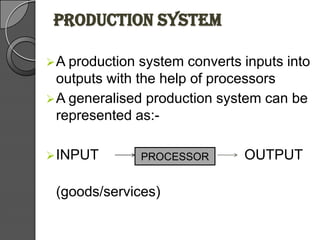
A production system converts inputs into
outputs with the help of processors
A generalised production system can be
represented as:-
INPUT OUTPUT
(goods/services)
PROCESSOR
Types of production
systems
 Classification on the basis of output
Three bases considered-
1. Variety
2. Uniformity
3. Volume per output type
o Two types -
a)continuous
b)intermittent
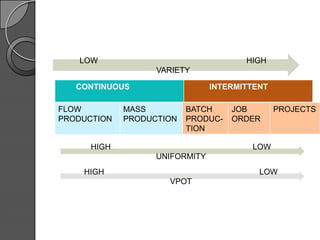
CONTINUOUS INTERMITTENT
FLOW
PRODUCTION
MASS
PRODUCTION
BATCH
PRODUC-
TION
JOB
ORDER
PROJECTS
LOW HIGH
VARIETY
HIGH LOW
UNIFORMITY
HIGH LOW
VPOT
DIFFERENCE BETWEEN CONTINUOUS AND
INTERMITTENT SYSTEMS
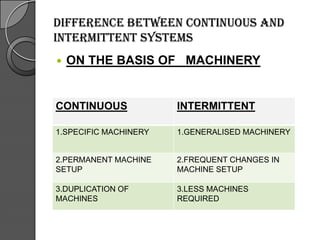
 ON THE BASIS OF MACHINERY
CONTINUOUS INTERMITTENT
1.SPECIFIC MACHINERY 1.GENERALISED MACHINERY
2.PERMANENT MACHINE
SETUP
2.FREQUENT CHANGES IN
MACHINE SETUP
3.DUPLICATION OF
MACHINES
3.LESS MACHINES
REQUIRED
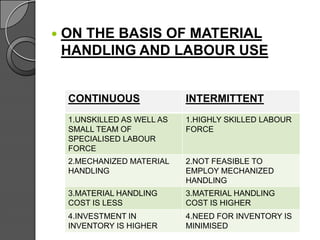
 ON THE BASIS OF MATERIAL
HANDLING AND LABOUR USE
CONTINUOUS INTERMITTENT
1.UNSKILLED AS WELL AS
SMALL TEAM OF
SPECIALISED LABOUR
FORCE
1.HIGHLY SKILLED LABOUR
FORCE
2.MECHANIZED MATERIAL
HANDLING
2.NOT FEASIBLE TO
EMPLOY MECHANIZED
HANDLING
3.MATERIAL HANDLING
COST IS LESS
3.MATERIAL HANDLING
COST IS HIGHER
4.INVESTMENT IN
INVENTORY IS HIGHER
4.NEED FOR INVENTORY IS
MINIMISED
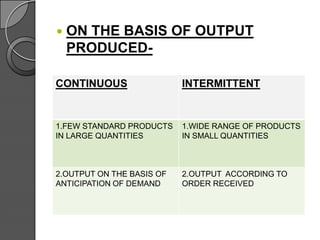
 ON THE BASIS OF OUTPUT
PRODUCED-
CONTINUOUS INTERMITTENT
1.FEW STANDARD PRODUCTS
IN LARGE QUANTITIES
1.WIDE RANGE OF PRODUCTS
IN SMALL QUANTITIES
2.OUTPUT ON THE BASIS OF
ANTICIPATION OF DEMAND
2.OUTPUT ACCORDING TO
ORDER RECEIVED
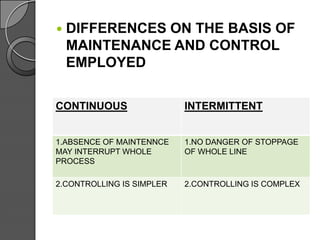
 DIFFERENCES ON THE BASIS OF
MAINTENANCE AND CONTROL
EMPLOYED
CONTINUOUS INTERMITTENT
1.ABSENCE OF MAINTENNCE
MAY INTERRUPT WHOLE
PROCESS
1.NO DANGER OF STOPPAGE
OF WHOLE LINE
2.CONTROLLING IS SIMPLER 2.CONTROLLING IS COMPLEX
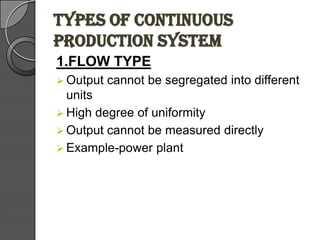
TYPES OF CONTINUOUS
PRODUCTION SYSTEM
1.FLOW TYPE
 Output cannot be segregated into different
units
 High degree of uniformity
 Output cannot be measured directly
 Example-power plant
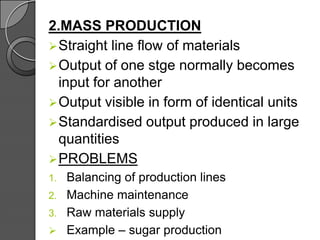
2.MASS PRODUCTION
Straight line flow of materials
Output of one stge normally becomes
input for another
Output visible in form of identical units
Standardised output produced in large
quantities
PROBLEMS
1. Balancing of production lines
2. Machine maintenance
3. Raw materials supply
 Example – sugar production
Types of intermittent
production systems
1.BATCH PRODUCTION SYSTEM-
 Variety of products are made in small quantities
 Various products compete for share of machines
 Outputs are aggregated in form of batches
 Batches may comprise of similar or dissimilar
outputs
 PROBLEMS
1. Machine-job allocation problem
2. Determination of economic batch quantity
3. Scheduling and sequencing of operations
 Example – electrical goods
2.JOB-ORDER PRODUCTION SYSTEM
 Does not has its own standard product
but accepts whatever customer orders
come in
 Output identifiable in terms of specific
job order
 Material flow is very complex
 PROBLEMS
1. Determination of the sequence of
processing
 Example – tailor shop
3.PROJECT PRODUCTION SYSTEM
Project is a temporary endeavour
having a defined beginning and end
;undertaken to meet unique goals and
objectives
Project is non repetitive
This type of production system uses
resources on different projects
Product remains fixed and manpower
and facilities put work on it
PERT/CPM can be used for planning
and control in this case
THANK YOU

788893 634312966211085000

  • 1.
    PRESENTAION BY- DEEP SHREE TYPESOF PRODUCTION SYSTEMS
  • 2.
    PRODUCTION A production processconsists of activities that are required in transforming an input set (human resources, raw materials, energy, money,information, e tc.) to valuable outputs with the help of processors.
  • 3.
    Production system A productionsystem converts inputs into outputs with the help of processors A generalised production system can be represented as:- INPUT OUTPUT (goods/services) PROCESSOR
  • 4.
    Types of production systems Classification on the basis of output Three bases considered- 1. Variety 2. Uniformity 3. Volume per output type o Two types - a)continuous b)intermittent
  • 5.
  • 6.
    DIFFERENCE BETWEEN CONTINUOUSAND INTERMITTENT SYSTEMS  ON THE BASIS OF MACHINERY CONTINUOUS INTERMITTENT 1.SPECIFIC MACHINERY 1.GENERALISED MACHINERY 2.PERMANENT MACHINE SETUP 2.FREQUENT CHANGES IN MACHINE SETUP 3.DUPLICATION OF MACHINES 3.LESS MACHINES REQUIRED
  • 7.
     ON THEBASIS OF MATERIAL HANDLING AND LABOUR USE CONTINUOUS INTERMITTENT 1.UNSKILLED AS WELL AS SMALL TEAM OF SPECIALISED LABOUR FORCE 1.HIGHLY SKILLED LABOUR FORCE 2.MECHANIZED MATERIAL HANDLING 2.NOT FEASIBLE TO EMPLOY MECHANIZED HANDLING 3.MATERIAL HANDLING COST IS LESS 3.MATERIAL HANDLING COST IS HIGHER 4.INVESTMENT IN INVENTORY IS HIGHER 4.NEED FOR INVENTORY IS MINIMISED
  • 8.
     ON THEBASIS OF OUTPUT PRODUCED- CONTINUOUS INTERMITTENT 1.FEW STANDARD PRODUCTS IN LARGE QUANTITIES 1.WIDE RANGE OF PRODUCTS IN SMALL QUANTITIES 2.OUTPUT ON THE BASIS OF ANTICIPATION OF DEMAND 2.OUTPUT ACCORDING TO ORDER RECEIVED
  • 9.
     DIFFERENCES ONTHE BASIS OF MAINTENANCE AND CONTROL EMPLOYED CONTINUOUS INTERMITTENT 1.ABSENCE OF MAINTENNCE MAY INTERRUPT WHOLE PROCESS 1.NO DANGER OF STOPPAGE OF WHOLE LINE 2.CONTROLLING IS SIMPLER 2.CONTROLLING IS COMPLEX
  • 10.
    TYPES OF CONTINUOUS PRODUCTIONSYSTEM 1.FLOW TYPE  Output cannot be segregated into different units  High degree of uniformity  Output cannot be measured directly  Example-power plant
  • 11.
    2.MASS PRODUCTION Straight lineflow of materials Output of one stge normally becomes input for another Output visible in form of identical units Standardised output produced in large quantities PROBLEMS 1. Balancing of production lines 2. Machine maintenance 3. Raw materials supply  Example – sugar production
  • 12.
    Types of intermittent productionsystems 1.BATCH PRODUCTION SYSTEM-  Variety of products are made in small quantities  Various products compete for share of machines  Outputs are aggregated in form of batches  Batches may comprise of similar or dissimilar outputs  PROBLEMS 1. Machine-job allocation problem 2. Determination of economic batch quantity 3. Scheduling and sequencing of operations  Example – electrical goods
  • 13.
    2.JOB-ORDER PRODUCTION SYSTEM Does not has its own standard product but accepts whatever customer orders come in  Output identifiable in terms of specific job order  Material flow is very complex  PROBLEMS 1. Determination of the sequence of processing  Example – tailor shop
  • 14.
    3.PROJECT PRODUCTION SYSTEM Projectis a temporary endeavour having a defined beginning and end ;undertaken to meet unique goals and objectives Project is non repetitive This type of production system uses resources on different projects Product remains fixed and manpower and facilities put work on it PERT/CPM can be used for planning and control in this case
  • 15.